Peace and conflict studies (PACS), through which students seek to understand and address some of the world’s most daunting problems, is a fast-growing subfield (Mac Ginty Reference Mac Ginty2019). While drawing heavily from political science, PACS courses may employ a range of disciplinary lenses and approaches to examine the complexities of conflicts and peace. Courses that do so usefully expose students to the complicated nature of peace and conflict but also may risk becoming disjointed or even incoherent (Matyók Reference Matyók, Matyók, Senehi and Byme2011). One challenge for PACS educators, then, is to strike a balance between introducing students to wide-ranging, multidisciplinary, multi-perspectival content, on one hand, and ensuring that they are able to make sense of the subject matter, on the other.
Beyond the university, employers in the field seek not only theoretical knowledge of peace and conflict but also the ability to apply knowledge in practical ways (Carstarphen et al. Reference Carstarphen, Zeiler, Harris and Smith2010). The literature on peace building suggests, moreover, that required skills include creativity, curiosity, and a willingness to take risks (Lederach Reference Lederach2005), as well as continual processes of questioning and reflecting (Graf, Kramer, and Nicolescou Reference Graf, Kramer, Nicolescou, Webel and Galtung2007). Thus, another challenge for educators is to enable practical applications of PACS knowledge that equip students with skills to adapt amid the unpredictability of responding to conflict and building peace—typically from the comfort and safety of the classroom.
Well-designed experiential learning activities in PACS provide opportunities for students to make sense of complex content and also to try their hand at adaptability, fusing the theoretical and the practical. As PS readers know, research has well established the usefulness of experiential learning strategies in higher-education classrooms (e.g., Hertel and Millis Reference Hertel and Millis2002). By taking active control of their own learning, students discover and grow in ways that are distinct from and complementary to what they gain through traditional instruction.Footnote 1 The numerous positive effects of experiential learning include impacts on knowledge acquisition and retention (e.g., Asal et al. Reference Asal, Sin, Fahrenkopf and She2014; Bernstein and Meizlish Reference Bernstein and Meizlish2003; Centellas and Love Reference Centellas and Love2012); skills including critical thinking, writing, and public speaking (e.g., Grummel Reference Grummel2003; Mariani and Glenn Reference Mariani and Glenn2014); and attitudes such as a positive outlook and heightened motivation (e.g., Coffey, Miller, and Feuerstein Reference Coffey, Miller and Feuerstein2011; Lay and Smarick Reference Lay and Smarick2006). In political science courses, activities including simulations (Asal and Blake Reference Asal and Blake2006), media projects (Rinfret Reference Rinfret2017), student-led classes (McBride Reference McBride2017), and service-learning projects (Dicklitch Reference Dicklitch2003) add valuable dimensions to the classroom experience. Less has been written, however, about experiential learning in PACS.
This article presents one experiential learning approach—a conflict analysis activity—that has both theoretical and practical objectives for PACS students. Developed for the semester-long introduction to PACS course at New York University (NYU),Footnote 2 the activity invites students to synthesize course content on the causes of conflict, use their creative and critical-thinking skills to design their own frameworks, and experience first-hand the bumpy road of breaking down a case in real time. Because students must make choices about how to analyze a particular case, put their choices to the test, and reflect critically on their experience, we argue that this exercise mirrors processes that take place in real-world work in the field. Through engaging in this messy learning process, our aim is that—alongside the goals of being able to identify and analyze causes of conflict—students will (1) gain an increased theoretical understanding of the complexity of conflict; (2) practice adaptability; and (3) increase their self-efficacy, inspiring them to further engage in the world around them.
Because students must make choices about how to analyze a particular case, put their choices to the test, and reflect critically on their experience, we argue that this exercise mirrors processes that take place in real-world work in the field.
To share what we and PACS students have learned through this pedagogical approach, this article describes the Conflict Analysis Tool and our reflections on its effectiveness. King, the course instructor, designed this course and activity and collaborated with Blewitt and Choi, two graduate-student “PACS Leaders”Footnote 3 from the fall 2018 semester, to assess students’ learning and to write this article. The authors observed students’ participation in the activity, reviewed their anonymized assignments, and analyzed the results of a survey on whether and how students perceived the exercise to have met certain learning objectives. The following discussion first provides a step-by-step description of the activity. Next is an analysis of how well the activity enabled knowledge and skills that are useful for PACS, both theoretically and practically, by assessing whether students achieved the three core learning objectives.Footnote 4 The conclusion suggests ways that the activity could be adapted to other courses. We hope that insights gained through our approach will be useful to other educators seeking creative ways to introduce students to the PACS field and beyond.
CONFLICT ANALYSIS TOOL: ACTIVITY DESCRIPTION
Introduction to Peace and Conflict Studies introduces undergraduate students to the field of PACS in a global context and is the anchor course for the cross-university PACS minor. The course is organized sequentially around three broad themes: the causes, consequences, and responses to conflict. Although the course is set out in a linear fashion, a key takeaway from it is that conflict is a complex system: there are multiple pathways into conflict, feedback loops can make consequences and responses become causes, and responses must be informed by a multiplicity of views. To culminate the course’s first theme, the Conflict Analysis Tool pushes students to make choices about how to analyze conflicts in all of their complexity and to give them a deeper understanding of multicausality before turning to consequences and responses.
Activity Preparation
In the first third of the course, students learn about multiple causes of inter- and intra-state conflicts. Lectures and associated readings are organized thematically, but the instructor welcomes students to become a little confused: Do conflicts arise from many causes at the same time? What about causes that sound contradictory, such as “environmental scarcity” and the “paradox of plenty”? Are any conflicts truly only intra-state?
To draw lessons on the causes of conflict to a close and transition to this section’s culminating activity, the instructor introduces students to a common party game. She asks them to have only a pencil and paper and then pulls 20 objects out of a bag, naming each one before putting it away. After displaying all of the objects, she asks students to write down as many as they can remember. Then, she replays the game but organizes the objects thematically and explains that they fit into three categories—for example, objects she needs to get ready in the morning, objects her daughter plays with, and objects from her office. Most students do better in the second round, not only because they are seeing the objects again but also because categorizing and organizing helps us make sense of the world.
Between the two rounds of the game, the instructor leads the class through a discussion of the middle path between too much and too little complexity, illustrating with complex diagrams from Bumiller (Reference Bumiller2010) and Coleman (Reference Coleman2012), as well as a cartoon of an overly simplistic causal pathway (Harris Reference Harris2020). The debriefing of the game then focuses on the utility and shortcomings of categorization. Students are asked to think of different ways that these objects could have been organized (e.g., color, material, time of day that they are used, and size), and the instructor shows them how they might apply this same type of analysis to the causes of conflict. For example, causes may be organized as proximate and underlying (e.g., Brown Reference Brown1996); via levels of analysis (e.g., Singer Reference Singer1961; Waltz Reference Waltz1959); as social-structural and psychocultural (e.g., Ross Reference Ross2007); or thematically (e.g., Brown Reference Brown1996).
At-Home Assignment
During class, the instructor explains that students will be tasked with creating a Conflict Analysis Tool that they will use in the next session to analyze a film. They will be able to draw on examples they have encountered in readings—namely, the Swiss Agency for Development (2005) tip sheet on conflict analysis tools, which presents seven analytical frameworks through which to visualize the linkages among components of conflict (see online appendix A). They are encouraged, however, to be creative and trust their instincts about how to organize their own tool.
The instructions are as follows: “Create your own conflict analysis tool that integrates the theories we have talked about in class. Try to use one or more of the organizational ideas from the conflict analysis tools that you have in the readings and/or frameworks from today’s lecture. Bring it to the next class ready to use! Please also write one paragraph explaining the logic of your tool and strategy for conflict analysis.” Although students know they will analyze a particular conflict, via film, they are not given further details in advance to inform them in creating their tool.
In-Class Activity
For the next class session, students bring hardcopies of the tool they created. They learn which film they will be watchingFootnote 5 and that their task is to fill out their tool to the best of their ability. Students view the movie using their template to analyze the conflict in real time, making notes about factors such as root causes, stakeholder interests, and events in the unfolding storyline, based on the framework that their tool provides.
After watching the film, students have 10–15 minutes to complete the third and final piece of the individual assignment: they write one or more paragraphs on the successes and shortcomings of their tool as well as their overall experience of the exercise. The instructor invites interested students to stay after class for a short, informal debriefing; many stay to share their in-the-moment excitement and insights.
As we were making the final revisions to this article, we were able to successfully adapt this exercise to the online COVID-19 pandemic context. Students electronically submitted empty tools in advance of the class meeting, and the instructor sent an email with the link to the film at the designated meeting time. Students then viewed the film on their own and submitted completed tools and reflections at the end of class.
Activity Debriefing and Evaluation
In the next class, the instructor leads students through a discussion of the experience of designing and using a tool to analyze the conflict. With their permission, the instructor shows anonymized examples to illustrate the diversity of approaches that students took and simultaneously to highlight the range of learning styles in the classroom. The discussion addresses the pros and cons of the chosen film and allows the class to begin listing and categorizing consequences of conflict as a useful transition to the second third of the course. Finally, the instructor emails additional readings after class for those who want to learn more about the issues that the film raised.
The goal of this assignment is not for students to design an outstanding tool. Indeed, our expectation is that the tools will not work very well and that the experience will improve students’ understanding of the complex nature of conflict and challenges of “one-size-fits-all” approaches. As such, students are evaluated on the depth of their effort and reflection rather than on whether their tool “works.” Although many students initially are uncomfortable with the messiness of this activity—some want to take their tool home to polish before handing it in, for example—the reflective writing and discussion components help them to realize that the goal is not to “get it right” (not an easy feat for high-achieving undergrads!) but rather to learn through trial and error and to find their own way to develop knowledge and skills.
The goal of this assignment is not for students to design an outstanding tool. Indeed, our expectation is that the tools will not work very well and that the experience will improve students’ understanding of the complex nature of conflict and challenges of “one-size-fits-all” approaches.
ASSESSMENT OF LEARNING PROCESSES AND OUTCOMES
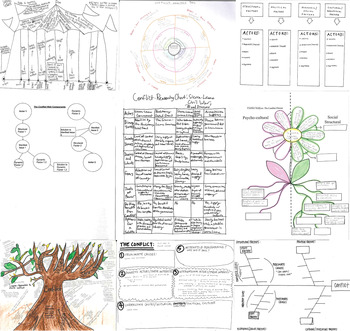
Students impressed us with the creativity and diversity of their assignments. They imaginatively integrated course learnings into models including a tent, a flower, an iceberg, and various other diagrams.Footnote 6 Some students brought typed charts, others hand-drew figures, and still others came with large, sketched poster boards. Figure 1 presents a few examples.
Examples of Conflict Analysis Tools
Note: Reprinted (in anonymized form) with students’ permissions.

In reflections that they wrote during class, many students indicated that they gained insight through mistakes. For example, one remarked, “I realize that in attempting to include so much information [in my model], I made it almost impossible to use without prior information and research.” Several students specified ways that components of the framework could be rearranged more effectively for a subsequent attempt. Then, during the debriefing, many noted the difficulty of fitting aspects of a real-world conflict into neatly defined categories that at home seemed clear, discrete, and comprehensive. Difficulties included not being able to identify certain factors that their tool called for, finding themselves making assumptions about underlying causes, struggling to disentangle interrelated elements, and even erasing everything they had written to begin anew. Using both fictional and documentary films provided opportunities to discuss the commonality of information being imperfect, biased, or one-sided in real-world situations.
We begin our analysis of learning outcomes by highlighting these difficulties because it is precisely the messy learning process that we believe mimics experiences in the field and helps students to embrace the challenges of PACS work. Through this process, consequently, we see that students were able to (1) increase their understanding of the complexity of conflict, (2) practice adaptability, and (3) gain self-efficacy.
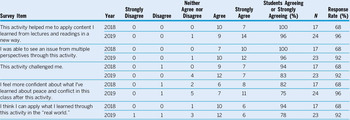
First, many students acquired an increased understanding of complexity in PACS through this experience. All respondents in 2018 and 96% in 2019 indicated in an in-class surveyFootnote 7 that the activity enabled them to see an issue from multiple perspectives, an important aspect of avoiding overly simplistic interpretations. Their newly multi-perspectival views of conflict were reflected in their writing. One student, for example, said that outlining psychocultural causes of the conflict was “helpful in understanding how young people/children were able to commit such acts of violence.” During our debriefing discussion and in writing, students noted that the activity helped them to realize the dangers of oversimplifying conflicts—for instance, one principal takeaway “was how complicated conflict can get, and how difficult it is to have an all-encompassing conflict analysis tool.” We had discussed the multicausality of conflict in previous classes, but the experience of applying theoretical content from lectures and readings through this exercise, as well as critically reflecting on it afterwards, made the lessons about complexity come into clearer view.
Results of Student Survey

Second, the activity allowed students to practice being adaptable. Their flexibility of mind was evident in that many of them adjusted their way of thinking about their tool while they watched the film and commented afterwards on different approaches that they could have taken. This adaptable mindset also manifested through novel applications of ideas—100% of students in 2018 and 96% in 2019 stated on the survey that the activity helped them to apply course content in a new way. Furthermore, we saw evidence that students felt pushed out of their comfort zone, with 94% of students in 2018 and 83% in 2019 indicating that they felt challenged. Although some were nervous about the challenge at first, engaging in critical reflection through individual writing and group discussion helped all students to learn from the imperfections of their choices. We believe that practicing these skills makes adaptability come more easily—as one student said, not being able to use all of the categories she included in her tool actually made her learn from and enjoy the activity more.
Third, the opportunity to embrace complexity and adaptability gave students greater confidence. As one wrote, “Being able to create [a tool] that was geared toward my own understanding helped me focus on the aspects I knew challenged me the most.” In the survey, 82% of students in 2018 and 75% in 2019 indicated that they felt more confident about PACS course material after the activity; 94% and 78%, respectively, reported that they think they can apply what they learned through the activity to the real world. After class, one student told us that she loved the activity and felt that analyzing conflicts was what she wanted to do with her life—even though her tool did not work for the film “at all.” These are promising indications that the confidence and agency students experienced ultimately will make them feel more empowered to engage in PACS after the course concludes.
CONCLUSION
In one question on their final exam, students were asked to describe how they would design a PACS major at NYU. In a strong testament to the value of the Conflict Analysis Tool and other hands-on activities, several specified that experiential learning must be part of a PACS course of study. Through our conversations with students as well as our analysis of their discussions, assignments, and survey responses, we see evidence that these opportunities to actively engage with course concepts helped them to appreciate complexity, practice being adaptable, and gain self-efficacy. Accordingly, we think that this conflict analysis exercise provides theoretical insights and practical experience that help to prepare students for PACS-related work.
Through our conversations with students as well as our analysis of their discussions, assignments, and survey responses, we see evidence that these opportunities to actively engage with course concepts helped them to appreciate complexity, practice being adaptable, and gain self-efficacy.
This activity is simple to implement and could be adapted to any PACS or political science course. First, of course, instructors may choose different films. The length of a film is important to consider given the constraints of class time—although some instructors might consider scheduling an extended viewing session. Moreover, any manner of cases could be analyzed—from another violent conflict to interpersonal conflicts to US political events. Alternatively, instructors could design similar activities in which students create their own conflict analysis tool to apply to a current conflict, drawing on media reports and emerging analysis. Such an approach might include iterative assignments and discussions in which students work through the challenges of analyzing a real-world conflict during the course of the semester. Finally, self-designed conflict analysis tools could be paired with in-class simulations, adding another layer of learning to one of the more tried-and-true experiential activities in political science classrooms. We hope that instructors will find this activity to be a useful way to blend the theoretical and the practical, thereby helping students feel more empowered to respond to the challenges of our complex world.
SUPPLEMENTARY MATERIALS
To view supplementary material for this article, please visit http://dx.doi.org/10.1017/S1049096521000445.