The first record of killer whales in Venezuela was reported in 1979 from a stranded individual at the mouth of the Maracaibo Lake, west coast of Venezuela (Rodríguez et al., Reference Rodríguez, Acosta, Pérez, Urdaneta, Parada, Cabezas, Fuenmayor, Arrieche, Gómez, Bong, Viloria and Duarte1993). Subsequently, there have been several anecdotal accounts, and even sightings of occasional individuals in published reviews on the cetacean fauna in territorial waters (Bolaños & Boher, Reference Bolaños and Boher1996; Acevedo, Reference Acevedo Galindo2001, Reference Acevedo Galindo2007; Romero et al., Reference Romero, Agudo, Green and Nobartolo di Sciara2001) and a review of occasional sightings recorded by non-professional observers (Bolaños-Jiménez et al., Reference Bolaños-Jiménez, Fertl and Iñíguez2008). Nevertheless, even within those published records, a major proportion of them lack visual evidence such as clear pictures or video recordings. Therefore, the presence of Orcinus orca in Venezuelan waters has remained somewhat unclear.
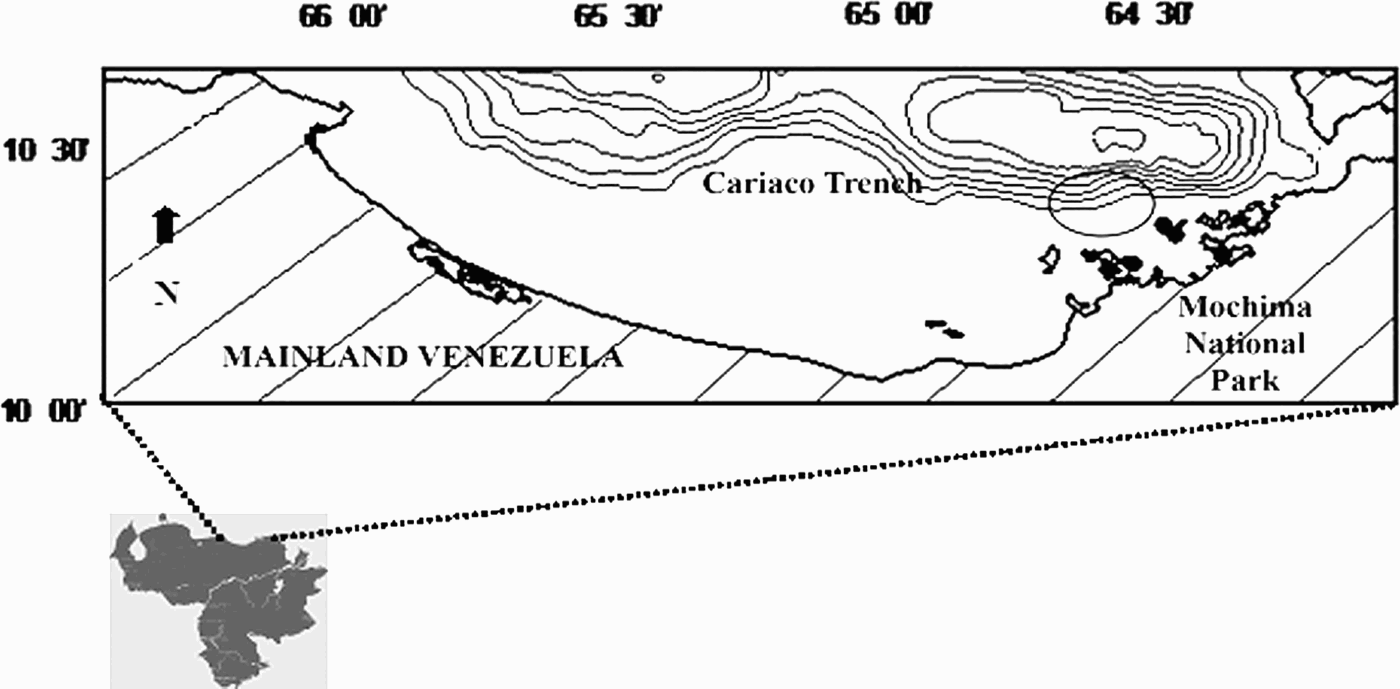
On 15 April 2007, a group of three killer whales (Orcinus orca) was video-recorded interacting with a leatherback turtle (Dermochelys coriacea). The observers, a family group on a recreational fishing trip, made the video widespread by uploading some portions of it to a mass media website on the Internet (http://www.youtube.com). This report is based on an extensive review of the original video taken during the sighting event and a detailed interview with the observers. The whales were first sighted at approximately 1400 hours. The group was composed of one adult male and either two adult females (judging by notable size differences according to the account of the observers) or an adult female and a sub-adult of unknown sex. The whales were located ten nautical miles north-west of Isla Borracha (Mochima National Park), off north-eastern Venezuela (Figures 1 & 2). The smaller whales were engaged in a high level of interaction with the turtle while the male remained surfacing at a distance of about 500 m from the boat. One of them initiated the interaction at all times, in what seemed to be an attempt to encourage the other whale to participate in the interaction event. The killer whales appeared to harass the turtle by continuously swimming alongside it in circles and turning the turtle upside down by creating turbulence, making escape by the turtle difficult. The interaction lasted for at least 30 minutes from the time of first sighting; the whales appeared to be undisturbed by the presence of the boat. The interaction ended with the dragging of the turtle by one of the whales to a depth of approximately 100 m (recorded by the Fishfinder on the boat), closely followed by the juvenile (see also Bolaños-Jiménez et al., Reference Bolaños-Jiménez, Fertl and Iñíguez2008). After the whales dived with the turtle, they were not re-sighted. Additional interest is that over two weeks later (5 May), another group of killer whales was sighted in the same location, possibly the same group, since it was also composed of three individuals (a mature male, a female and a juvenile). Photographic evidence supports these observations; however they were not of sufficient quality for photo-identification purposes.
Killer whales aside the leisure boat. Photograph taken by the Alcara family, on 15 April 2007, ten miles off Isla Borracha, north-east coast of Venezuela.

Killer whales sightings (15 April and 5 May 2007) location (solid line ellipse) off Isla Borracha, Mochima National Park, north-east coast of Venezuela.

Fertl & Fulling (Reference Fertl and Fulling2007) reported several cases of killer whales preying on sea turtles. Of particular interest is that reported by Caldwell & Caldwell (Reference Caldwell and Caldwell1969) of three whales killed from a group of six by a commercial fishing boat in the Caribbean island of St Vincent, all with remains of leatherback turtle in their stomachs. According to the information from the interview with the observers, and the analysis of the video, this episode would not entirely represent a predatory event, in terms of prey consumption as described in some others reports (Sarti et al., Reference Sarti, Flores and Aguayo1994; Pitman & Dutton, Reference Pitman and Dutton2004), even though the whales disappeared with the turtle. As mentioned before, the latter interaction seemed to be opportunistic play in the context of prey capture, possibly led by an adult towards a sub-adult.
Little directed research on killer whales in the tropics is closely related with the low density of the species in lower latitude areas (Baird et al., Reference Baird, McSweeney, Bane, Barlow, Salden, Antoine, LeDuc and Webster2006). For instance, Baird et al. (Reference Baird, McSweeney, Bane, Barlow, Salden, Antoine, LeDuc and Webster2006) consider killer whales to be rare around the Hawaiian islands, based on the ease of recognizing this species, the number of potential observers on the water (including researchers on vessel and aerial platforms, as well as commercial whale and dolphin watching companies and sport-fishing charter operators), and the fact that many of these records are of sufficient public interest to make it into the media (such as the case of this contribution). In a recent review of occasional sightings recorded aboard leisure boats in north-eastern and central Venezuela between 2001 and 2008, Bolaños-Jiménez et al. (Reference Bolaños-Jiménez, Fertl and Iñíguez2008) hypothesized about the possible relation of the presence of killer whales with cold water incursions and even with the presence of billfish, tunas and whale-sharks, but this remains to be investigated. This record of killer whales interacting and possibly preying on D. coriacea is highly relevant in terms of confirming the species presence in the region and for the potential implications of killer whales in the trophic dynamic of the north-eastern coast of Venezuela. Therefore, continuity in research effort directed to the non-common species should be considered.
ACKNOWLEDGEMENTS
The authors would like to especially thank the Alcaras family: Miguel Alcaras, Estefy and Gabriela Alcaras. They have made a crucial contribution to the study of whales and dolphins in Venezuela by sharing the information they collected. Robin Baird, Dagmar Fertl, Miguel Iñíguez and Robert Pitman provided us with useful insights to improve the manuscript.