Introduction
How could blood be so scarce yet provide for the nutrition of the entire body? This is the fundamental problem that William Harvey identified in De motu cordis (1628). For Harvey, the solution to this problem was simple: the paucity of blood in the body was of little concern because blood constantly recirculated. No other way could account for the massive amount of blood that the heart pumped over even a small amount of time, let alone an hour or a day. Harvey explained the necessity for a recirculation by way of his ‘computation’ (computatione), that showed that the blood was not abundant enough in the body to account for the amount that moved through the heart. This suggested that only a small, finite amount of blood nourished the body, provided it was recirculated by the heart.
‘Let us suppose’, Harvey wrote, ‘how much blood the left ventricle contains in its dilation (either by thought or experiment) is either two drachms, three drachms, or one and a half drachms’.Footnote 1 Harvey posited that each forceful systole thrust forth the total amount of blood that the left ventricle contains, whether one assumes that amount to be two, three, or one and a half drachms of blood. Because ‘the heart in one half hour makes over a thousand pulses … and sometimes three or four thousand’, the amount of blood that the heart expelled was necessarily massive, no matter how scarce the quantity of blood the left ventricle contains at any one time. Harvey estimated that two drachms of blood in the left ventricle accounted for twenty pounds and ten drachms if circulating for one half-hour; likewise, half an ounce of blood could account for forty-one pounds and eight drachms, or one ounce could for eighty-three pounds and four drachms. This exercise in accounting explained Harvey's proposition that the blood moved ‘in a circuit … from the centre of the body to the extremities, and from the extremities to the centre’.Footnote 2 It treated the left and right heart – and the pulmonary and systemic circulations – as balanced and symmetrical.Footnote 3
Historians date the emergence of Harvey's ideas about the systemic circulation to the 1620s, but they remain at odds about the sources and origins of Harvey's description of the systemic circulation and his quantitative argument in particular.Footnote 4 This paper argues that the quantitative argument – arguably the most famous and significant portion of De motu cordis – was an exercise in accounting. The quantitative argument has never been understood in this way, despite Harvey's precise language of accountancy in De motu cordis. An older generation of historians sought to portray Harvey as an empiricist breaking with a qualitative past.Footnote 5 More recently, historians such as Jerome Bylebyl and Michael Shank have sought natural-philosophical lineages for the argument, focusing significantly upon the traditional domains of Aristotelian and Galenic medicine.Footnote 6 As Don Bates has argued, Harvey's observations of anatomy and description of the forceful systole suggested that need to rationalize the circulation by way of quantification, although such rationalization was secondary to Harvey's anatomical observations.Footnote 7 Other scholars have focused on the possible impact of metaphors on Harvey's thought.Footnote 8 I argue here that Harvey's description of the circulation emerged not primarily due to the diverse reasons that this rich scholarship has ascribed to Harvey – the forceful systole, his experimentalism, his application of an Aristotelian teleology and so forth – but from the way that Harvey treated the circulation of blood as subject to accounting and arithmetic calculation. Accounting for the circulation of blood rendered the circulation legible – and thus credible – to Harvey's readers in early seventeenth-century England, and it allowed Harvey to solve the problem of scarcity.
In thinking about scarcity, Harvey drew, I argue, on the calculative and rhetorical skill of accounting familiar to him and promoted by mercantile advisers to the royal court. The mercantile advisers, who like Harvey's brothers hailed from chartered trading companies including the Levant and East India Companies, sought to explain the scarcity of moneys specifically, and commercial circulation generally. As mercantile advisers such as Thomas Mun and Edward Misselden posited, an apparent scarcity of moneys – whether coin, specie, bills of account, foreign currency, etc. – was a symptom of a decaying trade, though not necessarily a cause of a weak commercial exchange. Healthy and vigorous commerce depended significantly on the export of moneys, no matter how badly the Crown wished to retain those moneys within England. Even a relatively scarce amount of coin could, through its export and eventual recirculation, achieve a profoundly positive commercial impact. Only a merchant who was well versed in practices including accounting could fully appreciate and explain this recirculation.
The argument that Harvey drew significantly on the practices of mercantilist advisers to the English Crown not only makes sense of his peculiar quantitative argument, but also revises Harvey's place within the historiography of early modern science. The apparent elision of venous and arterial blood seems – in the context of accounting for the blood – like the application of concepts such as commensurability and fungibility. Like a merchant balancing credits and debits, import and export, goods and moneys, Harvey applied an arithmetic quantity to superficially distinct substances in such a way as to render the otherwise abstract concept of circulation legible, and thus credible to his patrons at the royal court. The qualitative differences were ultimately immaterial, if Harvey's readers could believe the quantifiable symmetry of blood in the aorta, vena cava, or elsewhere in the blood's circular transit. Such revisions to our understanding of Harvey's way of thinking about the body put this article into a broader conversation with the recent, robust literature on science and commerce in the early modern period that reveals how central commerce was to the new sciences.Footnote 9 Such histories demonstrate the extent to which Harvey was indebted to ways of thinking that were fundamentally mercantile in origin, extending even to Harvey's Aristotelianism, which shared a great deal with the Aristotelianism of the mercantile advisers to the royal court. Demonstrating the shared origins at the royal court of corporeal and commercial circulations, this paper argues for the movement of epistemic values between superficially dissimilar forms of knowledge about the body and economy, rather than a simple or unilateral relationship between the production of knowledge in the two domains.
Clues among Harvey's critics about the centrality of accounting
While historians have not seen accounting in Harvey's De motu cordis, Harvey's contemporaries did. Harvey's contemporaneous critics identified the centrality of accounting to De motu cordis. Caspar Hofmann criticized Harvey on the grounds that Harvey was a mere accountant. Hofmann's criticisms arose in letters exchanged with Harvey, and in a famous altercation in Nuremberg. Accompanying the Earl of Arundel to the Continent, Harvey arrived in Nuremberg sometime around May 1636. Harvey wrote to Hofmann to invite him to a public demonstration of his account of the circulation. Legend has it that Harvey, in the presence of the earl and a few other dignitaries, did his best to convince Hofmann of the truth of his claims, but failed to sway Hofmann, who supposedly threw down his knife and left the theatre after mounting one of the harsher critiques of Harvey.Footnote 10 Hofmann assailed Harvey's quantitative argument as little more than an accountant's trick.Footnote 11 In Hofmann's view, Harvey was no anatomist or philosophically informed physician; he was merely a keeper of ledgers, balancing blood like an accountant balances his books.Footnote 12 By asking his readers to go beyond observation – reasoning by way of quantification – Harvey feigned knowledge of the body, and offered nothing of therapeutic or philosophic use.Footnote 13
Hofmann may only have been taking Harvey at his word: Harvey himself employed the language of accountancy when he described his thought experiment about the quantity of blood in circulation from and around the heart. Hofmann may have been responding to Harvey's use of the words computatio and ratio. Computatio’s English cognate, ‘computation’, was not universally a term of accountancy, nor was ratio, but taken together in context, they had specific meanings related to accountancy.Footnote 14 For Harvey's contemporaries, the English cognate ‘computation’ often referred to a precise determination of a date, or the amount of time between two dates, but for those involved in the stewardship of the kingdom's resources, computation retained the implication of an accounting calculation. As Francis Bacon wrote around 1612, ‘the greatness of a state in bulk or territory doth fall under measure; and the greatness of revenue doth fall under computation’.Footnote 15 Ratio, which often referred to a reckoning or laying of accounts, was a term that Harvey's contemporaries understood and used themselves. The phrase ratione subducta may not have been exceedingly popular in printed texts from the period, but when used in the context of accounting and mathematical calculation, its meaning was clear. It appears in nearly contemporaneous descriptions of trade, including John Milton's early 1650s letter of state on ‘Some damages sustained … from the Dutch East India Company’.Footnote 16 Providing his estimates of the principal and interest on losses that were owed to the English, Milton began with a simple statement of the principal losses sustained, writing that ‘for the customs of Persia … from the year 1624, which until 1629 is estimated at eight thousand royals’.Footnote 17 To that sum Milton ‘added four thousand lib.’, a number he found ‘with the books having been laid out [ratione subducta]’.Footnote 18 Milton seemed to suggest a rigorous accounting, and he used the same phrase (ratione subducta) that Harvey had used.
Modern translations of Harvey's De motu reveal to varying degrees the roots in accounting of computatio and ratio, albeit never with as much clarity about the significance of those words as contemporary translations of De motu. Robert Willis's mid-nineteenth-century translation, for instance, renders a key phrase that Harvey borrowed from accountancy incorrectly, converting the singular ablative absolute ratione subducta (‘with the account being laid’ or ‘by laying of account’) into the plural ‘and the reasons assigned’, losing the phrase's true meaning.Footnote 19 Kenneth Franklin's mid-twentieth-century version is more consistent with the language of accountancy that Harvey used, particularly in Franklin's treatment of computatio: ‘To this the answer our previous reckoning shows, on balance, that the extra amount of blood …’.Footnote 20 The first English translation, printed in England in 1653, makes the connections between Harvey's thought experiment and accountancy plain, in language much more indicative of the practice of accounting. Like Franklin, that translator rendered computatio as ‘reckoning’. But he also grounded his translation concretely in the practice of accounting, translating subducta ratione as ‘by laying of an account’, rather than the more general ‘on balance’ of Franklin's translation:
1628 Latin:
Respondendum, quod ex ante dicta computatione, subducta ratione, apparet, quantum cor repletum ulterius continet in sua dilatione quam in constrictione, tantundem (maiori ex parte) singulis pulsationibus emitti, & proinde in tanta copia, pertransire integro corpore, & secundum naturam constituto.
1653 English:
It is to be answer'd, That by laying of an account it appears fro[m] former reckoning that how much the heart being filld does contain more in its dilation than in its constriction, so much … for the most part at every pulsation is sent forth, and for that cause does there so much passe the body being whole, and constituted according to Nature.Footnote 21
This early English version is imperfect – owing in part to its basis in the 1648 Rotterdam edition and not Harvey's 1628 original – but as Don Bates has written, it ‘undoubtedly giv[es] us the flavour of seventeenth-century language’.Footnote 22 For a translator who worked during Harvey's lifetime to produce the first English translation of De motu cordis, computatio meant ‘reckoning’ and ratione subducta indicated a laying of account in this context.
Definitions for these terms in Latin dictionaries are consistent with those given by the early translator of De motu cordis, which is not to suggest that such definitions are timeless or invariable, but to show that the terms had strong associations with accounting. For computatio, Lewis and Short's Latin Dictionary gives, with ‘reckoning’, the English cognates ‘computing’ and ‘computation’, whereas the lexicographer of medieval British Latin R.E. Latham links the word specifically to accounting (‘account, financial statement’), dating it to 1239 and 1526.Footnote 23 Likewise, Niermeyer's contextually driven lexicon defines computatio as an ‘account’, compte-rendu in French, or Rechnung in German.Footnote 24 Computare carries the same meaning, of a reckoning of accounts, and not just the arithmetic determination of a numerical figure; Niermeyer defines computare first as ‘to render an account’, and alternatively as ‘to pay cash’ and ‘to carry to one's credit’.Footnote 25 The definition that Harvey's translator had in mind for ratio is consistent with Lewis and Short's first definition, ‘a reckoning, account, calculation, computation’, and bears important similarities to definitions given in the Oxford English Dictionary.Footnote 26 When paired with subduco – or with the past participle subductus – ratio is taken to refer specifically to the adding or drawing up of accounts. Lewis and Short give the definition for subduco (when it takes rationem as an object) as ‘to draw up, cast up, reckon, compute, calculate, or balance an account’.Footnote 27 One might also use the English of Harvey's translator, who translated it as the ‘laying of an account’, which suggests the physical act of laying open a book of accounts. This meaning is entirely absent from Willis's popular nineteenth-century translation, which renders the singular ablative absolute ratione subducta as a plural, offering a vague and incorrect ‘and the reasons assigned’.Footnote 28 Willis, like so many readers of Harvey's text after him, simply missed the connection to accounting that was apparent to Harvey's first translator, and to Caspar Hofmann.
For Harvey, the practice of accounting was no small matter. To practise accounting effectively required guidance that often began in youth. Fathers and older brothers tutored sons and younger brothers in bookkeeping. For merchants like Harvey's brothers, learning calculative skills went hand in hand with entering into a trading company. Royally chartered trading companies such as the Levant and East India Companies were full of members who were only admitted into the company because of family connections. Success in the company depended in part on the ability of a merchant to manage his affairs. In England's benefit and advantage, the merchant Thomas Mun listed knowledge of accounting first among all the ‘Qualities which are required in a perfect Merchant’.Footnote 29 Mun wrote that a merchant ‘ought to be a good Penman, a good Arithmetician, and a good Accomptant, by that Noble Order of Debtor and Creditor, which is used only amongst merchants’.Footnote 30 This was the first skill that Mun noted in his treatise. He rated it higher than knowledge of ‘divers languages’ (#11), higher than ‘Knowledge in the Goodnes and in the Prices of all the several Materials which are required for the building and Repairing of Ships’ (#8), and higher even than the ‘Measures, Weights, and Monies of all Foreign Countries, especially where we have Trade’ (#2).Footnote 31 There are many reasons why Mun may have privileged knowledge of accounting, but Mun's decision to list knowledge of accounting first among the many skills required of a merchant makes sense in light of the difficulty of learning accounting, and the credibility that accounting and elite, double-entry bookkeeping in particular commanded in the milieux frequented by Harvey's family.
The problem of the exchange of coins, and their scarcity within the realm
The concepts that animated Harvey's conceptualization of the circulation of blood – such as commensurability, fungibility, symmetry, and balance – shared intellectual and contextual origins with contemporary accounts of the circulation of goods and moneys. Harvey began his career as a courtier during a critical period in the history of English commerce, and he witnessed debates in which mercantile advisers to the Crown stressed these concepts in their counsel. These debates followed the worst economic downturn of the early seventeenth century in England, which began around 1620, just after Harvey's appointment as physician-extraordinary to King James. The most important of these debates occurred in 1622 and 1623. The Privy Council convened a commission of merchants who hailed from some of the same companies in which Harvey's brothers made their fortunes, subsequent to the formal establishment of their trading company in 1623. Like Harvey, the merchants who advised the Crown strove to provide explanations of balance (or imbalance) between interrelated features of a complex circulatory system, and as Harvey later would, they emphasized Aristotelian notions of symmetry and reciprocity in their explanations. Substantively, the debate focused on the question of how to achieve a healthy circulation of moneys and wares, thus solving the problem of the scarcity of coins and bullion within England. The key disagreement lay in the nature of the exchange of moneys and specie, and the value of English currency.
The two most important mercantile advisers to the Crown were Edward Misselden and Thomas Mun, who were opposed to Gerard Malynes.Footnote 32 Malynes viewed the unfavourable exchange of moneys and specie as a cause of the decay of trade, whereas Misselden and Mun viewed the unfavourable exchange as the result of the imbalance of imports and exports. Malynes believed that the king could set a fixed value for currency, thus restoring balance to England's trade. Misselden, however, viewed the exchange as symptomatic of an unbalanced trade, and he argued that any effort to fix the rate of exchange would result in calamity, not restoration of a strong circulation of goods and moneys. Although Misselden, Malynes and Mun all shared a common set of broadly Aristotelian assumptions about money and commerce, they differed greatly in their policy proposals, with Malynes positioning himself strongly in opposition to Mun and Misselden, the close allies of trading companies.Footnote 33 The specific policy prescriptions that Mun and Misselden proffered reflected their advocacy for chartered trading companies. For instance, both defended the export of coin by the East India Company – albeit to varying degrees – on the grounds that the company's action would actually benefit the commonwealth through the circulation of previously exported coins and goods. Malynes had no such affiliations, and his advocacy of policies aimed at stemming the flow of specie from the kingdom in practically all circumstances reflected the royal court's deep-seated fears over the outflow of bullion.
Surviving manuscripts from the debates of 1622 and 1623 begin with a tract written on 1 May 1622 by Sir Robert Cotton, Sir Ralph Maddison, John Williams, William Sanderson and Gerard Malynes, in which Malynes argued forcefully for a fixed rate of exchange between English and foreign moneys. Malynes, who wrote elsewhere that he believed that merchants exploited undervalued English coin to their own advantage by unscrupulously exchanging it for foreign coin, referred to an apocryphal story of a royal edict, promulgated in 1586, that fixed the value of English coin and steadied the economy. Malynes wrote that an ‘edicte should be sett upon all currant coynes, accordinge to the intrinsique balance in fine silver & goyld’, then as had been done before in 1586.Footnote 34 Malynes confidently claimed that the effects of a forced par of the exchange, or a ‘par pro pari’ fixing of value, would be immediate and beneficial and would balance the trade. He wrote that ‘the Exchange went constant by then in one equalitie of waight & fineness Whereupon followes an ever ballansinge of trade the Exhange risinge & fallinge in prime accordinge to the plentie & scarsitie of mony or distance & plate’.Footnote 35 For Malynes, a long-time courtier whose commercial ventures usually began with the help of courtly patrons, commercial success grew from the proper exercise of royal power, which he hoped to extend to the problem of the exchange and the scarcity of coin. According to Malynes, the crisis in the trade of cloth and exchange of moneys was a natural outgrowth of the inability of buyer and seller to determine prices and values accurately. In his published work – as at court – Malynes retold the apocryphal story of how the fixing of prices for coins and wares in 1586 ended confusion about prices and resolved the commercial crisis.Footnote 36
A committee including Thomas Mun, Robert Bell, George Kendrick, Henry Wood, Thomas Jennings and John Skinner submitted their reply to the Privy Council on 31 May 1622, arguing that the exchange was not undervalued, and that any effort to pin the value of English coin to a supposed intrinsic value would harm the economy. These merchants claimed that the practical experience of buying and selling in other forms of currency gave them uniquely keen insight into the exchange and price of goods.Footnote 37 Mun, who used bills of exchange, asserted that he was likely more accustomed to thinking of currency in terms of its inscribed unit of account, rather than in terms of its correspondence to a coin with an intrinsic value. At one point in his report to the Privy Council, Mun argued that bills of exchange, like any good or money, varied in price according to other factors. He wrote that ‘the course of exchange by Marchants Bills hath ev[e]r varied in the rate accordinge to the plenty or scarcitie of monyes and the occasions of the p[art]ies takeinge and deliveringe the same respectively’.Footnote 38 Arguing emphatically against the idea of fixing the rate of exchange, he added that ‘neyther hath the exchange by Bills (as far as we can learne) ev[e]r gone constantly accordinge to the true valew of the monyes, nor were there any (to our knowldge) any courants between this or the Neighbor States to that purpose’.Footnote 39 The tract further claimed that there had been no Act in 1586 in England that fixed the exchange, nor was there any similar Act currently in effect in the United Provinces. According to Mun and his committee, the balance of trade determined rates of exchange and values of currency, and the relative plenty or scarcity of money depended on variations in values of the items being exchanged, not on any edict of the king that fixed a value for the exchange.
Mun and Misselden treated the low level of coin in England as less problematic than the vigour of the coin's circulation to and from England. According to their account – and the logic of companies such as the East India Company, which exported coin and bullion – the outflow of coin could enhance the commercial health of the kingdom. The Crown did sanction the export of some coin, provided it was of foreign origin. When Mun argued that increasing the export of coin would enhance commerce, he pointed to merchants’ books of account. For the years between 1601 and 1620, he claimed that the East India Company exported ‘548090. l. sterling in Spanish Rialls, and some Dollars’.Footnote 40 This, in turn, yielded ‘out of this Kindgome 292286. l. sterling in Broad-clothes, Kersies, Lead, Tinne, with some other English and forren commodities’.Footnote 41 That was ‘a good Addition’, but had the Crown licensed even more, East India merchants might have returned more to the kingdom.Footnote 42 Mun estimated that ‘by licence, they [the East India Company] might haue exported in that time 720000. l. sterling’.Footnote 43
As the account books suggested, the solution to the problem of scarcity, then, was to make coins scarcer, at least initially. In time, exported coins would return as goods to be sold at home and abroad, increasing the overall stock of coins as more returned. Mun treated goods and moneys as commensurate and fungible because both goods and moneys had a value that was accountable by merchants. Whether they examined money or wares, merchants considered the market value of items, irrespective of the outward denomination of coins, and without reference to concerns that an item might be sold too cheaply or too dearly for the commonwealth. Goods and moneys circulated together in a balanced fashion, owing to their basic fungibility. As Mun explained, ‘when the value of our commodyties exported doth ouer-ballance the worth of all those forraigne wares which are imported and consumed in this kingdome, then the remaynder of our stock which is sent forth, must of necessitie returne to vs in Treasure’.Footnote 44 Because moneys and goods were fungible, this circular return of treasure could begin with the export of goods or moneys, which would return and produce further circulatory motion. This recirculation of goods and money could promote the economic vitality of the commonwealth to a far greater extent than one might have presupposed, simply because of the multiplicative effect of increased output of coin and bullion from England.
Mun's and Misselden's explanations of the exchange reflect their facility in performing the arithmetic calculations necessary to understand and to conduct an extensive overseas trade. Harvey's brothers calculated with similar ease and to similar purposes. Little evidence of the specifics of the Harvey brothers’ business remains, although their massive double-entry ledger provides glimpses into the relative sophistication of their practice of accounting and arithmetic for the period. The ledger was physically imposing, designed to be an impressive testament to the claims the Harveys might have made in the course of a dispute. As Basil Yamey has suggested, the ledger may even have been a duplicate ledger, kept solely in case of a dispute, and used irregularly for the purpose of tracking the family's trade in Levantine goods.Footnote 45 The ledger holds 574 folios measuring 35.5 by 50.5 centimeters, and weighs nearly twenty kilograms. Among the pages of the ledger are scattered scraps with complex arithmetic calculations scrawled across them. These scraps appear rarely, stuck randomly between pages of the ledger, or plastered across expendable pages of the only extant subsidiary account book, a fragment of a book for a subsidiary agent in Rouen.Footnote 46 The few scattered scraps found inside the Harvey ledger have no obvious direct connection to the ledger itself, but they speak volumes to the precision and skill of the Harveys’ practice of accounting and arithmetic.
When performing calculations that seem to have allowed rapid determination of exchange from one currency to another, the Harveys dealt skilfully with pre-decimal values for pounds, shillings and pence, moving seamlessly between moneys that were counted using different bases. Pre-decimalization meant that the unit of account was based on the ratio of 1:20:240, where 1 pound equals 20 shillings or 240 pence. The Harveys divided most values in the ledger down to all three components. Many calculations on scrap paper list no pence, so that only pounds and shillings were components of calculations. This meant that the Harveys had to move between systems of counting based on two different bases, 10 (pounds) or 20 (shillings). For a clerk or merchant working on such calculations, it was necessary to do one of two things. He would either have needed to convert the units of account to the same base (or numeral system, either base 10 or base 20), or he would have needed to be able to perform calculations mentally without making the conversion on paper.
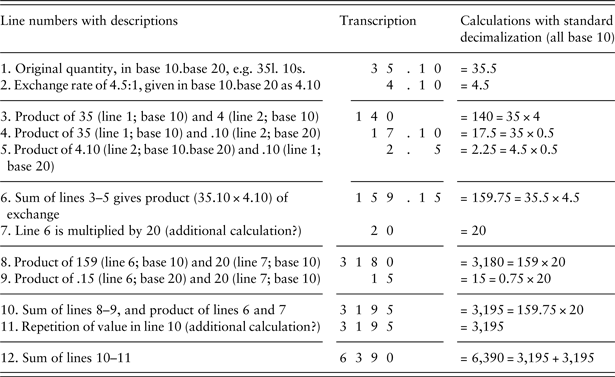
Table 1 shows rapid movement between calculations involving different bases, apparently to perform a currency conversion at a ratio of 4.5:1. Elements of this example are reproduced faithfully in the second column, including the annotations of dots and lines the Harveys used. The first column numbers the lines of the transcription, and provides a basic description of the contents of each line, while the third column gives the calculations with standard decimalization, i.e. with all numbers converted to base 10 notation.Footnote 47
Example of shorthand currency conversion

The rate for the currency conversion is listed in the second row of the calculation, as 4.10, with 4 in decimal (or base 10) notation, and .10 in vigesimal (or base 20) notation. That representation of quantities – with numbers given on the left of the dot in base 10 and numbers on the right given in base 20 – is repeated throughout the Harveys’ calculation. Whereas numbers to the left are counted in a manner used commonly today, with ten unique digits representing numerals, numbers to the right are counted using twenty digits, such that those numbers are counted according to powers of 20. In the case of the fractions that are indicated using vigesimal notation – as is regularly the case in this example – this means that 0.10 base 20 is equivalent to 0.50 base 10 (or the fraction ½), 0.05 base 20 to 0.25 base 10 (or the fraction ¼), 0.15 base 20 to 0.75 base 10 (or the fraction ¾), and so on.
The skill behind these calculations is important to emphasize. The Harveys moved seamlessly between the two different numeral systems, exploiting a shorthand that allowed rapid determination of the products of values given according to different numeral systems.Footnote 48 There was no need to make any conversion on paper, such as division by a factor of 20 to convert from base 20 to base 10. Many calculations, including the basic multiplication and addition, happened mentally, but remained accurate. The next step after the 4.5:1 currency conversion, in which 159.15 is multiplied by 20, has the calculator multiplying 159 by 20 (both in base 10) and 0.15 (in base 20: 0.15 base 20 = 0.75 base 10) by 20, showing once again how use of two numeral systems was no hindrance to effective and rapid arithmetic calculation that few of their contemporaries would have been able to perform.
Skill with arithmetic notwithstanding, this example provides a remarkable glimpse into the Harveys’ mastery of some of the skills of Mun's idealized merchant, and the way those skills lent themselves to the understanding of the circulation of money and goods that Mun advocated at the royal court. Precisely what the Harveys were calculating in this instance remains unclear – although it appears more likely than not to have been a currency conversion – but that slight uncertainty is itself a demonstration of the potential for accounting to recast goods as not only quantifiable but commensurate, fungible, and subject to arithmetic calculation. The value may have stood for some kind of money, or might also have represented some other specie, goods or services; no matter the object represented by the first value in the calculation, its quantification and representation in the scrap paper, followed by its conversion into an equivalent and commensurate value in some other object, made legible – and thus credible – the idea that all the motions and conversions of different goods and moneys were subject to the same cognitive practices of accounting, and ultimately to balancing of the credit and debit entries of the double-entry ledger.
That such calculations were undertaken not just with such ease but apparently with such regularity as to fill up scraps of paper speaks to the sophistication of the Harveys’ calculative practices, particularly in relation to the poor level of numeracy common to England in this period. In his seminal study of numeracy in early modern England, Keith Thomas described the lack of formal education in mathematics and the lack of meaningful, even basic, numeracy among ‘the supposedly educated classes’.Footnote 49 Thomas pointed to the oft-cited quote from John Wallis regarding the state of mathematical education in Wallis's youth, around the time De motu was published: ‘Mathematics, (at that time, with us) were scarce looked upon as Academical studies, but rather Mechanical; as in the business of Traders, Merchants, Seamen, Carpenters, Surveyors of Land, or the like; and perhaps some Almanack-makers in London’.Footnote 50 Indeed, for sons raised in these families, mastery of keeping books of account was often a noteworthy milestone, marked in diaries and other personal records.Footnote 51 The Harvey brothers, including William, knew how to make the kinds of calculation needed to keep books of account; such calculations are similar to examples laid out in William Oughtred's Key of Mathematics, a text that William bragged about mastering.Footnote 52 Because he learned the skills necessary to master Oughtred's text in his youth, at home among family, Harvey's mastery stood in stark contrast to the difficulty many otherwise well-educated men faced when attempting to learn Oughtred's text. The physician Charles Scarborough, Harvey's junior by several decades, enjoyed personal instruction from Oughtred before returning to Cambridge to teach Oughtred's text. Scarborough joined only a small number of men at either Cambridge or Oxford who had mastered Oughtred's text, many of whom, like Scarborough, had sought formal instruction from Oughtred himself because of the challenge of mastering his text.Footnote 53
In De motu cordis, Harvey used somewhat less sophisticated but nonetheless compelling calculations of the motion of blood, always calling attention to the multiplicative effect the heart had on an otherwise scarce amount of blood expelled during systole. His calculations relied on a kind of exchange of initially small quantities, whether of blood in the left ventricle for blood in the right atrium, or blood carried into the circulation over various periods of time. Emphasizing the multiplicative effect of the heart's constant expulsion of blood, Harvey estimated that the heart pulsed anywhere from one thousand to four thousand times per half-hour, depending on the person.Footnote 54 Based on the normal heart rates that Harvey proposes – all over one thousand in one half-hour – the actual number Harvey used to perform the quantitative argument was conservative, at just one thousand beats. For the measurement of the amount of blood expelled by the left ventricle, Harvey began with a similarly low estimate. Harvey had an idea of the true value, as he had ‘found [the left ventricle] in the dead body to hold more than two ounces’.Footnote 55 Nonetheless, Harvey opted to make the calculations for the quantitative argument using a range of estimates that were all meagre, beginning at just a single drachm, or one-eighth of an apothecary's ounce, representing a sixteen-fold reduction from his observation. Harvey worked up to an estimate of just one ounce, which was still less than half his original observation.Footnote 56 The blood recirculated, and when the quantity of the left ventricle was exchanged by multiplication for the quantity expelled over longer and longer periods of time, the apparently scarce amount of blood in the left ventricle came to represent a far greater amount in circulation.
Commensurability and fungibility of arterial and venous blood, or moneys and wares
Explanations of the vigour of a complex circulatory trade – whether involving either venous and arterial blood, or goods and moneys – required an understanding of commensurability. The merchants handled this problem mainly through an explication of the question of the balance of trade, whereas Harvey relied on the conversion of arterial and venous blood at the heart to demonstrate their commensurability. By April 1623, Mun was expounding at length on the key question of the commensurability of goods bought or sold to money and the relationship between the balance of trade and the balance of the exchange. Mun argued that the problem of the decay of trade was fundamentally a problem of the ‘overbalance’ of trade. According to Mun, as a result of this imbalance between exports and imports, money left the realm: ‘This overballance of our Comodities in valew must of necessitie bee carried awaie in readie money’.Footnote 57 Mun put forth the same argument in his posthumously published treatise England's Treasure by Forraign Trade, also published under the title England's Benefit and Advantage by Foreign Trade. Consistent with Misselden's views, Mun's treatise stressed the essential commensurability of goods with money and other goods.Footnote 58 Malynes, meanwhile, remained committed to fixing the rate of exchange, stressing his belief that merchants were complicit in dragging down the value of English coin. Contrary to Malynes, merchants like Mun and Misselden pointed to larger, systemic problems that caused the diminution of the value of English money. For merchants like Mun and Misselden, the problem of the poor exchange rate was a function of the overbalance of trade, not a cause of it.
The question of the balance of trade was of particular interest to Misselden, who provided a more complete account of commercial exchange than Mun. In his counsel to the Crown, Misselden articulated the relationship of a wide set of economic forces, such as (1) the balance of imports and exports; (2) domestic consumption; (3) the rate of exchange between domestic and foreign currency; (4) the relative weight and fineness of coins and moneys containing metal such as gold and silver, which were both commodities and intermediaries of exchange; (5) the divergence between the face value (or denomination) of currency and the intrinsic value of the metal contained in the money; and (6) the inflow or outflow of specie from England. Misselden developed a strong sense of how these factors came into balance with each other, with changes to one part of the system creating a proportional change in another.
To understand Misselden's conceptualization of commercial circulation, one must begin with his discussion of changes in the balance of imports and exports. Misselden claimed that ‘Ballancing or ouer Ballancing of trade’ changed the rate of exchange between domestic and foreign currency because merchants and other vendors had to adjust prices as the balance of trade shifted. According to Misselden, merchants, who always ‘pry into the price and value of all things’, consistently changed their purchasing habits, depending on their ability to purchase imports from one locale or another.Footnote 59 Merchants also adjusted prices according to the relative value of currency they used. As Misselden argued, vacillations in the exchange compelled a merchant to ‘raise the price of his Commodity in due proportion’ to changes in the exchange.Footnote 60 This, in turn, led to proportional changes in the supply and consumption of goods. As prices rose, consumption fell and merchants bought fewer goods to bring to market, leading to changes in the value of domestic currency. Through variations in the buying and selling of goods, prices rose or fell. Changes in the level of consumption had the potential to debase the value of English coin, which, depending on the relative fineness or weight of the metals it contained, might be worth less than its ‘outward denomination or account’.Footnote 61
Misselden's emphasis on the balance of commensurate values of coins and goods contributed significantly to his position against the ‘forst Par’, or fixed exchange rate. According to Misselden, the ‘forst Par’ would have severely disrupted the balance between the parts of his commercial system. As Misselden put it, ‘plenty or scarcity of commodities maketh their Price’ and ‘the plenty or scarcity of monies, causeth their Values … By Price in the one, is ment Valuation: by Value in the other, is ment Denomination or account’.Footnote 62 In other words, the price and value would diverge if the denomination and valuation diverged. Such a divergence would result in the export of English moneys to foreign lands to be converted into foreign coins, reducing the volume of English coin in the kingdom in a devastating way. Mun and Misselden argued that English merchants could, in certain circumstances, export coin and specie to alleviate the problem of scarcity. Against the opinion of Malynes, they claimed that the export of coin by English merchants to procure goods would return more coin, so long as no edict had forced a par on the value of the exchange.
Because accounting made his arguments legible, Misselden based his argument against Malynes's proposal for a royal edict largely on his reporting of books of account. When Malynes claimed that a royal edict from 1586 setting a par for the exchange of monies resolved a crisis similar in form to the current crisis, Misselden treated merchants’ account books as supporting evidence against Malynes. It is unclear whether Misselden actually consulted account books, although he asserted that he did. Using language reminiscent of a legal dispute, Misselden claimed that ‘all the Merchants Bookes of his owne and our Nation kept there and here … will testifie, that neither the Exchange in the yeare 1586. nor at any time since, went constantly at 33. sh. 4. d. but sometimes was higher, sometimes lower then that rate’.Footnote 63 This was due to the simple fact that merchants kept a record of the rates of exchange in their books, as a ‘commendable propertie of a good Merchant’ was to ‘to advise and bee advised of the rates of all Exchanges in all places’.Footnote 64 The practice of accounting furnished exactly the proof that Misselden needed, just as it would later for Harvey, who ‘by laying of account’ and ‘by former reckoning’ would make his case about the circulation.Footnote 65
Just as he had in the case of the fixed exchange, Misselden applied double-entry bookkeeping to estimates of imports and exports in making his case that trade in and out of England was not balanced. Towards the end of his Circle of Commerce, Misselden accounted for imports and exports by making the kingdom creditor ‘for all the Importations of the merchandize thereof’ and debitor ‘for all the Exportations of the Merchandize thereof’.Footnote 66 Misselden extrapolated from supposedly known rates for customs, tallying total imports and exports for wines, fish, cloths, cottons and other goods. Misselden's account demonstrated a ‘great Vnder-Balance of Trade with other nations’, a mismatch between imports and exports from Christmas 1621 to Christmas 1622, approximately the same time he was called to advise the Crown.Footnote 67 Misselden's estimates were critical to the case that he made to his royal audience; his fundamental complaint against Malynes, his rival at court, was that the true cause of the ‘want of money’ in the kingdom was the overconsumption of foreign goods.
The application of commensurability to questions of a healthy circulation further strengthened claims about the positive effect of circulating otherwise scarce coin or blood around the centre of a commercial or corporeal circulatory system. In Harvey's system, a small amount of blood left the heart, but was ultimately returned. Over time, the small amount of blood expelled at any given moment created a recirculation of blood ‘in such a larger quantity than should be sufficient for nutrition’.Footnote 68 Mun's argument mirrored Harvey's as he imagined a greater return of coins as more left, ultimately keeping a larger quantity continually in circulation, and invigorating English commercial output with the ‘vent of our wares, into such remote places’ as had previously not been the sites of major trade.Footnote 69 Mun's description always assumed a ready conversion between goods, contracted to England, at the center of his commercial system, and moneys, whose outward flow should be promoted.
Harvey, likewise, imagined the exchange of material of different quality but proportional quantity in the heart, writing that venous blood entered the heart ‘cold, coagulated, and effete’, but was quickly converted into arterial blood, renewed of its ‘fluidity, natural heat’, to create ‘a kind of treasury of life’.Footnote 70 The expulsion of this ‘treasury of life’ was essential because preventing its export would be lethal. As Harvey explained, the restriction of the outward movement of blood through the aorta caused a ‘suffocation from excess’.Footnote 71 By removing the restriction of the outward flow of this treasure, the heart continued to thrive, providing nutrition to the body at large. Contrary to the ‘authority of Galen’, Harvey treated the blood as being constantly expelled by – and eventually returned to – the heart. According to Harvey, the blood was ‘forced by the action of the left ventricle into the arteries’ and then ‘distributed to the body at large’.Footnote 72 The blood then returned to the heart, where it was ‘impelled by the right ventricle into the pulmonary artery’ before passing through the lungs, through the left atrium, and into the left ventricle, where it began its transit again.Footnote 73 Valves constantly restricted any backflow of blood. Contrary to Galen, Harvey treated the heart's interventricular septum as impermeable, meaning the entire contents of the right side of the heart necessarily had to move through the pulmonary circulation before entering the left side of the heart. Harvey had demonstrated the unidirectional motion of the blood through the heart – from right atrium to right ventricle, through the lungs, and from left atrium to left ventricle before entering the body – but in doing so he necessarily assumed the commensurability and fungibility of blood in the right heart, which impelled blood into lesser or pulmonary circulation, and left heart, which impelled blood into the greater or systemic circulation. His circulatory system required symmetry between its parts, with the quantity of blood contained in each part balanced and equivalent. Like the merchant balancing his books, Harvey was balancing intake and output, debit and credit, or – as in a double-entry ledger or the septate heart – left and right.
These aspects of Harvey's text crystallized at a time when he was increasingly engaged with matters of commercial concern to the Crown, following his appointment as physician-extraordinary to the king around 1618. This is apparent in Harvey's participation in efforts undertaken by the Royal College of Physicians to advise on the plague, a matter of profound economic importance, or in Harvey and the Royal College's support for the Privy Council's revocation of a lucrative license to operate an alum works.Footnote 74 At times, Harvey and the college's involvement turned to matters such as the importation of tobacco, which was of significant concern because tobacco's sale seemed to upset the balance of trade and weaken English currency.Footnote 75 In one particularly salient example, a report from 1622 warned of the loss of £60,000 per year from the consumption of Spanish tobacco – citing this loss as a major contributor to the scarcity of coin and bullion in England – before advocating for royal privileges for the Virginia tobacco trade and bans on the import of tobacco from Spain.Footnote 76 Although initially permissive of the importation of tobacco from Virginia, the king and Privy Council ultimately sought to restrain the importation of tobacco from Virginia, favouring tobacco from Maryland, whose governor was an ally of the Crown.Footnote 77 Harvey and the Royal College formally entered the dispute with declarations to the Privy Council that resoundingly sided with the king's interests. In 1628, the same year that Harvey had De motu cordis published, Harvey sat at the Comitia for the College and heard a request from the Privy Council to report on the possible ill effects of smoking tobacco grown in Virginia. The college replied that tobacco from more southern parts would be better and that smoking tobacco from Virginia could do harm.Footnote 78 In the case of Virginian tobacco, Harvey and the college reciprocated the support of royal patronage and royal privileges with expertise aligned closely with Crown interests.
The heart and the king: a common Aristotelian treatment of balance
The analogous heart and king sat at the centre of each system, serving as the critical guarantor of balance and symmetry, described using a common Aristotelian language of kingship. Harvey's dedication to King Charles invoked an image of circulation that bore a striking resemblance to Misselden's description of commercial circulation.Footnote 79 When Harvey wrote that the king was like ‘the heart of animals’ and ‘the basis of life … on which all growth depends, and every strength and power emanates’, he offered a view of the sovereign-heart as a creator of wealth and power through its expulsion of blood, a ‘treasury of life’.Footnote 80 Misselden similarly wrote that he ‘beheld this former flourishing Trade of ours, to be threatened by many as eminent as imminent dangers, and the very life thereof to lie a bleeding’.Footnote 81 The king had the power to ‘behold from his throne, the various revolutions of Commerce’, and so could ‘contract trade to its own Center’, thus promoting balance.Footnote 82 The language that Harvey and Misselden used was not as much royalist as it was Aristotelian, despite vigorous debates about the possibility that Harvey may have – if inadvertently – suggested some republican sympathies in his dedication.Footnote 83
Partly through its use of this Aristotelian language, Harvey's dedication set up a description of a circulatory model that spoke to some of the most urgent questions of balance and symmetry that animated contemporary debates at the royal court.
The language of both Harvey's and the merchants’ descriptions of kingship went beyond mere heart–king symbolism, describing an Aristotelian model of balance and reciprocity between mutually dependent parts. The heart/king, at the centre of their circulatory systems, governed and protected the flow of blood, bullion, specie or goods. This kind of Aristotelian language figured prominently in the courts of King James and King Charles, providing a kind of vernacular in which advisers to the Crown could provide counsel. This language helped them to articulate their thinking on the duties and obligations of the ruler to the ruled, and the ruled to the ruler, guarding against the possibility that the king might behave like a tyrant without the essential check of good counsel.Footnote 84 In this way, the king might remain, as Harvey put it, ‘the basis of life … on which all growth depends, and every strength and power emanates’, while overseeing a system such as Misselden described, in which all the many constituent parts of the system ‘empt themselves againe into this Ocean’, giving back to the king what the king originally gave to them.Footnote 85
This Aristotelianism of reciprocity and balance was distinct from the more widely studied Aristotelian teleological thinking central to the rest of De motu and many other texts. A significant literature devoted to explaining Harvey's Aristotelianism largely emphasizes the centrality of demonstration to Harvey's experimentalism, as well as the rhetoric that Harvey employed to explain the proof of his observations.Footnote 86 On this view, Harvey followed a latent, if powerful, Aristotelian imperative to collect as many examples and derive from them a single archetypal circulation, locating in each body part a final cause or purposes to observable functions. Harvey then presented his observations in a manner that employed an Aristotelian rhetoric of proof, which emphasized evidence rather than emotions to persuade.Footnote 87 Others have developed this view, arguing that tacit Galenic modes of demonstration intermingled with Harvey's Aristotelianism to produce Harvey's experimental method.Footnote 88
Harvey's Aristotelianism, however, was even broader. It shared a great deal with merchants such as Mun and Misselden, who were interested in how notions of balance and reciprocity can be used for the advancement of a stable civil society or economy. For the merchants, the main interest was in establishing a hierarchical order under a conscientious and fair king, inclusive of a consumer society in which goods and moneys were regularly transacted. Money mediated the commensurability of different goods, because ‘all things must be somehow commensurable’ and ‘[i]t is for that reason that money has been introduced’.Footnote 89 By facilitating orderly transactions between different tradesmen, money allowed for the fulfilment of social roles, allowing just payment for qualitatively disparate but quantifiably equivalent work.Footnote 90 Commensurability and proportionality ultimately depended on the benevolent rule of a king, who safeguarded them.Footnote 91 Government thus brought ruler and ruled into a union that could temper man's passions, and provide for the common good, allowing the ruler and the ruled to coexist in a relationship of mutual dependence.Footnote 92 For the merchants who advised the royal court, double-entry bookkeeping could make the balance of this complex, dynamic system legible. For Harvey, the interest was similarly in grasping a hierarchical order of organs of the body, in which parts were organized in a system of mutual dependency, linked not by money but by blood. Like the merchants, Harvey could explain the motion of blood through a complex system using the language and tools of accounting and arithmetic. For Harvey's readers, accounting for blood as though it were money required little inference, given the importance of the blood–money metaphor in the tracts of the merchants who advised the royal court.Footnote 93
Conclusion: beyond the blood–money metaphor of the seventeenth century
While Harvey was not the first to draw on corporeal and sanguine metaphors to describe the body politic, his vision of blood's circulation reconfigured the relationship between blood and body, or wealth and the body politic. In a treatise on the movement and exchange of coins originally published in Italian in 1588 and translated into English in 1696, Bernardo Davanzati drew on a Galenic conception of the circulation in which a large quantity of blood was directed outward as needed. He wrote that blood ‘nourishes and restores as much of it as was dri'd up and evaporated by the natural Heat: In like manner, Money, which we said before was the best Juice and Substance of the Earth, does, by circulating out of the richer Purses into the poorer, furnish all the Nation’.Footnote 94 Blood was constantly consumed for the ‘necessities of Life’, and needed to be kept in a quantity sufficient to keep the circulation moving outward, from rich purses to poor to be consumed.Footnote 95 Diverging so significantly from Galenic teaching on the circulation, Harvey broke down the basis for the kind of sanguine analogies to the movement of money that Davanzati used. While Harvey's metaphors were not always explicitly monetary – as when he adopted the Aristotelian water cycle from Aristotle – his use of accounting and arithmetic in the quantitative argument drew significantly on political, economic and intellectual resources that he shared with merchants who advised the Crown. Through the practice of accounting and arithmetic, Harvey produced a conceptualization of the movement of blood that overturned the traditional Galenic system, in which blood was continually produced and sent just once into the body. Blood was scarce, but in its recirculation, it continuously nourished the body, just as the recirculation of scarce coin could nourish the English commonwealth.
The respective conceptualizations of circulation of Harvey, Misselden and Mun spoke with great specificity to the commercial problems that the Crown faced in the 1620s. The problem of scarcity, in particular, illustrates such specificity. The problem of the scarcity of coin always caused a degree of panic in many Crown advisers and courtiers, with advisers like Malynes advocating retaining coin in the kingdom. Mun and Misselden's conception of balance – between imports and exports, domestic consumption, moneys, the exchange, and the fineness of coins – offered a way around this problem. Mun and Misselden both observed, in a way that was self-evidently in the best interest of the companies they represented and yet reflective of the interconnectedness of a wide array of economic factors, that increasing the export of coin instead of impinging on its outward flow would lead to a greater recirculation of goods and moneys. The problem of scarcity was a problem of circulation; in order to allay the ill effects of the scarcity of coin, the Crown had to pursue policies that would allow a freer flow of coins. At the same time, recognizing the interconnectedness of the companies they represented to the Crown, and the Crown's dependence on those companies for political and financial support, they also offered a conception of reciprocity and mutual dependency that linked the very survival of the sovereign to that of the trading companies. These rich and nuanced conceptions of the necessity of balance between different factors and parts – whether Crown and company, imports and exports, or inflows and outflows of coin – emerged in the precise circumstances of the economic calamities of the 1620s, articulated by advisers to the Crown who were closely affiliated with corporatist bodies that enjoyed the benefits of royal patents.Footnote 96
The emergence of these models of circulation from the same broad set of concerns speaks to the value that the English Crown placed on using accounting and arithmetic to generate knowledge about circulation. Other than his and the Royal College's intervention in matters related to tobacco from Virginia, precisely what Harvey directly witnessed of the commercial debates remains unclear, and our knowledge of Harvey is limited by factors including the destruction of his papers during the Civil War. Nonetheless, Harvey's adoption of the merchants’ methods suggests the movement of epistemic values from commercial to corporeal domains. This movement followed shifts in the epistemic value of different ways of knowing – some rooted in the practical aspects of a career as a merchant, for instance – following changes in the relationship between Crown and corporatist bodies like the Levant and East India Companies. The consolidation of the patrimonial system that Robert Brenner has described, wherein spoils were used to induce loyalty and support, was coextensive with the move towards greater emphasis on notions of balance and reciprocity, alongside the practical aspects of expertise in commercial matters, such as possessing and demonstrating knowledge of accounting.Footnote 97 As the merchants argued, true knowledge of the commercial crisis depended on such expertise, which in turn depended on membership in royally chartered trading companies. Only those charged by the king's royal patents to trade had the keen eye for the commercial crisis, and they alone understood the interconnected problems of balance between the exchange, trade, consumption and fineness of coins. Their knowledge was demonstrable through the application of practices such as accounting to problems such as the scarcity of coin. Consequently, Harvey's conceptualization of circulation – and the conceptualizations of Mun and Misselden – produced a quantitative argument about circulation, whether of blood or of coins. Like Mun's argument that more export of coin would return more coin, Harvey's quantitative argument asserted that the recirculation of blood provided more than one might ever suspect and eventually returned much more than was even ‘necessary for nutrition’.Footnote 98 In this way, both Harvey and the merchants who advised the Crown offered plausible solutions to some of the most vexing problems of the early part of the seventeenth century, most notably the scarcity of blood and coin.