Introduction
It has long been known from clinical follow-up studies that children with attention deficit hyperactivity disorder (ADHD) often continue to have symptoms, especially of inattentiveness, in adulthood (Weiss & Hechtman, Reference Weiss and Hechtman1993; Mannuzza et al. Reference Mannuzza, Klein, Bessler, Malloy and LaPadula1998). It is also known that adult ADHD is associated with substantial role impairment (Biederman et al. Reference Biederman, Faraone, Spencer, Mick, Monuteaux and Aleardi2006; Able et al. Reference Able, Johnston, Adler and Swindle2007). The effects of adult ADHD on work performance are especially noteworthy. In 2005, a report from the National Comorbidity Survey Replication (NCS-R) found that adult ADHD is associated with >120 million lost workdays in the USA each year, with a human capital value of US$19.5 billion (Kessler et al. Reference Kessler, Adler, Ames, Barkley, Birnbaum, Greenberg, Johnston, Spencer and Ustun2005a). Given that experimental studies have documented significant effects of treatment on the impairments associated with adult ADHD (Barkley et al. Reference Barkley, Murphy, O'Connell and Connor2005; Adler et al. Reference Adler, Spencer, Levine, Ramsey, Tamura, Kelsey, Ball, Allen and Biederman2007) and that few adults with ADHD are in treatment (Kessler et al. Reference Kessler, Adler, Barkley, Biederman, Conners, Demler, Faraone, Greenhill, Howes, Secnik, Spencer, Ustun, Walters and Zaslavsky2006a), this evidence of high work impairment might mean that workplace screening–treatment of ADHD would be cost-effective from the employer's perspective.
The current report presents data from a health risk appraisal (HRA) survey carried out in a large manufacturing firm to screen for ADHD. The aim was to determine the prevalence and workplace costs of ADHD in order to evaluate the possible return on investment of a workplace screening–treatment program for workers with ADHD. Actuarial evidence that adult ADHD is associated with elevated risk of accidents and injuries was of special interest to the employer (Swensen et al. Reference Swensen, Birnbaum, Ben Hamadi, Greenberg, Cremieux and Secnik2004; Fischer et al. Reference Fischer, Barkley, Smallish and Fletcher2007; Reimer et al. Reference Reimer, D'Ambrosio, Coughlin, Fried and Biederman2007), as workplace accidents-injuries are a major problem in manufacturing firms (Zaloshnja et al. Reference Zaloshnja, Miller and Waehrer2006). An important additional aim of the survey, then, was to determine whether ADHD was significantly associated with workplace accidents-injuries in this firm.
Method
Sample
The HRA survey was carried out in the autumn of 2005 (n=4140) and again in the autumn of 2006 (n=4423) as part of the Atlanta-Chicago Health and Work Performance (ACHP) initiative (Kessler et al. Reference Kessler, Richling and Sullivan2004b). Survey respondents represent 35–38% of the workforce of the firm. Approximately two-thirds of baseline respondents completed the second HRA (n=2656). The sample was pooled across waves to treat the data array as a cross-sectional sample of 8563 (i.e. 4140+4423) observations, taking into consideration that 2656 cases were repeat observations. The pooled sample was post-stratified to match the distribution of the entire workforce on the cross-classification of age, sex and broad occupational category using the first digit of the US Bureau of the Census occupation category classification scheme (www.bls.gov/ncs/ocs/ocsm/comuseindex.htm).
Measures
ADHD
Current ADHD was assessed with the World Health Organization (WHO) Adult ADHD Self-Report Scale (ASRS; Kessler et al. Reference Kessler, Adler, Ames, Demler, Faraone, Hiripi, Howes, Jin, Secnik, Spencer, Ustun and Walters2005b), a short screening scale developed for the WHO World Mental Health Surveys (Kessler et al. Reference Kessler, Haro, Heeringa, Pennell and Ustun2006c). Two independent general population clinical reappraisal studies have documented good concordance of the ASRS with blinded clinical assessments of current adult ADHD, with an area under the receiver operating characteristic curve (AUC) of 0.84 (Kessler et al. Reference Kessler, Adler, Ames, Demler, Faraone, Hiripi, Howes, Jin, Secnik, Spencer, Ustun and Walters2005b) and 0.90 (Kessler et al. Reference Kessler, Adler, Gruber, Sarawate, Spencer and Van Brunt2007). A calibration scheme using the method of Multiple Imputation (MI; Rubin, Reference Rubin1987) was developed based on these clinical reappraisal studies to transform ASRS scores into predicted probabilities of DSM-IV adult ADHD. These predicted probabilities were then used to estimate the prevalence and correlates of ADHD, using methods described below in the section on analysis methods.
Workplace outcomes
All respondents were administered the WHO Health and Work Performance Questionnaire (HPQ; Kessler et al. Reference Kessler, Barber, Beck, Berglund, Cleary, McKenas, Pronk, Simon, Stang, Ustun and Wang2003, Reference Kessler, Ames, Hymel, Loeppke, McKenas, Richling, Stang and Ustun2004a). The HPQ includes a self-report assessment of sickness absence days in the month (30 days) before the survey and a scale of on-the-job work performance in the month before the survey. Validation studies have documented significant associations (r=0.61–0.87) of HPQ absenteeism reports with employer payroll records (Kessler et al. Reference Kessler, Barber, Beck, Berglund, Cleary, McKenas, Pronk, Simon, Stang, Ustun and Wang2003) and significant associations of HPQ work performance reports with both supervisor assessments (r=0.52) (Kessler et al. Reference Kessler, Ames, Hymel, Loeppke, McKenas, Richling, Stang and Ustun2004a) and other administrative indicators of performance (0.58–0.72) (Kessler et al. Reference Kessler, Barber, Beck, Berglund, Cleary, McKenas, Pronk, Simon, Stang, Ustun and Wang2003).
The HPQ also includes a question about the occurrence of workplace accidents-injuries in the year before the survey. The accidents-injuries question asks if the respondent had ‘an accident that either caused injury, damage, work delay, a near miss, or a safety risk’. The recall period is longer than for absenteeism and work performance questions because accidents-injuries are comparatively rare and because accidents-injuries are sufficiently noteworthy that they can be recalled with better accuracy over a long recall period than can sickness absence days or information about work performance (Landen & Hendricks, Reference Landen and Hendricks1995; Jenkins et al. Reference Jenkins, Earle-Richardson, Slingerland and May2002).
Co-morbidity
The HPQ includes a self-report checklist of the 12-month prevalence of a wide range of chronic physical and mental conditions. These conditions were selected from the much larger condition checklist in the US National Health Interview Survey (Schoenborn et al. Reference Schoenborn, Adams and Schiller2003; National Center for Health Statistics, 2005) based on evidence in previous studies that the HPQ conditions are commonly occurring and have significant effects on work performance (Kessler et al. Reference Kessler, Greenberg, Mickelson, Meneades and Wang2001; Wang et al. Reference Wang, Beck, Berglund, Leutzinger, Pronk, Richling, Schenk, Simon, Stang, Ustun and Kessler2003). Condition checklists of this sort are widely used in population-based health surveys and have been shown to yield more complete and accurate reports than estimates derived from responses to open-ended questions (Knight et al. Reference Knight, Stewart-Brown and Fletcher2001).
The HPQ condition checklist distinguishes between symptom-based conditions (e.g. chronic headaches, depression) that can be self-reported with good accuracy and silent conditions (e.g. diabetes, hypertension) that require diagnosis by a health-care professional. All respondents were asked to self-report the presence of the symptom-based conditions on the checklist and to report whether a doctor or other health-care professional diagnosed them with the silent conditions. Methodological studies have documented good concordance between the latter reports and medical records (Edwards et al. Reference Edwards, Winn, Kurlantzick, Sheridan, Berk, Retchin and Collins1994; Baker et al. Reference Baker, Stabile and Deri2001).
Seventeen conditions in the HPQ checklist were sufficiently common (30 or more respondents with the condition in each of the two surveys) to be considered in this report. These include two musculoskeletal conditions (arthritis, chronic back–neck pain), two other pain conditions (migraine, other chronic pain), two cardiovascular conditions (hypertension, hyperlipidemia), two digestive conditions (gastroesophageal reflux disease, ulcer), two respiratory conditions (asthma, seasonal allergies), five other physical conditions (cancer, diabetes, urinary–bladder disorders, insomnia, chronic fatigue), and two classes of mental conditions (anxiety disorders, depression).
In addition to the self-report HPQ data, medical and pharmacy claims data were available for the year prior to the baseline survey to assess the prevalence of treated ICD-9 conditions. To obtain information on both untreated and treated conditions, we abstracted from these records information only about the conditions assessed in the HPQ self-reports. The condition measures used in the analyses reported here include both self-report data and administrative claims data for these 17 conditions. A condition was defined as present if it was either self-reported or found in the administrative claims database.
Health-care costs
The medical-pharmacy claims data were also used to calculate health-care costs and to compare these costs for workers with ADHD versus other workers. Total health-care costs (for all conditions, not limited to the 17 conditions in the HPQ) were also decomposed for this purpose into out-patient costs, pharmacy costs, in-patient costs, and emergency room costs.
Other controls
All analyses included controls for respondent age, sex, broad occupational category (executive, white-collar technical, white-collar non-technical, clerical, blue-collar skilled, and blue-collar semi-skilled), and the hours of work per week the respondent is expected to work.
Analysis methods
As noted above, ASRS scores were transformed into predicted probabilities of DSM-IV adult ADHD based on calibration rules developed in previous ASRS clinical reappraisal studies (Kessler et al. Reference Kessler, Adler, Ames, Demler, Faraone, Hiripi, Howes, Jin, Secnik, Spencer, Ustun and Walters2005b, Reference Kessler, Adler, Gruber, Sarawate, Spencer and Van Brunt2007). Each respondent was assigned 10 predicted probabilities. Each predicted probability was generated from a separate pseudo-sample based on ASRS clinical reappraisal studies. These predicted probabilities were then used to generate 10 prevalence estimates of DSM-IV ADHD for each respondent by selecting a separate random number for each respondent from the binomial distribution for each of the respondent's predicted probabilities.
Prevalence estimates of ADHD based on these imputed diagnoses are unbiased if the calibration probabilities used to make the imputations are accurate for the study population. However, estimates of standard errors are biased downwards if they are calculated using conventional procedures because these procedures treat the dichotomies as true values rather than imputations. The MI method corrects this problem by using simulation to adjust estimates of standard errors to take into consideration the imprecision introduced by the imputations. The same procedure can be used to correct the standard errors of the parameter estimates in regression analysis. This was done in the current analysis by replicating all substantive analyses 10 times, once for each of the 10 sets of diagnoses. The parameter estimates obtained in these 10 replications were then averaged to arrive at best estimates of the parameters, and the squares of the standard errors of these estimates averaged to calculate within-replicate error variance. A term for between-replicate variation in parameter estimates was then added to the within-replicate average to represent between-replicate error variance. The square root of this sum was used to represent the standard error of the MI parameter estimate. This approach adjusts for the imprecision introduced by diagnostic imputation (Schafer, Reference Schafer1999).
The prevalence of DSM-IV ADHD was estimated by calculating the MI mean of the imputed diagnostic dichotomies. The associations of ADHD with HPQ measures of work performance and, in the claims data, with information about health-care costs were estimated with MI multiple regression analysis. Medical costs were disaggregated into out-patient, pharmacy, in-patient, and emergency department costs. Controls were included in all the regression equations for sociodemographics (age, sex, occupation) and expected hours of work. Results were also replicated in models that added controls for co-morbidity. Comparison of results with and without controls for co-morbidity were made based on the assumption that the early age of onset of ADHD makes the vast majority of co-morbid conditions temporally secondary. This means that the components of the associations of ADHD with the outcomes that occur through co-morbid conditions can plausibly be considered long-term indirect effects of ADHD (i.e. effects of ADHD on the outcomes through effects of ADHD on risk–persistence–severity of the co-morbid conditions, which, in turn, have effects on the outcomes).
The regression analyses used a logistic link function (Hosmer & Lemeshow, Reference Hosmer and Lemeshow2001) to predict the dichotomous measures of any sickness absence and any workplace accident-injury. A generalized linear model (GLM) that allowed for non-linear link functions and for non-normal distributions of prediction errors (Dobson, Reference Dobson2001) was used to predict the continuous outcomes of number of sickness absence days, work performance, and health-care costs. GLM was used rather than ordinary least-squares (OLS) regression because most of the continuous outcomes are highly skewed (e.g. a majority of respondents reporting no sickness absence days and no in-patient or emergency room costs). A variety of link functions (linear, square root, natural log) and error structures (normal, Gamma, Poisson) were investigated in the GLM model-fitting process to maximize prediction accuracy in the face of these skewed outcomes. GLM is the preferred statistical method to use in situations of this sort (Buntin & Zaslavsky, Reference Buntin and Zaslavsky2004; Moran et al. Reference Moran, Solomon, Peisach and Martin2007). It turned out, however, that the results based on the OLS regression closely approximated those based on the best-fitting GLM models. The OLS results are consequently reported here because of the easier interpretation of OLS than GLM regression coefficients.
The estimated effects of ADHD on sickness absence and job performance were monetized based on respondent salary reports with an assumed 25% fringe benefit rate. In the case of sickness absence, the percentage of all lost work days estimated to be due to ADHD was translated into an annualized equivalent percentage of the mean annual salary of workers with ADHD. In the case of lost work performance on days at work, the impact of ADHD on the 0–10 HPQ scale (where 0 represents no work performance and 100 represents the performance of a top worker) was assumed to represent a proportional decrement in work performance that we translated into the equivalent proportion of mean daily salary of workers with ADHD. These monetized estimates were annualized by projecting effects for a 30-day recall period to a 12-month period.
Standard errors of all estimates were calculated using the jackknife repeated replications (JRR) method of pseudo-replication (Wolter, Reference Wolter1985) implemented in the MI framework to take into consideration the imputations of diagnoses. JRR adjusted for the weighting of the data as well as for the clustering introduced by the fact that the pooled dataset included some respondents who were surveyed in both years. Multivariate significance was evaluated using Wald χ2 tests based on JRR design-based coefficient variance–covariance matrices. Statistical significance was consistently evaluated at the 0.05 level with two-sided tests.
Results
Sample characteristics
The workforce of the manufacturing firm was largely male (70.2%). The median age of the workers was 46 years, with an interquartile (IQR; 25th–75th percentiles) age range of 40–51 years. The occupational distribution was 3.0% executives, 39.3% white-collar technical, 1.6% white-collar non-technical, 11.0% clerical, 41.8% blue-collar skilled, and 3.3% blue-collar semi-skilled.
Prevalence and sociodemographic correlates of DSM-IV ADHD
The prevalence (MI standard error in parentheses) of DSM-IV ADHD was estimated to be 1.9% (0.4) in the total sample. Prevalence estimates decreased somewhat with age from 2.7 (0.9) for workers aged 18–34 to 2.0 (0.6) for workers aged 35–49 and 1.5 (0.3) for workers 50+, but these differences are not statistically significant (χ22=3.7, p=0.16). Nor was the prevalence estimate of 2.3 (0.7) for women significantly different from the 1.7 (0.4) prevalence estimate for men (χ12=1.4, p=0.24). Although the lowest prevalence within the occupational subgroups was among executives [0.9 (0.7)] and the highest among blue-collar semi-skilled workers [3.3 (1.9)], the range of prevalence estimates was much narrower across the other occupations (1.7–2.1). As a result, the overall association between occupation and prevalence is not statistically significant (χ52=1.8, p=0.88). Furthermore, no statistically significant interactions exist between age and sex (χ22=1.4, p=0.49), age and occupation (χ102=7.7, p=0.46), or sex and occupation (χ52=4.7, p=0.46) in predicting ADHD.
Co-morbidity of DSM-IV ADHD with other conditions
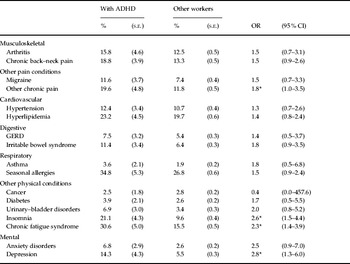
ADHD is positively related to 16 of the 17 co-morbid conditions considered in the analysis, the exception being cancer (Table 1). The associations [odds ratios (ORs)] were estimated in logistic regression equations that adjusted for respondent age because ADHD prevalence decreases somewhat with age whereas the prevalence of most co-morbid conditions increases with age. The estimates were also adjusted for respondent sex. Four co-morbid conditions were significantly related to ADHD [OR (95% confidence interval (CI)]: depression [2.8 (1.3–6.0)], chronic pain disorder [1.8 (1.0–3.5)], insomnia [2.6 (1.5–4.4)] and chronic fatigue syndrome [2.3 (1.4–3.9)].
Estimated co-morbidity (odds ratios) of multiply imputed DSM-IV ADHD with other conditions in the pooled dataset (n=8563)Footnote a

ADHD, Attention deficit hyperactivity disorder; s.e., standard error; OR, odds ratio; CI, confidence interval; GEDR, gastroesophageal reflux disease.
a Based on a series of multiple logistic regression analyses in which a dummy predictor variable that distinguished between workers with ADHD (coded 1) and other workers (coded 0) was used to predict the presence versus absence of each co-morbid condition, controlling for age, sex, and year of survey.
* Significant at the 0.05 level, two-sided test.
Individual-level associations of ADHD with workplace outcomes
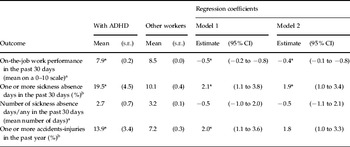
ADHD was associated with a statistically significant decrement in on-the-job work performance after adjusting for age, sex, occupation, expected number of hours of work, and year of survey, with mean (standard errors in parentheses) values of 7.9 (0.2) for respondents with ADHD v. 8.5 (0.0) for other respondents on the 0–10 HPQ work performance scale and a standardized (for control variables) mean difference of −0.5 (95% CI −0.2 to −0.8; χ12=9.1, p=0.001) (Table 2). Introducing an additional control for co-morbidity had only a modest effect on this estimate. If we think of the 0–10 work performance scale as representing proportional work performance, then workers with ADHD would be estimated to have about 4–5% lower on-the-job work performance than other workers. In a 250-day work year, this is equivalent to an annualized decrement of approximately 10–12 lost days of productive work associated with ADHD.
Associations of multiply imputed DSM-IV ADHD with workplace outcomes in the pooled dataset without (model 1) and with (model 2) controls for co-morbid conditions (n=8563)

ADHD, Attention deficit hyperactivity disorder; s.e., standard error; CI, confidence interval.
a Based on ordinary least-squares (OLS) regression analysis in which a dummy predictor variable that distinguished between workers with ADHD (coded 1) and other workers (coded 0) was used to predict the continuous outcomes controlling for age, sex, occupation, expected number of hours of work, and year of survey.
b Based on a multiple logistic regression analysis in which a dummy predictor variable that distinguished between workers with ADHD (coded 1) and other workers (coded 0) was used to predict the presence versus absence of the dichotomous outcomes, controlling for age, sex, occupation, expected number of hours of work, and year of survey.
* Significant at the 0.05 level, two-sided test.
Workers with ADHD were also found to have a significantly higher probability than other workers of the same age, sex, and occupation of having at least one sickness absence day in the month before the survey (19.5% v. 10.1%), with a standardized OR of 2.1 (95% CI 1.1–3.8, χ12=6.2, p=0.013). This effect became somewhat weaker, but was still significant, when we added a control for co-morbidity (OR 1.9, 95% CI 1.0–3.4, χ12=4.5, p=0.035). There was no significant difference in the expected duration of sickness absence days, however, between workers with ADHD and other workers (χ12=0.5, p=0.48). The significant associations between ADHD and work loss are equivalent to annualized decrements of 2–3 work loss days.
Workers with ADHD were also found to have a significantly elevated probability of having a workplace accident or injury in the year before the survey (13.9% v. 7.2%), with a standardized OR of 2.0 (95% CI 1.1–3.6, χ12=5.1, p=0.024). This effect became insignificant, however, when we added a control for co-morbidity (OR 1.8, 95% CI 1.0–3.3, χ12=3.6, p=0.06). These associations are equivalent to 5–6 excess respondents with one or more workplace accidents-injuries per year per 100 workers with ADHD.
Associations of ADHD with health-care costs
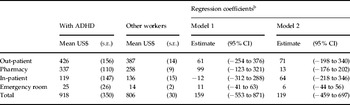
Medical claims data showed that only four of the respondents with ADHD were in treatment for this condition. (No respondent who did not screen positive for ADHD had a history of ADHD treatment in the medical-pharmacy claims records.) ADHD was not significantly associated with overall health-care costs after adjusting for age, sex, occupation, expected number of hours of work, and year of survey (US$917.74 v. US$805.76, χ12=0.2, p=0.68) (Table 3). Introducing an additional control for co-morbidity had no meaningful effect on the significance of this difference (χ12=0.1, p=0.66). We decomposed total health-care costs into four components, but failed to find significant associations of ADHD with any of these four either with or without controls for co-morbid conditions. These cost components included out-patient (χ12=0.2–0.3, p=0.60–0.70), pharmacy (χ12=0.0–0.8, p=0.38–0.88), in-patient (χ12=0.0–0.2, p=0.65–0.94), and emergency department (χ12=0.1–0.2, p=0.67–81).
Associations (all of them non-significant) of multiply imputed DSM-IV ADHD with health-care costs in the year before the baseline interview in the baseline sample without (model 1) and with (model 2) controls for co-morbid conditions (n=4140)Footnote a

ADHD, Attention deficit hyperactivity disorder; s.e., standard error; CI, confidence interval.
a Based on ordinary least-squares (OLS) regression analysis in which a dummy predictor variable that distinguished between workers with ADHD (coded 1) and other workers (coded 0) was used to predict the continuous measures of health-care costs controlling for age, sex, occupation, expected number of hours of work, and year of survey.
b None of the regression coefficients is significant at the 0.05 level using two-sided tests.
Monetized total workplace costs
We monetized the workplace effects of ADHD on increased sickness absence and decreased on-the-job work performance using the human capital method. At the average reported salary of workers with ADHD, the human capital costs (standard error in parentheses) in terms of salary for ADHD-related sickness absence and lost work performance combined in the year before interview were estimated to be US$4336 (676) per worker with ADHD and US$8241 (1338) per 100 workers in the workforce (assuming an ADHD prevalence of 1.9%).
Discussion
Several limitations of the study are noteworthy. First, HRA surveys typically have low response rates and the surveys analyzed here were no exception. Although the low response rates could introduce bias, methodological research that used successively more intensive recruitment methods and financial incentives to increase HPQ HRA response rates showed that the same general patterns of prevalence and associations with measures of workplace outcomes held in surveys that had high and low response rates (Wang et al. Reference Wang, Beck, McKenas, Meneades, Pronk, Saylor, Simon, Walters and Kessler2002). It is possible, nonetheless, that ADHD is an exception to this general pattern, as the inattentiveness associated with ADHD might be associated with an especially low survey response rate. If so, then the ADHD prevalence estimate reported here might be conservative and the workplace effects of ADHD might be underestimated. It would be useful for future workplace HRA surveys on ADHD to include an outreach component aimed at increasing the response rate in order to evaluate the impact of low response on these possible biases.
Second, concerns could be raised about the ADHD diagnoses. As DSM-IV criteria for ADHD were developed with children in mind, only limited guidance exists in the DSM on adult diagnosis (McGough & Barkley, Reference McGough and Barkley2004). The clinical reappraisal studies used to calibrate the ASRS used narrowly defined DSM-IV criteria to define cases. Yet clinical studies show that symptoms of ADHD are more heterogeneous and subtle in adults than in children (DeQuiros & Kinsbourne, Reference DeQuiros and Kinsbourne2001; Wender et al. Reference Wender, Wolf and Wasserstein2001), leading some commentators to suggest that accurate assessment of adult ADHD might require an increase in the variety of symptoms assessed (Barkley, Reference Barkley1995), a reduction in the severity threshold for diagnosis (Ratey et al. Reference Ratey, Greenberg, Bemporad and Lindem1992), or a reduction in the DSM-IV six-of-nine symptom requirement (Kooij et al. Reference Kooij, Buitelaar, van den Oord, Furer, Rijnders and Hodiamont2005). To the extent that such broadening of criteria would lead to a more valid assessment than in the clinical interviews carried out in the current study, our prevalence estimate is conservative and the workplace effects of ADHD are underestimated.
A third potential problem with the ADHD diagnoses involves their exclusive reliance on self-reports. Childhood ADHD is diagnosed largely from parent and teacher reports because children with ADHD are notoriously unaware of their symptoms (Jensen et al. Reference Jensen, Rubio-Stipec, Canino, Bird, Dulcan, Schwab-Stone and Lahey1999). As use of informants is much more difficult for adults, however, assessment of adult ADHD is based largely on self-reports even though methodological studies comparing adult self-reports with informant reports document the same general pattern of underestimation in adult self-reports of ADHD as in child self-reports (Gittelman & Mannuzza, Reference Gittelman and Mannuzza1985; Zucker et al. Reference Zucker, Morris, Ingram, Morris and Bakeman2002). This suggests that the estimates of prevalence and workplace effects reported here might be conservative.
A fourth concern about ADHD diagnoses is that the model used to impute diagnoses was based on clinical assessments of ADHD in different samples than the one considered here. We have no way of knowing if these calibrate rules hold for workers with ADHD in the manufacturing firm studied here. To the extent that this is not true, the results reported here will be biased. The only way to resolve this problem, however, would be to carry out a clinical reappraisal study in each firm where an HRA survey is carried out, which would be impractical.
A fifth set of concerns could be raised about the HPQ estimates of sickness absence, work performance, and accidents-injuries. As noted above in the section on measurement, previous validation studies have documented good agreement between HPQ reports of these outcomes and administrative records. However, we were unable to obtain records of this sort for the current firm to confirm that the same associations hold in this sample. It is consequently possible that the outcomes are biased in ways that overestimate the effects of ADHD. It would be valuable for future research to obtain objective administrative records of sickness absence, work performance, accidents, and injuries to assess the workplace effects of ADHD.
Within the context of these limitations, the results suggest that adult ADHD is a relatively uncommon, but significantly impairing, condition in the manufacturing firm studied here. The 1.9% prevalence estimate is less than half the 4.2% prevalence estimate obtained among workers using the same measure in the nationally representative NCS-R (Kessler et al. Reference Kessler, Adler, Ames, Barkley, Birnbaum, Greenberg, Johnston, Spencer and Ustun2005a). It is conceivable that the much lower prevalence estimate in the current study is due to the prevalence in fact being lower in this firm than in the total US workforce. This possibility is consistent with the clinical observation that patients with adult ADHD tend to self-select into occupations that allow them to have flexibility in scheduling their time in and out of employment, unlike those in the company studied here, where job responsibilities are relatively structured. Another possibility is that ADHD prevalence was underestimated because of the low response rate or because of bias in the calibration rules used to generate diagnoses.
The finding that adult ADHD is associated with significant decrements in work performance is consistent with clinical observations that adult ADHD causes substantial role impairment (Adler & Spencer, Reference Adler and Spencer2004) as well as with neuropsychological evidence that adult ADHD causes impairment in cognitive functioning (Hervey et al. Reference Hervey, Epstein and Curry2004). The estimated US$4336 average annual loss in work performance due to ADHD is larger than published estimates for most other chronic physical and mental disorders (Druss et al. Reference Druss, Marcus, Olfson, Tanielian, Elinson and Pincus2001; Kessler et al. Reference Kessler, Greenberg, Mickelson, Meneades and Wang2001; Wang et al. Reference Wang, Beck, Berglund, Leutzinger, Pronk, Richling, Schenk, Simon, Stang, Ustun and Kessler2003). The fact that the majority of this lost productivity is associated with low on-the-job performance rather than sickness absence is important because job performance is much more difficult to manage than sickness absence as the latter can be managed with limits on paid sick days and disability insurance.
We made no attempt to estimate other workplace costs of ADHD, such as on decreases in the efficiency of other workers who are members of work teams that include a worker with ADHD and increases in hiring–training costs associated with the possibility that workers with ADHD have higher job turnover than other workers. Nor did we attempt to monetize the workplace costs of accidents-injuries associated with ADHD, as we had no basis for estimating these costs. Considerable controversy exists regarding how to estimate the workplace costs of injuries even when administrative data are available (Reville et al. Reference Reville, Bhattacharya and Sager Weinstein2001; Weil, Reference Weil2001). The situation is even more complex when, as in the current study, no administrative data are available and the question used to assess injuries did not distinguish injuries from accidents that caused damage, work delay, a near miss, or a safety risk.
Even though we did not monetize their effects, it is important realize that accidents and injuries can have substantial workplace costs of numerous sorts beyond disability payments and medical expenses. Included here are replacement costs of damaged equipment and materials, productivity losses associated with disrupted work processes, legal expenses, and regulatory constraints on work processes. In light of the finding that ADHD is associated with a doubling of accidents-injuries in the firm studied here, it would be useful for future research to collect more detailed information on the nature of the accidents and injuries associated with ADHD and to use this information to develop estimates of the monetary costs of these incidents from the employer's perspective.
In light of the above considerations, the estimate that ADHD has an annual human capital cost of US$4336 per worker with ADHD is likely to be conservative. It is not clear, despite experimental evidence that treatment of adult ADHD leads to substantial gains in neuropsychological task performance and cognition (Schweitzer et al. Reference Schweitzer, Lee, Hanford, Zink, Ely, Tagamets, Hoffman, Grafton and Kilts2004; Simpson & Plosker, Reference Simpson and Plosker2004; Turner et al. Reference Turner, Clark, Dowson, Robbins and Sahakian2004), how much this lost human capital value could be recovered with treatment. However, even if treatment led to no more than a 25% reduction in conservatively estimated human capital loss, the financial value of this reduction would exceed the cost of treatment.
With regard to accidents-injuries, the experimental treatment literature documents significant effects of ADHD treatment in reducing driving accidents and in increasing simulated driving performance (Barkley & Cox, Reference Barkley and Cox2007). It would be useful to carry out effectiveness trials in workplace samples to determine whether similar effects could be documented in reducing more general workplace accidents and injuries as well as in reducing sickness absence and in increasing on-the-job work performance. Recent research has shown that workplace effectiveness trials can feasibly be carried out to screen for and treat workers with major depression and that best-practices treatment of this sort can have a positive return-on-investment from the employer's perspective (Wang et al. Reference Wang, Simon, Avorn, Azocar, Ludman, McCulloch, Petukhova and Kessler2007). Given evidence that the workplace costs of ADHD are even higher than those of depression on a per-worker basis (Kessler et al. Reference Kessler, Adler, Ames, Barkley, Birnbaum, Greenberg, Johnston, Spencer and Ustun2005a, Reference Kessler, Akiskal, Ames, Birnbaum, Greenberg, Hirschfeld, Jin, Merikangas, Simon and Wang2006b), the above considerations suggest that ADHD might be a good candidate for similar workplace effectiveness trials.
Acknowledgments
The preparation of this report was supported, in part, by CDC grant R01 DP000091 and by Eli Lilly and Company.
Declaration of Interest
Dr Van Brunt is an employee of Eli Lilly and Company, which also provided funding for this paper. Professor Kessler has been a consultant for Astra Zeneca, Bristol–Myers Squibb, Eli Lilly and Company, GlaxoSmithKline, Pfizer, Sanofi-Aventis, and Wyeth and has had research support for his epidemiological studies from Bristol–Myers Squibb, Eli Lilly and Company, Ortho-McNeil, Pfizer, and the Pfizer Foundation.