Introduction
Triticale (×Triticosecale Wittmack) is grown for grazing, fresh forage, silage and hay under a wide range of production conditions. Furthermore, cereal straw is a main animal feed source, and the use of triticale as straw is in continuous expansion, especially in Mediterranean and semi-arid countriesReference Bilgili, Cifci, Hanoglu, Yagdi and Açıkgöz1. The practice of grazing winter cereals before heading and subsequently harvesting the forage is common in some countriesReference Cazzato, Laudadio and Corleto2. Little research has been done on the effect of grazing on the forage yield of winter cereals. Hennessy and ClementsReference Hennessy and Clements3 recommend a single light grazing in early spring because more intensive grazing of winter cereals results in reduced subsequent growth. Data on the effect of forage removal (grazing or clipping) on grain yield of cereal crops are availableReference Royo, Lopez, Serra and Tribò4, while data on the effect of grazing on forage production were not well definedReference Drake and Orloff5.
Nitrogen (N) fertilization has a direct effect on the plant N uptake and consequently the N present as a protein in animal feed. Mineral N fertilizer is regarded as a significant contributor to water pollution by nitrates and to atmospheric pollution by nitrous oxides, but there is little likelihood that adequate food supplies can be maintained without fertilizersReference Tilman, Cassman, Matson, Naylor and Polasky6. The development of cropping strategies that increase N use efficiency (NUE) could reduce unnecessary input costs to farmers and environmental impact of N losses, while maintaining crop yield. Splitting of N fertilizer application has been suggested as a strategy to improve NUE in winter cereal, on the assumption that the timing of application has a significant effect on the N uptake by the cropReference Dilz, Jekinson and Smith7, Reference Arregui and Quemada8. Low efficiency attributed to N fertilizer application in autumn has been observed in a large number of studies, and justifies N applications in springReference Sowers, Miller and Pan9, Reference Strong and Bacon10, particularly in Mediterranean climates. A further possible means of increasing NUE is the addition of a nitrification inhibitor (NI) to the fertilizer, particularly in the case of large applications. Since the 1960s, the fertilizer industry has developed compounds that delay bacterial oxidation of NH4+ to NO2− (first step of nitrification) to diminish nitrate losses and to increase N-fertilizer efficiencyReference Prasad and Power11. In one study, Zerulla et al.Reference Zerulla, Barth, Dressel, Erhardt, Horchler von Locquenghien, Pasda, Radle and Wissemeier12 proposed (3,4-dimethylpyrazole phosphate, DMPP) as an NI, effective when added to granulated N fertilizers at a rate of 0.5–1.5 kg ha–1, and able to diminish N2O emissions to the atmosphereReference Irigoyen, Muro, Azpilikueta, Aparicio-Tejo and Lamsfus13.
Since several species of bio-activators have been isolated from the rhizosphere, many experiments have been conducted to test bacteria and endo-mycorrhizal fungi as inoculants to enhance the performance of plants, but few trials have been conducted on triticaleReference Lestingi, De Giorgio, Montemurro, Convertini and Laudadio14. Little work has been performed on the management of triticale as forage, specially on dry matter yield (DMY) and quality in terms of crude protein (CP) fractions and nutrient digestibility. Therefore, the objective of this work was to assess the effects of the mode of utilization, N fertilization and mycorrhizal fungus inoculation on forage yield, protein fractions and digestibility of triticale.
Materials and Methods
Field trial
A trial was conducted in southern Italy at Gaudiano di Lavello—Potenza (41°06′N; 15°51′E; 180 m above sea level) on a sandy-clay soil, characterized as sub-alkaline, low in total N (0.77‰; the Kjeldahl method) and high in available P (83 mg l−1; the Olsen method) and exchangeable P (482 mg l−1; BaCl2; the TEA method). The experimental site was characterized by a summer-dry climate with a total annual rainfall of 450 mm distributed from Autumn to Spring and a mean temperature of 16 °C. During the experimental period, the total rainfall was 258 mm and temperatures did not show any significant variation from the average. The effects of 12 different treatments obtained by the factorial combination of three N fertilization levels (N0 = without N; N100 = 100 kg ha−1 of N, 23 kg ha−1 as diammonium phosphate 18-46-0 before sowing followed by 77 kg ha−1 as ammonium nitrate top-dressing in February (Zadoks’ stage 22 at tillering;Reference Zadoks, Chang and Konzak15); N100E = 100 kg ha−1 of N as Entec 25-15-0 containing 3,4 DMPP®, applied before sowing), two modalities of herbage utilization (H = cut at heading stage for hay production; GSH = cut during winter grazing simulation and regrowth cut at heading stage for hay production) and two treatments of inoculation with (M) and without (M0) commercial mycorrhiza (Mikendo—Gitenbiological® at a rate of 1.5 kg of inoculum per 100 kg seeds) were studied. The inoculum used was based on a mixture of spores (Glomus intraradices and Glomus moseae), with a density of 0.6 kg l−1, in the form of wettable powder, containing 2000 spores of arbuscular mycorrhizal fungus per gram. This product was formulated to be applied to seeds, before sowing, so that the mycorrhizal propagules remained adhered to the seed and would then be able to germinate and to colonize the new roots. Other ingredients in the formulation included: dextrose, vermiculite and clay (in order to help the propagules to adhere to seeds). Since N100 and N100E received 60 kg ha−1 of P2O5, treatment N0 received the same amount of P2O5 as superphosphate before sowing in order to give uniform P fertilization. A split–split plot experimental design was used with three replicates and sub-sub-plot area of 18 m2; the ‘mycorrhizal fungus inoculation’, ‘N fertilization’ and ‘mode of utilization’ effects were tested in the whole plot, sub-plot and sub-sub-plots, respectively. Soil preparation was performed in November 2007, plowing the soil to a depth of 30 cm. The previous crop was safflower (Carthamus tinctorius L.). Triticale cv. Rigel (spring variety) was sown on December 12, 2007 at a seeding rate of 250 kg ha−1 and a row spacing of 20 cm. Forage at winter cut was removed at Zadoks’ stage 31 (first node detectableReference Zadoks, Chang and Konzak15). Forage yield was determined by harvesting the whole plot.
Chemical analysis
Samples of each treatment were ground in a hammer mill with a 1 mm screen and analyzed in duplicate for dry matter (DM), ash, CP (Kjeldahl N × 6.25) and crude fat (ether extract with previous hydrolysis) according to the procedures described by the Association of Official Analytical Chemists (AOAC)16. Neutral detergent fiber (NDF) and acid detergent fiber (ADF) were determined according to Van Soest et al.Reference Van Soest, Robertson and Lewis17, and were corrected for residual acid insoluble ash. Acid detergent lignin (ADL) was determined by the method of Van Soest and RobertsonReference Van Soest and Robertson18.
Fractionation of CP
Fractionation of CP was carried out by the Cornell Net Carbohydrate and Protein SystemReference Sniffen, O'Connor, Fox and Van Soest19. According to this system, CP was partitioned into three fractions: fraction A was non-protein N (NPN) × 6.25; fraction B was true protein and fraction C was unavailable protein. Fraction B was further divided into three sub-fractions B1, B2 and B3 of rapid, intermediate and slow rates of ruminal degradation, respectively. CP fractions A and B1 were soluble in borate–phosphate buffer, CP fraction B2 was insoluble in the buffer but soluble in neutral detergent solution, and fraction B3 was insoluble in the buffer and in the neutral detergent, but soluble in acid detergent. CP fraction C was insoluble in acid detergent (acid detergent insoluble protein, ADIP); and contained protein associated with lignin, tannin–protein complexes, and Maillard products known to be highly resistant to microbial enzymes. Precipitated true protein, buffer insoluble protein, neutral-detergent insoluble protein (NDIP) and ADIP were analyzed as described by Licitra et al.Reference Licitra, Hernandez and Van Soest20. Fraction A was calculated as the difference between the total CP and precipitated true protein determined by Kjeldahl analysis of the residue resulting after precipitation with tungstic acid followed by filtration. CP fraction B1 was estimated as true protein minus buffer insoluble protein, fraction B2 as buffer insoluble protein minus NDIP and fraction B3 by subtracting the ADIP (fraction C) from the NDIP.
In vitro digestibility determination
In vitro digestibility of DM (DMd), organic matter (OMd), CP (CPd) and NDF (NDFd) were determined using the DaisyII Ankom® incubator system. The complete unit consisted of four incubation vessels with a capacity of 2 liters each. Each vessel contained 1.6 liters of buffer solution, 400 ml of either rumen liquor or faecal liquor as the inoculum and 24 nylon bags. Collected plant samples were ground to pass through a 1 mm screen. Each of the samples was digested in duplicate for each source of inoculum. Nylon filter bags (Ankom F57, ANKOM Technology, Fairport, New York) were rinsed in acetone and allowed to air dry before drying at 100 °C for 24 h, after which dry bag weight was recorded. For each treatment, 0.25 g of ground sample was added to nylon bags, which were then dried at 105 °C for 24 h, after which dry sample plus bag weight was recorded. Duplicate nylon bags for each feed type were randomly allocated to one of the four digestion vessels and to one of the four inoculum treatments. The microbial inoculum was prepared from rumen liquor collected from four mature healthy sheep using an esophageal tube under mild vacuum. The sheep were fed a diet sufficient for their maintenance allowance21, which contained a 50:50 chopped alfalfa hay and grain mixture. After collection, the rumen liquor was placed in an air-tight container and transported to the laboratory at 39 °C. The inoculum from each animal was filtered through eight layers of gauze cloth, purged with CO2, and kept in a prewarmed thermos until use (within approximately 20 min). The 400 ml of inoculum were introduced in each flask and placed into a DaisyII system. Each digestion vessel contained 400 ml of inoculum and 1.6 liters of buffer solution (1:4, v/v). The buffer solutionReference Tilley and Terry22 consisted of 1.33 l buffer A (KH2PO4, 10.0 g l−1; MgSO4.7H2O, 0.5 g l−1; NaCl, 0.5 g l−1; CaCl2.2H2O, 0.1 g l−1; and urea, 0.5 g l−1) and 266 ml of buffer B (Na2CO3, 15.0 g l−1 and Na2S.7H2O, 1.0 g l−1), mixed in each digestion vessel and the pH was adjusted to 6.8. Rumen liquor (400 ml) was then added to the buffer solution in separate digestion vessels after which CO2 was purged for 30 s and then sealed. The sealed digestion vessels were placed into the pre-warmed DaisyII incubator. The incubator maintained a constant temperature of 39 °C throughout the incubation, while the digestion vessels were continuously agitated. The digestion vessels were removed after 48 h and the filter bags were immediately rinsed for 30 min with cold water to stop microbial activity. After 48 h of incubation, filter bags were removed from the flasks and washed with distilled water. For each treatment, three bags were dried to a constant weight at 105 °C, and OMd was obtained by difference following ashing (5 h at 550 °C); three bags were used to determine residue N and, finally, three bags were used to determine residue NDF.
Statistical analysis
Data were analyzed by analysis of variance (ANOVA) using CoStat version 1.03 Software (CoHort Software Inc., Monterey, California). The statistical analysis was applied to data following the split-plot design for winter cut forage, and the split–split-plot design for heading stage forage. Differences betweens the means of treatments were compared using the Student–Neumann–Keuls test at P < 0.05.
Results
DM and protein yield
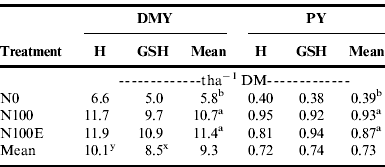
The ANOVA for combined winter simulated grazing and subsequent cutting at heading did not show significant differences for mycorrhizal fungus inoculation treatment on DMY and protein yield (PY) of triticale forage; therefore, we report the effects of N fertilization and mode of utilization (Table 1). Total DMY (winter cutting + heading cutting), as overall mean of 9.3 t ha−1, increased significantly (P < 0.05) with N fertilizations (10.7 and 11.4 t ha−1, respectively) compared to no N supplied (5.8 t ha−1). In H modalities, DMY was significantly (P < 0.05) higher (10.1 t ha−1) than GSH modalities (8.5 t ha−1). Total PY (winter cutting + heading cutting), as overall mean of 0.73 t ha−1, was more than double (P < 0.05) with fertilization treatment compared with N0, whereas no differences were observed between the modes of utilization of herbage.
Effect of N fertilization and mode of utilization on DMY and PY of winter cutting plus heading cutting of triticale forage.
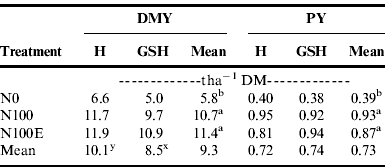
N0, without N fertilization; N100, 100 kg ha−1 of N, 23 kg ha−1 of N as diammonium phosphate 18-46-0 before sowing followed by 77 kg ha−1 of N as ammonium nitrate as top-dressing in February; N100E, 100 kg ha−1 of N as Entec 25-15-0; H, cut at heading stage for hay production; GSH, cut during winter grazing simulation and regrowth cut at heading stage for hay production.
Means within a row (a, b) and column (x, y) with different superscript letters differ significantly (P < 0.05).
Values are expressed as the mean of three determinations per treatment.
Forage quality
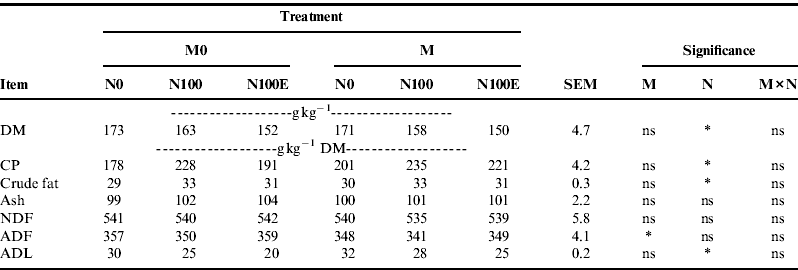
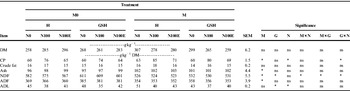
Data on forage quality of winter and heading cuttings of triticale are reported in Tables 2 and 3, respectively. Regardless of the treatments applied, in the winter cutting the protein content was, as expected, about three times higher than in the forage harvested at heading stage (209 versus 69 g kg−1 DM, respectively). For the winter cutting, mycorrhizal fungus inoculation significantly lowered (P < 0.05) ADF content, whereas N fertilization influenced (P < 0.05) DM, CP, crude fat and ADL contents (Table 2). Conversely, when triticale was cut at heading, the mycorrhizal fungus inoculation treatment resulted in a significant effect (P < 0.05) on CP, ash, NDF and ADF content (Table 3). Winter cut simulating grazing had a significant (P < 0.05) effect, increasing NDF and decreasing ADL values of triticale forage harvest in the heading stage. Moreover, the N fertilization improved the forage quality in terms of CP and ADL for both winter and heading cuts. In particular, N100 treatment improved (P < 0.05) CP content compared to the other N applications (N0 and N100E, respectively) in winter cuts (232 versus 190 and 206 g kg−1, respectively) and heading cutting (79 versus 60.8 and 67 g kg−1, respectively). Various interactions among treatments were significant, e.g., CP (G × N) and NDF (M × N, M × G and G × N).
Effect of mycorrhization and N fertilization on chemical composition of winter cutting triticale forage.
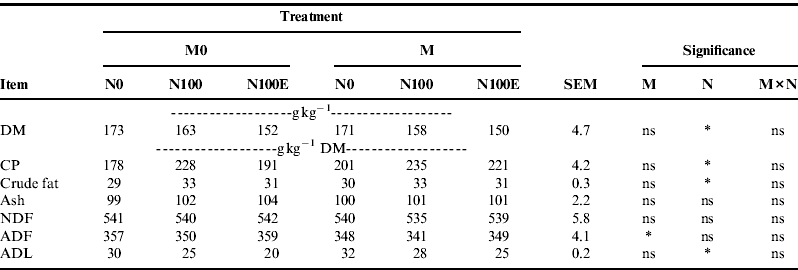
N0, without N fertilization; N100, 100 kg ha−1 of N, 23 kg ha−1 of N as diammonium phosphate 18-46-0 before sowing followed by 77 kg ha−1 of N as ammonium nitrate as top-dressing in February; N100E, 100 kg ha−1 of N as Entec 25-15–0; M0, without mycorrhiza inoculation; M, with mycorrhiza inoculation.
* P < 0.05; ns, not significant.
Values are expressed as means of three determinations per treatment.
Effect of mycorrhization, N fertilization and mode of utilization on chemical composition of triticale forage cut at heading stage.

N0, without N fertilization; N100, 100 kg ha−1 of N, 23 kg ha−1 of N as diammonium phosphate 18-46-0 before sowing followed by 77 kg ha−1 of N as ammonium nitrate as top-dressing in February; N100E, 100 kg ha−1 of N as Entec 25-15–0; M0, without mycorrhiza inoculation; M, with mycorrhiza inoculation; H, cut at heading stage for hay production; GSH, cut during winter grazing simulation and regrowth cut at heading stage for hay production.
* P < 0.05; ns, not significant.
Values are expressed as means of three determinations per treatment.
Protein fractionation
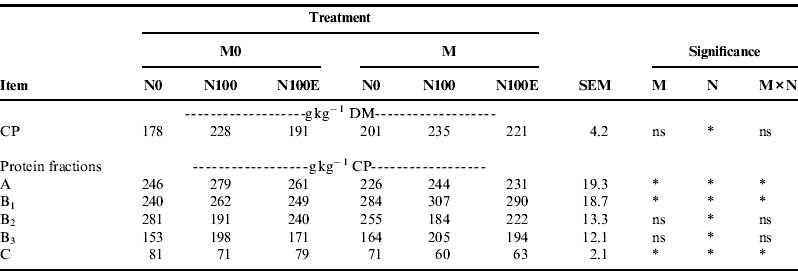
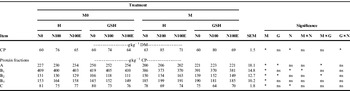
The fractionation of CP of winter and heading triticale cuttings are reported in Tables 4 and 5. Mycorrhizal fungus inoculation significantly decreased (P < 0.05) fractions A (from 262 to 234 g kg−1 of CP) and C (from 77 to 65 g kg−1 of CP) and increased fraction B1 (from 250 to 294 g kg−1 of CP). The N fertilization had a significant (P < 0.05) effect, on winter cutting, on all CP fractions. In particular, an increase of fractions A, B1 and B3 and a decrease of fractions B2 and C (Table 4) were observed. This effect was particularly significant (P < 0.05) in N100 treatments. At the triticale heading stage cut (Table 5), the mycorrhizal fungus inoculation treatment influenced significantly (P < 0.05) all CP fractions, showing a decrease in fractions A, B1 and C, and an increase of fractions B2 and B3. Winter cut simulating grazing had a significant (P < 0.05) effect on fractions A and B2 of the subsequent heading stage cut. N fertilization caused a significant decrease of fractions B1 and C.
Effect of mycorrhization and N fertilization on protein fractions of triticale forage at winter cutting.
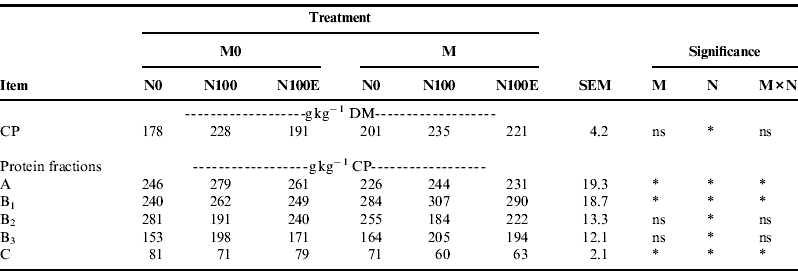
N0, without N fertilization; N100, 100 kg ha−1 of N, 23 kg ha−1 of N as diammonium phosphate 18-46-0 before sowing followed by 77 kg ha−1 of N as ammonium nitrate as top-dressing in February; N100E, 100 kg ha−1 of N as Entec 25-15-0; M0, without mycorrhiza inoculation; M, with mycorrhiza inoculation.
* P < 0.05; ns, not significant.
Values are expressed as means of six determinations per treatment.
Effect of mycorrhization, N fertilization and mode of utilization on protein fractions of triticale forage cut at heading stage.

N0, without N fertilization; N100, 100 kg ha−1 of N, 23 kg ha−1 of N as diammonium phosphate 18–46–0 before sowing followed by 77 kg ha−1 of N as ammonium nitrate as top-dressing in February; N100E, 100 kg ha−1 of N as Entec 25-15–0; M0, without mycorrhiza inoculation; M, with mycorrhiza inoculation; H, cut at heading stage for hay production; GSH, cut during winter grazing simulation and regrowth cut at heading stage for hay production.
* P < 0.05; ns, not significant.
Values are expressed as means of six determinations per treatment.
In vitro digestibility
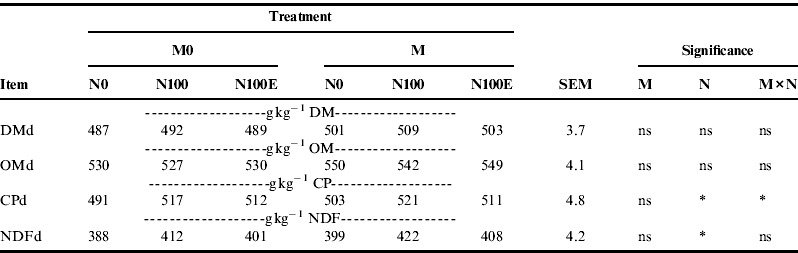
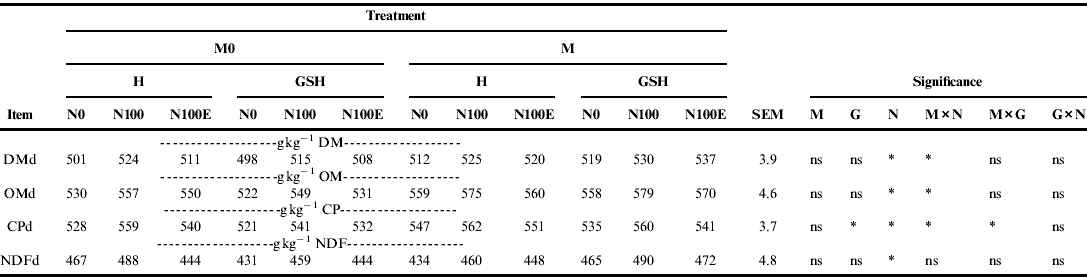
Mycorrhizal fungus inoculation treatment did not affect digestibility of winter harvested triticale (Table 6). N fertilization caused a significant improvement in digestibility of CP and NDF in forage (P < 0.05). There were significant effects of N fertilization and the interaction of inoculation and N fertilization upon digestibility of forage collected at the heading stage (Table 7). However, winter harvested forage was characterized by a decrease in digestibility of CP (P < 0.05).
Effect of mycorrhization and N fertilization on in vitro digestibility of triticale forage at winter cutting.
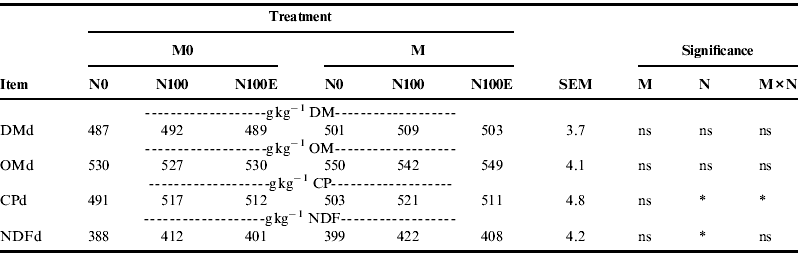
N0, without N fertilization; N100, 100 kg ha−1 of N, 23 kg ha−1 of N as diammonium phosphate 18-46-0 before sowing followed by 77 kg ha−1 of N as ammonium nitrate as top-dressing in February; N100E, 100 kg ha−1 of N as Entec 25-15-0; M0, without mycorrhiza inoculation; M, with mycorrhiza inoculation.
* P < 0.05; ns, not significant.
Values are expressed as means of 12 determinations per treatment.
Effect of mycorrhization, N fertilization and mode of utilization on in vitro digestibility of triticale forage cut at heading stage.
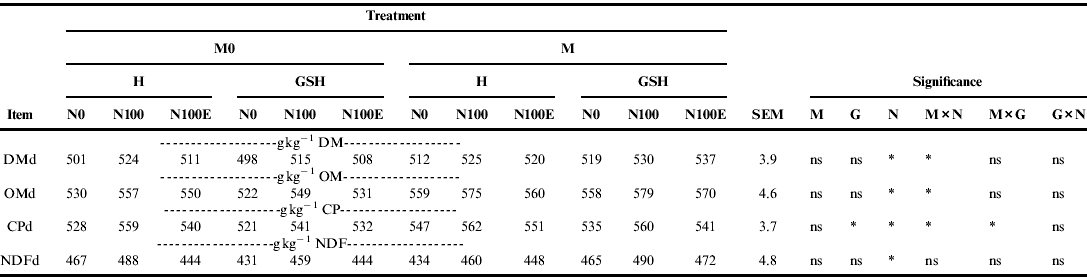
N0, without N fertilization; N100, 100 kg ha−1 of N, 23 kg ha−1 of N as diammonium phosphate 18-46-0 before sowing followed by 77 kg ha−1 of N as ammonium nitrate as top-dressing in February; N100E, 100 kg ha−1 of N as Entec 25-15-0; M0, without mycorrhiza inoculation; M, with mycorrhiza inoculation; H, cut at heading stage for hay production; GSH, cut during winter grazing simulation and regrowth cut at heading stage for hay production.
* P < 0.05; ns, not significant.
Values are expressed as means of 12 determinations per treatment.
Discussion
Triticale, which was not subjected to winter use, led to higher DM production (+19%) compared to the herbage grazed in winter. Decreases in DMY after winter grazing have been related to plant tillering, stem elongation and subsequent growth of leaves and rootsReference Davidson and Milthorpe23. In accordance with our findings, Drake and OrloffReference Drake and Orloff5 reported that delaying initiation of grazing, or re-grazing after 1 to 2 weeks rest, increases the amount of forage for grazing, but subsequent hay yield and total production are reduced dramatically. However, considering the PY per hectare, GSH is able to provide a protein production similar to H, with the advantage of providing a better distribution of grass during the growing season. Similar results were also obtained by Cazzato et al.Reference Cazzato, Laudadio and Corleto2 in forage mixtures (oat, crimson clover and vetch). The winter grazing resulted in a decrease of the quality of hay produced in terms of NDF content and protein quality, with a decrease of fractions A and B2; this trend was particularly evident when triticale was not subjected to mycorrhizal fungus inoculation. Presumably, this result was due to the positive effect of mycorrhiza on the plant's ability to overcome stress by cutting in winter, although mycorrhizal fungus colonization of roots was not measured. Lestingi et al.Reference Lestingi, De Giorgio, Montemurro, Convertini and Laudadio14 reported that the effect of bio-activators is particularly important when triticale is utilized for grazing and during the first phenological stage. Moreover, despite the decrease of degradable protein, there were no substantial variations in the degree of nutrient digestibility of triticale forage harvested at the heading stage in response to simulated grazing. The mycorrhizal fungus inoculation had a positive effect on the quality of the forage harvested at heading stage which resulted in less fiber and more protein. The presence of more protein in inoculated plants was mainly due to their higher uptake of N from the soilReference Mishra, Sharma and Vasudevan24. The inoculated plants had also less NDF and ADF content. The data pertaining to the decrease in protein content and increase in NDF and ADF with increased in DM of plants confirm the findings of Reling et al.Reference Reling, Niekerk Vaan, Coertze and Rethman25. It is also reported by Sukhchain and SidhuReference Sukhchain and Sidhu26 that fodder quality in general tends to decline as DMY improves. Although N fertilizer improved CP in plants, it also enhanced NDF and ADF. This is also corroborated by Bamikole et al.Reference Bamikole, Ezenwa, Akinsoyinu, Oduguwa, Fanimo and Oshinowo27. In our study, DMY and CP content increased in inoculated plants, but NDF content remained low. This may be interpreted as biofertilizers being a more suitable source of fertilizer in grasses than chemical fertilizer to improve their overall production and fodder quality. Our findings are in agreement with those of Martínez-López et al.Reference Martínez-López, Vázquez-Alvarado, Gutiérrez-Ornelas, del Río, López-Cervantes, Olivares-Sáenz, Vidales-Contreras and Valdez-Cepeda28, who found significant improvement of forage when inoculated with mycorrhiza in terms of higher CP and lower NDF contents. Few investigations have been conducted on the effect of mycorrhiza application on the protein fractions in cereal and forage crops. In this field trial, when mycorrhiza were applied, the forage protein quality of winter grazing improved because it contained less indigestible protein (fraction C) and NPN (fraction A), and a positive increase in medium-degradable fractions in cutting hay. These results indicate that the use of plant inoculation could modify the distribution of protein fractions in triticale forage. In contrast to our findings, Lestingi et al.Reference Lestingi, De Giorgio, Montemurro, Convertini and Laudadio14 found that the utilization of bio-activators increased, even if not significantly, fraction A compared with fraction B1, due to different nitrate organization capability in triticale at different phenological stages. The lack of consistency with results of the previous study may be partially attributed to the arbitrary dates for forage removal, which in many cases did not take into account the stage of development of the crop, the different pedological condition of the study site and the agronomic techniques.
N fertilization, as the average of the two N application modalities, caused an increase in DMY (+90%) and in protein production (+130%), in agreement with results found by Cazzato et al.Reference Cazzato, Laudadio and Corleto2 and Harmoney and ThompsonReference Harmoney and Thompson29. Our result could be attributed to the reduced content of N in the soil. Fertilization has a direct effect on the proportion of plant N present as true proteinReference Peyraud and Astigarraga30. N fertilization consistently caused an increase of CP, a decrease of lignin and, in terms of protein quality, an increase in NPN only in winter forage; this trend was particularly significant when the N was split into two phases (N100), presumably because the winter cutting was performed about 3 weeks after top dressing. In fact, the N uptake by the plant increased with the level of N fertilization and this led to a build-up of non-protein organic N, thereby decreasing the proportion of protein N. At high levels of fertilization, the greater N uptake was followed by an accumulation of nitrate in the plant which further reduced the protein N fraction. The nitrate content of grass reached a maximum 2 weeks after N application, as found by WilmanReference Wilman31. The reduction of absorbed nitrates into ammoniacal N and its incorporation into protein can, in fact, be considered as a single step limited by the enzyme nitrate reductase that mediates the first reactionReference Peyraud and Astigarraga30. The application of N fertilization tended to decrease the fraction of indigestible protein (fraction C) both in fresh forage and in forage cut at heading stage. This result could explain the moderate improvement of protein and fiber digestibility of forage produced in our trial. According to the effect of N fertilization on the CP content of grass, cell wall digestibility may have been lowered on less fertilized swards. Peyraud et al.Reference Peyraud, Astigarraga and Faverdin32 reported a decrease of fiber digestibility by 0.06 unit when the CP content of grass decreased from 160 to 110 g kg−1 DM, whereas no variation in fiber digestibility was observed when the CP content of grass decreased from 210 to 170 g kg−1 DMReference Van Vuuren, Krol-Kramer, Van Der Lee and Corbijn33. This may have been related to conditions prevailing within the rumen when cellulolytic activity was impaired by a shortage of degradable N supplyReference Hoover34, Reference Kennedy, Choudhury and Kecskes35, or it may have been related to inherent characteristics of the plant cell wall. Messman et al.Reference Messman, Weiss and Erickson36 and Valk et al.Reference Valk, Kappers and Tamminga37 indicated that there is a lower rate of degradation of cell walls with reduced levels of N fertilization. This effect on cell wall digestibility may explain why greater variations in OM digestibility have been reported when comparing with extreme reductions in N fertilization. For example, Reid et al.Reference Reid, Jung and Thayne38 reported a decrease of 0.05 unit in OM digestibility for a reduction of 500–0 kg N yr−1. Finally, the moderate effect of reduced N fertilization on OM digestibility of grasses could be attributed to the fact that any decrease in the CP content of forage is partially compensated for by an increase in water soluble carbohydrates which are highly digestible, despite the risk of a moderate decrease in fiber digestibility.
Conclusions
When triticale was grown for forage in a Mediterranean climate, mode of utilization and N fertilization affected forage yield and quality, while mycorrhizal fungus inoculation influenced positively some quality parameters. The utilization of herbage cut at heading stage improved DMY, therefore this practice is recommended when the farm management does not provide grazing animals, whereas winter grazing offers the advantage of a better grass distribution without reducing PY. N fertilization was very effective regardless of mode of herbage utilization due to its positive effects on forage production and quality in terms of CP and nutrient digestibility. In addition, splitting N fertilization enhanced the protein quality only in fresh forage compared to a N fertilizer with NI applied just once before sowing. Finally, the results about the improvement of forage quality with mycorrhizal fungus inoculation suggest the need to study this issue in depth.