While many debate the nature of the Olmec manifestation outside the southern Gulf lowlands (e.g., Sharer and Grove Reference Sharer and Grove1989; Grove and Joyce Reference Grove and Joyce1999; Blomster et al. Reference Blomster, Neff and Glascock2005; Flannery et al. Reference Flannery, Balkansky, Feinman, Grove, Marcus, Redmond, Reynolds, Sharer, Spencer and Yaeger2005), few have taken a close look at the Olmec material expression and its variation from household to household within the southern Gulf lowlands. Such an examination is necessary for two key reasons: (1) to provide a detailed understanding of what constitutes Gulf Olmec material culture, thereby allowing us (2) to better evaluate what are and are not Gulf Olmec manifestations outside the southern Gulf lowlands. Without a clear understanding of the Gulf Olmec, how are we to identify and measure Gulf Olmec presence or influence on other areas?
For decades, scholars have known that items were widely exchanged and symbols were shared between regions of Mesoamerica during the Early Formative period (Agrinier Reference Agrinier1989; Blomster et al. Reference Blomster, Neff and Glascock2005; Cobean et al. Reference Cobean, Coe, Perry, Turekian and Kharkar1971; Cobean et al. Reference Cobean, Vogt, Glascock and Stocker1991; Flannery Reference Flannery and Benson1968; Flannery et al. Reference Flannery, Balkansky, Feinman, Grove, Marcus, Redmond, Reynolds, Sharer, Spencer and Yaeger2005; Flannery and Marcus Reference Flannery and Marcus1994, Reference Flannery and Marcus2000; Grove and Gillespie Reference Grove, Gillespie, Demarest and Conrad1992; Hammond Reference Hammond1989; Hirth Reference Hirth1984; Pires-Ferreira Reference Pires-Ferreira1975, Reference Pires-Ferreira and Flannery1976; Sharer and Grove Reference Sharer and Grove1989; Stoltman et al. Reference Stoltman, Marcus, Flannery, Burton and Moyle2005). But as several authors (e.g., Stein Reference Stein1999; Stark Reference Stark and Isaac1990) have pointed out, a shared symbol system and even the actual movement of material goods may indicate interaction but not necessarily unidirectional influence or migration. While it remains challenging for archaeologists to identify and measure interaction (trade and emulation) and migration and determine their directionality, Flannery and Marcus (Reference Flannery and Marcus2000:15; see also Grove Reference Grove, Sharer and Grove1989) have argued that features (motifs or items) originating in a host area should appear earlier, be more abundant, display greater variety, and/or be better made when compared to receiver areas. In which region these features (1) occur earliest, (2) are most abundant, (3) display greatest variety, and (4) are best made is a major point of contention among some Mesoamerican archaeologists (Blomster et al. Reference Blomster, Neff and Glascock2005; Flannery and Marcus Reference Flannery and Marcus2000; Sharer and Grove Reference Sharer and Grove1989).
Researchers working in both Old and New World regions have argued that interregional trade, emulation, and migration can be archaeologically distinguishable by their material manifestations (Stein Reference Stein1999:66–73; Spence Reference Spence and Berlo1992:77) and that they manifest in everyday items (from a range of contexts), and not just those symbolically-charged items like incised motifs, a figurine style, or a type of stone monument. Gil Stein (Reference Stein1999:66–67) has argued that interregional trade is observable by the presence of foreign portable objects and the absence of foreign architecture and culinary practices. Robert Santley and his colleagues (Santley et al. Reference Santley, Yarborough, Hall, Auger, Glass, MacEachern and McCartney1987:87–88) have proposed that an enclave should be observable in all kinds of artifacts from all types of contexts including the domestic activities, culinary practices, ritual and burial customs, and domestic and public architecture. Emulation can be identified by the presence of actual imports or imitations in high-status households (Stein Reference Stein1999:66–73) since foreign symbols and styles are often held in high regard by local elites (Helms Reference Helms and Lang1992), and they are particularly subject to local emulation by high-status individuals.
Stein contends that “[t]he use of multiple criteria combined with contrastive patterning between the foreign and local assemblages is necessary to distinguish the presence of foreign settlers from (a) trade without a trade diaspora or (b) emulation by groups of local elites who are simply adopting status-related aspects of foreign material culture (through either importation or imitation)” (1999:72). When describing the Zapotec enclave of Tlailotlacan at Teotihuacan, Spence (Reference Spence and Berlo1992:77) states that ethnicity “[impinged] on virtually every aspect of community … from occasional public rituals … to daily household practices” (see also Spence Reference Spence, Guadalupe Mastache, Parsons, Santley and Serra Puche1996:335–336, 350–353). And Stein (Reference Stein1999:71) maintains that in enclaves “artifact similarities to the homeland should reflect a broad complex of material culture used in a variety of contexts.”
The preceding discussion supports the idea that when developing and testing hypotheses of interregional exchange and interaction, scholars must take into consideration the full range of material variation in a variety of contexts in both the foreign and local regions. While the published studies on the San Lorenzo Olmec region (Coe and Diehl Reference Coe and Diehl1980; Cyphers Reference Cyphers1997a; Symonds et al. Reference Symonds, Cyphers and Lunagómez2002) are detailed and comprehensive in what they set out to accomplish, they do not provide detailed information on the range of material variation in San Lorenzo Olmec household inventories and nonhousehold contexts. As a result, we have a rather narrow and incomplete understanding of what San Lorenzo Olmec was, which I argue biases any analysis of interregional exchange and interaction.
In order to begin to remedy this problem I present data on a nonelite domestic assemblage from the site of El Remolino situated in the San Lorenzo Olmec region. I present these data as a baseline for future studies on what Olmec was in terms of the material culture of nonelite households. Specifically, excavated materials from San Lorenzo phase (1200–900 b.c., radiocarbon years; 1400–1000 b.c.), domestic contexts at the Bajío area of the Remolino site are analyzed in a preliminary attempt to evaluate the particulars (intricacies and variations) of an Early Formative period Olmec nonelite domestic assemblage. I compare quantities of different artifact classes, vessel forms, vessel orifice diameters, and pottery decoration to arrive at an understanding of a modest Olmec household inventory. Through this analysis, I argue that several of the San Lorenzo horizon markers cited as evidence of Olmec influence or migration elsewhere in Mesoamerica are quite rare in the Olmec heartland itself. Both Calzadas Carved and Limón Carved-Incised pottery decoration occur in minute quantities (<1%) in the Remolino (and San Lorenzo) assemblage, and hollow white-ware figurines are entirely absent at El Bajío. Surprisingly, except for its location 5 km from San Lorenzo, El Remolino would not qualify as an Olmec site based on the lack of artifact markers emphasized by archaeologists working outside of the southern Gulf Coast. Results show that we need a better idea of the range of Gulf Coast Olmec variation before we delve too far into discussions of Gulf Coast influence. I hope future comparative studies will follow that will include examinations of household debris to see how Gulf Olmec material culture is expressed in a range of materials and contexts, aside from the caches, monuments, and portable artifacts so often associated with the Olmec.
THE MATERIAL CULTURE OF EL BAJÍO AT THE REMOLINO SITE
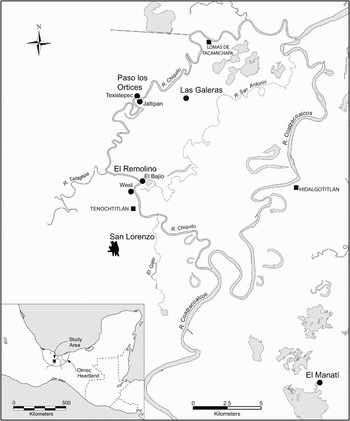
El Bajío is the eastern portion of the Remolino site (Figure 1), which Symonds et al. (Reference Symonds, Cyphers and Lunagómez2002:38, 70, 72) argue was one of two Early Formative period secondary centers in the San Lorenzo polity. They base El Remolino's economic and political position on its estimated size, the presence of two stone columns excavated by Stirling and Drucker (Coe and Diehl Reference Coe and Diehl1980:36–37, 373; Stirling Reference Stirling1955:7), and the site's location at an ancient river juncture 5 km from the San Lorenzo plateau. Today El Remolino consists of an eastern (El Bajío) and western portion, which, when combined with the zone lying between the two zones, cover a total of 130 ha (Symonds et al. Reference Symonds, Cyphers and Lunagómez2002:38).
The San Lorenzo region.

Excavations conducted along El Bajío's 55-m exposed riverbank revealed two unmixed San Lorenzo phase (1200–900 b.c., radiocarbon years) strata (Wendt Reference Wendt2005a). While few architectural remains were encountered, we discovered considerable amounts of domestic refuse. The near absence of architectural features at El Remolino was the result of the rammed earth-wall building technique that is common at the site of San Lorenzo (Cyphers Reference Cyphers, Stark and Arnold1997b:100). Packed earth surfaces and layers of horizontal sherds (surfaces) were discovered in many areas throughout the excavations, and rammed earth walls were inferred from areas of provisional discard that formed against structural features (Wendt Reference Wendt2005b). Structure location and site patterning, specifically a multistructure household unit with a central patio, was inferred by studying densities of various classes of debris (ceramics, obsidian, ground stone, and bitumen) and other architectural patterns across the profile cut (Wendt Reference Wendt2005b). Based on the diversity of artifacts and low quantity of prestige goods encountered, the Bajío household most likely represents a nonelite occupation.
In the following sections, I consider a range of artifact categories, as well as pottery decorations, in order to arrive at an understanding of what a San Lorenzo Olmec household looked like in terms of material culture. In doing this, I make special reference to those features that Coe, Diehl (Diehl and Coe Reference Diehl, Coe and Guthrie1995), and others (e.g., Blomster et al. Reference Blomster, Neff and Glascock2005; Flannery and Marcus Reference Flannery and Marcus1994:385–390) identify as “Horizon A,” “Early Horizon,” or “San Lorenzo Horizon” markers (e.g., hollow white ware baby figurines, Calzadas Carved pottery, and kaolin pottery). It is important to stress that the patterns described for El Bajío should not be taken as representative of the Remolino site since El Bajío is but one area within the larger site. Material variation between households at El Remolino is probably similar to the variation Flannery and Marcus (Reference Flannery and Marcus1994, Reference Flannery and Marcus2005) have described between households, as well as barrios, at San José Mogote during the San José phase.
In the following sections, I use Ann Cyphers' working descriptions for pottery type, vessel form, and decoration classification (see Symonds et al. Reference Symonds, Cyphers and Lunagómez2002:Appendix II; Wendt Reference Wendt2003:Appendices A and B).
Pottery Types
The San Lorenzo phase El Bajío pottery assemblage contains the same range of fine-and coarse-ware ceramics as the site of San Lorenzo (Symonds et al. Reference Symonds, Cyphers and Lunagómez2002; Wendt Reference Wendt2003:198–327). A few notations can be made with regard to differences in relative percentages from San Lorenzo and El Bajío. Poor preservation of surface slips and polish on pottery from El Bajío appears to have reduced the counts of those pottery types—when defined on the basis of surface treatments (Wendt Reference Wendt2005a). For instance, poor preservation will reduce the frequency of the white slipped pottery types of Tiburón Blanco and Tejón Blanco, which are roughly comparable to Coe and Diehl's (1980:153–154, 177, 185) La Mina White, El Tigre White, and Yagua Orange. On the other hand, poor preservation will not affect counts of kaolin wares since they are easily identifiable from their paste characteristics.
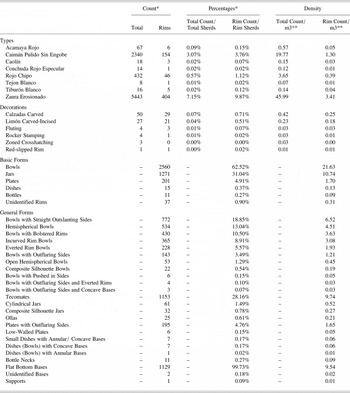
Fine-paste kaolin wares (Cyphers' Caolín, which is roughly comparable to Coe and Diehl's Xochiltepec White and Conejo Orange-on-White [1980:171, 179]) are notably very rare in the Bajío sample—only 18 sherds of the kaolin type were found in San Lorenzo phase contexts (Table 1). However, other fine-pasteFootnote 2 wares such as Caimán Pulido Sin Engobe and Acamaya Rojo (types with few, very fine temper and roughly comparable to Coe and Diehl's Moral Buff-to-Cream and Rosas Burnished [1980:138, 148] and Chilpate Red-on-Cream [1980:140], respectively) are not equally rare in the Bajío assemblage. These pottery types occur in frequencies comparable to those excavated in other areas at San Lorenzo.
Pottery from the Bajío Profile Operation, Strata F and H (San Lorenzo phase)

*Type and decoration counts based on 76,153 sherds, 4,995 of which are rims. Form counts based on the subset of 4,095 rim sherds and 1,132 base sherds that are of Early Formative types with >5% orifice or base present.
**118.353 m3 excavated in srata F and H of the Profile Operation.
Note: Pottery types and decorations detailed here are those commonly referred to as San Lorenzo Horizon markers.
Pottery Decorations
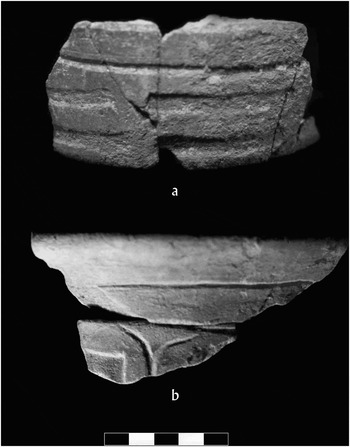
Only 77 of the 76,153 classified sherds from San Lorenzo phase layers at El Bajío possessed Calzadas Carved (0.07%, n = 50) or Limón Carved-Incised (0.04%, n = 27) decorations (Table 1; Figure 2). Of these 76,153 sherds, 4,995 were rims—29 had Calzadas Carved decoration (0.71%), and 21 had Limón Carved-Incised (0.51%) designs. Both carved decoration types occurred in higher percentages on fine-ware sherds (92.2%; Calzadas Carved, n = 46; Limón Carved-Incised, n = 25) when compared to coarse ware sherds (7.8%; Calzadas Carved, n = 4; Limón Carved-Incised, n = 2). Like the carved decoration types, other decorations, including rocker stamping, red-slipped rim, fluting, and zoned crosshatching, also occur in very low frequencies at El Bajío (Table 1). The low frequencies of these decorative elements at El Bajío are worthy of comment and are discussed below. How is it that a site just 5 km from San Lorenzo, and likely a San Lorenzo Olmec secondary center, exhibits such low frequencies of so-called “San Lorenzo Olmec pottery”?
Examples of (a) Calzadas Carved and (b) Limón Carved-Incised decorations from El Bajío.

Some have argued that the poor and eroded condition of Gulf Coast pottery has erased many decorative elements (Arnold Reference Arnold2003). My research in the San Lorenzo region suggests that while erosion certainly affects surface slips and paint, plastic decorations like incising are rarely affected (i.e., erased). I contend that surface erosion does not greatly affect counts of Calzadas Carved, Limón Carved-Incised, and other incised decorations, although it surely reduces the frequency of slips, paints, and polish affecting counts of those pottery types that are defined on the basis of these surface treatments (see discussion above).
If the lack of Calzadas Carved and Limón Carved-Incised decorations cannot be attributed to the poor condition of the San Lorenzo Olmec sherds, then perhaps the nonelite position of the Bajío household best explains the low frequency of incised pottery. If the residents at El Bajío were poorer than the residents of San Lorenzo, they may have had less access to fancy decorated ceramics. However, I am not aware of a single study that has shown Calzadas Carved or Limón Carved-Incised decorations to be correlated with high status. In fact, Coe and Diehl state that in their excavations in the San Lorenzo region, Calzadas Carved bowls “formed part of the ordinary household debris” (1980:159). And David Cheetham argues (this section) that at Cantón Corralito sherds decorated with Calzadas Carved and Limón Carved-Incised designs occur in similar percentages in elite and nonelite contexts. Unfortunately, the low frequency of carved sherds and the few structures excavated do not allow for a spatial analysis of pottery motifs at El Bajío.
An examination of published data on carved pottery from Coe and Diehl's (1980) San Lorenzo volumes reveals that Calzadas Carved and Limón Carved-Incised sherds occurred in low proportions at San Lorenzo as well, although not nearly as low as that of El Bajío. For instance, in the SL-PNW-St.II excavation (Strata F-K2), Coe and Diehl (Reference Coe and Diehl1980:Table 4-1) excavated 29 Calzadas Carved sherds and 9 Limón Carved-Incised sherds, which calculate out to 0.88% (29 of 3,288 total sherds) and 0.27% (9 of 3,288 total sherds) of the San Lorenzo phase SL-PNW-St.II assemblage, respectively. In the Monument 23 excavation they excavated 6 Calzadas Carved sherds and 2 Limón Carved-Incised sherds from Strata H-C, which calculate out to 0.94% (6 of 639 total sherds) and 0.31% (2 of 639 total sherds) of the San Lorenzo phase Monument 23 assemblage, respectively. Calzadas Carved type decorations appear to be more common at the beginning of the San Lorenzo Horizon. This pattern is evident at such sites as San Lorenzo (Coe and Diehl Reference Coe and Diehl1980:Table 4-1), Las Galeras (O'Rourke Reference O'Rourke2002:180), and sites in the Valley of Oaxaca (on Leonardo Gray pottery) (Flannery and Marcus Reference Flannery and Marcus1994).
It is worth mentioning here that David Cheetham (personal communication 2006) has reexamined all rim sherds from Coe and Diehl's excavations (Coe brought all rim sherds to Yale upon the completion of the Río Chiquito Project), and when considered together, the percentages of Calzadas Carved and Carved-Incised rims are much higher than what is found in either the SL-PNW-St.II or Monument 23 excavations. Cheetham reports 6.38% Calzadas Carved and 8.80% Limón Carved-Incised rims overall (dividing by total rims). While Cheetham's recalculations are certainly interesting, it is difficult to use his figures in the present comparisons since we lack details on the composition of the Yale sample. For instance, it is not clear whether the Yale sample includes material from mixed deposits (e.g., Stratum K2 from SL-PNW-St.II is a mixed Chicharas and San Lorenzo A deposit containing abundant Calzadas Carved pottery [Coe and Diehl 1980]), or only unmixed San Lorenzo phase deposits.
Ann Cyphers' forthcoming results from her excavations at San Lorenzo promise to shed new light on the present percentage discrepancies. Until Cyphers presents her results, the most complete data sets (i.e., samples with the best provenience) from San Lorenzo are those reported in Coe and Diehl's San Lorenzo volumes. When compared to these percentages, the low frequency of Calzadas Carved and Limón Carved-Incised decorated pottery at El Bajío appears to be within the norm of San Lorenzo Olmec. The slightly lower frequency at El Bajío is likely at least partially a result of the site's chronological position in the latter portion of the San Lorenzo phase (see Wendt Reference Wendt2005a). In the following section, I consider how these decorations were distributed on El Bajío vessel forms.
Pottery Forms
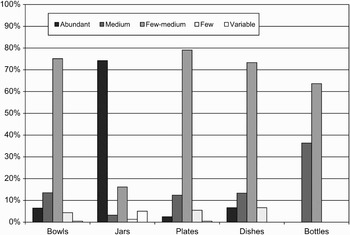
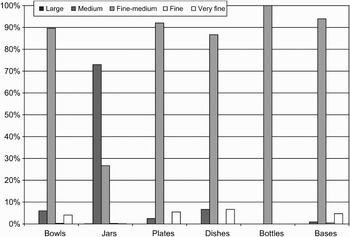
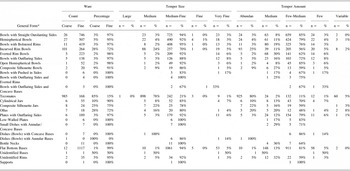
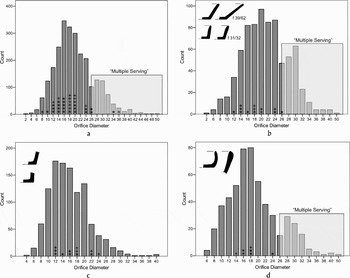
Bowls and jars dominate the Bajío assemblage, followed by plates, dishes, and bottles (Table 1). Most of the forms with restricted orifices (jars and bottles) were made in coarse-ware types, and most of the bowls, plates, and dishes were made of fine wares (Figures 3–4; Table 2). This was expected since cooking and storage was most likely done in coarse-ware, utilitarian vessels that would have needed to withstand repeated heating and cooling. Serving bowls, eating bowls, plates, and dishes would have been made of finer wares (Table 2).
Temper amount per basic vessel form (El Bajío, Profile Operation, Strata F and H).

Temper size per basic vessel form (El Bajío, Profile Operation, Strata F and H).

Detail of ware and temper by general vessel forms from the Bajío Profile Operation, Strata F and H (San Lorenzo phase)
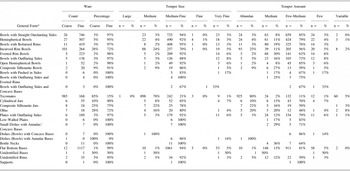
*Counts based on 76,153 sherds, 4,995 of which are rims. Form counts based on the subset of 4,095 rim sherds and 1,132 base sherds that are of Early Formative types with >5% orifice or base present.
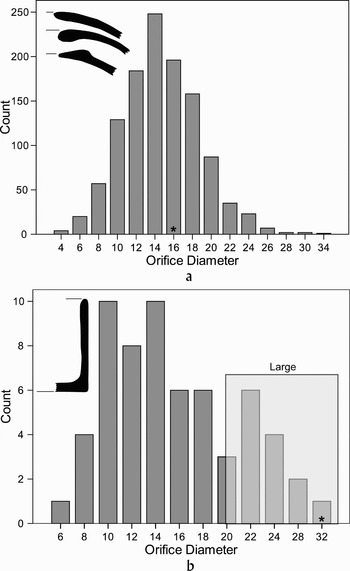
Tecomates are the most common jar form at El Bajío, comprising 28% of the San Lorenzo phase assemblage. The Bajío sample provides little information of the overall size of tecomate vessels since we lack large sidewall portions that would provide information on the height, volume, and overall shape. Orifice diameter measurements ranging from 4 to 34 cm show that tecomates varied greatly in size, but the clear central tendency of 15 cm (mode and mean) indicates that most vessels fell in the middle of this distribution (Figure 5). When decorated, tecomates most often possessed striations below the vessel lip, which probably helped those handling the vessels when the tecomates were full and wet (see Rice Reference Rice1987:232). Out of the 1,153 tecomate rim sherds excavated from the Bajío houselot, only one had a band of red paint around the rim, one had rocker stamping, none exhibited fluting, and none possessed zoned crosshatching.
Bar graph of rim diameter measurements for (a) Tecomates (n = 1153, μ = 14.69, δ = 4.091) and (b) Cylindrical Jars (n= 61, μ = 15.64, δ = 5.721), (rims > 5 %), El Bajío Profile Operation, Strata F and H, Formative period ceramic types. Rim diameter measurements in centimeters. (* = a rim sherd with Calzadas Carved decoration, + = a rim sherd with Limón Carved-Incised decoration.).

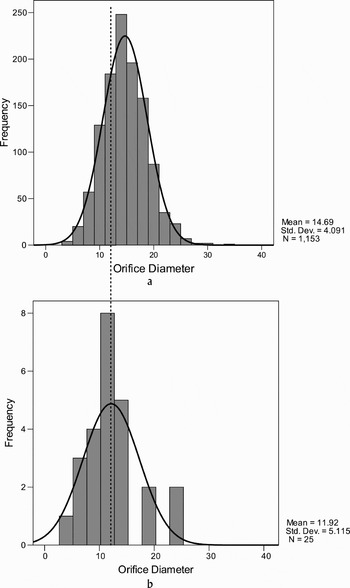
Although, most tecomates would have been ideal for cooking, liquid storage, and liquid transport (see Rice Reference Rice1987; Arnold Reference Arnold, Skibo and Feinman1999), those made in the Rojo Chipo type—a coarse-ware red-slipped type analogous to Coe and Diehl's Tatagapa Red—frequently possessed smaller than average orifice diameters and various plastic decorative elements (Figure 6). These features suggest that the vessels had a primary function other than cooking and served a storage, display, ritual, or medicinal function.
Histograms comparing rim diameter measurements of (a) all tecomate rim sherds and (b) the subset of Rojo Chipo tecomate rim sherds (rims > 5%), El Bajío Profile Operation, Strata F and H, Formative ceramic types. Rim diameter measurements in centimeters.

The second most frequent jar form in the Bajío sample was cylindrical jars (Figure 5). Orifice diameter measurements indicate that there were two general cylindrical jar sizes—a small jar with an orifice diameter between 6 and 14 cm, and a larger jar with an orifice diameter ranging from 20 to 32 cm. Cylindrical jars were rarely decorated, and only one (1/61) had Calzadas Carved decoration. Composite silhouette jars, ollas, and bottles represent the remaining jar forms; these were few in number and very rarely decorated.
Bowls were most frequently made in ceramic types with few to medium amounts of very fine to fine-medium size temper (Figures 3–4). Amount and size of temper in the paste of bowls indicate that most bowls would not have withstood repetitive heating and cooling that is required of vessels used for cooking. Moreover, the shape of most bowls in the sample (open orifice forms, flat bottoms, shallow profiles) suggests that they mainly had a food service function (Henrickson and McDonald 1983; Rice Reference Rice1987; Smith Reference Smith and Nelson1985). Nevertheless, some larger, deep-basin bowl forms (e.g., some everted rim bowls) were surely used in food preparation, while other bowl forms (e.g., incurved rim bowls) probably served a cooking and/or storage function. Finally, the presence of incised decorations and slips on some bowls further indicates that these vessels were used in serving food rather than cooking food over a fire.
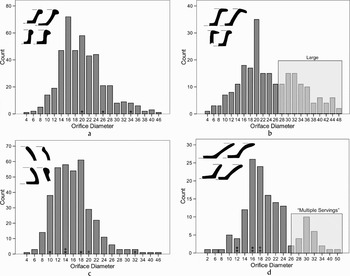
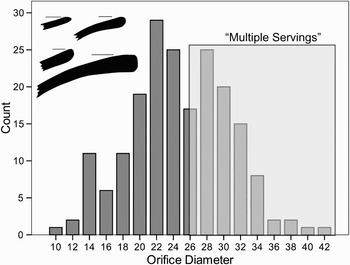
A large variety of bowl forms make up the Bajío assemblage. Bimodal (and near bimodal) distributions of orifice diameters of four of the six most frequent bowl types is noteworthy and appear to reflect two categories of vessels—the smaller (8–25 cm) perhaps for single servings and the larger vessels (26–50 cm) for multiple servings (Figures 7–8). What is most intriguing about bowl orifice diameters is the “single serving” and “multiple serving” ranges (breaking at 26 cm) are the same for four of the six most frequent bowl forms. Interestingly, in his ethnoarchaeologial study of modern households in the Sierra de los Tuxtlas, Arnold (1991) noted that single-serving bowls had a mean value orifice diameter of 18 cm (Arnold Reference Arnold1991:Table 2), which is very similar to the Bajío pattern (see Figure 7).
Bar graph of rim diameter measurements for (a) all Bowls (n = 2560, μ = 19.87, δ = 7.048), (b) Bowls with Straight Outslanting Sides (n = 772, μ = 21.31, δ = 6.518), (c) Flat Bottom Bases (n = 1129, μ = 15.84, δ = 5.334), and (d) Hemispherical Bowls (n = 534, μ = 18.80, δ = 6.753), (rims > 5 %), El Bajío Profile Operation, Strata F and H, Formative period ceramic types. Rim diameter measurements in centimeters. (* = a rim sherd with Calzadas Carved decoration, + = a rim sherd with Limón Carved-Incised decoration.)

Bar graph of rim diameter measurements for (a) Bowls with Bolstered Rims (n = 430, μ = 20.03, δ = 6.419), (b) Everted Rim Bowls (n = 228, μ = 24.25, δ = 9.283), (c) Incurved Rim Bowls (n = 365, μ = 15.98, δ = 5.301), and (d) Bowls with Outflaring Sides (n = 143, μ = 20.17, δ = 6.770), (rims > 5%), El Bajío Profile Operation, Strata F and H, Formative ceramic types. Rim diameter measurements in centimeters. (* = a rim sherd with Calzadas Carved decoration, + = a rim sherd with Limón Carved-Incised decoration.).

The five most frequent bowl forms carry the majority of the Calzadas Carved and Limón Carved-Incised designs in the sample, and 94% of all the Calzadas Carved and Limón Carved-Incised designs on bowls occur on the small, “single serving” category. Flat-bottom bases, which represent the bases of many bowl forms, have a large proportion of carved decoration on the “small” examples as well. It is interesting to note that a similar pattern is observable in Coe and Diehl's (1980:162–169, 171–175) profile drawings of Calzadas Carved and Limón Carved-Incised rims, suggesting that carved designs on smaller bowls is not an isolated phenomena or related to status. Although the sherds illustrated in Coe and Diehl (Reference Coe and Diehl1980) certainly do not constitute a representative sample, it is interesting that of the 37 Calzadas Carved bowl profiles illustrated (Coe and Diehl Reference Coe and Diehl1980:162–169), 89% (33/37) of the rims had orifice diameters ≤ 26 cm and fall into my “single serving” category. And of the 11 Limón Carved-Incised rims illustrated (Coe and Diehl Reference Coe and Diehl1980:171–175), 100% fall into the ≤ 26 cm, “single serving” category.
Bowls with straight outslanting sides, the most common bowl form in the sample, can be categorized into two groups based on wall angle. Form 31/32 has a wall angle ranging from 70–85 degrees and Form 39/62 has an angle ranging from 40–60 degrees. It is notable that only the most outslanting rims (Form 39/62)—albeit very few—carried the Calzadas Carved (n = 7) and Limón Carved-Incised (n = 6) decorations, which is interesting since the angle would not facilitate display as much as the more vertical variety. This is also notable since all of Coe and Diehl's (1980:165–172) illustrations of Calzadas Carved on this vessel form are on the steeper-angled variety, indicating a possible disparity between the Bajío and San Lorenzo serving-ware complexes. Nevertheless, the nature of these bowls' decorations, combined with their open form and high frequency in the assemblage suggests that they fulfilled an important function in food service. Presumably the larger vessels could have been used in feasting and/or serving food to many individuals (i.e., families).
Hemispherical bowls constitute the second most frequent bowl form in the sample. These vessels were occasionally decorated with Calzadas Carved (n = 5) and Limón Carved-Incised (n = 2) designs, which occurred on vessels with smaller orifices. A weak bimodal distribution of hemispherical bowl orifice diameters might indicate an indigenous large and small category of this form.
Bolstered rim bowls from El Bajío have rim orifices that do not exhibit a bimodal distribution, and only 3 out of the 430 rims were decorated in the Calzadas Carved designs. This low incidence of Calzadas Carved decoration (and absence of Limón Carved-Incised decoration) from the Bajío sample is noteworthy given the frequency that Coe and Diehl (Reference Coe and Diehl1980:162–163; 168–169; 174–175) illustrate bolstered rim forms with Calzadas Carved and Limón Carved-Incised decorations.
Of the incurved rim bowls 20% were made of coarse-ware types (Wendt Reference Wendt2003:Tables 5.13 and 5.15), which when combined with their restricted shape, indicate that some of these vessels had a serving and cooking function. Six of these rim sherds were decorated with Calzadas Carved (n = 3) or Limón Carved-Incised designs (n = 3).
Arguably, the shape of everted rim bowls would have been ideal for food preparation. Their wide orifices would have permitted easy access to their contents, their flat bases would have provided stability, and their everted rims could have served as grips or handles to facilitate transport. None of these rims were decorated with Calzadas Carved or Limón Carved-Incised.
The orifice diameter distribution of bowls with outflaring sides is clearly bimodal, suggesting there were at least two categories of vessels, which can be roughly divided into single-serving and multiple-serving categories. This form is occasionally decorated with Calzadas Carved (n = 4) and Limón Carved-Incised (n = 2) decorations on the smaller orifice examples.
Although plates were surely used as serving vessels, surprisingly none was decorated with Calzadas Carved, Limón Carved-Incised, or any other plastic decoration besides a single line incised on the rim. Similar to some bowl forms, plates with outflaring sides (Figure 9) seem to fall into single- and multiple-serving categories, with the break at 26 cm. Only 15 dish rims were encountered in the entire El Bajío sample, and none was decorated.
Bar graph of rim diameter measurements for Plates with Outflaring Sides (n = 195, μ = 24.74, δ = 5.958), (rims > 5%), El Bajío Profile Operation, Strata F and H, Formative ceramic types. Rim diameter measurements in centimeters.

Other forms, such as censer/brazier and spoons, are very rare in the Bajío assemblage. It is important to note that unlike excavations at San Lorenzo, the Bajío excavations did not produce a single spatula.
Figurines
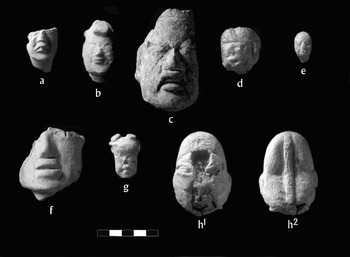
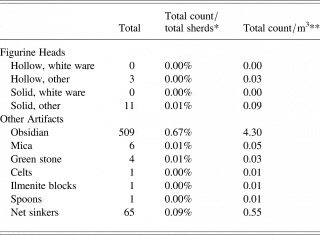
Very few figurines fragments were discovered during our excavations at El Bajío, and only 14 figurine heads came from San Lorenzo phase contexts, none of which was the hollow white-ware type that scholars often associate with the San Lorenzo Horizon (Table 3). Nevertheless, both hollow and solid figurine fragments (heads, arms, legs, and torsos) were present at the site and most of the heads do possess the so-called “typical Olmec” characteristics (Figure 10).
Sample of figurines from El Bajío, Profile Operation, San Lorenzo phase levels. (a) Stratum H, Lot 28, 320–341 cm; (b) Stratum F, Lot 24, 270–290 cm; (c) Stratum F, Lot 24, 283 cm; (d) Stratum F, Lot 5, 230–240 cm; (e) Stratum F, Lot 24, 265 cm; (f) Stratum H, Lot 27, 301 cm; (g) Stratum F, Lot 25, 250–260 cm; (h1) Stratum F, Lot 19, 215–235 cm [front]; (h2) Stratum F, Lot 19, 215–235 cm [back]. Scale in centimeters.

Artifact counts and densities from the Bajío Profile Operation, Strata F and H (San Lorenzo phase), some of which are considered San Lorenzo Horizon markers

*76,153 sherds.
**118.353 m3 excavated.
Miscellaneous Artifacts
Many other artifact types were excavated at El Bajío, yet too many to describe in detail. Groundstone, chipped stone, and asphalt (bitumen) artifacts were abundant throughout the habitation area (Wendt Reference Wendt2005b), and an in-depth analysis of these is ongoing (Wendt and Cyphers Reference Wendt and Cyphers2008). Other artifacts that were present but very rare at El Bajío include mica, green stone artifacts, celts, and multidrilled ilmenite block fragments (Table 3). No sculpture or magnetite artifacts were discovered in the excavations.
HOW “OLMEC” IS EL REMOLINO?
Few would argue that El Remolino is not a San Lorenzo Olmec site. Its location 5 km from the San Lorenzo plateau, and radiocarbon dates (Wendt Reference Wendt2005a) clearly place it spatially and temporally within the San Lorenzo Olmec polity. However, with its low quantity of San Lorenzo Horizon material culture markers, I believe that few Olmec specialists would identify the site as San Lorenzo Olmec by examining its artifact assemblage alone. If I am right, this presents a significant problem in the current debate on Olmec influence and migration. Without a clearer idea of the variation of San Lorenzo Olmec (or for that matter, Gulf Olmec), how are we to identify and differentiate Olmec influence and migration? Should we be looking for a mini-San Lorenzo to argue for San Lorenzo Olmec influence? I believe that we need a better idea of San Lorenzo Olmec variation before we delve too far into discussions of San Lorenzo Olmec influence.
Household archaeology in the San Lorenzo region reveals some important features with regard to the composition of a San Lorenzo Olmec artifact assemblage. Perhaps the most important observation is the low percentages of Calzadas Carved, Limón Carved-Incised, and other so-called Olmec decorations (San Lorenzo Horizon markers) at El Bajío. San Lorenzo Horizon figurine markers were also quite rare at El Bajío—not a single white-ware figurine head (solid or hollow) was discovered at the site. Other artifact types often associated with the Gulf Olmecs, such as spatulas, ilmenite blocks, and magnetite artifacts were also very rare or absent at El Bajío (Table 3). Kaolin pottery is nearly absent at El Bajío and kaolin figurines are nonexistent. This absence is startling and appears to support the idea that kaolin represents a high status or elite ware.
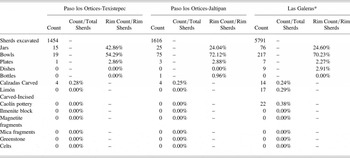
How does the Bajío assemblage compare to those of other contemporaneous habitation areas in the San Lorenzo region? A brief comparison with three habitation areas in the San Lorenzo region show that while regional differences certainly do exist, household assemblages within the region are quite similar. Paso los Ortices-Texistepec, Paso los Ortices-Jaltipan (Wendt Reference Wendt2003), and Las Galeras (O'Rourke Reference O'Rourke2002), situated in the San Lorenzo region (Figure 1), all possess a low number or a complete absence of certain San Lorenzo Horizon markers (Table 4), whereas other aspects of these sites' material assemblages are surprisingly alike. Relative percentages of jars, bowls, plates, dishes, and bottles are roughly similar between habitation areas. Varying percentages of jar and bowl types that exist between sites can be attributed to differing sample sizes. Density figures were calculated by dividing the number of the particular artifact type by the number of sherds excavated (Table 4). Calzadas Carved and Limón Carved-Incised densities are low in all areas, though slightly elevated in the Galeras sample, which O'Rourke (Reference O'Rourke2002) believes might be an area of high status during the San Lorenzo phase. Nevertheless, even in these habitation areas, carved decorations occurred on less than 0.3% of the sherds (count/total sherds). Ilmenite blocks, magnetite, mica, greenstone, and celts were absent in Paso los Ortices and Las Galeras, and Caolín pottery was only present at Las Galeras, and even there it occurred in very low density (Table 4).
Counts and densities of San Lorenzo phase (1200–900 b.c.) materials from Paso los Ortices-Texistepec, Paso los Ortices-Jaltipan, and Las Galeras

*Main Area (RSLT-152), Layers 13–22. Data taken from O'Rourke (Reference O'Rourke2002).
The present analysis indicates that Gulf Olmec influence and migration might be manifest very differently than one would imagine when taking into account only those symbolically charged items like carved pottery, hollow baby figurines, and monuments (see Arnold Reference Arnold and Powis2005). I contend that there is a strong likelihood that Gulf Olmec influence and migration may show up at non-Gulf sites in a variety of ways including similar types and percentages of utilitarian artifacts, including pottery forms, orifice diameter distributions within those forms, and in artifacts made of raw materials that are restricted to the Gulf lowlands (e.g., asphalt). This contention is supported by research conducted in other areas (Stein Reference Stein1999; Santley et al. Reference Santley, Yarborough, Hall, Auger, Glass, MacEachern and McCartney1987; Spence Reference Spence and Berlo1992, Reference Spence, Guadalupe Mastache, Parsons, Santley and Serra Puche1996; Paddock Reference Paddock, Flannery and Marcus1983:174) that have shown that interregional trade, emulation, and migration have particular manifestations in domestic assemblages. For instance, Stein (Reference Stein1999:148–149) found substantial differences in the forms and dimensions of Uruk domestic ceramics in comparison to contemporaneous Anatolian domestic ceramics at the Anatolian site of Hacinebi, Turkey. Uruk deposits at Hacinebi had many more bowls (most with beveled rims) when compared to the local Anatolian assemblage, which consisted of jars, local casserole cooking vessels, and larger bowls. Stein contends that these differences “show clear contrasts in the functions or activities represented in the assemblages” (1999:148).
Detailed analyses of domestic assemblages could prove to be a powerful tool in evaluating ideas of Early Formative trade, emulation, and migration in Mesoamerica. I challenge researchers working in non-Gulf regions to broaden the range of indicators used to identify and measure Gulf Olmec trade, emulation, and migration to include the more mundane aspects of material assemblages (e.g., domestic pottery) and to document house-by-house inventories. Bimodal orifice diameter distributions in serving ware (with a 26 cm break) would be something specific to look for in San Lorenzo Olmec influence/interaction/migration as would carved plastic decorations on the smaller and more outslanting-walled serving vessels. Of course, bimodal orifice distributions in serving ware vessels could be a result of the prevalence of local feasting activities (see Adams Reference Adams2004; Clarke Reference Clarke, Deitler and Hayden2001; DeBoer Reference DeBoer, Scott Raymond and Burger2003) and more related to the specific context (elite vs. nonelite) of the sample (see Rosenswig Reference Rosenswig2007). In an elite Conchas phase (800–900 b.c., uncalibrated) midden at the site of Cuauhtemoc in Soconusco, Robert Rosenswig (Reference Rosenswig2007:21) found a bimodal distribution in the rim diameters (peaks at 20–22 cm and 27–30 cm) of serving dishes, a pattern not present on serving dishes in a nonelite midden. Nevertheless, I suggest that comparing orifice diameter distributions between assemblages and regions is a worthwhile line of investigation in order to better understand (and explain) regional and interregional variation.
Though it is beyond the scope of this paper to speculate on possible reasons for the higher percentage of carved decoration on the more outslanting-sided serving vessels in the Bajío sample, it appears that serving ware at El Bajío was not necessarily decorated with carved designs for the purpose of displaying the motifs to large groups of people. This is intriguing given the emphasis that some scholars place on the importance of competitive feasting in the context of developing social inequality (Clark and Blake Reference Clark, Blake, Brumfiel and Fox1994; Clark and Gosser Reference Clark, Gosser, Barnett and Hoopes1995; Hayden Reference Hayden1990, Reference Hayden, Douglas Price and Feinman1995), although Bowser (Reference Bowser2002:235–257; Bowser and Patton Reference Bowser and Patton2004) has recently observed community members in Conambo, in the Ecuadorian Amazon, conveying subtle cues on status, political alliance, conflicts, and mood through designs and symbols on the interiors (for individual viewing) and exteriors (for public viewing) of ceramic beer-drinking bowls. Specific vessels are selected for certain visitors for the purpose of conveying information to particular individuals in the context of house visits. The Conambo case is intriguing for the discussion of the context in which Olmec carved pottery was produced and consumed. Data from El Remolino suggest that serving bowls with carved designs were not produced for large public displays but rather for small household-centered events.
Final Observations
I have used data from the site of El Remolino to describe a San Lorenzo Olmec domestic assemblage and to highlight some patterns in these data that researchers can use to evaluate possible Olmec presence or influence outside the southern Gulf lowlands, and in doing so I have taken the first (exploratory) steps in highlighting some attributes to look for when evaluating Gulf Olmec trade, emulation, and migration. Following Stein and others (Santley et al. Reference Santley, Yarborough, Hall, Auger, Glass, MacEachern and McCartney1987; Spence Reference Spence and Berlo1992, Reference Spence, Guadalupe Mastache, Parsons, Santley and Serra Puche1996; Stein Reference Stein1999), I have argued that archaeologists must take into consideration everyday objects in order to be able to distinguish between interregional trade, emulation, and migration. Fortunately, most of our data consist of just these objects. When combined with studies of other artifact classes, intrasite spatial patterning, and architecture between areas, we can arrive at more robust measures of regional similarities and differences.
In closing, I have a few final remarks on Gulf Olmec influence and migration. First, emulation and borrowing occur between societies all the time, past and present. As Braswell (Reference Braswell and Braswell2003:15) points out, in considering Teotihuacan influence on the Maya, interaction is always a two-way street, even in cases of one dominant society (see also Flannery Reference Flannery and Benson1968; Flannery et al. Reference Flannery, Balkansky, Feinman, Grove, Marcus, Redmond, Reynolds, Sharer, Spencer and Yaeger2005:11221–11222; Neff et al. Reference Neff, Blomster, Glascock, Bishop, Blackman, Coe, Cowgill, Diehl, Houston, Joyce, Lipo, Stark and Winter2006). While studies that have documented the actual movement of raw materials and finished goods during the Early Formative period (Blomster et al. Reference Blomster, Neff and Glascock2005; Cobean et al. Reference Cobean, Coe, Perry, Turekian and Kharkar1971; Cobean et al. Reference Cobean, Vogt, Glascock and Stocker1991; Pires-Ferreira Reference Pires-Ferreira1975, Reference Pires-Ferreira and Flannery1976), they have neither adequately specified the mechanisms nor documented the social circumstances (interregional influences and their potential directionality) and the political framework within which the items moved. For instance, was the receiving area seeking foreign objects (pull)? Was the host area imposing the items (and beliefs) on the receiving society (push)? Or was it some of both? How to distinguish and measure “push” and “pull” archaeologically (Braswell Reference Braswell and Braswell2003; Earle and Ericson Reference Earle and Ericson1977; Stark Reference Stark and Isaac1990) is another question entirely and is beyond the scope of this paper.
Second, migration should appear in receiver sites in the presence of locally produced wares in the style of the host area (as well as actual imports), but so should emulation. I suggest that the one good way to differentiate emulation from migration is to examine (and measure differences in) all kinds of artifacts from all types of contexts, including domestic assemblages, artifacts reflecting culinary practices, artifacts from ritual and burial customs, and domestic and public architecture (see Santley et al. Reference Santley, Yarborough, Hall, Auger, Glass, MacEachern and McCartney1987:87–88; Spence Reference Spence, Guadalupe Mastache, Parsons, Santley and Serra Puche1996:350–353). Moreover, evaluating differences between intragroup and intergroup (or private and public) displays of identity are good ways to approach the study of migration, colonies, and enclaves. Finally, it is important to keep in mind that over multiple generations, certain symbols of ethnicity or identity would be expected to diminish and vanish in cases of migration, but foreign symbols will remain as long as communities interact, exchange, and emulate each other. This observation seriously questions the overall usefulness of analyzing the distribution of pottery and pottery motifs when evaluating ideas of influence and migration.
RESUMEN
Si bien los estudiosos activamente buscan materiales e indicadores simbólicos de la influencia olmeca fuera de la costa del Golfo de México, pocos han tenido una vista de cerca de la variación y la complejidad del material del periodo formativo temprano en la región de la costa del Golfo. El creciente cuerpo de datos de restos de casas de los olmecas de la zona nuclear está permitiendo hacer comparaciones y, por otra parte, la realización de nuevos tipos de análisis que anteriormente no eran posibles en los estudios olmecas. Los materiales excavados de la fase San Lorenzo (1200–900 a.C., años de radiocarbono calibrados; 1400–1000 a.C.) de las viviendas en El Remolino, en la región de San Lorenzo, se analizan en un intento preliminar para evaluar los componentes diagnósticos de la fase San Lorenzo, con el fin de proporcionar una base de referencia para futuras investigaciones. Al comparar las cantidades de las diferentes clases de artefactos, las formas de vasijas, diámetros de abertura de la boca y la decoración cerámica para llegar a una comprensión detallada del inventario olmeca doméstico. A través de este análisis, se argumenta que varios de los marcadores de San Lorenzo citados como evidencias de la influencia olmeca o la migración en otras partes de Mesoamérica son muy raros en el propio territorio olmeca. Ambos tipos de decoración Calzadas grabado y Limón grabado-inciso están presentes solamente en pequeñas cantidades (menos del 1% del conjunto) en el Remolino (y San Lorenzo) y las figurillas blancas y huecas están totalmente ausentes en este contexto no élite. A pesar de su ubicación a 5 km de San Lorenzo, El Remolino podría no calificar como un sitio olmeca bajo el argumento de la falta de artefactos diagnósticos olmecas, haciendo hincapié en los marcadores para los arqueólogos que trabajan fuera de Veracruz. Sostengo que necesitamos una mejor idea de la gama de la variación de materiales diagnósticos olmecas de la costa del Golfo antes de profundizar demasiado en los debates sobre las influencias de la costa del Golfo.
ACKNOWLEDGEMENT
I thank David Cheetham and Jeffery Blomster for inviting me to present in their organized session and to participate in this special section of Ancient Mesoamerica. I owe very special thanks to Ann Cyphers, whose generous support of the Bajío project has been continuous. I thank Laura O'Rourke for being so generous with her data from Las Galeras. For their comments and suggestions I extend my sincere thanks to Flip Arnold, Jeffery Blomster, David Cheetham, Kent Flannery, David Grove, Joyce Marcus, Ranmalee Perera, Stacie King, Robert Rosenswig, and one anonymous reviewer. I thank the Consejo de Arqueología of the Instituto National de Antropologia e Historia for granting permission for the investigations and the municipal presidents of Texistepec and Jaltipan for their support of the project. Funding for the El Remolino and Paso los Ortices work was provided by a National Science Foundation Dissertation Improvement grant (BCS-0000354), a FAMSI grant (#99068), two Penn State Hill Foundation Dissertation Support Grants, and a Pennsylvania State University Dissertation Support Grant. In addition, funding was provided by a National Geographic Society Research and Exploration grant (#6717-00) to Ann Cyphers, Carl Wendt, and Roberto Lunagómez. All errors are my own.