Intestinal infections from rotavirus, enteropathogenic and enterotoxigenic Escherichia coli, Shigella and Salmonella are predominant causes of illness in infants, often producing high morbidity and mortality (Mitra et al. Reference Mitra, Mahalanabis, Ashraf, Unicomb, Eeckels and Tzipori1995; Bogstedt et al. Reference Bogstedt, Johansen, Hatta, Kim, Casswall, Svensson and Hammarstrom1996; Chen et al. Reference Chen, Huang, Wu, Kuo, Ho and Hsiang2007). Previous studies have indicated that the antibody-mediated antibacterial effect of bovine milk can be induced or enhanced by immunizing cows with microbial cells or purified antigens (Tomita et al. Reference Tomita, Nickerson, Owens and Wren1998; Xu et al. Reference Xu, Chen, Gao and Du2006). Oral administration of the specific antibodies may effectively prevent humans and animals from intestinal infections caused by diarrheagenic pathogens such as Esch. coli, Shigella flexneri and rotavirus (Mietens et al. Reference Mietens, Keinhorst, Hilpert, Gerber, Amster and Pahud1979; Tacket et al. Reference Tacket, Binion, Bostwick, Losonsky, Roy and Edelman1992; Mitra et al. Reference Mitra, Mahalanabis, Ashraf, Unicomb, Eeckels and Tzipori1995; Dominguez et al. Reference Dominguez, Perez, Puyol, Sanchez and Calvo2001; Samadpour et al. Reference Samadpour, Kubler, Buck, Depavia, Mazengia, Stewart, Yang and Alfi2002). Therefore, immune colostrum or milk preparations, as a supplement for special food products that exert immunological protection against environmental pathogens, is greatly encouraged and developed. Our recent studies reveal that antibodies from colostrum or milk of cows immunized with a multivalent vaccine, which consists of whole cells of three different species of pathogenic bacteria containing Esch. coli, Salmonella and Shigellai, can significantly protect mice from diarrhea induced by enteroinvasive Esch. coli, Sal. typhi, Sh. dysenteriae, or mixed Esch. coli/Sal. typhi/Sh. dysenteriae, respectively (Xu et al. Reference Xu, Chen, Gao and Du2006; Huang et al. Reference Huang, Chen, Gao, Zhang, Chen, Xu and Zhang2008). These data suggest that the bovine immune colostrum or milk may give patients with pathogenic bacteria-induced diarrhea powerful passive immunization and immunotherapy. This prompted us to further study dynamic changes of specific IgG activities in colostrum (milk) of calving cows (lactating cows) immunized with these diarrheagenic bacteria to obtain more sources for isolating immunoglobulin (Ig).
Previous data have demonstrated that bovine IgG present in milk may resist treatments of low temperature-long time (LTLT) and high temperature-short time (HTST) pasteurization (Li-Chan et al. Reference Li-Chan, Kummer, Losso, Kitts and Nakai1995; Dominguez et al. Reference Dominguez, Perez and Calvo1997, Reference Dominguez, Perez, Puyol, Sanchez and Calvo2001; Mainer et al. Reference Mainer, Sanchez, Ena and Calvo1997). However, complete loss of IgG activity takes place after high thermal treatments as in canned evaporated milk and sterilized milk (Dominguez et al. Reference Dominguez, Perez, Puyol, Sanchez and Calvo2001; Li-Chan et al. Reference Li-Chan, Kummer, Losso, Kitts and Nakai1995). In addition, the pH also influences the stability of immunoglobulins (Shimizu et al. Reference Shimizu, Nagashima and Hashimoto1993; Dominguez et al. Reference Dominguez, Perez, Puyol, Sanchez and Calvo2001). Although a mass of information about the effect of heat treatment and pH on the stability of IgG has been accumulated (Fasano & Shea-Donohue, Reference Fasano and Shea-Donohue2005; Antalis et al. Reference Antalis, Shea-Donohue, Vogel, Sears and Fasano2007; Kong et al. Reference Kong, Zhang, Musch, Ning, Sun, Hart, Bissonnette and Li2008), until recently, few have described the effect of two factors (heat and pH) combined on antigen-binding activity of specific IgG from milk of bovine immunized with diarrheagenic bacteria antigens containing Esch. coli, Salmonella and Shigellai. Therefore, the aim of the present trial is to obtain information about the effect of heat treatments on specific IgG from immunized milk at different pH by evaluating the dynamic changes of antigen-binding activity of special IgG in whey of immunized lactating cows.
Materials and Methods
Vaccine preparation
The vaccine was prepared using three different species of pathogenic bacteria including four strains of enterotoxigenic Esch. coli, five strains of enteropathogenic Esch. coli, three strains of enteroinvasive Esch. coli, two strains of Sal. typhi, and one strain each of Sh. dysenteriae, Sh. sonnei and Sh. flexneri (total 17 strains) originated from human intestinal tract (National Institute for the Control of Pharmaceutical and Biological Products, Beijing 100050, China) as described previously (Xu et al. Reference Xu, Chen, Gao and Du2006).
Immunization of cows
Ten pregnant Holstein cows were chosen and divided randomly into normal control group (n=5) and immunized group (n=5). Additionally, ten lactating cows were also chosen for similarly designed experiment. Animals in immunized group were injected intramuscularly on both sides of the neck with 10 ml (2×5 ml) of vaccine. The control cows were injected with saline in the adjuvant at the same dose and frequency. For pregnant and lactating cows, immunization was started at the onset of drying off about 2 months before the predicted day of parturition and at the crest-time of lactating about 45 days after calving, respectively. Three booster injections (2×5 ml) were given at 2-week intervals starting 2 weeks after the initial injection. The cows were healthy and did not receive any antibiotics during the immunization procedure in order to follow the specific anti-17 pathogenic bacteria antibody activity formed.
Collection and treatment of colostrum, milk and blood samples
Milk and blood samples for experiment of lactating cows were harvested from the 2nd to 11th week post the beginning of immunization. For experiment of pregnant cows, samples were collected from the 1st (for colosrum/milk) or the 3rd (for blood) to the 28th day after calving. Colostrum or milk samples were filtered to get rid of particles, and solidified fat were removed by centrifugation at 9500 g for 10 min to obtain the whey. The sera in blood were separated by centrifugation at 1800 g for 20 min at 4°C. All specimens were stored at −20°C until analysis.
ELISA
The immunological specificities of whey and serum samples were examined using an indirect enzyme-linked immunosorbent assay (ELISA) with some modifications as described (Loimaranta et al. Reference Loimaranta, Tenovuo, Virtanen, Marnila, Syvaoja, Tupasela and Korhonen1997; Xu et al. Reference Xu, Chen, Gao and Du2006). In short, the wells of polystyrene microtitre plates (Greiner bio-one, America) were coated with a 150 μl suspensions of 17 viable pathogens in 0·05 m-sodium carbonate buffer (pH 9·6). After incubation overnight at 4°C, the plates were centrifuged at 1200 g for 20 min, and then the wells were washed ×3 with 0·1 m-phosphate buffered saline containing 0·05% Tween 20 (PBST, pH 7·4). The coated wells were blocked with 200 μl 1% gelatin (Sigma, USA) in PBST and incubated for 120 min at 37°C, then washed as described above. Samples of whey (1:10 000 for calving cows, 1:2000 for lactating cows) or serum (1:10 000 for calving cows, 1:5000 for lactating cows) were diluted in PBS and an aliquot of 100 μl per well was added to the antigen-coated plates. After incubation (90 min at 37°C), the wells were washed as before and then incubated with 150 μl horseradish peroxidase-conjugated rabbit anti-bovine IgG (dilution 1:2000 for specimens from calving cows or 1:5000 for that from lactating cows, Sigma, USA) for 60 min at 37°C. After washing, OPD (o-phenylendiamine, Shanghai Chemicals, China) was used as the substrate. After 30 min the reaction was stopped with 50 μl 2 m-H2SO4 and the absorbance (A) was measured at 490 nm using an ELx800 Microplate Reader (Bio-Tek Instruments, Inc. Winooski, Vermont, USA). The activity and titre for specific IgG were expressed using A490 value and the highest dilute strength for A490>0·1 of negative control, respectively.
Analysis for activity of specific IgG in whey exposed to pH environment under different heat treatment
Whey samples (1 ml) from immunized lactating cows after the 3rd vaccination were adjusted to different pH from 1 to 10, with 1 m-HCl or 1 m-NaOH, respectively, and exposed for 0, 0·5 and 5 h at 37°C. The pH of samples were also changed to 4·5, 5·5 and 6·5, and combined with heat treatment at 70, 72, 75, 77, 80°C for 30 min by immersion of the tubes into a temperature-controlled water bath (±0·1°C), respectively. Then, treated samples were collected and immediately cooled in ice, followed by analysis for antigen-binding activity of specific IgG using an ELISA as described above.
Statistical analysis
The values are expressed as mean±standard error. Statistical analysis was performed by Student's t-test (STATISTICA, Statsoft Inc., Tulsa, USA). Results were considered significant at a probability of P<0·05.
Results and Discussion
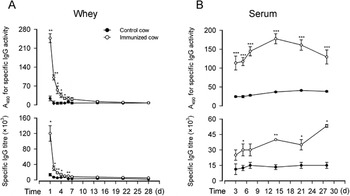
In the current study, we showed that on the first day after calving for immunized pregnant cows, the highest specific IgG activity and titre from colostrum whey were observed, decreasing markedly during the five following days (Fig. 1A). Afterwards, they decreased gradually and were near to those in control animals (Fig. 1A). However, the high levels of specific IgG in serum existed from the 3rd to 28th days after calving compared with those in control cows (Fig. 1B).
Specific IgG activities (100×A490) and titres in whey (dil, 1:10 000) (A) and serum (dil, 1:10 000) (B) from immunized and non-immunized calving cows, respectively. Results are presented as means±S.E. of n=5 for each group (* P<0·05, ** P<0·01, *** P<0·001 vs. control group).

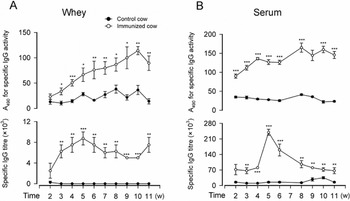
To provide more sources from which to isolate immunoglobulin to prepare hyper-immune products from immune milk, the lactating cows of about 45 days after calving were chosen and immunized with the multivalent vaccine. As demonstrated in Fig. 2A, during the entire experiment post immunization, specific IgG activity in milk whey of immunized lactating cows was superior to that in control cows and a significantly elevated tendency was seen until the 11th week (Fig. 2A). We also observed that the whey titre of specific IgG showed significant increases, which comprised an initially gradual ascent and peaked at the 5th week post immunization, then a slow decay at a high level until the 11th week (Fig. 2A). Similar responses were also detected in serum of control and immunized animals, showing a significant difference of the specific IgG activity and titre between control and immunized cows (Fig. 2B). The findings clearly indicate that the specific IgG with high activity and titre, as an abundant source of hyper-immune products for prevention of multibacteria-induced diarrhea, may be continuously obtained from the milk of immunized lactating cows.
Specific IgG activities (100×A490) and titres in whey (dil, 1:2000) (A) and serum (dil, 1:5000) (B) from immunized and non-immunized lactating cows, respectively. Results are presented as means±S.E. of n=5 for each group (* P<0·05, ** P<0·01, *** P<0·001 vs. control group).

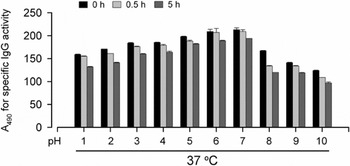
It has been reported that IgG incubated at 37°C is stable under neutral pH for several hours, but its reactivity gradually declines with decreasing or increasing pH values especially for pH below 4·0 or above 10·0 (Shimizu et al. Reference Shimizu, Nagashima and Hashimoto1993; Dominguez et al. Reference Dominguez, Perez, Puyol, Sanchez and Calvo2001). In the studies, we observed that specific IgG from milk antibodies of immunized lactating cows kept a relatively high activity under pH 5·0–7·0, and a lower activity appeared at pH below 4·0 or above 8·0 at 37°C for 5 h (Fig. 3), indicating that pH <4·0 or >8·0 obviously influences the stability of 17 strains of diarrheagenic bacteria antigens-immunized lactating cows' immune milk specific IgG incubated at 37°C.
Antigen-binding activities (100×A490, dil, 1:1000) for specific IgG in whey from immunized lactating cows, incubated at different pH from 1 to 10 for 0, 0·5 and 5 h of heat treatment at 37°C, respectively. Results are presented as means±S.E. of n=5 for each group.

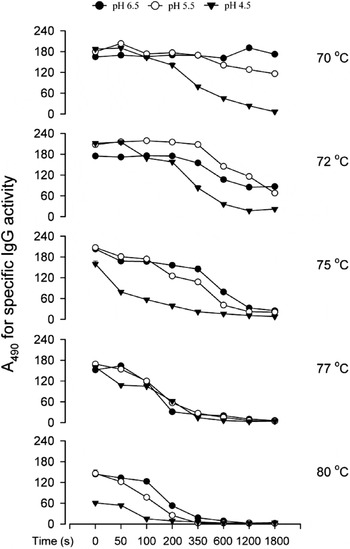
To successfully reduce or eliminate important bacterial pathogens such as Salmonella spp., Listeria monocytogenes, Esch. coli O157:H7, Staphylococcus aureus and Mycobacterium avium ssp. paratuberculosis (Stabel et al. Reference Stabel, Hurd, Calvente and Rosenbusch2004; McMartin et al. Reference McMartin, Godden, Metzger, Feirtag, Bey, Stabel, Goyal, Fetrow, Wells and Chester-Jones2006), heat treatments for pasteurization are extensively used to preserve colostrums and milk. For example, a commercial HTST continuous-flow pasteurization method or normal pasteurization conditions are 72°C for 15 s or for 120 s (Stabel et al. Reference Stabel, Hurd, Calvente and Rosenbusch2004; Godden S et al. Reference Godden, McMartin, Feirtag, Stabel, Bey, Goyal, Metzger, Fetrow, Wells and Chester-Jones2006). However, immunoglobulins have been reported to be thermally sensitive, especially when sterilization is conducted at high temperature (72°C) (Li-Chan et al. Reference Li-Chan, Kummer, Losso, Kitts and Nakai1995; Dominguez et al. Reference Dominguez, Perez, Puyol, Sanchez and Calvo2001). Therefore, it is important to consider immunoglobulin stability during storage or following processing methods that includes pH variations and thermal treatments such as pasteurization and sterilization. To this end, our experiments were performed to determine an appropriate range of temperature and pH. Initially, we noticed that specific IgG of whey at pH 4·0 heated at 72°C completely lost the antigen-binding activity after 4 s of treatment (data not shown). This time was too short to harvest samples for a kinetic study. Finally, a pH ranged from 4·5 to 6·5 and a temperature ranged from 70 to 80°C was chosen. As shown in Fig. 4, at pH 4·5, the antigen-binding activity of specific IgG in milk whey decreased or rapidly decreased as heating time increased at 70, 72, 75, 77 and 80°C, and the activity was almost abolished after 350 s of treatment at 75, 77 and 80°C. Consistently, at pH 5·5 or 6·5, the sharp decreases of specific IgG activity were seen after 350 s at 72 or 75°C as well as after 50 s at 77 or 80°C (Fig. 4). However, specific IgG activity at pH 5·5 or 6·5 heated at 70°C was relatively stable during the entire experiment, and similar results were obtained within 350 s at 72°C (Fig. 4). These results suggest that normal pasteurization conditions such as 72°C for 120 s may not affect the specific IgG activity in milk from lactating cows immunized with a multivalent vaccine containing Esch. coli, Salmonella and Shigellai, thereby exerting its immunoprophylactic or therapeutic potential.
Effect of heat treatment at 70–80°C on antigen-binding activities (100×A490, dil, 1:1000) for specific IgG in whey from immunized lactating cows, incubated at pH 4·5, 5·5 and 6·5 for 30 min, respectively. Results are presented as means±S.E. of n=5 for each group.

This work was supported in part by the Special Programs of State Science and Technology Ministry of China (No. 2002BA518A12), Agricultural Key Technologies Research and Development Program of Science and Technology Commission Foundation of Jiangsu Province, China (No. BE2002302), the Natural Science Fund from the Education Department of Jiangsu Province, China (No. 09KJD550001). We thank Nanjing Weigang Dairy Company for study support in immunization of cows.