1. INTRODUCTION
From the high middle ages onwards, in all urban centres of the southern Low Countries, beguinages gave adult single women of all ages the possibility to lead a religious life of contemplation in a secure setting. The research at hand re-examines a hypothesis formulated in recent historiography, which considers beguinages as artificial families during the early modern period – a period that is traditionally associated with the increasing dominance of the nuclear family and the unravelling ties of extended family. To test these highly influential assumptions, this paper re-examines the family networks of beguines by means of a micro-study of the wills left by women who lived in the Great Beguinage of St Catherine in sixteenth-century Mechelen, a middle-sized city in the Low Countries. As elsewhere in the southern Low Countries, the beguine movement in Mechelen originated at the end of the twelfth century as an informal gathering of pious single women, who, from the second quarter of the thirteenth century onwards, started to identify themselves as a formally institutionalised community.Footnote 1 Initially their support came from wealthy noblewomen such as Maria van Lummen (died 19 May 1280), second wife to Wouter VI Berthout, feudal lord of Mechelen. Given such prominent aid, beguines swiftly acquired collective property, and as such became able to establish their own residences for communal living. In the following decades, begijnhoven or beguinages were founded in all urban centres of the southern Low Countries, where they became a distinctive feature of the urban infrastructure.Footnote 2
In terms of their organisation, the communal settlements of beguines usually had their own grand mistresses, regulations and parish priests, and varied in size from small convents and houses to larger court beguinages inside or outside the city walls. The largest beguinages often had the appearance and many functionalities of a small town: these begijnhoven became the dominant model in the bigger cities like Antwerp, Leuven, Ghent and Mechelen.Footnote 3 On the other hand, smaller urban centres such as Tongeren and Lier generally housed beguine convents and residences within the city walls, which usually were organised spatially as a central courtyard, around which the beguine houses were aligned. Given the common infrastructure of these beguinages, most urban centres in the southern Low Countries still bear witness to the popular and spatial impact of this religious movement. Though they are not all entirely preserved, most beguinages in present-day Flanders have well withstood the test of time. As fascinating, concrete reminders of the beguine movement, they have been on the UNESCO World Heritage List since 1998. They still speak to the imagination of many with their picturesque ‘houses, churches, ancillary buildings and green space’, all the more so since the end of the movement itself with the death of Marcella Pattyn (April 2013), the world's last living beguine.Footnote 4 Small wonder, then, that the longevity and wide appeal of the beguine movement amazes historians until this very day: in the late middle ages even small beguinages could count more than 100 inhabitants, whereas even large nunneries commonly housed no more than 60 nuns.Footnote 5
Significantly, unlike nuns, beguines never took permanent religious vows and theoretically they were free to leave the community at any time. As such, they did not constitute a closed religious order, although their daily lives were strictly regulated. Apart from mandatory masses and religious services, they were also expected to lead sober lives and to obey strict regulations regarding their public appearance and social conduct.Footnote 6 The 1588 ordinances left but little room for doubt. Single women who wanted to become beguines had to prove their ‘good name and reputation’ (goeden naeme ende fame), and an edifying and exemplary behaviour was expected of all. Each kind of ‘idle and worldly leisure’ (lichtveerdighe weerlijcke recreatien) was to be shunned. Moreover, beguines had to cut their hair short, cover their heads modestly with veils and wear only simple clothing. Inside as well as outside the beguinage, any form of ‘showiness’ (curioesheyt) was strictly forbidden.Footnote 7
However, beguines further differed from women of regular religious orders in that beguines did not have to take a vow of poverty. As a consequence, they retained rights to the property they had when they entered the beguinage. The most wealthy beguines, for instance, could buy (the right to live in) a house within the beguinage, and they all brought their own household furniture, goods and clothes.Footnote 8 In other words, beguines at least in theory could retain the living standards they were used to before they entered the beguine community.Footnote 9 Hence it has been argued that the daily lives of beguines probably closely resembled those of ordinary single women and widows in cities, even though most beguinages were enclosed by walls and a gate, spatially separating them from the adjacent urban environment.Footnote 10
2. REPLACING THE FAMILY?
Although hagiographic and pious manuscripts circulating from the thirteenth century portrayed the beguine life as the ultimate implementation of a blessed vita apostolica, scholars these days no longer study it as an exclusively religious phenomenon. Moreover, in recent attempts to explain the popularity of the beguine movement in the long run, two dominant explanatory theories have increasingly been questioned, though both held their ground for several decades. The first of these hypotheses maintained that an unbalanced sex ratio in (late) medieval towns prompted a (supposed) ‘surplus of women’ to join the beguine movement as a way of escaping marriage or entering a cloister (known as the Frauenfrage debate).Footnote 11 The second put forth the idea that beguinages can be considered as a refuge for women from the lower classes, whose parents could not afford the necessary dowry for marriage or for entering a nunnery.Footnote 12 Both of these influential ways of thinking about beguines are now generally considered outdated. During the past decade these older narratives have gradually made way for new theories and hypotheses, which mainly link the beguine movement to the evolution of family structures and even to the development of the labour market. For instance, according to Tine De Moor, beguinages were ‘able to develop in western Europe because of loose family ties, the European marriage pattern (EMP), and because of changes in the labour market, which allowed women to secure their own incomes’.Footnote 13 Katherine Lynch followed a comparable line of argument when she reasoned that beguinages can be considered as ‘examples of lay efforts to construct artificial families and communities within an urban setting’.Footnote 14
Historians of late medieval and early modern cities, to be sure, generally support the idea that traditional family structures gradually loosened and that, as a consequence, wider kinship ties lost many of their functions in densely urbanised western Europe. In the course of the middle ages, the EMP – characterised by the formation of a new household upon marriage as well as high marriage ages for both men and women – is thought to have become a dominant feature of urban demography, affecting fertility and, consequently, population growth.Footnote 15 Along with the demographic setting of towns, with their high levels of mortality and continuous temporary as well as permanent migration, the EMP allegedly made for the dominance of the nuclear familyFootnote 16 – as opposed to the extended family – and caused an increase in the number of single persons in highly urbanised regions, such as the Low Countries. Evidence from tax records, wills, urban surveys and partial censuses indeed suggests that urban families and households in this period were generally rather small.Footnote 17 Hence it has become widely accepted amongst historians that this ‘northern European family’ constituted the norm in medieval and early modern cities in western Europe.Footnote 18 Moreover, with regard to the supposed impact of the EMP on the familial and social well-being of individuals, the influential and much debated ‘nuclear hardship hypothesis' proposes that the rising dominance of the nuclear family went hand in hand with the gradual dissolution of extended family structures. As formulated by Peter Laslett and others, this disbanding, in turn, made individual town dwellers more vulnerable to poverty and social isolation.Footnote 19 Inspired by this very influential hypothesis, most studies on pre-modern urban societies in Europe presume that the loss of kinship as the main organising principle of society motivated town dwellers to create and join alternative social support networks that were not based on blood ties, such as guilds, confraternities and, perhaps, beguinages.Footnote 20
And yet, while most historians of associational life in the Low Countries assume that family relations and kin-based support became less important in towns, only a few have thoroughly investigated the consequences of the (supposedly) weakening family ties for individual actors.Footnote 21 Family historians, on the other hand, tend to focus their studies on the nuclear unit and have been criticised for their possible underestimation of the continued importance of extended kin.Footnote 22 This perspective at least partly explains why up until this day little is known about the familial and social embeddedness of single men and women, though they formed a substantial group in pre-modern urban societies. Single women sometimes even made up between one-fifth to as much as half of all adult women, and – especially in the southern Low Countries – a considerable group of these never-married women grew old in a beguinage.Footnote 23
3. THEORY VERSUS PRACTICE: A CASE STUDY
To examine empirically the hypothesis that beguinages can be considered as ‘artificial families’ in light of the supposed dissolution of kinship ties in the early modern period, this study will focus on beguines living in the beguinage of Mechelen in the period 1532–1591. In doing so, the research at hand takes the middle ground between studies on family structures in pre-modern cities, and on the beguine movement in general. The question central to this investigation into Mechelen's beguines is how important their blood relatives were, given the fact that virtually none of these women ever started or headed their own families. This research question will be answered by combining quantitative analysis with in-depth reading of beguines' last wills and testaments, focusing on what motivated these women in their choices for beneficiaries of real property, bequests of objects (such as household objects, clothes, silver and shop gear) as well as bequests of cash and rents.
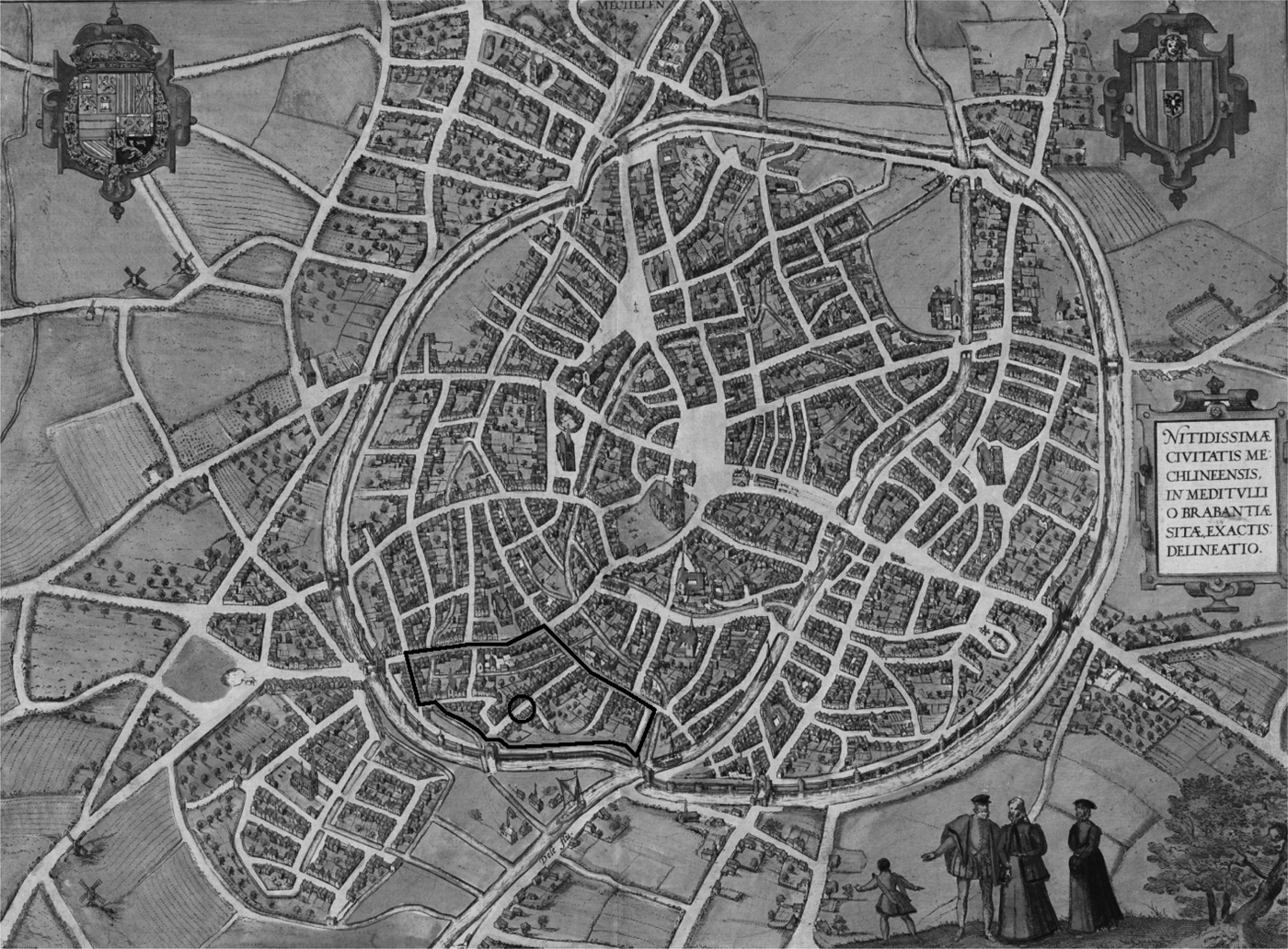
Sixteenth-century Mechelen – a city which at the same time was a separate province in the Habsburg Netherlands – presents a good case study for the family networks of beguines: from the late fifteenth century onwards, the city hosted the largest population of beguines in the southern Low Countries. Thanks to generous gifts from noble and wealthy women such as Maria van Lummen, the Great Beguinage of St Catherine became a very large and prosperous hortus conclusus outside the walls of Mechelen. In his well-known Descrittioni di tutti i Paesi Bassi (1567), Ludovico Guicciardini described the beguinage of Mechelen as a marvellous munistero, surrounded by walls and a gate ‘like a castle’ (a guise di castello). He also admired its splendid church dedicated to their patron Saint Alexis, as well as countless buone habitationi of the beguines.Footnote 24 In the Low Countries, in fact, the Great Beguinage of St Catherine stood out for its exceptionally large community. At the height of the city's expansion, beguines even accounted for close to 6.5 per cent of Mechelen's total population of about 30,000 inhabitants: Walter Simons estimated between 1,500 and 1,900 beguines in the late fifteenth and first half of the sixteenth centuries. Moreover, whereas at first most beguines belonged to the nobility, by the sixteenth century the beguinage housed rich and poor alike. As such, it formed a microcosm of the female population of the city of Mechelen, and was ‘composed of women who came from all social milieus and whose economic status diverged widely’.Footnote 25 Contemporary sources, such as the city chronicles and the Descrittioni by Guicciardini, confirm that in the second half of the sixteenth century the Great Beguinage of St Catherine remained densely populated. In the year 1578, however, Mechelen's beguines had to flee their houses, as the city magistrate decided to burn down the beguinage and other buildings outside the city walls to prevent them from being used as shelter by enemy troops in the event of a possible siege of the city by Habsburg forces. After the duke of Parma's Spanish troops defeated the Calvinists in 1585, the beguines returned and settled in a smaller beguinage within the city walls (Figure 1), since the Council of Trent (1545–1563) prescribed that new beguinages had to be established within city walls.Footnote 26
The beguinages of Mechelen. The Great Beguinage of St Catherine is situated in the lower left corner of this city map. The location of the new beguinage within the walls, in the area of the Nonnestraete, is marked in black. Source: Georg Braun and Franz Hogenberg, Civitates orbis terrarium – 1574. © Beeldbank Mechelen.

4. WILL-WRITING IN SIXTEENTH-CENTURY MECHELEN
The research for this inquiry is based on a sample of 422 wills for the period 1532–1591, of which 40 were left by beguines, and 40 by lifelong or never-married single women. I collected all wills from the second half of the sixteenth century that were preserved in the archives of the beguinage of Mechelen, and gathered additional sixteenth-century wills left by beguines that were preserved in the City Archives of Mechelen.Footnote 27 Without a doubt, when compared with an estimated beguine population of at most 1,900 women at any given time, a sample of 40 wills in a 60-year period at first sight appears quite unimpressive. Nevertheless, a preliminary analysis of this sample of wills indicated that they were written by older and younger beguines, by richer and poorer. As such, they do enable us to shed light on the family embeddedness of a small yet meaningful group of beguines.Footnote 28 Moreover, a comparison with the wills of lay single women will further enable us to distinguish more correctly particular bequest patterns emerging in the wills of beguines, and allow us to add nuance to the aforementioned assumptions and theories.
In recent times more and more historians, among them Martha Howell, Amy Froide, Judith Bennett and Kate Staples, study wills as entry points to comprehending the lives of single women in late medieval and early modern cities. Wills have indeed proved to be highly useful sources because of the light they cast on, for instance, the testators' religiosity, charitable-giving practices, mind-sets about property and embeddedness in social and family networks.Footnote 29 Even so, any historian studying wills faces inevitable difficulties and biases, owing to the fact that a will, of course, is nothing but a snapshot of a critical moment in the decedent's life. In the present case of Mechelen's beguines during the period 1532–1591, a close reading of the wills left by them – in which adult nieces are, for instance, often mentioned as beneficiaries – suggests that they normally wrote their wills at a later moment in their lives; in fact, 7 out of 40 beguines wrote their wills on their deathbeds, when they more than ever knew that ‘nothing is more certain in this miserable world than death, yet nothing more uncertain than its hour’ (egheen dinc op dese allendigher werelt sekerder en es dan die doot, ende nijets onsekerder dan dhueren der selver).Footnote 30 Therefore, we must take into account that in analysing these beguines’ wills, the networks we can reconstruct most probably were at their maximum extent when they were written. Studies have pointed out that especially when a testator wrote his will at a later period in life, his concerns extended to relatives beyond the nuclear family, such as siblings, nieces and nephews, and more distant kin.Footnote 31 Although wills cannot reveal the full range of relatives of a testator, it must be clear that they indicate beyond a doubt those family members considered most important at that given moment in the testator's life.Footnote 32 Moreover, considering the fact that beguines – like all (lifelong) single women – ‘did not marry and form nuclear families, their wills are exceptionally good sources for revealing the prominence of blood ties in late medieval and early modern cities’.Footnote 33 This certainly is the case for wills written in mid-sixteenth-century Mechelen. Whereas in this period testators in Flanders could only bequeath one-third of their property outside their circle of legal heirs, testators in Mechelen were free of such restrictions, and, most important, every woman had a right to her parents’ inheritance without having to marry, and was allowed to transfer property as testator.Footnote 34
The wills left by beguines of Mechelen indicate that they were well aware of their right to manage their property independently by means of a will: many beguines rewrote or changed their wills several times. When beguines died intestate, their property was divided according to the heritance laws of the city adjacent to the beguinage.Footnote 35 Yet, apparently many took the chance to choose certain beneficiaries outside or inside their circle of legal heirs, whom they endowed with some of their most valuable possessions. The great quantity and diversity of legacies and gifts in some of these wills show that beguines could be highly affluent: the list of beneficiaries could be surprisingly long. In her will of 1546, Barbele Cnobbaert, for instance, mentioned no fewer than 26 different beneficiaries, who included the urban poor, the priest of the beguinage and fellow beguines, as well as her brothers and sisters, nephews, nieces and godchildren. Similarly, the diversity in her legacies is also indicative of Barbele's wealth. Her gifts ranged from silver spoons and pieces of furniture to clothing, as well as to substantial bequests of annual rents and cash.Footnote 36 This example, of course, calls to mind the fact that the bequest patterns emerging in wills were always highly influenced by the testators' social status and wealth.Footnote 37 Moreover, will-writing was only really relevant to those who had possessions to bequeath. Most of the beguines (and lay single women) central to this study, in other words, most probably came from the upper and middling strata of society. Without inventories attached, it unfortunately is impossible to estimate the value of beguines' properties, and hence their living standards. Vague descriptions of significant gifts, such as the ‘remainder of all movable and immovable goods’ (surplus ende overschot van allen haeffelijcke ende erffelijcke goeden) occur frequently and likewise make it difficult (if not impossible) to evaluate a beguine's social status.Footnote 38
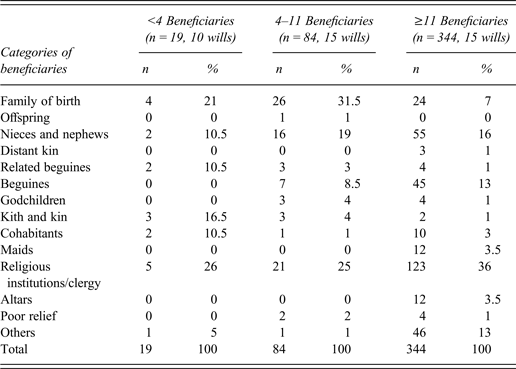
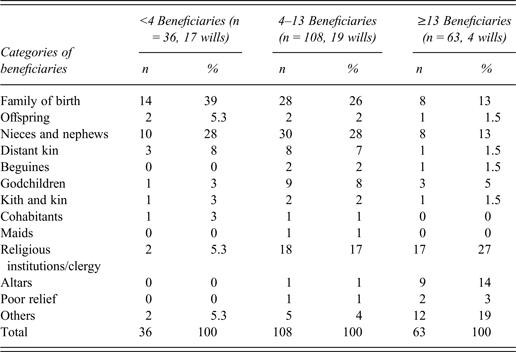
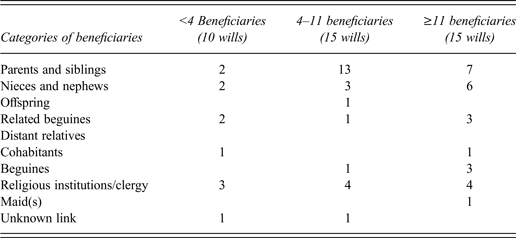
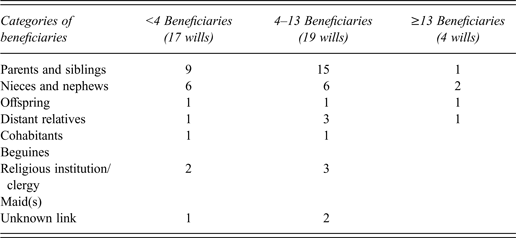
Fortunately, the number of beneficiaries mentioned in wills can be considered an indicator of testators’ prosperity, and further allows for a social stratification.Footnote 39 In order to give nuance fully to the bequest patterns that emerge in the wills left by beguines living in sixteenth-century Mechelen, therefore, a distinction is made between three categories. The first category contains beguine wills in which fewer than four unique beneficiaries were mentioned (n = 10), the second contains wills of which between 4 and 11 recipients benefited (n = 15). A third and final category is formed by wills left by beguines who endowed 11 or more beneficiaries (n = 15). The fact that 30 out of 40 beguines endowed four or more beneficiaries can be considered rather revelatory for their (possible) wealth, especially when compared with the wills of lay single women: 17 out of 40 left legacies to fewer than 4 recipients, whereas only 4 lay (and clearly rich) single women endowed more than 12 unique beneficiaries (see Tables 1 and 2).
Beneficiaries mentioned in the wills of beguines, 1532–1591, Mechelen (n = 40) (absolute numbers and percentages)
Source: Database K. Overlaet.
Beneficiaries mentioned in the wills of single women, 1532–1591, Mechelen (n = 40) (absolute numbers and percentages)
Source: Database K. Overlaet.
5. BEGUINES AND THEIR BENEFICIARIES
In order to estimate the family embeddedness of beguines, these analyses will focus on: (1) the living arrangements of beguines who lived in one of the houses of the beguinage; (2) their networks of support; (3) the identity of their chief heirs; and (4) finally the beneficiaries of objects with an essentially emotional value, such as pieces of jewellery, clothing and beds. We will further study the differences between the bequests in the wills of beguines and those in the wills of lay single women.
5.1. Living arrangements of beguines
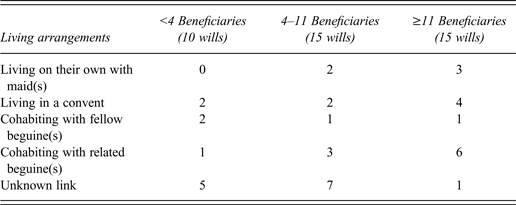
First, if beguines were wealthy enough to afford their own house in the beguinage, they tended to choose their household members amongst related beguines (see Table 3). A quarter of the 40 beguines lived together with one or more sisters or nieces, whom they generally endowed with valuable legacies in their wills. The blood-based beguine households most often consisted of an aunt who took care of (and was taken care of by) one or more of her nieces, and who as such could exercise a great influence on these young(er) girls' lives (seven cases). Five beguines shared a house with a non-related beguine. As a rule these 15 beguines appointed the longest-living cohabitant chief heir of their estate, which underlines the importance of these relationships of support (blood-based or not). Katherina Gommaers left Katherine Hemelrycks in 1586 all of her movable and immovable property out of gratitude for the support she received from ‘her in her old age’ (haere oude ende ongevallige dagen).Footnote 40 Considering these alternative households as replacements for the family, however, is probably overstretching the argument. Living together with a non-related beguine did not prevent beguines from taking in nieces for a limited period of time either. Margarete Lams and Anna Van Kruibeke had lived together for 34 years when they wrote their will in the year 1583, in which they endowed Goedele van Kruibeke, ‘who had lived with them for many years’ (die bij henlieden vele jaeren gewoont heeft gehadt), with an annuity worth 10 guilders a year.Footnote 41
Living arrangements of beguines, 1532–1591, Mechelen (n = 40) (absolute numbers)
Source: Database K. Overlaet.
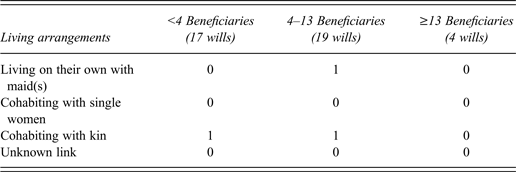
The contrast with the living arrangements of lay single women is remarkable. From a total of 40 women, only two explicitly mentioned to have lived together with a sister, while the household of only one single woman included also a maid (see Table 4).
Living arrangements of single women, 1532–1591, Mechelen (n = 40) (absolute numbers)
Source: Database K. Overlaet.
5.2. Networks of support
However, when we single out gifts and legacies that were accompanied by an explicit expression of gratitude for ‘services, good deeds and support’ (diensten, weldaden ende bijstanticheyden), never-married women, like beguines, appear to have depended highly on the care of their closest relatives. Out of 40 single women, 11 endowed sisters and nieces out of gratitude for their support. This set of wills thus gives the impression that the family also was of great importance for single women who, unlike beguines, probably did not have many others to turn to when they were in need of support.
5.3. Identity of their chief heirs
Tables 5 and 6 confirm this observation: in the wills of both beguines and single women, relatives were most frequently chosen as chief heirs, or heirs of at least an extensive part of the estate.Footnote 42 Moreover, other empirical evidence suggests that family remained all-important for beguines. Whereas entering a beguinage in the earliest stages of the beguine movement mostly involved a radical break with the family, by the sixteenth century nothing seems to have prevented Mechelen beguines from remaining involved in the maintenance of their kin relations.Footnote 43 The will Rombout van den Dorpe and his wife Elizabeth left in 1546 suggests that even leaving legacies to related beguines could be part of a family strategy. In their will they endowed their daughters Lynken and Leenken, both beguines, with the considerable sum of 100 guilders and an equal share of the inheritance, albeit on the condition that they had to appoint their other brothers and sisters as chief heirs. The beguines' inherited possessions, in other words, were expected to return to their blood relatives after their deaths.Footnote 44 This example – albeit unique in its kind – therefore suggests that encouraging daughters to become beguines could form part of a strategy to secure (at least part of) the family patrimony.
Beguines and their chief heirs, 1532–1591, Mechelen (n = 40) (absolute numbers)
Source: Database K. Overlaet.
Single women and their chief heirs, 1532–1591, Mechelen (n = 40) (absolute numbers)
Source: Database K. Overlaet.
Granted, the work of De Moor still considers forcing daughters into becoming beguines as an ‘unsuccessful’ financial strategy (and hence probably rarely applied) because of these women's freedom to manage their properties independently. Yet it appears from the Mechelen case that beguines instead felt themselves ‘bound’ by their responsibilities towards kin.Footnote 45 This obligation to kin is to a lesser extent reflected in frequently reappearing phrases in the wills which stipulated that beneficiaries belonging to the testators' family of birth had to content themselves with their legacies if they did not want to lose their share of the inheritance. Barbele Cnobbaert left her brother Claes, without knowing whether he was still alive or not, 1 guilder on the condition that he would give up his right (as legal heir) to the remainder of her estate. Compared with the numerous generous gifts she made to her nieces, who were to receive (amongst other gifts) annuity rents worth more than 10 guilders, her brother had to be satisfied with but a small piece of the pie.Footnote 46 Geertruyt Oeyens left her kith and kin only 20 stuivers (worth 1 guilder) and appointed the convent Ter Kranken as her chief heir.Footnote 47 Agneet Claes went even further in her will of 1579. She endowed her nieces and nephew with the usufruct of her immovable properties, but forbade the guardians of her nephew (who was the only child of her deceased brother) any ‘administration’ (bewind oft administratie) of her belongings after her death.Footnote 48
Clauses such as these occur in 8 out of 40 wills, but – for the sake of full disclosure – never prevented the respective testators from endowing other relatives. Maximiliane De Begge left the children of her brother Arthur a guilder each, in order that they ‘shall not share in the rest of her movable and immovable property’ (zelen vuyt blijven vuyt allen haeren goeden haeffelijcke ende erffelijcke). It is possible that these limited gifts were motivated by a troubled relationship with her brother Arthur, since Maximiliane appointed her other brother Willem and sister Margrete as her chief heirs.Footnote 49 These examples primarily confirm that beguines did not maintain close relationships with all of their relatives. It is, in other words, most likely that they considered the endowment of kin a moral obligation rather than a favour. Whereas the choice of the chief beneficiaries might not have been considered as ‘free’ for beguines and single women, the choice of the recipients for particular emotionally valuable possessions was up to them. Therefore, the specific kinds of legacies left to certain relatives can be considered a better indicator of their importance to beguines at the moment they wrote their wills.Footnote 50
5.4. Beneficiaries of objects with emotional value
In this regard, a comparative reading of the wills of lifelong single women points to another remarkable similarity with the beguines. While these single women might also maintain close relationships with their nephews – for whom beguines and lifelong single women were regularly chosen as godmothers – relationships with blood relatives were significantly female-centred. Indeed, most legacies with an emotional or symbolical value, such as pieces of silver or golden jewellery, pieces of clothing and beds, went to sisters and nieces when bequeathed both by beguines and by never-married single women.Footnote 51 In the case of beguines, their nieces were most often endowed with pieces of clothing (mostly typical beguine dresses which would only be useful to them if they became or remained beguines). When Heylwych Ansens wrote her will in 1556, she endowed Anneke Ansens, one of her co-resident nieces, with several goods: a cupboard (tresoer), bed and best bedding, three of her blue cushions and her coats, best bodice and all of her beguine dresses (beghijnen rocken).Footnote 52 It is most likely that with these gifts Heilwych wanted to provide her niece with a kind of dowry, which would enable her to start her own household as a beguine. Two beguines left a bed with bed linen to a niece, but five others chose their beneficiary for this precious piece of furniture amongst fellow beguines. Six single women, on the other hand, endowed their sister(s) or niece(s) with a bed, but did not leave anyone pieces of clothing.
Notwithstanding these differences, the wills central to this research strengthen some of the arguments put forward in recent international scholarship on family networks of single women in pre-modern European cities, which have stressed ties to female kin. Froide has emphasised the importance of the emotional and material support that lifelong single women received from their sisters, aunts and nieces. Research by Nele Provoost on early modern Lier, a small nearby town in Brabant, has confirmed that single women were often strongly embedded in female-centred family networks.Footnote 53 According to Froide, again it is likely that most single women maintained close connections with their kin to compensate for their lack of a spouse or own children to bear and rear (such as Marion Trévisi has argued for eighteenth-century relationships between aunts and nieces in Northern France). Yet in her view – and I do agree – it is equally possible that precisely such strong (instead of weak) kinship ties gave single women the chance to remain single and, in the case of beguines, to live a life of contemplation while independently earning a living.Footnote 54 The aforementioned 1588 ordinances of the beguinage of Mechelen stipulated that aspiring beguines had to be able to prove their possession of sufficient capital, or the ability to earn a living, while new members were prohibited from receiving support from the beguinage's poor boxes (the so-called Tables of the Holy Spirit) during their first three years at the beguinage.Footnote 55 In other words, now that the continued importance of kin for beguines has been amply demonstrated, it is worth wondering to what extent single women needed a firm kin network if they wanted to become a beguine.Footnote 56 In this regard, the wills left by Adriane Van Hanswijck (1546) and Kathelijne Reyers (1548) are perhaps the best examples of the potentially great importance of kin. In her will, Adriane mentioned that she owed her father Wouter the sum of 15 guilders, which he had lent her to enable her to rent a house ‘in the Great Beguinage’ (staende opt groot bagijnhoff).Footnote 57 Kathelijne Reyers, on the other hand, shared a house with fellow beguine Barbele Van Beringen, and – most likely for that arrangement – annually received a certain amount of flax from Barbele's parents, Ypoliet Van Beringen and his wife Margriete.Footnote 58
Froide's and Provoost's analyses of early modern wills (albeit for different regions) suggest that single women could themselves play a significant part in helping to sustain the households of their kin.Footnote 59 Similar observations can be made for sixteenth-century Mechelen. If they were prosperous, beguines could be of great help to their relatives. Catherina Van Bussekom had loaned her nephew Willem a certain amount of money which he still had to repay when she wrote her will (1588).Footnote 60 Kathelijne Van Brecht had given Ieneke her ‘sister of illegitimate birth’ (natuerliker sustere) an advance of her inheritance as dowry when she left the beguinage of Mechelen to marry Gerrit Van Ymersele.Footnote 61 These situations were at least partly caused by the inheritance system of Mechelen. Women were entitled to their parents' inheritance without having to marry, and property could be transferred to and via women, as heirs or testators.Footnote 62 Therefore, last wills and legacies of lifelong single women and beguines could be of great importance for relatives who were starting or sustaining a household of their own, or facing hard times.
However, we must be cautious before considering the bequests of beguines to kin as illustrations of unconditional love, for bequests such as these sometimes came with the explicit condition that the recipients became (or remained) beguines themselves.Footnote 63 Marieke, the niece of the aforementioned beguine Kathelijne Van Brecht, risked disinheritance if she did not join the beguine community of Mechelen.Footnote 64 In the will she wrote in the summer of 1553, Appolone Van Soricke similarly stated that her niece Clara would receive only half of her legacy if she did not become a beguine, and that if her other nieces wanted to become beguines, they would be rewarded with a bequest as well.Footnote 65 Johanna De Bruyne likewise endowed her nieces Nelleke and Lysken with valuable pieces of clothing and an annuity rent worth 20 guilders on the condition that they stayed on the beguinage ‘for the rest of their lives’ (haeren leefdach lanck geduerende).Footnote 66 These stipulations of course raise questions about the extent to which young single women who risked disinheritance when they did not become beguines like their aunts found themselves without other options, depending on their social status and wealth. This observation also runs counter to De Moor's argument that the women who joined a family member in a beguinage probably considered their kin-beguine as ‘a successful example of female “liberation” and/or independence and that they simply sought to follow their example instead of being the subject of family intrigues and strategies'.Footnote 67 The question remains as to how free this choice could have been.
6. CONTINUITY OR CHANGE?
The density and scope of the family networks of beguines living in sixteenth-century Mechelen are hard to explain, especially in this period associated with the growing dominance of the nuclear family and the decreasing importance of (extended) kinship ties due to the EMP. First, the relationships that most beguines appear to have had with relatives suggest that the beguinage they entered was not very far away from the location of their birth, so they had the possibility to maintain blood-based relationships.Footnote 68 Additionally, there was a considerable overlap between them, since many beguines shared their houses with sisters and/or nieces. Along with the apparent relationships of support between non-related beguines, these little households in which sisters and nieces looked after each other made the Great Beguinage of St Catherine a solid safety network for single women of all ages and status, partly built on existing bonds within the (extended) family. According to Simons this alleged ‘unique flexible combination of an active life among urban citizens and a contemplative life within a secure setting’ can be considered as a fundamental reason for the wide appeal of the beguine movement.Footnote 69
However, there is a flip side to every coin. The social benefits and other features of secular life characteristic of beguinages came with a considerable cost, and the wills left by beguines in late sixteenth-century Mechelen have clearly demonstrated that the alleged flexibility towards beguines who wanted to leave the beguinage (for marriage) must be reconsidered. Many nieces of beguines risked losing their inheritance when they did not become or remain a beguine themselves. Therefore, as observed above, it is worth questioning to what extent single women felt free to join or leave the beguine community of Mechelen, and especially to what extent young single women who risked disinheritance found themselves – depending on their social status, wealth and pre-existing social and family networks – without other options. Perhaps this explains why references in wills to beguines leaving the beguinage (to get married, for example) are extremely rare. Probably most women who entered the beguinage of Mechelen experienced their residence in this institution as a permanent vocation, rather than as a transitory stage in life.
Wills have proved to be well-suited sources for an analysis of the familial embeddedness of beguines in Mechelen in the period 1532–1591, which made clear that the importance of family ties for beguines in an early modern urban context cannot be underestimated. Therefore, and most important for this study, these wills add convincing variation to Lynch's hypothesis that beguinages can be interpreted as efforts to construct artificial families. Indeed, almost none of Mechelen's beguines lacked a firm family network. It is worth wondering to what extent young single women needed family support before they could consider entering the beguinage. Rather than compensating for loose family ties or the lack of a spouse and own children to bear and rear, relationships with fellow beguines complemented and frequently overlapped with kinship ties.
As such, the wills left by beguines and lifelong single women in sixteenth-century Mechelen also raise questions about the alleged dissolution of family ties in the late medieval and early modern period. The wide range of kin recognised in their wills does not correspond with the assumption that (distant) relatives became less important in the course of the late middle ages and early modern period. Apparently close and extended kinship ties continued to be highly important for individual city dwellers, even when they participated in alternative networks of support which were not essentially based on blood ties, such as the beguine movement. Therefore, the results of the research at hand raise questions about the alleged impact (and dominance) of the EMP on traditional kinship, and add nuance to the recent historiography that assumes that in this period the extended family became less important than the nuclear family and other networks of support.Footnote 70
ACKNOWLEDGEMENTS
The Research Foundation Flanders (FWO) has funded my research for this article, which presents findings of my doctoral research on the importance of extended family in early modern Mechelen. I would like to thank Peter Stabel, Maarten F. Van Dijck, Tine de Moor, Bram Caers, John R. Eyck, and the editors of Continuity and Change for their stimulating and constructive comments on the first drafts of my paper.