Introduction
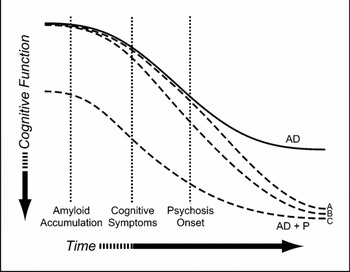
Psychotic symptoms in Alzheimer's disease (AD +P) identify a distinct subtype of AD characterized by a more rapid rate of cognitive decline, higher rates of institutionalization, and higher rates of cognitive impairment than in AD subjects without psychosis. There is evidence that genetic variation contributes to the development of AD + P, which has been shown to aggregate within families and demonstrates linkage to chromosomal loci (Bacanu et al., Reference Bacanu, Devlin, Chowdari, DeKosky, Nimgaonkar and Sweet2002; Sweet et al., Reference Sweet2002b; Hollingworth et al., Reference Hollingworth2007). How genetic variation may result in AD + P and the associated excess cognitive burden is unknown, though several possibilities, which can be differentiated by their time course, are shown in Figure 1. Genetic variation may lead to onset of psychotic symptoms, with excess cognitive impairment only emerging as part of the psychotic state (Figure 1, Trajectory A). Alternatively, genetic variation may interact with neurodegeneration of the brain during AD to accelerate the accumulation of pathologic lesions, resulting in a more rapid cognitive decline and ultimately greater cognitive impairment in AD + P subjects (Figure 1, Trajectory B). Finally, AD + P might result from genetic variation creating a “cognitive risk phenotype” which is present prior to AD onset (Figure 1, Trajectory C). As neurodegeneration progresses, this cognitive risk phenotype would manifest itself as AD + P. There is evidence for this last trajectory, for example, in schizophrenic psychosis, in which cognitive deficits may be present during neurodevelopment many years prior to the onset of frank psychotic symptoms (Niendam et al., Reference Niendam2003). Moreover, cognitive deficits are present in non-affected first-degree relatives of subjects with schizophrenia, suggesting that these deficits may result from genetic variation that contributes to a cognitive risk phenotype, in at least this disorder (Snitz et al., Reference Snitz, Macdonald and Carter2006).
Possible trajectories of greater cognitive impairment relative to onset of psychosis in AD, and implications for the relationship of genetic variation to AD + P. Genetic variation may contribute to the risk of psychosis onset, with greater cognitive burden only emerging as a result of the psychotic process, i.e. after the onset of psychotic symptoms (Trajectory A). Alternatively, genetic variation may accelerate the neurodegenerative process leading to greater cognitive decline and onset of AD + P (Trajectory B). Finally, genetic variants may act during neurodevelopment or normal aging to create a “cognitive risk” phenotype that will manifest as AD + P after the independent onset of neurodegeneration (Trajectory C).

Although numerous studies have demonstrated greater cognitive impairment after the onset of AD + P (Stern et al., Reference Stern, Mayeux, Sano, Hauser and Bush1987; Drevets and Rubin, Reference Drevets and Rubin1989; Jeste et al., Reference Jeste, Wragg, Salmon, Harris and Thal1992; Rockwell et al., Reference Rockwell, Jackson, Vilke and Jeste1994; Levy et al., Reference Levy, Cummings, Fairbanks, Bravi, Calvani and Carta1996; Ballard et al., Reference Ballard, O'Brien, Coope and Wilcock1997; Lopez et al., Reference Lopez, Kamboh, Becker, Kaufer and DeKosky1997; Reference Lopez, Wisniewski, Becker, Boller and DeKosky1999; Paulsen et al., Reference Paulsen2000a; Scarmeas et al., Reference Scarmeas2005), there is limited information that would help differentiate these possible trajectories. Two prior studies have examined whether the risk of incident psychosis in subjects with AD is predicted by greater cognitive impairment. Paulsen et al. (Reference Paulsen2000b) in subjects with AD, and Wilkosz et al. (Reference Wilkosz, Miyahara, Lopez, DeKosky and Sweet2006) in subjects with AD or mild cognitive impairment (MCI), longitudinally examined individuals who were without psychosis at study entry. Significant associations were found between lower MMSE scores and an increased risk for the onset of psychosis in both studies. However, because neither of these two studies separately evaluated subjects with mild AD at study baseline, it is possible that the observed associations of cognitive impairment with increased AD + P risk were largely due to the occurrence of AD + P in more advanced disease stages (Trajectory A), rather than to a cognitive phenotype emerging prior to, and mediating, the subsequent onset of psychosis.
Thus, the primary objective of the current study is to examine subjects prospectively and longitudinally, stratified by degree of cognitive impairment, to determine the relationship of greater cognitive impairment to subsequent AD + P onset.
Methods
Subjects
All subjects were recruited through the University of Pittsburgh Alzheimer Disease Research Center (ADRC) and participated in the study using a protocol approved by the University of Pittsburgh Institutional Review Board. They were all assessed at baseline with standardized neurological, neuropsychological and psychiatric evaluations, cognitive testing, laboratory studies and brain imaging as previously described (Becker et al., Reference Becker, Boller, Lopez, Saxton and McGonigle1994; Lopez et al., Reference Lopez, Kamboh, Becker, Kaufer and DeKosky1997; Sweet et al., Reference Sweet, Nimgaonkar, Kamboh, Lopez, Zhang and DeKosky1998; Wilkosz et al., Reference Wilkosz, Miyahara, Lopez, DeKosky and Sweet2006). Subjects diagnosed with possible or probable AD (McKhann et al., Reference McKhann, Drachman, Folstein, Katzman, Price and Stadlan1984; Lopez et al., Reference Lopez2000a; Reference Lopez2000b) or MCI (Lopez et al., Reference Lopez2003) without psychosis at baseline were included in the analyses.
All subjects underwent a neuropsychological battery assessing global cognitive functioning, immediate and delayed memory, attention, working memory, and visuospatial and language abilities as follows: the Mini-mental State Examination (MMSE; Folstein et al., Reference Folstein, Folstein and McHugh1975); the Alzheimer's Disease Assessment Scale 10-item word-list learning test and 30-minute delayed recall (Rosen et al., Reference Rosen, Mohs and Davis1984); the copy, immediate, and delayed recall of the modified Rey-Osterrieth Complex Figure (Becker et al., Reference Becker, Boller, Saxton and McGonigle-Gibson1987); the Benton Visual Discrimination Test (Benton et al., Reference Benton, Hamsher, Varney and Spreen1983); the Digit Span Forwards and Backwards Test (Wechsler, Reference Wechsler1987); the Category Fluency Test (Benton, Reference Benton1968), the Phonological Fluency Test (Borkowski et al., Reference Borkowski, Benton and Spreen1967); the Boston Naming Test (Kaplan et al., Reference Kaplan, Goodglass and Weintraub1983); the Trail Making Test A and B (Reitan and Wolfson, Reference Reitan and Wolfson1993). Neurological evaluation, cognitive testing, and diagnostic re-evaluation were conducted on an annual basis. Subjects were followed longitudinally until study completion, loss to follow-up, or until the subject became too impaired to return to the clinic for assessments.
Assessment of psychosis status
Psychosis was assessed using the Consortium to Establish a Registry for Alzheimer Disease Behavioral Rating Scale (CBRS; Tariot et al., Reference Tariot1995). The CBRS interview was designed to be administered to an informant. Informants for the CBRS were predominantly spouses (51%) or children (34%). Most informants (77%) had contact with the subject five or more days per week. The CBRS was completed at baseline and at annual assessments, and between assessments at approximately six-month intervals via telephone. Symptoms occurring during an episode of delirium were not rated on the CBRS. Psychosis at any assessment was considered present when any of the CBRS items 33 and 35–45 were rated as occurring ≥ 3 times in the past month. The CBRS items include: misidentified people (item 33), not recognized self in mirror (item 34), misidentified things (item 35), people harming or stealing (item 36), spouse is unfaithful (item 37), caregiver plotting to abandon (item 38), caregiver is an imposter (item 39), characters on TV are real (item 40), phantom boarder in home (item 41), dead person is alive (item 42), house is not home (item 43), auditory hallucinations (item 44) visual hallucinations (item 45). Inter-rater reliability on the CBRS was established using 10 CBRS interviews. Inter-rater agreement for the presence or absence of psychosis was high (mean ± SD of κ, 0.98 ± 0.08).
Statistical analysis
Cox proportional hazard models with time-dependent covariates were used to test associations of time to psychosis onset with MMSE. The selected covariates were age, education, age of onset, gender, and cognitive enhancer (CE) use. In all models, age, MMSE, and CE use were included as time dependent variables. The same analyses were repeated twice with restricted samples of patients with early to middle stage disease (baseline MMSE scores were greater than or equal to 16, n = 293) and early disease (baseline MMSE scores were greater than or equal to 20, n = 224).
For testing the association of psychosis onset with MMSE score one to two years prior, all subjects with a baseline visit and without onset of psychosis prior to one (or two) consecutive annual follow-up assessments were identified, resulting in 259 subjects available for analysis of the one-year lag and 143 subjects available for analysis of the two-year lag. For the one-year lag analysis, the time to psychosis onset was calculated from the one-year follow-up assessment date. As in the models described above, the MMSE scores were entered as a time-dependent variable. In order to model the time to psychosis onset and MMSE one year prior, the baseline MMSE scores were entered in the model as starting values. Similarly, for the two-year lag analysis, two-year follow-up dates were used to calculate the time to psychosis onset, and the baseline MMSE scores were used as starting scores.
For the MMSE change analysis, the MMSE rate of change was calculated by taking the difference between two consecutive MMSE scores and dividing by the number of years between the two assessments. In addition to the covariates listed above, MMSE rate of change was included in the models as a time-dependent variable. Analysis of neuropsychological tests on time to psychosis onset used Cox proportional hazard models with time-dependent covariates as described for the analyses of MMSE, above, with all of the tests entered as independent variables.
Results
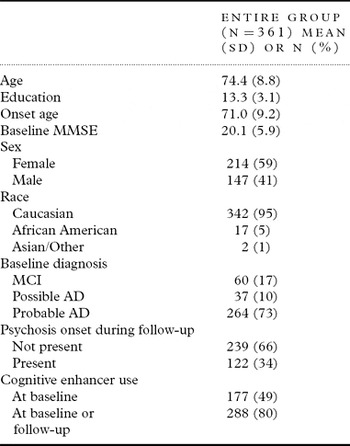
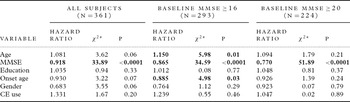
A total of 361 subjects completed at least one follow-up assessment. Demographic and clinical information on these 361 subjects is presented in Table 1. Psychotic symptoms were observed in 122 subjects during the duration of the study. The only variable consistently associated with reduced time to onset of AD + P was (lower) MMSE (Table 2). The association of MMSE with onset of AD + P was strengthened when analyses were restricted to those with early to mid-stage disease (MMSE ≥ 16) or to those with early stage disease (MMSE ≥ 20).
Demographic and clinical characteristics

MMSE = Mini-mental State Examination; MCI = mild cognitive impairment; AD = Alzheimer's disease.
Association of demographic variables, MMSE score, and cognitive enhancer use with risk of psychosis onset

*Wald χ2 test with 1 df.
MMSE = Mini-mental State Examination; CE = cognitive enhancer.
Cognitive impairment 1–2 years prior and AD + P risk
Subjects for whom the one-year and two-year lag analyses could be conducted did not differ significantly from the entire cohort in age, sex, race, education, age of onset, or baseline MMSE. Results of the lag analyses for the entire group, for subjects with early to middle stage disease, and for the group with early stage disease are presented in Table 3. Lower MMSE one year prior remained a strong predictor of psychosis onset. The association between lower MMSE score and subsequent onset of AD + P remained significant when examining MMSE scores lagged by two years. Once again the association was strongest in those subjects with early stage disease.
Association of MMSE scores one to two years prior with risk of psychosis onset

*Wald χ2 test with 1 df.
MMSE = Mini-mental State Examination.
Rate of cognitive decline and AD + P Risk
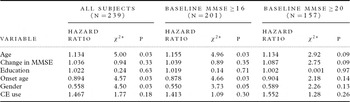
There was no association of rate of change in MMSE score with onset of psychosis in the entire group, in the subjects with early to middle stage disease, and in the group with early stage disease (Table 4).
Association of annualized rate of change in MMSE scores with risk of psychosis onset

*Wald χ2 test with 1 df.
MMSE = Mini-mental State Examination; CE = cognitive enhancer.
Effect of diagnosis
Because some of the above results may have been influenced by diagnostic group, we reran the analyses including variables encoding MCI, possible AD, and probable AD diagnoses, and their interactions with MMSE. There were no main effects of diagnosis, and no interactions of diagnostic group by MMSE over time. In contrast, the findings presented in Tables 2, 3 and 4 remained essentially unchanged, with the exception that the two-year lag MMSE analysis was now only significant in the MMSE ≥ 20 group.
Specific cognitive assessments and time to onset of psychosis
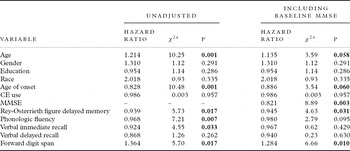
We conducted additional analyses in the 207 subjects with baseline MMSE ≥ 20 for whom complete neuropsychologic test scores were available to determine what neuropsychological domains contributed to the association of global cognitive impairment with subsequent onset of AD + P (Table 5). These analyses were confined to the early stage group because they demonstrated the strongest associations of MMSE with AD + P onset, and floor effects on the neuropsychologic measures utilized were least likely in this group. We found that time to onset of psychosis was associated with greater impairment in the Rey-Osterrieth Complex Figure Delayed Recall, Immediate Verbal Recall, and Phonological Fluency. In contrast, time to onset of AD + P was associated with better performance on Forward Digit Span. In order to examine whether reduced time to onset of psychosis was associated with performance in a specific cognitive domain that was disproportionate relative to global cognitive functioning, the above analysis was repeated with MMSE entered as a covariate. After accounting for MMSE, time to onset of psychosis continued to be associated with greater impairment on the Rey-Osterrieth Complex Figure Delayed Recall and better performance on Forward Digit Span.
Cognitive assessments and time to onset of psychosis

*Wald χ2 test with 1 df.
MMSE = Mini-mental State Examination; CE = cognitive enhancer.
Discussion
Subjects who developed AD + P exhibited greater global cognitive impairment prior to the onset of psychosis symptoms than subjects who did not develop psychosis. Results strengthened when we restricted the sample to subjects in the early stages of the disease. Furthermore, we found that greater global cognitive impairment was present up to two years prior to onset of overt psychotic symptoms in subjects who ultimately developed AD + P, even in mild stages of AD. In contrast, we did not find evidence that more rapid decline in cognition preceded the onset of AD + P. While greater cognitive impairments associated with AD + P were most pronounced in measures of delayed recall, somewhat surprisingly we found relative preservation of performance on forward digit span to be associated with AD + P onset.
The relationship of cognition to AD + P onset might be characterized by one of several trajectories, with differing implications for the mechanism whereby genetic variation may result in AD + P and its associated excess cognitive burden. In Trajectory A of Figure 1, subjects with AD + P would only demonstrate excess cognitive impairment after onset of psychosis. In Trajectory B, subjects would have equal cognitive status at the onset of AD, but genetic variation leads to an accelerated rate of cognitive decline to produce AD + P. In contrast, in Trajectory C, individuals with genetic variation predisposing to AD + P would enter AD with worse cognition at the end of normal development and/or normal aging, then decline at the usual rate, with the additive effects resulting in AD + P. The current findings that greater cognitive impairment is already present one to two years prior to onset of psychosis in AD subjects, but that cognition does not decline more rapidly during the same time period, would be most consistent with Trajectory C in our model.
The above interpretation should be tempered, however, by several additional considerations. In contrast to global and domain-specific evidence of greater cognitive impairment predicting subsequent AD + P, we found better performance to be present on forward digit span. If this is a true positive result, it would indicate that global cognitive trajectory is not a proxy for the relationship of all cognitive functions to AD + P onset. However, the possibility that this result is a false positive needs to be considered given that we did not find significant preservation of other attention and executive function measures in our cohort (Trails Test A and B, Backward Digit Span). Moreover, a prior study found decline in measures of attention to be predictive of AD + P (Paulsen et al., Reference Paulsen2000b).
We only examined the course of individuals after onset of clinical symptoms of neurodegeneration and until onset of psychosis. Others, however, have found that detectable differences in cognitive function may be present years (Saxton et al., Reference Saxton2004) or even decades (Snowdon et al., Reference Snowdon, Kemper, Mortimer, Greiner, Wekstein and Markesbery1996; Whalley et al., Reference Whalley, Starr, Athawes, Hunter, Pattie and Deary2000), prior to onset of AD. For example, Saxton et al. (Reference Saxton2004) examined cognitive performance in 693 normal elderly subjects. They found that differences in cognitive scores between individuals who developed AD and those who did not were evident up to eight years prior to AD onset. Whether these differences are confined to, or greater in, subjects at risk for AD + P remains to be determined. Similarly, our data cannot address whether there is an additional cognitive burden conferred subsequent to psychosis onset.
Although the degree of cognitive impairment predicted psychosis, we did not find the rate of cognitive decline was increased in individuals with subsequent onset of AD + P. The lack of more rapid decline corresponds to the observations by Paulsen et al. (Reference Paulsen2000b) that the rate of change on the MMSE was not predictive of psychosis. However, Paulsen et al. examined neuropsychological tests in addition to the MMSE. They found more rapid decline in the Mattis Dementia Rating Scale Total Score, the Attention and Construction Subscale Scores, and a separate measure of verbal fluency to be predictive of AD + P. Thus, it remains possible that AD + P is associated with more rapid cognitive decline during the early disease stages, at least in a subset of cognitive domains (Figure 1, Trajectory B). The conclusion that individuals destined to develop AD + P do not decline more rapidly in the early disease course is also subject to the limitation that only individuals already demonstrating symptomatic cognitive dysfunction were studied. However, the accumulation of neurodegenerative lesions likely precedes the onset of cognitive symptoms by years (Saxton et al., Reference Saxton2004). Thus it is possible that those of our subjects who developed AD + P underwent a phase of accelerated degeneration prior to entering our clinic.
If greater cognitive impairment is present in individuals destined to develop AD + P either prior to disease onset or early in the course of the disease, how might this inform understanding of the pathophysiology of AD + P? Recent conceptualizations of AD have shifted the focus of early pathogenic events from formation of amyloid plaques and neurofibrillary tangles to the effects of β-amyloid and tau phosphorylation on synapse loss. This understanding has emerged in part from recognition that in transgenic mice overexpression of amyloid precursor protein results in cognitive deficits in advance of plaque formation (Guenette and Tanzi, Reference Guenette and Tanzi1999) and that early synapse loss can exceed neuronal loss (Hsia et al., Reference Hollingworth1999). There is similar evidence in humans that reduced synapse number is present early in disease (Masliah et al., Reference Masliah2001; Scheff and Price, Reference Scheff and Price2003), is not accounted for by neuronal loss (Davies et al., Reference Davies, Mann, Sumpter and Yates1987; Hsia et al., Reference Hsia1999), and is the strongest correlate of cognitive impairment (DeKosky and Scheff, Reference DeKosky and Scheff1990). Similarly, we have shown that markers of synaptic integrity in the cortex are more disrupted in AD + P than in AD subjects without psychosis (Sweet et al., Reference Sweet, Nimgaonkar, Devlin, Lopez and DeKosky2002a). Of interest, reduced synapse number is also a consistent finding in schizophrenic psychosis (Glantz and Lewis, Reference Glantz and Lewis2000; Sweet et al., Reference Sweet, Bergen, Sun, Marcsisin, Sampson and Lewis2007). Reduced synaptic number could arise during development as an interaction of genetic and environmental factors, and be later additive with synapse loss during AD to yield greater cognitive impairment and subsequent onset of AD + P. Alternatively, genetic and environmental factors may influence the rate of neurodegenerative synapse loss during prodromal stages and provide a similar outcome.
Some potential methodological limitations of this study should be noted. The study was conducted in an Alzheimer Disease Research Center referral clinic, and may not be representative of the general population. In a naturalistic follow-up of an elderly, infirm population, biases may emerge due to the effects of drop-outs and missed visits. Though we can not exclude this possibility, our approach to follow-up was designed to limit this potential bias, and overall resulted in relatively low missed visit rates (averaging < 5%) and similarly low drop-out rates (averaging < 4%) at each assessment time point. In contrast, one strength of our study was the inclusion of subjects in the early clinical stages of disease. This includes subjects diagnosed with MCI, which in this setting consists of individuals with a high probability of subsequent conversion to AD.
In conclusion, we found that greater global cognitive impairment was associated with subsequent onset of AD + P. This effect was strongest in individuals who entered the study with the mildest degree of cognitive impairment, was detectable up to two years prior to AD + P onset, and did not appear to result from more rapid cognitive decline during the early course of symptomatic illness. Future prospective longitudinal studies assessing cognition and psychosis status should be conducted in subjects prior to the onset of AD to evaluate other cognitive predictors for AD + P and to confirm the results of this study. Studies to evaluate whether cognitive impairments mediate the effects of specific genetic variations, e.g. COMT (Sweet et al., Reference Sweet2005), on AD + P risk are also needed.
Conflict of interest
None.
Description of authors' roles
Analyses were performed by Patricia A. Wilkosz and Sachiko Miyahara. All the authors participated in interpreting the results and drafting and reviewing the text.
Acknowledgments
This study was supported in part by USPHS grant AG05133 and AG027224 from the National Institute of Aging. The content is solely the responsibility of the authors and does not necessarily represent the official views of the National Institute of Aging or the National Institutes of Health.