Understanding the production of utilitarian vessels is critical to our interpretation of ancient Maya economies and can aid in evaluating nonelite, hinterland social organization (Freter Reference Freter2004; McAnany Reference McAnany, Ericson and Baugh1993a; Masson and Freidel Reference Masson and Freidel2002). Production locales, often identified based on the presence of primary firing features, raw materials, production tools, products, and by-products (Stark Reference Stark and Nelson1985), are notoriously difficult to detect in the archaeological record (Sullivan Reference Sullivan1988). This is especially true in the Maya Lowlands because of multiple factors, including poor preservation, the tendency of archaeologists to focus on architectural remains, heavy vegetation obscuring activity areas, and the nature of domestic production itself. Utilitarian ceramic production is often seasonal and sporadic, with timing linked to both agricultural cycles and seasonality. This can result in relatively low volumes of finished products (Rice Reference Rice1987). Researchers working in some parts of Mesoamerica, particularly in the Gulf Lowlands, have identified ceramic production locales through systematic survey. In that region, the presence of at least two lines of evidence form the “gold standard” (Stark Reference Stark, Pool and Bey III2007:168) of investigating ceramic production: primary production features (kilns, kiln furniture), high densities of ceramic wasters (misfired or overfired sherds and vessels) or finished products, and unusually high percentages of particular pottery types or form classes (Arnold Reference Arnold1991; Arnold et al. Reference Arnold, Pool, Kneebone and Santley1993; Feinman and Nicholas Reference Feinman, Nicholas, Pool and Bey III2007, Reference Feinman, Nicholas, Manzanilla and Hirth2011; Pool Reference Pool and Hirth2009; Santley et al. Reference Santley, Arnold III and Pool1989; Stark Reference Stark, Pool and Bey III2007; Stark and Garraty Reference Stark and Garraty2004).
The adoption of these same criteria for the Maya Lowlands is problematic in two ways. First, potters likely used open firing methods. These are difficult to identify archaeologically, even if researchers focus their efforts on areas between house structures, where open firing likely occurred. Such identification has been difficult even in the arid American Southwest, where visibility and preservation are considerably better (Sullivan Reference Sullivan1988). In the absence of kilns or open firing features, it is unlikely that wasters (a major line of evidence elsewhere) would be found in any abundance. Second, although potters at some sites surely participated in larger-scale community specialization, not all utilitarian ceramics were produced in large quantities. It is likely that many household potters, particularly in smaller polities, produced ceramics solely for the household or for intrapolity exchange. Household production does not leave the same signatures as community specialization, if it leaves any trace at all in the archaeological record.
Although locating primary firing features would be ideal, the lack of these features should not preclude researchers from investigating utilitarian pottery production. Nonetheless, it is necessary to rely on multiple lines of evidence given the ambiguities that can exist when determining the function of simple household tools of production. In this article, we discuss use-wear analysis on pottery production tools made of ceramic and stone material, analyses of finished products, and the spatial organization of settlement groups as evidence for utilitarian production at Uxbenka during the Late Classic period (A.D. 600–800). We draw on ethnographic and ethnoarchaeological literature to identify patterns of domestic production and develop a model of evidence that should be visible in the archaeological record. The model is useful for researchers working across the Maya Lowlands and in other regions where remains of open firing features are elusive. This case study highlights the variability in domestic production and the difficulty in understanding the scale and intensity of domestic ceramic production in the Maya Lowlands. To contextualize our study, we provide a brief review of studies of ceramic production in the Maya Lowlands. We recognize that human behavior cannot be placed into discrete typological bins, although typologies can be useful for comparison. In order to avoid reducing pottery production to a mode defined by the presence or absence of a series of traits, we use data to evaluate how domestic production fit into the overall economy of the Uxbenka polity and the southern Belize region (Hirth Reference Hirth and Hirth2009). We argue that the medium-sized Maya polities of southern Belize were self-sufficient in terms of ceramic production. Self-sufficiency might have been supported by an abundance of natural resources (such as clay), a wealth of high-quality agricultural lands that did not necessitate intensification of ceramic production to supplement household income, or lower population densities resulting in less demand (Arnold Reference Arnold1985).
Ceramic Production in the Maya Lowlands
Many studies of pottery production in the Maya Lowlands distinguish between polychrome vessels produced by elites and utilitarian vessels made by commoners. These traditions existed simultaneously during the Late Classic period and “their products circulated among different populations by means of different mechanisms at both local and larger regional levels” (Ball Reference Ball, Sabloff and Henderson1993:259). Scholars have invested considerable effort in understanding elite pottery production in the Maya Lowlands. Evidence suggests that specialists attached to and working within architectural palace complexes decorated, and perhaps constructed, polychrome vessels (Ball Reference Ball, Sabloff and Henderson1993; Foias Reference Foias, Wells and Davis-Salazar2007; Halperin and Foias Reference Halperin and Foias2010; Inomata Reference Inomata and Shimada2007; Reents-Budet Reference Reents-Budet1994, Reference Reents-Budet, Costin and Wright1998; Reents-Budet et al. Reference Reents-Budet, Bishop, Taschek and Ball2000; Rice Reference Rice2009). Direct evidence for palace production is generally limited to tools used to decorate vessels (Inomata Reference Inomata2001; Inomata and Triadan Reference Inomata and Triadan2000). Nonetheless, examination of stylistic, epigraphic, chemical, and typological attributes provides indirect evidence of regional production, workshops, and individual artisans (Reents-Budet et al. Reference Reents-Budet, Bishop, Taschek and Ball2000). The Maya used polychrome vessels for serving food and drink, to record historical events and ideological information, and for gift giving and tribute (Reents-Budet et al. Reference Reents-Budet, Bishop, Taschek and Ball2000; Rice Reference Rice2009).
Unlike elaborately decorated polychrome vessels, little is known about utilitarian ceramic production, distribution, and consumption in the Maya Lowlands (e.g., Lopez-Varela et al. Reference Lopez Varela, McAnany and Berry2001, Reference Lopez Varela, van Gijn and Jacobs2002; Pool Reference Pool and Hirth2009; Rice Reference Rice2009; Stark Reference Stark and Nelson1985). Late Classic elites consumed utilitarian vessels but likely did not participate in their production or distribution (Ball Reference Ball, Sabloff and Henderson1993). Ethnographic and archaeological evidence indicates that utilitarian pottery production among the Maya and in much of Mesoamerica took place at the household level, although not all households were producers (Arnold Reference Arnold1985; Deal Reference Deal1998; Feinman and Nicholas Reference Feinman, Nicholas, Pool and Bey III2007; Hayden and Cannon Reference Hayden and Cannon1984; Hirth Reference Hirth and Hirth2009; Reina and Hill Reference Reina and Hill1978; Rice Reference Rice2009). Lowland Maya household production is often characterized as a decentralized, part-time, seasonal activity conducted in rural areas, where domestic craft production was a means to diversify household production and mitigate against risk (Hirth Reference Hirth and Hirth2009:13–32).
In the absence of known production areas, regional studies of consumption and distribution present one way to approach utilitarian ceramic production (Fry Reference Fry1979, Reference Fry and Fry1980; Hammond et al. Reference Hammond, Harbottle and Gazard1976; Rands and Bishop Reference Rands, Bishop and Fry1980). Such studies suggest community specialization at larger centers, such as Palenque and Tikal, but “cannot rule out production by individual households or local part-time specialists” (Fry Reference Fry1979:495). At Palenque, compositional and microscope data (instrumental neutron activation analysis [INAA] and petrography) identified four primary paste groups that could be traced to four distinct geographic zones due to the heterogeneity of the landscape, which is fortuitous and anomalous in the Maya Lowlands. At Palenque, ceramic vessels were produced on a “community or zonal basis” (Rands and Bishop Reference Rands, Bishop and Fry1980:42). A similar pattern, based on fall-off curves, exists at Tikal, where there were three to five production zones in the periphery that were distributed up to 20 km from the site core (Fry Reference Fry1979, Reference Fry and Aimers2013; Straight Reference Straight, Gonlin and French2016). On the basis of high sherd densities of specific wares at Tikal, Becker (Reference Becker1973:400) also identified a household that possibly participated in specialized production. At Copán, unfired clays, wasters, production tools, and high frequencies of ceramic sherds indicated the existence of seven production locales (four residential, three nonresidential single mounds) near clay sources (Freter Reference Freter, Mastache, Parsons, Santley and Puche1996, Reference Freter2004). By contrast, at Lubaantun, located 13 km northeast of Uxbenka, Hammond and colleagues (Reference Hammond, Harbottle and Gazard1976) determined that utilitarian and polychrome vessels were produced locally using similar raw materials recovered from within 6 km of the site core. Based on INAA data, they determined that “Lubaantun was basically self-sufficient in ceramics; domestic and ceremonial wares were all made on the spot, and a flourishing school of potters and vase-painters existed there” (Hammond et al. Reference Hammond, Harbottle and Gazard1976:167). Subsequent work on the Lubaantun assemblage supports this assertion (Fauvelle et al. Reference Fauvelle2012). Notably, compared to Palenque and Tikal, Lubaantun is a much smaller site, with a low population density; it is located in the southeastern periphery and lacked integration into wider political and economic spheres (Daniels and Braswell Reference Daniels and Braswell2014; West Reference West, Masson and Freidel2002).
Uxbenka and Southern Belize
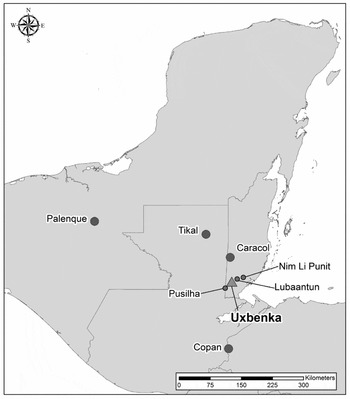
Uxbenka is a medium-sized polity located in the fertile foothills of the Maya Mountains near the modern Mopan Maya village of Santa Cruz in the Toledo District of southern Belize (Figure 1). It is one of the earliest and longest occupied sites in what is today a peripheral and sparsely populated region of the Maya Lowlands (Prufer et al. Reference Prufer, Moyes, Culleton, Kindon and Kennett2011). The three other major centers in the region, Pusilha, Lubaantun, and Nim li Punit, also are located in hilly terrain between the Maya Mountains and the coastal plain. Uxbenka, Lubaantun, and Nim li Punit are located on highly fertile upland soils of the Toledo Beds, but Pusilha is located on limestone bedrock and is associated with the Moho River drainage. Accelerator mass spectrometry radiocarbon dates (Culleton et al. Reference Culleton, Prufer and Kennett2012:1583–1585; Prufer et al. Reference Prufer, Moyes, Culleton, Kindon and Kennett2011:205–214) and ceramic crossties (Jordan Reference Jordan, Prufer and Thompson2014; Jordan and Prufer Reference Jordan and Prufer2014; Prufer et al. Reference Prufer, Thompson, Meredith, Culleton, Jordan, Ebert, Winterhalder and Kennett2017) indicate that Uxbenka was initially settled during the Late Preclassic (prior to A.D. 100) and its occupation extended into the Late/Terminal Classic period (ca. A.D. 800). Southern Belize reached its demographic peak during the Late Classic period, when all four major inland sites were occupied. Although the region is geographically isolated from other areas of the Maya Lowlands, inland and coastal sites exhibit evidence of trade and interaction with sites in the Petén, Guatemala, Highlands and the Belize Valley (Dunham et al. Reference Dunham, Jamison, Leventhal, McAnany and Isaac1989; Hammond Reference Hammond1975; McKillop Reference McKillop2009; Prufer et al. Reference Prufer, Moyes, Culleton, Kindon and Kennett2011).
The location of Uxbenka. (Map by A. E. Thompson.)

The Uxbenka Archaeological Project (UAP) began survey and excavation at Uxbenka in 2005. Excavation strategies focused primarily on building an absolute chronology to understand the founding and demise of the Uxbenka polity in relation to ecological variables and climate change (Culleton Reference Culleton2012; Prufer et al. Reference Prufer, Moyes, Culleton, Kindon and Kennett2011). The site core is comprised of nine groups of monumental architecture located atop modified hilltops. Masonry structures are limited to hilltops and are widely distributed across the landscape; this can be partially attributed to high rainfall levels (often greater than 4 m/year) that make low-lying areas unsuitable for habitation and subsistence milpa farming, which occurs on hillslopes (Prufer et al. Reference Prufer, Thompson and Kennett2015). Using a combination of pedestrian survey and Light Detection and Ranging (LiDAR), the UAP has identified 80 settlement groups of varying sizes and architectural complexity. These structures are dispersed over approximately 30 km2 and extend as far as 3 km from the site core (Prufer et al. Reference Prufer, Thompson and Kennett2015). Like many other Lowland Maya centers, the Uxbenka settlement area is best described in terms of low-density agrarian-based urbanism with a center surrounded by a dispersed settlement, emphasizing the importance of farming in these communities (Fletcher Reference Fletcher2009, Reference Fletcher and Smith2012; McAnany Reference McAnany, Sabloff and Henderson1993b; Robin Reference Robin2003).
To date, 44 settlement groups have been excavated. Type-variety analyses of diagnostic sherds from excavated settlement groups indicate that nearly all (n = 37) exhibit evidence of Late Classic occupation. The most represented ceramic groups are Remate Red, Puluacax Unslipped, and Turneffe Unslipped, with limited amounts of Belize Red, Zacatal Cream polychromes, and Hondo (see Supplemental Table 1). The Belize Red and Hondo Group ceramics are almost certainly imported, the first from western Belize and the second from Nim li Punit. Many of the Late Classic structures are ephemeral (less than 1 m high) and contain few diagnostic artifacts. Small sample sizes are due to the excavation of test pits focused on chronology building rather than the exposure of larger areas. Because settlements are located on hilltops, refuse was probably disposed of off hillsides. As a result, communal household middens did not develop and, unfortunately, were not incorporated into construction fill. On the positive side, the discrete hilltop placement of each settlement group also increases the likelihood that artifacts recovered nearby were consumed—and even produced—at that location. Although not all of the materials discussed in this paper were recovered from primary contexts (e.g., middens, burials), the ceramic sherds and tools recovered from within settlement groups are probably reflective of activities performed there.
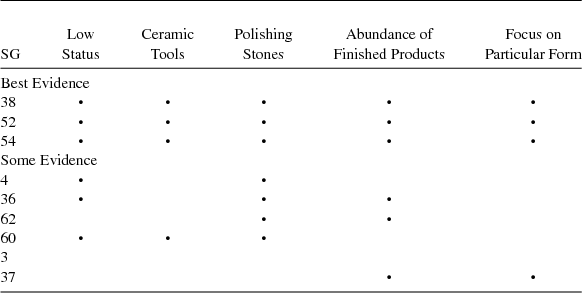
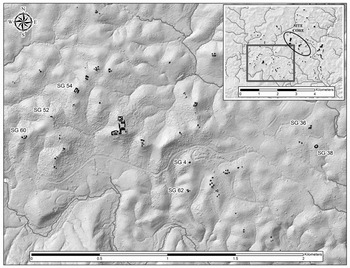
We identify households involved in ceramic production based on the presence of manufacturing tools, the abundance of finished products, and a focus on particular vessel forms within single settlement groups (Table 1). The strongest evidence for Late Classic household ceramic production comes from Settlement Groups (SGs) 38, 52, and 54. All three SGs have ceramic and ground stone tools, have greater quantities of finished products compared to other households, and evince production focused on a particular vessel form. SG 4, SG 36, and SG 62 also show evidence of Late Classic utilitarian ceramic production, although they do not present the full suite of features discussed above. There is evidence of Early Classic ceramic production at SG 60 (Figure 2). Lastly, residents of SG 37 likely participated in the production of incense burners, perhaps as attached specialists. This settlement group is located close to the site core and elite residences, and it contains an unusually large quantity of specialized ceramic forms.
Evidence for Ceramic Production at Uxbenka, by Settlement Group

Uxbenka site core and location of SGs with evidence of ceramic production. (Map by A. E. Thompson.)

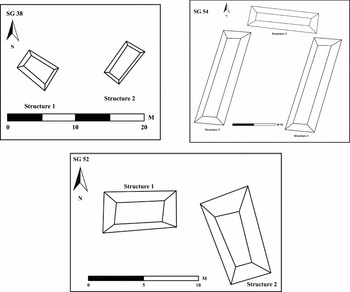
Our discussion focuses on SG 36, SG 52, and SG 54 because these groups exhibit multiple lines of evidence for Late Classic utilitarian ceramic production. All three settlement groups are low to moderate status households (Types 1–3). Similar to settlement typologies at other Maya sites (Ashmore Reference Ashmore1981), the settlement type designation at Uxbenka is based on the number, arrangement, and architectural elaboration of structures within a settlement group. Type 1 groups consist of a single structure, Type 2 groups consist of two to three structures with no formal arrangement, and Type 3 groups consist of four to seven structures formally arranged around a plaza. At a larger scale, Type 4 groups consist of seven to nine structures on raised platforms, and Type 5 groups consist of over 10 structures arranged around multiple plazas. The types represent status or functional differences between settlement groups. Artifact assemblages from SG 36, SG 52, and SG 54 are comparable and include locally produced ceramics, tools made from locally acquired chert, tabular sandstone abraders, granite grinding-stones, and obsidian blades. We hypothesize that settlement Types 1–3 at Uxbenka represent domestic residences of single family units of varying sizes (Figure 3).
Plan view of SG 38, SG 52, and SG 54.

Lack of Firing Features at Uxbenka
We did not locate any primary firing features associated with the firing process. This is no surprise. At Uxbenka, as elsewhere in the Maya Lowlands, potters likely used the open firing method. Results from a refiring experiment show that locally produced Uxbenka ceramics were fired at a temperature of between 700 and 800°C, consistent with open firing (Rice Reference Rice1987:156). Because Uxbenka household groups are located on hilltops, the extent of the architecture and high winds on hills would have made firing difficult. Ethnographic data indicate that most open firing is done in the early morning to avoid high winds (Bryant and Brody Reference Bryant and Brody1986; Deal Reference Deal1998; Reina and Hill Reference Reina and Hill1978; Rice Reference Rice1987; Shepard Reference Shepard1980). At Uxbenka, potters probably fired clay vessels at low points on the landscape, away from settlements, and perhaps on the leeward side of hills to reduce the effects of wind. Archaeological and ethnographic evidence indicates not all households were involved in craft production. In the absence of primary firing locations, the co-occurrence of the tools used in ceramic production, higher frequencies of finished products, and focus on a particular functional form are suggestive of individual (household) specialization at Uxbenka.
Tools of Manufacture
To create a functional ceramic vessel, potters must collect and process raw materials and form, finish, and fire the vessel (Rye Reference Rye1981). Many of the tools used throughout the manufacturing process are made from perishable materials, and they can be difficult to identify in the archaeological record. Excavations at Uxbenka did not recover evidence of resource acquisition (e.g., lumps of unfired clays, tempers, or pigments). Nonetheless, we did find an abundance of tools that are associated with finishing treatments such as smoothing, burnishing, and polishing. Usually, this process involved hard tools, such as stone, shell, wood, or ceramic sherds, that are moved over the vessel surface (Rye Reference Rye1981:89–90). The identification of portable production tools can be problematic because recovery context does not necessarily equate to production context (Hayashida Reference Hayashida1999; Stark Reference Stark and Nelson1985) and household tools are often multipurpose implements. We use a combination of use-wear studies and the presence of multiple tool types within a single settlement group to identify households that engaged in pottery production at Uxbenka.
Ceramic Tools
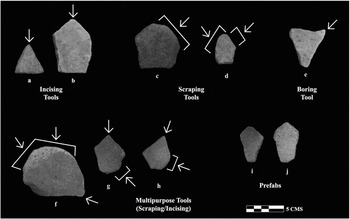
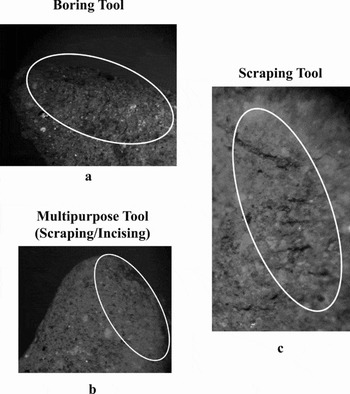
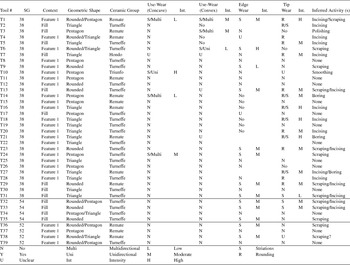
Broken ceramic vessels are used for various purposes including household construction and ritual activities. They also are used in the manufacture of new vessels as barriers between unfired pottery and open flames to reduce fire clouding and firing mishaps, as temper to improve the properties of clay, and as tools (Stanislawski Reference Stanislawski1969). Shaped ceramic production tools, first identified in the Maya Lowlands at K'axob, Belize (Lopez-Varela et al. Reference Lopez Varela, van Gijn and Jacobs2002), are fragments of fired ceramic vessels used for production activities including smoothing, scraping, incising, polishing, and boring (Figures 4 and 5). Jordan analyzed all non-diagnostic ceramic fragments collected by the UAP from site core and household contexts. Of the 44 settlement groups excavated at Uxbenka, ceramic sherd tools were found only at SG 38, SG 52, SG 54 (Late Classic), and SG 60 (Early Classic). All tools from Late Classic household contexts (n = 39) were analyzed as part of this study. Use-wear analysis followed the methodology established by Lopez-Varela et al. (Reference Lopez Varela, van Gijn and Jacobs2002) for sherd tools at K'axob based on experimental studies. We collected data on weight, width, length, thickness, and hardness (using a Mohs Hardness Scale) for each ceramic tool (Supplemental Table 2). Using a 40x VWR dissecting microscope, we also recorded directionality and intensity of use-wear on the concave and convex sides of the tool as well as the edges and tips. The average length (42.79 mm) and average width (30.97 mm) of the tools are commensurate with the K'axob data. Of the 39 tools analyzed, 13 exhibited no evidence of use-wear. These may have been prefabricated tools (Figure 4i–j) or the sherds were too soft or porous (Mohs hardness of 3–4) to show use-wear. Most of the tools were made from Turneffe Unslipped and Remate Red ceramic groups, and the paste characteristics are consistent with finished products found in the settlement groups at Uxbenka. Many of the expedient tools were used for more than one activity (Figure 4f–h). A tool not identified in the K'axob sample is a rounded type that likely functioned similar to a gourd scraper (Figure 4c; Reina and Hill Reference Reina and Hill1978:23). See Table 2 for a summary of use-wear data and inferred activities.
Selected ceramic production tools from SG 36, SG 52, and SG 54. (a:T2, b:T4, c:T6, d:T36, e:T21, f:T13, g:T32, h:T33, i:T8, j:T15.)

Microwear on select ceramic tools. (a:T21, b:T33, c:T36.)

Use-Wear and Inferred Activities for Ceramic Production Tools.

Polishing Stones
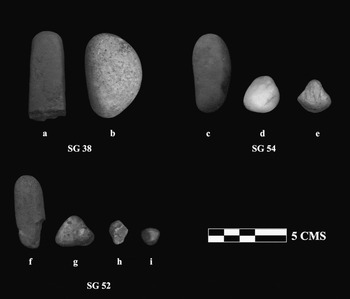
Waterworn chert, quartz, and sandstone pebbles were found at SG 4, SG 36, SG 38, SG 52, SG 54, and SG 62 (Figure 5). Hammond (Reference Hammond1975:363) notes the presence of pot polishers at Lubaantun. Unlike those from Uxbenka, the manuported pebbles from Lubaantun are primarily sandstones and siltstones. The pebbles at Uxbenka likely came from the nearby Rio Blanco, and were transported to habitation areas for use in household activities. In pottery production, such stones are used for smoothing a vessel (when the clay is still wet) or polishing it (when the clay is at the leather-hard stage; Shepard Reference Shepard1980:66). Among tools associated with ceramic production, polishing stones have been documented across the Maya region (Deal Reference Deal1998; Freter Reference Freter, Mastache, Parsons, Santley and Puche1996; Halperin and Foais Reference Halperin and Foias2010; Reina and Hill Reference Reina and Hill1978; Thompson Reference Thompson1958). They also can be used for activities unrelated to ceramic production, such as smoothing plaster, and caution is necessary in assigning pebbles to a potter's toolkit (Geib and Callahan Reference Geib and Callahan1988). In this case, use-wear, pebble size, and association with other pottery production tools suggest that waterworn pebbles at Uxbenka were used for smoothing and polishing ceramic vessels.
The material, weight, hardness, length, width, thickness, direction of wear, intensity of wear, and surface coverage were recorded for each stone tool (Supplemental Tables 3 and 4; Supplemental Figure 1). All analyses were performed by the first author to eliminate the effects of intraobserver error. Two types of polishing stones were identified for each household: rounded rectangular stones and rounded pebbles of varying sizes. The rounded rectangular polishing stones (Figures 6a, c, f) had an average length of 60.43 mm, average width of 23.67 mm, and average thickness of 16.05 mm. The most intense evidence of use is seen on the distal ends, with some parallel and oblique striations on the long sides. This type of use-wear on ground stone is consistent with ceramic production, particularly vessel smoothing. According to a Highland Maya potter, “only the ends of the stones were used for smoothing while the sides of the flat stones might be used to form the inside of a vessel rim” (Deal Reference Deal1998:40–41). The smaller pebbles exhibit use-wear on all facets and were likely used for polishing (Figures 6b, d–e, g–i; Herr and Stinson Reference Herr and Stinson2005:68).
The Finished Products
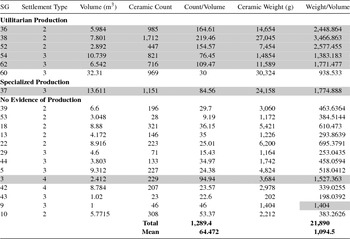
In the absence of primary production locations, archaeologists have used the abundance and distribution of ceramic vessel forms to identify ceramic production locations (e.g., Stark Reference Stark, Pool and Bey III2007). On their own, abundance data are problematic because they can be indicative of increased consumption or differential discard behavior rather than production. High sherd densities and concentrations of particular vessel forms or wares are more reliable indicators of ceramic production (Stark and Garraty Reference Stark and Garraty2004:126). Analyses of sherds from across the Uxbenka settlement area indicate that households with production tools have higher densities of finished products and an unusually high relative frequency of a particular vessel form type. To determine if households with production tools also had a greater abundance of finished products, we considered the total number and weight of sherds relative to the volume of excavated material. This quantitative measure provides complementary estimates of the number of pots at each settlement group (Rice Reference Rice2010:261–264). All settlement groups with production tools produced an abundance of ceramics well above the mean (Table 3). The only settlement group with higher-than-average numbers of finished products without evidence of ceramic production is SG 3, a Type 4 settlement group. It is possible that the high-status residents used greater quantities of vessels, but this hypothesis warrants further investigation.
Abundance of Finished Products by Volume (SG Sherd Counts/Weights above the Mean Are Highlighted in Gray).

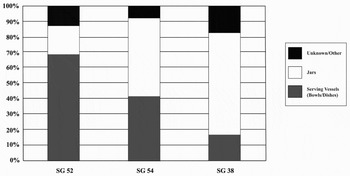
It is unlikely that the greater abundances of ceramic sherds at settlement groups with production tools are due to higher rates of consumption. Relative frequencies of vessel forms indicate higher quantities of particular vessel classes for SGs 38, 52, and 54. For each settlement group, diagnostic ceramics were classified according to primary vessel form based on the classification of vessel forms at Seibal (Sabloff Reference Sabloff1975): serving vessels (bowl/dish), jars, unknown/other (e.g., appendage). Each sherd also was assigned to a ceramic group (defined in Hammond Reference Hammond1975) based on surface treatment. Both SG 38 and SG 54 focused on the production of jars. SG 38 likely produced unslipped (Turneffe ceramic group) jars while SG 54 produced red-slipped (Remate Red ceramic group) jars. SG 52 was involved in the production of Remate Red serving wares (Figure 7). It is unclear if each settlement group produced all vessel forms for their household, or if they specialized in a single form and traded for others. This issue will be addressed by future petrographic analyses on the Uxbenka assemblage. The data on vessel forms at each group are unlikely to be the result of different consumption practices because each settlement group was of a similar size and status.
Spatial Distribution of Producing Households
SGs 36, 52, and 54 are clustered in the southwest periphery of Uxbenka (see Figure 2). The spatial arrangement of production households is instructive for three reasons. First, the location of these households on the periphery of the site is consistent with Fry's (Reference Fry and Aimers2013:76) proposal that “production locations were dispersed in lower-density occupation areas at the edge of major sites,” possibly due to the proximity of resources (e.g., clays and tempers) or the pollution (smoke) associated with open firing. Households with evidence of ceramic production at Copán, Honduras, were strategically located near clay sources (Freter Reference Freter2004:99). The southwest periphery of the Uxbenka settlement area is situated on chik lu'um soils, which are “poorly-drained oxidized red soils” (Culleton Reference Culleton2012:95) with a very high clay content. This characterization of chik lu'um clays is consistent with macroscopic observations of ceramic paste properties. Future work will focus on geological sampling to determine if the clay sources near producing households were indeed used for pottery production. The nearby Rio Blanco, a major water source, also would have been useful to potters. Second, all potters at Uxbenka belong to lower-status households. In both Chanal and Aguacatenango, domestic potters were of lower to middle socioeconomic status (Deal Reference Deal1998). According to Deal (Reference Deal1998:26), “for wealthier households there was no economic pressure on the women of the household to learn pottery making.” Third, the presence of an Early Classic potting household in the same spatial location as the Late Classic household suggests continuity in locale and toolkit for this activity at Uxbenka.
Household Modes of Production and Archaeological Correlates
Most discussions of ceramic production in Mesoamerica use the classification schemas proposed by Van der Leeuw (Reference Van der Leeuw1977), Peacock (Reference Peacock1982), Rice (Reference Rice1987), or Santley et al. (Reference Santley, Arnold III and Pool1989). These divide production into four (or more) main categories based on the amount of time devoted to craft production (i.e., part-time vs. full-time) and whether production takes place within the household or in a designated, nonresidential workshop. These classes are useful but the distinction between household and workshop industries is not as relevant to utilitarian pottery production in the Maya Lowlands because no evidence of pottery production workshops has been found (Rice Reference Rice2009). Therefore, we follow the classification proposed by Costin (Reference Costin1991) as a means to frame our discussion.
For our purposes, a specialist is a potter who produces more vessels than he or she consumes, regardless of intensity of production (Costin Reference Costin, Feinman and Price2001; Rice Reference Rice, Bishop and Lange1991). Since it is unlikely that utilitarian vessel production was sponsored by elites for their own use within the political economy, the distinction between independent and attached production is not germane to this case (Costin Reference Costin, Feinman and Price2001:276). We follow Hirth (Reference Hirth and Hirth2009:21) and use the term “intermittent crafting,” because the distinction between part-time and full-time activities does not accurately reflect time allocation of household activities in agrarian societies. Intermittent crafting means that potters produce vessels during only part of the year, dependent on weather conditions and time allocated to other household activities such as subsistence (Arnold Reference Arnold1985). The following is a review of household production, individual (household) specialization, and community specialization, the modes most relevant to Lowland Maya utilitarian ceramic production. It should be noted that McKillop (Reference McKillop2002) documented evidence of nondomestic, specialized production of vessels for salt production at coastal sites in southern Belize. Clearly defining the boundaries of the modes of production and assigning archaeological data to them can be a difficult task because all three modes occur within residential contexts and ethnographic data indicate that considerable variability can exist within each (Arnold Reference Arnold2008). Other types of specialization (e.g., workshops and attached specialization) are not described.
Household production, also called domestic production, occurs when potters produce vessels solely for their own use or that of their household. This mode of production is occasional, not influenced by market demand, and leaves few material traces (Rice Reference Rice1987). Although this type of production undoubtedly occurred in the past, it is difficult to identify archaeologically because the ceramic assemblages of producing and nonproducing households are similar in composition and density (Santley et al. Reference Santley, Arnold III and Pool1989:108). Furthermore, household potters often use expedient, multipurpose tools, and any evidence of production is intermixed with residential debris (Arnold Reference Arnold1991).
Individual (household) specialization occurs “when autonomous individuals or households produce for unrestricted local consumption” (Costin Reference Costin1991:8). This type of specialization is most similar to the household industry category, in which consumers are often members of the potters’ communities (Rice Reference Rice1987; Santley et al. Reference Santley, Arnold III and Pool1989). Household specialization is still an intermittent activity, but more frequent than domestic production. Among the Tzetzal Maya, Deal (Reference Deal1998) distinguishes between part-time, elementary specialization and full-time, artisan specialization. Both produced limited vessel forms, but elementary specialists produced vessels more frequently and for people outside the household. Differentiating these types of production based on the archaeological record may not be possible. Household specialization results in higher vessel frequency and more tools than household production; production debris is intermixed with residential debris but more visible in the archaeological record. This is the most common mode of production at Matacapan (Santley et al. Reference Santley, Arnold III and Pool1989) and probably also at Lubaantun (Hammond et al. Reference Hammond, Harbottle and Gazard1976), Colha, and Kichpanha (Iceland and Goldberg Reference Iceland and Goldberg1999), given that these sites were self-sufficient in ceramic production and show evidence of limited distribution. Household specialization also may have occurred at Copán (Freter Reference Freter, Mastache, Parsons, Santley and Puche1996) and in some households at Caracol (Chase and Chase Reference Chase and Chase2014).
Community specialization occurs when “an autonomous individual or house-based production units, aggregated within a single community, produce for unrestricted regional consumption” (Costin Reference Costin1991:8). Community specialization is common among contemporary Mesoamerican potters (Deal Reference Deal1998; Reina and Hill Reference Reina and Hill1978), and it was probably at least one of the modes of production at Tikal and Palenque. Ethnographic and archaeological evidence suggest that community specialists often focus their production on a particular vessel form. Homogeneity in paste groups for a particular vessel form is further evidence of this mode of production. Some researchers have suggested that community specialization may occur when a site is close to a high-quality raw material source, as has been documented among lithic producers at the site of Colha (Shafer and Hester Reference Shafer and Hester1991). Community specialization may also arise in response to growing population and a greater demand for utilitarian vessels.
Ethnographic documentation indicates that the intensity and scale of domestic production is based on the economic needs of community residents. Household specialization is most common among potters in Mesoamerica, although production solely for household consumption and community specialization for regional consumption are also present (Arnold Reference Arnold1985; Arnold Reference Arnold1991; Deal Reference Deal1998; Reina and Hill Reference Reina and Hill1978; Stark Reference Stark and Nelson1985). Due to the abundance and availability of natural resources used for producing pottery in the Maya Lowlands, ceramic production was possible at every ancient Maya site (Foias and Bishop Reference Foias, Bishop, Pool and Bey III2007; Freter Reference Freter, Mastache, Parsons, Santley and Puche1996, Reference Freter2004; Hammond et al. Reference Hammond, Harbottle and Gazard1976; Howie Reference Howie2012; Iceland and Goldberg Reference Iceland and Goldberg1999). Although each polity could have been self-sufficient, community specialization did occur (Fry Reference Fry1979; Rands and Bishop Reference Rands, Bishop and Fry1980; Scarborough and Valdez Reference Scarborough, Valdez, Scarborough, Valdez and Dunning2003; Schafer and Hester Reference Shafer and Hester1991). Like ceramic production in modern villages across Mesoamerica, modes of domestic production among the ancient Maya probably varied spatially and temporally and may have even occurred simultaneously, particularly at larger sites.
Discussion
Archaeological interpretations of the organization of pottery production often rely on less-than-ideal datasets, particularly in the Maya Lowlands (Rice Reference Rice1987). In the absence of primary firing features, archaeologists must rely on tools and finished products to make inferences about the organization of craft production. At Uxbenka, households participating in ceramic production were clustered near one another, used a similar repertoire of production tools, and focused production on a particular vessel class. The location of production households may have been determined by the presence of natural resources (e.g., clays or water) or the pollution of the open firing process. The clustering of production households and shared production toolkits could also be indicative of workgroups (Deal Reference Deal1998). The current data indicate that three (and potentially eight) households were involved in utilitarian pottery production. Nonetheless, the absence of evidence in other settlement groups at Uxbenka does not necessarily indicate absence of production, due to the often ephemeral nature of domestic ceramic production.
In studies of residential production, it is important “not to conflate scale and intensity” (Feinman Reference Feinman, Skibo and Feinman1999:85) when assessing production organization. The intensity of production refers to the amount of time potters spend on their craft. The scale of production is characterized by the size and composition of the production unit (Costin Reference Costin1991). More recent discussions of production stress the importance of decoupling these two aspects of scale (Arnold Reference Arnold2015:4–5; Costin Reference Costin, Feinman and Price2001). We have no way of knowing how many potters participated in production at Uxbenka; nonetheless, given that production occurred within the household we can infer that the production units were composed of kin-based groups consistent with ethnographic reports from across Mesoamerica. Residents of lower-status households, such as those at Uxbenka, tend to learn craft production within the family context, while higher-status households interact with a broader range of personnel (Hayden and Cannon Reference Hayden and Cannon1984).
Following Hirth's (Reference Hirth and Hirth2009) characterization of household craft production, potters at Uxbenka were intermittent crafters who also farmed the surrounding landscape. There is no evidence of significant multi-crafting, and the high-quality agricultural land surrounding Uxbenka (Culleton Reference Culleton2012) suggests that pottery production was not a risk-management strategy to subsidize household subsistence (Hirth Reference Hirth and Hirth2009). Given that it is impossible to reconstruct time allocation in the past, it is perhaps more useful to consider craft production in terms of product specialization rather than economic specialization. According to Rice (Reference Rice2010:357), this approach “distinguishes specialists, or individuals having an occupational (or task, or process) specialty or special skill, from the existence of economic specialization in the context of the ‘self-sustenance’ of a domestic unit (group or community).” Taken together, the data indicate that at Uxbenka during the Late Classic period, some level of residential-based product specialization took place in which the producing household focused on particular functional classes.
The data we have presented, together with information on ceramics from other polities, allow us to better understand the regional economy of southern Belize during the Late Classic. Leventhal (Reference Leventhal, Danien and Sharer1992) proposed the existence of a southern Belize tradition based on the absence of vaulted architecture and limited masonry superstructures, the use of natural topography in construction (modified hills), ballcourts enclosed by walls, numerous carved monuments, and inconsistent lunar series content on carved monuments. More recent evaluations, based primarily on epigraphic evidence, indicate that the four major centers in southern Belize were largely independent (Braswell and Prufer Reference Braswell and Prufer2009:52). Pusilha, Uxbenka, and Nim li Punit all have emblem glyphs suggesting some level of political independence; inscriptions on over 60 carved monuments never mention the other polities in the region (Braswell and Prufer Reference Braswell and Prufer2009). The epigraphy is instructive but only provides insight on elite interactions. Given that all four major polities in southern Belize are located less than 47 km from one another, it is possible that nonelite residents of these polities interacted with one another independent of their elite rulers, either through direct interaction or marketplace exchange (Masson and Freidel Reference Masson and Freidel2012).
The pottery of Pusilha is significantly different stylistically and technologically from the other major centers, suggesting interaction with sites outside of southern Belize, most likely the southwestern Petén (Bill and Braswell Reference Bill and Braswell2005). As a result, Pusilha is not considered in our discussion of regional production and distribution. Uxbenka, Nim li Punit, and Lubaantun share the same ceramic groups originally identified by Hammond (Reference Hammond1975), although differences exist in abundance of types, vessel form, and technology (Fauvelle et al. Reference Fauvelle2012:Figure 6; Hammond Reference Hammond1975; Jordan and Prufer Reference Jordan and Prufer2014). For example, Hondo group ceramic materials that were likely produced at Nim li Punit (based on abundance) are virtually absent at Lubaantun and Uxbenka, while sherds of the coarse-tempered Puluacax group—a southern Belize tradition— are abundant at Uxbenka and Lubaantun but less common at Nim li Punit (Supplemental Table 1). Turneffe Unslipped jars, the most abundant ceramic and form group, display different forms in different polities. The most abundant jar form at Lubaantun is the vertical-neck jar, a form rarely found at Uxbenka, where jars have little or no neck. The majority of sherds at Lubaantun are tempered with limestone (60 percent), while very few sherds at Nim li Punit (6 percent) contain limestone (Fauvelle et al. Reference Fauvelle2012:56). The ceramic pastes at Lubaantun and Uxbenka are most similar, although Uxbenka sherds are also tempered with crystalline calcite; the different vessel forms suggest to us that different social units were involved in their production. INAA analysis of Lubaantun ceramic materials indicate utilitarian and polychrome vessels were produced using similar raw materials recovered within 6 km of the site core (Hammond et al. Reference Hammond, Harbottle and Gazard1976).
Waterworn pebble tools from SG 36, SG 52, and SG 54. (a:L2, b:L3, c:L5, d:L19, e:L10, f: L11, g:L12, h:L13, i:L20.)

Relative frequency of vessel forms from SG 36, SG 52, and SG 54.

If potters residing in southern Belizean Maya sites participated in community specialization, the finished products should be widespread across southern Belize, reflecting unrestricted regional distribution of goods. The exact opposite appears to be the case, indicative of household specialization and intrapolity distribution of finished products. The general lack of economic interaction between Lubaantun and Nim li Punit is further supported by differential access to and proportions of obsidian at the two sites (Daniels and Braswell Reference Daniels and Braswell2014). Nonetheless, some exchange certainly existed, as evidenced by the small number of Hondo group ceramic sherds from Nim li Punit that are found at Uxbenka and Lubaantun. Further, ceramic vessels and salt were likely traded between inland and coastal sites (McKillop Reference McKillop2002). Nevertheless, the data suggest that a vibrant, intraregional market system, in which ceramic vessels were exchanged on a regular basis in large quantities, did not exist in Late Classic southern Belize. At the same time, mechanisms were in place for the acquisition of nonlocal items, as evidenced by the presence of obsidian and granite in the assemblages of all three polities (Nazaroff and Prufer Reference Nazaroff, Prufer, Prufer and Thompson2011). There is not enough evidence to characterize the organization of production at Lubaantun and Nim li Punit, although indications exist that they were also self-sufficient in terms of domestic pottery production. Our work at Uxbenka supports Hammond et al.’s (Reference Hammond, Harbottle and Gazard1976:166–167) assertion that both polychrome and utilitarian vessels were produced locally using similar raw material sources. All available data indicate that the polities of southern Belize had independent domestic economies during the Late Classic period despite their proximity to one another and relative isolation from other polities.
We used ethnographic data from Mesoamerica to contextualize this discussion and provide some explanation for the patterns of ceramic production and consumption observed in Late Classic southern Belize. Self-sufficiency and household specialization are potentially related to three factors: widely available natural resources, high-quality agricultural lands, and small population sizes. Each major polity used different clays and tempers, presumably located within close proximity (Arnold Reference Arnold1985). Pottery is no longer commonly produced in southern Belize today, but in the 1920s villages produced their own pottery using locally available materials (Thompson Reference Thompson1930). This tradition continued until at least the 1960s (Hughes-Hallett Reference Hughes-Hallett1972, Reference Hughes-Hallett1974). Ancient Maya potters accessed the same lands as groups today and would not have had to travel far for clays and tempers. In Highland Guatemala, community specialization is often linked to a lack of high-quality agricultural lands. Ceramic production is a means for potters to supplement household income and trade for comestibles. Uxbenka, Lubaantun, and Nim li Punit are all located on well-drained, high-relief features on the Toledo Bed, composed of interbedded sandstones and mudstones (Culleton Reference Culleton2012; Prufer et al. Reference Prufer, Thompson and Kennett2015). The geology of this region, combined with high annual rainfall rates, makes southern Belize an extremely fertile region of the Maya Lowlands. Today, nearly every household in Santa Cruz village participates in subsistence farming (Baines Reference Baines2015). Community specialization and subsequent exchange with other polities as a risk management strategy may not have been necessary in regions with abundant and fertile farmland. The polities of southern Belize are much smaller than those where community specialization has been inferred from the archaeological record (e.g., Tikal and Palenque) or documented ethnographically (e.g., Amatenango). Hammond (Reference Hammond1975) suggested that Lubaantun had no more than 3,000 inhabitants and probably many fewer. Uxbenka has been estimated to have a Late Classic population of 3,427 based on an estimate of 5.5 persons per household, which stands in stark contrast to polities such as Tikal with population estimates of 49,000 inhabitants (Haviland Reference Haviland1969:429). The conditions of self-sufficiency and household specialization are the likely result of a combination of widespread suitable clays for pottery production, an abundance of suitable agricultural land that did not require community specialization as a risk management strategy, and small population sizes that kept demand low.
Conclusion
The data from Uxbenka demonstrate the utility of investigating domestic pottery production in the absence of primary production locales. This has significant implications for the study of household economic organization in low-density urban settings. It is necessary to use multiple lines of evidence, including spatial data, use-wear on production tools, and analysis of finished products to identify households engaging in ceramic production. If archaeologists can identify more than one household participating in ceramic production, then some inference can be made about the organization of production. This case study highlights the importance of considering craft production within the social, political, and environmental context of the potter (Costin Reference Costin1991). Utilitarian vessel production in southern Belize occurred somewhere on a continuum between household production and household specialization. Although the evidence from Uxbenka cannot be directly applied to Lubaantun or Nim li Punit, it is unlikely that community specialization existed in southern Belize during the Late Classic period. The lack of larger-scale community specialization could be due to the widespread availability of high-quality clays and tempers, low population densities resulting in less demand, or very productive agricultural lands that did not require residents to turn to craft production to subsidize the household.
Acknowledgments
We would like to thank the Belize Institute of Archaeology, particularly Dr. John Morris and Dr. Jaime Awe. Research from 2005 to 2015 was conducted under permits issued by the Belize Institute of Archaeology to Dr. Keith Prufer, the most recent of which was permit number IA/H/2/1/15(10) for 2015. We appreciate the invaluable comments from Laura Kosakowsky, Prudence Rice, Norman Hammond, and two anonymous reviewers. Thank you to all of the members of the UAP, particularly Amy E. Thompson for providing maps and Brian and Edward Bardalez for helping with the initial sorting and cataloguing of ceramics. We appreciate Dr. Bruce Huckell and Thaddeus Liebert for providing guidance on lithic and ground stone analyses and Dr. Patricia Crown for reading an early draft of this manuscript and providing thoughtful comments and critiques. Funding was provided by the Wenner-Gren Foundation to Jillian M. Jordan and by the National Science Foundation (grants BCS-0620445 and HSD-0827305) and the Alphawood Foundation (2010–2014) to Keith M. Prufer.
Data Availability Statement
The artifacts discussed in this article were excavated by the UAP, directed by Keith M. Prufer. Excavation reports are on file with the Belize Institute of Archaeology and are available from either author upon request. The analyses and interpretations form part of Jillian M. Jordan's doctoral research. The data are available from the first author by request.
Supplemental Materials
Online supplemental materials are linked to the online version of this paper, which is accessible via the SAA member login at http://dx.doi.org/10.1017/laq.2016.3. These include the following files:
Supplemental Table 1. Relative Frequencies of Major Ceramic Groups at Uxbenka, Lubaantun, and Nim Li Punit.
Supplemental Table 2. Ceramic Production Tools.
Supplemental Table 3. Waterworn Pebble Tools.
Supplemental Table 4. Use-Wear on Waterworn Pebble Tools.
Supplemental Figure 1. Surface Descriptions for Waterworn Pebble Tools.