Description of the “Inca Mirror”
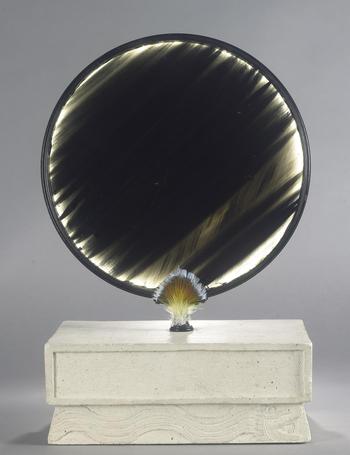
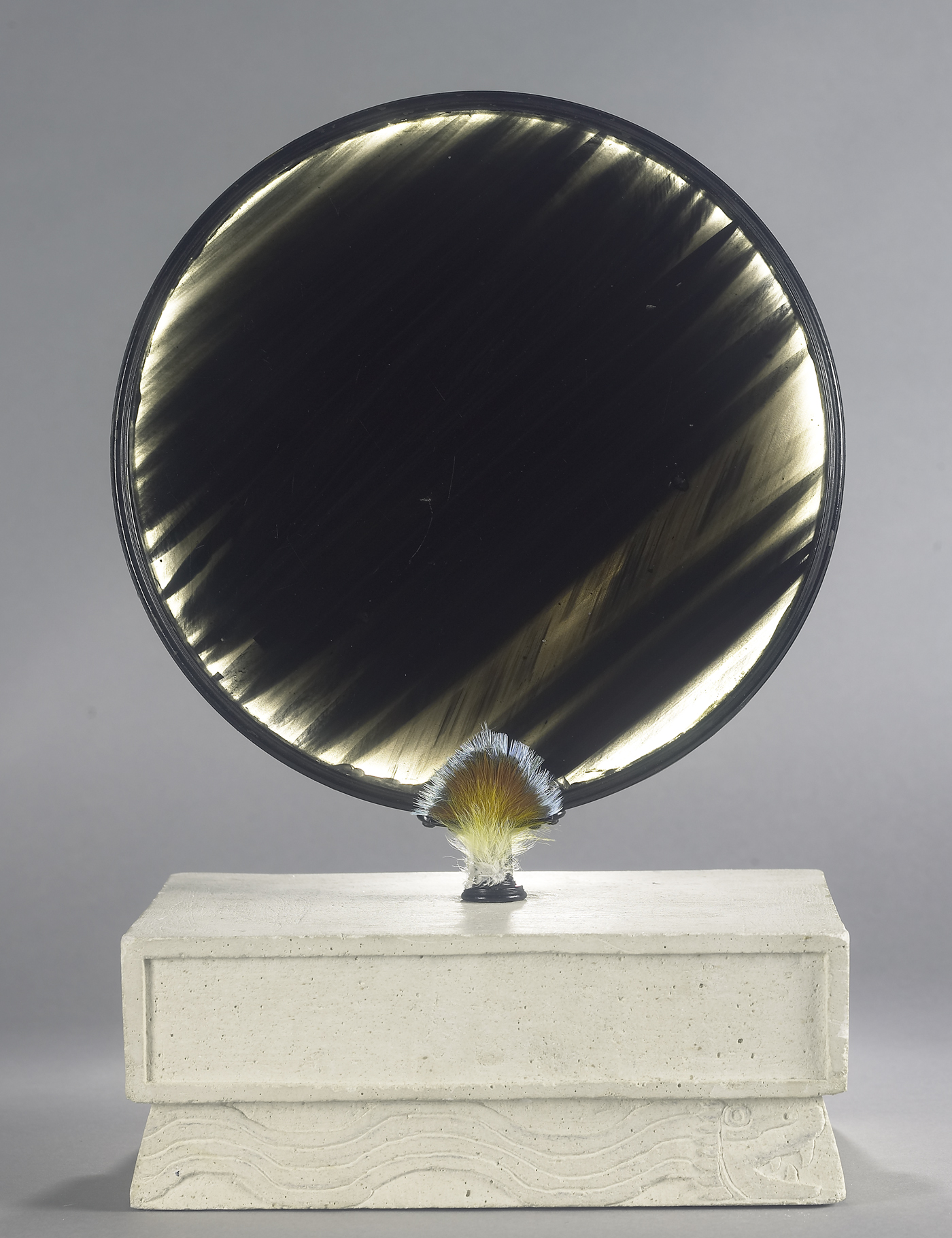
The artifact, which is part of the mineralogical-geological collection of the Muséum National d'Histoire Naturelle (MNHN) in Paris, is a polished lens of obsidian, measuring 250 mm in diameter and 20 mm in maximum thickness, mounted in a black-painted bronze circular frame on an oak pedestal (Figure 1). An old handwritten note under the base reads “Mirror of the Incas, Gallinace stone, Plinian Obsidian stone” [translation by authors], with the number 22.U on the back of the label (Schubnel et al. Reference Henri-Jean, Chiappero and Gonthier2001:31). Henri-Jean Schubnel, curator of the MNHN mineralogical collection, could not link this number to any reference in the museum catalogs and hence assigned to it the new reference 176.101.
Obsidian “Inca mirror” No. 176.101 of the Muséum National d'Histoire Naturelle (Ø: 250 mm x 20 mm thickness). The plaster base and the feather decoration were added and made in a Mesoamerican style to conform to the supposed Mexican origin of the mirror. (Photograph by D. Vigears/C2RMF.)
Historical Analysis
In 1987, Mireille Simoni-Abbat suggested that the lens was part of the treasures sent by Hernán Cortés to Emperor Charles V, which was captured by the French privateer Jean Florin (Simoni-Abbat Reference Simoni-Abbat, Battesti and Schubnel1987:53; see also Supplemental Text 1). She also noted, however, that Dezallier d'Argenville reported the presence in “the gallery of the Natural History … located in the Jardin [Royal] des Plantes Médicinales [currently the Jardin des Plantes], of a large biconvex plate of black and wavy crystal, found in the tombs of the Incas in Peru” (Reference Dezallier d'Argenville1742:199).Footnote 1 All translations of primary sources are by the authors. The latter historical description, which is in good agreement with the appearance of the lens, rules out a Mexican origin.
It is known that Cortés used to take note of all objects he was shipping to the emperor, to his father, or to other influential Spaniards to prevent him against possible accusations of embezzlement. The lists of his treasures shipped to Spain do not mention an obsidian lens or a similar artifact (Martínez Reference Martínez1990:232–249). To determine how and when the object reached the Jardin Royal des Plantes médicinales (JRPM) therefore required a reappraisal of the historical records.
On the Inca Trail
Our bibliographic investigations of old descriptions of the MNHN and the JRPM collections found several mentions of this type of object. This section includes the most relevant and oldest ones.
In 1803, according to the Count de Caylus, who was himself citing Antonio de Ulloa, Louis de Launay reported that “the former inhabitants of Peru … employed this stone to make mirrors” and that “we found in the tombs of the ancient Peruvians, two sorts of mirrors, some of Inca stone, a kind of pyrite, and others of gallinace stone: the Peruvians worked them on both sides into the shape of a lens, and polished both surfaces so that they reflect objects” (Reference de Launay1803:363–364).
In 1802, Nicolas Jolyclerc gave an accurate description of obsidian mirrors:
One, which is called … in Peru stone of gallinace or Inca mirror, is a black glass…. The inhabitants of Peru used it as a glass to make their mirrors.… One of these mirrors is displayed in the galleries of the National Museum of Paris. It is nine inches in diameter and ten lines thick; it is convex on both sides, but with a somewhat rough and uneven surfaceFootnote 2 (Reference Jolyclerc1802:343).
In 1768, Valmont de Bomare devoted a paragraph to the stone of gallinace: it is a “kind of blackish glass, very hard and heavy, that the Peruvians use to make their mirrors,” and “a very beautiful example may be seen in the King's Cabinet of Natural History; it was found in a remote tomb in the Pichencha [sic: Pichincha] mountains near Quito. It is nine inches in diameter and one face is more polished than the other” (Reference Valmont de Bomare1768:590).
Count de Caylus's dissertation on obsidian written in 1764 gave the key to the origin of mirror No. 176.101:
According to Mr. Godin, in a letter written to Mr. the Count de Maurepas … The Stone of gallinace is a sort of very beautiful black crystal; its color evokes the name gallinace after a bird common in America…. The Indians also call this stone money of the dead, guanucuna culqui, because it was their custom to bury pieces with their dead and shaped pieces are indeed found in their tombs… two such worked fragments are conserved in the Cabinet d'Histoire naturelle du Jardin du Roy. The larger, as Mr. Godin stated, is one of the most beautiful that we have seen from the country; it was found in a remote tomb in the mountains, near Quito; it is nine inches in diameter, and ten and half lines thick, convex on both sides but with unequal curvature, and one of its faces is more polished than the other; it would appear that the ancient Indians used it as a mirror [Reference de Caylus and Philippe1764:485].
The Godin–La Condamine Expedition to South America (1735–1743)
Two major French scientific expeditions were mounted in 1735 and 1736—the first to South America and the second to Lapland—to measure the angle of arc at the meridian in order to test Newton's theory that the terrestrial globe is flattened at the poles. Two Spanish naval officers—Antonio de Ulloa (1716–1795) and Don Jorge Juan y Santacilia (1703–1773)—were seconded by King Philippe V of Spain (1683–1746) to the South American expedition led by Louis Godin (1704–1760).
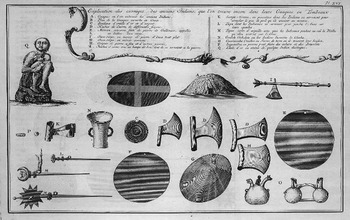
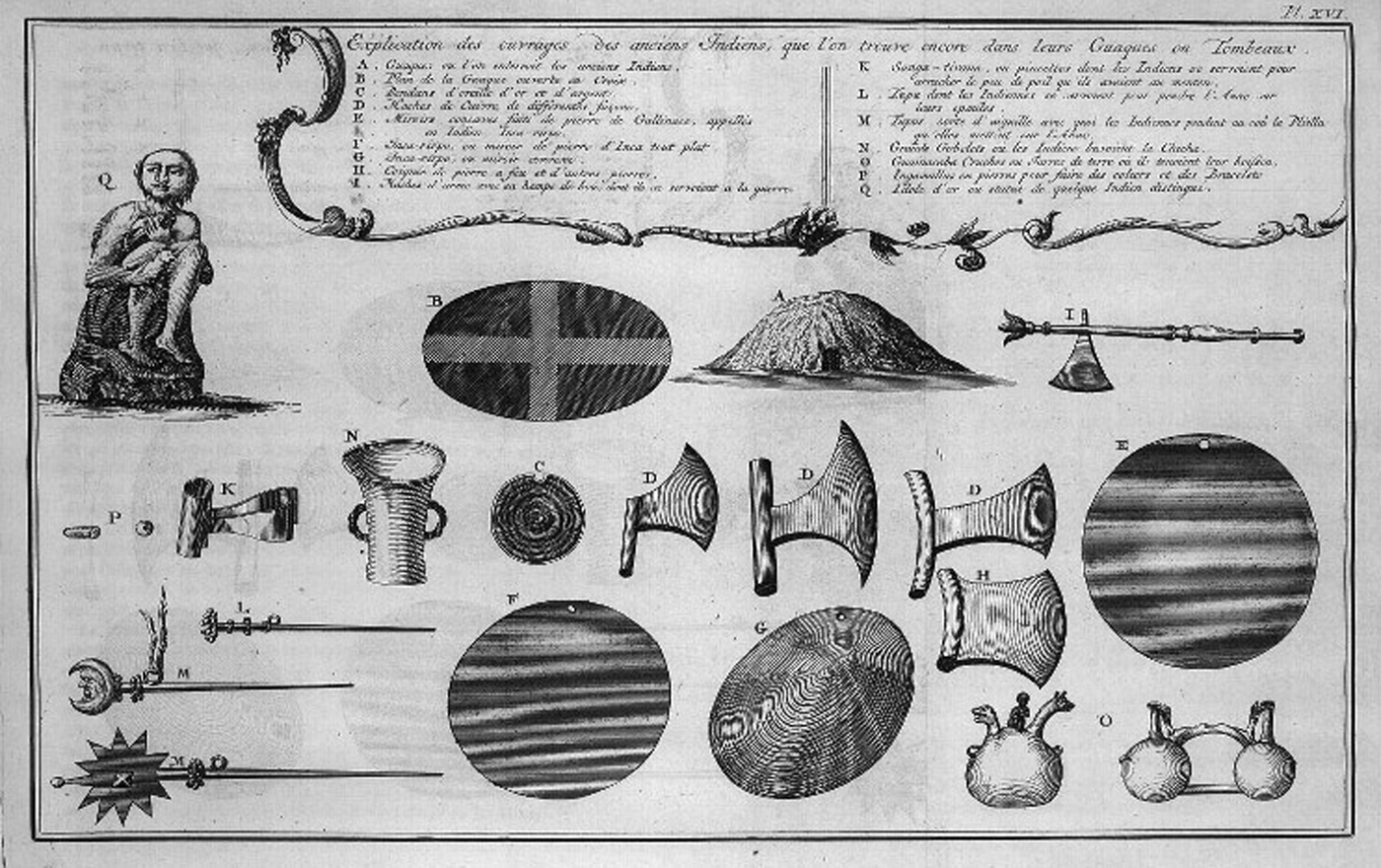
At the end of the eight-year mission in 1743, de Ulloa published a travel journal.Footnote 3 His report on the opening of the “Guasques” (burial mounds) is illustrated by drawings, notably Plate XVI, which represents the ruins of prehispanic buildings and the discovered artifacts (de Ulloa Reference de Ulloa1752). Along with pieces of ceramic artifacts and jewelry there are three wavy lenses pierced with a hole near the edge (Figure 2), although it is not clear that such obsidian mirrors are genuine artifacts from the prehispanic Andean cultures; these objects could be colonial and been fraudulently presented to the expedition team as archaeological relics.
Plate XVI from Journal de Voyage of Antonio de Ulloa (Reference de Ulloa1752) depicting three obsidian mirrors: E, F, and G.
The Gallinace Stone
The term “stone of Gallinace” employed by de Ulloa to describe the obsidian refers to the color of feathers from the black vulture (Coragyps atratus), similar to that of the dark bands found in the Gallinace stone, as seen in the obsidian lens No. 176.101. De Ulloa specifies: “Two kinds of stone mirrors are found in the Guasques, some made of Inca stone, and others of Gallinace stone…. The name comes from its color, like that of the Gallinazo.… Among the mirrors of the latter type, some are flat, others are concave and yet others are convex” (1752:L.VI, chap. XI, 383–385, 392).
Shipments from the Godin–La Condamine Expedition to the Jardin du Roy
The archaeological artifacts collected by the astronomers in Ecuador were sent to various destinations. La Condamine reports that the shipments of June 1737 and October 1740 were lost, but that two others reached their French recipients: Charles Cisternay du Fay (1698–1739), intendant of the Jardin du Roy, and Jean Frédéric Phélypeaux, Count de Maurepas (1701–1781), navy minister under Louis XV: “The cabinet of the Jardin du Roy houses our first shipments, sent together from our islands and from Portobelo [sic: Portobello, Panama] in 1735, and another shipment made from Quito in 1737, by Mr. Godin, in which I was much involved” (de La Condamine Reference de La Condamine1751:104, footnote).
Excerpts from a letter by Godin confirm this shipment: “I sent to my lord the Count de Maurepas, in the month of May 1737 from Quito… a crate containing various curiosities to the address of my lord the Count de Maurepas: it was received by M. du Fay, and apparently distributed in the cabinet of the King” (Godin Reference Godin and Sérieys1802[1752]:214, 217). The lens arrived in Paris in 1737 and was later mounted in its bronze frame.
Analytical Techniques
All obsidian slabs and mirrors conserved at the MNHN (Musée de l'Homme) and at the Musée du Louvre were nondestructively analyzed by the particle induced X-ray emission (PIXE) method using the AGLAE accelerator of the Centre de Recherche et de Restauration des Musées de France (C2RMF), which had been placed in the Musée du Louvre for a previous study (Calligaro et al. Reference Calligaro, Dran, Dubernet, Poupeau, Gendron, Gonthier, Meslay and Tenorio2005; Supplemental Figure 1).
PIXE Analysis of Obsidian Lens No. 176.101
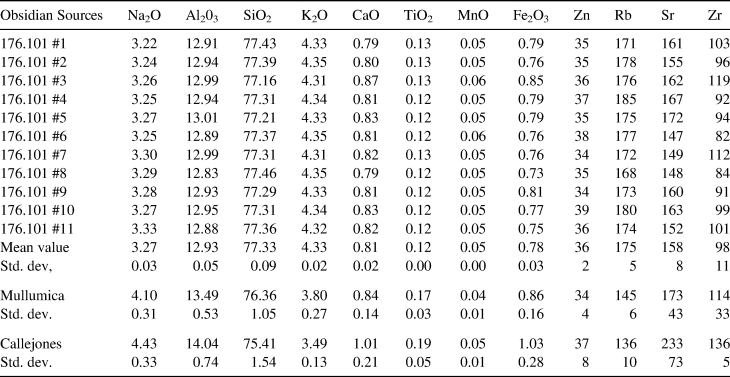
The obsidian of mirror No. 176.101 is translucent; it exhibits parallel dark and light bands alternating across much of the disc. This banding of microscopic inclusions probably reflects the direction of the flow during its formation. The chemical composition of the material measured on 11 spots located every 2 mm across a band on the more polished face varies little (Table 1), reflecting the homogeneity of the glass matrix. Comparison of the recorded compositions with those of obsidian from Mexican sources reported in Calligaro and colleagues (Reference Calligaro, Dran, Dubernet, Poupeau, Gendron, Gonthier, Meslay and Tenorio2005) and elsewhere (Cobean Reference Cobean2002) disproves a Mexican origin, particularly considering the presence of three trace elements: manganese (Mn), rubidium (Rb), and zirconium (Zr). The museum lens contains 360 ± 32 µg/g Mn. Only two Mexican sources have Mn concentrations in this range: Paredón (Puebla State; 358 ± 18 µg/g) and Otumba (Mexico State; 380 ± 26 µg/g). All other Mexican sources have either markedly higher or lower concentrations. The low Zr concentration in the lens (97 ± 22 µg/g) excludes the Paredón deposit (193 ± 14 µg/g), whereas the high Rb concentration in the lens (175 ± 9 µg/g) excludes the Otumba deposit (118 ± 5 µg/g). Thus the chemical composition of the obsidian of the lens does not correlate with any analyzed obsidian source from Mexico. The uncertainties given for our measurements correspond to two standard deviations (95% confidence level).
Composition of Obsidian from the “Inca Mirror” No. 176.101 Compared to that of the Mullumica and Callejones Sources in Ecuador.

Note: Oxide concentrations are given in weight percentage, whereas elemental trace elements are given in μg/g (ppm).
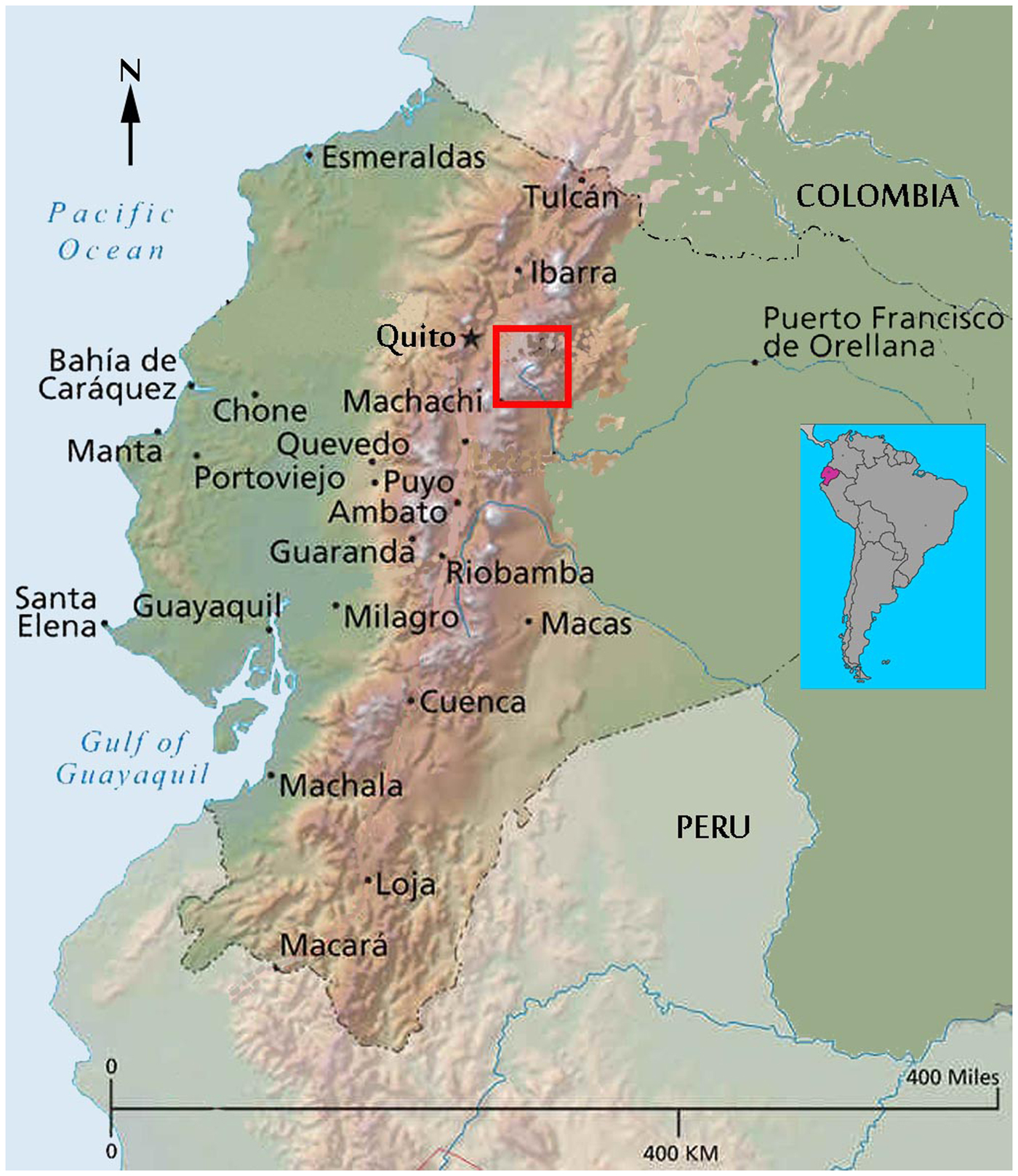
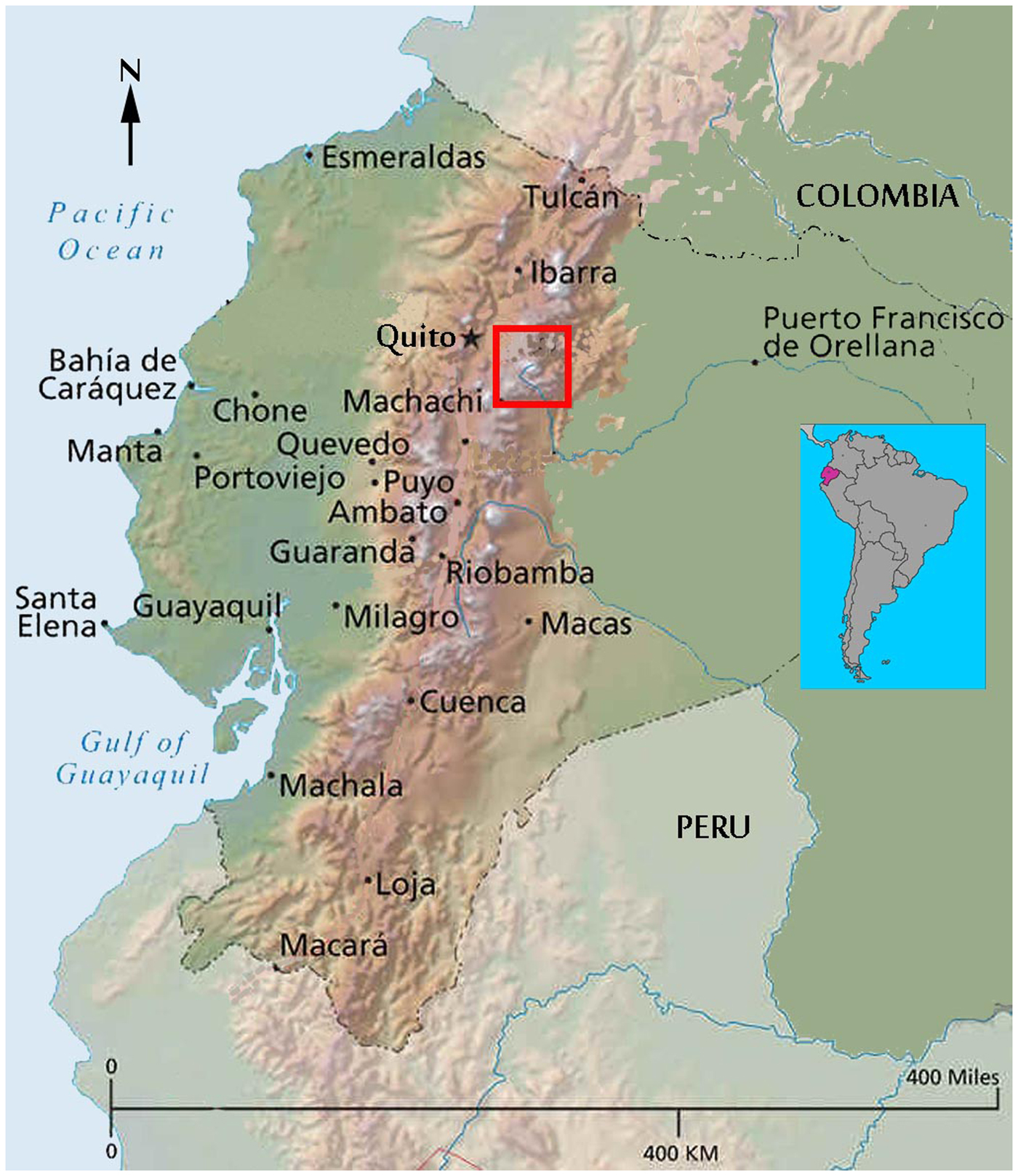
In contrast, the composition matches that of other American sources. It corresponds within two standard deviations to the reported values of the Ecuadorian obsidian deposits, in particular that of Mullumica, Sierra de Guamaní (Table 1); it is a little similar to those from Callejones, Pichincha province (Figure 3; Bellot-Gurlet et al. Reference Bellot-Gurlet, Poupeau, Dorighel, Calligaro, Dran and Salomon1999, Reference Bellot-Gurlet, Dorighel and Poupeau2008). The relatively large range for the Mullumica and Callejones compositions is due to the well-known natural heterogeneity of these obsidian flows.
The box indicates the Sierra de Guamaní, the site of the Mullumica obsidian source.
Conclusion
PIXE analyses indicate that the obsidian of the lens No. 176.101 from the MNHN mineralogy collections in Paris originate from the Mullumica deposit located in the Sierra of Guamaní, Ecuador. This provenance is consistent with the writings by Valmont de Bomare in Reference Valmont de Bomare1768. This finding, combined with bibliographical research, allowed us to identify the lens as the only known artifact that can be assigned to the Godin–La Condamine geodesic expedition to Ecuador (1735–1743). This mirror was reputed in Quito for its fascinating appearance when it was offered to the expedition and delivered to the JRPM in France in 1737. Accordingly, it is among the rare artifacts from Ecuador to have reached Europe during the eighteenth century. Doubt remains as to the prehispanic origin of this obsidian mirror because few similar artifacts were found in archeological contexts on Ecuadorian sites (La Tolita) and those that were found exhibit very different shapes (Uhle Reference Uhle1927:figure 21; Valdez Reference Valdez1987:72).
Acknowledgments
The research project on the obsidian mirrors of the MNHN benefited from the financial help of the French Ministry of Research contract ACI (2005–2008), “Du Chopper au brillant.” The authors thank Timothy Greenland for his help in English translation. This article is dedicated to the memory of Gérard Poupeau.
Data Availability Statement
The obsidian mirror No. 176.101 is exhibited at the Mineralogical Gallery of the Museum national d'Histoire Naturelle, 36 rue Geoffroy St-Hilaire 75005, Paris, France.
Supplemental Materials
For supplementary material accompanying this report, visit https://doi.org/10.1017/laq.2019.3
Supplemental Text 1. More details regarding the “Inca Mirror” of the MNHN.
Supplemental Figure 1. Obsidian “Inca Mirror” No. 176.101 during its analysis by the AGLAé probe in 2006. (Photograph courtesy of D. Vigears/C2RMF.)