1. Verb agreement in Tibeto-Burman languages
The provenance and antiquity of verb agreementFootnote 1 in the Trans-Himalayan (Sino-Tibetan) family has been a matter of controversy since the phenomenon was first reported in the mid-nineteenth century. With the tremendous increase in the available documentation over the last generation, we now have enough information to reconstruct an ancestral paradigm in some detail. But controversy remains over whether the descendants of that ancestor include all the Trans-Himalayan languages (or all the Tibeto-Burman languages, for those who believe in such a clade), or only those where an archaic paradigm can still be found. The reconstruction of verb agreement to Proto-Trans-Himalayan (PTH) follows the principles of the Comparative Method, the foundation of historical linguistics since the Neogrammarian revolution. The argument that the ancestral paradigm should be reconstructed only to some hypothetical lower-level branch is presented within an idiosyncratic alternative framework. In this paper I will review the arguments for agreement in PTH in terms of the traditional Comparative Method.
The importance of the question of the provenance of verb agreement to historical Trans-Himalayan linguistics is twofold. As we will see, it is essential for the correct subclassification of the family. If it is a secondary feature, then all of the languages which have apparently cognate agreement paradigms must constitute a distinct branch of the family, a conclusion which would require a complete re-imagining of our picture of the internal structure of the family. More broadly, the question is of considerable importance outside the field of Trans-Himalayan linguistics. The complex paradigmatic structure of the verb in Macro-Qiangic, Nungish, Kiranti, Chepang-Magaric, Jinghpaw-Northern Naga, South Central (Kuki-Chin), and several other yet unclassified languages is areally anomalous; across Eurasia similar phenomena are found only in the Caucasus and Siberia. Bickel and Nichols (Reference Bickel, Nichols, Dryer and Haspelmath2013) refer to the Himalayas and the Caucasus as “typological enclaves” within Eurasia, and the history of such enclaves is of obvious importance to understanding patterns of language stability and change, and concepts of linguistic areas. If the agreement paradigms which we will examine here were a secondary innovation within Trans-Himalayan, they would be a major source for the study of the evolution of grammatical complexity. Since, as we will see, they date back to Proto-Trans-Himalayan, the disappearance of this complexity in much of the family is highly relevant to current issues in language contact and, equally importantly, the fact that morphological complexity, including hierarchical alignment, is ancient in Trans-Himalayan has important implications for the typological history of Eurasian languages.
This paper is concerned only with the first question, the historical provenance of verb agreement in the family and its relevance to problems of subgrouping. In particular, I argue against the “Rung” hypothesis, which proposes that verb agreement is a recent innovation confined to one branch of the family, that branch being defined by that innovation. LaPolla (Reference LaPolla2012: 118–9) lays out a methodological critique of the arguments for the hypothesis of PTH agreement. In a subsequent paper (LaPolla Reference LaPolla, Bickel, Grenoble, Peterson and Timberlake2013) this critique is elaborated as the case for a Rung branch of the family, which includes all and only those groups that preserve a conservative version of the paradigm. The argument for a Rung clade betrays a gross misunderstanding of the Comparative Method, and the primary aim of the present work is to analyse this misunderstanding and demonstrate that the case for Rung is vacuous, and that the distribution of cognate agreement paradigms forces us to reconstruct an ancestral paradigm for the common ancestor of all Tibeto-Burman languages.
2. History of the question
It has been known since the work of Hodgson (Reference Hodgson1874, Reference Hodgson1880) that while the better known Tibeto-Burman languages lack verb agreement, a significant subset index one or more arguments on the verb. Until a generation ago most scholars assumed that the simpler structure found in Tibetan and Burmese must be original, and the morphological complexity of Kiranti and Rgyalrongic secondary. But James Bauman (Reference Bauman1975) demonstrated the cognacy of forms and paradigms in Rgyalrong, Kiranti, West Himalayan, Jinghpaw, and very plausibly in two languages of the Northeastern Peripheral (or Northern Chin) subbranch of South Central (Kuki-Chin). As this set of languages could not constitute a branch under any proposed classification of the family, Bauman thus established the fact of verb agreement as a feature of the proto-language. Work over the next generation (DeLancey Reference DeLancey1981, Reference DeLancey1989; H. Sun Reference Sun1983, Reference Sun, Nishi, Matisoff and Nagano1995; van Driem Reference Driem1993, Reference Driem, Yadava and Glover1999; Watters Reference Watters2002) added further refinements to the reconstructed system, but failed to solve the problems presented by certain recalcitrant forms. One set of problems involved languages which have prefixes as part of their agreement paradigm, since the basic reconstructed paradigm is suffixal. Even more challenging were the systems found in South Central and Jinghpaw, where the agreement indexes behave as separate words. These two sets of problems intersected in the aberrant postverbal 2nd person indexes in Chepang and in South Central, which were evidently related to prefixes elsewhere in the family, but could not be integrated into a reconstruction scheme. Recent work (DeLancey Reference DeLancey2010, Reference DeLancey, Yap, Grunow-Hårsta and Wrona2011a, Reference DeLancey2013, Reference DeLancey2014a, Reference DeLancey, Hill and Owen-Smith2014b, Reference DeLancey2015; Jacques Reference Jacques2012, Reference Jacques2016) has resolved most of these remaining issues; this will be summarized in §4.2.
Somewhat less than half of the low-level, inspectionally obvious genetic units in the family include languages with verb agreement paradigms that appear to contain cognate forms. There are three logically possible explanations for the presence of a particular feature, such as a particular morphological paradigm, in a language: it may represent vertical transmission, inheritance from an ancestral state of the language; it may represent horizontal transmission, “borrowing” from another language; or it may represent innovation, the result of some internally motivated change in the language. All three explanations have at one time or another been casually invoked with respect to TH verb agreement, but no one has ever presented an explicit hypothesis for how any attested agreement paradigm in any TH language might have been innovated or borrowed.Footnote 2 There is no longer any disagreement that most of the attested paradigms are in fact cognate, i.e. that the paradigms of at least Rgyalrongic, Qiangic, Nungish, Kiranti, Central Himalayan, and West Himalayan are inherited from a common ancestor (van Driem Reference Driem1993; DeLancey Reference DeLancey2010; LaPolla Reference LaPolla, Bickel, Grenoble, Peterson and Timberlake2013). Thus in the current state of the debate there are two questions, or perhaps better two aspects of one larger issue. First, given that the paradigms of Rgyalrongic, Kiranti, Nungish and West Himalayan descend from a common ancestral paradigm, is that common ancestral paradigm also ancestral to the paradigms found in Jinghpaw, Northern Naga, and South Central, and various currently unclassified languages such as Gongduk, Raji-Raute, and Kaman-Meyor? And then, is the common ancestor from which these paradigms descend the common ancestor of all of Trans-Himalayan (or Tibeto-Burman), or do all the languages with cognate paradigms belong to one clade within the family?
Previous work, from Bauman to the present, has aimed to provide explicit histories for attested forms in the various languages. Since all of this work has assumed the standard Comparative Method, the literature has concentrated on data rather than on methodology. The dissenting literature, in contrast, has tended to argue at higher levels of abstraction, and has had little to say about the forms and paradigms in the attested languages. So far no one has presented an empirical argument against the theory (e.g. an explicit account of the origins of the Jinghpaw, Northern Naga, and South Central agreement word paradigms which we will examine in §5), and to date the opposition presents only methodological arguments (LaPolla Reference LaPolla2012, Reference LaPolla, Bickel, Grenoble, Peterson and Timberlake2013). The primary purpose of this article is to engage with these claims, and to show that the standard Comparative Method requires that we reconstruct an argument indexation paradigm to Proto-Trans-Himalayan.
LaPolla, in a series of papers (Reference LaPolla and Hall1989, Reference LaPolla1992, Reference LaPolla1994, Reference LaPolla, Aikhenvald and Dixon2001, Reference LaPolla, Bickel, Grenoble, Peterson and Timberlake2013), presents a range of objections to the hypothesis of PTH verb agreement:
We then have, aside from the Proto-Tibeto-Burman verb agreement system hypothesis, three other possibilities: (a) those languages with verb agreement systems are genetically related on a higher level; (b) a verb agreement system independently developed in one language and spread geographically; or (c) some combination of innovation within two or more subgroups and geographic spread or drift occurred. (Lapolla Reference LaPolla1992: 301).
Possibility (a) obviously subsumes the “Proto-Tibeto-Burman verb agreement system hypothesis”, but here LaPolla intends some level lower than PTB. LaPolla now (Reference LaPolla, Bickel, Grenoble, Peterson and Timberlake2013) explains the similarities among Rgyalrongic, Nungish, Kiranti, and West Himalayan in terms of the first possibility. It seems from various statements in his work that he would account for the facts of the Jinghpaw, Northern Naga and South Central in terms of the second and third, although he has never offered an explicit explanation for any form in any language in any of these groups. His current argument rests on a novel approach to reconstruction and subgrouping which, he argues, forces us to group all of the languages which show cognate agreement systems in a single branch of the family. LaPolla's arguments against the PTH agreement hypothesis are all arguments in principle; with the exception of a misconceived interpretation of the facts of Tangut (see §6.1), in none of his published work on the subject does he attempt to refute any specific comparison or reconstruction. LaPolla accepts the cognacy of some of the paradigms, but argues for the separation of all of these languages from the rest of the family in a subgroup characterized by this innovation.
3 Overview of the Tibeto-Burman languages
Though I adopt the term Trans-Himalayan in preference to the traditional Sino-Tibetan (partly) to avoid the assumption of a binary Sinitic–TB split in the family, the Sinitic branch obviously has nothing to offer the present inquiry. Readers who believe in the validity of a Tibeto-Burman clade can simply substitute Proto-Tibeto-Burman (PTB) wherever I use Proto-Trans-Himalayan (PTH), the argument remains the same.
The case for PTH agreement can be made on the basis of any extant classification of the family, but the argument will be presented in §4 and §5 in terms of the tripartite classification of the family suggested by Bradley (Reference Bradley and Sybesma2012) and DeLancey (Reference DeLancey, Sidwell and Jenny2021a). However, to avoid prejudicing the case we will begin with the most agnostic published model, van Driem's (Reference Driem, Owen-Smith and Hill2014) “fallen leaves”, a list of the lowest-level, inspectionally obvious clades. Omitting Sinitic, which regardless of its taxonomic position has a unique history, and Pyu, about which we do not know enough to say, leaves 40 clades, of which 16, or 40 per cent, include languages with verb agreement paradigms which are demonstrably at least partially cognate to one another, and 24, or 60 per cent, have no attested verb agreement or, in a handful of cases,Footnote 3 innovative agreement. I list these in four groups: the three posited branches, with an overflow “Eastern Himalaya” category of languages which are not yet well attested, but which will probably turn out to be Central. Readers sceptical of this classification can take this grouping as purely geographical, as nothing in my argument depends on it. Clades where the ancestral paradigm is attested are in italics:
• Eastern: Bai, Ersuish, Karenic, Lolo-Burmese, Naic, Rgyalrongic, Qiangic, Tujia
• Central: Angami-Pochuri, Ao, Brahmaputran, Dhimalish, Jinghpaw, Karbi, South Central, Meitei, Mru-Hkongso, Tangkhul, Zeme
• Eastern Himalaya: Hrusish, Digarish, Kho-Bwa, Lepcha, Lhokpu, Mijuish, Nungish , Siangic, Tani, Tshangla
• Western: Black Mountain, Bodish, Chepangic, Dura, Gongduk, Kiranti, Magaric, Newaric, Raji-Raute, Tamangic, West Himalayan
In §4 and §5 we will see that the agreement paradigms in the italicized clades are cognate. LaPolla acknowledges the cognacy of all of the Eastern and most of the Western paradigms, plus Nungish (LaPolla Reference LaPolla, Bickel, Grenoble, Peterson and Timberlake2013, Reference LaPolla, Thurgood and LaPolla2017: 49) and explicitly denies that the paradigms of Brahmaputran or Jinghpaw are related (LaPolla Reference LaPolla, Thurgood and LaPolla2017: 51). We will summarize the status of agreement in the Eastern and Western languages in §4, and return to the question of the Central languages in §5.
4. The case for agreement in Trans-Himalayan: the “Rung” clades
The cognacy of the suffixal verb agreement paradigms in Macro-Qiangic (Rgyalrongic + Qiangic), Kiranti, Central Himalayan, West Himalayan, and Nungish is self-evident and not disputed (DeLancey Reference DeLancey2010; LaPolla Reference LaPolla, Bickel, Grenoble, Peterson and Timberlake2013); the only issue is whether the cognate paradigms represent shared retention from PTH or a shared innovation which defines a putative “Rung” subbranch (§6). In this section I will summarize the case for the cognacy of these paradigms, then in §5 we will see that by the same logic the archaic paradigm is much more widely attested.
4.1. The basic paradigm
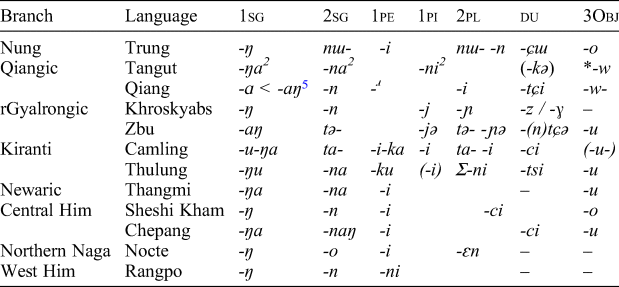
As the overall conclusion is not controversial, we do not need to work through the argument in detail (see van Driem Reference Driem1993; Watters Reference Watters2002; DeLancey Reference DeLancey2010, Reference DeLancey2014a; Jacques Reference Jacques2012, Reference Jacques2016). Table 1 gives examples of the data which need to be explained.
Agreement indexes across the familyFootnote 4

We can hardly doubt that 1sg #-ŋ,Footnote 6 1pl #-i, dual #-tsi, and 3Obj #-u represent shared inheritance in these languages. The case for the 2nd person forms is less clear, but 2sg #-n has reflexes in every clade except Nungish and Northern Naga. We will look at the significance of the #t- forms in §4.2.
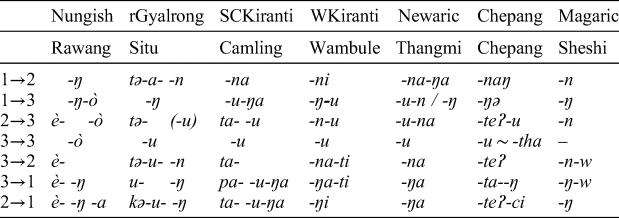
As well as the actual forms, we can reconstruct a “hierarchical” structure for the ancestral paradigm. In Table 2 we see that across the family both the 1→3 (i.e. 1st person acting on 3rd) and 3→1 forms index the 1st person argument, and both 2→3 and 3→2 index 2nd person. In other words, a 1st or 2nd person argument is always indexed in preference to a 3rd person, regardless of whether it is subject or object.
Hierarchical agreement in archaic clades

Returning to Table 1, it is obvious how to interpret the 1sg column: we reconstruct a suffix #-ŋ. The forms in the various languages resemble one another more than we can imagine happening by chance. There is no way that it could represent multiple independent innovation, as not all of the languages have a reflex of PTH *ŋa as their 1st person pronoun. It is not the sort of thing which we ordinarily see borrowed. Therefore we conclude that it represents shared inheritance from the nearest common ancestor of all the languages which have it. When we see that we have almost a strong a case for 2sg #-n, 1pl #-i, dual #-tsi, and 3Obj #-u, and that in all of the languages the agreement indexes are organized into a typologically unusual hierarchical pattern, the case is closed; we see a shared paradigm inherited into the attested languages from a common ancestor.
4.2. Second person indexation
While Table 1 demonstrates a compelling degree of correspondence in agreement indexes, the 2sg column is somewhat problematic, since we have four distinct forms just in this sample of languages. (And with a larger set of languages we find more.) As noted above, 2sg #-n has reflexes in every clade in the chart except Nungish and Northern Naga, and thus is our best candidate for the ancestral paradigm. But we need some explanation for the non-corresponding forms in other languages.
Most of the aberrant 2nd person forms are found in only one clade, and therefore can be assumed to be innovations (DeLancey Reference DeLancey2021b). In Nungish, for example, all varieties have a prefix indexing 2nd person, but Trung has nɯ-, Rawang è-. Neither form has apparent cognates in the other languages, and so we have no grounds to reconstruct either to any ancestral node. If both are recent innovations, then they are irrelevant to our reconstruction of the ancestral paradigm. In contrast, both #-n and #t- are attested in more than one branch (and two branches preserve both), and thus must be reconstructed.
Based on its attestation across the family, 2sg #-n can be securely reconstructed for the proto-paradigm. Its absence in Zbu Rgyalrong, or in most of the paradigm of Camling (South Central Kiranti), where we instead find #t-, is irrelevant to this question. Since we do find it in other Kiranti languages, such as Thulung, and in other Rgyalrongic languages, such as Khroskyabs, we reconstruct it to their common ancestor. If that common ancestor is also ancestral to Camling and Zbu, then those two languages must have lost #-n subsequent to their divergence from the common Kiranti and Rgyalrongic stocks.
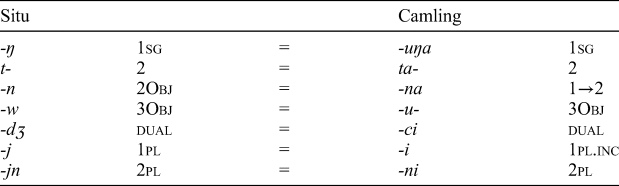
By the same logic, unless we can explain the shared t- in South Central Kiranti and Rgyalrong as independent innovation or borrowing, we must reconstruct #t- for the nearest common ancestor of these two clades. It cannot be independent innovation, since we cannot identify a source for it in either branch. It cannot plausibly be borrowing, given the geographical distance between the languages. Therefore it must be reconstructed. It is important to emphasize – since this has been an issue in the debate on this topic – that this case can be made simply on the basis of two languages. Consider the agreement indexes of Situ Rgyalrong and the South Central Kiranti language Camling shown in Table 3.
Agreement indices in Situ (Rgyalrongic) and Camling (Kiranti)

These cannot have been innovated independently in the two languages. For one thing, while the 2nd person object suffixes in the two languages have at least a consonant in common with the 2sg pronouns (Situ naŋ, Camling khana), there is no evident source in either group of languages for the #t- prefix. So we must reconstruct this paradigm, including #t-, to the common ancestor of Kiranti and Rgyalrongic, regardless of whether it is or is not attested in sister languages within each clade. In this case the prefix is securely attested across Rgyalrong proper and South Central Kiranti (see Table 4).
Singular agreement in rGyalrong and SCK

But in the other Rgyalrongic languages the only 2nd person index is -n (e.g. Khroskyab in Table 1). Likewise in Kiranti we find the t- prefix only in the SCK subbranch. But since we have to reconstruct #t- for the nearest ancestor of Rgyalrong and South Central Kiranti, other descendants of that ancestor which lack #t-, such as Khroskyabs and Western Kiranti, must have lost it. The close match across these languages in the form and syntagmatic inconsistency of the 1st and 2nd person forms attests to the antiquity of this prefix in the two groups, since if the paradigms are not cognate, this unlikely paradigm must have arisen independently twice. Since they are cognate, #t- must predate Proto-Kiranti and Proto-Rgyalrongic, and so must have subsequently been lost in other Kiranti and Rgyalrongic languages.
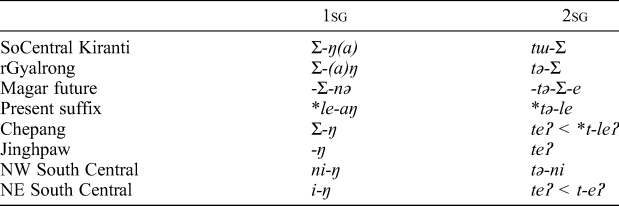
Still, many linguists consider an argument based on evidence from only two low-level branches to be inconclusive, citing Meillet's Principle (§4.3) to insist on a third witness. In fact we have considerably more than that; the evidence is given at length in DeLancey Reference DeLancey2014a and summarized in Table 5.
Summary of -ŋ/t- paradigms

Thus we need to reconstruct two distinct 2nd person verb affixes for the common ancestor of all of these languages.
4.3. Meillet's Principle
The traditional criterion in historical linguistics for reconstructing a feature to the proto-language is Meillet's (Reference Meillet1934: 380, inter alia) Three Witness Principle (Trask Reference Trask2000: 209), that the presence of a form in three daughter languages is sufficient to require its reconstruction to their common ancestor. But, as we have just seen, strictly speaking the logic of the Comparative Method requires only two:
To guard against the effects of secondary developments in daughter languages, we may refer to Meillet's rule that in reconstructing the vocabulary of a proto-language we need the testimony of three, rather than two, independent witnesses. For many other purposes, however, reconstruction from more than two witnesses may well be viewed as a mere extension of the fundamental operation involving only two. (Hoenigswald Reference Hoenigswald1950: 357–8)
The logic is inescapable: if a feature is found in two languages, and it cannot be explained as independent innovation or horizontal transmission, the only remaining explanation is shared inheritance from a common ancestor. Therefore the feature must have been present in that common ancestor.
This is the logic by which we reconstruct not only the ubiquitous 1sg #-ŋ, but also both #-n and #t-, as well as 1pl #-i, 2pl #-ni, and 3Obj #-u for the common ancestor of all the languages in Table 1, even though each of them is absent in one or more of the daughter languages. (This sort of scattered inheritance is similar to what biologists call “incomplete lineage sorting”, as described in Jacques and List Reference Jacques and List2019.)
5. The case for agreement in Trans-Himalayan: the Central clades
The clades listed as Central in §3 have not generally been regarded as related at any lower level than Tibeto-Burman. Indeed, earlier classification schemes were based on the assumption that Jinghpaw and Mizo (South Central) represent distinct major branches of the family. However, DeLancey (Reference DeLancey2015) presents morphological evidence that Jinghpaw, Northern Naga, South Central, and Meyor belong to a single branch of the family which presents robust evidence for our reconstructed paradigm. Of course, if one insists on keeping the languages discussed in this section in distinct major branches, then they are independent witnesses to the antiquity of the paradigm, and the evidence for PTH provenance of the agreement paradigm becomes that much more compelling.
Jinghpaw, the Northern subgroup of Northern Naga, several subbranches of South Central, and Meyor and K'man (Kaman or Miju) in Arunachal Pradesh share the characteristic that argument indexation is in the form of agreement words, highly grammaticalized conjugated auxiliaries which follow the verb stem but are phonologically independent of it. I have described this phenomenon and the forms in the various languages at length elsewhere (DeLancey Reference DeLancey2014c, Reference DeLancey2015, Reference DeLancey2021c); briefly, in these languages a finite verb consists of the verb stem followed by a phonologically independent word, usually a single syllable whose onset expresses a tense/aspect/polarity category, while the rime indexes person and number. It is possible that the agreement word construction is a Central innovation, but arguably it could be an areal phenomenon (DeLancey Reference DeLancey2014c). In any case the forms of the indexes correspond well across the branch, and with the rest of the family. In §5.1 I will present a detailed argument for reconstructing agreement for the Sal branch, and in §5.2 show that all of these paradigms have the same ultimate origin as those which we compared in §4.
5.1. Agreement in the Sal branch
The Sal group (Burling Reference Burling1983, Reference Burling, Thurgood and LaPolla2003), equivalent to Shafer's Baric (Shafer Reference Shafer1955), includes Bodo-Garo, Northern Naga, and Jinghpaw-Asakian. Across this group, there is no verb agreement at all in Bodo-Garo or Asakian, and it is absent in some varieties of Northern Naga and of Jinghpaw. While LaPolla acknowledges the cognacy of most of the paradigms discussed in §4, he dismisses the possibility that the indexation systems found in Sal languages could be cognate (LaPolla Reference LaPolla, Thurgood and LaPolla2017: 51). We will see that they are.
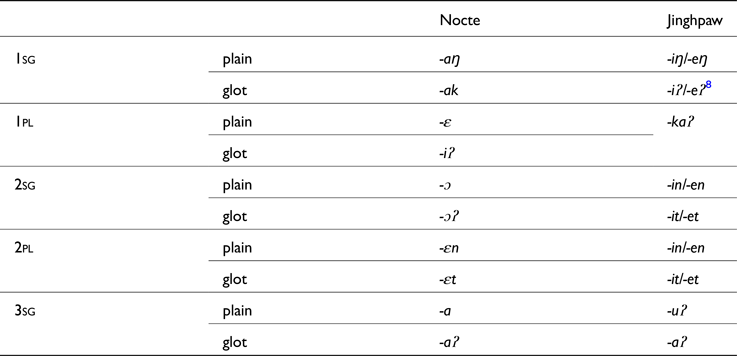
Let us begin by comparing the two best-known languages of the set, Nocte (Northern Naga) and Standard Jinghpaw. (The data are presented in more detail in DeLancey Reference DeLancey2015.) Table 6 presents the agreement indexes in the two languages.
Jinghpaw and Nocte singular agreement suffixes

Of ten slots, the languages have comparable forms in five. This is a strong degree of correspondence, but it is made more compelling when we can explain the mismatches. Neither language distinguishes the Inclusive category, and the collapse of the earlier distinction is reflected in the modern forms: Nocte /|-ɛ/ and /-iʔ/ reflect PTH Inclusive #i, and the Jinghpaw form reflects PTH Exclusive #ka (DeLancey Reference DeLancey2019). Nocte 2sg /-ɔ / reflects a PTH irrealis construction which is well-attested across the family as an imperative, and in Northern Naga has replaced the original 2sg suffix (DeLancey Reference DeLancey2014a).
Thus all of the forms in both paradigms can be traced to PTH, all but Nocte 2sg /-ɔ / to the original indexation paradigm, and there are independently supported diachronic explanations for every divergence between the two languages. But still beyond this, both languages share a corresponding alternation between two series of agreement suffixes. In Nocte, certain forms of the verb, including past or perfective, show final glottalization, which is realized as /ʔ/ following a vowel, and transforms a nasal ending into the homorganic stop. In Jinghpaw, the corresponding stop-final forms have a perfective or punctual sense. This alternation is a shared innovation between Jinghpaw and Northern Naga, with no direct parallel elsewhere in the family. It is also noteworthy that the languages share the -aʔ 3rd person form.
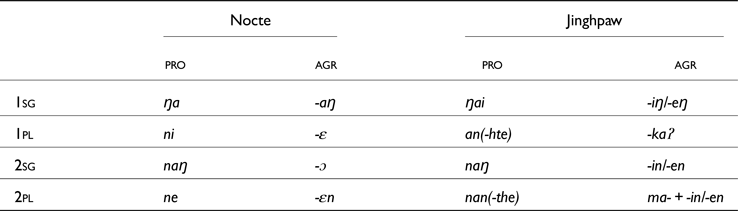
All critics of the idea of PTH verb agreementFootnote 7 – Qu (Reference Qu1983) and Nagano (Reference Nagano1984) as well as LaPolla – attach great weight to resemblances between the agreement indexes and independent pronouns, so it is worth considering that question here. Compare the agreement indexes with the independent pronominal forms in the two languages, in Table 7.
Agreement indexes and independent pronouns in Nocte and Jinghpaw

The 1sg agreement and independent pronominal forms are all apparently related, across category and language, as this form reliably is across the family. The 1pl pronouns in the two languages may be related, but neither agreement index is related to the pronominal forms, nor are they related to each other. The Jinghpaw 2sg index is presumably related to the pronominal form in both languages, but it is far from clear how direct the relationship is. Anyone adducing this as an example of “transparent grammaticalization” (LaPolla Reference LaPolla2012, see §6.1) needs to identify the source construction and the pathway that led from the pronominal form to the index. Finally, the Nocte 2sg index has no relation to any pronominal form in Northern Naga or anywhere else.
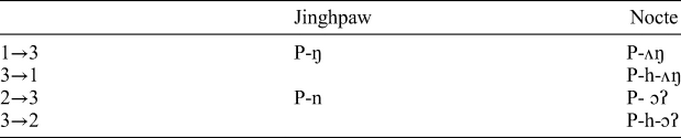
Another important point of correspondence between the two systems is that, like the languages discussed in §4, they share hierarchical agreement: in both languages a 1st or 2nd person argument is indexed in preference to a 3rd person, regardless of grammatical role (see Table 8).
Hierarchical agreement in Nocte and Jinghpaw

(The Nocte paradigm has explicit inverse marking, which is not present in Jinghpaw.)
The Jinghpaw and Nocte forms and paradigms are too different to represent borrowing, but correspond much too closely to be independent innovation. Then by the logic of the Comparative Method, we have no choice but to reconstruct the paradigm for the nearest common ancestor of Jinghpaw and Nocte. The absence of any evidence for this paradigm in languages of the southern Northern Naga group such as Chang and Konyak, and Jinghpaw varieties such as Singpho, has no relevance to the argument, and no effect on the conclusion.
By the same logic, if Northern Naga and Bodo-Garo form a clade (van Driem's Brahmaputran) within Sal, so that the nearest common ancestor of Jinghpaw and Nocte is Proto-Sal, then we need to reconstruct the corresponding elements of the paradigm to Proto-Sal, despite the fact that it is completely absent in Bodo-Garo and Asakian. In this case we have a strong hypothesis which can explain the loss of agreement in Bodo-Garo as a result of intense language contact (DeLancey Reference DeLancey, Hill and Owen-Smith2014b), which can be extended to apply to Singpho and possibly some of the other languages. But we do not need any such hypothesis to justify reconstructing the corresponding elements of the Jinghpaw and Nocte paradigms to Proto-Sal; by the logic of the Comparative Method the existence of those correspondences requires that reconstruction, regardless of what we may or may not find in other languages in the same clade. The simple fact is, these paradigms have to reconstruct to a common ancestor.
5.2. Reconstructing agreement morphology for Proto-Central
The South Central or Kuki-Chin branch is known for its innovative proclitic agreement system, with originally possessive proclitic pronominals attached to what was originally a nominalized verb stem. But most of the languages retain all or part of an older paradigm of postverbal agreement words cognate to what we have just seen in Jinghpaw and Northern Naga. Postverbal indexation was first noted for two closely related languages of the Northeastern Peripheral subbranch, Tedim (or Tiddim; Henderson Reference Henderson1957) and Sizang (or Siyin; Stern Reference Stern1963). Both authors noted the likely connection between this paradigm and the suffixal agreement paradigms found elsewhere in the family. By now the paradigm has been found also in the Southern Peripheral and Northwestern subbranches, as well as clear traces in the Central and Maraic subgroups, and is manifestly reconstructable for Proto-South-Central (DeLancey Reference DeLancey2021c). Evidently cognate agreement word paradigms are also found in K'man and Meyor, spoken in the eastern Himalayas on both sides of the line of control (DeLancey Reference DeLancey2015, Jacquesson Reference Jacquesson, Post, Morey and DeLancey2016).
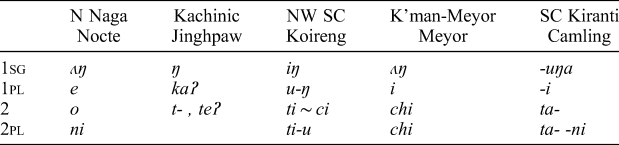
A simple comparison of some sample paradigms makes it clear that we are looking at reflexes of a common ancestral system (see Table 9).
Person–number agreement in Central languages

Note complete agreement in 1sg marking across the table. This is significant since South Central and Meyor both have stop-initial 1sg pronouns, so the nasal agreement index must pre-date the innovative 1st person pronoun in both clades. We have the archaic 1pl #-i in both Northern Naga and Meyor. But the most striking fact is the evidence for the alternate 2nd person #t- (§4.2) everywhere except in Northern Naga, which has an idiosyncratic 2sg form, probably deriving from an original irrealis construction (DeLancey Reference DeLancey2014a). We also find hierarchical agreement in Jinghpaw, Meyor, and some but not all Northern Naga and South Central languages (DeLancey Reference DeLancey2014a, Reference DeLancey, Cristofaro and Zuñiga2018; Morey Reference Morey, Post, Morey and DeLancey2016; Awan Reference Awan2019; Boro Reference Boro2019; Chelliah et al. Reference Chelliah, Peterson, Utt, Blair and Khular2019; Haokip Reference Haokip2018, Reference Haokip2019; Konnerth and Wanglar Reference Konnerth and Wanglar2019; Ozerov Reference Ozerov2018).
Even without the corresponding 1sg forms, we could base a claim for the genetic unity of Jinghpaw, South Central, and Meyor solely on the shared postverbal 2nd person #te(ʔ). This form cannot possibly be independent innovation in more than one language, and in any case has no evident source in any of the languages involved. And, given the South Central evidence that this form derives from an auxiliary conjugated with the 2nd person prefix (Table 5, §4.2), the 1sg #-ŋ / 2 #t- paradigm is sufficient to establish the cognacy of these paradigms with those of Rgyalrong and South Central Kiranti, and thus their common descent from the ancestral PTH paradigm.
6. Proposed arguments against reconstructing verb agreement
The cognacy of the paradigms discussed in §4 is uncontroversial; no one suggests that the correspondences can be explained as either independent innovation or borrowing. And no one has presented any counterargument to the demonstration in §5 that the same applies to the correspondences among Jinghpaw, Northern Naga, and South Central, and between them and the languages discussed in §4. Thus we reconstruct to their nearest common ancestor a paradigm from which the attested paradigms descend. The remaining question is, whether these languages might have a common ancestor more recent than PTH, or, if we ignore the Central languages, that the other languages have such an ancestor – that being LaPolla's Rung hypothesis. In this section I will review LaPolla's arguments for Rung.
The key concept in LaPolla's attempt to refute the hypothesis of PTH agreement is the putative “Rung” clade. (For a summary of the hypothesis see Thurgood Reference Thurgood, Thurgood and LaPolla2017: 24–5). Since it is clear that the paradigms of the archaic languages descend from a common ancestor, the only way to avoid reconstructing that paradigm for PTH is to imagine a more recent common ancestor for these languages, thus classifying them all in a single branch of the family. LaPolla argues that hierarchical verb agreement is a recent innovation in a hypothesized Proto-“Rung”, spoken in southwest China not more than a millennium ago, with the Himalayan clades representing subsequent westward migration from the Rung homeland. Since he regards the relatively simple paradigm of Tangut to be a primitive stage in the development of the system, rather than a secondary simplification, he imagines that all this can be dated back to the first attestation of Tangut, that is, within the last thousand years (LaPolla Reference LaPolla1992: 301). Part of the argument for this hypothesis is the claimed transparency of the agreement forms, along with an assertion that hierarchical agreement is less grammaticalized than subject agreement, and thus further evidence that the TB agreement systems cannot be very old. We will address the issue of transparency in §6.1. LaPolla's other major argument is that we cannot reconstruct agreement for the family as a whole because the attestation is insufficient; we will examine this claim in §6.2 and §6.3.
6.1. Transparent grammaticalization
A key point in LaPolla's argument is his claim that we can only reconstruct for the proto-language features whose origin cannot still be identified in the modern languages:
I assume that if a morphological form is a transparent grammaticalization, it should be a recent innovation, and I assume in terms of methodology that one only reconstructs those items of morphology for which we cannot see any obvious source in grammaticalization, and so I do not think we should reconstruct person marking to Proto-Tibeto-Burman (LaPolla Reference LaPolla2012: 119).
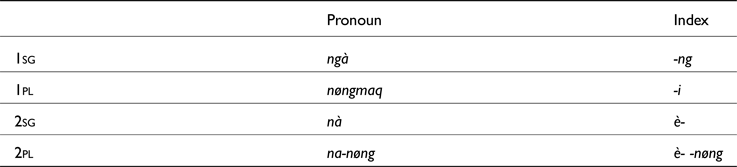
The reference to “transparent grammaticalization” seems to be based on LaPolla's analysis of Tangut, where he claims that the agreement indexes are identical to the pronouns. This is not, in fact, true – see Kepping Reference Kepping1994 and Jacques Reference Jacques2016. In the Rgyalrongic branch most of the agreement suffixes are easily relatable to independent pronominal formsFootnote 9 (although the #t- prefix is not), but this is hardly the case anywhere else. We saw this with respect to Jinghpaw and Northern Naga in §5.1; for another example, consider the forms in Table 10 from Rawang (forms taken from LaPolla Reference LaPolla and Zhaoming2010, except for the 2sg pronoun, which is reconstituted from Barnard Reference Barnard1934).
Pronouns and agreement indexes in Rawang

In Barnard's paradigm the -nøng seems to be a general pronominal plural, not specific to 2nd person. This and the 1sg forms could conceivably represent recent grammaticalization (although we have seen that this is not the case, and LaPolla effectively acknowledges as much when he reconstructs the 1sg form for Proto-Rung), but the 2sg and 1pl forms show no apparent relation between pronoun and index.Footnote 10
In fact when we compare forms and paradigms across the branches, we find the kind of variation, and sometimes opacity of function, which is indicative of ancient morphology. We have demonstrably cognate forms which differ dramatically in form and in syntagmatic position; for example, 2nd person #t- is found as a prefix to the verb stem in Rgyalrong and South Central Kiranti, as a verbal suffix (through grammaticalization of an inflected auxiliary) in Magar, and as part of an independent agreement word in South Central, Jinghpaw, and Meyor. We find forms whose function varies considerably from one branch, or even language, to another, for example #-n, which in West Himalayan, Western Kiranti, and non-Rgyalrong Rgyalrongic languages, is a general 2nd person index, but in many Kiranti languages, Chepang, and Raji-Raute, occurs only in the 1→2 form. And we find forms which cannot be synchronically analysed as having any clear function, for example a prefix ɨ- in Bantawa (South Central Kiranti), which is a reflex of an original inverse prefix #u-, but synchronically occurs only in the 3→1 form. Finally, in a number of Rgyalrongic and Kiranti languages – and in Tangut – we find that agreement is reflected in opaque morphophonemic alternations in the verb stem along with the agreement indexes (Jacques et al. Reference Jacques, Lahaussois, Michailovsky and Rai2012; Jacques et al. Reference Jacques, Antonov, Yunfan and Nima2014; Jacques Reference Jacques2016). These are not the sorts of thing which we find in cases of recent “transparent grammaticalization”; they are the familiar stigmata of ancient morphology.
6.2. On the number of witnesses
Another argument LaPolla presents is that the attestation of agreement across the family is not sufficient to justify reconstructing it:
I also assume that for a form to be reconstructable to Proto-Tibeto-Burman, there should be a statistically significant representation of the form in the family … and so I would not reconstruct a form to Proto-Tibeto-Burman based on the forms in two or four languages out of hundreds. (LaPolla Reference LaPolla2012: 119)
The reference to “statistically significant representation” here contradicts the Comparative Method. As discussed in §4.3, in standard practice two independent witnesses present a case for reconstruction, and three prove it. As we saw in §3, cognate agreement paradigms have now been documented for about 40 per cent of the low/mid-level uncontroversial clades in the family.
LaPolla's statistical argument rests on the assumption that the likelihood of the languages which lack agreement sharing this feature is also small, and this is simply false. Without some estimate of that likelihood, the statistical argument is empty. Linguistic history around the world shows us that verbal person marking can disappear over a matter of centuries (Swedish) or generations (Haitian Creole); DeLancey (Reference DeLancey2010, Reference DeLancey, Hill and Owen-Smith2014b) discusses such examples in Trans-Himalayan. Sun and Liu (Reference Sun and Guangkun2009) present a neat case study of the disintegration of a Nungish agreement paradigm over a few generations, under intense contact with Lisu. And if this is a common occurrence, and it is, then LaPolla's argument is vacuous.
Again, this is a well-established principle in historical linguistics:
One must add that the use of de may disappear from a French dialect or that of -s from an English dialect without these dialects ceasing to be French or English. Only positive facts have a conclusive value. (Meillet Reference Meillet1970: 40, emphasis added)
Meillet gives as an example the wholesale loss of Indo-European case inflection in branches such as Romance. On a smaller scale, consider the distribution of the inherited Proto-Germanic case paradigm in the modern languages. In the modern Germanic languages – Swedish, Danish, Norwegian, Icelandic, German, Dutch, Frisian, and English – Proto-Germanic case inflection is still preserved in only three: Icelandic, German and Frisian. But although fewer than half of the languages have this feature, we must reconstruct it for the common ancestor of all, because we have corresponding forms in both major branches of the family. In North Germanic only Icelandic has the case paradigm, while Norwegian, Swedish, and Danish lack it. Looking only at North Germanic, we cannot argue by the Comparative Method that Icelandic is archaic, although we could infer this from the fact that there is no evident source, either in Icelandic or in the cognate languages, for the attested case forms. But once we find it in German, in the West Germanic branch, then the case is closed; the feature must be reconstructed for the common ancestor of Icelandic and German, which can only be Proto-Germanic. Adding Frisian fulfils the demand of Meillet's Principle, and thus confirms the reconstruction, but is not a precondition for it. The absence of the paradigm in the other North Germanic languages as well as Dutch and English is irrelevant to the reconstruction. And the same logic would apply no matter how many other branches there might be in the tree, even if none of the others shared the feature. In this case history provides a check on our method, since we have the additional testimony of Old English, Old Norse, and Gothic to prove the antiquity of case marking. And, of course, it turns out that our results are correct, because our method is correct.
6.3. On comparing partially corresponding paradigms
In a more recent paper, LaPolla presents an explicit justification for insisting on a “statistically significant” representation of a form as a precondition for reconstruction. He starts with Nichols’ (Reference Nichols, Durie and Ross1996) explanation of the statistical basis for maintaining strict requirements for correspondence when initially establishing genetic relationship on the basis of paradigmatic comparison. Nichols points out that the relationship of two clades not previously considered to be related can be established on the basis of only a few forms, provided that they are paradigmatically related, and emphasizes that when we do this it is essential that all the compared forms are attested in any language which we want to claim to belong to the larger clade. This is the approach used to argue for a hypothesis of distant relationship like Dene-Yeniseian (Nichols Reference Nichols, Kari and Potter2010). Nichols’ paper is about establishing relationship, not about how to subgroup languages that are already known to be related; beginning with the basic assumption of the comparative method, that we reconstruct starting with related languages, she presents the logical obverse: if we can reconstruct a paradigm, then the languages must be related.
LaPolla applies the same reasoning to the problem of establishing subgroups within an established family:
There is a second use, though, to which we can put this criterion. We can apply this same level of statistical significance in determining whether some feature should be reconstructed to the deepest level proto-language or to some lower level of the family tree (LaPolla Reference LaPolla2012: 124).
This notion is incoherent within the logic of the Comparative Method. As Nichols argues, when we are establishing relationship on the basis of a very small set of comparisons, relationship cannot be considered established unless all comparanda are present. When we are doing subgrouping, we already know that the languages are related. Again, by logic of the Comparative Method, two witnesses make a case for reconstructing a feature to the proto-language, and by Meillet's Principle, three witnesses constitute a conclusive case. There is no logical basis for any requirement of any “level of statistical significance” in the sense of a minimum number of witnesses larger than three, and no historical linguist would suggest that reconstructing a feature for the proto-language requires that it be present in a majority of the daughters.
In attempting to apply Nichols’ method to the problem of subgrouping languages already known to be related, LaPolla discards the essential step in the Comparative Method, in which we determine (by whatever means we can) whether features shared among different clades are shared innovation and thus taxonomically significant, or shared retention and thus irrelevant to subgrouping. LaPolla's persistent assertion that:
Person marking in Tibeto-Burman only appears in about half the branches of Tibeto-Burman and so does not reach the level required to be reconstructable to Proto-Tibeto-Burman (LaPolla Reference LaPolla, Bickel, Grenoble, Peterson and Timberlake2013: 467)
shows an outright disregard for the Comparative Method. Using that method, as we have seen, leads to the opposite conclusion: person marking is attested in far more than the required three witnesses, and thus the case for reconstructing it is not only sufficient, but overwhelming.
7. Conclusions
LaPolla justifies his Rung clade entirely on the basis of cognate verbal morphology shared by the proposed members. As we have seen, this morphology is considerably more widely shared than LaPolla admits. Since there is no other evidence for Rung – in particular, no lexical evidence at all (Jacques and Pellard 2020) – the only argument for such a clade is LaPolla's argument against reconstructing agreement for the ancestor of languages where it is not attested. We have seen that that argument is incompatible with the standard principles and practices of historical linguistics, and specifically, that LaPolla's arguments against reconstructing PTH agreement are inconsistent with the Comparative Method, and must be rejected.
And if there is no basis for the idea of Rung, then Macro-Qiangic, Kiranti, Nungish, and Jinghpaw-Northern Naga have no common ancestor that is not also the ancestor of Lolo-Burmese, Bodic, and Bodo-Garo. Thus the demonstration in §4 and §5 that the nearest common ancestor of the former set had a complex hierarchical verb agreement paradigm means that the latter set are also descended from that ancestor – which can only be the common ancestor of all the Tibeto-Burman languages.
Bauman demonstrated the PTH provenance of verb agreement a generation ago, using standard methods of historical reconstruction. DeLancey (Reference DeLancey2010, Reference DeLancey2011b, Reference DeLancey2014a, Reference DeLancey2015), presents a detailed theory of agreement in the PTH verb, which is able to provide an explicit historical derivation for most of the forms in the paradigms of all of the languages in the family which have verb agreement. It is incumbent on critics of this theory at least to outline an explicit alternate theory with comparable explanatory power.