INTRODUCTION
The interaction of ultra-intense laser pulses with nanometer-scale solid density foil targets has raised a lot of interest as it promises the generation of mono-energetic ion and electron bunches via novel, more efficient acceleration mechanisms such as radiation pressure acceleration (RPA) (Bin et al., Reference Bin, Lei, Yang, Huang, Yu, Yu and Tanaka2009; Esirkepov et al., Reference Esirkepov, Borghesi, Bulanov, Mourou and Tajima2004; Henig et al., Reference Henig, Steinke, Schnürer, Sokollik, Hoerlein, Kiefer, Jung, Schreiber, Hegelich, Yan, Meyer-Ter-Vehn, Tajima, Nickles, Sandner and Habs2009; Klimo et al., Reference Klimo, Psikal, Limpouch and Tikhonchuk2008; Robinson et al., Reference Robinson, Zepf, Kar, Evans and Bellei2008; Yan et al., Reference Yan, Lin, Sheng, Guo, Liu, Lu, Fang and Chen2008). The key to efficient RPA is to suppress heating of the target electrons (Klimo et al., Reference Klimo, Psikal, Limpouch and Tikhonchuk2008; Robinson et al., Reference Robinson, Zepf, Kar, Evans and Bellei2008, Shoucri & Afeyan, Reference Shoucri and Afeyan2010) and careful control of the target surface area density (Yan et al., Reference Yan, Lin, Sheng, Guo, Liu, Lu, Fang and Chen2008). To obtain information on these quantities, a diagnostic capable of probing the dynamics of the entire laser generated plasma during the acceleration process is necessary. We show that surface high harmonic generation (SHHG), i.e., the generation of high harmonics on the sharp plasma-vacuum interface of nanometer-scale (nm) foil targets irradiated under normal incidence allows detailed studies of crucial interaction parameters such as the target deformation and plasma density when the peak of the driving pulse interacts with the target, i.e., while the particle acceleration takes place, without requiring an additional probe beam. Moreover, our results advance the understanding of the harmonic generation process itself as previous experiments have not addressed normal incidence interactions in detail.
The generation of high-harmonic radiation from solid density bulk (Baeva et al., Reference Baeva, Gordienko and Pukhov2006, Reference Baeva, Gordienko and Pukhov2007; Bulanov et al., Reference Bulanov, Naumova and Pegoraro1994; Dromey et al., Reference Dromey, Kar, Bellei, Carroll, Clarke, Green, Kneip, Markey, Nagel, Simpson, Willingale, Mckenna, Neely, Najmudin, Krushelnick, Norreys and Zepf2007, Reference Dromey, Adams, Hörlein, Nomura, Rykovanov, Carroll, Foster, Kar, Markey, Mckenna, Neely, Geissler, Tsakiris and Zepf2009; Hörlein et al., Reference Hörlein, Nomura, Tzallas, Rykovanov, Dromey, Osterhoff, Major, Karsch, Veisz, Zepf, Charalambidis, Krausz and Tsakiris2010; Nomura et al., Reference Nomura, Hörlein, Tzallas, Dromey, Rykovanov, Major, Osterhoff, Karsch, Veisz, Zepf, Charalambidis, Krausz and Tsakiris2009; Quere et al., 2006; Tarasevitch et al., Reference Tarasevitch, Lobov, Wünsche and Von Der Linde2007; Teubner & Gibbon, Reference Teubner and Gibbon2009; Tsakiris et al., Reference Tsakiris, Eidmann, Meyer-Ter-Vehn and Krausz2006) as well as foil targets (George et al., Reference George, Quéré, Thaury, Bonnaud and Martin2009; Teubner et al., Reference Teubner, Eidmann, Wagner, Andiel, Pisani, Tsakiris, Witte, Meyer-Ter-Vehn, Schlegel and Foerster2004; Krushelnick et al., Reference Krushelnick, Rozmus, Wagner, Beg, Bochkarev, Clark, Dangor, Evans, Gopal, Habara, Mangles, Norreys, Robinson, Tatarakis, Wei and Zepf2008) has been studied extensively in recent years as it promises extreme-ultraviolet and soft X-ray pulses of attosecond (as) duration with unprecedented intensities (Baeva et al., Reference Baeva, Gordienko and Pukhov2007; Tsakiris et al., Reference Tsakiris, Eidmann, Meyer-Ter-Vehn and Krausz2006), and is a powerful probe of the ultra-fast target dynamics. Recent experiments have shown that the harmonics generated on solid targets are indeed phase-locked and emitted as a train of as-pulses (Hörlein et al., Reference Hörlein, Nomura, Tzallas, Rykovanov, Dromey, Osterhoff, Major, Karsch, Veisz, Zepf, Charalambidis, Krausz and Tsakiris2010; Nomura et al., Reference Nomura, Hörlein, Tzallas, Dromey, Rykovanov, Major, Osterhoff, Karsch, Veisz, Zepf, Charalambidis, Krausz and Tsakiris2009) and have demonstrated the efficient generation of harmonics up to the keV energy range (Dromey et al., Reference Dromey, Kar, Bellei, Carroll, Clarke, Green, Kneip, Markey, Nagel, Simpson, Willingale, Mckenna, Neely, Najmudin, Krushelnick, Norreys and Zepf2007). Simultaneously, high harmonic generation gives detailed insight into the laser plasma dynamics in high-intensity laser solid interactions allowing the probing of, for example, the plasma density (Quere et al., 2006), magnetic fields (Tatarakis et al., Reference Tatarakis, Watts, Beg, Clark, Dangor, Gopal, Haines, Norreys, Wagner, Wei, Zepf and Krushelnick2002), surface dynamics (Dromey et al., Reference Dromey, Adams, Hörlein, Nomura, Rykovanov, Carroll, Foster, Kar, Markey, Mckenna, Neely, Geissler, Tsakiris and Zepf2009; Tarasevitch et al., Reference Tarasevitch, Lobov, Wünsche and Von Der Linde2007), and electron heating (Krushelnick et al., Reference Krushelnick, Rozmus, Wagner, Beg, Bochkarev, Clark, Dangor, Evans, Gopal, Habara, Mangles, Norreys, Robinson, Tatarakis, Wei and Zepf2008).
In this paper, we present measurements of the harmonic emission in transmission of nm-scale (sub-20 nm) high-density (2.7 g/cm3) diamond-like carbon foils irradiated with ultra-high contrast linearly polarized laser pulses at normal incidence (Fig. 1). We show that the harmonic emission, apart from being an interesting radiation source, is a versatile probe of the ultra-fast target dynamics. The experiments give insight into the three-dimensional nature of the laser-foil interaction dynamics and allow the determination of the target density at the instant when the peak of the driving pulse interacts with it. This constitutes the first measurement of critical plasma parameters in normal incidence interactions of relativistic laser pulses with nm-scale foil targets relevant, for example, for ion acceleration (Steinke et al., Reference Steinke, Henig, Schnürer, Sokollik, Nickles, Jung, Kiefer, Hörlein, Schreiber, Tajima, Yan, Hegelich, Meyer-Ter-Vehn, Sandner and Habs2010). Moreover, the experiments confirm a central theoretical prediction in SHHG at normal incidence (Baeva et al., Reference Baeva, Gordienko and Pukhov2006; Bulanov et al., Reference Bulanov, Naumova and Pegoraro1994, Tsakiris et al., Reference Tsakiris, Eidmann, Meyer-Ter-Vehn and Krausz2006) that has so far lacked conclusive experimental proof. In this case, SHHG should be dominated by the v × B component of the Lorentz force oscillating at twice the laser frequency. Unlike in the oblique incidence case, this should result in the generation of only odd-numbered harmonics.
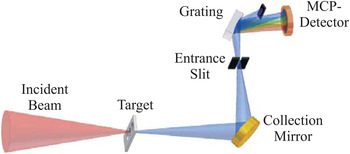
(Color online) Schematic drawing of the experimental setup.

HIGH HARMONIC GENERATION FROM NM-SCALE FOILS
Like in the interaction with bulk targets, two distinct mechanisms capable of generating high-order harmonics in the transmission of nm-scale foils have been identified (George et al., Reference George, Quéré, Thaury, Bonnaud and Martin2009). For sub- and weakly-relativistic intensities corresponding to a normalized vector potential a 0 = sqrt{I L λL2/1.37 × 1018 Wcm−2 µm2} below, or on the order of unity, where I L and λL stand for the cycle-averaged intensity and the wavelength of the incident laser light, harmonics are generated via linear mode-conversion of plasma waves (Sheng et al., Reference Sheng, Mima, Zhang and Sanuki2005) in the density gradient on the rear side of the foil. These plasma waves, unlike on the front side of the target, are excited indirectly by as-electron bursts propagating up the rear side density gradient. These bunches are accelerated in the electric field set up by other electron bunches generated on the front side that penetrate through the foil (George et al., Reference George, Quéré, Thaury, Bonnaud and Martin2009; Teubner et al., Reference Teubner, Eidmann, Wagner, Andiel, Pisani, Tsakiris, Witte, Meyer-Ter-Vehn, Schlegel and Foerster2004). This mechanism is conventionally called coherent wake emission (CWE) (Quéré et al., Reference Quéré, Thaury, Monot, Dobosz, Martin, Geindre and Audebert2006). For larger intensities and especially in the relativistic limit (a 0 >> 1), harmonic radiation can also be emitted by plasma electrons close to the critical density layer coherently oscillating with velocities close to the speed of light in the driving laser field (Baeva et al., Reference Baeva, Gordienko and Pukhov2006; Bulanov et al., Reference Bulanov, Naumova and Pegoraro1994; Tsakiris et al., Reference Tsakiris, Eidmann, Meyer-Ter-Vehn and Krausz2006). In the case of very thin foil targets, this mechanism can also generate harmonics emitted in the forward direction that propagate through the target, and can be observed at the rear side (George et al., Reference George, Quéré, Thaury, Bonnaud and Martin2009; Krushelnick et al., Reference Krushelnick, Rozmus, Wagner, Beg, Bochkarev, Clark, Dangor, Evans, Gopal, Habara, Mangles, Norreys, Robinson, Tatarakis, Wei and Zepf2008). The predominant mechanism in a specific experiment can be determined by the characteristics of the detected harmonic spectrum. While relativistic harmonics exhibit an intensity dependent spectral cut-off, CWE harmonics do not. Instead, they have a distinct high energy cut-off determined by the maximum plasma frequency, and thus peak density in the target. In this case, the highest generated harmonic order is q co = ωp,max/ωL where ωL and ωp,max = sqrt{n e,maxe 2/ε0m e} with n e,max the peak electron density are the laser and peak plasma frequency, respectively. In addition, the generation of CWE harmonics requires oblique incidence as the conditions for mode conversion cannot be fulfilled otherwise (Sheng et al., Reference Sheng, Mima, Zhang and Sanuki2005). In contrast, relativistic harmonics can also be generated under normal incidence in which case the electron oscillations are driven by the v × B component of the driving force oscillating at twice the laser frequency resulting in the generation of only odd harmonics (Tsakiris et al., Reference Tsakiris, Eidmann, Meyer-Ter-Vehn and Krausz2006).
In the case of a mildly relativistic laser pulse incident normally onto a thin foil the harmonic spectrum may show signatures of both harmonic generation mechanisms, which one dominates, will depend on the detailed dynamics of the interaction. Especially denting of the target in the focus will alter the interaction significantly as this result in effectively oblique incidence on the sides of the focal spot. Due to the lower intensity level in these regions of the focus, the harmonic generation will likely be dominated by CWE in such regions resulting in a spectrum containing all harmonics with a density dependent cut-off. If relativistic harmonics are also generated they will originate predominantly from the center of the focus where the intensity is highest and likely display only odd orders owing to the true normal incidence in this region. The relative efficiency of the two mechanisms will vary depending on how planar the laser target interaction is, resulting in different intensity ratios between odd and even harmonics. In addition target non-uniformities across the focal region can also influence the effective angle of incidence of the driving electric field.
SIMULATIONS
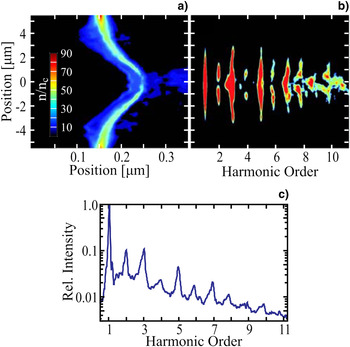
To verify this argumentation, we have conducted two-dimensional particle-in-cell (PIC) simulations of the laser foil interaction at normal incidence using the code PICWIG (Hörlein et al., Reference Hörlein, Rykovanov, Dromey, Nomura, Tzallas, Adams, Geissler, Zepf, Krausz and Tsakiris2009; Rykovanov et al., Reference Rykovanov, Geissler, Meyer-Ter-Vehn and Tsakiris2008). As will be discussed later even for the ultra-clean laser pulses employed in this experiment, the target will have expanded in the rising edge of the 45 fs pulse with a 0 = 3.6. Taking this into account, the simulations were initialized using a triangular density profile with a peak density of n 0 = 100n c and a linear ramp of length 25 nm on both the front and the rear side. Considering that the original target density in the experiment is approximately 480n c this corresponds to a solid density foil of approximately 5 nm in original thickness. The laser pulse was Gaussian both in space and time (spot size 3 µm full width at half maximum (FWHM), duration 15 cycles FWHM in the field) and incident normally onto the target. The size of the simulation box is 6 λL in laser propagation direction and 15 λL in polarization direction. The time step is τL/400 and the laser propagation direction spatial step correspondingly is λL/400 where τL is the period of the driving laser. The results of the simulation are depicted in Figure 2. The denting of the foil during the interaction is clearly visible in Figure 2a where the electron density near the instance when the peak of the pulse interacts with the target is shown. Figure 2b shows the harmonic spectrum emitted in the forward direction as a function of position across the target recorded at a position just behind the target surface. On-axis only odd harmonics are generated, which can only originate from relativistic electron oscillations as the condition for mode conversion necessary for CWE (Sheng et al., Reference Sheng, Mima, Zhang and Sanuki2005) cannot be fulfilled in this geometry while off-axis all harmonics are generated owing to the effectively oblique incidence of the driving pulse. To derive the total harmonic spectrum collected in the experiment after propagation to the detector, we sum over the spectra emitted at the different positions in the focus. The resulting power spectrum is shown in Figure 2c. The integrated spectrum contains all harmonic orders but an enhancement of odd harmonics originating from the center of the generation region is visible constituting a clear signature of relativistic harmonic generation on axis.
(Color online) Results of two-dimensional PIC-simulations of the interaction of a relativistic laser pulse with a triangular shaped target with 25 nm gradients on each side and a peak density of 100n c. (a) show the electron density distribution at the instance when the peak of the driving pulse arrives at the initial target position (note the different length scales used to emphasize the denting of the target) and (b) the time integrated harmonic spectra emitted in the forward direction as a function of radial position recorded at a position just behind the target surface. A clear difference in the emission characteristics on- and off-axis is visible. Radially integrating the individual spectra in (b) to account for the collection of the signal with a mirror yields the spectrum shown in (c) exhibiting all harmonics with an enhancement of the odd orders.

EXPERIMENTAL RESULTS
The experiments presented in this article were conducted using the 30 TW laser facility at the Max-Born-Institute in Berlin. The Ti:sapphire laser system delivered pulses with an energy of 0.7 J and a pulse duration of 45 fs at a central wavelength of 810 nm to the target. To enhance the temporal contrast of the laser a recollimating double plasma mirror (Andreev et al., Reference Andreev, Steinke, Sokollik, Schnürer, Ter Avetsiyan, Platonov and Nickles2009) was introduced into the system enhancing the temporal contrast to better than 1:1010 on the few picosecond scale. The beam was focused to a near diffraction-limited focal spot of 3.6 µm FWHM diameter using a dielectrically coated f/2.5 off-axis parabola resulting in a peak focused intensity of I 0,peak = 5 × 10¹⁹ W/cm2 corresponding to a normalized vector potential of a 0,peak~5.
Free-standing diamond-like carbon foils like the ones used in Henig et al. (Reference Henig, Steinke, Schnürer, Sokollik, Hoerlein, Kiefer, Jung, Schreiber, Hegelich, Yan, Meyer-Ter-Vehn, Tajima, Nickles, Sandner and Habs2009) and Steinke et al. (Reference Steinke, Henig, Schnürer, Sokollik, Nickles, Jung, Kiefer, Hörlein, Schreiber, Tajima, Yan, Hegelich, Meyer-Ter-Vehn, Sandner and Habs2010) ranging from approximately 5 to 17 nm in thickness were irradiated under normal incidence in the focus of the driving laser beam. The radiation emitted in the laser propagation direction was collected using a spherical mirror with an unprotected gold coating positioned under an angle of 45° (see Fig. 1). The resulting line focus was placed on the entrance slit of a normal incidence ACTON VM-502 VUV-spectrometer equipped with a micro-channel-plate detector and a fiber-coupled charge-coupled device-camera. The spectrometer allowed the detection of radiation from 140 down to 50 nm corresponding to harmonics 7 to 16 of the fundamental laser wavelength.
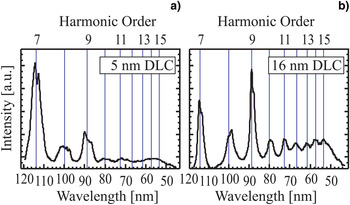
Two typical normalized harmonic spectra obtained from targets of different thicknesses are depicted in Figure 3. The absolute peak intensity in Figure 3a is approximately twice as big as in Figure 3b. Both spectra show odd and even harmonics with a pronounced enhancement of the odd harmonics, especially the orders of 7 (H7) and 9 (H9). The spectra do however differ significantly in the highest harmonic visible. The spectrum from the thinner target (Fig. 3a) shows harmonics up to H9 whereas radiation with significantly shorter wavelength up to H15 is generated from the thicker target (Fig. 3b).
(Color online) Normalized high harmonic spectra obtained from targets with two different thicknesses.

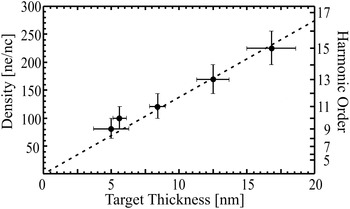
These spectral properties suggest that the harmonics in our experiment are indeed generated by two different mechanisms as predicted by simulations, one generating predominantly odd and one producing all harmonics. The thickness dependent cut-off with higher harmonics from thicker foils in combination with the moderate intensities on the sides of the focus suggests that this part of the spectrum is generated by CWE (George et al., Reference George, Quéré, Thaury, Bonnaud and Martin2009). This means that the target has to be dented significantly to facilitate motion of the plasma electrons in and out of the surface in the electric field as predicted by the simulation. The trend of higher harmonics from thicker targets is visible for all measured targets and is displayed in Figure 4, where the cut-off harmonic order and corresponding peak target density is plotted versus the original foil thickness. The peak density in the interaction region as inferred from the harmonic generation emitted during the most intense phase of the laser foil interaction is found to increase linearly with initial target thickness. This suggests that the target plasma expands with similar velocities in all cases resulting in densities during the interaction that are significantly lower than those of the original foil. For all studied targets, the decrease in density is consistent with an exponential density ramp with a scale length of approximately 18 nm on each side of the foil at the onset of the relativistic interaction. The dashed line in Figure 4 shows the peak target densities expected in such a scenario and is in very good agreement with the measured data. To check these values for consistency, we estimate the expansion of the foil after ionization, and prior to the relativistic interaction considering a Gaussian pulse shape on the rising edge of the 45 fs pulse. Assuming uniform energy deposition in the foil (Price et al., Reference Price, More, Walling, Guethlein, Shepherd, Stewart and White1995) the ion sound velocity rapidly increases over a time window of 70 fs to approximately c s,peak = 5 × 107 cm/s corresponding to a hot electron temperature T e~5 keV at which the plasma becomes non-collisional under our experimental conditions (Blanc et al., Reference Blanc, Audebert, Falliès, Geindre, Gauthier, Santos, Mysyrowicz and Antonetti1996; Gibbon, Reference Gibbon2005; Kruer, Reference Kruer1988). During this time, the average sound velocity is found to be c s,av~2.2 × 107 cm/s which results in an expansion by 15.4 nm in good agreement with the measured data. Thus, in addition to the determination of the target density, the experiment gives information about the target heating prior to the relativistic interaction and demonstrates a fundamental limitation of the nm-foil density at the instance of the interaction with the peak of the laser pulse which can be crucial when even thinner targets are employed.
Peak target density and cutoff harmonic plotted as a function of original target thickness. The dashed line corresponds to the peak density expected for a one dimensional foil expansion with a scale length of 18 nm on each side. The spectra shown in Figures 3a and 3b correspond (from left to right) to the second and the fifth data point respectively.

CONCLUSIONS
In conclusion, we have presented the first experiment demonstrating the generation of high order harmonics in the transmission of few-nm-scale foil targets irradiated at normal incidence. The measurements in combination with two-dimensional PIC-simulations demonstrate that the harmonics are generated via two different mechanisms in different regions of the laser focus giving detailed insight into the dynamics of the foil target under experimental conditions also of interest, for example, for particle acceleration experiments. While non-uniformities such as denting of the target lead to effectively oblique incidence of the driving field on the sides of the focus and the generation of all harmonics in this region, only odd harmonics are generated exactly on the laser axis. This constitutes the first unambiguous demonstration of relativistic harmonic generation at normal incidence as predicted in many theoretical publications. Harmonics are mainly generated via CWE in regions of oblique incidence, which allows the determination of the instantaneous target density of the foil in the relativistic interaction. The densities inferred from the observed harmonic spectra are in good agreement with the one-dimensional expansion of the foil targets. This expansion occurs even for perfect Gaussian laser pulses and thus imposes a fundamental limit on the peak density of few-nm-scale foil targets during the relativistic part of the laser solid interaction. The experiments demonstrate that, beyond the fundamental study of the harmonic generation process itself, this method is a powerful diagnostic of the laser plasma interaction that can be employed in many experimental scenarios pertaining to efficient laser particle acceleration including RPA with circular polarization. In fact, the method does not even require any modifications to existing particle acceleration experiments except for the implementation of a pickoff optic as all the information is generated by the driving laser beam itself.
ACKNOWLEDGMENTS
We would like to thank the Berlin laser staff for their support. This work was funded in part by the DFG through SFB Transregio18 and the Cluster of Excellence Munich Center for Advanced Photonics (MAP) and by the Association EURATOM – Max-Planck-Institut für Plasmaphysik. A. H., S. G. R., D. K. and D. J. acknowledge financial support from IMPRS-APS. X. Q. Y. acknowledges financial support from the Humboldt Foundation and NSFC (10935002).