

I. Introduction
The assessment of farmers' risk attitudes is fundamental in agricultural economics, and a large body of work is devoted to studying the use of risk-mitigating inputs such as pesticides (Liu and Huang, Reference Liu and Huang2013; Gong et al., Reference Gong, Baylis, Kozak and Bull2016). These chemical inputs have an insurance role on harvests (Carpentier et al., Reference Carpentier, Barbier, Bontems, Lacroix, Laplana, Lemarie, Turpin and Aubertot2005; Carpentier, Reference Carpentier2010) and their use, as all insurance systems, is related to risk preferences (Sexton, Lei, and Zilberman, Reference Sexton, Lei and Zilberman2007). This article focuses on wine production in France, where the intensive use of pesticides raises environmental concerns. While vineyards represent only 3% of the agricultural surface, winegrowers use 20% of all pesticides sold (Aubertot et al., Reference Aubertot, Barbier, Carpentier, Gril, Guichard, Lucas, Savary and Voltz2005). Agro-environmental policies were recently implemented in an effort to reduce this intensive pesticide use (Ecophyto, Reference Ecophyto2008; Ecophyto II, Reference Ecophyto II2015). However, there exists few viable options for reducing pesticide use without compromising yield and the climatic conditions in wine growing regions are favorable to fungi. The use of pesticides reduces production uncertainty and vine is a cash crop, with high returns on chemical inputs. Profit-maximizing winegrowers use chemical inputs as long as the marginal cost of doing so is lower than the marginal benefit. Most of the wine production in France is produced under appellation regimes that restrict maximum yields (Pennerstorfer and Weiss, Reference Pennerstorfer and Weiss2012; Castriota and Delmastro, Reference Castriota and Delmastro2014)—so-called appellation minimum quality standards (Protected Designation of Origin (PDO), Protected Geographical Indication (PGI)). Yield restrictions are imposed on specific and limited areas to restrict volumes and guarantee wine quality.
Farmers' attitudes about the risk of viticulture have not yet been examined. Because the appellation regime imposes a constraint on yields, one needs to study input choices conditional on the expected output level, that is, to estimate an ex-ante cost function (Pope and Chavas, Reference Pope and Chavas1994; O'Donnell and Woodland, Reference O'Donnell and Woodland1995). Unlike some previous work on farmers' risk attitudes (see e.g., Kumbhakar (Reference Kumbhakar2002); Koundouri et al. (Reference Koundouri, Laukkanen, Myyra and Nauges2009); Foudi and Erdlenbruch (Reference Foudi and Erdlenbruch2012)), our analysis is based on a joint estimation of a production cost function and a risk preferences function. Unobservability of the expected output level typically plagues cost function estimations under planned-output constraint (Moschini, Reference Moschini2001; Moschini and Hennessy, Reference Moschini, Hennessy, Gardner and Rausser2001). Not in our study: The information relative to appellation yields is available in the specifications of PDOs. We use these appellation yield figures as a measure of the planned output. Usually, risk aversion is described as decreasing with expected profit (Atanu, Love, and Schwart, Reference Atanu, Love and Schwart1994; Chavas and Holt, Reference Chavas and Holt1996). With production caps, however, we expect risk aversion to increase with expected profits. This relation is reinforced by the fact that vine is a perennial crop—a pest attack in a given year affects the production potential of the vine in the following year—increasing the potential risk and loss for winegrowers.
Our analysis proposes to simultaneously estimate (1) the parameters of the cost function, (2) the share-cost equations, and (3) the risk preferences function. We assume that winegrowers face yield risk and are able to access a stochastic and multiplicative production technology. Under these assumptions, winegrowers choose the input quantity that minimizes their production cost under the planned-output constraint. We split the expected utility maximization process into two stages. In the first stage, the winegrower chooses the input level that minimizes his cost of producing the expected output quantity. In the second stage, the winegrower chooses the output level that maximizes his expected utility of profit, given the costs computed in the first stage. The resulting planned output is not observable—our analysis uses the maximum yields imposed by PDOs as a proxy for the expected output level.
II. Context and Data
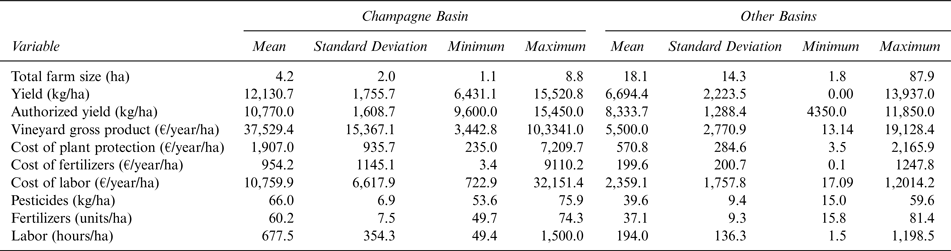
French wines capture a large share of the world wine market.Footnote 1 This sector is prominent in French agriculture. It is the largest agricultural sector in value (15% of the value of production in 2007, INSEE data 2017). The vast majority of wines (80%) are produced under appellations of origin (Table 1), for which production volumes are restricted. These appellations certify the origin of products whose quality and characteristics are tied to their geography, but not only (Economie Rurale, 2000). Few strictly selected terroirs qualify for the appellation of origin label (Hinnewinkel, Reference Hinnewinkel and Hinnewinkel2002), which is based on the respect for local uses, soil, climate, and human know-how.
Descriptive Statistics

Our analysis is based on data from the European Farm Accountancy Data Network (FADN).Footnote 2 This database includes annual farm-level data on surface, yield, value of wine production, working hours, cost of pesticides, fertilizers, and labor. Our dataset consists of a balanced panel of 100 winegrowers in the main French wine production basins and 25 winegrowers in the Champagne region over the 2005–2014 period, which led to a sample of 1,250 observations. This sample includes the most important wine production basins in France: Alsace, Beaujolais, Bordelais, Bourgogne, Languedoc-Roussillon (Lang. Rouss.), Provence-Aples-Côte-d'Azur (PACA), Rhône, Sud-Ouest, Val de Loire, and Champagne. For annual authorized yield figures in each wine production region, we use a database compiled by the French National Institute of Origin and Quality (INAO). Table 1 provides an overview of the data.
III. Theoretical Model
Our empirical specification is based on the assumption that there is uncertainty around the level of output relative to the level of input. We consider a winegrower who makes ex-ante decisions about quantities of inputs. We consider that quantities of pesticides are chosen before output realizations are known. Therefore, we assume that the winegrower maximizes his expected utility of profits with the decisions program given as follows:
 $$\mathop {\max} \limits_{x,y} \lcub {E\lpar {U\lpar \pi \rpar } \rpar = E\lpar {U\lpar {\,py-{w}^{\prime}x} \rpar } \rpar } \rcub ,$$
where U(π) is a Von Neumann-Morgenstern utility function form and π = py − ω′x is the profit of the winegrower. y represents output, p denotes the price of output, x a vector of variable inputs, and ω a vector of variable input prices.
We define a multiplicative stochastic production function given by y = f(x)ϵ, where ϵ is a non-negative random term. This random term ϵ represents exogenous shocks that may affect grape production. We assume that E(ϵ) = 1 and Var(ϵ) = σ ϵ = 2 (Just and Pope, Reference Just and Pope1978). We denote by  $\bar{y}$ the ex-ante planned output level.
In this context, the expected utility-maximizer winegrower will choose the quantity of inputs that minimize his cost of producing the expected output level  $\bar{y}$. Thenceforth, the ex-ante cost dual to the expected output function is defined as:
 $$c\lpar {w,\bar{y}} \rpar = \mathop {\min} \limits_x \lcub {{w}^{\prime}x{:}\;f\lpar x \rpar \ge \bar{y},x \ge 0} \rcub. $$
This cost function represents the minimum factor cost of producing the expected output level y when the input price vector is w. The factor share equations are obtained using Shephard's lemma with s i = ∂ln(c(w,  $\bar{y}$))/∂ln(w i), where s i represents the cost share on input i.
As explained earlier, we split the expected utility maximization process into two stages. In the first stage, the winegrower chooses the input level that minimizes his cost of producing the expected output quantity  $\bar{y}$. In the second stage, the winegrower chooses the output level
 $\bar{y}$ that maximizes his expected utility of profit, given the costs computed in the first stage, as follows:
 $$\mathop {\max} \limits_{\bar{y} \ge 0} \lcub {E\lpar {U\lpar {\,p\epsilon \bar{y}-c\lpar {w,\bar{y}} \rpar } \rpar } \rpar } \rcub .$$
The first order condition with respect to the planned output  $\bar{y}$ is as follows:
 $$\displaystyle{{\partial E\lpar {u\lpar \pi \rpar } \rpar } \over {\partial \bar{y}}} = p\theta \lpar. \rpar -\displaystyle{{\partial c(w,{\bar y)}} \over {\partial \bar{y}}} = 0.$$
The function θ( $\bar{y}$, w, p) represents the risk preferences function and is defined by θ(
 $\bar{y}$, w, p) = E(U′ϵ)/E(U′), where U′(π) is the marginal utility of profit.
Following Kumbhakar and Tveteras (Reference Kumbhakar and Tveteras2003), we approximate U′(π) by a second-order polynomial at the point (ϵ − 1 = 0). This approximation is made under the assumption that U(π) is continuous and at least twice differentiable. This allows us to rewrite the risk preferences function as a function of the Arrow-Pratt measure of absolute risk aversion (ARA), with the variance of winegrower profit (σ π2 = p 2 $\bar{y}$2), the degree of asymmetry or the skewness of the distribution of ϵ (γ = E(ϵ 3)), and the measure of downside risk aversion (DRA = U′′′(π)/U′(π)). Thus, this risk preferences function can be rewritten as follows:
 $$\theta \lpar {\bar{y},w,p} \rpar = \displaystyle{{1-ARA\sigma _\pi + 0.5DRA\sigma _\pi ^2 \lpar {\gamma -3} \rpar } \over {1 + 0.5DRA\sigma _\pi ^2}}. $$
The estimation of this risk preferences function requires a parametric form of ARA. Following Kumbhakar and Tveteras (Reference Kumbhakar and Tveteras2003), we define this Arrow-Pratt measure of absolute risk aversion as:  ${\rm A}RA = \; \mathop \sum \nolimits_{q = 0}^Q \delta _q\mu _\pi ^q $. This is a flexible parametric function of the winegrower's expected profit μ π, where q is the order of the polynomial and δ q are parameters to be estimated. In our case, the winegrower's expected profit is defined as: μ π = E [pϵ
 $\bar{y}$ – c(w,
 $\bar{y}$)], which is equal to μ π = p
 $\bar{y}$ – c(w,
 $\bar{y}$).
The planned output ( $\bar{y}$) is not observable. We, therefore, use the appellation yield constraint as a proxy for expected output. In order to rigorously estimate winegrowers gross profit, we assume that the planned output corresponds to the minimum between the yield obtained (y) and the appellation yield constraint (
 $\hat{y}$). In other words, yield = min (y;
 $\bar{y}$). Thus, μ π = p · min (y,
 $\hat{y}$) – c(w,
 $\hat{y}$).
The measure of downside absolute risk aversion can be derived from ARA as follows: DRA = − ∂ARA/∂μ π + ARA 2. We simultaneously estimate the factor share parameters s i and the risk preferences function. A positive sign for the derivative of ARA with respect to μ π indicates an increasing absolute risk aversion, while a negative sign indicates a decreasing absolute risk aversion. When the derivative is equal to zero, we consider absolute risk aversion as constant. The specifications of the empirical model are further described in Aka, Alonso Ugaglia, and Lescot (Reference Aka, Alonso Ugaglia and Lescot2018).
IV. Results: Risk Attitudes Estimates
Risk attitudes are based on the values of the risk preferences function (θ). However, the ARA and downside risk aversion (DRA) values are more interesting to analyze than the θ-function. Indeed, the magnitude of the risk preferences function is influenced by the output variance, the skewness of output distributions, ARA, and DRA.
A positive ARA indicates risk aversion, and a large positive value signals strong aversion to risk. DRA illustrates the fact that, when choosing between two output distributions with the same mean and variance, winegrowers prefer the output distribution which is less skewed to the left (Kumbhakar and Tveteras, Reference Kumbhakar and Tveteras2003). Intuitively, winegrowers are willing to pay a premium in order to avoid particularly bad outcomes (Koundouri et al., Reference Koundouri, Laukkanen, Myyra and Nauges2009). A positive DRA indicates that individual producers are averse to downside risk.
Another interesting measure of risk aversion is the Relative Risk Premium (RRP), where  $RRP = \; \textstyle{{\sigma _\pi ^2 ARA} \over {2\mu}} -\; \textstyle{{\sigma _\pi ^3 \lpar {E\lpar {\epsilon^3} \rpar -4} \rpar DRA} \over {6\mu}} $ (Antle, Reference Antle1987). RRP measures the share of profit that a winegrower is willing to sacrifice to avoid production risk.
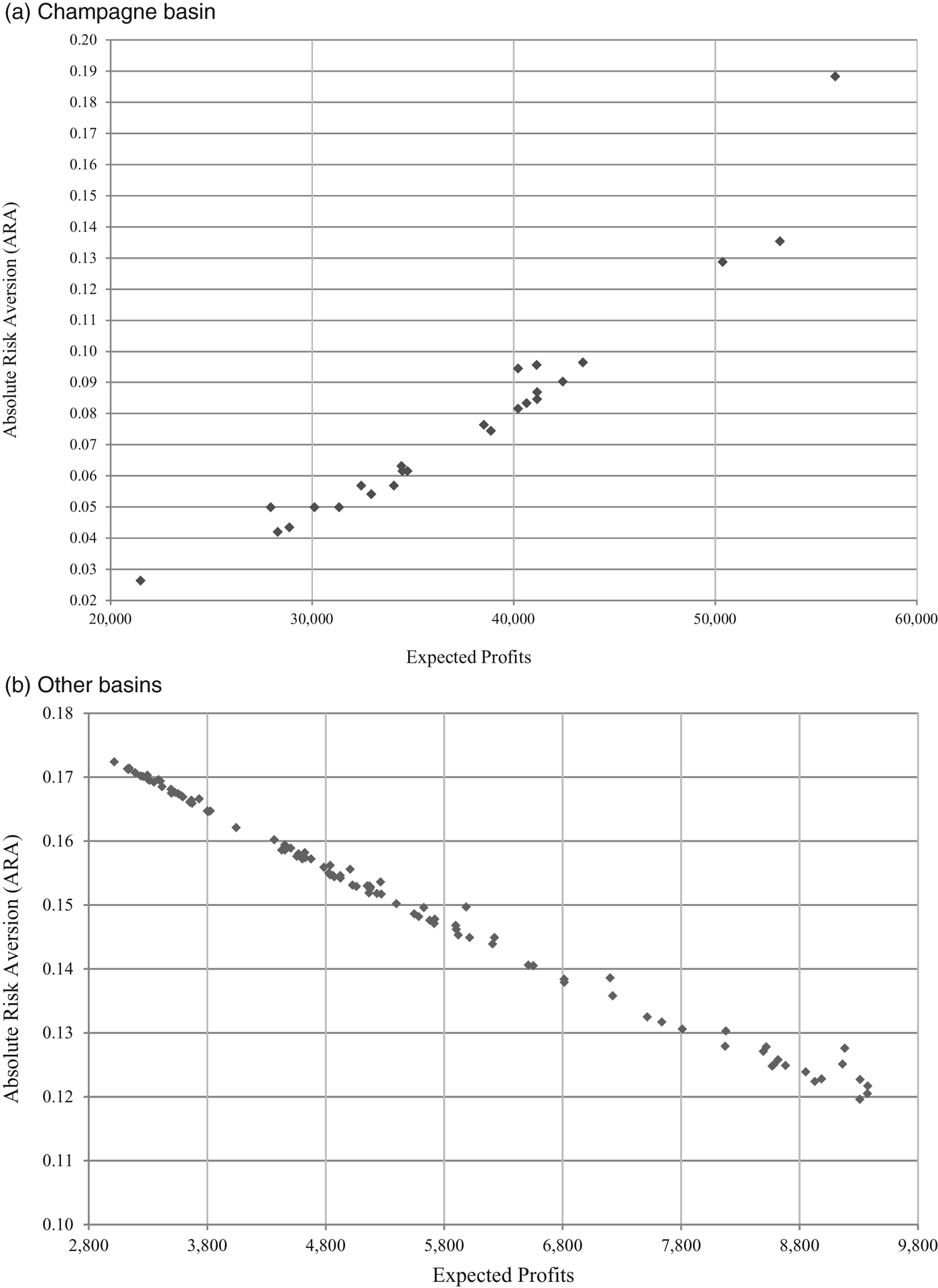
Figure 1 presents ARA points as a function of expected profits. We set out to test whether risk aversion is increasing or decreasing with expected profit. In our sample for other basins, we find that winegrowers display decreasing absolute risk aversion (ARA), or “DRA.” This finding is consistent with several empirical analyses on farmers’ risk attitudes (Koundouri et al., Reference Koundouri, Laukkanen, Myyra and Nauges2009; Foudi and Erdlenbruch, Reference Foudi and Erdlenbruch2012). Results for the Champagne region, however, are consistent with our initial intuition: when expected profits are very high, risk aversion increases with expected profit. The behavior of producers in Champagne is different from that in the other regions.
Arrow-Pratt Coefficients as a Function of Expected Profits
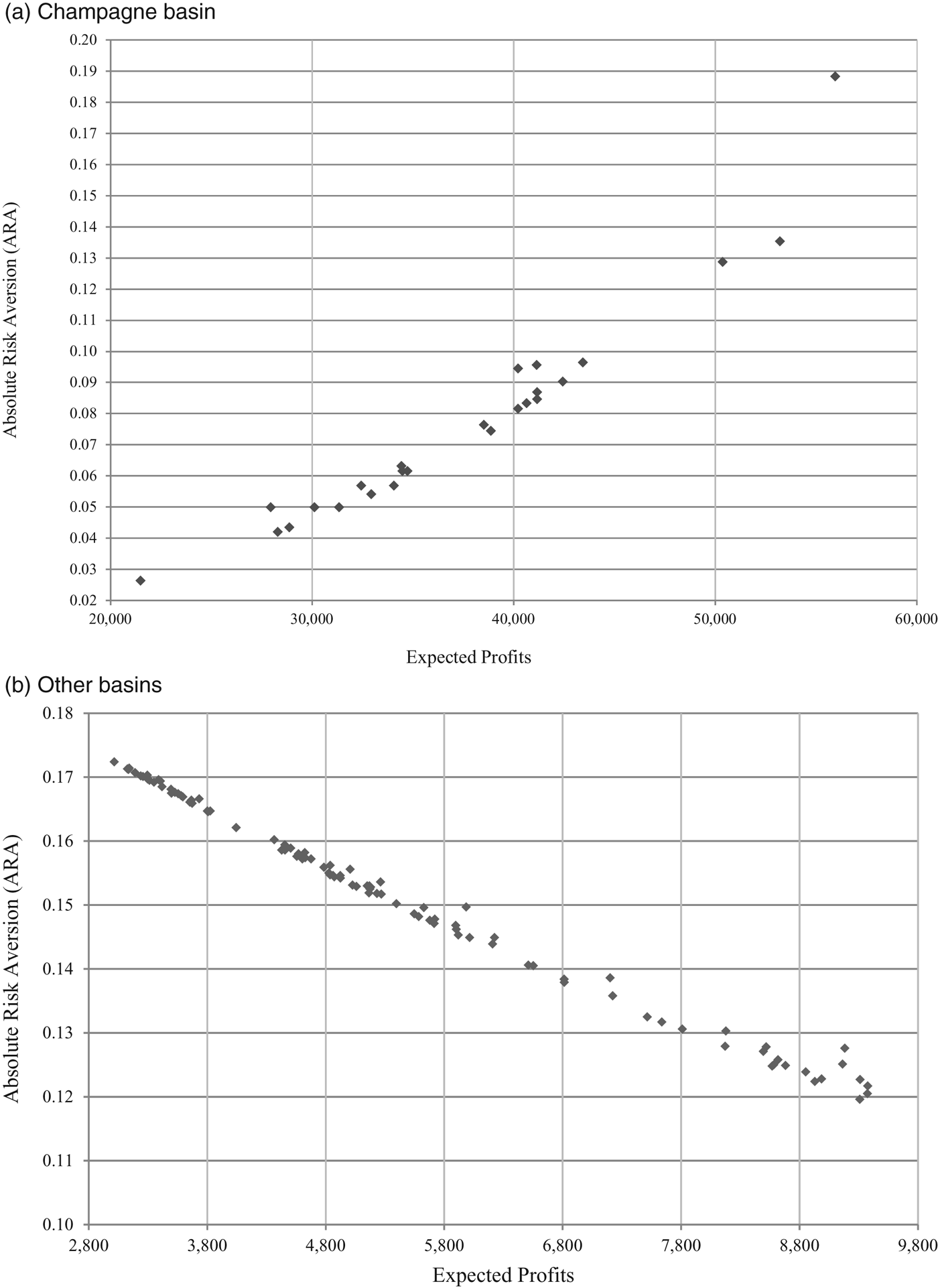
We now turn our attention to risk attitudes in the main wine basins. The ARA value in Alsace, Bourgogne, and Rhône is positive (0.14), but lower than in other basins, although the difference is small (0.15 or 0.16). Champagne stands out with an ARA coefficient of 0.08, indicating that Champagne winegrowers are less risk averse than winegrowers in other regions. RRPs in all basins range from 0.3 to 7%. RRP is highest in the Champagne basin. We find that risk aversion attitudes evolve differently in Champagne than in other regions: in Champagne, risk aversion increases with expected profit. This difference is due to Champagne's exceptionally high value of production. For this product, sometimes considered as a luxury good rather than a type of wine, the level of expected profit is such that the risk aversion of the producers is higher.
V. Conclusion
This paper presents an empirical analysis of winegrowers’ risk attitudes in France. In France, most of the production is carried out under an appellation regime that constrains the maximum authorized yield. Under this constraint, we used a trans-log cost function to estimate risk preferences. We found that winegrowers are risk averse. Risk aversion decreases with expected profits in all basins except Champagne. In Champagne, where expected profits are significantly higher than in other regions, winegrowers become more risk averse as expected profits increase.