Introduction
Recent estimates suggests that over-utilization, referring to high-frequency use, misuse, and non-emergent use, of Emergency Medical Services (EMS) is increasing in the United States.Reference Maragh-Bass, Fields, McWilliams and Knowlton 1 - 3 In the past two decades, annual emergency department (ED) visits and medically unnecessary EMS transports have increased, with annual ED visits rising beyond what would be expected based on population growth.Reference Richard, Hubble and Zwehl-Burke 4 - Reference Tang, Stein, Hsia, Maselli and Gonzales 7 Annual costs of medically unnecessary transports since 1997 are estimated at a minimum of US $200 million.Reference Camasso-Richardson, Wilde and Petrack 8 - Reference Cone, Benson, Schmidt and Mann 10 In response, the National Academy of Medicine (NAM; Washington, DC USA), which provides evidence-based research and recommendations for public health and science policy, issued a call for evidence-based practices in EMS, and also identified a critical need for rigorous prehospital emergency care research.Reference Maragh-Bass, Fields, McWilliams and Knowlton 1 , Reference Brown, Hubble and Cone 11 Specifically, the NAM noted that much of the protocols implemented by EMS are informed by research conducted in hospital settings, and that systems-level barriers have prevented the conduct of research in prehospital settings.Reference Maragh-Bass, Fields, McWilliams and Knowlton 1 , Reference Brown, Hubble and Cone 11
EMS Over-utilization and Misuse in Urban Settings
Extant research suggests EMS misuse and over-use varies by demographic factors. For example, studies have identified that EMS misuse and over-use is seen frequently among elderly patients and patients with psychiatric conditions and/or substance dependence.Reference Leonard, Scharff and Koors 12 - Reference Pines, Mullins, Cooper, Feng and Roth 17 Recent studies also suggest that higher rates of medically unnecessary EMS transports occur in urban cities, and often are due to a small percentage of patients comprising a large percentage of individual transports.Reference Bender, Skodol and Pagano 18 - Reference Durant and Fahimi 23 Similarly, a recent study by Ondler and colleagues found that frequent ED users accounted for 10 times the amount of visits as infrequent users at an urban academic hospital, and that they were often unemployed, under-insured, and had behavioral health conditions such as substance abuse.Reference Weaver, Moore, Petterson and Yealy 6 A recent qualitative review by Rees and colleagues also found that the majority of the patients in the studies they examined had mental illness issues, which ED providers were unable to adequately care for.Reference Davydow, Hough, Zatzick and Katon 19 Other studies corroborate these findings, such that in resource-limited communities, much of the population using EMS services is under-insured, racial/ethnic minorities, homeless individuals,Reference Squire, Tamayo and Tamayo-Sarver 24 and those with limited access to other health care and social services, such as substance treatment programs.Reference Blank, Li and Henneman 25 - Reference Knowlton, Weir and Hughes 28
To date, little research has distinguished between demographic characteristics of frequent EMS versus frequent ED users. The research that has been conducted suggests that frequent EMS users are often under-insured, racial/ethnic minorities, particularly in urban settings.Reference Xu, Nelson and Berk 27 - Reference Szekendi, Williams, Carrier, Hensley, Thomas and Cerese 34 Conversely, a recent national study by Pines and colleagues suggest that ED frequent users are more likely to be white American and female, many of whom are insured.Reference DiPietro, Kindermann and Schenkel 35 , Reference Pines, Asplin and Kaji 36 Therefore, more research is needed to characterize EMS over-use as distinct from ED use, as well as the magnitude of behavioral health conditions on patterns of health care utilization.
Engaging EMS and Conducting Research in Urban Settings
Recently, studies identifying factors to understand and mitigate use of emergency services have been conducted.Reference LaCalle and Rabin 37 , Reference Schnall, Clark, Olender and Sperling 38 However, many of these studies have been conducted in the ED rather than with EMS providers.Reference LaCalle and Rabin 37 - Reference Brice, Garrison and Evans 43 Irrespective of intervention type, important facilitators identified include demonstrated effectiveness of screening and health interventions and study “champions” to maintain the impact of the interventions.Reference Maragh-Bass, Fields, McWilliams and Knowlton 1 , Reference Brown, Hubble and Cone 11 , Reference LaCalle and Rabin 37 - Reference Sayre and Gausche-Hill 41 Among studies of research in out-of-hospital settings, a major barrier identified is lack of knowledge of ethical research standards, such that participants may not be aware of institutional safeguards to protect privacy and ensure maximum benefits.Reference Mahabee-Gittens, Dixon, Vaughn, Duma and Gordon 39 Alternatively, a facilitator of prehospital research is incorporation of study elements into existing EMS workflow and protocols, though more research is needed in prehospital settings to identify factors which facilitate research.Reference Schmidt, Nelson, Daya, Delorio, Griffiths and Rosteck 40 , Reference Brice, Garrison and Evans 43 - Reference Williams, Perillo and Brown 45
As mentioned, an important area for further EMS research is understanding the impact of substance use on medically unnecessary transports, particularly in resource-poor urban settings. Baltimore City (Maryland USA), characterized by both EMS and ED over-use, is an urban area where much can be gleaned from engaging EMS in research to inform evidence-based prehospital care.Reference Xu, Nelson and Berk 27 , Reference O’Toole, Pollini, Gray, Jones, Bigelow and Ford 29 , Reference Szekendi, Williams, Carrier, Hensley, Thomas and Cerese 34 An estimated one in eight adults are heroin-dependent, and as a result, the city has the highest national prevalence of heroin use and drug-related mortalities.Reference Callaham 46 - 48 Within EMS, longer wait times due to non-emergent substance use may be contributing to these issues. Previous research by Knowlton and colleagues found that frequent EMS utilizers in Baltimore City are usually middle-aged, African-American males, many of whom utilize EMS due to non-emergent alcohol and/or opiates use.Reference Xu, Nelson and Berk 27 , Reference O’Toole, Pollini, Gray, Jones, Bigelow and Ford 29 Despite high rates of substance use and medically unnecessary EMS transports, no prehospital interventions to address these factors have been conducted in Baltimore to date.
As a result, the Johns Hopkins Bloomberg School of Public Health (JHSPH; Baltimore, Maryland USA) and Baltimore City Fire Department (BCFD) formed a partnership to test a novel prehospital intervention program. Emergency Medical Service providers will be trained to screen patients for substance abuse, deliver motivational messages to encourage patients to enter drug treatment, and refer clients to the JHSPH study site for active treatment referral. While brief alcohol dependence screenings and interventions have been shown effective, additional research is needed to test this approach in opiate-using populations. 49 - Reference Krupski, Sears and Joesch 53 Therefore, the present partnership is critical to identifying novel ways to reduce EMS misuse and over-use in an urban, resource-limited setting.
Summary and Purpose
Currently, there is a dearth of research identifying approaches to reduce over-utilization of EMS, including understanding the needs and current practices of EMS providers. In urban cities such as Baltimore, EMS providers have direct contact with marginalized individuals, many of whom are substance users. The partnership between the JHSPH team and BCFD was borne of the need for prehospital, evidence-based recommendations to inform standards of care for substance-using populations. The purpose of the present formative research was to understand the contextual factors associated with EMS care provision for substance-using populations in Baltimore City. Specific study objectives were to: (a) explore providers’ views on EMS over-use; (b) understand the demands of providers caring for substance-using patients; and (c) gain insights from EMS providers on participating in the implementation of the intervention. Findings will inform EMS training and implementation of the larger intervention study.
Methods
EMS System in Baltimore City
In Baltimore City, the EMS system is operated by the BCFD. The catchment area of EMS is roughly 80 square miles, with a resident population of over 640,000 individuals.Reference Xu, Nelson and Berk 27 , Reference Heather 54 Previous research suggests that the BCFD responds to approximately 235,000 calls every year.Reference Heather 54 The BCFD operates EMS out of 38 fire stations located throughout Baltimore City. Staffing regulations require that each engine and truck are equipped with at least one EMS provider (eg, emergency medical technician or paramedic). Each engine is equipped with Basic Life Support (BLS) and Advanced Life Support (ALS) equipment, respectively, and EMS providers who are either BLS and/or ALS trained.Reference Xu, Nelson and Berk 27 , Reference Heather 54 Current regulations employ a universal access mandate, such that all individuals requesting access to EMS must be cared for.
Study Design
The present research was the formative phase of the LADDER to Recovery study. In this first phase, semi-structured, qualitative, in-depth interviews were conducted with EMS providers. Their insights will inform Phase II, during which a training of EMS providers to briefly screen their patients for substance abuse and refer them to treatment programs will be conducted. Finally, Phase III will consist of collaboration with local treatment programs to verify the admission of patients referred by the JHSPH study site. Qualitative health research defines meaning through rich description, as compared to quantitative approaches which deductively summarizes.Reference Heather 54 , 55 Recently, it has been used increasingly to explore the insights of EMS personnel on various health issues.Reference Brown, Hubble and Cone 11 , Reference Schmidt, Nelson, Daya, Delorio, Griffiths and Rosteck 40 - Reference Brice, Garrison and Evans 43 , Reference Creswell 56 , Reference Bigham, Aufderheide and Davis 57 Therefore, it was ideal for Phase I of the study.
Study Setting and Population
Interviews were conducted between April and June of 2013 at a centrally located fire station in Baltimore City. In order to accommodate the schedules of the providers, all interviews were completed prior to the beginning of the EMS providers’ scheduled shift time. Interviews were conducted in private rooms of the station utilizing a semi-structured interview guide. The LADDER study is the result of an existing partnership between the study team and the fire department which oversees EMS in the area. Therefore, recruitment of EMS providers for this study was facilitated by the fire department leadership. Recruitment was implemented using a three-step protocol. Step One consisted of identifying trends of EMS use in Baltimore, to identify the two fire stations that are in the catchment area of the academic institution’s hospital, which is located in a predominantly low-income area of the city. Step Two consisted of internal memos circulated by the fire department on behalf of the study team, which explained the project and solicited participation from EMS personnel. Interested persons were given the study contact information. Finally, in Step Three, the study team followed-up with these individuals, giving them more information about the study, answering their questions, and scheduling interviews.
Study Protocol and Measures
Written consent was obtained from all participants at the beginning of the interview. The principal investigator and three trained research team members conducted interviews with EMS providers. First, demographic information was obtained from each provider (eg, age, race, and number of years of experience). Next, perceptions of substance users and opinions about EMS playing a role in linking them to drug treatment services were elicited. The comprehensive interview guide was developed by the study team members to elicit rich description of the providers’ perceptions (Appendix A; available online only). Previous research suggests that alcohol and opioids are most commonly used in Baltimore; thus, these substances were the only ones discussed. Interviews were either conducted one-on-one or as dual interviews so that partners could participate at the same time to ease their shift scheduling. Interviews lasted up to one hour and ended if providers were called to duty. All study procedures and materials were fully approved by the JHSPH Institutional Review Board.
Data Analyses
Completed interviews were professionally transcribed verbatim and coded by three researchers using grounded theory and constant comparison methods. Grounded theory is an approach whereby data are inductively analyzed to derive theory through social context.Reference Heather 54 , Reference Sasson, Forman and Krass 58 Constant comparison is the means by which data analysis is iterated upon, thereby forming the grounded theory.Reference Heather 54 , Reference Sasson, Forman and Krass 58 Its consists of three stages: (1) open coding, when tentative codes are assigned to summarize text; (2) axial coding, to identify relationships between the open codes; and (3) selective coding, during which the data are distilled to a single variable, thereby forming the grounded theory.Reference Heather 54 , Reference Sasson, Forman and Krass 58 The research team met multiple times throughout the coding process to achieve consensus coding and inter-coder consistency for all transcripts. Once thematic saturation was reached, interviews were discontinued and the codebook was finalized. Coded text was then analyzed for recurrent themes and salient quotes were extracted. Analyses were conducted in Atlas.ti 7.0 (Atlas.ti Qualitative Data Analysis and Research Software for Windows, Version 7.0; Berlin, Germany: 2012).
Results
Participants
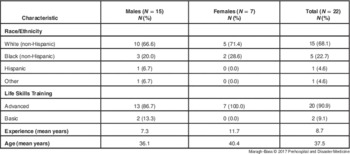
A total of 22 EMS providers were interviewed; Table 1 reports the demographic factors by sex. Among both males and females, the majority had Advanced Life Skills training (86.7% vs 100.0%, respectively). Males and females also were mostly White (66.6% vs 71.4%, respectively). On average, males were younger than females (36.1 vs 40.4 years, respectively). Most also had extensive experience, irrespective of sex; mean experience level was 8.7 years.
Demographic Characteristics of Participants

Themes
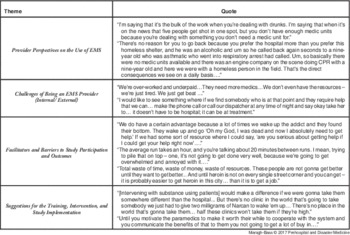
Four themes, summarized below, depicted views of EMS usage in Baltimore, the roles of providers, and recommendations to inform the intervention. Table 2 summarizes salient quotes.
Illustrative Quotations from Participants Presented by Theme

Theme 1: Provider Perspectives on the use of EMS
Providers talked about the frequent over-use and misuse of EMS in Baltimore, where over-use refers to frequent users and misuse refers to non-emergent cases. Colloquially referred to as “the frequent flyer problem,” many providers stated that this issue was both system-wide and a day-to-day challenge. Additionally, providers expressed frustration with misuse of EMS resources because non-emergent substance calls detain them from actual emergent cases:
“It’s overwhelming. Because there’s been times when I have had a regular, and there’s nothing wrong with them, other than they’re drunk. And literally, there’s a call literally around the block for a child. There was a child in cardiac arrest. And I’ve said to them, ‘You realize there is a child that is dying around the corner, and I’m dealing with you.’ They don’t care. No care, no concern whatsoever. And I can’t leave them, because they’re not refusing service. And here’s this child that is in need of immediate care, and I’m unavailable. So, that gets frustrating.”
Several noted that mental illness and homelessness were prevalent, and that the structure of the local health care delivery resources contributed to EMS misuse and over-use. As a result, patients misuse EMS due to limited access to other medical and social services:
“It’s the middle of January and they’re not high and they’re homeless and they’re hungry and lonely, tired, you know that kind of thing. [So] they want to get off the street they want to go to the hospital for a few hours to get warm.”
Finally, providers described that many EMS over users were older adults:
“Shockingly, they’re older. Yeah, on Fridays and Saturdays we get the partying kids because we have [Federal] Hill in our area, but on most occasions, they’re late 40 s all the way up into the 80 s. Yeah, very rarely are we picking up 35-year-olds that are falling down drunk all the time. I mean, we get those on the weekends but they’re typically once and never see them again. But the ones that we’re picking up over and over and over are late 40 s…. And I’ve had them up into the 80 s, but probably late 60 s, early 70 s is usually that frame. A lot of them are veterans [too].”
Theme 2: Challenges and Demands of being an EMS Provider
Providers expressed challenges in two main areas of their work: internal and external demands placed on them. External demands refer to their collective disappointment with the local health care delivery system. Providers stated that because of resource limitations and budget cuts in both the BCFD and the city at large, the quality of care delivery suffers. As a result, patients’ needs, including substance users, are not being met, reducing team morale and thereby leading to burnout:
“Yeah, I mean that’s our biggest gripe as a department…. There’s just no resources to fix all these people [patients misusing EMS]. There’s just no way….”
Similarly, providers expressed frustrations with the inadequate substance treatment programs in the area. They cited long wait times to get appointments for patients and the lack of follow-up after patients are seen in an ED and/or undergo inpatient detoxification:
“As far as availability of detox long-term treatment, you know you can take somebody to the hospital where they might spend two or three days, they’re going to be right back out the same because there’s no follow-up.”
A few providers discussed what they believed to be differences in availability of drug treatment resources based upon socioeconomic status. They suggested that those of lower socioeconomic status – the majority of their patient population – had limited access to rehabilitation programs that may be more effective for recovery:
“I think it’s… segregated by your socioeconomic, you know, most people in the areas we serve in our communities are pretty much stuck in a culture of poverty. They can’t support Suboxone so they [go to] the methadone clinics, the type where they have to report every day. You know that can be difficult. So, they miss doses.”
Finally, internal demands refer to the challenges providers faced within their organizational culture and administration. Some providers expressed disappointment that they were not always given the opportunity to contribute to decisions that directly impact their daily responsibilities and tasks, which are often already time- and resource-limited:
“The problem that we probably run into the most is that ____ would come up with these grand ideas but not include us in the decision-making process, they’ll just come out with it and say here do it. Not give us any background or what’s actually going on.”
Theme 3: Facilitators and Barriers to Study Participation and Outcomes
While participants were not asked specifically about facilitators and barriers, several of these over-arching themes emerged from data analysis. First, a facilitator identified was the potential influence EMS providers have with their usual substance-using patients. Several mentioned that because they are usually the first responders on the scene of drug- and alcohol-related emergencies, and thus have direct contact with the population:
“Well, we’re paramedics, social workers, fathers, mentors. We play a lot of hats, because we are the first ones to arrive when someone calls for help. I think we should [intervene], because we’re always the first one there.”
In a similar vein, several providers agreed that when their overdose patients have been revived from overdose, and/or reach their “bottom,” they may be receptive to seeking help at that moment. Interviewees emphasized that this moment should be seized upon, because substance users may not be receptive to encouragement to seek treatment at other times:
“We do have a certain advantage because a lot of times we wake up the addict and they found their bottom. They wake up and go ‘Oh my God, I was dead and now I absolutely need to get help.’ If we had some sort of resource where I could say, ‘are you serious about getting help, if I could get your help right now’….”
A second facilitator would be the incorporation of the proposed study intervention into the existing workflow that EMS providers have. Most providers indicated that they already ask patients about their drug and alcohol use to assess their medical history and that screening questions could easily be incorporated. They suggested this could be done systematically by making the study questions required data fields in the electronic data collection platform currently being used.
A formidable barrier identified by EMS providers was their perceptions that many of their patients are unreceptive and/or cannot change. Several providers stated that their efforts to screen patients and deliver brief motivational interventions would not be worth the effort, as many patients would not be amenable to listening or to changing their habits. In general, when providers were willing to intervene, they expressed more willingness to intervene with younger people, as well as opiate addicts, because they could be revived and coherent:
“I would say I am more likely to probably try to talk to a young opiate addict than I am an alcoholic…. Once they get to [their 50 s] they’re not receptive… they certainly don’t want to be lectured to by somebody half their age.”
Several providers stated that they no longer reach out to addicted patients to encourage them to seek help, partly because they are rarely exposed to success stories of patients who recover:
“There’s a little tiny ray of hope that’s like once in every three years… we had a guy, an alcoholic, that was two-three times a day, sober for four years. And guess who was picked up via 9-1-1 four times in one day last week? This guy is back after four years of sobriety.”
Another major barrier expressed by providers was lack of infrastructure for patient intervention. They expressed little knowledge and/or training about substance abuse treatment modalities and logistics, and limited means to research this. They also feared negative repercussions:
“They could actually get p— enough to call the — number for the city and say you were mean to them and then I’m down here at the shift commander’s office explaining why I was rude to a patient…. you know, ‘No, but I was just telling them that they probably shouldn’t do heroin anymore it’s bad for them.’ ‘Well, that’s not your place, your place is to take care of them and take them to the hospital,’ is what they’d tell me.”
Theme 4: Suggestions for the Training, Intervention, and Study Implementation
Several EMS providers endorsed the idea of an alternative facility for substance-using patients who need to sober up or to be monitored after being revived, as opposed to current protocol which is transporting patients to the ED. Providers also suggested that these centers could be linked to drug treatment center programs, because long wait times for current substance abuse programs often deter patients from entering treatment:
“I would like to see something where if we find somebody who is at that point and they require help that we… would be able to make the phone call or call our dispatcher and any time of night and say okay take her; it doesn’t have to be a hospital it can be….”
Next, providers stressed the importance of collaboration to encourage participation of EMS providers. For example, several suggested that team members and collaborators go on “ride-alongs” to accompany providers during transports and to better understand their processes:
“Yeah, I figure if you guys can get to a realistic understanding of what it’s like then maybe you guys can tailor some of this a little more workable.”
Participants offered a few additional suggestions related to the implementation of the intervention, such as small information cards that are wallet-sized rather than pamphlets that might be lost or thrown away. Others expressed that simply being provided information to enhance their ability to intervene with patients would be helpful, particularly to account for issues such as differing levels of patient education and literacy:
“Training with our paramedics on how to approach the subject in a way that still respects the patient privacy that’s non-discriminatory, and that’s probably the key.”
Similarly, many could not recall having any specific training in substance abuse or addiction, despite their daily contact with patients dealing with these issues. Finally, providers suggested that these trainings should be run in part by EMS providers, particularly if they have relevant experience with the population. For example, several providers disclosed personal experience with addiction themselves, or with loved ones. Similarly, several stressed the importance of interdisciplinary collaboration, including hospitals, homeless shelters, and the health department:
“I think it’s probably going to be a collective group, because everybody’s going to bring certain expertise… like I can tell you about the EMS, but… somebody come in with the social work, somebody come in with the drug rehab or counselor… you might even have somebody that’s a reformed addict, you know, a success story… and then like maybe one of you guys… can just tie the whole thing together.”
Discussion
The purpose of the present research was to understand the demands of EMS providers who serve substance users in an urban area, and their willingness to participate in a novel intervention with this population. This investigation yielded rare insights into the processes and demands of engaging prehospital health care providers in research, thereby addressing a critical gap in the literature.Reference Maragh-Bass, Fields, McWilliams and Knowlton 1 , Reference Brown, Hubble and Cone 11 , Reference Schmidt, Nelson, Daya, Delorio, Griffiths and Rosteck 40 , Reference Brice, Garrison and Evans 43 - Reference Williams, Perillo and Brown 45 Moreover, the results highlight several significant findings, which will inform the future brief invention to train EMS providers to screen substance-using patients for substance dependence and connect them to substance treatment programs and resources in Baltimore City. Findings also have larger implications for prehospital research in urban settings.
First, providers stated that in their experiences, a small number of patients comprised a large amount of EMS calls, many of which were non-emergent cases. The study participants reported that older, male, substance-using patients were the most likely to misuse and over-use EMS in Baltimore City. Known as the “frequent flyer” problem, similar populations have been shown to over-use and misuse EMS in larger studies, particularly elder patients with behavioral conditions. 15 - Reference Lee, Schuur and Zink 22 Therefore, future intervention with EMS over users in Baltimore must address the health concerns of older populations, including both physical health function and mental health and quality of life-related factors.
Providers identified another key point in treating substance-using patients, which was lack of adequate resources in the community, particularly among those familiar with substance treatment programs in Baltimore City. Providers expressed disappointment with the limited number of slots in substance use treatment centers in the city, and also over-crowded health centers. However, several noted that these barriers are socio-economically-dependent, and therefore present among the disadvantaged populations that they serve. Similar findings have been established in a wealth of previous research, suggesting that EMS use and over-use is most common and problematic among racial/ethnic minorities with limited access to social servicesReference Blank, Li and Henneman 25 - Reference Knowlton, Weir and Hughes 28 and individuals with a history of chronic homelessness.Reference Squire, Tamayo and Tamayo-Sarver 24 Therefore, interventions in this population should be mindful of these socio-economic barriers to engagement in substance treatment; further, they must be mindful of resource limitations in urban settings, in terms of both substance treatment availability and demands of EMS providers currently caring for these patients.
A related systems-level barrier expressed by providers was lack of communication within the infrastructure of the BCFD to EMS providers. Several individuals expressed disappointment with top-down mandates, many of which are not mindful of their workflow and daily demands. Though the literature is sparse, research suggests that systems-level barriers have potentially far-reaching impacts. Previous studies of EMS personnel found that high work demands and lack of attention from upper administration were barriers to job satisfaction, and may ultimately lead to employee turnover.Reference Glaser and Strauss 59 , Reference Cydulka, Emerman and Shade 60 Similarly, administration and workforce shortages are often cited systems-level barriers to prehospital research.Reference Maragh-Bass, Fields, McWilliams and Knowlton 1 , Reference Brown, Hubble and Cone 11
In consideration of these obstacles, the present research assessed EMS providers’ views of facilitators of engaging in novel research to test the feasibility of a brief screening and motivational interviewing intervention among substance-using patients who utilize EMS. An important suggestion from providers was to incorporate intervention components into existing workflow and protocols. Providers cited the importance of having research team members complete “ride-alongs” to facilitate this process. As noted by several studies, including Lerner and colleagues, facilitation of intervention implementation via EMS workflow management is a necessary prerequisite to conducting research in EMS settings.Reference Schmidt, Nelson, Daya, Delorio, Griffiths and Rosteck 40 , Reference Brice, Garrison and Evans 43 , Reference Williams, Perillo and Brown 45
Finally, providers self-identified their roles as “first responders” with direct contact with substance-using patients who may need drug treatment programs and informational resources. Mahabee-Gittens and colleagues found that “study champions” greatly facilitated uptake of a tobacco intervention in a large inner-city ED.Reference Schnall, Clark, Olender and Sperling 38 While prehospital settings are understudied in comparison, it is possible that study champions – or research advocates invested in the program – also are needed. Emergency Medical Service providers may be uniquely positioned to serve in such a capacity.
Limitations
The present research is subject to several limitations. First, the interviews were conducted with EMS providers and centered around sensitive topics such as work morale and their perceptions of drug use. While the researchers ensured confidentiality for all participants, it is possible that social desirability and/or fear of punishment prevented participants from disclosing more information. Second, although it was an empirically-informed methodological decision to limit the scope to abuse of alcohol and opioids, this limits the generalizability of the findings. Third, the providers were mostly white Americans, highly trained, and only represented two fire stations in the city. While EMS providers are not required to routinely report their race on job applications and/or for surveillance, EMS work force reports from the last decade suggest that white Americans do comprise the majority, which is in-keeping with the study sample.Reference Patterson, Probst and Leith 61 Nonetheless, it is possible that contextual factors would differ among other providers and/or other areas of Baltimore. Therefore, including more diversity of personnel (eg, age, race, and training) and areas of Baltimore in future research also would increase the external validity of findings.
Conclusions/Future Utilizations
Despite study limitations, the present study is one of few to explore the views of EMS providers on substance-use-related EMS use in Baltimore City. This research is novel, given extant research usually evaluates ED providers rather than prehospital care. Findings suggest that, in the context of Baltimore City, substance-using patients may comprise many of the medically unnecessary EMS transports in the area. To that end, less than 10% of substance users in treatment currently are being referred by EMS and other health care providers.Reference Rosenberg, Knazik and Cohen 14 This may be because they are not trained to care for behavioral health conditions and experience frustration as a result of this and overall job demand.Reference Davydow, Hough, Zatzick and Katon 19 , Reference Cydulka, Emerman and Shade 60 , Reference Patterson, Probst and Leith 61 One possible solution to this issue is the proposed intervention, whereby EMS providers will receive training to screen patients for substance dependence and deliver a brief motivational intervention to encourage these patients to enter drug treatment programs.
Study findings will be utilized in several key ways during Phase II. First, the proposed intervention will help to address the “frequent flyer” problem identified by providers by addressing their gap in knowledge on substance-use treatment services in Baltimore City. Next, inclusion of EMS providers in all subsequent training sessions will be maximized, including having BCFD leadership on study communications. This will also hopefully mitigate some of the fear of negative repercussions from supervisors that several providers expressed. Finally, several individuals on the study team will complete “ride alongs,” during which the team will accompany EMS providers during routine transport to learn their current workflow. The knowledge gleaned in this study might ultimately create linkage points to social services through EMS providers to better serve disadvantaged, substance-using populations. Ongoing partnership with BCFD and EMS and innovation ultimately can improve health outcomes among substance-using patients and the development and implementation of new effective interventions. This ultimately will help reduce the costs and burden associated with EMS over-use and misuse in urban settings.
Supplementary Material
To view supplementary material for this article, please visit https://doi.org/10.1017/S1049023X16001424