Introduction
Portland cement additive chemistry is fundamentally important to oil and gas well construction and to ensure zonal isolation throughout the life of an oil well. When sealing the casing to the wellbore formation with cement, oil well cement additives regulate many important slurry properties including rheology, suspension stability, cement slurry fluid loss control, set time, and mechanical properties of set cement.[Reference Nelson and Guillot1] Poor engineering of oil well cement slurries can result in the loss of zonal isolation in a well potentially leading to the loss of a well and considerable hazard to field personnel.[Reference Plank2] The appropriate selection of the additives in cement slurries depends on the temperature and pressure profiles down the length of the well, the depth of the well, the geologic formations that the slurry contacts, as well as the presence of gas, water, and oil in the different zones of the well.[Reference Hunter, Tahmourpour and Faul3–Reference Kutchko, Strazisar, Dzombak, Lowry and Thaulow5] The understanding of cement chemistry and cement additive chemistry is critically important for the appropriate design of oil well cements used in wells with these well-specific parameters.[Reference Plank, Lummer and Dugonjić-Bil6]
There are many kinds of cement additives used in well cementing. The additives can be classified by the function that they impart into the cement for oil and gas well cementing operations. For example, fluid loss control additives are typically polymeric species that prevent the loss of water from the cement slurry into the rock formations surrounding the cement where it is placed. Some of the additives which are among the most used in well cementing are accelerators, fluid loss control additives, suspension aid additives, and retarders.[Reference Fink7] Retarding additives are added to cement slurries to delay the setting (hydration) time of the cement.[Reference Cheung, Jeknavorian, Roberts and Silva8] This is very important in well cements where the different thermal conditions in the well can give correspondingly different set times. Additionally, since the cement in slurry form is pumped into the well from the surface, the time required for accurate placements varies from well to well and zone to zone.
To understand the effect of how additives control cement properties, the composition of cement must be regarded. Cement is composed of multiple different components, or phases. These phases are responsible for different rheologic and mechanical characteristics of the cement before and after it hydrates. In order to appreciate the benefits of certain cementing additives, it is useful to review some essential cement chemistry. Cement chemistry is expressed for convenience in the abbreviated standard shorthand. In cement shorthand, calcium oxide (CaO) is referred to as C, silicon oxide (SiO2) is labeled S, water is H, aluminum oxide (Al2O3) is A, sulfate (SO3) is  ${\bar{\rm S}}$, and iron oxide (Fe2O3) is F. Calcium hydroxide [Ca(OH)2], for example, through cement shorthand is written as CH and gypsum (CaSO4) is written as C
 ${\bar{\rm S}}$. The primary phases of cement are tricalcium silicate (C3S), dicalcium silicate (C2S), tricalcium aluminate (C3A), tetracalcium aluminoferrite (C4AF), and gypsum (C
 ${\bar{\rm S}}$). The primary phases of Portland cement are presented in Table S1 in the ESI. Fig. S1 illustrates the organization of these phases on a cement grain.
The mechanism for cement curing is highly complex with many aspects of the hydration process still under debate.[Reference Bullard, Jennnings, Livingston, Nonat, Scherer, Schweitzer, Scrivener and Thomas9] When a cement grain is placed in contact with water, the different phases of cement react at different rates and with different enthalpies. The relative reaction rates follow this relation C3A > C3S > C4AF > C2S. However, gypsum is added to the cement to slow the reaction of tricalcium aluminate with water. This is essential since the hydration of C3A in the absence of gypsum produces a false set. The early mechanical strength of the cement comes almost exclusively from the hydration reaction of tricalcium silicate (C3S). At later times, C2S also provides mechanical strength to the set cement.[Reference Gani10]
Under ambient conditions, the hydration of C3S and C2S produces amorphous calcium-silicate-hydrate (C-S-H) and calcium hydroxide (or Portlandite/CH). Standard Portland cement maintains average calcium to silicon ratio of 1.7 in C-S-H, but when temperatures exceed 120 °C, the hydration products of Portland cement transform from amorphous C-S-H into crystallites.[Reference Krakowiak, Thomas, Musso, James, Akono and Ulm11] The mineralogy of the cement roughly depends on the relative concentrations of CaO and SiO2 in the cement. In standard Portland cements, the CaO : SiO2 ratio lends itself to the formation of α-C2SH and β-C3SH. These minerals are higher density than the amorphous C-S-H. The transformation to these high-density products introduces porosity into the cured cement which corresponds to a significant reduction in strength. The phenomenon is known in the industry as “strength retrogression.” Cements which undergo strength retrogression are more likely to contain breaches which result in zonal isolation loss. To minimize the impact of retrogression, it is standard practice to add crystalline silica to the cement to shift the mineralogy of the crystalline products to tobermorite [Ca5(OH)3Si6O16·4H2O] and xonotlite [Ca6(Si6O17)(OH)2]. These products are known not to effect cement in the same way as C2SH and C3SH mineral compositions and Portland cement does not display the same strength retrogression behavior when the mineralogy of cement is dominated by tobermorite and xonotlite over the higher calcium:silicon ratio mineralogies.[Reference Meller, Hall, Kyritsis and Giriat12]
The pozzolan reaction for silica with Portlandite[Reference John, Matschei and Stephan13,Reference Jeong, Youm and Yun14] :
 $$\eqalign{x {\rm Ca}({\rm OH})_2 + y {\rm SiO}_2 + z {\rm H}_{\rm 2}{\rm O}\; \to x{\rm CaO}\cdot y {\rm SiO}_2\cdot (x + z)\, {\rm H}_{\rm 2}{\rm O}{\rm.}} $$
In addition to the use of crystalline silica to mitigate strength retrogression at these higher temperatures, specialized retarders are used which are active and effective at these higher temperatures. The introduction of crystalline silica to the cement for high-temperature cementing introduces a new series of hydration reactions with different kinetics and mechanisms and so the corresponding hydration reactions are observed as distinct multi-tiered processes. The cement appears to build mechanical strength through a two-tiered process. The chemical reactions responsible for these two steps are proposed to include (1) the reaction of C3S with water to produce calcium-silicate-hydrates and (2) reaction of the crystalline silica with Portlandite to render calcium-silicate-hydrates (the Pozzolan reaction shown above). We have observed that two-tiered transition can become more distinct with powerful high-temperature cement set retarders. When the cement slurries are modified appropriately with nanosilicas, however, the two-tiered strength development is replaced by a single transition to the highest compressive strength.
Nanosilicas show distinct advantages in their application as cement additives.[Reference Bu, Hou, Wang and Du15–Reference Santra, Boul and Pang17] They are known to display a distinct advantage to commonly used accelerators[Reference Björnström, Martinelli, Matic, Börjesson and Panas18] because they decrease the set cement porosity and have been observed to increase the mechanical strength of set cement by up to 35%.[Reference Nili and Ehsani19] Nanosilicas and C-S-H nuclei have also been shown to reduce the risk of gas migration in oil well cements by shortening the time (transition time) between when the cement is a weak gel to when it is a strong set structural material.[Reference Bu, Hou, Wang and Du15–Reference Björnström, Martinelli, Matic, Börjesson and Panas18,Reference Choolaei, Rashidi, Ardjmand, Yadegari and Soltanian20–Reference Madani, Bagheri and Parhizkar22]
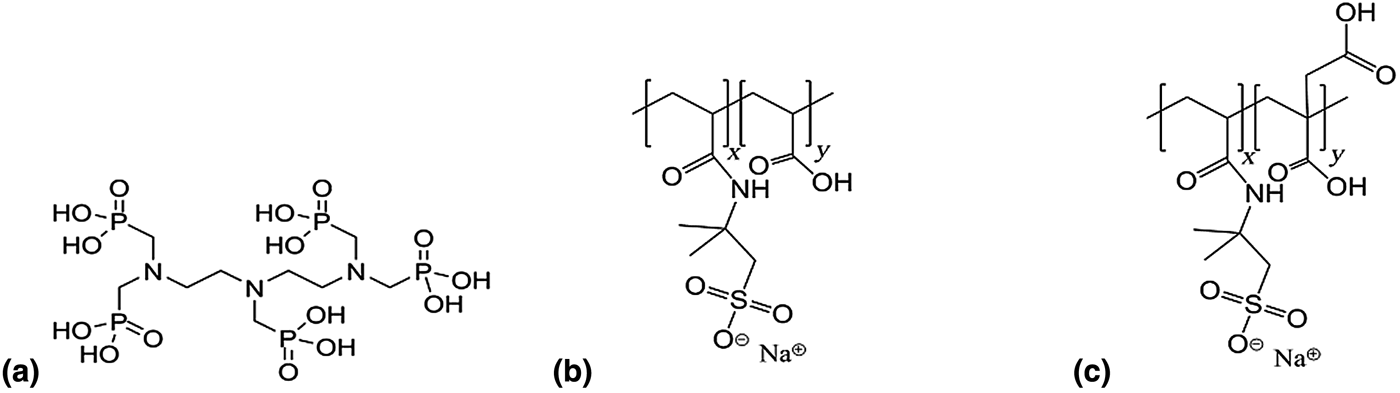
In this paper, we introduce a retarder package of three additive chemicals which display a pronounced synergetic effect on the hydration kinetics of Portland cement and on the underlying inorganic structure of the cement. The additive package overcomes high-temperature gelation phenomena characteristic of Saudi class G oil well cements. The package exploits the synergetics of diethylenetriamine penta(methylene phosphonic acid) (DTPMP), zinc oxide, and an acrylamido-tert-butyl-sulfonate/acrylate (ATBS/AA) copolymer [chemical structures illustrated in Figs. 1(a) and 1(b)]. These three components work synergetically to provide set hydration delay in Portland cement at temperatures up to 290 °C. The results obtained with the new retarding system are compared with DTPMP in the absence of other synergetic retarding additives and with ATBS/Itaconic acid copolymer (ITA). ATBS/ITA and DTPMP are known high-temperature synthetic retarders used for temperatures up to 260 °C; the structure for this additive is shown in Fig. 1(c).
The chemical structures of (a) DTPMP, (b) ATBS/acrylic acid (AA) copolymer, and (c) ATBS/Itaconic acid (ITA) copolymer.

Zinc oxide is a known retarder in Portland cement.[Reference Berke and Caldarone23] It has also been demonstrated for use in supplementary cementitious materials (SCMs) such as metakaolin in cement offering the possibility of increasing the reactivity of metakaolin as an SCM in Portland cement. Zinc oxide is believed to retard cement hydration through a nucleation and/or growth poisoning mechanism.[Reference Ataie, Juenger, Taylor-Lange and Riding24,Reference Taylor-Lange, Riding and Juenger25] Since the ZnO is known to accelerate the reaction of siliceous SCMs with Portland cement and water, it was thought that this additive while retarding C3S hydration could accelerate the pozzolan reaction of Portlandite with nanosilica and quartz (from silica our). In this way, the strength development of cement may occur in one stage as opposed to two as is often observed in high temperature cement when crystalline silica is added to cement as a strength retrogression mitigation additive.
DTPMP is an organophosphonate retarder which likely follows the same mechanism of cement hydration as nitrilotrismethylene phosphonate (NTMP). NTMP is believed to inhibit cement hydration through a nucleation and/or growth poisoning mechanism in tandem with a second mechanism. The second mechanism that has been proposed is that the NTMP coordinates to calcium in the cement slurry and the calcium complexes nucleate and grow until their solubility limit is reached in the cement pore solution. They then precipitate on the surface of the Portland cement grains.[Reference Bishop, Bott and Barron26–Reference Sangodkar, Smith, Gajan, Rossini, Roberts, Funkhouser, Lesage, Emsley and Chmelka28] The combination of the aforementioned retarding additives with each other renders a retarding package which has a remarkable high-temperature performance with a tunable influence on the kinetics of the cement's high-temperature mineralogic transformations.
Results
Rheology and high-temperature retarders
The details of the experimental testing procedures and materials are in the ESI. Saudi class G was used in all cement formulations. This cement has a similar mineralogy to standard class G cement, such as Dyckerhoff class G. Tables S2 and S3 show a semiquantitative composition for Saudi class G based on XRF and XRD (Rietveld) analysis. The silica flour used to prevent strength retrogression has a particle size distribution represented in Fig. S2. It was found that the cement slurries formulated with Saudi class G would display gelation behavior at high temperature when ATBS and phosphonate-based retarders were used. In the field, this characteristic could result in a phenomenon known as gas migration. Gas migration is a term used to describe the ingress of fluids into the cement from within the rock formation in the downhole environment. This results in leak pathways within the cement and can lead ultimately to well failure. Cements are prone to gas migration before they are set solids and when they hold a gel strength <240 Pa. Cement slurries with this gel strength or lower are deemed too low to resist fluid invasion at the pore pressures present in standard rock formations. The propensity for the cement to gel was found to influence the pumpability of the cement slurries as indicated through the HPHT thickening time. Figure S5 shows the effect of gelation on the building of compressive strength of a Saudi class G cement slurry with 35% by weight of cement (bwoc) silica flour and 0.94% bwoc ATBS/AA copolymer. The HPHT thickening time shows a stark increase (>100 Bc) in consistency at about 1 h. When the consistency exceeds 70 Bc, the slurry is considered unpumpable and cannot be placed in the wellbore for primary cementing. It takes an additional 2 h after the cement reaches this point for it to build an appreciable mechanical strength. We look to shorten this window by as much as possible. The trend with this cement is that the thickening time does not change appreciably with the polymer loading from 0.24% to 0.94% bwoc due to the effect of gelation.
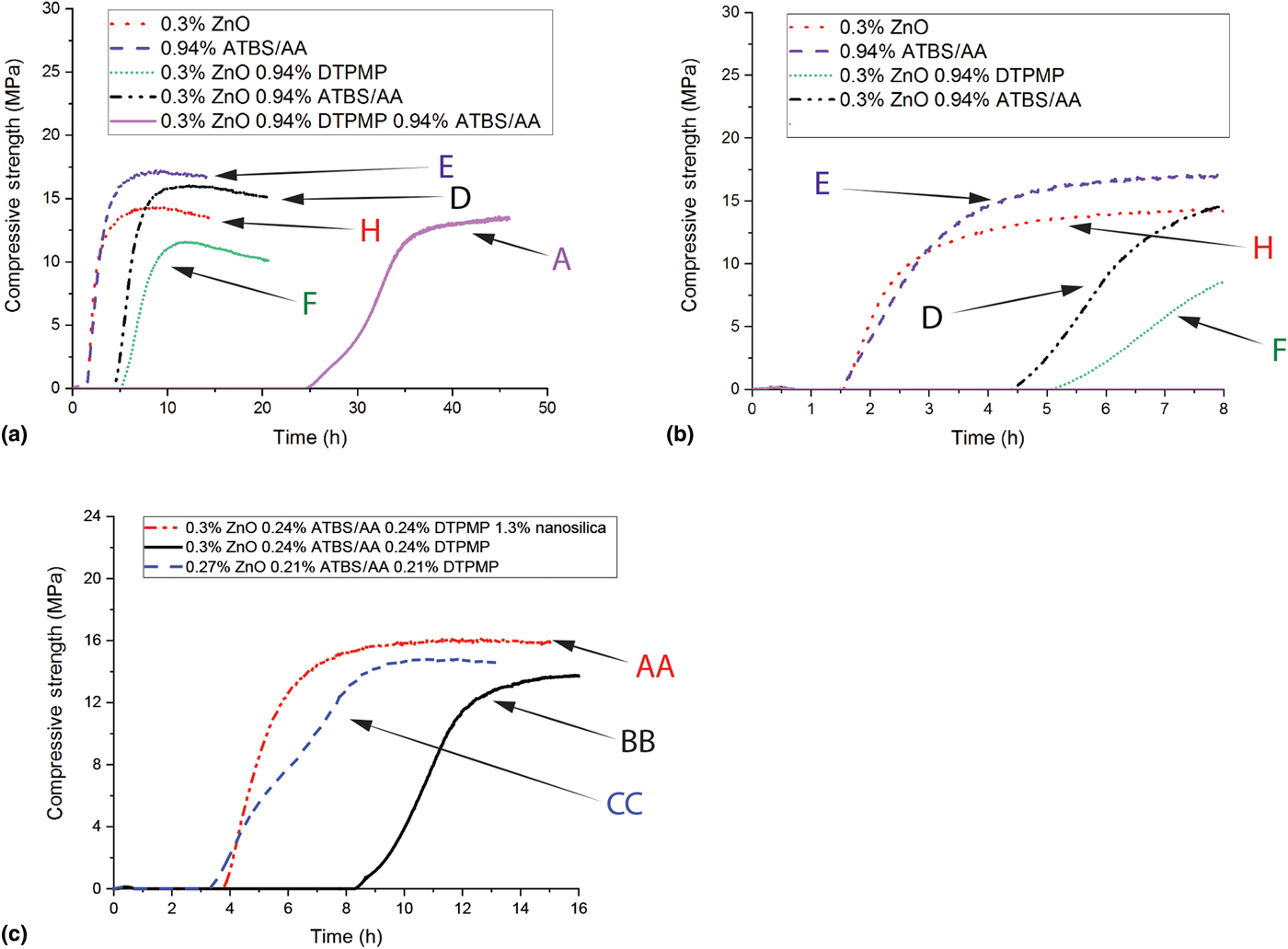
In addressing these high-temperature rheologic and mechanical issues, we found the zinc oxide (ZnO) provides a solution for high-temperature cementing without recourse to dispersants which can affect the slurry stability. Pumpable slurries achievable with ZnO show synergetic enhancements in retarding cement slurries when combined with ATBS/AA copolymer additives and/or DTPMP. Figure 3 shows the effect of these different retarders on the UCA determined set times of the additives, where the temperature is ramped to 205 °C in 1.3 h.
Three-component HT retarder system
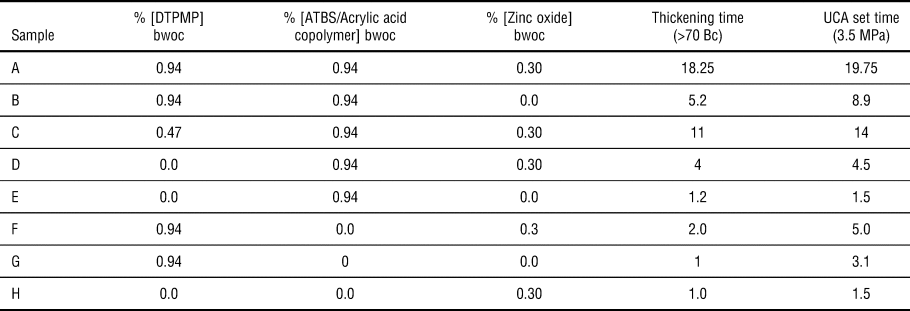
When zinc oxide is used as a co-additive, the zinc oxide functions synergetically with both DTPMP and the ATBS/acrylic acid copolymer as a retarding additive. The result is a powerful HT three-component retarder system. Table I displays thickening times for 1.9 g/cc class G cement with the varying concentrations of the three different retarding components, DTPMP, ATBS/acrylic acid copolymer, and zinc oxide. The cements are heated to 205 °C in 1 h, both in the HPHT thickening time and the UCA. The most powerful retarder is that containing all three retarders as in Sample A. This gives a thickening time of 18.25 h and a UCA set time of 19.75 h. In contrast, Sample B, which is identical to Sample A except that it contains no zinc oxide, shows a thickening time of 5.2 h and a UCA set time of 8.9 h. Aside from being substantially less retarded, there is a large (about 4.7 h) difference between the thickening time and the UCA set time. This indicates some rheologic control issues with the cement slurry and would give substantial time for the cement to remain vulnerable to gas migration after placement in the well. From further scrutiny of Table I, the presence of each one of the components compounds the retarding effectiveness of the cement slurries tested. The absence of zinc oxide is always marked with a large difference between the UCA set time and the thickening time. The exact formulations for experiments represented in Table I are shown in the ESI in Table S4.
Synergies of the additives demonstrated with a temperature ramp to 205 °C in 1 h and pressure set to 20.5 MPa.

Two-tiered strength development
The shape of the UCA curve is indicative of cement's suitability for downhole conditions. We have determined that the use of nanosilica in our cement additive system can produce a single-tiered strength development profile that is more suited to oil well cementing than what is observed with the retarding additives in the retarder package alone. Figure 3 shows the plot of three different UCA strength developments at 20.6 MPa of confining pressure and with a ramp to 205 °C in 1.25 h. A cement slurry with the ZnO, ATBS/AA copolymer, and DTPMP additive package combination is shown to follow the two-tiered hydration process in the absence of nanosilica. On the other hand, when nanosilica is included in the cement slurry, the additive produces a direct single-step strength development. A confluence of additive synergies offers the possibility of shortening this time period where the cement builds strength. The faster strength development offers the possibility for better well construction and mitigation of zonal isolation loss in the early construction process. It is thought that nanosilica nucleates C-S-H formation. These results indicate that nanosilica may accelerate the Pozzolan reaction.
Investigation of the mechanism of the two-tiered strength development
Further investigation into the details of the two-tiered strength development was performed with the cement slurry designs described in Table S6. The XRD and Rietveld analyses of the data collected from these tests are given in Figs. S6–S19.
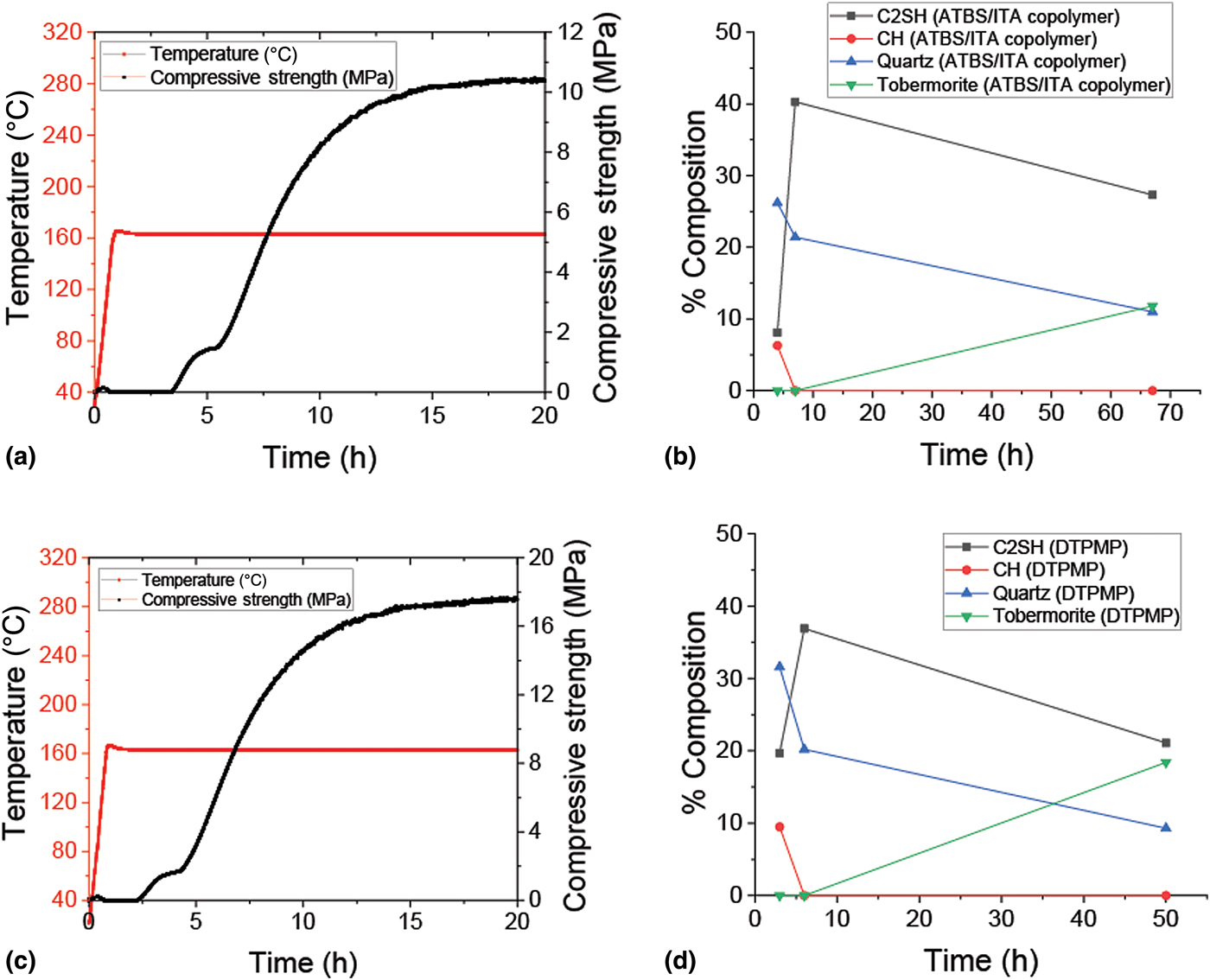
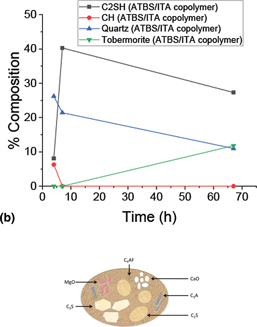
When ATBS/AA copolymer is used in 1.9 g/cc Saudi G cement at a 20.5 MPa confining pressure with a temperature ramp to 166 °C in 0.85 h, the cement displays two-tier strength developed as observed in the UCA [Fig. 2(a)]. In oil well cementing, it is important to target the ultimate compressive strength in as short a period as possible after placement of the cement within the well. In order to determine what may be occurring underneath the surface of the cement, three different cement slurries of this formulation were prepared for three different UCAs (Table S5). All cements were exposed to identical conditions (20.5 MPa confining pressure with a temperature ramp from 20 to 166 °C in 0.85 h). The three identical samples were removed at three different times: 4, 7, and 67 h. XRD was run on the samples. Rietveld analysis of the diffraction patterns revealed the relative content of the inorganic component to the cement. Figure 2(b) shows the time dependence of C2SH, CH, quartz, and tobermorite as the cement hydrates in the presence of the ATBS/AA copolymer.
(a) The effect of additive synergies on setting delay in the UCA from 0 to 50 h. (b) The effect of additive synergies on setting delay in the UCA from 0 to 8 h. (c) The role of nanosilica in achieving better setting results in high-temperature Saudi class G cements.

Investigating this two-tiered effect more closely, 0.2% bwoc DTPMP was formulated in a 1.9 g/cc Saudi class G cement. The hydration of this formulation was monitored with UCA with an identical temperature ramp to 166 °C in 0.85 h as described in the previous example. The UCA data are presented in Fig. 2(c). The same pattern is revealed with compressive strength development in that there is an initial plateau in strength development before the bulk of the structure of the cement is formed. From the XRD, Rietveld analysis of the cement at 3, 6, and 50 h reveals a pattern [Fig. 2(d)] which is identical to the ATBS/ITA copolymer experiment described in Figs. 2(a) and 2(b).
XRD patterns and analysis reveal three different reactions for cement hydration in the presence of retarders and crystalline silica. Both cases (DTPMP and ATBS/ITA copolymer slurries) show the same trends in the time-resolved XRD plots in Figs. 3(b) and 3(d). At the earliest time (3/4 h) in the UCA where the first plateau appears in Figs. 3(a) and 3(c), C2SH is a significant component in the cement slurry. Quartz is present in the slurries in about 33% which is close to the measured value at mixing of the cement slurry. Therefore, relatively little of the silica flour had reacted with the dissolved calcium in the cement pore solution. Portlandite (CH) is also present, as a crystalline material in the cement at 3 and 4 h.
The 0.5% bwoc ATBS/ITA copolymer in a 1.9 g/cc density cement with HEC as a suspension stability additive (a) UCA and (b) time-dependent composition from XRD Rietveld analysis. The 0.20% bwoc DTPMP in a 1.9 g/cc density cement with HEC as a suspension stability additive at 166 °C (c) UCA and (d) time-dependent composition from XRD Rietveld analysis.
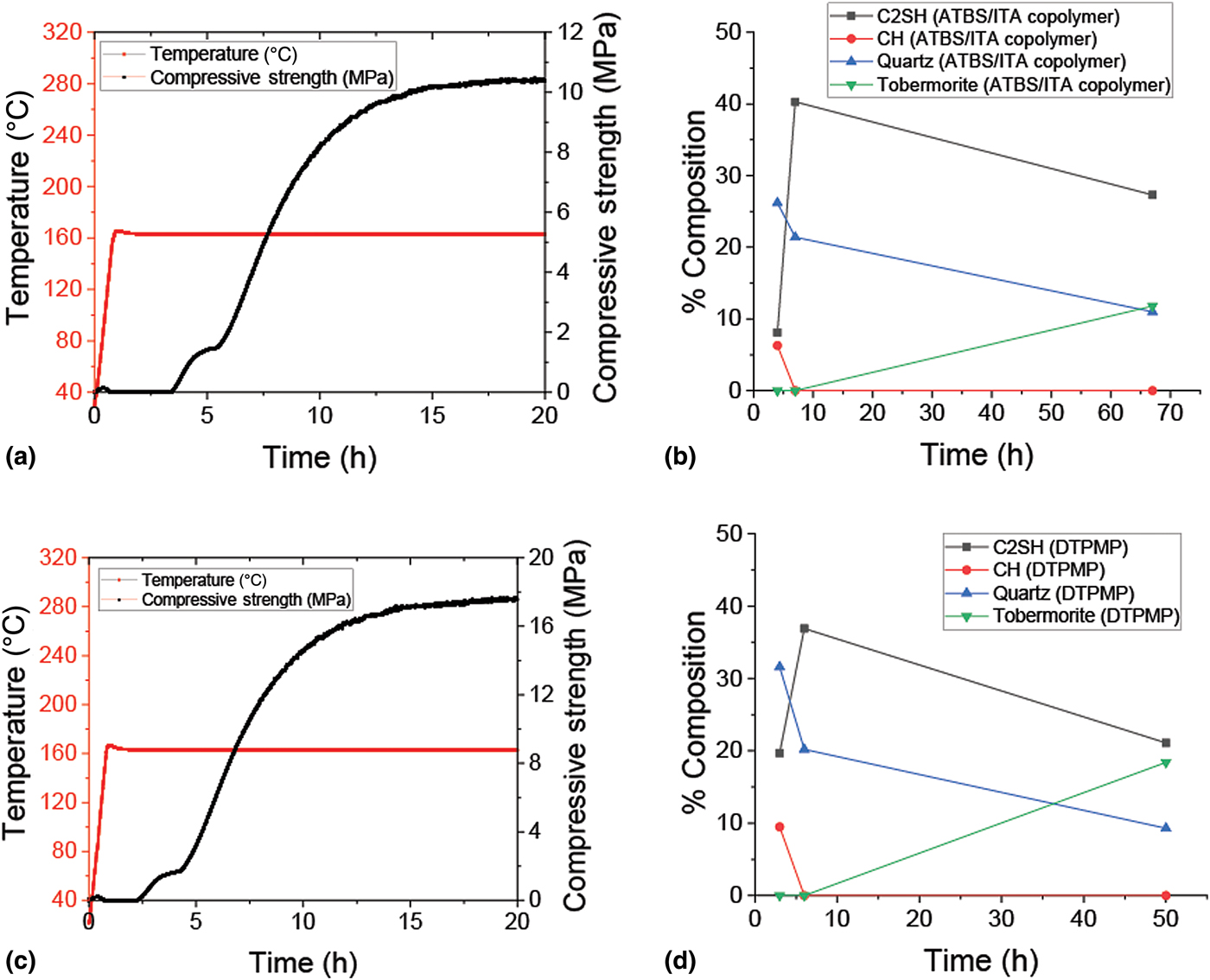
As the cement continues to react with water, at 6 and 7 h, the C2SH increases further to about 40% of the crystalline content of the slurries but Portlandite drops in concentration to about 0% while the quartz begins to deplete in about the same proportion of the Portlandite drop. This indicates that the Portlandite had likely dissolved into the cement pore solution and reacted with the silica flour to an extent. The amount of C2SH in both retarder systems shows an increase at 6–7 h.
At 50 and 67 h, the C2SH concentration drops as the crystalline components in the cement convert into tobermorite. The quartz concentration drops proportionately with the C2SH concentration while the tobermorite increase corresponds roughly to the decrease in quartz. The x-ray diffraction patterns for these experiments are displayed in Figs. S5 and S6.
From these results, the two-tiered system is due to the different kinetics of the Pozzolanic reaction of silica flour with dissolved calcium as compared to the reaction of calcium silicate with water to produce dicalcium silicate hydrate. There is also the distinct conversion of dicalcium silicate hydrate into tobermorite which appears to occur as a third chemical reaction.
Conclusions
A high-temperature retarder system for class G Portland cement has been developed exploiting the synergies between phosphonate, zinc oxide, and ATBS copolymer chemical additives. The reactivity of the inorganic component to cement revealed that phosphonate and ATBS'-based copolymer retarders establish a two-tiered strength development where amorphous C-S-H converts to crystalline dicalcium silicate hydrate (C2SH) in the first (low compressive strength) tier (plateau) prior to the reaction of Portlandite with the silica flour (added to mitigate strength retrogression). The reaction of Portlandite and C2SH with quartz occurs after the cement has reached the first plateau in compressive strength development. The reaction of C2SH and Portlandite with quartz leads to the formation of tobermorite as the predominant phase after the cement has reached its maximum compressive strength.
The three additive retarder system described in this study was tuned with nanosilica to eliminate the two-tiered strength development effect and lead to a smooth transition from the cement in the slurry form directly to its highest compressive shortly after hydration commences. This retarder package is shown to be effective out to 290 °C. The influence of the cement additives and the temperatures (from 166 to 205 °C) are investigated as they pertain to the time-dependent strength development in the cement.
These studies were performed with Saudi class G Portland cement, which demonstrates its suitability as a material for high-temperature oil well cementing in temperatures in excess of 205 °C when appropriate additive chemistry is used for the set delay to maintain pumpability until the cement is placed. The pumpability of the class G cement slurries are assured through the introduction of ZnO as a co-additive to the polymeric, ATBS/AA retarder, and DTPMP.
Supplementary material
The supplementary material for this article can be found at https://doi.org/10.1557/mrc.2019.70