Pulmonary regurgitation observed in most patients after repair of tetralogy of Fallot or in patients with other CHDs with right ventricular outflow tract reconstruction is responsible for chronic right ventricular volume overload. This condition exposes this population to adverse events such as heart failure, arrhythmias, and sudden death.Reference Harrild, Berul and Cecchin 1 – Reference Murphy, Gersh and Mair 3 To perform pulmonary valve replacement before the occurrence of irreversible myocardial damages, cardiac evaluation of these patients is focussed on right ventricle function assessment, particularly by means of ventricular volumes and ejection fraction at MRI; however, resting right ventricular function parameters do not reflect only the intrinsic contractility of the right ventricle in patients with pure pulmonary regurgitation because they are load dependent. Patients with pure pulmonary regurgitation with normal resting parameters may have impaired ventricular ejection fraction response in a radionuclide study.Reference Reduto, Berger and Johnstone 4 The correlation between right ventricular response and aerobic capacity observed in this population of patients in a recent MRI studyReference Luijnenburg, Mekic and van den Berg 5 argues for a decreased capacity of the right ventricle to maintain a sufficient right “effective” stroke volume and left ventricular filling during effort.
Thus, right ventricular response to exercise may represent an additional tool to approach the intrinsic ventricular contractility. Some stress MRI studies have already observed right ventricular response impairment in patients after Fallot repair.Reference Luijnenburg, Mekic and van den Berg 5 , Reference Parish, Valverde and Kutty 6 Maximal oxygen pulse may represent a more directly available parameter of right ventricular response than stress imaging. Oxygen pulse is generally considered to reflect global ventricular performance at exercise. Oxygen pulse is defined as oxygen uptake divided by heart rate. It is one of the main markers of heart function and it has been shown to be a powerful predictor of outcomes in patients with cardiovascular diseases.Reference Oliveira, Myers and Araújo 7 – Reference Corrà, Giordano and Mezzani 9 According to the Fick equation, oxygen pulse is the product of left ventricular stroke volume and arteriovenous oxygen content difference. Arteriovenous oxygen content difference remains quite stable across patients and reaches a plateau at a submaximal level. Thus, peak oxygen pulse is reduced in any condition that reduces left ventricular stroke volume response during a sustained effort.Reference Klainman, Kusniec, Stern, Fink and Farbstein 10 – Reference Klainman, Fink, Lebzelter, Krelbaumm and Kramer 12 Patients with pulmonary regurgitation and moderate right ventricle enlargement have been shown to have stable peak oxygen pulse before and after pulmonary valve replacement.Reference Lurz, Giardini and Taylor 13 In the present study, we aimed to measure the impact of pulmonary valve replacement on peak oxygen pulse in a population with pure pulmonary regurgitation and with different degrees of right ventricle dilatation. We also sought to determine the predictors of peak oxygen pulse after pulmonary valve replacement.
Methods
Between 2008 and 2013, 193 patients underwent surgical or transcatheter pulmonary valve replacement at our institution. We selected patients who underwent pre- and post-procedural exercise tests and who had pure pulmonary valve regurgitation to obtain a homogeneous population for our study. Thus, we excluded data from patients with residual associated outflow tract obstruction – assessed by right ventricular pressure >50 mmHg at echocardiography – because it has been previously shown that right ventricular pressure overload removal increases peak oxygen uptake.Reference Lurz, Giardini and Taylor 13 , Reference Sutton, Peng and Lock 14 Accordingly, we excluded patients with restrictive right ventricle physiology defined at echocardiography and MRI – that is, antegrade flow during atrial contraction to the pulmonary trunk throughout the respiratory cycle and normal diastolic right ventricular volume at MRI – which has a significant impact on peak oxygen uptake.Reference Gatzoulis, Clark, Cullen, Newman and Redington 15 , Reference Lee, Yoo and Roche 16 Finally, patients with significant residual pulmonary regurgitation (grade⩾2) and/or outflow tract obstruction with rising systolic right ventricular pressure above 50 mmHg after pulmonary valve replacement were also excluded. Data collected from cardiopulmonary exercise test performed before and after pulmonary valve replacement were peak workload, peak oxygen uptake, peak oxygen pulse, and peak heart rate expressed as the percentage of the predicted value, respiratory exchange ratio, peak ventilatory efficiency (ventilation/carbon dioxide output ratio), and ventilatory efficiency slope. We retrospectively collected MRI data before and after pulmonary valve replacement: end-diastolic and systolic right/left ventricular volumes, right/left ventricular ejection fraction, right/left ventricular stroke volume, and pulmonary regurgitation fraction.
Cardiopulmonary exercise test
Cardiopulmonary exercise tests were performed to assess maximal exercise capacity by means of a cycle ergometer (Ergoline®, Bitz, Germany). Patients were encouraged to continue exercising until dyspnoea or fatigue forced them to stop. The workload was increased by 10 to 15 W, depending on the predicted maximum exercise capacity, and in such a way that maximal effort was attained within ~8–12 min. Oxygen uptake and carbon dioxide output were measured breath-by-breath using an automated system (Sensor Medics system 290; Anaheim, California, United States of America). Measurements were taken at rest and every 20 seconds throughout exercise and recovery. The exercise test was considered as maximal if the patient achieved a respiratory exchange ratio >1.1 and/or maximal heart rate >90% of the theoretical maximal heart rate and/or as oxygen uptake reaching a plateau. Ventilatory threshold was determined graphically using the method of Beaver et al.Reference Beaver, Wasserman and Whipp 17 Measured cardiopulmonary exercise test parameters were compared with predicted normal values by Wasserman et alReference Wasserman, Hansen, Sue, Casaburi and Whipp 18 for adults and by Cooper et alReference Cooper, Weiler-Ravell, Whipp and Wasserman 19 for children. A value below 85% of the theoretical value was considered as abnormal. The system calibration was performed before every test according to the manufacturer’s specifications.
MRI
All MRI investigations were performed using a 1.5-T unit (“Avanto”; Siemens Medical Solutions, Erlangen, Germany) using a standardised clinical protocol. Cine images were obtained in two-chamber, four-chamber, right ventricle outflow tract, and short-axis planes with a temporal resolution that was sufficient to accommodate 20 true phases per cardiac cycle. Phase contrast imaging was performed for flow measurements through the right and left atrioventricular valves, the ascending aorta at the level of the right pulmonary artery, and the main and both branch pulmonary arteries with a temporal resolution that was sufficient to accommodate 25 true phases per cardiac cycle. Right and left ventricular volumes were measured from a stack of short-axis cine images using a commercially available software (Qmass MR, Version 7.1; Medis Medical Imaging Systems, Leiden, The Netherlands).
Statistics
Continuous variables are presented as mean±standard deviation. The non-parametric Wilcoxon test was used to compare the initial values and the values for each cardiopulmonary exercise test and MRI variables. We used Pearson’s correlation coefficient to estimate the association between values of peak oxygen pulse before and after pulmonary valve replacement and MRI parameters. Receiver operating characteristic curve analysis was used to compare predictors of normal – that is, above 85% of theoretical value – peak oxygen pulse after pulmonary valve replacement. For each predictor, positive and negative predictive values and likelihood ratios were calculated for the best cut-off that maximises (sensitivity+specificity). A two-sided value of p<0.05 was considered to be significant.
Results
Population
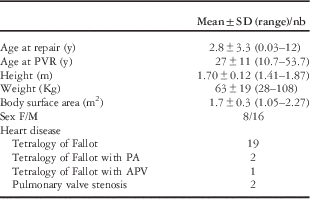
The underlying repaired CHDs of the 24 patients studied are summarised in Table 1. The mean age at repair of the underlying CHD was 2.8±3.3 years, and the mean age at pulmonary valve replacement was 27±11 years. In total, 22 patients underwent surgical pulmonary valve replacement, and two patients underwent percutaneous pulmonary valve insertion. None of the patients performed exercise training after pulmonary valve replacement.
Characteristics of the population.

APV=absent pulmonary valve; F=female; M=male; nb=number of patients; PA=pulmonary atresia; PVR=pulmonary valve replacement; y=years
Pre-procedural data
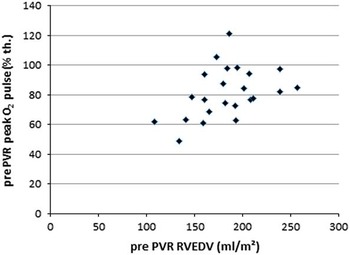
All the patients underwent a cardiopulmonary test before and after pulmonary valve replacement. All but one patient with a pacemaker had MRI investigations before pulmonary valve replacement. The mean time from pulmonary valve replacement to the second cardiopulmonary exercise testing was 1.7±1.3 years. The mean peak respiratory exchange ratio was higher than 1.1, indicating maximal or near-maximal effort during exercise test. Right ventricular end-systolic volume and right ventricular end-diastolic volume before pulmonary valve replacement ranged, respectively, from 108 to 257 ml/m2 (mean 182 ml/m2) and from 52 to 200 ml/m2 (mean 106 ml/m2). Among the 23 patients who had MRI investigations before pulmonary valve replacement, 19 underwent pulmonary valve replacement for initial right ventricular end-diastolic volume above 160 ml/m2. The indications for pulmonary valve replacement for the remaining five patients was dyspnoea on effort (confirmed on cardiopulmonary exercise testing) in three patients with right ventricular end-diastolic volume equal to 108, 143, and 147 ml/m2, respectively, supraventricular arrhythmia in one patient (end-diastolic volume: 159 ml/m2), and overt right ventricular failure in one patient (end-diastolic volume: 134 ml/m2). A positive but weak correlation was found between peak oxygen pulse/oxygen uptake and right ventricular end-diastolic volume before pulmonary valve replacement (Table 2, Fig 1).
Relation between peak oxygen pulse and right ventricular end-diastolic volume before PVR: r=0.43, p=0.037. PVR=pulmonary valve replacement; RVEDV=right ventricular end-diastolic volume; th=theoretical value.

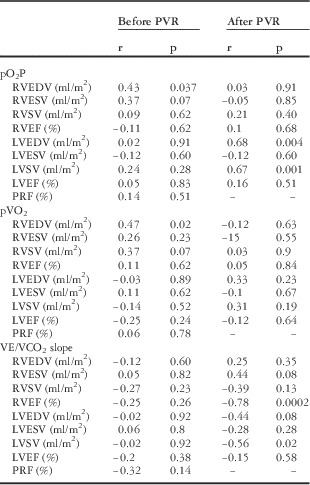
Relation between CPET and MRI parameters, before and after pulmonary valve replacement.

CPET=cardiopulmonary exercise testing; LVEDV=left ventricular end-diastolic volume; LVEF=left ventricular ejection fraction; LVESV=left ventricular end-systolic volume; LVSV=left ventricular stroke volume; pO2P=peak oxygen pulse; PRF=pulmonary regurgitation fraction; pVO2=peak oxygen uptake; PVR=pulmonary valve replacement; RVEDV=right ventricular end-diastolic volume; RVEF=right ventricular ejection fraction; RVESV=right ventricular end-systolic volume; RVSV=right ventricular stroke volume; VE/VCO2=ventilatory efficiency
Impact of pulmonary valve replacement
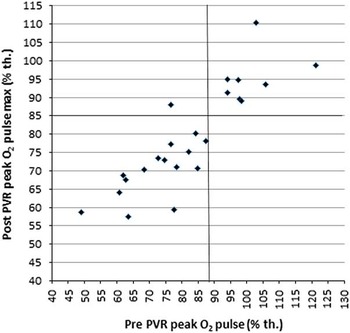
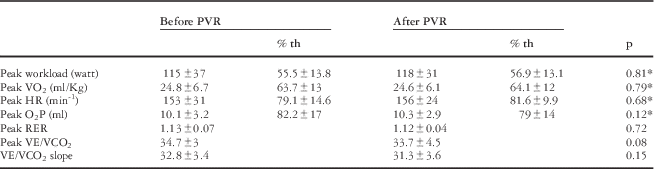
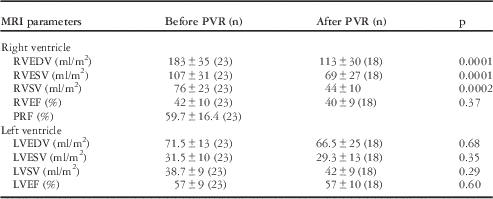
There was no significant change in peak workload, heart rate, oxygen uptake, respiratory efficiency, and VE/VCO2 slope after pulmonary valve replacement (Table 3). Values of MRI parameters before and after pulmonary valve replacement are summarised in Table 4. Significant reductions in right ventricular volumes were observed after pulmonary valve replacement, but no changes in right/left ventricular ejection fraction, left ventricular volumes, and stroke volume were evidenced (Table 4). After pulmonary valve replacement, non-significant residual pulmonary regurgitation was found at echocardiography. This was confirmed by the absence of significant difference between right and left ventricular stroke volume at MRI (42 versus 44 ml/m2, respectively, p=0.34). Among the 24 patients analysed, 15 had an abnormal peak oxygen pulse before pulmonary valve replacement (i.e. <85% of theoretical value). Only one patient with a slight decrease in oxygen pulse before pulmonary valve replacement had a normal oxygen pulse after pulmonary valve replacement (Fig 2). After pulmonary valve replacement, peak oxygen pulse correlated well with left ventricular stroke volume and left ventricular end-diastolic volume (r=0.67 and 0.68, respectively). A good correlation was also observed between ventilator efficiency slope and left ventricular stroke volume (r=−0.56) and between ventilator efficiency slope and right ventricular ejection fraction (r=−0.78) (Table 2). Finally, the ventilator efficiency slope did not correlate with peak oxygen pulse after pulmonary valve replacement (r=0.007, p=0.27).
Relation between peak oxygen pulse before and after pulmonary valve replacement: r=0.86, p<0.0001. PVR=pulmonary valve replacement; th=theoretical value; vertical line=pre-PVR cut-off value; horizontal line=post-PVR normal value.

Comparison between pre- and post-PVR cardiopulmonary exercise test parameters.

HR=heart rate; O2P=oxygen pulse; PVR=pulmonary valve replacement; RER=respiratory exchange ratio; th=theoretical value at peak; VE/VCO2=ventilatory efficiency; VO2=oxygen uptake
* p-value for percentages of theoretical value
Comparison between pre- and post-PVR left/right ventricle MRI parameters.

LVEDV=left ventricular end-diastolic volume; LVEF=left ventricular ejection fraction; LVESV=left ventricular end-systolic volume LVSV=left ventricular stroke volume; PRF=pulmonary regurgitation fraction; PVR=pulmonary valve replacement; RVEDV=right ventricular end-diastolic volume; RVEF=right ventricular ejection fraction; RVESV=right ventricular end-systolic volume; RVSV=right ventricular stroke volume
Prediction of post-procedural peak oxygen pulse
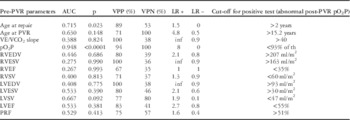
There was a high correlation between peak oxygen pulse before and after pulmonary valve replacement (r=0.86, p<0.0001) (Fig 2). The comparison of potential predictors of peak oxygen pulse is shown in Table 5. The only valuable predictor of post-procedural oxygen pulse was pre-procedural peak oxygen pulse (positive likelihood ratio=8, negative likelihood ratio=0, positive predictive value=94%, negative predictive value=100%) for a cut-off equal to 93% of the theoretical value (Table 5).
Comparison of pre-PVR predictors on post-PVR peak oxygen pulse.

AUC=area under the receiver operating characteristic curve; LR−=negative likelihood ratio; LR+=positive likelihood ratio; LVEDV=left ventricular end-diastolic volume; LVESV=left ventricular end-systolic volume; LVSV=left ventricular stroke volume; NPV=negative predictive value; pO2P=peak oxygen pulse; PPV=positive predictive value; PRF=pulmonary regurgitation fraction; PVR=pulmonary valve replacement; RVEDV=right ventricular end-diastolic volume; RVEF=right ventricular ejection fraction; RVESV=right ventricular end-systolic volume; RVSV=right ventricular stroke volume; VE/VCO2=ventilatory efficiency; p = p value for AUC different from 0.5
Discussion
Impaired peak oxygen pulse has been shown to be the main determinant of the progressive decrease in aerobic capacity in patients with pure pulmonary regurgitation.Reference Kipps, Graham, Harrild, Lewis, Powell and Rhodes 20 The present study confirms that pulmonary valve replacement neither improves exercise capacityReference Lurz, Giardini and Taylor 13 , Reference Ghez, Tsang and Frigiola 21 , Reference Sabate Rotes, Johnson, Burkhart, Eidem, Allison and Driscoll 22 nor improves peak oxygen pulseReference Lurz, Giardini and Taylor 13 in this population. A recent stress MRI study showed that a small right ventricle reserve predicts higher decrease in peak oxygen uptake during follow-up in patients with chronic pulmonary regurgitation.Reference Luijnenburg, Mekic and van den Berg 5 The lack of peak oxygen pulse improvement in our study argues for a poor impact of pulmonary valve replacement on global ventricular response in patients with pure pulmonary regurgitation. Studies that related improvement of oxygen uptake after pulmonary valve replacementReference Sabate Rotes, Johnson, Burkhart, Eidem, Allison and Driscoll 22 – Reference Warner, O’Brien, Rhodes, Kaur, Robinson and Payne 26 included patients with significant residual right ventricular outflow tract obstruction. The positive impact of obstruction relief on aerobic capacity and resting right ventricular function has been well demonstrated previously.Reference Lurz, Giardini and Taylor 13 , Reference Sutton, Peng and Lock 14 We did not observe such results in a series of 24 other patients who underwent right ventricular obstruction relief by pulmonary valve replacement. The large proportion of patients with associated significant pulmonary regurgitation may explain this difference (Supplementary Tables 1–3).
The prognostic value of peak oxygen uptake in patients with Fallot repair and its predictive value on early mortality after pulmonary valve replacement have been previously demonstrated.Reference Müller, Hager and Diller 27 , Reference Babu-Narayan, Diller and Gheta 28 International guidelines recognise that determining the optimal timing for pulmonary valve replacement remains a challenging issue.Reference Baumgartner, Bonhoeffer and De Groot 29 They stress the importance of presence of symptoms, decrease in peak oxygen uptake, and the change in right ventricular volumes rather than single measurements to assist decision making for pulmonary valve replacement; however, studies that predict oxygen uptake or global ventricular performance/function after pulmonary valve replacement are not yet available.Reference Biernacka, Piotrowicz and Fronczak 30 Among the 15 patients of our study with abnormal peak oxygen pulse, only one with a near-normal initial peak oxygen pulse recovered the normal value. Pre-procedural peak oxygen pulse appeared to be the only performant predictor of post-procedural peak oxygen pulse. A pre-procedural value above around 90% of the theoretical value predicts normal peak oxygen pulse after pulmonary valve replacement. We concluded that attention should be paid to patients with pure pulmonary regurgitation in whom peak oxygen pulse decreases with time, in order to take the decision to replace the pulmonary valve because it may reflect an irreversible ventricular lesion. Usefulness of global ventricular performance has already been demonstrated in evaluation of patients before aortic valve replacement. Left ventricular performance assessed by change of left ventricular ejection fraction during exercise better predicts long-term follow-up than resting indices,Reference Borer, Hochreiter and Herrold 31 left ventricular exercise response, and post-procedural follow-up after aortic valve replacement in asymptomatic patients.Reference Wahi, Haluska, Pasquet, Case, Rimmerman and Marwick 32 , Reference Tamás, Broqvist, Olsson, Franzén and Nylander 33
The decision for pulmonary valve replacement is mainly based on right ventricular volumes assessed by MRI;Reference Reduto, Berger and Johnstone 4 , Reference Luijnenburg, Mekic and van den Berg 5 , Reference Parish, Valverde and Kutty 6 however, although pulmonary valve replacement dramatically improved right ventricular volumes, we did not observe any changes in right ventricular ejection fraction as others.Reference Therrien, Siu, McLaughlin, Liu, Williams and Webb 34 – Reference Lurz, Nordmeyer and Giardini 36 From these observations, some authors deduced that pulmonary valve replacement should be considered before observing a decrease in right ventricular function;Reference Lurz, Giardini and Taylor 13 however, ability of pre-procedural right ventricular ejection fraction to predict post-procedural right ventricular ejection fraction has not yet been demonstrated and appeared to be poor in our series (Supplementary Table 4). Right ventricular ejection fraction is a load-dependent parameter that is not a valuable reflection of intrinsic myocardial characteristics. This may explain why we did not observe any significant correlation between peak oxygen uptake, as well as peak oxygen pulse, and resting right ventricular ejection fraction before pulmonary valve replacement. The literature is controversial regarding this point.Reference Menon, Kaza and Puchalski 37 – Reference Samman, Schwerzmann and Balint 41 Moderate correlation was found in studies including both patients with pulmonary regurgitation and patients with stenosis;Reference Roest, Helbing and Kunz 39 , Reference Meadows, Powell, Geva, Dorfman, Gauvreau and Rhodes 40 however, our results are concordant with studies excluding those with pulmonary stenosis.Reference Lurz, Nordmeyer and Giardini 36 – Reference O’Meagher, Munoz and Alison 38
Even after pulmonary valve replacement, we did not observe any correlation between peak oxygen uptake/oxygen pulse and resting right ventricular ejection fraction as others.Reference Ghez, Tsang and Frigiola 21 , Reference Eyskens, Reybrouck and Bogaert 24 Nevertheless, peak oxygen pulse did correlate well with left ventricular MRI parameters: stroke volume and end-diastolic volume. At the same time, we did not observe any correlation between peak oxygen pulse and ventilatory efficiency slope that was strongly related to right ventricular ejection fraction in our study. Ventilatory efficiency slope is known to be related to right ventricular function and vascular tone in patients with systolic left heart failure.Reference Lewis, Shah, Pappagianopolas, Systrom and Semigran 42 These results suggest that left ventricular – more than right ventricular – dysfunction may be the limiting factor of global ventricular performance after pulmonary valve replacement. Recent studies have evidenced the strong prevalence of systolic and diastolic left ventricular dysfunctions in patients with Fallot repair and their prognostic at follow-up.Reference Ghai, Silversides, Harris, Webb, Siu and Therrien 43 – Reference Diller, Kempny and Liodakis 45
Most of the patients in our study were above 20 years of age. A previous study showed that pulmonary valve replacement performed before 17.5 years of age predicted a better right ventricular function and ventilatory efficiency, but also a better resting left ventricular stroke volume after surgery.Reference Frigiola, Tsang and Bull 46 We hypothesise that improvement of peak oxygen pulse after pulmonary valve replacement could be expected in a younger population.
The potential progressive degradation of peak oxygen pulse late after pulmonary valve replacement remains another crucial point. In our series, most of our patients were controlled within the 2 years after pulmonary valve replacement. Lurz et alReference Lurz, Nordmeyer and Giardini 36 observed maintained impairment at 1 year after the procedure. The particular progressive degradation of peak oxygen pulse described by Kipps et alReference Kipps, Graham, Harrild, Lewis, Powell and Rhodes 20 could be observed late after pulmonary valve replacement in some patients with sufficient follow-up. At present, we suggest that a patient with significant pure pulmonary regurgitation and poor peak oxygen pulse, especially after the second decade, could be a potential candidate for pulmonary valve replacement. The non-expected positive correlation between peak oxygen pulse and right ventricular end-diastolic volumes before pulmonary valve replacement in our population prompt us to be cautious even if right ventricular volumes do not reach the commonly admitted cut-off values.
Our study presents some limitations as it is a retrospective study and included a small number of patients because systematic exercise test was not performed during the studied period; however, patients with pure pulmonary regurgitation constitute a homogeneous population in terms of loading conditions. A significant part of our population was beyond 30 years of age, explaining why the mean age of repair was quite high, above 2 years of age. Age at repair is known to predict arrhythmias and right ventricular dysfunction with restrictive physiology, and thus may affect peak oxygen improvement after pulmonary valve replacement.Reference Lu, Cotts, Agarwal, Attili and Dorfman 47 Exclusion of patients with restrictive physiology in this study might have limited this confusing factor. Another limitation is due to the nature of oxygen pulse. Oxygen pulse is a good indicator of global ventricular performance provided that the arteriovenous oxygen content difference is stable over time for each patientReference Jones 48 and throughout submaximal exercise.Reference Wasserman, Hansen, Sue, Casaburi and Whipp 18 Although none of the patients performed specific exercise training between investigations, some circumstances in patients with CHD may lead to significant arteriovenous oxygen content difference changes that may affect peak oxygen pulse, such as deconditioning, β-blocker therapy, or anaemia. Stress echocardiography and exercise/stress MRI could be other options for left stroke volume or right ventricular response assessment; however these investigations do not allow a maximal effort, and unavailability of stress MRI equipment and limited acoustic window limit their use in practice. Finally, the long delay between pulmonary valve replacement and the second exercise test might represent a limitation in some patients. Although valve function did not deteriorate since replacement, we could not exclude any change in physical activity that might affect peak oxygen pulse.
In conclusion, we did not observe any improvement in peak oxygen pulse in patients with pure pulmonary regurgitation. These results suggest that irreversible lesions can occur even if initial right ventricular volumes do not reach the commonly admitted values for pulmonary valve replacement. Pre-operative peak oxygen pulse seemed to be a performant predictor of global ventricular performance after pulmonary valve replacement. Thus, we suggest that pulmonary valve replacement may be discussed in patients with impaired peak oxygen pulse. Larger prospective studies are needed to specify the role of this exercise parameter in a clear pulmonary valve replacement decision algorithm.
Acknowledgement
None.
Financial Support
None.
Conflicts of Interest
None.
Ethical Standards
The authors assert that all procedures contributing to this work and has been approved by the institutional committee: Conseil D’Ethique de Necker-Enfants Malades (CENEM).
Supplementary Material
For supplementary material referred to in this article, please visit http://dx.doi.org/10.1017/S1047951115002504