“The competence of the German technician, the entrepreneurialism of the German businessman, the quality performance of the German worker and craftsman, and the tenacity of the German farmer have . . . brought before the whole world new proof of the German's potential for achievement.”
— President Paul von Hindenburg, Oppeln, September 1928Footnote 1“None of Poland's regions presents such a great cult of diligent and sacrificial work as . . . Silesia. Here the production promoted by the hands of the Polish worker and the mind of the Polish technician and engineer are constantly strengthening the nation's power status.”
— President Ignacy Mościcki, Katowice, May 1929Footnote 2On March 28, 1926, government officials and borderland activists staged a massive rally to protest the border with Poland in Oppeln (Opole), the capital of the German part of the Upper Silesian borderland.Footnote 3 The Social Democratic interior minister of the Prussian state, Carl Severing, took the occasion to articulate the terms of a rivalry with the Polish neighboring nation-state to which the disputed drawing of the border here in 1922 had given way. In his speech he noted that he was “not speaking about an arms race” but rather “a struggle” for “Germandom and Kultur” that “should be fought out with the weapons of the spirit”—rather than with actual arms. As part of the struggle, the whole of this border society was to demonstrate that they were “better than the eastern neighbor” in their everyday work.Footnote 4 This promotion of good stewardship was meant not only to ensure that Germany would not lose another “single foot-long of soil,” but also foremost “to uphold the faith of the Upper Silesian masses in Polish Silesia's speedy return to Germany.”Footnote 5 This last phrase was coined by Aleksander Szczepański, the Polish Consul in Beuthen (Bytom) on the German side of the border. Like other government officials, and also the media, he followed this rally and was startled by how—in his words—“tirelessly” “all of Germany” was calling for the border's revision. In turn, Szczepański warned the Polish government that “it is easy to imagine a sad outcome”—such as the revision of the border in Germany's favor—if Poland did not step up its efforts to counter such propaganda.Footnote 6
A “cold war” of words, showcases, and nerves ensued over the Upper Silesian province since its national partition between Germany and Poland in 1922. Given the economic importance of its industrial area as the first major industrial production center in Poland and second in Germany, this conflict was as heated as that over Danzig and the “Sudetenland.” This 1926 episode of the annual German “Plebiscite Day” rally was just one of many propaganda rallies and other “invented traditions” geared toward stirring popular zeal for the revision of borders to the respective nation's favor that had been staged and promoted in Germany and Poland during the interwar era.Footnote 7 Inherently tied to the irredentist ethos of these traditions, the engineering of cityscapes and physical symbolic spaces also marked a notable aspect of the “cold war” over the borderlands. The built environment marked an essential feature of “cultural propaganda”—as contemporaries referred to the use of cultural politics for propaganda purposes—which, in turn, was central to the waging of this standoff over the territories.
The following essay focuses on what I argue was the development of a transnational political culture of using the built environment to highlight a nation-state's rights to territory. A product of the interwar German-Polish dispute over the borderlands, this culture did not end with the outbreak of World War II, but was upheld by the governments controlling these regions through the war and beyond. I argue here that buildings, infrastructure, and plazas of innovative, grandiose, and impressive architectural and symbolic design represented the cultural-diplomatic tokens of a nation's superior stewardship of this borderland. In this regard, modern architecture and avant-garde forms commonly symbolized the deliverance of progress, modernization, and growth to the disputed borderlands. Polish-German relations alone certainly did not shape the character of the urban landscapes of Upper Silesia's industrial district (Oberschlesische Industriegebiet/Górnośląski Ośrodek Przemysłowy). Logistical and administrative concerns, as well as demographic shifts, particularly those spurred by this region's division between two nation-states, marked the basic shaping factors of landscape development here. Nevertheless, state agents used such icons to symbolize the nation-states' historical track record of what I refer to here as “Kulturträgerismus” (from Kulturträger or bearer of culture/cultural missionary), or in other words, its service to flourishing “culture” as well as improving the general living standards of its part of the disputed territory in past and present. As such, they were indicators of its potential to be the better steward here in general, and thereby highlighted its “rights” also to the neighbor's part of the borderland. In this sense, urban planning projects and architectural structures—modernism especially—became a prime example of Severing's “weapons of the spirit” used to demonstrate that one was “better” than the neighbor. A major topic of discussion for the media and government actors, these new landscapes remained a central object of transnational dispute between the two conflicting national-states. They were also contested by the Upper Silesian local populace known for its indifference to the one-sided national identities that the surrounding nations sought to impose.
Compared to political diplomacy and propaganda, spatial planning and construction have received far less scholarly attention in the context of how state borders were drawn and territories contested, particularly in interwar central Europe. As a general topic of academic inquiry, how landscape development has served as a tool of governments and political ideology is a well-researched one. With specific regard to border shifts, the bulk of the work on landscape has been concerned with the redrawing of nation-state boundaries in central Europe after World War II. One of the pioneering works of this genre by Gregor Thum demonstrates how urban planning went hand in hand with expulsion, resettlement, “voluntary” migration, and forced assimilation in turning the age-old German city of Breslau into the Polish one of Wrocław.Footnote 8 The present essay marks an analysis of the formative epoch of the politics of “ethnic cleansing” that was applied to Germany's former eastern provinces after 1945. Indeed, there is a consensus among historians that interwar irredentism—a term I use here to refer to territorial rivalry—and Nazi social engineering were the predecessors of postwar population politics in these territories. This essay attempts to demonstrate that the same was true with regard to cultural politics during the interwar and war eras, particularly the (re-)construction and usage of symbolic landscapes. Just as they had after World War II, during the interwar era German and Polish political actors instrumentalized building and development projects to leave permanent imprints of their authority, ideology, and nationality on cityscapes and their surroundings. After defeating Poland and annexing its part of the borderland in September 1939, the Nazi regime invested a surprising amount of effort and resources in the midst of war to renationalize the appearance of an “ugly, Polish” landscape. As I demonstrate in the last section, this was a process of appropriating, destroying, and remythologizing through which—in somewhat similar respects to their Polish predecessors—the new masters of this land hardly managed to win over the minds of locals. Before turning to this, I start with a historical overview and then address the topic at hand chronologically, beginning with the interwar period.
The Making of a Transnational Political Culture of Territorial Rivalry
In 1921 Upper Silesia became the site of a propaganda war surrounding the famous plebiscite of March 20, and then of a de facto two-month war between Germany and Poland, sparked by the Polish “third Silesian” uprising of May 3. After this fiasco, the Allies moved to resolve the “Upper Silesian question” in similar respects to the way they did other post-World War I territorial conflicts, by arbitrarily redrawing borders. Favoring a weak Germany, in mid-June 1922 they drew the national partition right through the industrial district in Poland's favor. The new Polish republic was awarded the majority of coal mines and industrial plants, along with the largest urban centers, Kattowitz (Katowice) and Königshütte (Chorzow), which had opted for Germany during the plebiscite in majorities ranging from sixty-five to seventy-five percent.Footnote 9 Violence and dislocation surrounded this parceling of the borderland, giving rise to a number of humanitarian, economic, bureaucratic, and logistical problems. In an effort to solve these, central planning, state intervention, and international auspices and regulations were implemented. After its partition and until mid-July 1937, Upper Silesia was not just governed by Germany and Poland in its respective parts, but also by the regulations established in the Geneva Convention of 1922, various agreements signed by the governments of Poland and Germany, as well as by the Allied Mixed Commission.
The region's partition and subordination to the auspices of international law only changed the nature of how it was now contested between German and Polish governments. No longer fought with weapons as it had been in 1921, a “cold war” over Upper Silesia ensued thereafter, waged by way of propaganda and cultural politics—or “cultural propaganda.” In Germany, centrists, conservatives, radical nationalists, and even prominent Social Democrats shared the belief that the region's partition was an act of injustice.Footnote 10 Although the drawing of the border had been made official by the Geneva Convention of 1922, because the latter was authored by the League of Nations, German public opinion associated this “unjust” “tearing away” and “tearing apart” of Upper Silesia with the “Diktat” of Versailles.Footnote 11 Supporters and opponents of the Weimar Republic alike refused to recognize the legitimacy of the Voivodeship Silesia, or the eastern and Polish part of the region, and openly called for its return. As the main benefactors of the partition, political activists in Poland were not as open and aggressive in their revisionism. Nevertheless, followers of Piłsudski (Sanacja), Dmowski (National Democracy, or “Endecja”) and Wojciech Korfanty (Silesian Christian Democratic Party, which turned centrist by 1927) shared faith in the myth that all of Silesia was a medieval “Polish land” and that its German parts had to be “recovered” for Poland. Such revisionist undercurrents began to be ever more often openly voiced after Jósef Piłsudski appointed the nationalist Michał Grażyński to the seat of governor (voivode) in May 1926.
Before World War I, the Polish-German conflict over this borderland remained within regional borders. German and Polish “awakeners” vied with one another in their attempts to integrate the Catholic and “nationally indifferent” population into their respective national folds.Footnote 12 This matter grew more multifaceted when Upper Silesia became an official international “question” after World War I. Now the contest to “Germanize” and “Polonize” the region became an object of strife in German-Polish state relations, as well as those between these nations, the Allies, and the international community. Recent scholarship on the Hungarian-Romanian conflict over territories has demonstrated that particularly after World War I, diplomacy was no longer an affair for just diplomats, but also a form of mass politics that took on popular cultural forms. The work of Holly Case demonstrates how “the interstate dynamic between Hungary and Romania ran much deeper than high diplomacy, saturating domestic politics, social science, cultural institutions, and ideas of statehood.”Footnote 13 That of Miklós Ziedler demonstrates that discontent with the “new European order” that the Allies forged after World War I promoted the intrusion of revisionist and irredentist ideas and symbols into everyday life in the form of myths, cults, popular literature, schoolbooks, and even children's board games.Footnote 14 As one of the most hotly contested territories in central Europe, Upper Silesia, and particularly its industrial district, marked another breeding ground for the new diplomacy of the post-World War I era.
The “cold war” over this borderland all the more put pressure on both state governments symbolically to erase any of its identities other than the respective national one. In Province Upper Silesia—or the western and German part of the region—the governing Catholic Center Party (Katholische Volkspartei, 1922–1932) made more concessions to the “nationally indifferent” culture than any other group in power. Yet even its leaders endorsed the notion that Upper Silesia was fundamentally the product of “700 years of Kultur.”Footnote 15 United in their faith that German Kultur was superior to the Polish counterpart, German centrists and nationalists shared the view that Poland was parasitizing the age-old fruits of these qualities without contributing much of anything notable on its own. Their official propaganda emphasized that “if Polish Upper Silesia wants to see economic and cultural prosperity, this can only happen when it is reunited with Germany.”Footnote 16
It was in the context of these propaganda tenets that the Prussian Minister of the Interior, Carl Severing, called for the waging of a “struggle . . . for a higher culture” to demonstrate that Germans were “better than the eastern neighbor.” One of the aims of this modern-day “Kulturträgerismus” was—in his words—to turn Province Upper Silesia into “a fortress of the east, where Kultur will converge.”Footnote 17 His symbolic throwing down of the gauntlet at the Poles' feet during the fifth “Plebiscite Day” merely formalized the existence of a “cold war” over the borderlands that had already been raging for half a decade. This transnational strife not only worked to undermine the republican system in Germany, but it also helped to fan the flames of nationalism in Poland. Coming into power just two months after Severing had delivered his address, the governor Michał Grażyński flaunted the notion of Polish Silesia as an “endangered borderland” to legitimate his authoritarian and repressive regional government. The major victory of the German (minority) Block in Voivodeship Silesia's communal elections at the end of 1926 all the more worked to legitimate his call for a more force-ful “Polonization” of this territory. And so, Grażyński launched a subtle internal war against “German revisionism” that lasted for the rest of the interwar era. Using violence, terror, purges, censorship, and the manipulation of elections and governmental proceedings, the governor—along with his Dmowskian nationalist servant organization, the Defense Union of the Western Territories (Związek Obrony Kresów Zachodnich, ZOKZ, and after 1934, Polski Związek Zachodni, PZZ)—eventually weakened the power of the Volksbund, the main German minority organization, and “Polonized” the bulk of an industry and local government that were still managed by Germans or Germanophile Upper Silesians until the 1930s.Footnote 18 By 1927, he embarked on a program to create an official “regionalism” for Upper Silesia. Novelists, poets, academics, teachers, and also architects answered the governor's own call to a “struggle to a higher (Polish) culture.” In this effort, Grażyński made good use of his region's powers to wage taxes that it had only as Poland's token semiautonomous governorship.Footnote 19 Armed with such authority, he embarked on the most expensive and also most grandiose aspect of this effort—the building of Katowice into a symbolic capital of what was to be “Poland's bulwark of Kultura” (Polish high culture).
Katowice, Capital of Polish Silesia
The “struggle” to give a “Polish face” to the Prussian urban center of Kattowitz began just after the partition and lasted to the very end of the interwar era. Apart from fueling the transnational “cold war” in building, this politics of urban development also gave rise to the cityscape that the Nazis struggled to come to terms with once they annexed the city. As the former Prussian administrative center of the industrial district, this municipal area was all the more fit to serve this purpose. The delegates of the Silesian Sejm (the legislative assembly) almost unanimously voted to redraw the Prussian municipal borders, which had given Kattowitz a size limited to 70,000 residents by 1914. By adding ten surrounding districts to its constitution, the regional government turned this former municipality into the metropolis of “Greater Katowice” (Wielkie Katowice). According to Volksbund leader Otto Ulitz, this marked a move on the part of Polish nationals aimed at “forever eradicating the German character of the city by way of an all-encompassing redrawing of districts.”Footnote 20 By merely expanding the municipal borders, the delegates now created the largest urban center of the industrial district, a city of 125,000 residents. Indeed, this size alone became a token of regional Polish pride, as well as evidence that the city had prospered more under Poland than Germany.Footnote 21
Apart from the erection of various statues, the real reconstruction of the city's landscape started during the Grażyński era. In the 1920s and 1930s, the Union of Silesian Architects and the Voivodeship Silesia's government's Bureau for Architecture and Construction constructed a “Polish Silesian” landscape that was both pragmatic and politically symbolic. In accordance with their main aim of giving the city a “Polish face,” Grażyński's cohort of planners and builders chose the less developed southern side of the city to serve as the new center of social and political life in Polish Silesia. This was driven by their desire to cast a shadow on the northern side of the city that had served this function during the German Imperial period with its town square (Stadtring), municipal theater, and city hall (Rathaus). Grażyński's government chose the southern side to serve as the bedrock of a politically functional and symbolic plaza that Polish art historians have referred to as the “Forum Katowice.”Footnote 22
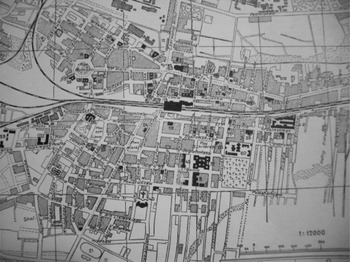
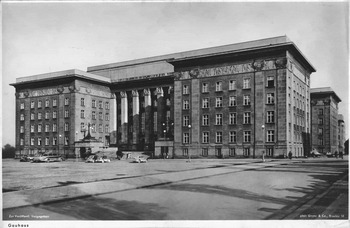
Built between 1923 and 1929, the Voivodeship Government (Office) Building (Gmach Urzędu Wojewódzkiego, hereafter VGB), marked the Forum's premier and most important structure (Figs. 1 and 2). This was a monumental work of 158,000 cubic meters (206,656 cubic yards) in size and four stories high, and built in monumental classical style.Footnote 23 Its chief function was to serve as the seat of both the legislative (Silesian Sejm) and executive (voivode) branches of the Voivodeship Silesia's unique semiautonomous government apparatus. With four bold square corners standing out from the main body of the structure, the latter took on the appearance of a military bastion, giving symbolic function to the nationalist myth of Silesia as Poland's fortress guarding an endangered border.Footnote 24 The building stood adjacent to a broad street used as a parade ground and had large empty squares that served as grounds for political mass rallies in front of the main entrance on its northern flank. The steep staircase and broad portico on this end functioned as the center stage for political mass ceremonies that brought the symbolism of the structure alive and into the eyes of the public.Footnote 25
Map of Katowice in the interwar era. The Voivodeship Government Building is represented below the rail line in the southern part of the city.

The Voivodeship Government Building opened in 1929. Reproduced with permission of Bibliotheka Śląska-Zbiory Specialne (hereafter BŚ-ZS).

The VGB's official symbolic function was an icon of Kultura at the border, a testament of Poland's own “Kulturträgerismus” to Silesia. In the words of the structure's chief architect, Adolf Szyszko-Bochusz, the purpose here was “to create in the capital of our western borderlands a monumental building to mark the development of our culture.”Footnote 26 To accent the building's national importance, Poland's president (1926–1939), Ignacy Mościcki, traveled to Katowice to host its ceremonious opening on May 5, 1929, at which he was joined by the bishop of the Katowice diocese (1926–1930), Arkadiusz Lisiecki, Grażyński, and other state officials. Their public statements at the occasion characterized the building as “great, beautiful, and wonderful” in the words of the bishop, a specimen of “Poland's culture and might” according to the governor, and also a demonstration of “production promoted by the hands of the Polish worker” in Mościcki's view.Footnote 27 These words marked a cultural-diplomatic message to the Germans, who were carefully monitoring the event, that the VGB represented the start of a Polish offensive in Severing's war waged by the weapons of the spirit. In his statement, the director of the Voivodeship Public Works Bureau, Henryk Zawadowski, declared that “the no-good landowner”—his metaphor for the state—“is one who neglects his land, who does not cultivate and develop it, build on it, and beautify it.”Footnote 28 And he went on to credit Grażyński with the accomplishment that was being celebrated, praising him not only as a fellow insurgent but also a builder for this region.Footnote 29 The VGB thus served as a prime symbol of the continued struggle for the borderland against Germany.
Just as this rally served as a boasting message to Poland's neighbors, it was also a means to raise patriotic spirits across Poland and spark excitement in the official crusade to “Polonize” the borderlands. To Grażyński, the VGB represented “social, cultural, and economic work, aimed at deepening the internal current of Polish consciousness among the popular masses” here.Footnote 30 Likewise, to Bishop Lisiecki, “the Silesian population wanted and yearned for such a great and wonderful building so that it could symbolize just how mighty, and even mightier, are its bonds with the motherland [Poland].”Footnote 31 In actuality, the governor's use of force, terror, and chicanery against his political enemies; his lack of respect for bilingualism and other “nationally indifferent” ways; and his policies of national centralization and secularization, among other factors, all did their own to alienate the majority of native inhabitants of Katowice from events such as this and from supporting the Sanacja in general. Wojciech Korfanty's Christian Democratic Party (ChD), the Polish opposition to the governor, which carried significantly more local support than the latter, boycotted this and similar rallies because of the political war Grażyński had launched against them.Footnote 32 Unable to rally the regional populace around the crusade to turn Silesia into a “fortress of Kultura,” the governor and his nationalist followers used grandiose and symbolic building projects to give the borderland a “Polish” appearance that cast a shadow over unofficial local cultural forms on the one hand, and the German memory of the city on the other.
One of the VGB's central ideological functions was as a center of “public tutelage” (oświata publiczna, or Volksbildung) for the Voivodeship Silesia's official foundation myth. This was spelled out on its dedication scroll as a “reconnection” “to the [Polish] Motherland” after “600 years” of “severance” “thanks to the [Polish] national consciousness of the Silesian peoples [Lud Śląski].”Footnote 33 This creed marked the Silesian version of a more or less standard all-national “myth of the western territories,” authored by Dmowski's National Democracy.Footnote 34 In 1930 the VGB's role as the hallmark of Polish-Silesian Kultura was extended with the opening of the Silesian Museum, and its academic research center auxiliary, within its walls. This institution marked Poland's answer to the German Upper Silesian Regional Museum that already existed across the border in Beuthen. In the Polish counterpart, maps, weapons, regional costumes, archeological relics, and miniatures of medieval-period wooden churches all served to give scholarly credit to the notion of an inherently Polish “Silesian peoples” and thus of the Voivodeship Silesia as Poland's “recovered territory”—a term already officially used during the interwar era to refer to Poland's postwar western lands. This institution helped to make the VGB into one of Poland's official tourist icons, a favorite destination for school trips and Polish scout excursions from all over the country.Footnote 35
Being at the center of almost all official commemorations in the region added significance to the function of the Forum Katowice as a Polish lieu de mémoire. The broad portico of its frontal façade served as the focal point of the annual Third of May holiday, and site where high-ranking church clerics hosted an outdoor mass, heads of state gave speeches, and the traditional military and civilian parade around Katowice culminated. In the Voivodeship Silesia, the May Third rally not only observed the constitution of 1791, as it did in the rest of the country, but was foremost devoted to commemorating the outbreak of the third Silesian insurgency on May 3, 1921.Footnote 36 As Poland's response to the German Plebiscite Day rallies, the government sought to accentuate the size and bombast of these events, particularly on important half-decade anniversaries. In 1931 Mościcki, and in 1936 Marshall Rydz Śmigły, Piłsudski's successor, were present at these rallies, along with crowds numbering as many as eighty thousand.Footnote 37 Unable to get ordinary Upper Silesians to participate in significant numbers, government officials transported participants from other parts of Poland. They also skillfully used photography, film, radio, and the presence of state leaders to promote the image of a vast “united front” coming to defend and “Polonize” Poland's existing border areas, and to demand the “return” of those still with Germany. In actuality, to lure participants to these official festivities, state activists offered plenty to distract them from the official political propaganda: they received discounts on train fare, food and drink, and entertainment of all sorts, including gymnastic performances, folk concerts, games and prizes, and song and dance evenings. As a way of getting locals to take part, activists pressured plant and mine managers, schools, and social organizations of all sorts within the Voivodeship Silesia to mobilize their members to march in rank and file.Footnote 38 Indeed, the character of these events was not that different from that of some First of May rallies of postwar Poland. The Polish opposition boycotted Grażyński's Third of May rallies, since in addition to serving their revisionist purpose they inherently legitimated his authoritarian government—as did the “regionalism” program in general. Nevertheless, the ChD conceded to “Polonization” and the symbolic spaces and rallies working in its service in principle.Footnote 39 Even the German consul in Katowice reported to his government that “one has to admit that the Voivodeship building does make an extraordinarily worthy and imposing impression.”Footnote 40 Together, the nationally minded political factions cultivated a transnational political culture of “Kulturträgerismus” to the borderlands that marginalized the voice of the “nationally indifferent” locals and also the communists, who likewise did not care for this nationalist symbolism and ritual.
Not all of Grażyński's building projects sported nationalist overtures as blatantly as did the VGB. In fact, the latter was more the exception in this regard than the rule. Between the late 1920s and mid-1930s a number of avant-garde structures of strictly functional and rational forms went up around the new southern part of the city, inspired by western European and American modern architecture. They were needed to house newcomer Polish elites and to serve as headquarters for new technical academies, as well as for the humanities centers that were among the hallmarks of the governor's “regionalism.”Footnote 41 One essential common feature of many of these modern buildings was the use of steel skeleton constructs. Grażyński embraced the use of steel for building as part of the forging of a “native style” in this region that produced this raw material. The use of steel skeletal constructs, which liberated walls and corners from their traditional support functions, allowed for avant-garde and boastful architectural design.Footnote 42
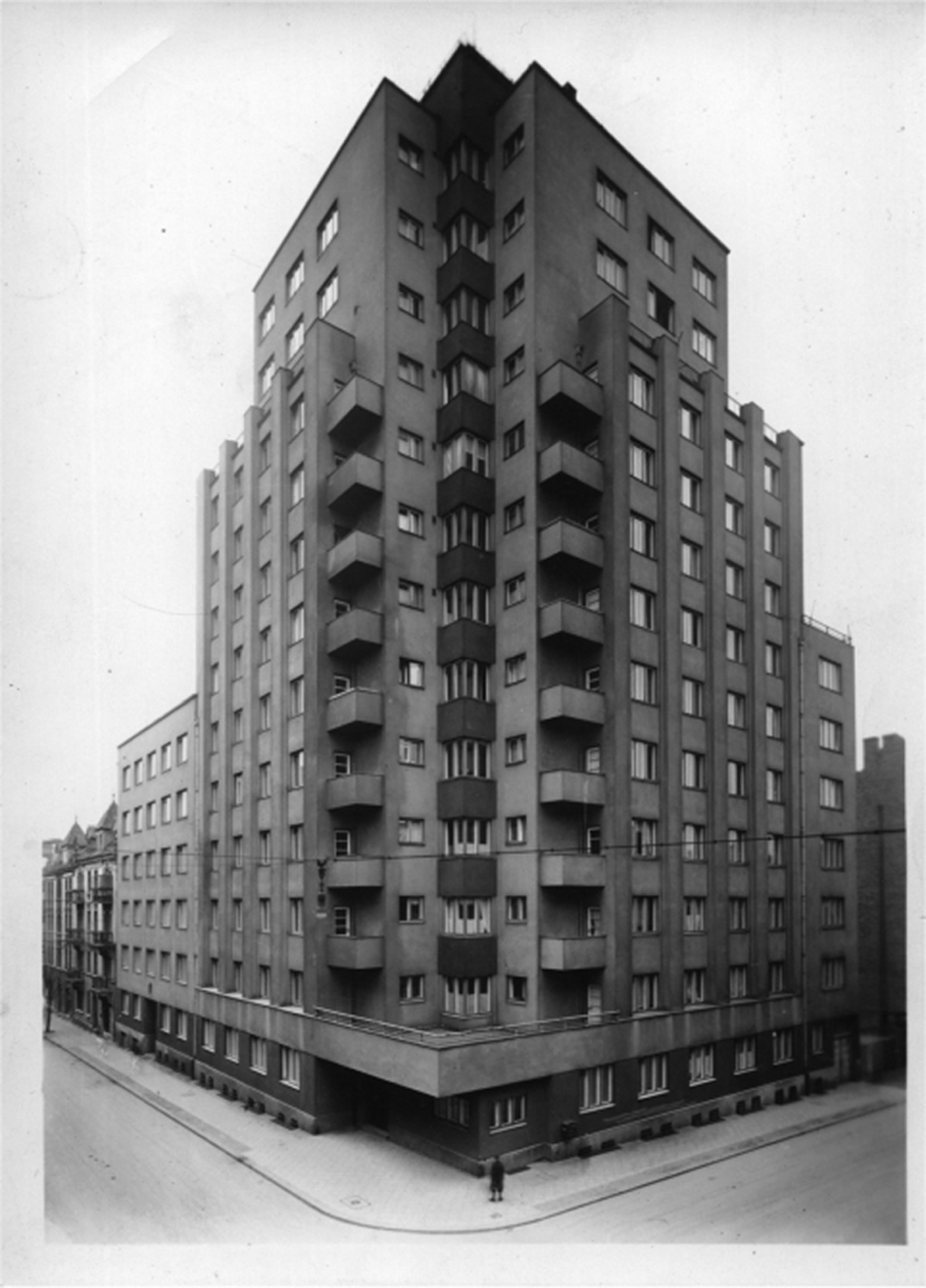
The most symbolic artistic products of the new steel building technology were high-rise buildings. Between 1930 and 1934 Poland's tallest structure was built in Katowice, a fourteen-story and 164-foot high structure that was designated mainly for residential but also for government office use. Popularly called the “skyscraper,” it quickly became a legend in a Poland where this new style and form of building aroused popular wonder (Fig. 3). As a symbol of technology and national progress, it was popularized in the short film, “Steel-Skeletal Building,” which was screened as a feature-show preview in cinemas throughout the country. The structure also quickly became an important tourist landmark in the city. For a token price visitors could enjoy the view from the building's terrace.Footnote 43 The building's popularity placed the then head of the Silesian Bureau for Building and Planning, Witold Kłębowski, in the spotlight of the modernist building trend in Poland. In his 1932 article on the “skyscraper” published in Poland's popular periodical, Architektura i Budownictwo (Architecture and Building), Kłębowski emphasized that this structure represented the importation of the “American style” to Katowice. In his words, “Silesia, this most American region of Poland . . . It is no wonder that Silesia, the fatherland of Polish steel, is the first area to build skyscrapers.”Footnote 44 In actuality no widespread movement of building skyscrapers unfolded in the region. This premier fourteen-story building remained the tallest structure in the region, although a similar high-rise building of lower elevation was built in the neighboring border city of Chorzow (Königshütte). Moreover, only two years after it was built, it had lost its status of being the country's tallest building to a fifteen-story high-rise constructed in Warsaw.Footnote 45 Nevertheless, this structure, along with various other avant-garde buildings made of steel, served to give Katowice the reputation of a modern and progressive “American city,” an image recognized on both sides of the border.
“Skyscraper,” Katowice. Completed in 1934. Courtesy of BŚ-ZS.

These avant-garde buildings were just among the most symbolically important of a number of landscape development projects carried out during this period across the Voivodeship Silesia. Other notable examples included the cathedral, work on which started not long after the establishment of the Katowice diocese as a way to “liberate” Polish Silesia from the control of the archbishopric in German Breslau.Footnote 46 Also of particular symbolic importance was the “Magistrale,” a rail line built to connect the industrial district to the seaports of another disputed border area, the “Polish Corridor.” All these development projects, in addition to countless workers' settlements, roads, railways, and an airport on the outskirts of Katowice were carried out to fulfill real logistical needs. At the same time, they were also turned into symbols of Polish “cultural propaganda.”Footnote 47 During one of its nationwide “Silesian Propaganda Month,” the main promoter of “knowledge” on the borderlands, the ZOKZ, represented the grandiose modernist structures as examples of how “Katowice was transformed from a provincial city of German times into a large regional metropolis . . . striving for one of the first places in the national culture of independent Poland.”Footnote 48 In answer to the neighbor's charge of being mere colonists and exploiters of an age-old land of Kultur, Polish propagandists thus represented the new Katowice as a prime example of how they turned a formerly neglected German periphery into a modernized Polish core province. To help fuel this myth of how better things had become under the Poles, the media also painted a dark portrait of German stewardship in this city. For example, in the words of the head of the Silesian Union of Polish Architects, Leon Dietz d'Arma:
I remember my impressions from a stay in Katowice in 1923. I remember very well that not large and crowded trade center, some of the store exhibits and their inscriptions . . . And those housing buildings, hopeless in their architecture, gray and soot-covered . . . This was one example—not needing further commentary—of the shortcomings and [inferior] standards of prewar German building culture of the borderlands.Footnote 49
On the German side of the border, officials certainly got the message. Reflecting on Katowice's new cityscape in the mid-1930s, the prominent borderland activist, Karl Sczodrok, reported to Berlin that the new achievements in building “will ‘demonstrate’ that the economic and cultural development of Upper Silesia was first successfully carried out under Poland.”Footnote 50 Even the Nazified local press could not help but admit the eastern neighbor's achievements. While certainly not known for such favorable portrayals of affairs in Poland, but rather for quite the opposite, the decades-old nationalist daily of Beuthen, Ostdeutsche Morgenpost, published an unusually positive article in 1938 on the new Katowice. Featuring a full page of photography of the VGB, the “skyscraper,” the “House of Enlightenment,” and other symbolic buildings, the article stated:
whoever has not seen the city of Kattowitz in a number of years could not leave without being somewhat astounded. . . . Since World War I Kattowitz has undergone a mercurial and forward-storming development, and in the realm of building and development, it has leaped over some decades.Footnote 51
Even as the Nazi regime officially regarded Poland as inherently incapable of properly managing territories within its borders, its local agents, who were longtime fighters in this “cold war,” continued to recognize Katowice's modernist landscape as a symbol of progress and achievement.
Whereas it certainly captivated the press of both main political factions of Polish Silesia, the Sanacja and the ChD, Katowice's new cityscape seemed to have had little influence in the way of evoking the patriotic pride of locals for Poland. A struggling Polish economy, the unpopular Grażyńskiite government, and the continuing clash with the newcomer Polish elites weakened whatever feelings of national pride were ever evoked by the new Katowice. The one major “nationally indifferent” political movement, Jan Kustos's “Upper Silesian Defense Union” (Związek Obrony Górnego Śląska, or ZOG), refrained from featuring the city's achievements in urban development in its bilingual press venue. A vociferous opponent of Grażyński, Kustos argued that valuable tax funds were being wasted on the establishment of “Polonization” institutions, including the construction of avant-garde buildings to house them, to the neglect of the welfare of ordinary Upper Silesians. Seeing these as the instruments of power of his hated newcomer elites, Kustos called for the Voivodeship Silesia to become a bilingual autonomous region run by its own native sons and daughters. Nevertheless, not least due to Grażyński's use of force and terror against it, this movement never acquired much rallying power.Footnote 52 On the other hand, the mainstream media was dominated by a Polish nationalist discourse, which, like Katowice's monumental buildings, served to keep “national indifference” out of public view. The Voivodeship Silesia was to be none other than a “Bulwark of Polishness.”
In nationalist propaganda, the construction of symbolic landscapes and the internal war on the “other”—the German minority in particular—marked two sides of the same coin. In its propaganda pamphlet handed out during the “Silesian Propaganda Week” in 1931, the ZOKZ proudly noted how the modernist buildings of Katowice were increasing in number, just as it boasted how the influence of votes for the German Block and sign-ups for German minority schools were declining.Footnote 53 Indeed, both “achievements” were the doing of Grażyński's politics, which, next to inventing a “Polish” official regional culture, included the waging of violence, terror, chicanery, and purges. Officially called “de-Germanization,” this high-handedness aimed to cripple the political, economic, and cultural influence of the Volksbund and German industrial elites within the Voivodeship Silesia. The modernist skyline of Katowice served as the cultural counterpart of this process, a venture to break from the city's Prussian/German past and cast a shadow over its architectural relics. This politics of ethno-cultural homogenization was not carried out in a vacuum, but rather spurred on by the Germans' own “Kulturträgerismus” in Province Upper Silesia.
The “Bulwark of Kultur”
The dislocations of Upper Silesia's partition likewise created their own logistical and social problems on the German side of the border. An influx of around 217,000 refugees from Poland by 1925 put a strain on a housing shortage already long in existence.Footnote 54 It also turned the tri-city border area (Beuthen, Hindenburg, Gleiwitz) into an eastern gateway into Germany, thus subjecting the area to heavy traffic and the need to survey imports and control customs, among other burdens. The building projects that these logistical needs gave rise to, including new apartment buildings and train stations, likewise sparked an opportunity to apply the newest construction technology and architectural forms, as well as to posit these as symbols of German Kulturträgerismus.Footnote 55 Such projects became subsumed in the pivotal scheme meant to transform the tri-city area into a façade of Kultur, the so-called “Tri-City Project” (Dreistadtprojekt). The latter marked a master plan that the government drafted for urban development in the border area. Introduced to the Landtag by the government building officer (Baurat) of Berlin, Henry Gerlach, in 1926, this project aimed to combine the municipalities of Hindenburg, Gleiwitz, and Beuthen into one metropolis, or “city,” as officials referred to it (by the English term). By way of central planning and building, the “Tri-City” was to form one legal, administrative, and communicational and municipal whole. Moreover, each of the three municipal areas was to specialize in one aspect of this wholesome unit, such as serving as a center of high culture or government. Like the landscape development efforts on the Polish side, this project was driven foremost by logistical factors and was then turned into a symbolic weapon in the cross-border “cold war.” One of its main purposes was to promote a centrally planned, collaborative, and concerted effort for solving the social and logistical problems created by the drawing of the border. Among the more urgent problems, the new national frontier had blocked the natural path of urban expansion in the tri-city area, which was eastward before 1922. For example, cut off by the border with Poland on three of its eastern flanks, the city of Beuthen lost its surrounding provinces and thus its ability to expand. Yet, the increasing population and the influx of migrants and refugees catalyzed this growth. The “Tri-City Project” offered a unified and collaborative effort to solve the problems created by the national partition in an area that was among the worst affected by them.Footnote 56
There was also a politically symbolic motive for this project. The idea of creating a megalopolis on the German side of the border was in part a reaction to the building of a large cultural, administrative, and communicative center of “Polish Silesia” by their eastern neighbors. Indeed, the “Tri-City” was to serve as an answer to “Greater Katowice” on the German side of the border, a showcase to demonstrate the “strength of Germandom” vis-à-vis the territories that passed to Poland.Footnote 57 Just as their Polish counterparts in Katowice, German cultural activists saw in the building necessity an opportunity to turn the border area into a politically symbolic façade for the nation. Moreover, here modern architecture and avant-garde style were used to compete with that of the neighbor. Ultimately, most aspects of the “Tri-City Project” remained on paper. Opposition to the project by some administrators, economic crises, and funding shortages all limited its realization. Once the Nazis were in power, they rejected the project due to the avant-garde architectural forms, including the perturbing influence of the “Neues Bauen” school, that were to be the basis of symbolic architecture in this megalopolis.Footnote 58 Nevertheless some aspects of the project were realized that were relevant to the transborder cultural rivalry.
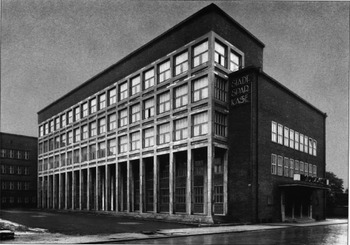
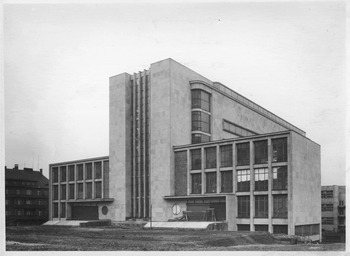
Just as the 1931 “Silesian Propaganda Week” did so in the Voivodeship Silesia, the Plebiscite Day rally of that year in Province Upper Silesia served to show off the latest accomplishments in building that had taken place. At this nationwide event, at which the German Chancellor, Heinrich Brüning, was the guest of honor, aspects of the “Tri-City Project” were there for participants to see. One of the most important was Beuthen's recently developed new central plaza, called Moltkeplatz. Here the most symbolically significant work of construction was a modern structure designed by the architects Albert Stürz and H. Hatler and completed by 1930 (Fig. 4). The strictly functional forms, intensive use of glass on the building's surface, and the blunt and tall columns that elevated part of its façade gave the structure a truly innovative appearance. It was not just the avant-garde character of this building that attracted the interest of officials on the eastern side of the border. In addition to making the ground floor the headquarters of the Savings Bank (Sparkasse), local authorities also gave the building's remaining three stories to the German Upper Silesian Regional Museum (Oberschlesische Landesmuseum) so that it could expand and also sport a symbolic appearance.Footnote 59 This museum's exhibits displayed similar content to those of its rival in Katowice, only these served—in the words of one official during the opening ceremony—“as weapons of serious Wissenschaft to defend against claims to the ancient Slavic or ancient Polish character of the Silesian region made by Polish academics.” The institution aimed to convey the myth that “in the course of its millennia-long cultural development,” Upper Silesia was “only tied with Poland politically for a very short and transitory time span.”Footnote 60 With more than eighty thousand visitors coming through its doors annually, this institution marked a prime site of official regional identity during the Weimar and Nazi eras. The opening of this new museum building in 1932 in turn prompted officials in the Voivodeship Silesia to begin planning for the construction of a counterpart for their own regional museum (Fig. 5). In the words of Dietz D'Arma in the national periodical Architecture and Building, “I have to admit, in the last years . . . the Germans have succeeded in building a grandiose regional museum in Beuthen.”Footnote 61
Upper Silesian Regional Museum, Beuthen/Bytom. Completed in 1930 and museum opened in 1932. Courtesy of Dr. Sebastian Rosenbaum.

Silesian Museum Building, Katowice. Completed in 1939. Courtesy of BŚ-ZS.

With the Nazis' coming to power, Province Upper Silesia's political and physical landscapes changed significantly. The regime instrumentalized the ongoing conflict over the borderland to legitimate the campaign of terror and violent repression it launched against the Center Party, the Polish minority, Catholic religiosity, and other local ways. In its eyes, political Catholicism, “national indifference,” and Polish national consciousness all worked to uphold Poland's territorial claims to Province Upper Silesia. This ethnic cleansing reached its height after the expiration of the Geneva Convention in mid-July 1937. Previously likewise protected by this treaty, Jews now became the regime's main victims, particularly during October and November 1938, when six thousand were expelled across the border to Poland and hundreds were sent to forced labor camps after “Kristallnacht.” The landscape reshaping effort of this homogenization politics included the destruction of synagogues, vandalism of Jewish property, the removal of Polish symbols and signs from public view, as well as the “Germanization” of Slavic/Polish-sounding place names. Some of this type of politics of symbolic homogenization had long been carried out on the eastern side of the border, where shortly after the partition Prussian-era place names were “Polonized” and some statues were destroyed.Footnote 62
Calling it “Kulturarbeit” (cultural work), the regime opened up its own program of Kulturträgerismus as part of this politics of social engineering. Doing away with the Plebiscite Day rallies of the Weimar Era, the Nazis were not interested in continuing their Centrist predecessors' policy of calling on the international community to redraw the border peacefully.Footnote 63 Nevertheless, they found in the standing conflict over Upper Silesia valuable cultural capital with which to rally the nation behind the regime and its imperialist ambitions on the basis of stirring vengefulness against Poland and the Versailles order. For this purpose, they constructed two towering lieux de mémoire that were to serve as “sites of national cultivation” (Volksbildungsstätte) for tourists from across the Reich: the “Borderland Tower” (Grenzlandturm) in Ratibor (Raciborz) (Fig. 6), and the Reich Memorial (Reichsehrenmal) atop the Mount of St. Anne in Gross Strehlitz (Strzelce Opolskie) (Fig. 7), both ceremoniously opened a day apart from one another, on May 21 and 22, 1938, respectively.
The Borderland Tower in Ratibor (Raciborz), opened 1938. Courtesy of Sebastian Rosenbaum.

Reich Memorial and Amphitheater atop the Mount of St. Anne. Opened in 1938. Courtesy of the Herder Institute Bildarchiv.

Like many of the symbolic architectural structures in this transnational contest, the first of these sites had a pragmatic and not strictly a symbolic function to fulfill. As a pressure-generating tower, it served to facilitate the delivery of water to the areas of higher elevation around Ratibor, which was also known as “the city on two borders”—that with Poland and Czechoslovakia. The Nazis took pride that their “superior” way of modernizing combined technology with art, however, and used this site as their way to exemplify this. Standing on a hill 236 yards above sea level and rising 131 additional feet, it chauvinistically sported “Deutschland über alles” under its roof. Like other grandiose symbolic structures on both sides of the border, this one's radiating boldness projected the myth that one-sided nationality towered over everything else in this borderland. Indeed, at the unveiling ceremony, Silesia's Gauleiter, Joseph Wagner, referred to the monument as “a symbol of this border Germandom's declaration of belonging to the German Volk.”Footnote 64 The structure was furnished with a whole apparatus for the public dissemination of this myth, including a small amphitheater at its base and a youth hostel—comprised of a sleeping quarter, wash area, dining hall, and classroom for instruction—for up to fifty guests within its walls. These facilities accommodated “border/borderland tours” (Grenzland-/Grenzfahrten) for Nazi youth, student, and teacher organizations, and occasionally even for ordinary locals, particularly those who could be compelled to participate because of their dependence on the state for welfare benefits.Footnote 65 Such visitors received guided visits to the structure's main feature, a shrine to the memory of the fallen of World War I, of the Freikorps and Selbstschutz of the borderland war of 1921, and also of the Nazi movement. Indeed, to make the memory of the borderland conflict politically useful for them, the regime wove all these historical events into one central narrative of internal and external “struggle” against the agents of the Versailles settlement, including Jews, the Weimar Republic, and Poland. Next to this history lesson, visitors were taken to the tower's viewing deck for a lesson in “current affairs.” With the Polish border just a kilometer away and clearly visible from this height, guides pointed viewers to “the suffering” of “Germany's lands under foreign rule” in an effort to fire up their zeal for the “struggle” to “recover” these “stolen” lands. Pamphlets promoting the Borderland Tower did so as an inherent part of this ongoing conflict for the borderland: it was to serve as an official replacement for the city's Bismarck Tower, which fell to Poland after 1922, and—like other monuments of this sort—was eventually destroyed as part of the “Polonization” process.Footnote 66
The Reich Memorial was built atop Upper Silesia's central site of Catholic pilgrimage and retreat, and had also been one of the major fields of battle during the fighting in summer 1921. The most removed from the border of all the places examined in this essay so far, the Mount of St. Anne had been a center of political contestation between supporters and opponents of the Weimar Republic before 1933. In May 1931, the Catholic Center Party unveiled a plaque within the youth hostel of the Franciscan Cloister heroizing the defense “of a great part of German land from foreign yoke” by “Germans of all tribes”—or in other words, from all over the country.Footnote 67 This marked an effort to promote a memory of the German struggle to put down the third Silesian insurgency that did not have the Freikorps and Selbstschutz—known for their extreme rightist sentiments—at its center, and that was in harmony with liberalism and the Mount's religious and Heimat-oriented spirit.Footnote 68
One of the most grandiose monuments ever built by the Third Reich, the Nazi Memorial served to eradicate and rewrite this memory.Footnote 69 Only the myth of a “united front” of Germans in defense of “their land” against “invaders” remained a constant. But now—as Juliane Haubold-Stolle demonstrated—the “soldiers without orders” were at the forefront.Footnote 70 Standing atop a mount rising some 437 yards above sea level, a thirty-three-foot-tall mausoleum, decorated with flame cauldrons, served to glorify the remains of these fallen Freikorps and Selbstschutz soldiers. Below this structure and at the base of its some 100-foot-high supporting rock stood the Third Reich's largest amphitheater, which seated up to 120,000 people and was equipped with a stage used for official rallies and festivities. According to Gunnar Brands, the round fortress-like mausoleum was built in the style of Bismarck memorials.Footnote 71 Likewise in accordance with Kaiserreich style, using “domestic [building] material” (heimisches Material), including “Silesian sandstone, granite, and marble,” the memorial's designer, Robert Tischler, aimed to “build this structure as harmonically immersed in its natural surroundings as possible.”Footnote 72 In accordance with this motive—as Brands pointed out—the surrounding natural environment was left untouched and people from the amphitheater had to walk through nature to reach the monument.Footnote 73 As Jim Bjork and Robert Gerwarth, as well as Haubold-Stolle, have pointed out, this site marked an attempt to turn a ground of regional religious pilgrimage into one of Nazi secular (or “neo-pagan”) ideology for the entire nation.Footnote 74 Like the Borderland Tower, this grandiose ceremonial ground aimed to erase Polonophile and “nationally indifferent” local ways from nationwide public view. With militarism and vengefulness radiating even more blatantly from the Reich Memorial than its counterpart in Ratibor, the former conveyed the ideological premises of the Nazis' claims to the borderlands. Unlike those made during the Weimar era, these rested not so much on demonstrations of Germany's superior stewardship of the disputed borderland as on intimidating displays of the Third Reich's organic unity, fanatical determination, and military supremacy.Footnote 75
Although the imposing nature of these sites promoted a superficial impression of the Third Reich's popularity in the region, the opposite was more the case in reality. Observing the opening ceremony of both sites, officials from the Polish consulate in Oppeln noted that that of the Ratibor Borderland Tower carried “a strictly local character,” while, although much larger, and at least some 20,000 people in size, that of the Reich Memorial still “in large part disappointed the hopes of organizers for a massive popular participation.”Footnote 76 Instead, the event was dominated by organized formations of regime-controlled organizations. In their study, Bjork and Gerwarth noted that pilgrimages to the Mount to the end of the 1930s were four times greater than this largest rally held at the Reich Memorial. Their observation is likewise well supported by the Landrat's reports of the Nazi's miserably failed attempt to organize a folk music festival at the site's amphitheater in mid-June 1939 as a way of preventing locals from participating in the men's pilgrimage to the Mount. Despite the pressures and threats that the regime imposed on local coal miners, only about 5,000 participated in the music festival—most of them not from among the local population—while 80,000 took part in the pilgrimage.Footnote 77 During this height of Nazi persecutions against local society, such processions were no longer only affairs for the pious, but rather served as a demonstration of resentment toward the regime from the mass of the latter's opponents, including devoted communists.Footnote 78
The challenge to the Reich's symbolic building projects likewise came from the eastern neighbor. Since October 1936, the Union of Poles in Germany (ZPwN)—the main Polish minority organization, which received political and financial support from its patron state—held rallies atop the Mount of St. Anne in an effort to contest its transformation into a German national lieu de mémoire. With prayer sessions at the center of these, the organization aimed to win the minds of locals for Polishness by representing itself as a guardian of Catholicism against Nazi “neo-paganism.” Once the Reich Memorial was built along with a nearby youth hostel and it thus became clear that the Nazis aimed to use the facility as an indoctrination center for the Hitlerjugend, the ZPwN held a prayer service and rally for 2,500 of local youth atop the Mount on July 4, 1938, as a gesture of resilience. On November 6 that year it organized another rally for women, in which 500 participated. In an effort to turn these rather small events into international showcases of Polish defiance against Nazism, Radio Katowice—another jewel of Grażyński's regionalism—gave them partial coverage.Footnote 79 Given that Poland's German minority could otherwise face reprisals, Nazi officials had little choice but to allow these rallies to go on.
The building of symbolic structures remained a process of interactive transnational rivalry throughout the interwar era. The Nazis did not have to search far for an excuse to build such grandiose symbols of Polonophobia as the Borderland Tower and Reich Memorial, which blatantly violated the spirit of the Polish-German Nonaggression Pact of 1934. Their appeals to the Polish government to refrain from staging the bombastic all-national rally to commemorate the fifteenth anniversary of the third insurgency—which even Weimar supporters had considered to have been a Polish invasion of Germany—landed on deaf ears.Footnote 80 Hitler himself prevented nationalist activists in Province Upper Silesia from holding a counterrally to this Third of May festivity in 1936 atop the Mount of St. Anne.Footnote 81 To legitimate the regime's work on its revanchist sites of memory in Province Upper Silesia, the German Consulate in Katowice kept its government informed of the “multiple new monuments to the memory of the era of the insurgency that have been erected or planned for” in the Voivodeship Silesia.Footnote 82 By the end of the 1930s such small places of memory decorated most cities and towns along the border and symbolized Poland's “rights” to both parts of the region. Voivodeship officials continued to unveil new “Insurgent Monuments” (Pomniki Powstańca) to as late as June 4, 1939.Footnote 83 In doing this, they helped to provide an element of logic to the propaganda that the Nazi sites of memory and also the media served to convey—that of an ongoing Polish threat.
Construction work on one of the most important of the Polish sites of memory, the Silesian Museum Building, did not start until 1934—in reaction to the opening of the avant-garde quarter of the German museum in Beuthen two years earlier. The Polish building's architect, Karol Schayer, designed the structure to have, above all, significant size (80,000 cubic meters or 104,636 cubic yards in area), but likewise, a futuristic avant-garde form, in demonstration of Poland's modernizing propensity. This structure of cubic shapes, glass walls, and very limited décor, was erected across the street from the northern flank of the VGB. Nearly completed in 1939, the museum awaited its own bombastic opening as a trophy to the twenty-first anniversary of interwar Poland's founding (November 11, 1939)—indeed, an occasion that never materialized.Footnote 84
“Germanizing” Kattowitz (1939–45)
The Nazi invasion of Poland put an official end to the transnational contest to build architectural icons and other symbols of “Kultur” and “Kultura” in this disputed territory. Despite this, the way that the Nazis officially legitimated Polish Silesia's annexation and direct incorporation into the Reich paved the logic for their continuation of the political culture of Kulturträgerismus, including in the form of reshaping the cityscape. Along with other western borderlands of Poland, as well as Alsace-Lorraine, Luxembourg, and the Belgian East Cantons, the regime conceptualized eastern Upper Silesia as Germany's “recovered territory.”Footnote 85 In doing this, it capitalized on a belief that its Weimar opponents did much to legitimate and popularize: that of the partition of 1922 as an inherent act of international injustice and of Germany's rights to the recovery of this territory. Using this premise as one of the pretexts for legitimating the invasion of Poland, the Nazis turned the Forum Katowice into an official lieu de mémoire for eastern Upper Silesia's “liberation.”
This started with the staging of the first “Freedom Day” rally—an event that had echoes in the Warthegau—at this site on October 16, 1939.Footnote 86 Speaking from the steps of the portico of the Voivodeship Government Building, the Silesian Gauleiter, Joseph Wagner, declared that Poland and the Allies had “imposed the war on us” by depriving Germany of its “holiest rights” to its territories.Footnote 87 With this rally, the Forum Katowice was turned from a symbol of Poland's myth of the “recovered territories” into that of the Third Reich. Indeed, in its essence, the German version of this narrative did not sound all that different from the Polish one: the Nazis represented this territory's annexation as “the reunion of eastern Upper Silesia with the [German] motherland, from which they [the locals] were never separated in spirit.”Footnote 88 Moreover, continuing along this trajectory of logic, they announced the final phase of history in the region. According to Wagner, after enduring seventeen years of “ruin” under “Polish mismanagement,” “with time this land will take on a different character in all walks of life from that which was once imposed on it, a character that would only exist there, where there is Germany.”Footnote 89 The Nazis had thus committed themselves to continue to wage the contest that Carl Severing had voiced thirteen years earlier—that of using cultural politics and development as means to demonstrate the superiority of Kultur over Kultura. With no eastern state actively to contest in this regard, the regime took up this challenge against the legacy of Grażyński's accomplishments. Indeed, his monumental building projects served as the most blatant reminder of these.
No longer impeded by either international conventions or the threat of Polish repercussions against German minority communities, the Nazis were free to engineer the annexed territories as they saw fit. Regarding the majority of the inhabitants of the former Prussian parts of eastern Upper Silesia to be German, they expelled Poles and Jews to the Generalgouvernement and to Auschwitz respectively. While mainly the former Russian imperial parts of the region were chosen as settlement grounds for transplanted “Volksdeutsche” from Galicia and Bukovina, the once-Prussian areas saw the inflow of civil servants from Germany proper, who became the new elites. The forging of a new regional identity was part and parcel of this politics of “renationalization” (Umvolkung).Footnote 90 This acculturation effort seriously started in 1941 with the organization of all of Upper Silesia into its own Gau Oberschlesien (O/S)—separate from Gau Schlesien—and the establishment of a central consortium for cultural politics, the Upper Silesian Heimatbund (OHB). The end goal of the latter's mission of forging a “beautiful German Heimat” was to shape the “nationally indifferent”—which after the introduction of the Deutsche Volksliste (DVL) in March was estimated to be sixty-four percent of the region's population—into “good Germans.”Footnote 91 According to the new Gauleiter, Fritz Bracht, this presupposed a full-fledged project of “Germanizing” all aspects of regional culture, including “cleansing the Heimat” of the “distortions” and “foreign ways of doing things” imposed on it in the era of “Polish tyranny.”Footnote 92
The OHB's bureau for “Landscape Shaping” undertook the task of planning for the reconstruction of Kattowitz's cityscape in accordance with this larger social engineering effort.Footnote 93 Just as with regard to the ethnic cleansing of individuals, that of the urban topography was preceded by the latter's discursive racialization, which was promoted in almanacs, the press, popular scholarly periodicals, and tour guides. Whereas Nazi propaganda ridiculed other parts of Poland for their “backwardness” and “primitivism,” Grażyński's Katowice, as one of Poland's most industrialized cities, was scorned for its “decadent” modernity. The OHB discourse on the cityscape was in tune with the broader German nationalist myth of “Polish management” (polnische Wirtschaft), which dictated, among other factors, that the Polish state—inherently incapable of proper management—had “disfigured” its territories, particularly with regard to aesthetic quality.Footnote 94 The organization's conceptions also reflected the broader Nazi discourse of “Kultur” as marking a superior path toward modernization than “civilization” (Zivilization), that of the liberal west and “international Jewry.” According to this myth, whereas “rootedness,” “idealism,” and “creativity” marked the qualities of the first path, in contrast, the second “stood for the artificial and merely technical achievements of a soulless western way of life.”Footnote 95 In their reflections on Katowice's cityscape, the OHB referred to this “civilization” as “Americanism” since, after all, the Poles had boasted the urban center's “American” identity.Footnote 96 Otherwise, it was also given the label “Jewish,” partly to reflect the regime's revulsion toward the avant-garde and to echo its notion of the war being one against “international Jewry,” but also to underscore the “foreign” and “imposed” character of Grażyński's building in this territory.Footnote 97 Although it now also exhibited Nazi ideological content, this propaganda on the Poles imposing “foreign” ways on an age-old German Heimat marked one of the mainstream irredentist discourses from the Weimar era.
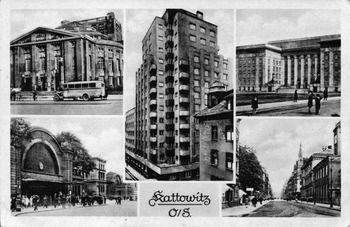
In their confrontation with Grażyński's symbolic landscape, the regime encountered a haunting dilemma. On the one hand, its cultural officials did not like what they saw and demanded “that appearances of the places that had been mutilated during the Polish era quickly receive a German face again.”Footnote 98 On the other hand, the raging war denied them the resources and means of carrying out any serious reconstruction. The city's residents and visitors, however, needed landmarks for identity and orientation purposes. As a result, even as the propaganda besmirched them, cultural officials also promoted images of some of Grażyński's icons of modernity as part of the officially endorsed façade of Kattowitz, the “capital of Germany's youngest Gau,” along with notable structures from the Prussian era, such as the central train station and municipal theater (Fig. 8).Footnote 99
Officially endorsed postcard of Kattowitz (Katowice) from the war period. Center: the “skyscraper.” Top right: the Voivodeship Government Building. Bottom left: train station from the Prussian period. Top left: municipal theater building from the turn of the century. Courtesy of BŚ-ZS.

The Forum Katowice marked the regime's most notable object of appropriation. Although the regime had invested years of effort and resources to build the Reich Memorial atop the Mount of St. Anne for this purpose, ironically, Grażyński's great masterpiece of Polish nationalism came to serve as a ceremonial center for the whole Silesian region. The “Day of Freedom” rallies of October 1939 and September 1, 1940, alone drew crowds of either equal or greater size than the other site saw: 30,000 and 70,000 people respectively—a reflection of both the NSDAP's compelling rallying tactics and also public intoxication with the Third Reich's growing might and territorial size at this time.Footnote 100 Initially making only cosmetic alterations, the regime started to make larger-scale alterations to the Forum Katowice by 1941 to reflect the site's symbolic remythologizing. The first of these was the installation of a large clock with musical porcelain bells inside the right flank wall of the avant-garde Administration Offices Building located across from the main façade of the “Gauhaus.” Its function was to play the melody of the new regional anthem (Heimatlied) for Gau O/S, Heinrich Gutberlet's “The March of the Germans in Poland,” one of the patriotic songs sung by the German minority of this country.Footnote 101 This officially turned the Forum Katowice into a symbol of the official myth of suffering and defiance under “Polish tyranny” on the part of the “Volksdeutsche”—the label that the regime cast on most locals—and of “liberation” by Hitler.
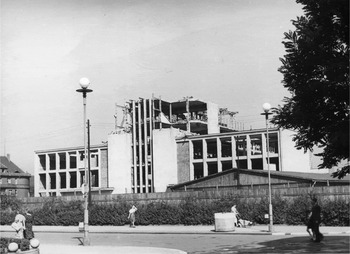
The deconstruction of the new Polish Silesian Museum building marked the most important alteration to the Forum Katowice the Nazis had made. Its dismantling was a gradual process lasting from 1942 to when the Nazis lost the city to the Soviets in January 1945 (Fig. 9). Not yet having been publicly opened as a museum by the start of the war, this glass-walled avant-garde structure was gradually dismantled—I would argue—to demonstrate “progress” in the way of the regime's mission to “cleanse” the city of “monuments of Jewish cubist architectural forms.”Footnote 102 Indeed, the thick-walled and fortress-like appearance of their appropriated “Gauhaus” was more akin to the architectural taste of regime officials. The museum building marked the second major structure the regime destroyed as part of its politics of ethnic cleansing. Immediately after taking Katowice from Poland during the first week of September 1939, the Nazis burned its municipal synagogue to the ground.Footnote 103
Dismantling of the Silesian Museum Building, 1942 to 1945. Courtesy of BŚ-ZS.

The politics of “Germanizing” eastern Upper Silesia's landscapes also had its mass mobilization component. As part of its larger program of Volksbildung aimed to “raise” (erziehen) locals into “good Germans,” the OHB initiated the “Operation More Beautiful Silesia” (Aktion Schönere Schlesien) in spring 1941. Using public exhibits, the press, other propaganda venues, as well as grassroots “community service” involvement, the organization aimed to make locals believe that despite the setbacks of war, their surroundings were still becoming more “beautiful” in the Third Reich than they had been under “Polish mismanagement” in that they were cleaner, more renovated, orderly, “properly” decorated, and foremost, devoid of “Polish” and “Jewish” traces.Footnote 104 As part of the effort, communal government officials coordinated the completion of small-scale building projects and the renovation of public recreation facilities from the Polish period. As a prime example, after carrying out some minor improvements to Katowice's municipal swimming pool from the Grażyński era, officials used the press and motion pictures to boast of their work as tokens of the benefits of Kultur. Also as part of the operation, local administrators and Nazi social organizations worked to mobilize ordinary individuals to renovate, clean, and decorate their places of residence and immediate surroundings according to officially established rules and regulations.Footnote 105 The latter also dictated the removal of the last traces of “Polishness” from local common areas. This referred not just to traces of language and to secular state symbols, but also to religious icons, such as commonplace caricatures of the Black Madonna, or the Virgin Mary depicted in dark skin.Footnote 106 Indeed, the destruction of the synagogue, gradual deconstruction of the Silesian museum, as well as the installation of the clock with porcelain bells, along with other acculturation projects, must be treated as part of this process of the regime's Kulturträgerismus—a core aspect of its politics of self-legitimation in this annexed territory.
The fact that this official “beautification” campaign was in actuality a means for the regime to tamper with long-standing traditions, as well as use fines and punishments against those who did not conform, all the more discouraged locals from enthusiastic participation. Even the usually overtly optimistically predisposed official daily newspaper—Kattowitzer Zeitung—emphasized that the “Operation More Beautiful Silesia” was met with indifference among Katowice's residents. The press complained that the public cared too little to keep the streets clean and about how the call for the renovation of private quarters and the decoration of balconies for state holidays too often landed on deaf ears.Footnote 107 Indeed, these tokens of apathy were only part of a larger increasingly staggering process of public alienation from the regime that followed a short-lived period of high expectations and enthusiasm. Officially promoted as a “liberation” from “Polish tyranny,” the annexation in actuality imposed a greater degree of state intrusiveness into the lives of ordinary individuals, a higher degree of intolerance for traditional ways, and most importantly, a greater volume of violence and the suppression of local voices than this society had ever seen. Ironically, the first major cause of local discontent toward the Nazis was the rise of a similar social phenomenon that had turned this society against Poland—the exclusion of locals from influence by the rise of a new class of regionally foreign elites, this time from Germany.Footnote 108 A subsequent factor of this alienation was quite original to the Nazis, however: the official dubbing of the majority (more than sixty percent) of ordinary inhabitants as only temporary and conditional—and thus officially second-class—citizens of Germany by virtue of their classification in “category three” of the DVL. By the end of 1942 and for the rest of the Nazi era, the public discontent against the regime gradually escalated to such proportions that the Landrat of Kattowitz spoke of a “resistance movement by the Volksdeutsche”—the official label that the majority of the population on the Volksliste were given.Footnote 109
Conclusion
The German-Polish contest over the Industrial District and the wider Upper Silesian region left a lasting imprint on this area's landscapes. The postwar conflict over this area and the dislocations of its partition between two warring nation-states helped to determine the logistical contingencies and the political tensions behind the bilateral contest of building that had erupted by the late 1920s. In their race to construct notable architectural landmarks and sites of memory, German and Polish state actors engaged in a process of interaction and mutual influence. A cross-border consensus had developed regarding the values and ultimate goals of this contest between the Weimar and Sanacja governments: the building of awing cityscapes was to demonstrate that each nation was the better “Kulturträger”—carrier of culture, progress, and modernity—and would be of greater benefit to this borderland in the long run. And to “cultural propagandists” on both sides of the border, structures of modern architecture and the avant-garde served as a common means of relaying this message both to the wider national and international communities.
The landscapes of revanchism that were the products of this transnational contest served as “cultural propaganda” in this cross-border war of words and symbols. Official sites of memory on both sides of the border served as symbolic surroundings from among which various German and Polish governments—not just right-wingers, but also liberals—disseminated nationalist and irredentist discourses. As grounds for mass rallies, tourist centers, and architectural landmarks, these symbolic landscapes officially reflected narratives of Germany's/Poland's track record of superior stewardship in Upper Silesia, of the inherent Polish/German identity of this region's locals, and of an ongoing nationwide struggle for the “recovery” of this borderland. German and Polish versions of these narratives were strikingly similar to and inherently interwoven with one another. Likewise, some of the tastes in architectural styles were similar among officials across the border, which enabled the Nazis merely to remythologize at least a part of the former “Polish landscape” and claim it as their own after September 1939. The Silesian-Sanacja and Nazi regional governments that inherited this war of symbols from the liberals who first promoted it were quick to use it to legitimate their own politics of authoritarianism, repression, and nationalist exclusion. Before the attack on Poland, the Nazis used their symbolic landscapes to cloak their imperialist policies in a discourse of irredentism that those of their Weimar predecessors had made familiar. After September 1939, they upheld this transnational culture of Kulturträgerismus to serve as a symbolic counterpart to their politics of genocide, expulsion, and social engineering. In doing so, they promised a “happy end to history” in the borderland, which would come with a final undoing and overcoming of “Polishness”—including Grażyński's avant-garde cityscapes. Despite their genuine efforts to deconstruct Polish buildings and “Germanize” the local population, they ultimately failed to realize their ambitions.
To German and Polish political borderland activists, defending and enlarging their nation's frontier territories and integrating these into the nation marked two parts of one “struggle” over these lands. Modern architectural forms that found their echo in other parts of each nation and their nationally renowned architects symbolized both the borderland's national integration as well as progressive, and—except for the Nazi era in Germany—also western character. Particularly under the Sanacja and Nazis, they also served symbolically to erase the memory of the unwanted other, not just Poles, Germans, and particularly under Hitler, Jews, but also “national indifference,” which the two governments commonly ventured to keep away from public recognition. In Polish Silesia this cultural politics of homogenization marked the symbolic backbone of Grażyński's coercive politics of “Polonization,” while under the Nazis it became an inherent part of full-fledged ethnic cleansing, which started on the western side of the region before, and was extended to its eastern part during, the war. Since they stood for authoritarian government, force, and intolerance, some of the marvels of building and sites of memory on both sides of the border roused apathy and/or resentment from among the local population. The locals' resilience in accepting the official nationalist myths these landmarks stood for was merely a reflection of the shortcomings of all German and Polish high-handed policies of nationalization in this borderland.
The year 1945 marked a clear end to the Nazis' effort to “Germanize” the landscapes of Polish Silesia, but not to the general use of urban planning and building to contest the identity of the German-Polish borderlands. Symbolic cityscape renationalization accompanied the expulsion of Germans from postwar Poland's western territories. One of the aims of the present study has been to shed light on the transnational as well as interwar and wartime development of this political culture of symbolically appropriating frontier landscapes for the nation. In their quest to defend and expand their territorial holdings, German and Polish government actors forged a cross-border political culture of using the built environment to represent their desires to integrate nationally and expand their borderland holdings. By the late 1930s, and particularly during World War II, urban planning became a counterpart of more forceful politics of reengineering national identity in the borderlands.