

1. Introduction: why we need land use regulation
Planning – regulating land use – is very valuable from both an economic and a social viewpoint. Land markets have endemic problems of ‘market failure’ meaning that unregulated they would serve neither the economy nor society well. The value of every parcel of land depends on the uses on all neighbouring plots of land: the spatial extent of these interactions can be very extensive. The occupants of a plot of land will suffer if a lead smelter sets up business next door so the value that can be derived from their plot will fall. That is a pure localised negative externality so represents not just an issue of market failure but justifies regulating the uses that any land can be put to. For example it might justify zoning. But these type of externalities can operate over long distances too: in the days of Concord lecturing had to stop for five minutes every morning at the University of Reading as the New York flight flew overhead and accelerated to its cruising height. Heathrow is 35 kms east of Reading. Equally the value of a plot of land in Reading increases if job prospects in central London improve.
An important reason London is so liveable is its abundance of beautiful green open spaces or areas of accessible natural beauty on its doorstep such as the North Downs. The welfare of all city residents increases because of urban green spaces and numerous studies have shown that access to urban green spaces is reflected in the price of houses (see, for example, Cheshire and Sheppard, 1995 or Reference Anderson and WestAnderson and West, 2006). Open spaces and beautiful countryside are ‘public goods’ – markets will not, or will inadequately, provide them because prices are not charged so there is no revenue, or land owners are rewarded too little, for the public benefits urban parks or beautiful countryside can generate – especially when it is accessible to enjoy.
Equally we need rules governing the provision of infrastructure – standards for roads for example or for provision for pedestrians and cyclists in new development. And we need to co-ordinate the provision of infrastructure – typically paid for, or at least initiated and planned by government – with new urbanisation.
So as a society we benefit from not allowing land owners to build anything, anywhere. We need to regulate and plan land use. We need rules to govern where and how building is allowed and co-ordinate public investment with urban development.
2. Risk, uncertainty and the supply of development
This brings us to the first problem with the British planning system: it has no rules. We do have building regulations. These are rules. A builder or architect reads them and if their design and construction conforms to them, they can go ahead more or less automatically. Not so with planning: all decisions are subject to the uncertain and gameable mechanism of ‘development control’: decisions are made by a local political committee and this is subject to lobbying and political expediency. As is explained in Section 7 we have inbuilt institutional structures and fiscal incentives to enable and motivate restrictiveness. A proposal may conform to the local plan – if there is one – but if it is in the ward of the committee chair it may still be refused. Or even worse, a member may live across the road from the proposed development and does not want it.
Other planning systems work according to rules – for example the Master Planning system of Denmark or Germany or the US Zoning system. The result is that a significant element of uncertainty in the development process is all but eliminated. The developer reads the (democratically adopted) plan relevant for the plot of land which they wish to develop and asks for what is allowed. Permission is all but automatic.
Development everywhere is a risky business: there are costs in the design, planning and construction processes incurred before any revenues flow. Design and construction costs are relatively easy to forecast but in the British system the costs of obtaining planning permission, even the probability of gaining it at all, are not. It is difficult – particularly for smaller developers – to arrange financing before planning permission is agreed and a scheme's details are clear: and no planning permission may be forthcoming. After the costs of design, planning and construction have been paid there is an expected flow of revenues from the finished development with the value of that flow influenced by the conditions of any planning permission obtained.
Development is an investment. Three consequences follow from this observation. The first has been addressed in the literature (see, for example, Reference Cheshire and SheppardCheshire and Sheppard, 1989; or Reference BarkerBarker, 2003 p. 158; Reference BarkerBarker, 2006a, pp. 55–66) and is the costs imposed by delays in reaching decisions including time potentially taken in appeal. This causes financing costs to increase in proportion to delay so reduces the volume of development. As has been shown by Reference BallBall (2011), the imposition of a target of thirteen weeks for decision making had little impact: the main effect seemed to be to increase the refusal rate leading to multiple applications for a given site. While government could claim that ‘nearly 70 per cent of applications were processed within thirteen weeks’ (Reference BallBall, 2011, p. 358) the actual median period in the planning process was 64 weeks.
There are two further implications of the investment nature of development: both relate to uncertainty induced by the unknown length of time needed at the outset to get permission and the further uncertainty that permission will be obtained at all. The first is the fact that in the face of uncertainty and an irreversible decision to invest or not there is value attached to an option to delay: uncertainty may increase that value of delay (see, for example, Reference Dixit and PindyckDixit and Pindyck, 1994). However in the present case the uncertainty is external to the development and the timing of the developer's (investor's) decision to invest is unlikely to influence the delay they face or the likelihood they will get permission; nor does a developer have any ability reliably to estimate the length of any delay. So the option to delay application to develop is not just difficult to exercise in this case but not of much value either.
But there is a second and more certain effect of the uncertainty contingent on the British use of a gameable and uncertain mechanism for making decisions about development. The development decision involves a discounting of expected cost and revenue flows and the rate at which they are discounted will incorporate a risk premium. More uncertainty in relation to the planning decision increases the development risk, so there must be an additional risk premium.
As shown in Reference Mayo and SheppardMayo and Sheppard (2001) this means less development appears to be viable and fewer projects get built. In other words the elasticity of supply is reduced since for a given current or expected future price of, say, houses, less development is viable. There is an additional and paradoxical effect of the specific mechanism applied to lever developers into including ‘affordable’ housing in new developments: Section 106 Agreements which make planning permission contingent on ‘obligations’ to provide a proportion of affordable units in any development.
The paradox is that this mechanism extends the time necessary to obtain permission and adds a further dimension of uncertainty to expected profitability, so further increasing development risk and further reducing the total number of houses built. The specific obligations that are imposed are the outcome of negotiations between Councils and developers but are not known until the Planning Committee meets and makes a decision. Even then such decisions are both negotiable and may be appealed. Since the extra risk imposed by S106 conditions is unknowable in advance, fewer projects are viable. This is a particular problem for smaller developers who have less access to planners and to internal finance. So by injecting yet more risk, our attempt to build affordable houses makes all houses less affordable because fewer get built.
A successful planning system inevitably imposes local restrictions on building and land use. Otherwise it could not fulfil its basic function of, for example, protecting beautiful countryside, sensitive wildlife sites or historic townscapes. But we should distinguish between purely local restriction of development and policies that restrict development in aggregate compared to what is demanded: what one might call ‘generic’ restrictiveness. The additional uncertainty the British planning system injects into the development process means that in effect our system has an inbuilt restrictive effect – it is ‘generically’ restrictive. No one has been able to quantify the impact this has. Its sign is clear – prices for all types of buildings increase – but devising a methodology to estimate its effects is extremely challenging.
3. Restrictions on the supply of space
There are, however, more direct ways in which our planning system is ‘generically’ restrictive. Perhaps the most obvious is ‘urban growth boundaries’ – in Britain, Green Belts – preventing any building over great tracts of land. The total area of Green Belts is more than 1.4 times the extent of that of all urban development. London's Green Belt extends from the North Sea to Aylesbury, it covers more than three times the area of the GLA, and its containment boundary has been in place since the late 1950s. Oxford's Green Belt covers eight times the area of Oxford city.
The Green Belt as implemented in 1955 was never intended to protect land from building for environmental or amenity reasons. It is called ‘green’ but this is essentially rhetorical. As the Minister for Housing and Local Government (Duncan Sandys) wrote:
“… even if … neither green nor particularly attractive scenically, the major function of the Greenbelt was … to stop further urban development”. [quoted in Reference HallHall, 1975]
That remains the function of Green Belts as confirmed in the National Planning Policy Framework (NPPF) (DCLG, 2012). Their purpose is to be empty spaces between cities, originally – London's was the first – to protect the Home Counties from the encroachment of London and force urban expansion to jump over Surrey or Hertfordshire to Northants, Cambridgeshire or Hampshire. The fifth purpose identified in the NPPF makes explicit the aim of restricting the supply of land for urban development in order to try to force development onto ‘derelict and other urban land’.
London Transport's tube network was well established by 1939 and had had the effect as it was constructed of rendering the supply of land for London's development highly elastic (see Reference Cheshire, Nathan and OvermanCheshire et al., 2014). WWII froze further urban expansion and building had not resumed in a significant way when Green Belt boundaries were established in 1955. The result was that tube stations became marooned in pockets of fields that development had not reached and have remained in that frozen state. Google Earth shows examples around Northwood Hills, Stanmore or Fairlop stations – all within 30 minutes of central London. Modern extensions of London's commuter rail system are going to isolate further and much bigger tracts of environmentally not very interesting but highly accessible land. All the stations on CrossRail – costing some £18 billion – beyond the Green Belt boundary will make large areas of land highly accessible to some of the most productive and highly paid jobs in Europe. Because stations like Taplow, Iver, Langley, Harold Wood, Brentwood or Shenfield all have large areas of Green Belt land around them, or are entirely surrounded by Green Belt, however, nothing can be built. The fact that the land may be used only for intensive arable, golf or horsey culture – or just more or less rural dereliction – is not relevant.
To this restriction on outward spread of cities we add height controls: again either directly – for example the Borough of Islington forbids all building of more than 7 floors except in a small enclave fringing the City and even that was only permitted from 2007: or indirectly because of extensive Conservation areas or protected views. No building, for example, can block the view of St Pauls Cathedral in an 18km corridor extending to Richmond Park. St Pauls is a magnificent sight but this view – given air pollution and prevailing atmospheric conditions – is available for only a few days a year to a very small number of people.
We know from several studies that urban conservation is a valuable public good (for example Reference Koster and RouwenthalKoster and Rouwenthal, 2017), but one must consider its value relative to its costs; but these are never considered. The costs come in the form of higher prices for housing and office space in London and our other cities and as Reference Ahlfeldt, Möller, Waights and WendlandAhlfeldt et al. (2017) show, conservation seems to have declining marginal benefits. Conservation also imposes a burden of additional carbon emissions since insulation in old buildings – Listed or in Conservation Areas – is far worse than in modern buildings (see Reference Hilber, Palmer and PinchbeckHilber et. al., 2017, for evidence on this). The question is not whether the preservation of important historical buildings or picturesque city neighbourhoods is worthwhile; it is how much is worthwhile.
4. Inbuilt restriction on land supply
Our planning system imposes yet more restrictions on space and its useful adaptation. The method used to calculate how much land to allocate for housing has an inbuilt and cumulative restrictive effect on supply relative to demand. Planning allocates the supply of a scarce resource – land. Prices are determined by the interplay of supply with demand but we allocate land supply without regard to price.
Our planning system allocates land supply for housing only on projections of local household numbers – the ‘numbers’ component of demand. But population increase has very little impact on the growth in demand for housing or housing space, so it has very little impact on its price. The reality of this is illustrated in table 1.

Commentators claim the rise in house prices in London is because of population growth. It is true London's population grew quite rapidly in the 30 years to 2011 – by 20.5 per cent. Real house prices – that is removing the effects of general inflation – grew ten times more, however, by 227.6 per cent. On the other hand, London's population in the previous 30 years shrank by 16.9 per cent yet real house prices still grew by 71.9 per cent. And over the whole period 1951 to 2011, London's population hardly changed yet real house prices increased by getting on for 500 per cent. Broadly house prices in London have doubled in real terms in every decade since we imposed our Green Belt and population growth has had very little to do with it.
A rather more formal approach to estimating the relative impact of incomes and population on the demand for, and price of, houses was embodied in some work commissioned in April 1997 by the then DETR to model the effects on house prices of alternative policies for land release. This built on the methodology already established (Cheshire and Sheppard, 1997; 2002) for estimating the net welfare effects of planning policies. The methodology built up from an empirically estimated hedonic model of housing markets (Cheshire and Sheppard, 1995) and then an estimated structure of demand for housing attributes (Cheshire and Sheppard, 1998), including both space inside houses and in gardens around them, as well as the ‘outputs’ of the planning system – represented as less industrial land in your neighbourhood, more accessible public space in parks etc. and more Green Belt land external to the city. These models were calibrated on individual house transactions and the reported incomes and socio-demographic characteristics of their occupants. It was thus based on detailed micro and spatial data and, given estimates of prices and incomes, it was possible to estimate both land and housing space consumption at alternative levels of income and household numbers. Equally, given values for those key variables (i.e. land supply, household numbers and incomes), one could use the model to simulate equilibrium house prices with the simulations based on observed behaviour of house buyers.
At the time the work was commissioned there was policy concern following a Green Paper on population growth (HMSO, 1996) projecting an increase in household numbers of 4.4 million in England over the 25 years from 1991. So one remit of the study was to provide robust estimates for house prices of growing population, applying alternative land release assumptions. Following the Green Paper, the model's horizons were set to 2016. Two simulations are noteworthy here. In both cases the assumption was made that land release policy would be as had then been recently announced: 60 per cent of all new housing would be on ‘brownfield sites’. This was interpreted as 60 per cent of new building being on land within the existing urban envelopes. The first simulation set the growth in household numbers at the projected rate and real incomes rising at their historic average. The second also set household number growth at the projected rate but set real incomes static at 1996 levels. The second, in other words, more or less corresponded to the planning system's methodology for land allocation.
The outcome was that on this second set of assumptions – officially projected growth in household numbers but constant real incomes – real house prices were forecast to increase by 4.4 per cent by 2016. In contrast, the first simulation, with the model set to assume both the forecast rate of household number growth and the historic mean annual income growth, showed real house prices increasing by 131.9 per cent by 2016. In other words, with restrictions on land availability (mild in comparison to the outturn proportion of all new building on brownfield land), household number growth made little difference to house prices but real income growth had a very substantial effect.
Officials were sceptical about the extent of real house price growth in the model forecast. The study (Reference Cheshire, Marlee and SheppardCheshire et al., 2000) was never officially published because by the time it was finally signed off, a policy of urban densification had been adopted as well as the 60 per cent brownfield target and it was feared that the results of the model ‘might be used by people critical of government policy’. However, as a postscript, the outturn increase in real house prices from 1996 to 2016 was some 125 per cent – well within the bounds of error in the model.
To an economist this is not very surprising. The analysis of markets has been a core interest for more than 200 years. The basic determinants of demand are well understood. Total demand increases with the size of the market (the total number of people wanting to buy); if tastes shift in favour of the good or service; and as income increases. We also know that the demand for some goods and services is much more sensitive to increasing income than is that for others and may be complementary (or a substitute) to the consumption of others.
As people get richer one of the things they try to buy more of is ‘housing space’ and ‘space in gardens’. As you get richer you do not want more beds, you want a bedroom each, bigger bedrooms, bathrooms or a separate kitchen and living room. Over the past two generations real incomes have increased threefold. Car ownership has increased 13-fold and – like it or not – the use of cars is complementary to the demand for space: cars owners want garages, off street parking and shops with parking around them.
In other words the income elasticity of demand for space both inside houses and around them in gardens is strong. They are not just normal goods but positively superior ones. There are few estimates available for the income elasticity of demand for housing space but one (Cheshire and Sheppard, 1998) produced a value of about 2; the study's separate estimates of income elasticity of demand for space i) inside houses and ii) in gardens were very similar. There are more recent estimates for the income elasticity of demand but for the composite good – ‘housing’. These are higher: Reference MeenMeen (2013) estimated a value of 2.7 and an OBR study (Reference AutersonAuterson, 2014) gave a value of close to 3.
So by far the most important driver of the increasing demand for housing and housing space is the increase in real incomes. This directly increases the demand for housing space but also increases the consumption of goods complementary to housing space. In allocating land for housing, however, our planning system ignores both these forces altogether. It allocates land for housing only on the basis of projected growth in household numbers in the local area over a short – typically 5-year – horizon. This is akin to designing planes while ignoring the laws of gravity.
As well as blocking urban expansion with Green Belt boundaries, therefore, relative to rising demand we have been systematically restricting the supply of land for two generations because of the methods used to estimate how much is ‘needed’.
5. Systematic differences in local restrictiveness
Our planning system imposes a generic restriction on supply in yet another way. It just says no; local planning committees reject proposals for development. This again reflects the politicised mechanism of decision-making we employ and the incentives for restrictiveness our fiscal system creates. A rejection may reflect local planning policies but very often it does not. That is partly because developers do not tend to apply for projects that flout local plans; but also because – as was discussed in Section 2 – the reality is that rejections are essentially political and reflect local pressures. Over the whole period since 1989 the average refusal rates for major residential developments by Local Authorities (LAs) vary very widely from half of proposals refused in several LAs in the South East to only just over 7 per cent in Middlesbrough. That half of proposals are refused by a given LA does not mean that half never get built. As was discussed in Section 2, one effect of greater local restrictiveness is multiple applications for the same site. This still delays and increases the cost of development and reduces the flow of new housing.
Research has shown (Reference Hilber and VermeulenHilber and Vermeulen, 2016) that ‘restrictiveness’ measured by the rate of planning refusal – very carefully offsetting for obvious problems of reverse causality and endogeneity bias in estimating – directly causes significant differences in house prices. These differences are far more significant than those caused by local land shortages generated by differences in topography or available developable land. The conclusion of this study was that if the average restrictiveness of LAs in the South East had been as low as the average in the North East, house prices in the South East would have been at least 25 per cent lower. The other two local measures of land supply restriction – less developable land or less flat, easy to build land – made some difference to local house prices but their influence was dwarfed by differences in the political restrictiveness of local decision-making. Even this estimate of 25 per cent is a lower bound, however, since their analysis is based in 1974, by which time Reference Hall, Gracey, Drewett and ThomasHall et al. (1973) had already published a study arguing that planning policies, notably containment, had been pushing up house prices.
6. Other consequences of greater local restrictiveness
A recent paper (Reference Cheshire, Hilber and KosterCheshire et al., 2018) has examined another effect of local restrictiveness, also measured as the proportion of major residential applications to which an LA says no: the impact on the proportion of empty homes and the distance workers with local jobs commute. Planners and NIMBY-pressure groups often argue that it is not necessary to allocate as much land – especially green field land – for housing because there are vacant homes.
Again there is a danger of ignoring the laws of gravity because they are inconvenient. However well a housing market is functioning there will be empty houses – people move or die; builders take time to sell or landlords are inefficient or unable to find tenants. It is rather like the labour market; it is desirable if there are fewer people unemployed but because people leave jobs to find better ones or lose their jobs, there are always some unemployed. The relevant questions are how many is enough and why are there empty houses/people looking for work? Without a diagnosis of causes, no policy can be expected to be effective.
We know greater restrictiveness increases the price of housing (Reference Hilber and VermeulenHilber and Vermeulen, 2016). That will generate an incentive to sell homes or find tenants as soon as possible, so will produce a force reducing housing vacancies – as proponents of restrictiveness might hope. However, over time, greater restrictiveness will also make it harder to adjust the characteristics of the housing stock to the changing demand for housing. A local school improves, so demand for family houses in its catchment area increases; people become richer and want more space; families get smaller so the demand for suitable homes increases; or local jobs increase so people want to move to the area. The list is endless but the fact is that demand for housing is always changing both in terms of the type of housing and its attributes and the location of housing. The more difficult it is to adapt the characteristics of the housing stock the more difficult it becomes for people to find the right house they can afford. So they have to search for longer – meaning that housing vacancies will increase; or they have to search further afield – meaning their journey to work becomes longer and, because they do not buy locally, housing vacancies will be higher than they would otherwise have been. We can call this the ‘mismatch’ effect: created by greater restrictiveness and tending to increase the number of empty homes.
So a policy of greater restrictiveness designed to reduce the number of empty homes may have that effect because it makes housing more expensive but since, at the same time, it makes it harder to find the ‘right’ house in the local area, it will tend to reduce the effectiveness of search and so increase the proportion of empty homes as well as increasing commuting distances. Which of these two forces dominates is an empirical question. More restrictiveness could go either way.
This is the question addressed in Reference Cheshire, Hilber and KosterCheshire, et al. (2018). The authors go to considerable lengths to deal with problems of reverse causation and endogeneity. There are 30 years of data for 350 English local authorities. The analysis shows with substantial reliability that the net effect of greater local restrictiveness is not just to increase the proportion of empty homes but to increase it substantially. A one standard deviation increase in local restrictiveness causes the local vacancy rate to increase by nearly a quarter. At the same time it also increases the average distance people with jobs in the LA have to travel to work. The same increase in local restrictiveness causes a 6.1 per cent rise in commuting distances.
So attempting to regulate housing vacancies away by allocating less land or being more restrictive with respect to new building or adaptation of existing houses, in reality increases the proportion of local homes that are empty as well as making people who work in the area commute further – the absolute opposite of what advocates of the policy want to achieve.
It is the mismatch between the preferences of households and the housing stock on offer that leads, other things equal, to higher vacancy rates in the more restrictive places. Such constraints will likely cause a significant welfare loss. This is because too much housing stays empty in the most regulated, most desirable and, by implication, most productive places with the strongest demand and highest valuations for living space. So people are induced to commute further, while living in the ‘wrong’ places.
The policy lesson is that planners should not allocate less land for development on the grounds that there are empty houses; nor should they make it more difficult to build or adapt houses. Rather they should encourage more flexibility with the number, location and type of houses if they want fewer houses to be empty.
There is moreover a disturbing irony for advocates of the ‘compact city’. In the UK the most common policy to attempt to implement this ideal is to impose Green Belts and so make land scarcer. Aiming for a compact city, in other words, makes planning policy more restrictive.
Our results show this, too, will have exactly the opposite to the intended effect because average commuting distances will lengthen as residents search further away for housing that they can afford and which more closely matches their preferences.
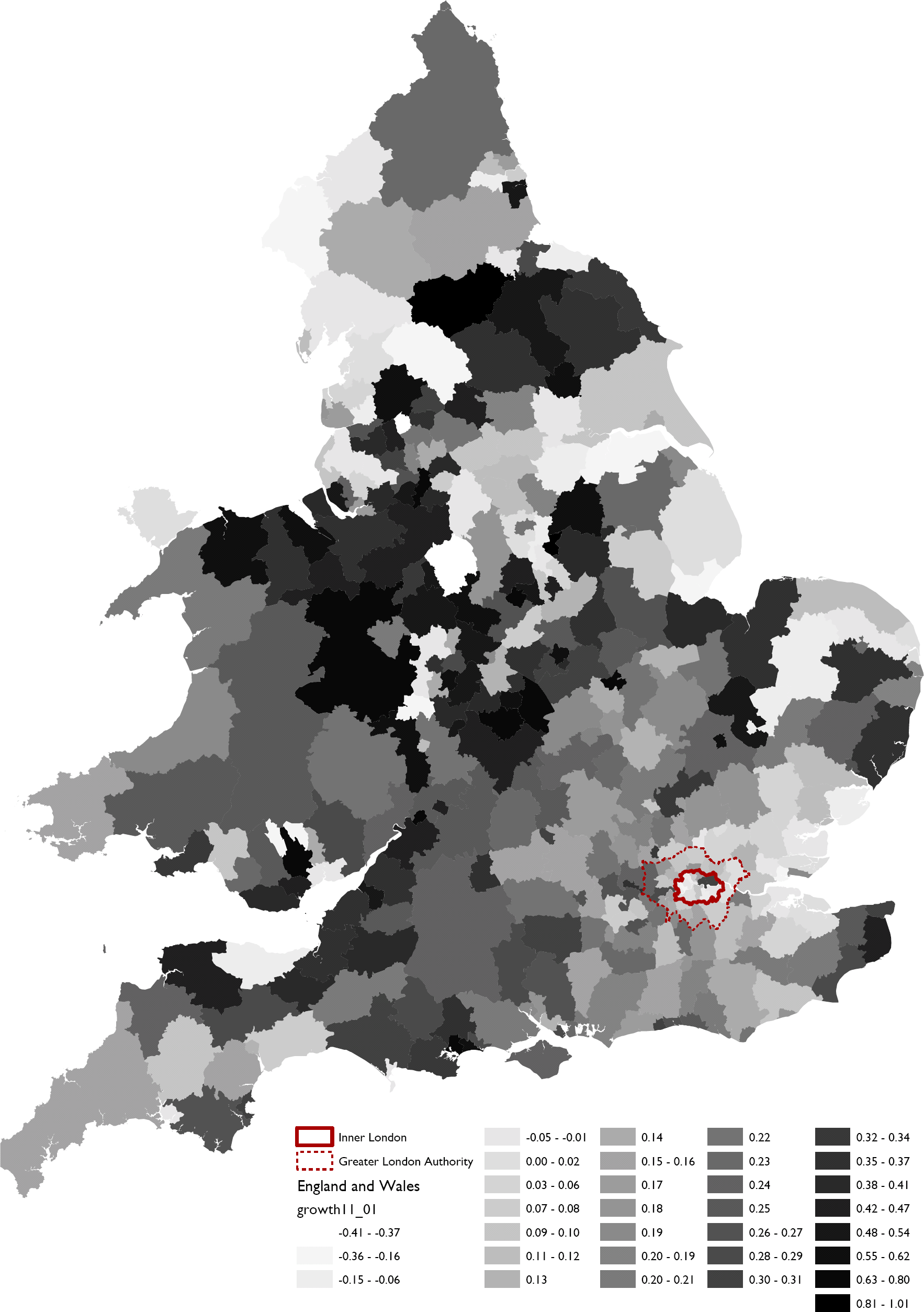
An even more general effect of Green Belts increasing commuting distances is suggested by figure 1. This illustrates for LAs, changes in the proportion of the employed local residents commuting to jobs in Inner London between 2001 and 2011. There was a reduction in commuting to Inner London from some LAs: the more negative/smaller was the increase the paler is the shading. Those areas with the largest rate of increase of commuting by their residents to Inner London are shaded the most darkly. The continuum from off-white to black represents an increasing commuter flow to Inner London. Most of London's Green Belt and much of the South East shows small, even negative, growth. The strongest growth was systematically way beyond the Green Belt as far away as South Wales, Somerset, Bournemouth, Norfolk, even Yorkshire, as an increasing number of workers with jobs in London leapt across the Green Belt to find cheaper housing space but at the cost of maybe four hours commuting a day. These changes are often very small numbers – maybe the number of people went from just two to three: but in proportionate terms it reveals a sad, systematic and unintended consequence of the restrictions we impose on space for housing in the more prosperous areas of England around London where workers would be most productive.
Changes in commuting to Inner London 2001 to 2011 by employed local residents: by Local Authority

7. Incentivising and enabling restrictiveness
There is not space to explore in detail in this paper the ways in which our institutional and fiscal system incentivises and enables NIMBYism. This is a rather different literature. However our highly centralised system of local government finance and property taxes ensure that local communities that permit development are financially penalised. In Reference Cheshire and HilberCheshire and Hilber (2008) it was demonstrated that the move to Uniform Business Rates, by eliminating all tax revenues from commercial property from LAs and making that transparent, led to even more restrictiveness on the part of local planning committees. Because of revenue equalisation and the fact that most services funded by LAs are paid for out of block grants from central government, Council Tax receipts provide no fiscal incentive to permit development. There are statutory obligations on LAs to provide services but no transparent revenues flowing from accommodating more houses, to pay for them. Some efforts have been made in the past five years to improve this situation but they have been inadequate and the changes in incentives have been opaque. Government continues to urge LAs to be more permissive towards development while still in effect fining them for doing so.
The situation in many other countries, especially those like Switzerland or Germany, with decentralised fiscal systems, is much more rewarding to communities which permit development. In Britain all that seems to happen if new houses are built in the community is that local roads and schools and social services become more congested.
In addition, our governmental structure enhances the voice of voters who are exposed to the costs of development (short-term disruption and congestion; longer-term possible loss of amenities such as open space) but excludes the interests of those who might benefit from, for example, more affordable or better adapted local housing or more jobs. This is because, as was first argued in Reference Cheshire, D'Arcy and GiussanoCheshire et al., 1992, the spatial extent of the costs of development, while often significant for individuals, is very local while that of the benefits of development is spatially very extensive. The more locally political decisions relating to development are made, therefore, the more relative voice is given to restrictiveness. In addition, as with free trade, benefits of development are thinly spread over many, while costs are concentrated and significant for the few.
The Abercrombie plan for London – 75 years ago – is arguably the first and last truly strategic plan for any major British city. That planned for the whole of the wider London region. In order that decisions on land release and development should give a balanced political weight to both the benefits and the costs of development, there needs to be strategic planning at the level of the City-Region or Functional Urban Area.
8. Conclusions
The evidence shows, then, that our planning system is restrictive in terms of the overall supply of land and housing space in the aggregate. It is not just locally restrictive in order to preserve land of significant environmental quality which in its unbuilt state generates amenity or has recreational value. Such purely local restrictions are likely to have positive welfare effects although the costs they impose also need to be taken into account. Overall restrictiveness of supply relative to demand, in the absence of such environmental gains, does not increase welfare but does increase the price of housing relative to incomes, so reduces welfare, and has, as we have seen, unintended adverse consequences; for example on the length of commuting.
Our planning system imposes this overall restrictiveness by means of at least four separate mechanisms. Its decision making is systemically restrictive because results of applications and conditions imposed for ‘affordable’ housing are unpredictable, so development risk is increased; it imposes quantitative restrictions on the supply of space (where it is most valued) by its imposition of Green Belts and height controls; its mechanism for deciding how much land to allocate for housing ignores the most important determinant of demand, so systematically undersupplies land; and there is substantial variation in local restrictiveness measured by the proportion of applications refused.
Since all have the effect of reducing the supply of housing and other development relative to demand this drives up prices in real terms. Not only has this made housing increasingly unaffordable but it has had very regressive distributional effects, especially redistributing assets to older home owners. There are other unintended effects of more restrictive planning. A more restrictive pattern of local decisions on housing proposals causes a substantial increase over time in the proportion of local homes that are empty. Not only that but greater local restrictiveness significantly increases the average length of commutes for those working locally. There is also evidence consistent with Green Belts increasing commuting distances as workers leap frog out to buy less expensive housing space. This increases the spatial extent of cities even if it reduces the footprint of urbanisation.
The extent of the price distortions induced by restrictions on the supply of land and housing mean that there is a misallocation of resources. Even in the US, where overall restrictiveness has historically been considerably less than in Britain, it has been estimated (Reference Hsieh and MorettiHseih and Moretti, 2017) that GDP would have been some 13.5 per cent higher had not restrictions on building slowed the flow of labour to the highest productivity locations over the period 1964 and 2009. No similar estimates have been done for other countries. Reference Cheshire, Hilber and KaplanisCheshire et al. (2015), however, did estimate that the loss of total factor productivity in the supermarket sector in England, as a result of forcing them to locate on particular sites in ‘town centres’, was 32 per cent just between 1996 and 2008. Reference Cheshire and HilberCheshire and Hilber (2008) estimated that the restriction on the supply of office space in British cities reached the equivalent of a tax on construction costs of 800 per cent in London's West End and even in less prosperous cities, such as Birmingham, averaged 250 per cent: there is certainly evidence that the economic effects of planning which is generically restrictive, can be large.
To sum up, there seem to be many reasons for concluding that our policies determining housing supply are broken but no obvious reason to conclude that the housing crisis results from a ‘broken housing market’.