Introduction
Freshwater snails of the genus Biomphalaria are usually found in standing or slow-flowing freshwater bodies in South America and the tropics. Biomphalaria pfeifferi, a species in the genus Biomphalaria found in Nigeria, is widely distributed only in Africa (Ndifon & Ukoli, Reference Ndifon and Ukoli1989; WHO, Reference Rozendaal1997). Trematodes undergo obligatory larval development in snails. Cercariae, when produced, leave the snail to encyst in a second intermediate host or infect a definitive host (Devkota et al., Reference Devkota, Budha and Gupta2011). Like many freshwater snails, B. pfeifferi is the intermediate host of some trematodes. In south-western and north-western Nigeria, B. pfeifferi has been reported to shed mammalian Schistosoma cercariae (Ndifon & Umar-Yahaya, Reference Ndifon and Umar-Yahaya1990; Okoli & Odaibo, Reference Okoli and Odaibo1999; Ayanda, Reference Ayanda2009). Schistosoma mansoni cercariae were implicated, due to the prevalence of intestinal schistosomiasis in these regions. Other cercaria morphotypes recorded in B. pfeifferi from these regions were echinocercariae, ornatae xiphidiocercariae, cystophorous cercariae and amphistome cercariae (Ndifon & Umar-Yahaya, Reference Ndifon and Umar-Yahaya1990; Yousif et al., Reference Yousif, Ayoub, Tadros, El Bardicy and Abolarinwa2014). In the south-eastern region of the country, stable populations of B. pfeifferi are also found but parasitological examination of this snail intermediate host had shown that they did not shed Schistosoma cercariae (Ozumba et al., Reference Ozumba, Christensen, Nwosu and Nwaorgu1989; Emejulu et al., Reference Emejulu, Alabaronye, Ezenwanji and Okafor1994). There has also been no published report of the prevalence of S. mansoni infection in this region. The only reported cercaria morphotype shed by B. pfeifferi collected from south-eastern Nigeria is gymnocephalous cercariae (Ozumba et al., Reference Ozumba, Christensen, Nwosu and Nwaorgu1989).
The present study reports trematode infections in the freshwater snail B. pfeifferi from the River Uzuru in south-eastern Nigeria, with special emphasis on Schistosoma cercariae.
Materials and methods
Collection and examination of snails
The study was conducted in the Nigeria Cement Factory (NigerCem) area, Nkalagu, Ishielu Local Government Area (LGA) of Ebonyi State (6°27ʹ and 6°36ʹN, 7°45ʹ and 7°52ʹE). NigerCem area is surrounded by three rivers: the River Ora (6°34.243ʹN, 7°47.840ʹE), the River Uzuru (6°31.344ʹN, 7°47.305ʹE) and the River Ebonyi (6°28.712ʹN, 7°50.712ʹE). The area is also inundated with marshy rice farms, stagnant pools and culverts, which serve as breeding sites for Bulinus globosus and B. truncatus, and have given the area a history of Schistosoma haematobium infection (Anya & Okafor, Reference Anya and Okafor1986–Reference Anya and Okafor1987; Okeke et al., Reference Okeke, Ubachukwu, Okafor and Shoyinka2012; Okeke & Ubachukwu, Reference Okeke and Ubachukwu2014).
The rivers, rice farms, stagnant pools and culverts in the area were searched for B. pfeifferi from October 2011 to September 2012. The snails were collected using the fractional sampling method described by Okafor & Obiezue (Reference Okafor and Obiezue2004) and transported in plastic containers to the laboratory. In the laboratory, the snails were examined for cercarial infections using shedding and crushing methods. Emerged cercariae were examined unstained under the microscope and their identification was as described by Frandsen & Christensen (Reference Frandsen and Christensen1984). The size of each snail was determined by measuring its shell diameter (mm).
Experimental infection in mice
Due to the public health importance of Schistosoma cercariae, mice were infected with Schistosoma cercariae shed by the snails. Ten albino mice, aged 10 weeks, were purchased from the animal facility of the Faculty of Veterinary Sciences, University of Nigeria, Nsukka. Five of the mice were injected subcutaneously with 100 of the Schistosoma cercariae, while the other five served as the normal control group. Thirteen weeks post-infection, the infected mice were perfused for harvesting of adult schistosome worms, according to the method of Christensen et al. (Reference Christensen, Gotsche and Frandsen1984). Spleen length and liver weight of the infected and normal mice were measured to check for differences. The spleen length was obtained using a string and ruler while the liver weight was measured using a sensitive weighing balance. Sections of the liver and spleen were fixed in 10% buffered formalin, embedded in paraffin wax and 5 μm thick sections were cut and processed according to routine protocol (Drury & Wallington, Reference Drury and Wallington1967).
Survey of Schistosoma mansoni in schoolchildren
The study population included schoolchildren from the four government-owned primary schools in the area, which are PS A (6°32.678ʹN, 7°47.072ʹE), PS B (6°32.578ʹN, 7°47.144ʹE), PS C (6°32.596ʹN, 7°47.445ʹE) and PS D (6°31.915ʹN, 7°48.196ʹE). The distances of the four government-owned primary schools (in alphabetical order) from the River Uzuru are 685 m, 671 m, 1 km and 706 m, and from the River Ora the distances are 1.7 km, 1.73 km, 1.6 km and 1.9 km. Sample size (n) was calculated using the statistical formula n = Z 2 p(1 – p)/d 2, where n = minimum sample size, Z is the critical value (1.96) at 95% confidence level, p = expected prevalence and d = margin of error (5%). The area has been reported to be of moderate risk for S. haematobium (Anya & Okafor, Reference Anya and Okafor1986–Reference Anya and Okafor1987; Okeke & Ubachukwu, Reference Okeke and Ubachukwu2014). Therefore, a prevalence of 20% was assumed for S. mansoni and this gave a minimum sample size of 246.
Schoolchildren in grades 3 to 6, and between the ages of 5 and 16 years, who had not taken praziquantel in the past 6 months, were selected. Each study participant was given a clean plastic container in which to collect his/her own stool sample. The stool samples were processed for microscopic examination using the Kato–Katz technique.
A structured questionnaire was used to gather information on sex, age, occupation of parents, history of visits to a river where B. pfeifferi was found, the season of the year the river was visited, water-contact activities in the river and other water sources in the area. Information on each question was obtained using a dichotomous response of ‘yes’ or ‘no’. Questions were translated into the students’ native language and read to each student by his/her class teacher. The response of each child was ticked by the teacher without any attempt to influence the response.
Oral consent was obtained from parents or guardians of the pupils and the headmistresses of the schools, 1 week before sample collection. Provision was made to treat those schoolchildren positive for S. mansoni with a single dose of 40 mg/kg praziquantel.
Data analysis
Data were entered into Microsoft Excel, checked for errors and exported to Statistical Package for Social Sciences (SPSS) software version 20.0 (SPSS Inc., Chicago, Illinois, USA) for statistical analysis. For the purpose of statistical analysis, the months of November–February were grouped as cool–dry and March–May as hot–dry seasons. The chi-square test was used to ascertain differences between prevalence of infection in different seasons. The Mann–Whitney U-test was used to compare mean intensity of cercarial infection between snails collected at different seasons. Prevalence and mean intensity of cercarial infections in the different size classes were also calculated. Statistical significance was set at P < 0.05.
Results
Levels of cercarial infections in Biomphalaria pfeifferi
Biomphalaria pfeifferi was the only snail species found in the River Uzuru, while in the rivers Ora and Ebonyi, the only snail species found was Lanistes spp. Biomphalaria pfeifferi was found and collected only in the dry season during the months of November 2011 to May 2012. The mean shell diameter of the 460 B. pfeifferi examined was 7.29 ± 1.26 mm. The cercaria morphotypes observed were armatae xiphidiocercariae, echinocercariae, Schistosoma cercariae, cystophorous cercariae and cercariaeum cercariae.
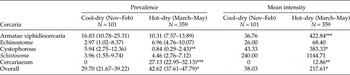
The overall prevalence of cercarial infections in B. pfeifferi was 39.78%. The overall prevalence in the hot–dry season was significantly higher than in the cool–dry season (P = 0.019). Cercariaeum cercaria was the most prevalent morphotype in B. pfeifferi, with infection rate being significantly higher in the hot–dry than in the cool–dry season (P < 0.0001). Armatae xiphidiocercariae, with a total prevalence of 11.74%, were regularly recovered from the examined snails but the prevalence in the cool–dry season was not different from the rate in the hot–dry season (P = 0.072). The overall infection rate of echinocercariae was 6.09%. The infection rate between the seasons was not significantly different (P = 0.138). For Schistosoma cercariae, prevalence in the hot–dry season was higher than in the cool–dry season but the difference was not significant (P = 0.829). Cystophorous cercariae had the lowest infection rate but, unlike the other morphotypes, prevalence in the cool–dry season was significantly higher than in the hot–dry season (P < 0.001) (table 1).
The prevalence and mean intensity of infection in Biomphalaria pfeifferi from the River Uzuru, Nkalagu, relative to season, from October 2011 to September 2012. N, number of snails examined, 95% confidence intervals are given in brackets, with levels of significance given as *P < 0.05, **P < 0.001, ***P < 0.0001.

The mean intensity of cercarial infections in B. pfeifferi was 195.46. The mean intensity of infections in the hot-dry season was significantly higher than in the cool-dry season (P = 0.019). Armatae xiphidiocercariae had a mean intensity of 301.29. The mean intensity of this morphotype was higher in the hot–dry than in the cool–dry season (P < 0.001). For cystophorous cercariae, the mean intensity also varied with the seasons (P = 0.024). Although the mean intensity of echinocercaria in the hot–dry season was high, the mean intensity in the cool–dry season was comparable (P = 0.78). The mean intensity of Schistosoma cercariae was also comparable in the cool–dry and hot–dry seasons (P = 0.093), while cercariaeum cercariae, with an overall mean intensity of 12.29, only occurred in the hot–dry season (table 1).
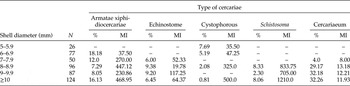
The shell diameter of B. pfeifferi ranged from 5.0 to 12.9 mm. Biomphalaria pfeifferi became infected with armatae xiphidiocercariae when the snails reached 6 mm (18.18%, 95% CI = 11.15–28.23%), but the B. pfeifferi ≥ 10 mm in size had the highest mean intensity. Cystophorous cercaria was the only morphotype observed in the 5.0–5.9 mm size class. Schistosoma cercariae infected B. pfeifferi when individuals reached ≥ 8.0 mm in size. Echinocercariae and cercariaeum cercariae were recorded in the snails between 7.0 and 7.9 mm but, unlike the other morphotypes, they were also observed in the largest size class of 12.0–12.9 mm. The lowest mean intensities of echinocercariae and cercariaeum cercariae were recorded in the size classes 8.0–8.9 mm and 7.0–7.9 mm, respectively (table 2).
The prevalence (%) and mean intensity (MI) of cercarial types relative to size classes of Biomphalaria pfeifferi from the River Uzuru, Nkalagu, from October 2011 to September 2012; N = number of snails examined.

The prevalence of double and triple cercarial infections in B. pfeifferi was 3.91% and 0.65%. The prevalence of cercariaeum cercariae/xiphidiocercariae double infection was highest (3.48%), followed by 0.65% prevalence of echinocercariae/xiphidiocercariae and cercariaeum cercariae/echinocercariae, and 0.22% prevalence each of cercariaeum cercariae/cystophorous cercariae and Schistosoma cercariae/xiphidiocercariae. Triple infections of Schistosoma cercariae/xiphidiocercariae/cercariaeum cercariae, xiphidiocercariae/echinocercariae/cercariaeum cercariae and Schistosoma cercariae/cercariaeum cercariae/echinocercariae were also recorded, with a prevalence of 0.22% each.
Infection of mice with Schistosoma cercariae
The infected mice had significantly enlarged spleens (43.33 ± 5.77 cm vs. 18.75 ± 1.77 cm) and livers (3.07 ± 0.43 g vs. 1.28 ± 0.23 g) compared to those of normal mice. Liver sections of normal mice showed normal hepatoctyes, while in liver sections of the infected mice, histological changes such as vascular congestion, severe portal infiltration of mononuclear cells and mild haematin pigment deposition were observed. Lymphocytes, red blood cells, plasma cells and macrophages were seen in the spleens of normal mice. The spleens of infected mice were very reactive. There were focal areas of fibrinoid necrosis with a preponderance of plasma cells and macrophages, and multifocal areas of parasite eggs surrounded by a clear zone. Adult worms were also recovered from the infected mice. Morphological and histological changes in the livers and spleens of the infected mice, and the presence of adult worms, were suggestive of schistosomiasis mansoni or rhodaini. Because of these findings, the primary school children in NigerCem area were sampled and the edges of the River Uzuru were searched for burrows and rodents.
Parasitological survey findings
A total of 286 schoolchildren aged 5–16 years (mean age = 11.17 ± 2.15 years) were sampled. Of these, 138 (48.25%) were boys and 148 (51.75%) were girls. Children aged ≤10 years constituted 37.06% (N = 106) of the study population, while those aged >10 years were 62.94% (N = 180) of the population. The occupation of most of the children's parents was farming (61.89%; N = 177), while the percentages of those whose parents were artisans, civil servants and traders were 19.23% (N = 44), 9.09% (N = 26) and 9.79% (N = 28), respectively. Of the 286 children who collected plastic containers, only 212 returned stool samples. Schistosoma mansoni eggs were not found in any of the examined stool samples, but the eggs of other intestinal parasites (Trichuris trichiura, Ascaris lumbricoides and hookworm) were seen.
Results from the structured questionnaire revealed that although the River Uzuru is nearer than the River Ora, most of the schoolchildren do their household chores, bathe and swim in the River Ora and not in the River Uzuru. They preferred the River Ora to Uzuru because water from the River Ora is cleaner. Some children indicated that their parents pay water tankers to supply water in their homes. These tankers also get their water from the River Ora. Visual observation on the physical attributes of the River Ora showed that the river is larger than the River Uzuru. The River Ora also lacks vegetation, weeds and algal growth cover and the substratum is sandy and clear. On the contrary, the River Uzuru is entirely shaded and covered by fallen and decayed Gmelina arborea leaves, weeds and algal growth. The dominant substratum is a mixture of mud and bedrock. Only 14 children from the number sampled visited the River Uzuru. Of these 14 children, nine of them had contact with the river in the dry season. Five out of this number only went to the river to bathe, while the remaining four children bathed and fetched water for household use.
We also observed that the inhabitants of NigerCem area use water from a quarry pit located 960 m, 766 m, 293 m and 1.2 km from the four government-owned primary schools. Interviews of women seen fetching water from the quarry pit revealed that the people do not drink water from the quarry pit because of its saltiness but they bathe, wash and do other household chores with it. Freshwater snails found in the quarry pit were B. pfeifferi (≤5 mm in shell diameter) and Lymnaea natalensis.
Three rats were captured and screened for Schistosoma rodhaini eggs, but none were found. However, a number of burrows were observed at the edges of the River Uzuru.
Discussion
In the present study, B. pfeifferi snails were not found in the rainy season. The absence of the snails in the rainy season corroborates the conclusions drawn by Utzinger & Tanner (Reference Utzinger and Tanner2000) and Chingwena et al. (Reference Chingwena, Mukaratirwa, Chimbari, Kristensen and Madsen2004) that water velocity and flooding affect the density of B. pfeifferi in rivers. Five cercaria morphotypes parasitized B. pfeifferi collected in south-eastern Nigeria. This contradicts the report of Ozumba et al. (Reference Ozumba, Christensen, Nwosu and Nwaorgu1989) that gymnocephalous cercaria was the common cercaria morphotype encountered in B. pfeifferi from this region of Nigeria. So far, this is the first report of other larval trematodes parasitizing B. pfeifferi in south-eastern Nigeria. There are published records of cercaria morphotypes from B. pfeifferi in other regions of Nigeria (Ndifon & Umar-Yahaya, Reference Ndifon and Umar-Yahaya1990; Yousif et al., Reference Yousif, Ayoub, Tadros, El Bardicy and Abolarinwa2014). In addition, Schistosoma cercariae have been recovered from B. pfeifferi from north-western (Ayanda, Reference Ayanda2009), north-central (Akufongwe et al., Reference Akufongwe, Oondji, Okwuosa, Dakul and Ntonifor1995) and south-western (Okoli & Odaibo, Reference Okoli and Odaibo1999) Nigeria. The presence of Schistosoma cercariae in B. pfeifferi in the present study is the first report in south-eastern Nigeria.
The overall prevalence of cercarial infections in B. pfeifferi in the present study was 39.78%. This prevalence is higher than the reported infection rates of 1.77% in Ivory Coast, 1.0% in Tanzania and 11% in Sudan (Ahmed et al., Reference Ahmed, Ibrahim and Idris2005; Nkwengulila & Kigadye, Reference Nkwengulila and Kigadye2005; Kinanpara et al., Reference Kinanpara, Yves, Felix, Edia, Theophile and Germain2013). The overall prevalence and the prevalence of cystophorous and cercariaeum cercariae varied with season, with the prevalence of all cercarial infections except cystophorous cercariae higher in the hot–dry season. Similar observations of seasonal variation in the prevalence of cercarial infections in freshwater snails have been reported in Tanzania (Nkwengulila & Kigadye, Reference Nkwengulila and Kigadye2005), Zimbabwe (Chingwena et al., Reference Chingwena, Mukaratirwa, Chimbari, Kristensen and Madsen2004) and Finland (Vayrynen et al., Reference Vayrynen, Siddall, Valtonen and Taskinen1981). The higher prevalence during the hot–dry season may be attributed to reduced water volume, which is usually accompanied by increased density of snail hosts. On the other hand, the higher prevalence of cystophorous cercariae in the cool–dry season may suggest the presence of a second intermediate host (copepods) during this season. However, the density of these copepods decreases in the hot–dry season because of the drastic reduction in water volume and clogging of the river by plant detritus. The intensity of all cercarial infections in B. pfeifferi was higher in the hot–dry season. According to Namsanor et al. (Reference Namsanor, Sithithaworn, Kopolrat, Kiatsopit, Pitaksakulrat, Tesana, Andrews and Petney2015), temperature is crucial for the growth and development of larval trematodes in snails. A temperature of 34°C was shown to be optimal for obtaining the highest infection rate, and such high temperature can be reached in the hot–dry season.
The cercariaeum cercaria, which is the description of a cercaria morphotype without a tail, had the highest prevalence in the present study. This cercaria morphotype has been recorded in Planorbis in North America (Cort, Reference Cort1918), Gyraulus in Tanzania (Nkwengulila & Kigadye, Reference Nkwengulila and Kigadye2005) and European pea clams in Finland (Niewiadomska & Valtonen, Reference Niewiadomska and Valtonen2007). The procurement of the second most prevalent cercaria morphotype, armatae xiphidiocercaria, in all the months when the snails were found suggests the constant presence of this cercaria's definitive hosts in the river. The recovery of armatae xiphidiocercariae and echinocercariae from B. pfeifferi in the present study contradicts the report of Nkwengulila & Kigadye (Reference Nkwengulila and Kigadye2005), who did not recover both cercaria morphotypes from B. pfeifferi in Tanzania. However, the recovery of echinocercariae from B. pfeifferi in the present study agrees with the work of Yousif et al. (Reference Yousif, Ayoub, Tadros, El Bardicy and Abolarinwa2014) in north-western Nigeria. Cystophorous cercaria, which is a cercaria morphotype with appendages, was also recovered from B. pfeifferi. This cercaria morphotype has been reported in B. pfeifferi (Loker et al., Reference Loker, Moyo and Gardner1981), Helisoma trivolvis (Schmidt & Fried, Reference Schmidt and Fried1997) and Physa gyrina (Bolek et al., Reference Bolek, Tracy and Janovy2010). The Schistosoma cercaria recovered is a mammalian schistosome, which, contrary to reports of Ozumba et al. (Reference Ozumba, Christensen, Nwosu and Nwaorgu1989) and Emejulu et al. (Reference Emejulu, Alabaronye, Ezenwanji and Okafor1994) is reported for the first time from B. pfeifferi in south-eastern Nigeria.
In the present study, B. pfeifferi only became infected with cystophorous cercariae once it reached the size class 5.0–5.9 mm. This observation does not agree with the report of Flores et al. (Reference Flores, Semanas and Veleizan2010) in Argentina, where B. peregrina of shell diameter 3.1 mm was infected. Similarly, the infection of smaller B. pfeifferi with cystophorous cercariae and larger ones with echinocercariae contradicts the reports of Fernandez & Esch (Reference Fernandez and Esch1991) and Williams & Esch (Reference Williams and Esch1991) in Charlie's pond, North Carolina, who found smaller Helisoma anceps infected with echinocercariae and larger H. anceps infected with Halipegus occidualis, a cystophorous cercaria. Infections with armatae xiphidiocercariae and cystophorous cercariae were higher in pre-reproductive B. pfeifferi (<8 mm), while echinostome, Schistosoma and cercariaeum cercariae were higher in reproductively active B. pfeifferi. A higher prevalence of xiphidiocercariae and cystophorous cercariae in pre-reproductive snails may be attributed to a very weak defence system, which predisposes them to infection by trematode parasites, leading to retarded growth and inability to develop into reproductively active snails. On the other hand, the high mortality rate of reproductively active snails is due to the pathogenic activity of some trematode parasites (Namsanor et al., Reference Namsanor, Sithithaworn, Kopolrat, Kiatsopit, Pitaksakulrat, Tesana, Andrews and Petney2015). As explained by Dreyfuss et al. (Reference Dreyfuss, Vignoles and Rondelaud2000) and McCarthy et al. (Reference McCarthy, Fitzpatrick and Irwin2004), the higher prevalence of echinostome, Schistosoma and cercariaeum cercariae in reproductive snails suggests parasite-induced gigantism. Parasite-induced gigantism is postulated to provide parasites with greater volume for occupation and reproduction. For all cercaria morphotypes, the size class ≥10 mm had the highest mean intensity of cercariae. Studies have shown that larger infected snails contained a higher number of trematode larvae than small ones. Furthermore, trematode miracidia are more attracted to snails of larger sizes because of the large area exposed to miricidia (Namsanor et al., Reference Namsanor, Sithithaworn, Kopolrat, Kiatsopit, Pitaksakulrat, Tesana, Andrews and Petney2015).
The prevalence of double cercarial infection in the present study (3.91%) is higher than the prevalence in B. tenagophila (1.1%) from tropical latitudes of Brazil (Flores et al., Reference Flores, Semanas and Veleizan2010) and the 1.2% prevalence in B. pfeifferi, B. sudanica and Lymnaea natalensis from lacustrine habitats (Loker et al., Reference Loker, Moyo and Gardner1981). Double infection in the present study contradicts the reports of only single cercarial infection in B. occidentalis from subtropical Argentina (Ostrowski de Nunez, Reference Ostrowski de Nunez1974), B. peregrina from Patagonia, Argentina (Flores et al., Reference Flores, Semanas and Veleizan2010) and B. pfeifferi from Ruvu Basin, Tanzania (Nkwengulila & Kigadye, Reference Nkwengulila and Kigadye2005). However, a higher prevalence of double cercarial infection (6.55%) involving Schistosoma cercariae and xiphidiocercariae was found in B. tenagophila from Sao Paulo State, Brazil (de Moraes et al., Reference De Moraes, Da Silva, Dhlweller and Kawano2009). In the present study, double infections of xiphidiocercariae and all cercaria types except cystophorous cercariae were found. A similar pattern of xiphidiocercariae and other cercaria co-infection has been reported in Kano State, Nigeria, where it was observed that ornatae xiphidiocercariae coexisted with four other cercaria morphotypes in B. pfeifferi (Ndifon & Umar-Yahaya, Reference Ndifon and Umar-Yahaya1990). The present study also reported triple infections, with prevalence of 0.22% each in B. pfeifferi. Triple infection was not reported in B. pfeifferi collected from a lacustrine habitat in Tanzania (Loker et al., Reference Loker, Moyo and Gardner1981).
The enlargement of the liver and spleen of the Schistosoma cercariae-infected mice are characteristic of S. mansoni infection. According to Meleney et al. (Reference Meleney, Sanground, Moore, Most and Carney1953), vascular congestion, infiltration of mononuclear cells and deposition of haematin pigments in the liver of the infected mice are inflammatory and toxic reactions caused by the presence of flukes. The spleen of the infected mice also had multifocal areas of parasite eggs surrounded by a clear zone. This observation is similar to results obtained by Wang et al. (Reference Wang, Zhang, Yin, Shen, Wang, Xu and Cao2015), who reported that S. japonicum eggs in the spleen of infected mice, even at 18 weeks post-infection, were without a granuloma node. The absence of a granuloma node around the egg was attributed to the location of egg deposition in the spleen medulla, since granulomas frequently form in the cortex but not in the medulla. Therefore, in the present study, eggs found in the spleen of the infected mice may have been deposited in the medulla region of the spleen, evidenced by the presence of clear zones around the eggs. Although the morphological and histological changes in the liver and spleen of the infected mice are characteristic of mansoni schistosomiasis, the probability of the Schistosoma cercariae being S. mansoni cercariae cannot be immediately confirmed in the present study for the following reasons: (1) S. rodhaini, the rodent schistosome, uses B. pfeifferi as intermediate host, and it elicits similar pathology in mice as S. mansoni (Steineur et al., Reference Steinauer, Mwangi, Maina, Kinuthia, Mutuku, Agola, Mungai, Mkoji and Loker2008; Standley & Stothard, Reference Standley and Stothard2012); (2) S. rodhaini has been reported in Nigeria (Akinboade et al., Reference Akinboade, Dipeolu, Ogunji and Adegoke1981); (3) the presence of burrows at the edges of the river, indicating that the river is inhabited and used by rodents; (4) the absence of any characteristic Schistosoma eggs in the few rats captured; and (5) the absence of the parasite eggs in the stool samples of the schoolchildren, which may be credited to their water contact pattern, in which they preferred to visit the River Ora to the River Uzuru, where the snails were found. Therefore, there is a need to identify by molecular analysis the Schistosoma cercariae shed by B. pfeifferi from this part of Nigeria. Efforts are being made to obtain funding and carry out this investigation.
Acknowledgements
We are thankful to Chief (Dr) Poly Emenike, the managing director of the Neros Pharmaceutical Company.
Financial support
This research was supported by funding from the Neros Pharmaceutical Company.
Conflict of interest
None.
Ethical standards
Ethical permission for this study was obtained from the Ebonyi State Ministry of Health.