INTRODUCTION
The ability to appeal to others in order to obtain objects, information, or support is a key aspect of human social interaction, and a skill that children exhibit from early on in development. Around the age of 0;10, children gradually become aware that their behaviour can have an effect upon others (Bates, Camaioni & Volterra, Reference Bates, Camaioni and Volterra1975; Bruner Reference Bruner1983; Tomasello, Reference Tomasello2003; Wootton Reference Wootton1997) and, as a consequence, certain aspects of their interaction take on a systematic and predictable form. In the current study we investigate one form of prelinguistic intentional behaviour referred to as the proto-imperative. According to Bates (Reference Bates, Camaioni and Volterra1976: 51) the term refers to ‘the use of an adult as a means to obtaining objects’ and is contrasted with the proto-declarative, which is defined as ‘the preverbal effort to direct the adult's attention to some event or object in the world’ (p. 57).
A number of studies have analyzed proto-imperatives within the wider context of intentional behaviour. These studies can be divided broadly into two camps. In one approach the organizing feature of the analysis is function; in these studies children's prelinguistic behaviour is categorized according to function and the analysis then focuses on how these functions are realized (e.g., Bates et al., Reference Bates, Camaioni and Volterra1975; Halliday, Reference Halliday1975). Other studies take as their starting point a particular aspect of prelinguistic behaviour, such as gesture or intonation, and then investigate how infants use the behaviour to express intentionality within the prelinguistic phase (e.g., Franco & Butterworth, Reference Franco and Butterworth1996; Leavens & Hopkins, Reference Leavens and Hopkins1999; Leroy, Mathiot & Morgenstern, Reference Leroy, Mathiot, Morgenstern, Zlatev, Johansson Falck, Lundmark and Andrén2009; Masur, Reference Masur1983; Tomasello, Carpenter & Liszkowski, Reference Tomasello, Carpenter and Liszkowski2007). Both approaches are valid and have resulted in important insights relating to children's prelinguistic behaviour. The current study is conducted in the spirit of Bates et al. (Reference Bates, Camaioni and Volterra1975), taking function as the organizing feature of the analysis. In the following section we review the literature relating to the behaviours and their interaction during the prelinguistic phase.
GESTURE
Two key hand gestures emerge within the prelinguistic stage of intentional behaviour, the index finger point, and a range of whole-hand gestures often referred to as ‘ostensive reaches’ (e.g., Bruner, Reference Bruner1983). A number of definitions have been proposed for each gesture, but for the purposes of the current analysis we adopt the definition provided by Masur (Reference Masur1983); thus pointing involves the extension of the index finger towards an object, while reaching is defined as the extension of the arm with the hand open. While the distinction between points and reaches appears straightforward, in reality the categorization of the two gestures can be blurred (see, for example, Cochet & Vauclair, Reference Cochet and Vauclair2010; Leavens & Hopkins, Reference Leavens and Hopkins1999), and consequently some researchers combine both gestures under the umbrella term of ‘point’ (e.g., Brink, Reference Brink2003; Carpenter, Nagell, Tomasello, Butterworth & Moore, Reference Carpenter, Nagell, Tomasello, Butterworth and Moore1998). While the merging of the reaches and points may remove the potential for unreliability within an analysis, it runs the risk of glossing over a subtle but potentially important aspect of development within proto-imperatives.
While not all studies of early intentional gesture have incorporated a functional dimension, the general consensus of those that have is that reaches are used exclusively within the proto-imperative function, while points are more closely associated with the proto-declarative (e.g., Bates, Benigni, Bretherton, Camaioni & Volterra, Reference Bates, Benigni, Bretherton, Camaioni, Volterra, Lewis and Rosenblum1977; Bruner, Reference Bruner1983; Franco & Butterworth, Reference Franco and Butterworth1996). However, studies have also indicated that, over time, points are also used with increasing frequency within proto-imperatives (e.g., Bruner, Reference Bruner1983; Franco & Butterworth, Reference Franco and Butterworth1996; Wootton, Reference Wootton1997). Therefore, in the current study we analyze the frequency of gesture type over time and also investigate whether a relationship exists between gesture type and other features of the proto-imperative.
EYE-GAZE
Most studies of prelinguistic intentional communication highlight the infant's frequent use of eye-gaze between object and the co-participant. Eye-gaze to the co-participant, or social checking, is viewed as a key indicator of intentionality on the part of the child and emerges around the age of 0;9–1:0 (Bates et al., Reference Bates, Camaioni and Volterra1975; Tomasello Reference Tomasello2003). Researchers have documented developmental shifts in eye-gaze within the production of proto-imperatives. Bates et al. (Reference Bates, Camaioni and Volterra1975) describe the gradual emergence and subsequent reduction in eye-gaze within their pilot study. For example, Bates et al. discuss Carlotta's attempts (aged 0;10) to gain possession of a box being held by her mother. Carlotta used physical force to try and get hold of the box but ‘during the entire sequence she never looks up into her mother's face’ (p. 214). However, just one month later Carlotta looked to the co-participant during the expression of both proto-imperatives and also proto-declaratives, thus signalling her understanding of others as agents who can intervene in order to help her attain her goals. Bates et al. state that the presence of eye-gaze within proto-imperatives does not remain stable over time; Marta, the oldest participant in the study (aged 1;4 at the onset of the study) did not engage in eye contact with co-participants when initiating a proto-imperative, though she did establish eye contact if her production did not achieve the desired effect. The developmental trajectory attested in Bates et al. is suggestive of developmental changes in eye-gaze during the production of proto-imperatives and calls into question studies which treat eye-gaze as an essential indicator of intentionality (e.g., Carpenter et al., Reference Carpenter, Nagell, Tomasello, Butterworth and Moore1998).
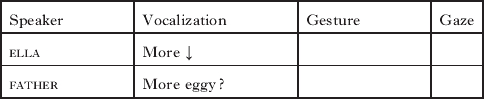
The sequential nature of eye-gaze within proto-imperatives also displays informative developmental patterns, according to the literature. Infants tend to structure their early proto-imperatives as a series of steps. Bates et al. (Reference Bates, Camaioni and Volterra1975) describe Carlotta's initial proto-imperatives and declaratives as involving a series of points and eye-gaze, first to the target object, then to the co-participant, and finally back to the object. Over time, however, the steps were produced simultaneously, displaying what Masur refers to as dual signalling, that is, the simultaneous production of a gesture towards an object and eye-gaze to the co-participant. The presence of dual signalling is highlighted in a number of studies (Bates et al., Reference Bates, Camaioni and Volterra1975; Bruner, Reference Bruner1983; Masur, Reference Masur1983) and is claimed to be essential for subsequent language development (Masur, Reference Masur1983). However, the age at which children are claimed to exhibit the behaviour varies; Bruner (Reference Bruner1983) claims that dual signalling was attested in his 0;9 sample, while findings from other studies indicate that even at age 1;2 there is still an absence of the behaviour (e.g., Murphy & Messer, Reference Murphy, Messer and Schaffer1977). However, there is evidence to suggest that infants are sensitive to context and are more likely to engage in dual signalling when in unfamiliar experimental settings as opposed to their home environment (Franco & Butterworth, Reference Franco and Butterworth1996). Therefore it is important to factor in the context of the observation setting when analyzing eye-gaze.
TERMINAL PITCH CONTOURS
Studies indicate that most gestures produced by infants are accompanied by some form of vocalization (e.g., Bates & Dick, Reference Bates and Dick2002; Cochet & Vauclair, Reference Cochet and Vauclair2010). However, the vocal aspects of prelinguistic and early linguistic imperatives (e.g., phonetic and/or prosodic features) appear to be the least documented and most contentious aspect of infants' proto-imperatives. With regard to prelinguistic functions, the main focus has been on the characteristics of the terminal pitch contour.
Early studies took an impressionistic approach to the analysis of phonetic and prosodic features and uncovered some interesting but conflicting patterns. For example, Halliday (Reference Halliday1975) claims that his son Nigel (aged 0;9) used a consistent form with specific intonation in the expression of prelinguistic requests. However, Marcos (Reference Marcos1987) claims that systematic use of intonation with intent was only attested in her sample after the age of 1;6. Bruner (Reference Bruner1983) also presents information on pitch contours but, unlike Halliday, the general picture seems to be a lack of systematicity within proto-imperatives. Bruner claims that after 0;9 the two boys in his sample replaced their effort sounds with stylized request calls. For one child the pitch was rising, but for the other, appeared to be falling.
While these studies have provided important insights, particularly with regard to the use of intonation in the prelinguistic phase, the reliability of impressionistic analyses is a major issue. Consequently, there has been a shift towards acoustic measurements of pitch contours. For example, Flax, Lahey, Harris and Boothroyd (Reference Flax, Lahey, Harris and Boothroyd1991) provide a systematic analysis of the relationship between pitch contour and communicative intent in the speech of three infants (aged 0;11 to 1;8). By means of acoustic analysis the authors found a significant correlation between requests (i.e., proto-imperatives) and rising intonation, although the level of association between the two varied from one child to the next (see Masataka, Reference Masataka1993, for similar findings). Conversely, comments and statements were more closely associated with falling terminal pitch contours.
A second issue regarding prelinguistic vocalizations and proto-imperatives relates to the degree of continuity between pitch contours in prelinguistic and linguistic interaction. Flax et al. (Reference Flax, Lahey, Harris and Boothroyd1991) suggest that the relationship between pitch contours and communicative function remains stable over time, thus reflecting the claims made by Bates et al. (Reference Bates, Camaioni and Volterra1975). A number of researchers have also suggested that intonation contours act as ‘place holders’ for intentional attitudes prior to speech (e.g., Bruner, Reference Bruner1975; Dore, Reference Dore1975; and more recently Tomasello, Reference Tomasello1999).
The interaction between eye-gaze, intonation, and gesture within proto-imperatives
Up until this point the three key features of the proto-imperative have been discussed in isolation. However, the relationship between the behaviours has the potential to provide as much insight into the development of prelinguistic communication as the behaviours themselves. To date, the relationship between all three features within the context of a particular communicative function have not been studied in detail. That is, there are studies which investigate the interaction between gesture and prelinguistic function, and between intonation and function, but few that investigate gesture and intonation within the context of communicative intent. One notable exception can be found in Leroy et al. (Reference Leroy, Mathiot, Morgenstern, Zlatev, Johansson Falck, Lundmark and Andrén2009), who document the interaction between pointing, vocalization, and eye-gaze in the longitudinal data from two French-speaking children (aged 0;8–1;11). The researchers analyzed the frequency of rise/non-rise intonation in the vocalizations which accompanied the two children's points, and correlated these with the proto-imperative and proto-declarative function. Their results indicate a lack of correlation between pitch contour and function; rise and non-rise intonation were as likely to be produced in the expression of both functions. These findings conflict with previous studies in which significant correlations were attested between pitch and function (e.g., Flax et al., Reference Flax, Lahey, Harris and Boothroyd1991; Masataka, Reference Masataka1993). However, as mentioned previously, individual differences are well attested with regard to pitch contours and functions in the literature. Also, it could be argued that by focusing only on points, the infants' earliest proto-imperatives (which typically would involve whole-hand reaches) may have been omitted from the analysis, and subsequently masked the relationship between pitch contour and function.
The interaction between gesture and intonation is therefore still in need of further study, and we suggest that the way forward involves the detailed analysis of the behaviours within a specific function. The relationship is of theoretical significance as there is evidence to suggest that the gesture and vocal modalities have a close relationship in the early stages of language development (e.g.,Özçalışkan & Goldin-Meadow, Reference Özçalışkan and Goldin-Meadow2009; So, Demir & Goldin-Meadow, Reference So, Demir and Goldin-Meadow2010), and evidence of a similar relationship at the prelinguistic stage would add strength to the notion of prelinguistic and linguistic continuity. Also, since both forms of behaviour have been shown to index communicative intent, some level of coordination between the two would be expected in the prelinguistic stage.
THE CURRENT STUDY
In the previous section we presented an overview of the three key behaviours associated with proto-imperatives. The studies indicate the presence of reaches and points, the use of rising and non-rising terminal pitch contours, and also a reduction in the use of eye-gaze to the co-participant over time. In the current study we analyze all three aspects of the proto-imperative by means of a longitudinal case study of one child's data (Ella). We investigate the relationship between gesture type and pitch contour within the function. The study addresses the following research questions:
1. How are the behaviours of gesture, intonation, and eye-gaze orchestrated in Ella's proto-imperatives?
2. What developmental shifts occur in Ella's use of the three key features?
3. Is there evidence of a relationship between the gestural and vocal modalities in Ella's proto-imperatives?
METHOD
Participants
The study is based on data from the Forrester corpus (Forrester, 2002), which consists of interactions between a father and his daughter and occasionally other family members (e.g., the mother and older sister) during mealtimes in their kitchen. The target child (Ella) was aged 1;0 to 1;7 during the sample included in the current study. Video-recordings were conducted on a monthly basis with each session analyzed in the current study lasting approximately eighteen minutes (range=3–29 minutes' duration). All data were coded into a conversation analysis version of CHAT and are freely available on CHILDES (MacWhinney & Snow, Reference MacWhinney and Snow1990) along with the original video-recordings (http://childes.psy.cmu.edu/browser/index.php?url=Eng-UK/Forrester/). The corpus is novel with respect to the co-participants; typically child language corpora consist solely of mother–child interaction. There is evidence to suggest that fathers and siblings interact in qualitatively different ways with infants than mothers (see, for example, Barton & Tomasello, Reference Barton, Tomasello, Gallaway and Richards1994; Tomasello and Mannle, Reference Tomasello and Mannle1985), and it is possible that such differences can also be found at the prelinguistic stage. These differences may also be reflected in the infants' use of gesture and expression of communicative intent. Since the current analysis takes the form of a case study, we do not comment on issues relating specifically to the gender of the caregiver, but remain mindful of the issue during the analysis.
Data sample
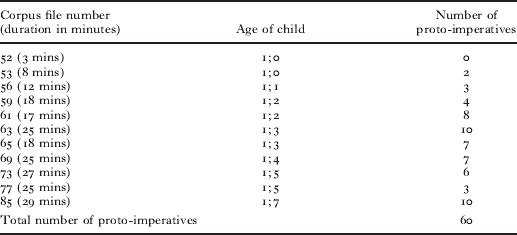
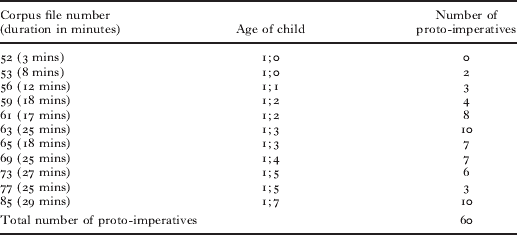
In the current study we analyzed all Ella's proto-imperatives from the onset of recording up until the point at which she was clearly within the linguistic stage of development (i.e., produced fifty lexical items). Table 1 displays the child's age and number of proto-imperatives identified in the current data sample.
Data sample for current study
Procedure
The identification of proto-imperatives was based on the video data and then cross-referenced to the Forrester CHILDES transcripts. Our criteria for the identification of proto-imperatives were data-driven, resulting from careful and fine-grained observations of Ella's behaviour. Minimally, the criteria used in the present study related to Ella's display of interest in an object which was not in her possession, and the production of intentional behaviours which appeared to draw in a co-participant in order to help her obtain the object.
Our analysis focused on the three main components of the proto-imperative attested in the literature; eye-gaze, hand gesture, and features of the terminal pitch contour associated with Ella's vocalization (see below). Therefore the identification of proto-imperatives involves what D'odorico and Franco (Reference D'odorico and Franco1991) refer to as the use of ‘co-occurring contextual indexes’ and therefore reduces the risk of identification being driven by one particular characteristic of the behaviour.
Acoustic analysis
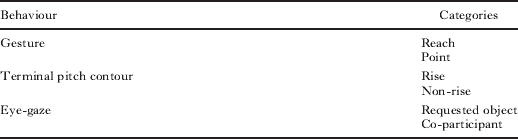
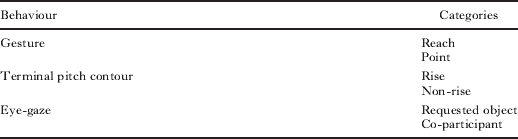
The vocal component of the proto-imperatives was analyzed in terms of a broad phonetic transcription for non-lexical items, and also by means of acoustic analysis focusing on the direction of the terminal pitch contour. The target vocalization associated with each proto-imperative was extracted and analyzed using PRAAT (Boersma & Weenink, 1992–Reference Boersma and Weenink2005). We focused on the final pitch contour of the utterance through the analysis of fundamental frequency over time. According to the literature, the distinction between falling and flat pitch contours does not appear to reflect different prelinguistic functions, while the rise/non-rise distinction does appear to correlate with differences in communicative intent. Therefore, in keeping with Flax et al. (Reference Flax, Lahey, Harris and Boothroyd1991), all vocalizations were categorized as displaying either rise or non-rise terminal contours. Table 2 provides a summary of the coding categories used in the current study.
Coding categories
Reliability tests were conducted on the identification of proto-imperatives and also the coding of gesture type and eye gaze. Fifty per cent of the data were coded independently by the author and a trained research assistant. Agreement on the identification of proto-imperatives was good (81%), as was agreement on the identification of gesture (92%) and eye-gaze to the co-participant/object (95%).
Analyses
We present two analyses: first a sequential qualitative analysis of Ella's proto-imperatives, and second a quantitative analysis focusing on the use of pitch and gesture across the sample. Examples of the qualitative analysis are presented in tabular form in the next section, with each row representing a move in the proto-imperative sequence. Rising terminal pitch contours are represented by an upward pointing arrow and non-rise contours by a downward pointing arrow.
RESULTS
Qualitative analysis
We identified three overlapping phases in Ella's proto-imperative development which were marked by shifts in the nature of the three key behaviours (i.e., eye-gaze, gesture, and vocalization). In the following section we describe each of the phases in turn. However, it is important to note that the phases are not discrete entities, but rather gradual shifts in Ella's proto-imperative development.
Phase One. Gaze bracketing proto-imperatives (age 1;0–1;2: Files 52–59)
Each proto-imperative contained eye-gaze to the target object, a hand gesture, a vocalization, and eye-gaze to the co-participant. However, Phase One contains only seven proto-imperatives and therefore our comments relating to Ella's early proto-imperatives remain speculative. Within this small sample there are two instances in which Ella produced each behaviour in turn (1), while in the remainder some of the behaviours occurred in combination (2 & 3).
(1) [File 56: Time 0·16]: Ella (E) is sat in her highchair and requests an object positioned close to her sister


In (1), Ella's proto-imperative consists of four distinct moves which are bracketed by shifts in gaze. The terminal pitch contour is rising but the gesture is a point as opposed to the prototypical reach often associated with proto-imperatives in the literature. In (1) Ella's older sister Eva is the co-participant and provides a clear refusal of Ella's proto-imperative.
In (2) and (3) Ella again produces all three behaviours in her proto-imperatives but in (2) the vocalization, gesture, and gaze to the co-participant are combined, while in (3) the gaze to the co-participant occurs after the combined production of the vocalization, gesture, and gaze to object.
(2) [File 56: Time 10·48]. E requests an object from the adjacent kitchen table
(gaze at object)
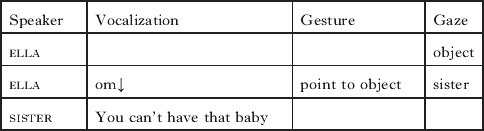
(3) [File 59: Time 3·39]. E is sat in her highchair and requests food from the kitchen table in front of her
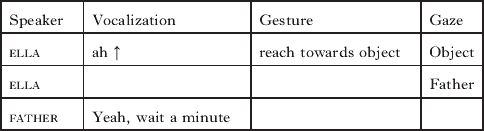
Ella uses both points and reaches, rise and non-rise pitch contours during this phase. However, in (3) Ella displays the prototypical behaviours associated with proto-imperatives in the literature, that is a reach with a rising terminal pitch contour.
Phase Two: Reach-rise proto-imperatives (1;2–1;3: Files 59–63)
The second phase of proto-imperative development is marked by the absence of eye-gaze to the co-participant and the simultaneous production of vocalization, hand gesture (either a reach or point) and gaze to the object.Footnote 1 The frequency of proto-imperatives expressed by a reach and rising terminal pitch contours increases in this phase. For example, in (4) Ella uses a reach and a rising terminal pitch contour but does not attempt to make any eye contact with her father as she requests food from his bowl.
(4) [File 61: Time 10·42].
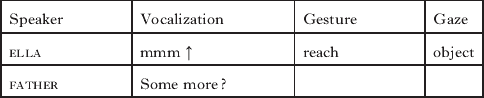
In (5) Ella initiates her request for food from her father's plate by means of combined vocalization with rising pitch and a point. In response to a refusal she retains the point but produces a vocalization with falling pitch.
(5) [File 63: Time 1·25]. Ella requests food from her father's plate.
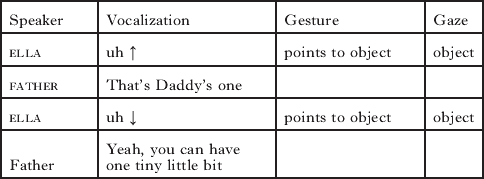
The use of an alternating pitch contour in response to an unfavourable response is frequent throughout this sample (occurring in five out of seven instances in which Ella receives an unfavourable response), though it is interesting to note that the gesture type is retained throughout these proto-imperative sequences.
Phase Three: Point-fall proto-imperatives (Age 1;3–1;7: Files 65–85)
The final phase in the current analysis is marked by an increase in pointing gestures and falling terminal pitch contours along with the re-emergence of eye-gaze, but only in situations where the target object is not within the co-participant's field of vision. While in Phase One all proto-imperatives were accompanied by co-participant eye-gaze, in Phase Three Ella's use of eye-gaze is more selective, thus indicating Ella's increasing awareness of her co-participant's perspective. For example, in (6) Ella requests some bread from a location out of her father's field of vision. Ella looks to the object, points and vocalizes with falling pitch and then looks to her father:
(6) [File 65: Time 8·24]. Ella requests bread from the kitchen bench.

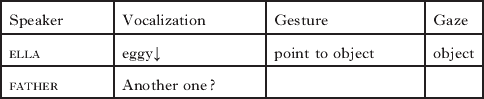
The second feature of the final phase relates to the eventual emergence of conventional linguistic forms in the expression of the function. In most instances involving lexical imperatives, e.g., (7), the lexical item is combined with other established proto-imperative behaviours (e.g., hand gestures and eye-gaze towards the target) but in others (two instances out of ten) the proto-imperative is expressed by the lexical item alone (8).
(7) [File 85: Time 6·04]. Ella requests more food from the table.
(8) [File 85: Time 12·12]. Ella again requests food from the table.
Quantitative analysis of terminal pitch contours and gesture type
In Analysis Two we present a quantitative analysis of gesture type and pitch in order to investigate their frequency over the sample and also to ascertain whether a relationship exists between pitch contour and gesture type.
Gesture
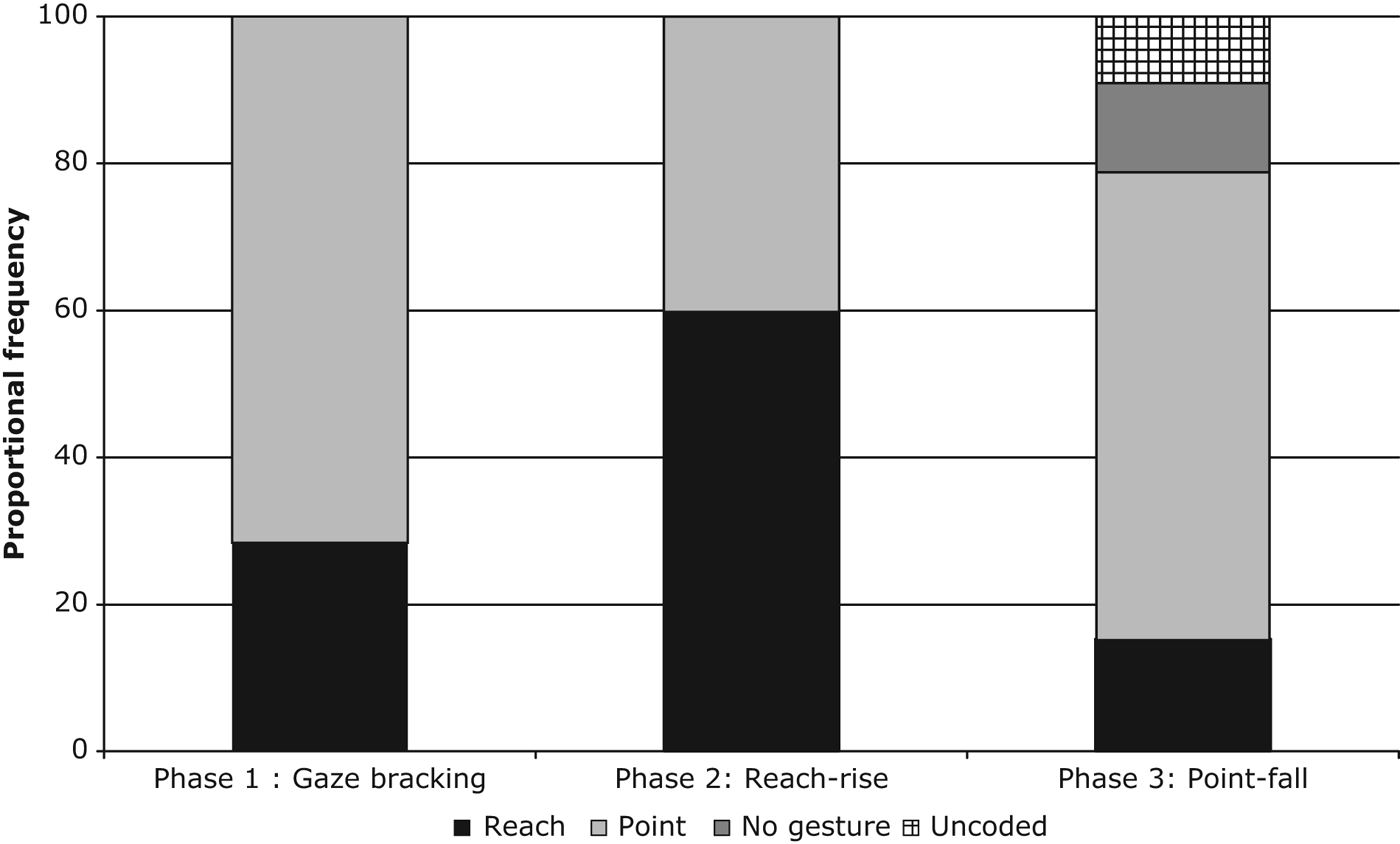
Both reaches and points were employed by Ella in her early proto-imperatives and display a development trend, as shown in Figure 1. In Phase 1, points occur with higher frequency than reaches but the low token frequency within this sample limits any claims regarding ‘typical’ gesture use in Ella's early proto-imperatives.
Proportional frequency of gestures over time.

By Phase 2, reaches are the predominant gesture in Ella's proto-imperatives and by Phase 3 points account for a much larger proportion of the data. The data therefore highlight the developmental shifts between reaches and points within Ella's proto-imperatives.
Pitch contours
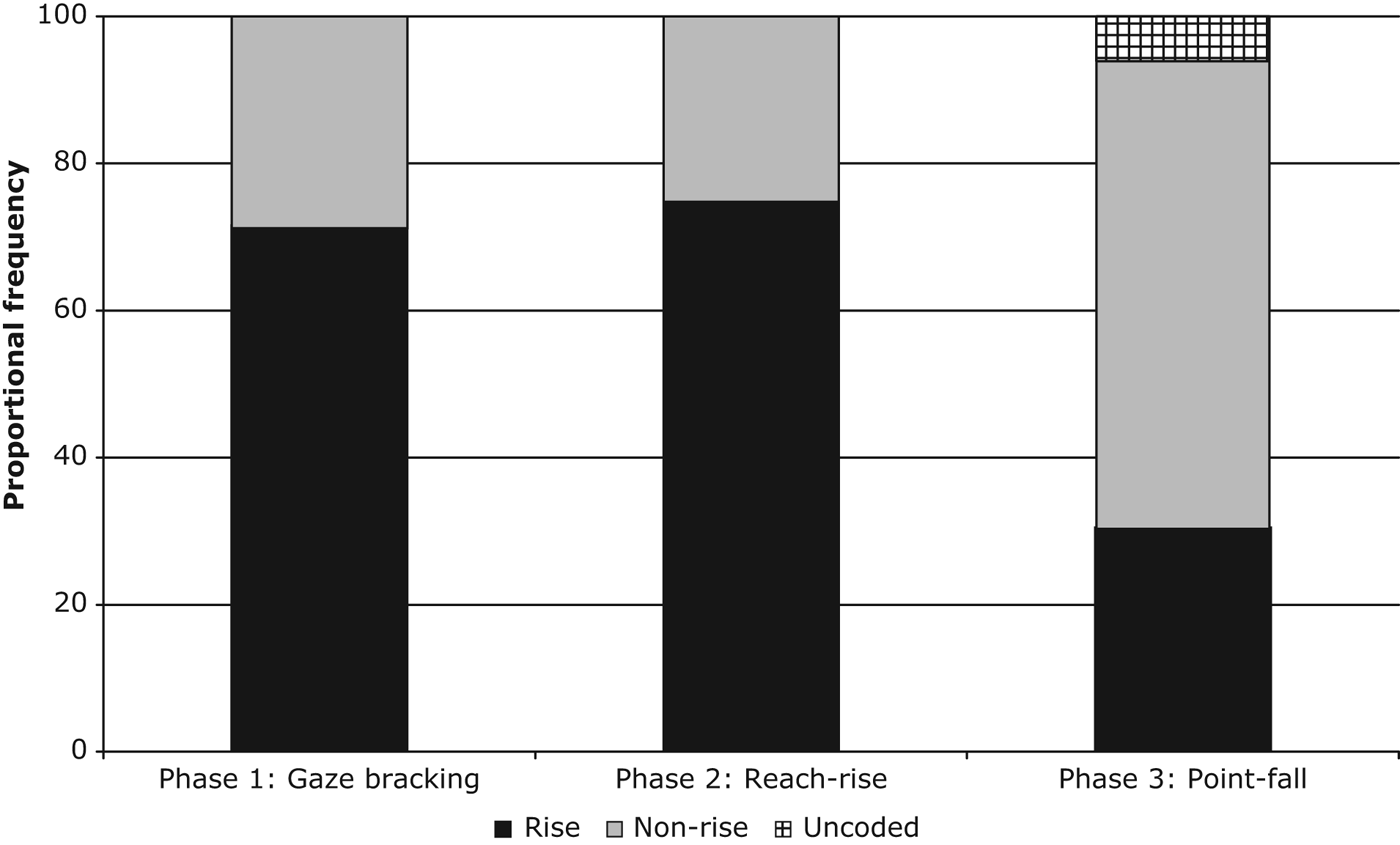
Ella's use of rise or non-rise terminal pitch contours is displayed in Figure 2. The analysis indicates the predominance of rising contours in Phases 1 and 2, but the shift to non-rise contours in Phase 3.
Proportional frequency of terminal pitch contours over time.
The relationship between gesture and pitch contour
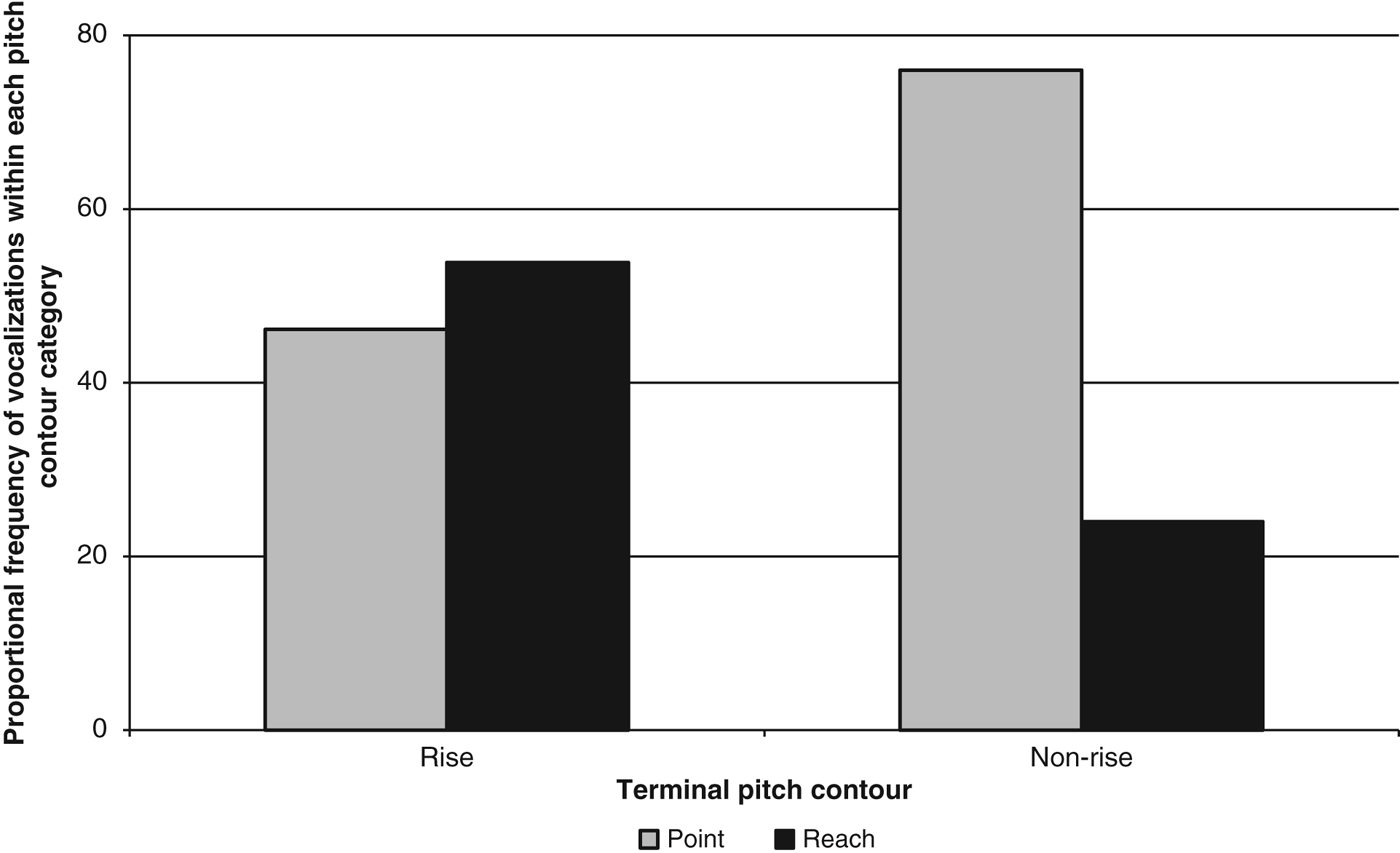
Given the developmental trends attested in Ella's use of gesture type and pitch contours, one question remains. Is there a relationship between pitch and gesture type within Ella's proto-imperatives? Due to sample size we do not have a sufficient number of tokens to perform a phase by phase analysis of gesture versus pitch. However in Figure 3 we present an analysis based on the combination all of the proto-imperatives produced by Ella.
The relationship between pitch type and gesture type in the sample.
The findings indicate a significant relationship between pitch and gesture type with points being more strongly associated with non-rise pitch contours. Chi-square analysis of the data substantiates the claim by indicating a significant relationship between pitch contour and gesture type (χ2 (1, N=53)=4·763, p=·021).
DISCUSSION
The current study tracked the production of gesture type, terminal pitch contour, and eye-gaze to the co-participant within the development of one child's proto-imperatives. The results indicated changes over time with regard to each behaviour in addition to a gradual integration of their production. We suggest that the patterns identified in the current study reflect Ella's growing confidence and skill in the production of proto-imperatives and that the developments paved the way for Ella's subsequent use of conventional linguistic forms within the expression of the imperative function. In this respect Ella's proto-imperative development supports the notion of continuity between prelinguistic and linguistic interaction. In the following section we discuss each phase of development in order to substantiate our claims.
The first phase of development (the gaze bracketing phase) contains a relatively small number of proto-imperatives and therefore the discussion at this point remains speculative. It is as this early stage that the step by step production involving eye-gaze to the co-participant, gesture, and vocalization described by Bates et al. (Reference Bates, Camaioni and Volterra1975) is attested in Ella's data. The use of eye-gaze to both the co-participant and object, along with the sequential nature of Ella's proto-imperative production, is indicative of a cautious and inexperienced approach to the expression of the function. Indeed it is possible that at this early stage Ella's proto-imperatives are more akin to a general request for help as opposed to a targeted request for a specific object. This characterization of Ella's early proto-imperatives is supported by the predominance of rising terminal pitch contours within the early recordings, a finding which is reflected in the literature (e.g., Flax et al., Reference Flax, Lahey, Harris and Boothroyd1991; Masataka, Reference Masataka1993). The use of rising pitch by infants is rare (see Snow and Balog, Reference Snow and Balog2002, for an excellent review). However, studies of prelinguistic communication and also infant-directed speech suggest that rising intonation patterns do occur in bids to gain attention and responses from infants (e.g., Ferrier, Reference Ferrier and Nelson1985; Fernald Reference Fernald1989; Flax et al., Reference Flax, Lahey, Harris and Boothroyd1991; Leroy et al., Reference Leroy, Mathiot, Morgenstern, Zlatev, Johansson Falck, Lundmark and Andrén2009). Therefore the high frequency of rising terminal pitch contours suggests that Ella's early proto-imperatives can be most appropriately categorized as calls for help, as opposed to true imperatives.
While some Phase 1 proto-imperatives involved sequential behaviours, there are also instances in which the behaviours are combined. In some cases the gesture is combined with the eye-gaze to the co-participant, constituting instances of dual signalling and providing support for the early emergence of the behaviour (Bruner, Reference Bruner1983). However, there are also instances in which the gesture and vocalization are produced in combination, which lends support to studies highlighting the close relationship between the manual and vocal modalities in early linguistic development (e.g.,Özçalışkan & Goldin-Meadow, Reference Özçalışkan and Goldin-Meadow2009; So et al., Reference So, Demir and Goldin-Meadow2010).
The main developments of Phase 2 (the reach–rise phase) are the increase in non-rise pitch contours and reach gestures along with a marked reduction in eye-gaze to the co-participant. We suggest that the reduction in eye-gaze to the co-participant signals Ella's increasing confidence in her expression of proto-imperatives, and a shift in her underlying representation of the function. That is, as Ella becomes more confident that her productions will be acted upon, she engages in less eye contact with the co-participant. The absence of eye-gaze to the co-participant has implications not only for the theoretical aspects of proto-imperative development, but also for the study of prelinguistic interaction. Some researchers stipulate eye-gaze to the co-participant as an essential indicator of intentionality (e.g., Carpenter et al., Reference Carpenter, Nagell, Tomasello, Butterworth and Moore1998), and therefore run the risk of missing instances of intentional behaviour and their associated developmental trajectories.
The findings relating to the reduction in eye-gaze to the co-participant, and the use of both reaches and points, are well attested in the literature. However, the increase in non-rise terminal pitch contours attested in Ella's proto-imperatives appear to challenge previous findings. Both Bates et al. (Reference Bates, Camaioni and Volterra1975) and Flax et al. (Reference Flax, Lahey, Harris and Boothroyd1991) claim that the prelinguistic infants in their studies retained the same terminal pitch contour throughout the development of each function (i.e., from the prelinguistic to the linguistic stage). However, Bates et al. (Reference Bates, Camaioni and Volterra1975) relied on perceptual analyses of terminal pitch contours. As noted in the ‘Introduction’, this form of analysis is problematic and difficult to verify. Therefore there is the possibility that changes in pitch contour did occur but were not identified. In the case of Flax et al. (Reference Flax, Lahey, Harris and Boothroyd1991) a distinction was made between prelinguistic requests for objects and actions, and request-commands, each of which was associated with its own terminal pitch contour (rising for the former and falling for the latter). It is highly plausible that the two categories actually are part and parcel of the same function (i.e., the proto-imperative) but refer to different stages on the developmental cline. Therefore the stability of pitch contours identified by Flax et al. (Reference Flax, Lahey, Harris and Boothroyd1991) may be a consequence of the coding taxonomy.
Bates et al. (Reference Bates, Camaioni and Volterra1975) and Flax et al. (Reference Flax, Lahey, Harris and Boothroyd1991) use their data to support the continuity hypothesis, that is, the direct relationship between the prelinguistic and linguistic stage. We also suggest that our data support the continuity hypothesis, but rather than claiming that the relationship between pitch contour and function remains static, we suggest that the relationship is dynamic and that the terminal pitch contour acts as a bridge between prelinguistic proto-imperatives which can be viewed as requests for help and linguistic proto-imperatives which are more closely allied to demands.
Phase 3 involves the re-emergence of eye-gaze to the co-participant in situations where the target object is not in direct view. That is Ella's use of eye-gaze to the co-participant is selective, as opposed to forming an integral component of the proto-imperatives sequence as seen in Ella's earliest proto-imperatives. In addition, during Phase 3 Ella begins to produce conventional linguistic forms either in combination with gestures or alone. The data indicate shifts in the use of both gesture type and terminal pitch contour. The prevalence of points and non-rise pitch contours are indicative of a more specific representation of the imperative function (i.e., ‘Give me X’).
The findings of the current study provide the first indication of a link between gesture type and intonation contour. The proto-imperative is, as far as we know, the only prelinguistic function involving both reaches and points, and also both rise and non-rise terminal pitch contours, making it the perfect prelinguistic function within which to study the relationship between gesture and pitch. The results of our analysis indicate a strong correlation between gesture type and terminal pitch contour, specifically that non-rise intonation is associated with pointing within Ella's proto-imperatives. Therefore even in the prelinguistic and early linguistic stage there is evidence of a link between the two modalities of gesture and vocalization.
The current study displays the usual limitations associated with a case study, that is we cannot be sure about the extent to which our findings can be applied to a wider population. In addition the low token frequency found in the initial stage of the study should be noted. Case studies and studies involving small sample sizes are frequent within the analysis of prelinguistic communication and, as noted by D'odorico and Franco (Reference D'odorico and Franco1991), are not without value due to the wide range of individual differences attested within prelinguistic communication. Nevertheless, it would be beneficial to extend the current study to a larger and more diverse population. It would be particularly informative to conduct the study on populations displaying language delay. For example, research relating to gesture in children with Autistic Spectrum Disorder (ASD) indicates that while declarative pointing is lacking or severely delayed, imperative pointing appears to be spared (e.g., Camaioni, Perucchini, Muratori, Parrini & Cesari, Reference Camaioni, Perucchini, Muratori, Parrini and Cesari2003). However, findings from the current study suggest that there is much more to prelinguistic imperative behaviour than pointing, and it would be interesting to see if any of the developmental trends attested in Ella's proto-imperatives are found in the ASD population. Specifically, it would be interesting to see if children with ASD displayed a similar trajectory of development from the proto-imperatives which could be viewed as generally signalling for help to those more closely related to conventional imperative behaviour.
In addition to widening the sample it would be interesting to analyze particular aspects of proto-imperative development in more detail, possibly by adopting a Conversational Analysis approach. For example, Ella's data provide some evidence of pitch shifts during second attempts at proto-imperative which initially received an unfavourable response. A more detailed CA analysis of the behaviour may provide an important insight into infants' representations of initiations and responses in the prelinguistic stage.
CONCLUSION
We conclude that the developmental patterns found in Ella's speech are indicative of a shift in her representation of the proto-imperative. In the early samples proto-imperatives can be thought of as an appeal for help, signalled by rising pitch contours, reaches, and eye-gaze to the co-participant. However, as Ella becomes more experienced the proto-imperatives become more akin to a conventional demand expressed by a point to the object required, and non-rising intonation. We suggest that this shift in development paves the way for subsequent linguistic expression of the function.