1. INTRODUCTION
The ‘Multicultural Paris French’ project (henceforth referred to as ‘MPF’) identified several potentially innovatory linguistic features among young speakers in the banlieues. So far, little is known about the connotations such features carry and the attitudes they evoke among the speakers themselves, and it is the object of this study to contribute to filling this gap. Unlike the position, for example, in the UK, in France a conservative version of ‘le bon français’ is idealised as a symbol of national unity and identity (as also seen in recent debates on new language reforms, see Libération 17/11/2017). Normative and prescriptive views at the state and institutional level are particularly strong (Haugen, Reference Haugen1966; Lodge, Reference Lodge1991), and movements for change are resisted and often ridiculed by commentators. Encrevé described the prevailing ideology of the French language as ‘une forme pathologique de la passion de l’égalité’ (Encrevé, 2007: 26): the prestige norm is not only valued, as standard varieties are elsewhere, but is considered a criterion of ‘Frenchness’ (Lodge, Reference Lodge2004)Footnote 2. Attitudes towards non-mainstream varieties are less well understood; methodologically speaking, these varieties cannot be ‘parcelled’ and identified in the same way as standard varieties, especially outside phonological aspects. In addition, such varieties can sometimes be considered a taboo subject (see Stewart, Reference Stewart2012, who discusses the ‘socially sensitive’ question of banlieue speech). Speakers of migrant origin may find themselves doubly ‘separated’ from the mainstream: first through not speaking in a standard way, and second through using varieties which are considered in some way as ‘foreign’ by the social elite. As a result, as Gal (Reference Gal2006) has said, ‘migrant and minority speakers sometimes see themselves through the ‘eyes’ of standard ideologies and hence devalue their own speech. Alternatively they may reject standard ideology and construct opposing perspectives’ (p.165) – which is arguably what we find here.
In this article, we investigate attitudes towards various linguistic features in the community in which they were observed, i.e. in a multi-ethnic, multicultural suburban area of Paris. We describe respondents’ evaluative reactions and attitudes, first, towards specific features, and second, towards recordings of speakers selected as representative of the MPF corpus. The respondents share the same socio-demographic characteristics as the participants in the MPF study, and it was therefore unlikely that their views would be determined by the traditional normative views referred to above. The study extends the scope of the literature on language attitudes towards peripheral language varieties in France, by investigating how language innovations are perceived in communities where they are actually present. Features associated with young people are often stigmatised as a sign of inarticulateness, and attitudes towards such features are mainly discussed, notably in the media, from the point of view of out-group members or the general public. Studies on innovation and change tend to be limited to relatively isolated linguistic features and are often ‘disconnected’ from the reality of those who use such features. Yet, we believe that the views of those whose language is investigated are important for understanding the complex mechanisms of language variation and change. This article, therefore, seeks to examine both self-reported usage and respondents’ perception and views of certain variables, in order to advance our understanding of language change from the perspective of the putative innovators.
2. ATTITUDES WITHIN SOCIOLINGUISTIC RESEARCH
2.1 Research on language attitudes
Understanding speakers’ attitudes towards their own speech and that of their peers has been a crucial aspect of sociolinguistic research ever since the early work of Labov in New York City (Reference Labov1966). In his classic paper ‘Language with an Attitude’, Preston writes that linguistic attitude studies need to ask two questions: ‘[. . .] what are the linguistic facts of identification and reaction, and what are the underlying constructs which promote and support them?’ (2004: 64). Both of these aspects are discussed below.
Social psychologists of language define language attitudes as ‘any affective, cognitive or behavioral index of evaluative reactions toward different language varieties or their speakers’ (Ryan et al., Reference Ryan, Giles, Sebastian, Ryan and Giles1982: 7). As attitudes cannot be observed as such, a variety of techniques have been employed to investigate them, from the most direct, i.e. questionnaires involving agreeing more or less strongly with a list of statements (Garrett, Reference Garrett2010), to the more disguised, such as the matched or verbal guise technique (Lambert et al., Reference Lambert, Hodgson, Gardner and Fillenbaum1960; Kircher, Reference Kircher and Hua2016). Using such techniques, attitudes towards particular languages have often been measured in the context of minority language survival (Baker, Reference Baker1992), though there are also studies examining attitudes to different varieties of particular languages (e.g. Stewart, Reference Stewart2009; Kircher, Reference Kircher2012).
In carrying out such studies, social psychologists distinguish between direct (or explicit) measures of attitudes, in which participants are asked various types of question (and which are by far the most commonly used), and indirect (or implicit ones), in which participants react to a stimulus but are not asked anything directly (Haddock and Maio, Reference Maio and Haddock2014). Although the present study is not a classic social psychological one, its results are consistent with Haddock and Maio's remark that results of implicit attitude studies do not always correspond to those of explicit ones. In this case the replies to the question: ‘Do you use this form?’ constitute the direct evidence, and the judgements expressed about recorded speakers who are using the same forms constitute the indirect evidence. Haddock and Maio claim that indirect measures have advantages in that they are (a) less affected by concerns about the social desirability of the opinions expressed and (b) predict variability in behaviour which cannot be explained by explicit measures on their own (ibid., 53–54). These advantages would appear to hold good when using indirect methods in the field of linguistic variation; it is clear for example that respondents’ attitudes to speakers who use certain variants are not purely determined by the use of those variants. For example they might express negativity towards standard forms when these are presented in isolation, but nevertheless express a positive attitude towards a teacher who speaks in a standard way. It is precisely by unpicking such apparent contradictions in people's attitudes that a more specific understanding of the latter can emerge. Overall, for example, negative attitudes towards non-standard varieties are well documented across languages, notably when it comes to status-related traits such as competence (e.g. Edwards, Reference Edwards1979; Stewart, Reference Stewart2012; Kerswill, Reference Kerswill and Androutsopoulos2014; Wiese, Reference Wiese and Rampton2014; Dragojevic et al., Reference Dragojevic, Mastro, Giles and Sink2016). However, it is not the same for traits relating to solidarity (Preston, Reference Preston, Chambers, Trudgill and Schilling-Estes2004) and the assumption that there is a positive predisposition towards the standard variety alone tends to be based on the attitudes of middle- and upper-class speakers (Beckford-Wassink, Reference Beckford-Wassink1999: 59; see also Cheshire and Stein, Reference Cheshire and Stein1997). While the educational and institutional usefulness of the standard language cannot be denied, sociolinguistic studies have shown that the notion of ‘standard’ plays out differently in different contexts. In France, the symbolic character of the standard language is detached from everyday vernacular varieties such as le français ordinaire (Gadet, Reference Gadet1989) – itself long considered more homogeneous than it is – and even more so from ‘peripheral’ varieties such as the multiethnic youth language spoken in urban areas. Yet, as we will see below, young speakers often reverse traditional values attached to different language varieties and redefine what is considered positive, acceptable or even correct, thus in practice emphasising the solidarity dimension rather than that of status. Our study confirms through a non-classic methodology that status and solidarity within the same communities often follow different paths. For example Kircher (Reference Kircher2012) found that attitudes towards Quebec French had improved since the 1980s as regards solidarity, though not as regards status. It is also of relevance to this study that second and third generation immigrants, faced with linguistic assimilationist policies by the State, often ‘engage in personal and collective strategies for achieving and maintaining a ‘positive distinctiveness’ vis-à-vis salient or rival linguistic outgroups’ (Bourhis, El-Geledi and Sachdev, Reference Bourhis, El-Geledi, Sachdev, Weatherall, Watson and Gallois2007: 39).
While social psychologists tend to talk of status, sociolinguists, ever since Labov's early studies in Martha's Vineyard and New York City (Reference Labov1963, Reference Labov1966), and Trudgill's (Reference Trudgill1972) work in Norwich, have worked with the concept of prestige. Trudgill demonstrated that some people – in that study, working-class men – were prone to over-report their use of vernacular features, just as others – mainly women – over-reported their use of RP variants. The ostensibly simple device of comparing how speakers actually spoke with how they said they spoke proved a fruitful way to reveal linguistic attitudes without asking about them directly. Since then, research in numerous contexts (some of which is reviewed below) has described speech configurations and speaker choices where the drive to approximate to the variety carrying the most status in the society at large, however this is perceived, is not the speakers’ only or main underlying motivation – if indeed it is a motivation at all.
In recent work, linguistic prestige continues to be a productive concept, which has now been shown to be multi-dimensional (Hawkey, Reference Hawkey2016). The perception of prestige is contingent on the type of linguistic situation, the type of speaker and the context in which the linguistic material is presented. Increasing relativism in applying the concept of linguistic prestige is heightened by the fact that, as Coupland (Reference Coupland, Maegaard, Gregersen, Quist and Jorgensen2009) has pointed out, standards hold less determinate and more complex values in late modernity (see also Milroy, Reference Milroy, Llamas, Mullany and Stockwell2007).
This relativism is also multi-dimensional. Dragojevic and Giles (Reference Dragojevic and Giles2014), the latter a pioneer of the matched guise technique, showed how attitudes and expressions of solidarity vary depending on the frame of reference within which judgements are presented: local, regional or international. A study by Bellamy (Reference Bellamy2012) investigated language attitudes in Britain and Austria, looking at which varieties of the national language carry higher or lower prestige, and demonstrating the impact of the different configuration in which the standard is embedded in each country (diglossic in Austria v. dialectal continuum in Britain). Schneider (Reference Schneider2016) shows that speakers express solidarity in relation to a number of code-switched varieties spoken round the world, which would certainly not be considered ‘standard’. Hedgecock and Lefkowitz (Reference Hedgecock and Lefkowitz2000), in a study among students learning French, show that prestige, measured here by the way the students wish to speak, is not necessarily unidirectional even in the normative environment of the language classroom. This research points to a need to adapt attitude studies to the precise circumstances of the study. It also suggests (a) that it can be advantageous to view language attitudes in parallel with actual behaviour and practice, since the two do not always map onto one another; and (b) that attitudes should be assessed through varied methodological means where possible. We have tried to achieve this in this study.
2.2 Language attitudes in France
In the French context – and particularly in Paris – studies examining attitudes towards innovative and changing features are rare and concentrate almost exclusively on judgements of accent. An early study by Paltridge and Giles (Reference Paltridge and Giles1984), for example, tested attitudes towards speakers with various regional accents, finding that older respondents were more generous in their judgements, and were prepared to say that regional accents carried the same appeal in professional contexts as supposedly ‘non-accented’ voices. However, recent work on attitudes to accents, including banlieue accents, confirms the ongoing existence of negative stereotypes concerning non-mainstream varieties (Armstrong and Boughton, 1987; Hawkins, Reference Hawkins and Sanders1993; Kuiper, Reference Kuiper2005; Stewart and Fagyal, Reference Stewart, Fagyal, Bertucci and Houdart-Merot2005; Stewart, Reference Stewart2012). The prestige of non-regionally marked metropolitan French is also attested in other Francophone contexts such as Quebec (Kircher, Reference Kircher2012). Castellotti and Robillard (Reference Castellotti and Robillard2003) and Paveau (Reference Paveau2008) show however that varieties traditionally considered as prestigious can also elicit negative reactions and be considered snobbish, and that views as to which variety is most ‘correct’ need not coincide with which one is best liked (Kuiper, Reference Kuiper2005). Boughton (Reference Boughton2006), using authentic speech samples, confirmed the existence of social and geographical stereotyping in Northern France, but not specifically in Paris. Stewart's (Reference Stewart2009) work casts light on the relationship between socio-geographic segregation and sociolinguistic stratification within the Paris region, with banlieue phonological features being clearly associated with specific locations and viewed negatively by respondents from a wider Paris area. Overall, despite intense media interest in the putative ‘impoverishment’ of French said to be brought about by youth vernaculars, up to now these have been the subject of scant academic analysis and that which exists often relies on the opinions of speakers with no direct relationship to the communities themselves (Boyer, Reference Boyer2001).
3. METHODOLOGY
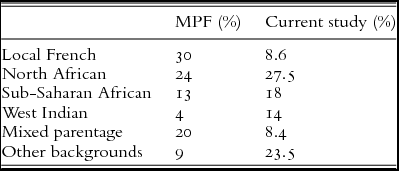
Our survey was carried out in two secondary schools in two predominantly working-class towns in a northern suburb of Paris: Le Raincy and Epinay-sur-Seine. It consisted first in a written questionnaire given to 35 pupils aged 15–18, of whom 72% were female and 28% male.Footnote 3 The sample was highly ethnically diverse, as defined by the origin of parents (8.6% were of local French and 91.4% of various immigrant origins). This differed slightly from the ethnic composition of the speakers in the overall MPF corpus, in which 30% of speakers were of local French descent (both parents born in France). Table (1) outlines the ethnic composition of the speakers in both studies.
Ethnic backgrounds

The study was collected by two experienced female researchers, both near-native speakers of standard French. They were introduced by the teacher during whose lesson the study took place, but who left before the study began. The respondents were advised that the results would be anonymous and encouraged to make their responses as honest as possible.Footnote 4
Part (A) of the questionnaire (see Appendix) used written examples of linguistic features identified in the MPF project recordings. The quantitative results of the MPF project had shown, unsurprisingly, that some of these features were more widespread than others. The questionnaire also permitted a quantitative evaluation of the popularity of these features, but added a significant qualitative dimension by soliciting pupils’ evaluative comments and exploring their perceptions of, and attitudes towards, the type of speakers likely to use them. As Hawkey (Reference Hawkey2016) pointed out, metacommentary by speakers (or the lack of it) provides an essential element to understand whether change is occurring ‘from above’ (i.e. whether it is conscious) or from below (unconscious). Part (B) used audio extracts from the same set of recordings, illustrating a variety of features including phonological variants which had been noted in the corpus. In Part (B), the object of which was to understand the pupils’ categorisations, identifications and any stereotypes associated with the stimuli, views on pronunciation and accent were naturally a more prominent focus. As other studies have shown, attempts to study attitudes to phonological features separately from other levels of language are methodologically challenging and the material used as a stimulus may, of necessity, depart markedly from natural speech; for example, Stewart (Reference Stewart2009) made use of artificially synthesised stimuli and Stewart and Fagyal (Reference Stewart, Fagyal, Bertucci and Houdart-Merot2005) studied reactions to single words.
Part (A) of the questionnaire contained 45 authentic sentences from transcripts of the MPF corpus. The questionnaire targeted features at all linguistic levels, namely grammar, vocabulary, discourse and phonology (the latter was presented by playing extracts from the recordings).
Inevitably, while the aim was to cover all language levels, they were not represented equally, as some features were more widespread than others and/or had a larger type/token ratio.Footnote 5 Each sentence was followed by these questions:
a) Would you use a sentence like this? (Answers: frequently, sometimes, never).
b) Who would you use a sentence like this with? (Answers: with everyone, including both younger and older people; only with family and friends; only with friends).
c) In what context would you use a sentence like this? (Answers: both in speech and in writing; only in speechFootnote 6).
The complete list of items can be found in the Appendix.
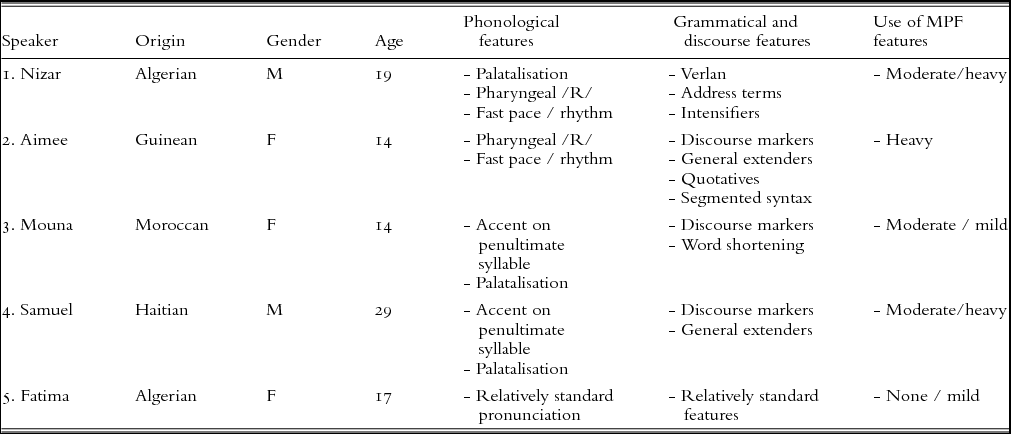
In Part (B), pupils were asked to give their opinion on the pronunciation of five speakers representative of the MPF corpus; it is of course possible, as mentioned above, that the opinions expressed were influenced by non-phonological aspects of the passages (listed separately in Table 2), e.g. the content of what was said. This is an inevitable side-effect of using natural speech as the stimulus. The extracts, each of a similar length, were chosen to illustrate a variety of accents, styles and ethnic origins characteristic of the corpus, from more standard speech containing few innovative and vernacular features, to more colloquial speech containing many such features. This method departs from the matched guise technique as it uses different speakers with noticeably different linguistic repertoires, and is closer to the verbal guise technique (see Kircher, Reference Kircher and Hua2016). The use of a mixed-method approach was intended to provide information on attitudes linked to all linguistic levels. Additional comments on the questionnaire provided further nuanced qualitative data.
Recorded extracts
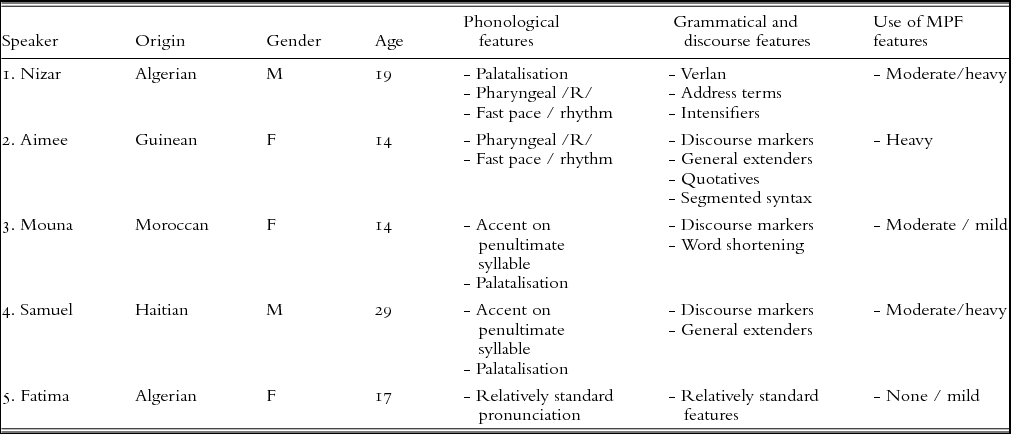
Table (2) lists the linguistic characteristics of the extracts chosen for Part (B) of the survey.
4. RESULTS
4.1 Quantitative results
We first examine the results for self-reported use in different linguistic categories. The total number of replies in each of the possible responses (i.e. frequently, occasionally, never) was converted to a single standardised score on a scale from 1 to -1. A score closer to 1 represented a more frequent usage (i.e. more people reported using the expression frequently), whereas a score closer to -1 showed a less frequent usage (i.e. more people reported never using the expression).
4.1.1 Lexical features
The vast majority of lexical items were reported as being used frequently (as shown by values above 0), suggesting that the innovations contained in these sentences were considered authentic (Appendix A2). It emerges that verlan, a form of slang based on inverting syllables, is still productive, as evidenced by high rates of use for words such as téma (‘mater’/regarder), chelou (‘louche’), de ouf (‘de fou’) comme aç (‘comme ça’) or wam (‘moi’). This also shows that verlan does not affect only nouns, but also adjectives and verbs, and more sporadically demonstrative and personal pronouns. There were also some ‘frequent’ results in the category of foreign-derived slang (e.g. avoir le seum, from Arabic, ‘to be gutted’, avoir du swag, from English swagger, meaning ‘to have style’), while others were less frequent (e.g. wallah, ‘I swear’, krari, ‘like/as if’). The stigmatised term wesh is relatively common, showing a score of 0.41. Despite the widespread stereotype linking this term to humorous portrayals of disaffected suburban youth, in the MPF data this form is used in meaningful ways, either as a clause-final focusing device or as an affective greeting indexing ingroup solidarity. Opinions on other lexical items were divided, some items being relatively popular (e.g. mort de rire, equivalent to ‘LOL’, fraîche, ‘cool/pretty’, daronne, ‘mother’) and others less so (e.g. terre-terre, ‘ends’, tchoin, ‘sket’).
4.1.2 Discourse-pragmatic features
Although less frequent than lexical features, the questionnaire included several examples of discourse-pragmatic forms identified as undergoing grammaticalisation, such as discourse markers (e.g. genre, ‘like’), quotatives (e.g. être là, literally ‘be there’, faire genre, ‘do like’) and general extenders (e.g. et tout, ‘and all’, tout ça, ‘all that’). Among these, the discourse marker genre is shown to be very popular, reaching a score of 0.53, indicating frequent use. This is consistent with previous research on youth discourse markers in French, which shows increased rates of use and many cross-linguistic similarities, especially of genre with English like (Fleischman and Yaguello, Reference Fleischman, Yaguello, Moder and Martinovic-Zic2004). Among innovative quotatives, respondents reported using être là and faire genre fairly frequently, with scores of 0.25 and 0.16, respectively. This is significant as the sentences did not contain any noticeable lexical distractors, so it is likely that the pupils commented on the actual quotative forms involved (for a detailed analysis of quotatives, see Cheshire and Secova, this issue). A similar result is obtained for the general extender et tout, displaying a score of 0.16. This positive result is consistent with previous research suggesting that et tout is grammaticalising and rising in frequency in spoken French, especially among younger generations (Secova, Reference Secova2017).
Last, within this category, intensifiers are worth scrutinising, as they commonly display a tendency to change from generation to generation and reveal a preference among young people for specific variants (Tagliamonte, Reference Tagliamonte2016). As our results show, some intensifiers such as grave and trop are extremely popular, while others are (now) disfavoured (e.g. méga or vachement).
4.1.3 Grammatical features
The most striking grammatical innovation found in the MPF data is the use of embedded in-situ questions (e.g. je vois pas c'est qui), which are the focus of Gardner-Chloros and Secova (this issue). We noted here that three out of four in-situ questions (item 12, 29, 34 and 37) were reported as frequently used. The older variant qu'est-ce que (item 27, c'est pas bien qu'est-ce que tu fais) is unpopular, which is consistent with the results of the MPF analyses showing that only 0.04% of all indirect questions in the corpus are of this type. The MPF results also show that the in-situ variant is preferred in shorter, primarily two-syllable clauses. This is confirmed by the results of the questionnaire in which short clauses, such as c'est qui, c'est où and y'a quoi obtained positive scores of use. The only in-situ question obtaining a negative score (item 37, tu sais elle faisait quoi la mère) is comparatively longer.
Another noteworthy result concerns word-shortening, potentially related to changes of grammatical category; new forms included direct, normal, sérieux, used adverbially. These items had a high score for use, suggesting that word- and phrase shortening is a productive word-alteration strategy, as is decategorisation, manifest in expressions such as sociable de ouf (the adjectival expression de fou is here used adverbially).
Other changes attested in the MPF data were not confirmed in the results of the questionnaire. Perhaps seeing innovative features in writing raised students’ awareness of their ‘non-standard’ character, as in the case of the plural normals instead of normaux in item (33). However, the lack of open comments on most grammatical innovations in the questionnaire suggests that, overall, such variation goes largely unnoticed by the respondents.
4.1.4 Contexts of use
The second question about each item on the questionnaire probed into contexts of use, asking whether students used the innovative expressions with everyone, just with family and friends, or only with friends. Table (3) outlines the results for items that had a positive result for self-reported use, classifying them into three contexts of use. Results for all items are in Appendix (A3) showing their standardised score on a scale from 1 (used with everyone) to -1 (used only with friends).
Contexts of use

The responses show pupils’ awareness of different registers and contexts of use. The column representing the widest context of use (i.e. use with everyone) contains predominantly grammatical and discourse features, with the exception of some widespread slang terms such as swag (‘style’) and que dalle (‘nothing’). Significantly, this column also includes all of the in-situ questions used (i.e. je vois pas c'est qui, je sais c'est où and tu sais y'a quoi dedans), suggesting that this grammatical innovation is widespread and has unrestricted contexts of use. The same is true for discourse-pragmatic innovations such as discourse marker genre and quotative faire genre, reported as used with everyone. Such expressions do not appear to be marked or stigmatised in this community. The ‘friends only’ column contains predominantly slang expressions, including verlan (e.g. de ouf, comme aç, chez wam, chelou).
Appendix (A3) shows that most innovative expressions are reported to be used both orally and in writing, while only a minority are said to be used only orally. However, one limitation of this study is that we cannot be certain how ‘writing’ was interpreted, as a broad definition of it nowadays includes a variety of forms and modes (text messages, emails, tweets), and pupils may have interpreted writing in that way.
4.1.5 Distribution according to ethnic background
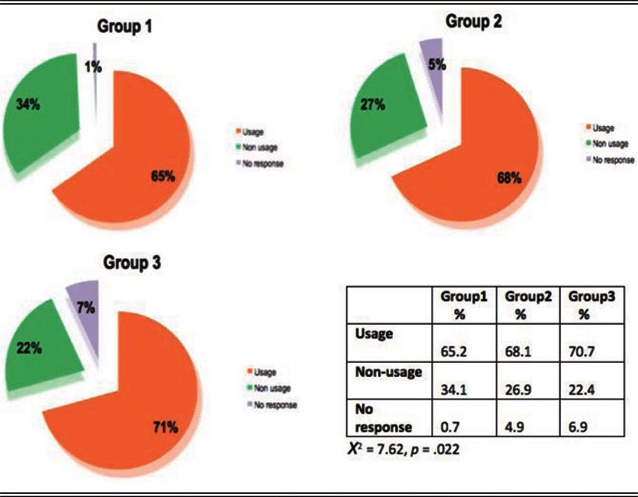
Table 4 outlines the distribution of answers on self-reported use according to the respondents’ ethnic backgrounds. As in the overall MPF project, the respondents were divided into three groups according to their ethnic origin: local French (group 1, both parents born in France), mixed (group 2, parents of different ethnic origins) and immigrant (group 3, parents of same origin born outside France). While all groups reported using sentences similar to those illustrated in the questionnaire, there were some small but significant differences in rates of reported use. The frequency of use increases incrementally from group 1 (65%) to group 3 (71%), as shown by the combined rates for the answers frequently and occasionally. Footnote 7 The table shows that the most prolific reported users are speakers with an immigrant background, which is consistent with the results of the overall project for certain types of innovation, namely in grammar (see Gardner-Chloros and Secova, this issue).
Self-reported use by ethnicity

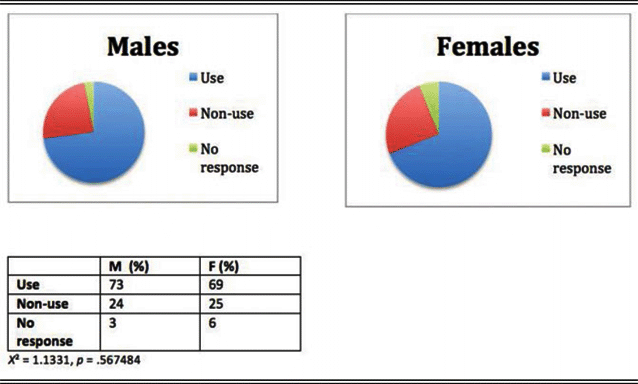
Self-reported use by gender

Percentage of responses across modes of production

Percentage of responses according to interlocutor

Some expressions are reported as never or rarely used across all groups (e.g. méga malade, vachement loin), which shows that the three groups share some common views. However, some items reported as frequent in groups 2 and 3 were not as frequent in group 1 (e.g. wesh, krari, ‘like/as if’, tchoin, ‘slag’, terre-terre, ‘territory/ends’), suggesting that some expressions may be socially or geographically more marked than others.
4.1.6 Distribution by gender
There was no significant gender difference in rates of use, with the majority of expressions reported as being used frequently or occasionally (69% among female and 73% among male respondents). The slightly higher rate of use for males may indicate, similarly to previous research (e.g. Trudgill, Reference Trudgill1972; Labov, Reference Labov1990), that men tend to favour vernacular/stigmatised variants more often than women.
With regard to contexts of use, most innovative expressions were reported as used both orally and in writing, with similar rates for males and females (33% and 32%, respectively). The male respondents had a greater number of expressions that they reported using with ‘everyone’ (33% compared to 16% among women), implying greater differentiation by females of sociolinguistic registers and contexts of use. However, as explained above, some items on the questionnaire were gender-marked or more likely to be uttered by males (e.g. frère, gros, elle est fraîche), which could explain the higher rate of non-response from females overall, as well as just in this category (6% compared to 3% for males overall, and 43% compared to 33% for males in this category).
4.2 Qualitative observations on self-reported usage
The pupils’ familiarity with the investigated features is also evidenced in their open comments. Some, for example, corrected what they considered grammatical or spelling errors, suggested alternative spelling or synonyms, or commented on the derogatory character of some items (‘j'aime pas dire ‘daronne’, je trouve que c'est irrespectueux envers ma mère’). While most expressions were reported as frequent, a minority were perceived as outdated, in which case alternative forms were often offered (e.g. grave, archi or de ouf instead of vachement).
The open comments further suggest that some words may be more strongly associated with the suburban youth vernacular or have more restricted contexts of use. Examples included words such as terre-terre, used only ‘in a mocking context when imitating a banlieue accent’ (‘uniquement pour rigoler en imitant l'accent banlieusard’), wesh, used ‘only when annoyed’ (‘seulement en cas d’énervement’) or ‘to imitate people who use it’ (‘j'utilise le wesh pour imiter les personnes qui l'utilisent’), or krari, associated with ‘people living on an estate’ (‘trop “gens de cité”’). Such evaluative comments were offered almost exclusively by females, potentially implying greater sensitivity to sociolinguistic variation and avoidance of stigmatised forms.
Overall, lexical features appear to be the most salient in terms of conscious awareness, as they attracted most of the open comments in the questionnaire. This is consistent with previous research on lexical differences (between language varieties), considered ‘highly salient and readily apparent to all speakers of the varieties concerned without any linguistic training or analysis’ (Trudgill, Reference Trudgill1986). Colloquial vocabulary and slang items are usually considered an intrinsic part of the youth repertoire, but they are perhaps also the shortest-lived form of innovation. This is confirmed in some comments for items that are no longer considered popular (e.g. le mot ‘méga’ il est mort) or items that are confined regionally (e.g. jamais entendu le mot ‘tchoin’).
The pupils’ metalinguistic awareness of pragmatic features was more limited than that of lexical features, with some pupils commenting on lexical choices even in examples that targeted grammatical and discourse features. While efforts were made to direct the pupils’ attention to the feature of interest, it was impossible to avoid some distractors. Despite this, many respondents provided relevant comments, especially on more widespread features such as discourse-marker genre (e.g. je dis ‘genre’ au début des phrases), quotative être là (e.g. le ‘être là’ est indispensable pour une conversation), general extender et tout (e.g. ‘utilisation de ‘et tout’ dans la narration d'histoires’), and even address terms such as frère. The latter was reported frequent even among females, and even when their interlocutors are also females. This recalls findings for the address term man used among females in London, suggesting that there may be cross-linguistic similarities in socio-pragmatic pressures affecting language change.
4.3 Reactions to stimuli
Part (B) of the questionnaire investigated speakers’ opinions on five recordings characteristic of the MPF corpus. Qualitative data of this type can be useful in revealing language ideologies, meaning societal constructs that are subtly distinct from attitudes. Pupils were asked to comment specifically on the pronunciation / accent of the recorded speakers (Appendix B). Recall Table (2), which outlines the most salient features of the extracts, as well as the degree to which these speakers use MPF features. Transcripts of these passages can be found in Appendix (C).
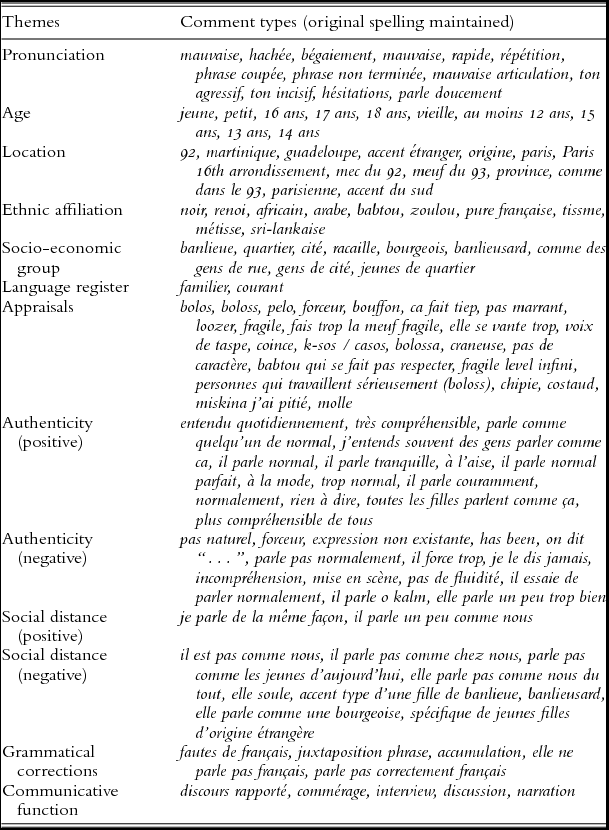
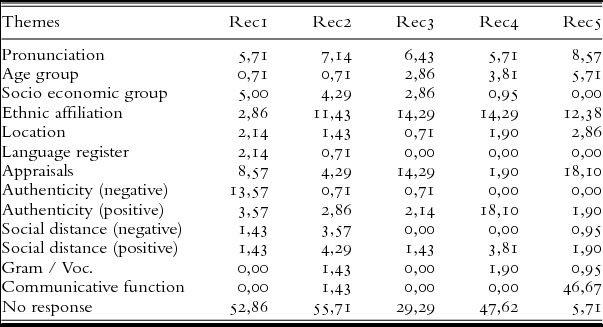
Confirming the fact that this technique taps into a broader understanding of speakers’ values, it was notable that despite the instructions given, many respondents did not provide explicit comments on the speakers’ pronunciation, but made more general observations about their identity and socio-demographic characteristics. Some pupils specifically commented on other linguistic areas such as grammar, register and vocabulary. The comments provided were grouped into major recurring themes, as outlined in Table (8). In Table (9), we set out the percentage of comments on specific themes in each recording, and we discuss the most relevant ones below.
Open comments’ themes

Comments on recordings

4.3.1 Social and ethnic origin
One recurrent theme was ethnicity, sometimes conflated with other social and geographical categorisations related to the speaker's perceived identity. These comments were particularly common among pupils of mixed heritage or of immigrant origin, who distinguished between speakers perceived as ‘white’, ‘posh’ or ‘upper-class’ and those perceived as Arab or African (e.g. ‘c'est une babtou’,Footnote 8 ‘pure française’, ‘une vraie bourgeoise’ vs. ‘perso elle parle comme moi peut-être une africaine ou arabe’). The former were often perceived as less streetwise and less ‘cool’ (e.g. ‘fragile’, ‘boloss’Footnote 9, ‘coincé’, ‘on dirait une bourgeoise’, ‘une bolossa’, ‘elle parle comme une vieille’, ‘babtou qui se fait pas respecter’), while if someone was perceived as black, mixed or of Arab descent, this was generally endorsed as legitimate and commented upon in positive terms (e.g. ‘ça va lui au moins il force pas – tismé’,Footnote 10 ‘il parle normal parfait arabe’, ‘c'est un noir toujours, il parle comme tous les jeunes’). Specifically, Samuel in Recording (4) was described as speaking like a local person from a banlieue, whereas Fatima and Mouna (Recordings 3 and 5) were perceived as posh white Parisians, although in fact, they were both of immigrant descent and lived in the banlieue. Overall, the results show some ethnic differentiation, whereby the language of majority speakers is generally rejected and perceived in negative terms. However, in some cases, negative stereotypes were also used in descriptions of the speakers who spoke the local banlieue vernacular, such as Aimée, although these were not as frequent (e.g. ‘elles parlent comme dans le 93, ça s'entend que c'est une racaille’). A disadvantage of using authentic extracts is that some reactions might be ascribed to the content of what is said rather than the speech characteristics, as in the case of a young girl who came in for negative appraisal, who had been saying her mother always worried about her when she went out, and so did not come across as streetwise. In addition to content and speech characteristics, such findings could also be partly related to the speaker's gender and age, together having an impact on how he or she is perceived. A younger female voice may inevitably be perceived as less streetwise than an older male voice (see Laur, Reference Laur2008 for a discussion of gender in speaker perceptions).
4.3.2 Authenticity
As mentioned above, the speakers’ perceived immigrant origin was also associated with being authentic, as in the case of Samuel in Recording 4 (e.g. ‘il parle normalement, mes amies et moi-même parlons comme ça’, ‘il parle comme tous les jeunes’). On the other hand, the most standard speakers were perceived as linguistically inauthentic, of a different ethnicity and living in a different geographical area (e.g. ‘elle parle pas comme nous du tout elle saoule’, ‘elle parle comme une vieille’, ‘on dirait une parisienne’). However, sometimes even a speaker who shared local, vernacular features, such as Nizar in Recording (1), was described in negative terms. Most respondents who commented on his speech argued that it was not or not completely authentic (perhaps due to his vocabulary perceived as out-dated) and described him as a ‘forceur’ or a ‘gros forceur’ (‘somebody who tries too hard to be cool’).
4.3.3 Correctness
Another recurrent theme was the speakers’ perceived ‘correctness’, with respondents of local French origin providing most linguistic comments. The respondents often commented on particular ways of speaking, accent, pronunciation or register (e.g. ‘elle n'articule pas et son registre est familier’, ‘mots mal articulés, toujours le même ton’; ‘beaucoup de répétitions’; ‘bégaiement, mots hachés, prononciation un peu trop rapide’). Again, correctness is closely intertwined with ethnicity and authenticity: the default variety, described as ‘normal’ and ‘common’ – especially among multicultural respondents – is the suburban vernacular (e.g. ‘il parle couramment, normalement, rien de spécial, on dirait un arabe’, ‘il a pas d'accent’). The link between correctness and geographical origin was also evident in some comments which explicitly touched upon linguistic standards, indicating that speaking ‘too well’ may not be considered correct or authentic in the community under investigation (e.g. ‘elle parle pas correctement français’, ‘c'est une parisienne elle parle un peu trop bien à mon goût’).
This topic was touched upon again in an informal, non-technical lecture on sociolinguistic variation that the pupils were given after the survey. In the course of this, pupils were presented with two variant forms of indirect questions: je sais pas ce que c'est vs. je sais pas c'est quoi. The two variants sparked lively reactions, with most participants, despite the school setting, rejecting the traditional word order (the first sentence) which they described as ‘too French’, too ‘fragile’ (i.e. pity-inducing, see www.valantine.fr/langage-jeunes/), and adding that they themselves would not use it. The sentence with the post-verb wh-form, on the other hand, was described as one that ‘sounds better’ (ça passe mieux) and is quicker and easier to say. This is particularly indicative of the fact that standard varieties tend to hold less value in suburban youth communities and traditional values may actually be reversed.
5. DISCUSSION AND CONCLUDING REMARKS
The results of the questionnaire and reactions to the recordings analysed here were designed to test pupils’ attitudes towards innovations which many of them used themselves. Methodologically speaking, the combination of the following three factors represents a new contribution to the field: (1) a mixture of direct or explicit methods (questionnaire) and indirect, implicit methods (eliciting reactions to recordings); (2) asking pupils to react to speakers essentially similar to themselves; (3) directing pupils to comment on specific linguistic features in terms of their own propensity to use these features, and the context in which they would do so.
This study is also unusual among attitudinal studies of Paris French in exploring grammatical and lexical variables along with phonological ones. The decision to examine attitudes to accent on the basis of natural speech samples contrasts with earlier studies where phonology was kept separate from other aspects (for example, by presenting participants with a word list). While a purely phonological study can go into greater detail, the approach taken here allows for a more holistic view of attitudes towards the relevant variants.
The results show that respondents not only express affiliation/disaffiliation with individual linguistic features, but also – a more unusual finding – that they appear to have in their minds an image of the speakers who use these features. The combination of methods chosen here allowed us to confirm the results of other studies which show that language plays a crucial role in the construction of youth identity along different social and linguistic dimensions.
We noted also that speakers have different degrees of conscious awareness of specific linguistic features. Lexical features are the most readily enregisteredFootnote 11 and commented upon, grammatical and discourse features being less salient. However, the grammatical and discourse features also obtain positive scores, with participants confirming that they use such structures. A noteworthy example concerns in situ indirect questions. The results here, in line with the results in Gardner-Chloros and Secova (this issue), show that these questions are favoured by certain speakers (males, especially those with a multi-ethnic background) and occur in specific syntactic contexts (short clauses).
It was further established that some items on the questionnaire index strong affiliative and disaffiliative attitudes. Despite being in the normative environment of their school, participants generally did not criticise features which are stigmatised by the teaching establishment; in fact, several such features elicited positive attitudes and enjoyed a level of prestige. Naturally we cannot be sure to what extent our participants were aware of the stigmatisation of such terms in the broader (or more conventional) French context; but this exercise should lead us to reflect further on the overt/covert prestige distinction and its relevance or otherwise to working class dynamics (Woolard, Reference Woolard1985; cf. also Lee, Reference Lee1999). The traditional distinction suggests a double awareness of two sets of standards, the prestige accorded by conventional social forces and the transgressive prestige of linguistic features used by certain speakers within the community which carry connotations of (traditionally masculine) ‘bad boy’ strength and affiliation (Gordon, Reference Gordon1997). These may be accorded status as markers of ingroup loyalty (Marlow and Giles, Reference Marlow and Giles2008), and speakers who use covert prestige variants do not necessarily positively evaluate the overt prestige variant – as is indeed the case here. In this, our results differ from those of other attitude studies in which the most standard speakers are rated highly for ‘competence’, whereas other sociolects are rated for more human qualities like ‘integrity’, ‘attractiveness’, or more generally ‘solidarity’ (Preston, Reference Preston, Chambers, Trudgill and Schilling-Estes2004: 42).
The acid test is of course the extent to which not only the usage, but also the attitudes of young people such as these are drivers of actual sociolinguistic change. A good comparison is provided by Kristiansen (Reference Kristiansen2001), who found that young Danes are bringing about change in the notion of Standard Danish through their acceptance of features of ‘low’ Copenhagen speech. Kristiansen noted that they rated users of the ‘low’ variants highly on the ‘dynamism’ scale, as opposed to the ‘superiority’ scale which no longer reflects their priorities so well (see also Marlow and Giles Reference Marlow and Giles2008).
In terms of identity, most participants in this study similarly reject what they see as the affluent ‘Parisian’ persona, describing it as ‘fragile’ and ‘boloss’. The distinction is clearly felt between ‘posh’ people living in inner Paris and those in the banlieues, or more restrictively the cités (housing estates). This is in line with much of previous work that stresses the importance of language as a marker of youth identity, and as a powerful tool used to include or exclude out-group members (Tagliamonte, Reference Tagliamonte2016: 3). The differentiation is made not only along geographical and social lines, but also, to a great extent, along ethnic lines. In one conversation in the MPF corpus, two females aged 14, living in a north-western suburb of Paris, described the labels used at school by and for their peers; most of these geographical and identity categories intersected with ethnicity. For instance, boys living in affluent inner Paris were described as mécheux (i.e. as having a long, floppy fringeFootnote 12) as opposed to those with swag (generally ‘style’, but more specifically rapper style). The girls further explained that a young black or Arab man could not be a mécheux (due to their hair type) and conversely, it was difficult for a white Parisian guy to have swag. Such binary distinctions underscore what has been called a fracture linguistique et sociale (Goudailler, Reference Goudaillier1996): a negative term referring to a split between geographically and socially isolated (sub)urban communities and those in affluent urban areas, leading to the values of the latter not being relevant to understanding the behaviour of the former.
Part (B) of the study, eliciting attitudes towards recordings from the MPF corpus, confirms the extent to which language plays a role in the construction of a streetwise youth identity. As social psychology has shown, respondents typically hold more favourable attitudes towards speakers who are perceived as ingroup members than those perceived as an outgroup (Dragojevic and Giles, Reference Dragojevic and Giles2014, Hewstone et al., Reference Hewstone, Rubin and Willis2002). We might even say that the in-group defines what is considered ‘right’: the most standard speaker in the sample was described as not speaking ‘correctly’, suggesting that the status of the mainstream variety is somehow reversed, and traditional ‘French’ culture and linguistic standards are rejected. This casts a linguistic light on research showing that speakers from immigrant backgrounds experience a decreased sense of belonging to their host society and experience alienation – an alienation which can be alleviated by identification with other similar speakers (Giles and Rakic, Reference Giles, Rakic and Holtgraves2014). This can also be viewed in the context of broader discussions of ‘demoticization’ (Mattheier, Reference Mattheier, Mattheier and Radtke1997). Unlike ‘destandardization’, in which the standard ideology is gradually eroded, this term describes situations where the ‘standard ideology’ as such remains in place, but other ways of speaking are no longer valued in the same way (Coupland and Kristiansen, Reference Coupland, Kristiansen, Kristiansen and Coupland2011: 28).
Our results show that language is crucial in determining the way in which speakers in this context are perceived and accepted. This finding emerged intriguingly in certain cases where the ethnic origin of the speaker was identified incorrectly, when the speaker did not use a variety/style that was stereotypically associated with his or her ethnic profile. Attitudes to speech varieties are of course only one aspect of reactions to individuals in face to face encounters, and of attitudes more generally. But we would argue that a mixed methodology such as this, which investigates attitudes both explicitly and implicitly, can provide valuable information on the broader interplay of social and linguistic factors in language change, and on the complex priorities of the speakers involved.
APPENDIX (A1): QUESTIONNAIRE: ACCOMPANYING QUESTION FOR EACH SENTENCE
Voici une liste des phrases tirées des enregistrements de jeunes Parisiens. Cochez la case qui correspond à votre usage personnel:
Utiliseriez-vous une telle phrase? Cochez plusieurs cases le cas échéant:
1) C'est un bolos.
[ ] Fréquemment
[ ] De temps en temps
[ ] Jamais
[ ] Avec tout le monde, adultes ou jeunes
[ ] Uniquement en famille ou entre ami(e)s
[ ] Uniquement entre ami(e)s
[ ] A l’écrit comme à l'oral
[ ] Uniquement à l'oral
Autre commentaire?....................................................................................
APPENDIX (A2): QUESTIONNAIRE ITEMS AND RESULTS FOR SELF-REPORTED USE

APPENDIX (A3): QUESTIONNAIRE ITEMS AND RESULTS FOR CONTEXTS OF USE

APPENDIX (B): QUESTIONNAIRE PART (B): OPINIONS ON RECORDINGS
Remarquez-vous quelque chose de particulier dans la prononciation de ces personnes ?

APPENDIX (C): TRANSCRIPTS OF RECORDINGS