


The Ivoirian Crisis (2002–7) that preceded the recent post-electoral crisis (2010–11) has at times been understood as an inter-generational conflict (Konaté Reference Konaté2003; see McGovern Reference McGovern2011 for an historical perspective). There have been a number of recent studies of the roles of young men on both sides of the conflict: on the patriotic groupings led by Charles Blé Goudé (Arnaut Reference Arnaut2008; Banégas Reference Banégas2007) as well as the Forces Nouvelles rebellion under the leadership of Guillaume Soro (Fofana Reference Fofana2011). Zouglou, one of the most important contemporary Ivoirian popular music genres, is the music of the generation that erupted onto the political scene during the Ivoirian Crisis.
Côte d'Ivoire has travelled a full circle from economic success (from 1960 to about 1979) to failure (from the 1980s onwards) in little more than a generation. The young people who were to become the ‘Zouglou generation’ are precisely the generation that bore the brunt of this economic deterioration. Zouglou music is a form of cultural production practised predominantly by relatively young men who have come of age in the context of declining employment possibilities in the formal sector, the same age group as the young men active in the rebellion and patriotic groups. Through Zouglou music, marginalized youths have asserted themselves as a group, and have created a discursive space to communicate their demands for social inclusion and intergenerational justice to a national audience. In the symbolism of Zouglou song texts, this generation of Ivoirian youth bore the brunt of the economic crisis and have become metaphorical orphans.
In the early 1990s, Zouglou music emerged at the residences of the University of Abidjan in Yopougon, in the context of a widespread student movement for democratization. In order to place the Zouglou songs discussed in this article in their historical context, I shall consider briefly the importance allocated to education in government policy since independence; the role of the student movement and in particular the student union – Fédération Estudiantine et Scolaire de Côte d'Ivoire (FESCI) – in the pro-democracy movement; and the effect of the repression of the FESCI in the early 1990s. Some observers indicate that the culture of violence in the FESCI stems from these early experiences of repression (see Vidal Reference Vidal, Ouédraogo and Sall2008). It was indeed the FESCI that produced some of the youth leaders and protagonists of the Ivoirian Crisis, most notably Soro and Blé Goudé, who led FESCI in 1995–8 and 1998–2001 respectively. While this article will not examine Zouglou songs engaging directly with the Ivoirian Crisis, I aim to analyse here how the genre developed into a platform for social and political critique in order to shed light on some of the emergent (cultural) citizenship practices associated with it.
Zouglou is the most famous Ivoirian popular music style internationally; it is enjoyed throughout Francophone West Africa and has made it to European (notably French) charts on several occasions.Footnote 1 An important factor in Zouglou music's wide appeal, especially in Côte d'Ivoire and Francophone West Africa, are incisive song texts of social commentary. It is well known that in many African cultures musical performance is evaluated in large part through the song texts (Agawu Reference Agawu2003), and this article will examine several of Zouglou's song types in the context of the social and economic changes in recent Ivoirian history.Footnote 2 Barber notes that ‘art forms do not merely reflect an already-constituted consciousness, giving us a window onto something already fully present. They are themselves important means through which consciousness is articulated and communicated’ (1987: 4). Through their music, Zouglou artists have been engaged in the construction of a social group, as well as the creation of a self-understanding (cf. Brubaker and Cooper Reference Brubaker and Cooper2000) of Côte d'Ivoire's ‘sacrificed generation’.
THE ‘ABANDONED GENERATION’
Today's students compare themselves with preceding generations, those who could count on getting government jobs because of their degrees; they see themselves as an abandoned generation (Cruise O'Brien Reference Cruise O'Brien, Werbner and Ranger1996: 65).
Parent. This is the way that students address each other since 1990, to indicate that their elders, their families and political authorities, have abandoned them (Proteau Reference Proteau2002: 275).
Zouglou is the music of that generation that Cruise O'Brien has described as the ‘lost generation’ or, as Zouglou artists such as the group Les Salopards have expressed it, the ‘sacrificed generation’. Zouglou was created at a time when university students experienced a general downgrading (déclassement) not only as students but also as future graduates hoping to find employment. In addition, the number of students and school pupils who were unable to complete their education grew considerably during this time. As will become evident from the discussion that follows, these phenomena were to have a profound influence on the development of what was to become the philosophy associated with Zouglou music.
Since 1960, the Ivoirian state has promised to guarantee access to education for all. However, by the 1980s the economic crisis and the attendant structural adjustment programmes had undermined this goal in several major respects. Not only did structural adjustment entail significant cuts in the budget allocated to education, making it extremely difficult for Ivoirian youth to complete their education and leading to ever larger numbers of school drop-outs (déscolarisés), but the economic crisis also led to unemployment for those who made it through the education system and who had become school and university graduates. Certificates and degrees no longer had the same social weight as in the first two decades of independence and opportunities for social mobility through education were increasingly denied, as access to dominant social positions became a matter of inheritance (Proteau Reference Proteau2002: 339). As the crisis deepened, dropping out of school became an experience shared by an increasing number of young Ivoirians. Consequently, Zouglou became a means of expression not only for university students, but also for a generation of youth who had had to abandon their education prematurely. Zouglou has thus been regarded as the most significant art of the ‘sacrificed generation’.
Since this experience of the education system had a profound influence on the world-view and the music of this generation of young Ivoirians, I will examine this link in some detail here. In fact, as I aim to show, the many songs about orphans in Zouglou music can be read as a symbolic statement about the experience of the ‘abandoned generation’. Additionally, many artists hold that songs of encouragement are at the heart of what Zouglou, these days, is all about. Through these songs, discussed in the latter part of this article, Zouglou artists exhort their listeners not to lose hope in the face of hardship, advise patience and hard work as the road to success, but also hold the youth of their generation responsible for their actions.
LA PRIORITÉ DES PRIORITÉS: A BRIEF HISTORY OF EDUCATION POLICY IN CÔTE D'IVOIRE
Education played a key role in social mobility long before Ivoirian independence, as the example of the ‘Compagnons de l'Aventure de 1946’, a group of students who travelled to France to complete their education, reveals. In August 1946, Félix Houphouët-Boigny decided to send a number of young Ivoirians to France for their tertiary education, since at the time such establishments did not exist in the territory that was to become Côte d'Ivoire. The governor of the colony, André Latrille, arranged for a ship, the Frégatel'Adventure, to take the students on board. In 1950 another group followed, and most of these students proceeded to the higher echelons of the state administration (Yéré 2006: 16). These first voyages firmly established the link that connected education not only to social mobility, but also to a career in state employment (in effect, becoming a cadre). They can also be seen as a precursor of the central place education was to assume in Ivoirian development policy under Houphouët-Boigny.
In 1965, at the Fourth Congress of the Parti Démocratique de Côte d'Ivoire (PDCI), then the only political party, national education was declared ‘the priority of priorities’ (N'da 1987: 112) among the resolutions adopted. The President of the Republic himself set the goal of ‘scolarisation à 100%’ (Proteau Reference Proteau2002: 62). The Ivoirian government instituted a number of measures to make teaching an attractive professional option, such as granting free housing to university professors. Furthermore, both professors and students benefited from free public transportation and a monthly stipend (Yéré 2006: 16). However, secondary students, let alone tertiary students, remained ‘the fortunate few’ according to Clignet and Foster (Reference Clignet and Foster1966). Also, as Yéré mentions, the relationship between the university and the government remained uneasy despite these major incentives (2006: 16). It is worth examinining the causes of tension in more detail.
THE ECONOMIC CRISIS AND THE STUDENT MOVEMENT OF 1990
By 1985, the Ivoirian government had begun to implement austerity measures as part of structural adjustment. The consequent cuts in the investment budget brought infrastructure projects to a halt, which resulted in a spectacular fall in orders for material and manpower from the building and public works sector (Fauré Reference Fauré1985: 89). During this time, unemployment developed considerably and public wages were frozen, but inflation continued to rise. Financial reform included the removal of several branches in the state administration, the reform of state-owned enterprises, and a reduction of civil servants. At the same time, social services were restricted, as new charges for medical care were introduced and the education budget slashed. As Fauré notes, these austerity measures subsequently contributed their share to the development of the crisis (Fauré Reference Fauré1985: 89). By the mid-1980s, the scarcity of openings for young people seeking advancement and the growing gap between the hopes that were born during the boom years and the actual possibilities during the crisis aggravated the tensions between generations (Fauré Reference Fauré1985: 89).
On the evening of 19 February 1990, a student revolt started in the university residences in the Yopougon quarter, Abidjan, after repeated electricity cuts during a period when students were revising for exams. This revolt soon spread to other residences, notably on the campus in Cocody. On 23 February 1990, students led a large demonstration, during which 137 of their leaders were arrested, and as a result the students gained the support of the professors’ and teachers’ trade union, Syndicat National de la Recherche et de l'Enseignement Supérieur (SYNARES). After further demonstrations on 2 March 1990, the state decreed, on the following day, the closure of all school and university establishments, the prohibition of all meetings and demonstrations, and the postponement of the Koumoué (structural adjustment) Plan (Proteau Reference Proteau2002: 102). After the death of a school pupil, shot by a soldier in early April 1990, the government announced the année blanche, cancelling the 1990 academic year. After two months of almost uninterrupted demonstrations from February to April 1990, the PDCI party, pushed to the wall by domestic and international pressure, was forced to accept multi-party elections, the liberalization of the press, the creation of the independent (anti-government) student union FESCI, and the disbandment of the government-controlled student union Mouvement des Étudiants et Élèves de Côte d'Ivoire (MEECI) (Arnaut Reference Arnaut2004: 333).
In the context of general economic crisis, university students, even if increasingly impoverished, were still part of the (possible future) elite. Throughout its existence, the PDCI government has spent considerable resources and energy in an attempt to maintain its influence over students (Arnaut Reference Arnaut2004). This is in stark contrast with the large groups of underprivileged (urban) youth who have not been able to complete their education. They form part of that segment of youth described by Touré as having been ‘abandoned to [their] fate’ (Touré Reference Touré1985: 288; also see Arnaut Reference Arnaut2004: 331). This group of school leavers became known in Côte d'Ivoire as déscolarisés. Until 1984, failure would cause some students to drop out of school, but, from this year onwards, even academic achievement no longer guaranteed a successful school career (Le Pape Reference Le Pape1986: 105; Yéré 2006: 70). In 1985, the goal of a schooling rate of 100 per cent set at the Fourth Congress of the PDCI in 1965 was officially abandoned by the government (Proteau Reference Proteau2002: 90). While Zouglou music was initially a creation of university students, today most professional Zouglou artists started out among those who had to abandon school before completion.
ZOUGLOU AS THE MUSIC OF THE ‘ABANDONED GENERATION’
By 1991, as we have seen, Zouglou music had emerged in the University of Abidjan student residences in the Yopougon quarter. From there, Zouglou took the city by storm. The liberalization of the media allowed for the creation of new radio stations, which contributed to its expansion. The genre also had the support of cultural brokers such as George Aboké, whose television show Podium became a showcase for Zouglou music. Within the same year, the genre became a sensation across the country as music festivals in its honour were held in Bouaké and in Katiola.
Created at a time when students were facing unprecedented hardship, Zouglou became a means for students to express themselves. One of the most famous of the early Zouglou groups, Les Parents du Campus Ambiance, explain in a newspaper interview:
First of all, Zouglou is a dance of misery, a dance of hardship. When dancing, one lifts the arms towards the sky; it means that the student is imploring God, asking for a blessing from our Lord because he has many problems. When we bring down our arms toward the bottom, it's to show that the student after all of his studies, is blocked, because he cannot find any work. (Man and Kraidy Reference Man and Kraidy1991: 10)
Didier Bilé, their lead vocalist, concurs:
We've asked men to help us, and we did not get anything from them. That's why we decided to turn to God: that's why we raise our arms when we dance Zouglou. We hold out our arms because he who hasn't got anything can only ask. We are careful not to smile when we dance, in order to show how angry we are about our situation. The reason why we tie bandages or t-shirts around our knees is because we prayed on our knees for so long that they have grown weary, so we need to protect them. (Yéré 2006: 53)
Zouglou thus became the music of young people who had been failed by the state, the primary victims of the economic crisis. Vidal, for example, notes that for several years these urban fractions of Côte d'Ivoire, severely impoverished by the economic crisis, have undergone a general downgrading that particularly affected the youngest layers of this population (Vidal Reference Vidal1990: 166). As mentioned above, for students this manifested itself in a reduction in the number and amount of scholarships. According to Didier Blé, journalist at the radio station ONUCI FM,
Didier Bilé and the students … were speaking of students’ problems. It was the 1990s when life got more and more difficult and expensive. Scholarships frequently no longer came, there were no more coaches and the buses were difficult to get. So they wanted to find a possibility of expressing themselves without being repressed; it was thus that they began to sing. (Blé Reference Blé2008)
The song ‘Génération sacrifiée’ (Sacrificed generation), from an album with the same title by the group Les Salopards (Reference Salopards1997), reveals how students' economic and political grievances were expressed simultaneously:

‘Génération sacrifiée’ put into song many of the historical events discussed above: the slash in social benefits such as subsidized bus fares, rooms and catering for students, the student strikes, the imprisonment of the FESCI leadership, and the army raid on the residence in Yopougon on 17–18 May 1991. In response to the violent repression of the student movement in the early 1990s, this song calls not for revolution but for dialogue: ‘Let's sit down and discuss!’ Thus Zouglou musicians were calling for a resumption of the ‘tradition’ of ‘dialogue à l'ivoirienne’ (Vidal Reference Vidal, Ouédraogo and Sall2008: 170) and peaceful resolution of conflict, of which Côte d'Ivoire had become a symbol in public discourse. In the early 1990s, the student movement had been repressed with unprecedented severity, and this has tarnished the legacy of Houphouët-Boigny as a man of peace and dialogue.
Indeed, Zouglou music has become one of the prime vehicles for the public debate in Côte d'Ivoire. Zouglou songs have, since the early 1990s, been characterized by their direct and frank song texts (of course, symbolic readings are also possible, as the next section will illustrate), and by addressing issues deemed to be of national importance.Footnote 4 This direct approach has become central to Zouglou music, and is attributed to the genre's creation during the protracted student strikes for political pluralism, which not only made the emergence of Zouglou possible, but also allowed for the development of an aesthetic of urgency and a very outspoken approach to song texts. Political liberalization allowed for the liberalization of the press, and since that time vigorous public debate has also taken place on relatively new platforms outside established information channels, including open-air public discussion spaces known as parlements and agoras (see Bahi Reference Bahi2003), as well as in popular music.
ORPHANS AS SYMBOLS OF THE ‘ABANDONED GENERATION’
As mentioned above, while the returns from education were diminishing, the number of school drop-outs was rising. This category of young people found it even more difficult to find employment, and often found themselves in the position of absolute dependants. According to Vidal,
The category of ‘dependant’ has seen a new increase in young persons. There now is a relative, sociological poverty which is not radical poverty, but which is a phenomenon specific to the generation of the crisis. The increased rigour of the school system (effective for all the social categories which do not have a weighty income or serious support in the political apparatus) devalued school competences which, before 1980, gave access to employment, but not now. Those who, ten years ago, were practically sure to reach the status of lower middle class, see their school resources (their school capital) devaluated. This impoverishment is due to requirements of their school careers; in fact these déscolarisés continue to remain in their urban families but as absolute dependants (Vidal Reference Vidal1990: 169).
As a consequence, many young Ivoirians were threatened with a palpable social death: ‘what primarily defines the “new poor” since the 1980s, is isolation: what this means concretely and sociologically is to have lost the right to the positive assistance from urban relations’ (Vidal Reference Vidal1990: 170). Didier Blé's account of how this fear of a social death led to songs of mourning for the living is so pertinent that I will quote it in full:
If you listen to a Zouglou album that was recently released, it will consider the problems of everyday life in Côte d'Ivoire, and the social problems of Africa in general. But you will always have a song which renders homage, because, while Zouglou music always contains an expression of humour and of ambiance, it also contains an expression of pain. It is this type of Zouglou that requires the listener to isolate himself, to contemplate and weep, and it is called nougbou pou weli.Footnote 5 This is the principal means of expressing pain among the Bété and it has also captivated the rest of the population. It is from here that the original expression of suffering in Zouglou originates: ‘I'm an orphan; I no longer have any one to support me.’ This trope was taken up by all Zouglou artists and certain artists like Soum Bill, Les Garagistes, or Yodé & Siro are very skilled in this style. Perhaps no Zouglou singer is respected if he does not master nougbou pou weli, which means ‘let us mourn our dead’. Nowadays, in a way, we no longer mourn only the dead, since we have seen that the living who are penniless are equal to death. Thus it is the expression of all the suffering of the people which is articulated in this manner. (Blé Reference Blé2008)
Zouglou has consequently become the music of this abandoned generation. The sense that this generation of Ivoirian youth have been abandoned by their elders, their families and political authorities, becomes apparent through the many Zouglou songs sung to console such (metaphorical) orphans. I discuss two of the best-known examples below. The first is ‘Orphelin’ from Dezy Champion's album with the same title (2001).

The repetition of ‘han, han, han, yé, yé, yé’ throughout ‘Orphelin’ suggests the crying of orphans and is significant as non-textual content accentuating the mood of the song. The song presents itself explicitly as advice to orphans and highlights the importance of self-reliance: the orphan is exhorted to go and work hard, to struggle to make a living, without counting on the help of relatives. ‘Orphelin’ also emphasizes that those who have nothing are often neglected by relatives and by society at large, compounding not only hardship, but also isolation. In this manner, the song expresses the anguish of that generation who were no longer, in large part, able to count on the help of their elders: ‘What will become of us … ?’
The song ‘Kouyou’ from the album Tapis rouge by the group Les Garagistes (Reference Garagistes2003) recounts the story of someone who was pampered by his relatives while his parents were alive, but who is abandoned by these same relatives after the death of his parents. In this manner, the song describes the experience of loss, hardship and isolation, twice over.
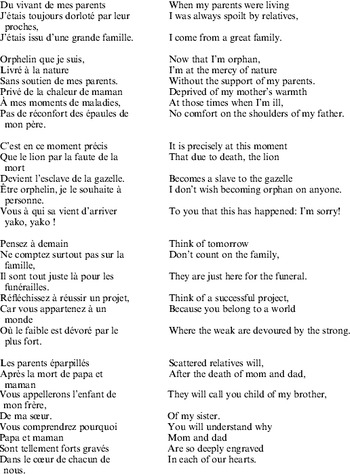
‘Kouyou’ thus laments the loss of parental support, as well as the loss of support from relatives. This is evident as these relatives call the orphan ‘child of my brother’ or ‘child of my sister’, implying ‘not my child’, which serves to emphasize the sense of abandonment in this song. The singer therefore calls on the orphan addressee not to count on relatives, but to think of a successful project, since ‘you belong to a world where the weak are devoured by the strong’ and where ‘due to death, the lion becomes a slave to the gazelle’. Other than providing advice, songs for orphans also provide consolation, adding to the cathartic functions of Zouglou.
In Zouglou, orphans are not only the symbols of the ‘abandoned generation’ but also an expression of the fear of what Collins (Reference Collins1994: 390) describes as ‘the quintessential disaster that can befall a human being: to be without close and caring family members’ (van der Geest Reference van der Geest2004: 438). These songs are not conceived to render homage to the deceased, even though many such songs exist in Zouglou. Instead, their emphasis is on the idea that orphans often suffer disproportionately through not only the loss of their parents, but also a lack of support from their relatives, and these songs evoke not only the consequent sense of isolation and rejection, but also the material hardship that accompanies it.
Significantly, Houphouët-Boigny was (and is) commonly referred to as ‘Le Vieux’, meaning ‘father’ in Ivoirian popular French. He had opposed the devaluation of the CFA franc, which was imposed in 1994 shortly after his death on 7 December 1993, and which halved the buying power of the Ivoirian population. As described above, the economic crisis entailed the cutback of social benefits and the dismantling of the Ivoirian ‘tropical welfare state’, at a time when employment in the formal sector crumbled. This implies that this generation of Ivoirians was orphaned by the simultaneous withdrawal of the state, along with the ‘Father of the Nation’. However, as evident from the song examples discussed above, Zouglou musicians do not ask for state resources, instead exhorting listeners to count on their own resourcefulness. The unprecedented economic crisis has profoundly influenced Zouglou music. It has become the bedrock of la Zougloutique, or the philosophy of Zouglou, which is about surviving hardship. The rapid and severe impoverishment of the Ivoirian population has had other far-reaching effects on Zouglou song texts, as discussed in the next section.
SONGS OF ENCOURAGEMENT: THE SOCIO-ECONOMIC CONTEXT OF ZOUGLOU MUSIC
Zouglou was born in a rough and brutal manner. But it is not a spontaneous music because spontaneous music is music which comes out of nowhere. However, Zouglou has its roots in the cultural, political and social evolution of Côte d'Ivoire. This is a fundamental point in the analysis of Zouglou. (Téhé Reference Téhé2008)
Any description of Zouglou music would be incomplete without a consideration of the impact that the economic crisis of the early 1980s has had on it: the theme of survival in the face of economic hardship has become one of the central concerns of Zouglou. As Adom notes, ‘these topics are the reflection of a certain break in Ivoirian society. … It hardly astonishes that this break appears through song: during a time of loss of references, only poetry makes it possible to express the emotions which people feel confusedly’ (Adom Reference Adom2004).
Côte d'Ivoire was often described as an economic ‘miracle’ in the 1970s but became a Highly Indebted Poor Country (HIPC) by 2009. According to Bogetic, Noer and Espina, there are two distinct periods in the recent economic history of Côte d'Ivoire: the period of growth from 1960 to about 1979 and the period of economic decline from 1980 to 2002 (Bogetic, Noer and Espina Reference Bogetic, Noer and Espina2007: 1). The first generation of Zouglou artists started university in the late 1980s and early 1990s. As mentioned earlier, not only was this generation at the forefront in demanding political pluralism in 1990, but they were also the ‘lost’ generation that came of age in a period of general economic decline. According to a recent World Bank report, Côte d'Ivoire's real GDP per capita in 2003 was about the same as in the early 1960s. Therefore, ‘the country has travelled a full circle from economic success to failure in little more than a generation’ (Bogetic, Noer and Espina Reference Bogetic, Noer and Espina2007: 1). As I remarked at the outset, it was the Zouglou generation that was most adversely affected by this impoverishment.
Furthermore, ‘having achieved a real GDP level of $1,379 per capita in 1978 (in 1995 US dollars), real output has fallen under $776 per head in 2002, which is lower than the $849 achieved in 1964. Consumption per head fell by half from 1979 to 2002’ (Bogetic, Noer and Espina Reference Bogetic, Noer and Espina2007: 2). Poverty has been a constant theme in Zouglou songs and the genre exposes how poverty and the loss of employment opportunities in the formal sector have affected Ivoirian youths. Many Zouglou songs have been termed songs of encouragement, encouraging listeners to persevere in the face of hardship. Additionally, the songs give advice to listeners not only on what course of action is fruitful in the long term, but also on what is morally acceptable. While being an art of marginalized youth, Zouglou does not express a rejection of society. Rather, it encourages those who are trying to find a way into society.
Asalfo, of the internationally famous group Magic System, explains:
Today we are singing ‘Rêve d'enfance’ (Childhood dream). In ‘Rêve d'enfance’, we recall a bit of our journey; we left the poor districts of Abidjan and here we are today. Therefore, to some people, Magic System is like their mirror: they say to themselves, they [Magic System] fought hard to succeed; it means that we can also be successful. So that's what Zouglou is all about: to give hope to those who have lost hope and to evoke people's problems: those problems that people carry in their heart and about which they can't open up. When we evoke these problems, it relieves them because when there's something on your mind, it wears you down, but when you open up about it, you are at peace. (Traoré Reference Traoré2008)

Even though this song does refer specifically to Magic System and their extraordinary story, it is also a quintessential ‘song of encouragement’. Like ‘Rêve d'enfance’, many such songs focus on the fact that those who are poor can become rich through hard work. The repetition of ‘dynamo’ in the chorus line refers to the idea of the dynamic unpredictability of life, a common feature of Zouglou songs of encouragement. Magic System, however, use real life examples, not just their own and that of their manager Angelo Kabila, but also those of President Laurent Gbagbo, reggae star Alpha Blondy, and football star Didier Drogba.Footnote 6 Remarkably, all but one of these models of success do not hail from the classic intellectual/political leadership sphere. As discussed above, since the 1980s the university has ceased to be an effective route for socio-economic advancement, with the disintegration of the ‘established equation between education, employment and social success’ (Banégas and Warnier Reference Banégas and Warnier2001: 6). Since then, musicians, athletes, religious leaders and brouteurs (Abidjanese slang for cybercriminals) have become role models and popular opinion leaders.
‘Tébé’ by Molière (Reference Molière2004) is a song of encouragement of a slightly different nature. Rather than focusing on poverty per se, it asks its listeners to think of what they have, since, according to Molière, others may have less. According to this song, a wealthy person may fall ill and wish to be as healthy as someone who may be quite poor otherwise. This song encourages its listeners to count on God; the title translates as ‘Asking God for help’. However, rather than encouraging passivity through reliance on the divine, the song encourages its listeners to work for their success.

While this song recommends work as the means to success, it is important to note that the term used, grouiller, denotes a certain type of work. Grouiller is in fact a nouchi (Ivoirian street slang) term that implies unstable, insecure and badly remunerated informal sector labour. The nouchi terms used for work in this song such as ‘se chercher’ and ‘grouiller’ entail certain philosophical connotations, such as ‘to find yourself’. Moreover, by designating informal sector work in particular, Zouglou artists comment on the effects of poverty and the loss of employment opportunities in the formal sector on Ivoirian youths. As a result of the economic crisis in Côte d'Ivoire, ‘modern sector employment fell by 14 per cent, employment in the informal sector more than doubled, and unemployment tripled’ (Grootaert Reference Grootaert1996: 81). By 1980, ‘the informal sector was smaller than the modern sector, but in 12 years it has become almost three times the size of the modern sector and now accounts for three quarters of urban employment’ (ibid.). Grootaert observes that ‘this appears to be an impressive growth rate in the midst of a protracted economic crisis’, but, as he points out, ‘there is little doubt that the informal sector hides a lot underemployment and low productivity work’ (ibid.). Work in this sector does not provide a substantial income and poverty among informal sector workers is widespread. In fact, he found that poverty incidence among informal sector workers (employees as well as self-employed) was the highest (26 per cent) of any urban group.
A sense of abandonment pervades the songs referring to the sacrificed generation and the songs for orphans, while the exhortations in these songs to endure suffering and to work hard in the hope of eventual success and individual self-betterment are echoed in the songs of encouragement. The apparent contradiction between the collective action of the student movement, the collective identity espoused in Zouglou music, and the individualism of the self-betterment idea may be regarded as a sign of the deepening crises, both political and economic, in Côte d'Ivoire. Yet, in the songs for orphans, a lament is also a protest against the given situation, while the alternative reality that the songs of encouragement aspire towards is never far from view.
Through Zouglou music, Ivoirian youths have asserted themselves as a group and demanded a way into the Ivoirian society, rather than its upheaval. This may seem to contrast with the student movement of the early 1990s, which presented a challenge to the prevailing political system itself. However, Zouglou artists have been extremely critical of the abuses of the political elite throughout the post-Houphouet-Boigny era, including the Bédié, Gueï and Gbagbo governments.Footnote 7 Recently, individuals close to the Gbagbo government, aware of the genre's popular appeal and symbolic power, have tried to recuperate Zouglou music for ‘patriotic’ political mobilization. In this manner, during the Ivoirian Crisis, an attempt was made to redirect Zouglou music's militant potential towards actors other than the government through political patronage. These circumstances might invite the interpretation that cultural entrepreneurship in Zouglou music and political entrepreneurship in rebellion or patriotic groups has become a key means for young men to generate income in the context of a failing formal economy. However, evidence suggests otherwise for both groups: except for a few ‘stars’ in each group, most participants have not been successful in gaining prosperity.Footnote 8 Indeed, a career in the music business has only provided a way out of precariousness for a minority of Zouglou artists; most have indicated that they cannot survive financially from their music, and some artists have set up enterprises, often bars or night clubs, to enable them to earn additional income. Copyright piracy has been a major concern for Zouglou musicians, and has been regarded as a threat to the very existence of the Ivoirian music industry. Zouglou artists, though often playing a major role not just as entertainers, but also as public opinion leaders, face the contradiction that their symbolic capital (cf. Bourdieu) has not readily translated into financial capital.
CONCLUSION
As I have shown in this article, Zouglou music has become a means of expression not only for university students, but also for a generation of youth who had to abandon their education prematurely. Accordingly, Zouglou has been regarded as the most significant art of the ‘sacrificed generation’. The many songs about orphans in Zouglou music can be read as a symbolic statement about the experience of this generation. Zouglou music has become an important platform through which this generation has been able to express their experiences, as well as a site for oral street poetry and collective catharsis. Zouglou artists have acted as cultural agents and as active producers of meaning, and they have become social commentators and transmitters of social knowledge. Zouglou artists have also created a discursive space to address a national audience, and to communicate their demands for social inclusion and intergenerational justice. Through their music, young Ivoirians have contributed to the formation of a cultural identity, as their music went from being the art of marginalized youth to become part of Ivoirian national culture. In other words, it is Zouglou music that, as a communicative medium, has allowed the ‘abandoned generation’ to ‘be visible, to be heard, to belong’ (Rosaldo Reference Rosaldo, Torres, Miron and Inda1999: 260).
SUPPLEMENTARY MATERIAL
The album cover of the CD Génération sacrifiée by the Zouglou group Les Salopards (1997) accompanies this article as supplementary material on the journal's website (http://journals.cambridge.org/afr).
ACKNOWLEDGEMENTS
This article was first drafted when I worked as a teaching fellow at the School of Oriental and African Studies (SOAS), London. I revised the article while I was working as a postdoctoral fellow at the University of the Witwatersrand, Johannesburg. The dissertation research upon which this article is based was supported by the Arts and Humanities Research Council (AHRC), the University of London Central Research Fund and the School of Oriental and African Studies (SOAS) Postgraduate Fieldwork Fund. I would also like to thank Graham Furniss for his support. I am indebted to the Ivoirian artists who took the time to respond to my many questions so thoughtfully. An earlier version of this article was presented at the Cadbury Fellows’ Workshop on Popular Culture and Urban Experience in Sub-Saharan Africa at the Centre of West African Studies, University of Birmingham. I would like to thank the participants and organizers of this workshop and conference for many stimulating discussions, and to thank Africa's anonymous reviewers for their comments on this article.



