

With the realisation that there is much to be learned through shared knowledge, the British Anaesthetic and Recovery Nurses Association (BARNA) sought to establish international associations with several professional perianaesthesia nursing organisations over the past nine years. This evolution was due in large part to BARNA Past Chairperson Pat Smedley’s 2002 connection with American Society of PeriAnesthesia Nurses (ASPAN) Past President Susan Shelander at an ASPAN national conference held in San Diego, California. Over the years, collegial relationship and mutual respect grew. The election of an International Representative to BARNA’s Governing Committee in 2007 is another step outward. Today, BARNA’s professional affiliations include Executive Committee representation with the International Federation of Nurse Anesthetists, ASPAN, Irish Anaesthetic and Recovery Nurses Association (IARNA), National Association of PeriAnesthesia Nurses of Canada (NAPANc), and interested practitioners from several European nations, Greece and New Zealand.
BARNA’s international nursing relations have emerged through ongoing communication between organisational leaders and participation at respective annual conferences. This regular contact has supported the sharing of typical practice models and care standards. Such involvement reveals that although perianaesthesia nurses encounter common experiences and challenges, actual nursing practice may significantly vary by cultural tenets and physical location. During the 2008 BARNA annual conference, a conversation among international attendees fueled interest in global perianaesthesia practice outreach. To that end, during ASPAN’s April 2009 national conference, a meeting was convened to explore interest in, and achievability of, a proposed international perianaesthesia nursing conference (Brady, Reference Brady2009).
Led by ASPAN Past President Susan Fossum, a group of representatives from BARNA, ASPAN, IARNA and NAPANc discussed goals for the development of a collaborative international perianesthesia conference. The meeting was followed by joint development of an online interest survey, which was posted during summer 2009 on the ASPAN website while concurrently being disseminated via a global e-mail contact list and through postcard distribution at several international nursing meetings (Brady, Reference Brady2009). Based on the survey results, the group’s discussion continues to move forward with a hope of holding the inaugural conference in Canada during the fall of 2011. This is quite an exciting prospect for broadening collective perianaesthesia nursing knowledge! BARNA leaders, as active participants, will keep its members informed on the international collaborative group’s progress as plans develop.
A Report from the 8th IARNA Conference
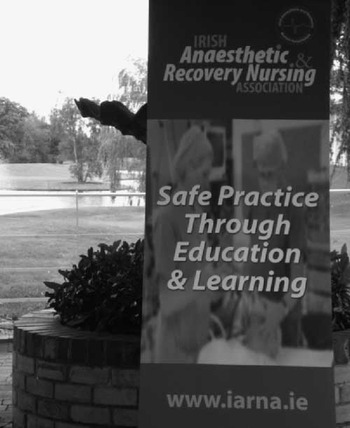
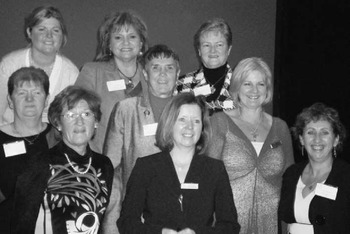
It was my honor to represent BARNA at the fall 2009 IARNA Annual Conference held in Dublin at the lovely City West Hotel. Situated on a lush green golf course, the venue offered a tribute to the Emerald Isle moniker (see Photo 1). Sincere gratitude is given to the IARNA Conference Committee for BARNA’s invitation to participate, and such gracious hospitality while together in Dublin (see Photo 2). The one-day ‘Back to Basics’ program focused on safety in perianaesthetic nursing practice. The curriculum was divided into three sessions with a different chairperson serving as moderator for each three-speaker grouping. Time was permitted for an audience question and answer period at the conclusion of each session’s presentations. I found this format to be particularly valuable for clarifying and strengthening salient points presented, and for the opportunity to share broader geographic perspectives on related care delivery paradigms. Session topics ranged from the alternatives to general anaesthesia and perioperative pain management, to surgical consent issues, to post anaesthesia care unit complications and health service preparedness for disaster emergency response and pandemic flu. A summary of selected safety-related sessions follows.
The City West Hotel Conference Center. Safety in practice: IARNA’s 8th Annual Conference focus.

International Colleagues Together in Dublin. From left: IARNA Conference Organiser Phil Lohan; IARNA Treasurer Aoife Buckley; IARNA Immediate Past Chairperson Fionuala O’Gorman; BARNA Representative Joni Brady; ASPAN Past President Lois Schick; IARNA Chairperson Grainne McPolin; AORN Past President Sharon McNamara; IARNA founder and Web Manager Sheila Murphy; Assistant IARNA Conference Organiser Caroline Tracey.

Opening Address: Dr Anne-Marie Ryan
The conference began with an excellent address delivered by Dr Anne-Marie Ryan, Chief Education Officer, An Bord Altranais (the Irish Board of Nursing). Dr Ryan, a former medical–surgical nurse specialising in oncology, has served as the Board’s Chief Education Officer since 2001. The primary goal of her team is to establish professional standards and education requirements for nurse and midwifery education in Ireland. In addition to describing the important work of An Bord Altranais and domains of professional competence, she discussed implications of the 2008 Madden Report, Building a Culture of Patient Safety, published by the Commission on Patient Safety and Quality Assurance (Madden et al., Reference Madden2008). Dr Ryan emphasised the need to ensure patient safety through strong health care governing structures, more clinical auditing supported by senior leadership, and a sound structural incidence reporting system (Ryan, Reference Ryan2009). She concluded by highlighting the importance of professional standards to guide safe care and praised specialty nursing organisation efforts to develop more evidence-based standards of care.
Consent Issues Arising in the Surgical Setting: Ms. Aisling Gannon
Obtaining a valid consent is an essential antecedent to any surgical procedure. Ms Aisling, a qualified solicitor and member of the Academy of European Law and Irish Healthcare Risk Manager’s Association, discussed various aspects of obtaining a full, free and informed consent. She pointed out that the World Health Organisation’s (WHO) Time Out procedural guidelines support consistent adherence to the surgical consent process. She then shared practical advice for perioperative nurses to incorporate into practice in the event of an unforeseen occurrence. The suggested steps are: document the incident, your role in the process and what you did in response to the incident. Participate in a team discussion, which should be led by the surgeon, to communicate and debrief the incident and then coordinate how and when the patient and next of kin will be notified regarding the event (Gannon, Reference Gannon2009).
Introduction to Time OUT: Ms. Sharon McNamara
Ms McNamara is a Past President of the Association of periOperative Registered Nurses (AORN) and a Director of Surgical Services in Raleigh, North Carolina, USA. Her presentation outlined some high-profile cases involving major surgical errors. These sentinel events serve to frighten and enrage health care consumers while placing the organisation at fault under intense media scrutiny. Ultimately, grievous surgical errors garner a loss of public faith and respect and cause financial loss to the liable parties. Such errors often result from poor adherence to the surgical preparation process. The WHO Safe Surgery Saves Lives initiative and adoption of its surgical checklist, including a crucial pre-incision Time Out phase, takes aim at eliminating the human error in surgical care processes. Since the surgical checklist’s inception in most organisations, theatre nurses have been given the responsibility to document the Time Out. Ms McNamara presented strategies for enforcing Time Out in the often difficult multidisciplinary culture found within the operating theatre. One successful measure involves leaving the scalpel off of the instrument tray and unavailable to the surgeon until Time Out has been thoroughly completed. She stressed the need for theatre nurses to be unafraid to speak out and advocate for the patient when the Time Out process is disregarded or not taken seriously by other surgical team members (McNamara, Reference McNamara2009). Patient safety is paramount. No one entering a surgical facility should become a headline because the wrong kidney or limb was removed. The responsibility to enforce the Time Out process requires a shift in both thinking and action by nurses historically silenced by the sometimes toxic theatre culture and fear of reprisal.
Poster Presentations
One of my favorite aspects of attending international conferences is reviewing the poster presentation displays that showcase the unpublished research efforts of perianaesthesia colleagues. This very work, often having taken place at the bedside by clinical nursing practitioners, helps to build a body of evidence to substantiate care practices and standards. IARNA, having international poster submissions, hosted a best poster contest using international nurse judges in attendance. The poster subjects included: malignant hyperthermia; a study on minimum volume of blood wastage from arterial lines; time out; waking up to quality patient care; a nurse led multidisciplinary change in practice to improve perioperative patient safety; a measurement of traceability compliance in the use of red cells; and simple interventions that lead to enhanced patient outcomes reducing the rate of catheter-related blood stream infections (IARNA, 2009). BARNA encourages members to submit posters reflecting audits performed in your facility for its 2010 conference in Manchester. For more information on BARNA conference poster presentations please contact info@barna.co.uk.