1. Introduction
In this paper, I explore the economic relation governing the institutional structure of production (ISP) as originally described by Coase (Reference Coase1937). To do so, I focus on the period between 1930 and 1950, when Coase's intuitions were first developed and the debate between ordinalists and cardinalists ensued until the dominance of the ordinal approach by the mid-50s.
The central argument of the paper runs as follows: economic analysis was placed into an ‘institutional vacuum’ and firms and consumers became black boxes when cardinal ‘utility theory’ (originally ‘value theory’) was replaced by the Slutsky–Hicks–Samuelson (SHS) ordinal ‘expenditure theory’ (neoclassical price theory based on compensated demand functions). Thus, the ordinalists’ obsession to drop ‘the last vestiges of the utility analysis’ (Samuelson, Reference Samuelson1938: 62) permitted legitimate normative conclusions based solely on observable purchasing behaviour, while reducing economic actors to the status of passive black boxes. In fact, in the SHS ordinal world actors cannot transact or purchase resources, only services. This guarantees that utility in expenditure (the direct problem in the SHS approach) can be inverted into utility in consumption or in use. However, the absence of resources administered at the actor level conceptually turns consumers and producers into rational, dis-embedded black boxes.
Approached from the ordinal-cardinal debate, Coase's conclusions on the ISP have multiple interpretations. TC become necessary and sufficient to explain the ISP only in the ordinal SHS framework, where all actors share the same objective opportunity costs in exchange and use. Conversely, in a cardinal approach where actors exchange and control resources, subjective opportunity costs in use do not necessarily coincide with objective opportunity cost in exchange (market price) and TC are never sufficient (and maybe unnecessary) to explain the ISP. This is the approach of early Austrians such as Menger and Wieser, who kept subjective value in use distinct from objective exchange value. In general, TC cease to be a necessary and sufficient condition in the ISP when productivity (marginal cost) is treated as an economic (therefore institutionally-embedded) characteristic of a resource, rather than as a technological (therefore dis-embedded) characteristic of the production process.
Additionally, I show how interpretations of TC and opportunity costs vary according to the unit of analysis adopted. For instance, Coasean TC apply to subjective opportunity costs in cardinal value theory, while neoclassical frictions apply to objective prices in exchange theory. This in turn redefines the concept of ‘asset specificity’, first introduced into economic analysis by Wieser (Reference Wieser1930 [1889]). Consistent with Coasean TC, specificity is an institutionally embedded characteristic of a good in cardinal value theory, but loses meaning under the SHS ordinal approach. This is in direct contrast with the accepted interpretation of ‘specificity’ in both Transaction-Cost Economics (TCE) and OE.
I further revisit the conceptual relation between the nature of the firm and central planning. Contrary to accepted interpretation, I suggest that the (Coasean) ‘nature of the firm’ and socialist central planning are two antithetical concepts. The latter is only explained by the SHS ordinal paradigm, where socially scarce resources are directly allocated to different uses and not distributed to heterogeneous users. Yet, when ‘allocation’ happens at the social level firms’ heterogeneous rights and capabilities (in use) necessarily become irrelevant. This makes central planning and complete market decentralization two (perfectly consistent) extremes of the same framework, where both ‘scarcity’ and opportunity costs are defined at the social (not individual) level and exchange and use values conflate.
I thus suggest a dichotomy based upon Adam Smith's contraposition of use and exchange values, contrary to the usual dichotomy of firms and markets. While adaptation through transactions (market exchanges) occurs whenever the relevant opportunity cost of an actor is the objective market price, adaptation through internal redeployment (administration in use) occurs when her opportunity cost is given by the value of an alternative employment. Clearly, the latter can only occur when actors have some control or power over the resources they employ.
The paper proceeds as follows: section 2 defines the Coasean relation of the ISP; section 3 provides a brief overview of the 1930s welfare debate and discusses how the new ordinal (Edgeworth–Pareto (EP)) approach to normative economics, as refined by SHS, eventually overtook Cambridge welfare economics; section 4 discusses the subjectivist critique of Cambridge welfare economics advanced by positivists (such as Lionel Robbins), consistent with the subjectivist approach of early Austrians; section 5 provides an interpretative framework for the definition of opportunity costs and TC; section 6 reinterprets Coase's ISP, showing the different approaches to result in different interpretations of the origins of economic institutions; section 7 shows that the necessary and sufficient condition to re-introduce institutions into economic analysis is to keep Adam Smith's distinction between use and exchange values (costs), in a way that is consistent with how accountants treat ‘costs’; section 8 concludes with the implications for the fields of ‘Law and Economics’ (L&E), TCE, and property-rights in OE.
2. The institutional structure of production redefined
In his seminal paper, Coase (Reference Coase1937) provides a concise answer for how production is organized within a social system (p. 396);
If there are two firms (A and B):
‘A therefore will take over the whole of B's organisation only if his cost of organising B's work is not greater than B's cost by an amount equal to the costs of carrying out an exchange transaction on the open market’.
Hence, activity k is allocated to firm A if [CA < (CB + TCk)], or: [(CA − CB) < TCk]. CA and CB represent, for firms A and B respectively, the costs of operating k internally, while TCk defines the TC associated with activity k. Thus, the relation (ΔCAB < TCk) summarizes ‘the way in which the activities undertaken within an economic system are divided up between firms’ (Coase, Reference Coase and Fuchs1972a: 60) or the ISP.Footnote 1
From the previous relation, two implications follow.
First, the relation has not one but two degrees of freedom, as no single term alone is necessary and sufficient to explain the ISP. Second, it suggests that TC and ΔCAB are commensurable as both variables must refer to the same economic mechanism with respect to time frame and unit of analysis.
Concerning the first implication, it follows that the mere presence of positive TC is not sufficient to understand how activity k will be allocated between firms A and B as long as they operate under two different production conditions so that: [CA ≠ CB].Footnote 2 Moreover, if ΔCAB depends on the institutional context, and in a particular institutional setting [CA > CB], while in another [CA < CB], both with respect to the same activity k (other things being equal), then production in the two contexts will be organized differently even when TC are absent.
Still, TC becomes the necessary condition when ΔCAB is a constant (dis-embedded) parameter. In the extreme case where firms share the same costs in production (ΔCAB = 0), TC becomes both necessary and sufficient for understanding how activities are allocated among actors. Here the relation defining the ISP becomes (TCk > 0), and firm A will internalize activity k if and only if markets fail.
Thus, the role of the ‘transaction term’ TCk in the ISP depends on the way ΔCAB is interpreted and modelled. For this reason a proper understanding of the mechanism behind the ISP must begin with a correct interpretation of the two terms in the above relation.
The works of Allen (Reference Allen, Bouckaert and Geest2000), Klaes (Reference Klaes2000) and Langlois (Reference Langlois2006) represent in-depth analyses of the nature and meaning of the sole transaction term TC. Conversely, Buchanan (together with Medema, Reference Medema1994) focus primarily on the way Coase interprets the concept of opportunity costs (Buchanan, Reference Buchanan1969: 26–29; Reference Buchanan and Medema1995; Buchanan and Thirlby, Reference Buchanan and Thirlby1973).
I am not aware of any systematic enquiry into the two ‘institutional terms’, with regards to their specific role in determining the ISP, and their conceptual relationship in economic theory. This is quite striking given that Coase's (Reference Coase1988b: 10–11 and 37–40; Reference Coase1990: 10–11) first motivation for investigating vertical and lateral integration also derived from his interest in how different organizational arrangements affect firms’ production costs. Moreover, an economic theory explaining the way activities are divided among productive entities was readily available since the beginning of the 19th century, namely the well-known Ricardian doctrine of comparative costs (DCC), summarized by Gottfried Haberler as follows (Reference Haberler1936 [1933]: 141):
‘. . .a good will not be exported or imported unless the difference in its cost of production between the two countries exceeds the cost of transporting it from one to other’.
Stated differently, country A will undertake the production of k internally (vis-à-vis country B) if: (ΔCAB < TCk).
Obviously, the meaning of the two Ricardian terms is very different than those of Coase. Though strikingly similar, the key explanatory term in Ricardo's DCC has always been the production term ΔCAB and not TCk (defining transport costs).
It is therefore time to take stock, so to understand why and how the course of economic theory progressively shifted from a comparison among three not-sufficient, and potentially non-necessary, variables (CA, CB and TCk) to Coase's (Reference Coase1992: 717) influential conclusion on the necessity of looking predominantly (maybe exclusively) at TC: ‘let us study the world with positive transaction costs’.
3. The welfare debate revisited: cardinalists versus ordinalists
Coase's motivation to understand the economic drivers behind firms’ vertical and horizontal integration mainly derived from the socialist planning debate: ‘How did one reconcile the impossibility of running Russia as one big factory with the existence of factories in the western world?’ (Coase, Reference Coase1988b: 8). Bylund (Reference Bylund2014) illuminates the influences of this debate on Coase's ideas, focussing on his relationship with his (positivist) professors at the London School of Economics (LSE), including Robbins and Hayek.
Yet, the debate over socialist planning constitutes but one aspect of a much broader controversy on the role of subjective (and cardinal) utility in economic analysis in the 1930s and 1940s.Footnote 3 As a result, I identify two stages in the debate concerning the legitimacy of ‘normative’ welfare economics, consistent with the contextual development of utility and value theory.
The 1934 ordinal revolution: from cardinal utilities to ordinal ‘compensated’ isoquants
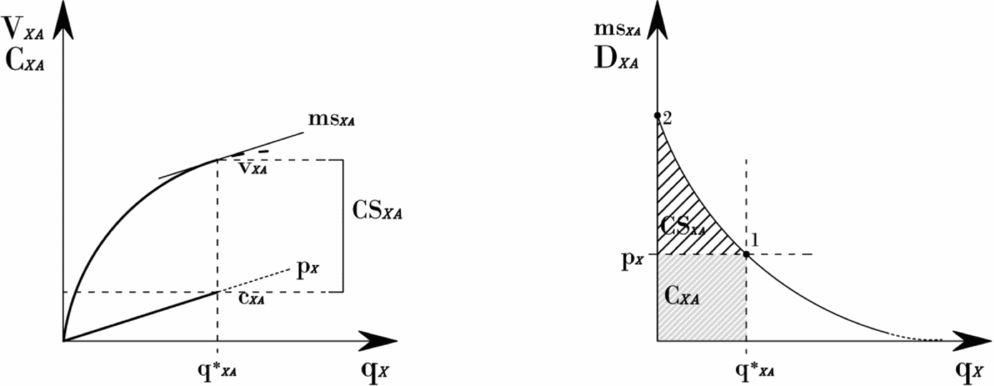
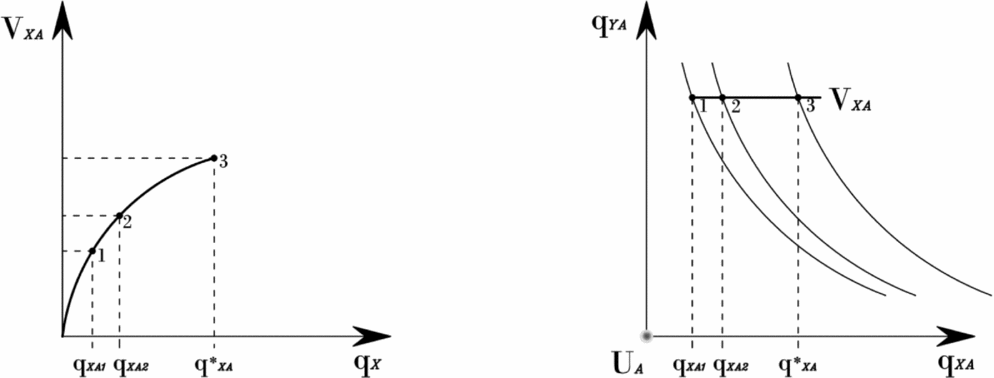
Before 1934, Cambridge (Pigouvian) welfare economics relied on the Marshallian concept of consumer surplus and on interpersonal comparison of utilities (Figure 1).
Independent Utility (VXA) and cost (CXA) curves in the Marshallian framework.

The Cambridge welfare relation with respect to the consumption of good X by the part of A, denoting ‘consumer surplus’ (CSXA) can be summarized as:
 \begin{equation}
{\rm CS}_{{\rm XA}} = \left[ {V_{XA}^* - C_{XA} } \right] = \left[ {V_{XA}^* - {\rm p}_{\rm X} q_{XA}^* } \right],\end{equation}
where (CXA = pXq*XA) represents the total cost incurred by actor A to purchase X at market price pX, while the optimal level of consumption (q*XA) is reached when marginal satisfaction equals marginal cost (msXA = pX). Thus, CSXA is a (monetary) measure of the welfare of individual A for the consumption of good X.
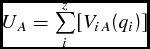
From 1934, with the rediscovery of Slutsky (Reference Slutsky1915) article by Hicks and Allen (Reference Hicks and Allen1934) and Schultz (Reference Schultz1935),Footnote 4 Cambridge cardinal welfare economics in partial equilibrium was replaced by the EP framework in general equilibrium using generalized utility functions (UA in Figure 2).Footnote 5 Yet, differently from the original EP approach, the Slutsky–Hicks (SH) ordinal revolution shifted the analysis from the original utility function to the ‘expenditure function’ derived from compensated demand curves. In this new SH ‘compensated world’, the utility deriving from the efficient consumption of a good (as was the case among early marginalists), is replaced by the utility deriving from the ‘efficient use of the consumer's purchasing power’ (Mas-Colell et al., Reference Mas-Colell, Whinston and Green1995: 58), or in other words, by the utility of income deriving from the efficient purchase of goods, obviously measured in monetary terms.Footnote 6
(Left) Cardinal independent utility of good X (VXA). (Right) EP isoquants where the cardinal distance between isoquants matters. The generalized utility of actor A (UA) is now on the third axis, perpendicular to the page sheet.
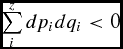
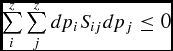
To guarantee univocal correspondence between utility in expenditure and utility in consumption, ‘rationality’ entered economic analysis in the form of Samuelson's (Reference Samuelson1938) ‘weak axiom of revealed preferences’, implying the well-known condition of non-intersecting isoquants. Though the latter is usually explained as non-coherent or non-consistent behaviour, non-intersecting isoquants (identifying rational behaviour) imply a much stronger assumption: a consumer cannot potentially receive different utilities in consumption from the same bundle of purchased goods or, stated differently, each point on the expenditure curve must univocally map to a point on the utility curve. Thus, in the SH ‘compensated’ world, actors are really consumers of goods, not users nor administrators.
This is essentially the heritage of the SH ‘compensation effect’, or the SHS ordinal revolution.Footnote 7
Rationality, expenditure function and the feasibility of socialist planning
Once non-intersection of isoquants is accepted, the ordinal SHS framework becomes watertight and its extension to normative economics follows immediately. For this reason, while pre-1934 normative economics was substantially Cambridge welfare economics, what has developed since can be renamed ‘welfare economics of the expenditure function’ (WEEF).
Three different applications of WEEF can be identified.Footnote 8
First is the ‘social welfare function’ approach (Bergson, Reference Bergson1938; Samuelson, Reference Samuelson1947: chapter 7; Reference Samuelson1950; Reference Samuelson1956), which developed from Barone's 1908 paper, first translated to English by Hayek (Barone, Reference Barone and Hayek1935). This contribution was eventually refined by Lange (Reference Lange1942) to provide a solution to the problem of the optimal centralized allocation of resources. What is usually referred to as ‘the socialist debate’ falls within this category (Bergson, Reference Bergson and Ellis1949; Hayek, Reference Hayek1940). Second is the Kaldor–Hicks–Scitovsky ‘compensation test’, also defined as ‘New-Welfare Economics’. Key works are Kaldor (Reference Kaldor1939), Hicks (Reference Hicks1939) and Scitovsky (Reference Scitovsky1941), all of which represent a defence and a correction of Pigou's original approach to taxation within a ‘compensated framework’. Last are the works in partial equilibrium on monopoly power and the optimal pricing of utilities (Hotelling, Reference Hotelling1938; Lerner, Reference Lerner1934).
By the early 1940s, the new ordinal approach could place Pigou's welfare economics on a much safer basis, justifying normative conclusions on the optimal allocation of resources in general equilibrium while avoiding the inter-personal summation of utilities. Thus, by the beginning of the 1940s Russian socialist planning had become (at least theoretically) feasible and fully justified, as shown in the works of Lange (Reference Lange1942) and Lerner (Reference Lerner1944) (see Bergson, Reference Bergson and Ellis1949).Footnote 9
I now return to Coase. First, it should be underlined that all three developments of the ‘welfare economics debate’ influenced Coase's ideas to some degree, and not solely the central planning debate (Coase, Reference Coase1988a: chapters 1 and 6).Footnote 10 Second, Coase developed his paper between 1932 and 1934 (Coase, Reference Coase1988b: 19), thus before the SHS ordinal revolution, and apparently initially sharing the normative position of Lerner and Lange, while opposing Mises, Robbins and Hayek's positivist approach (Coase, Reference Coase1988b: 8; Reference Coase1993: 248–249).
Still, a clear contradiction arises here, since Coase never clearly adopted the Paretian ordinal approach, in sharp contrast with Lerner and normativists in general. For example, in the ‘Marginal Cost Controversy’ Coase adopts a critical position towards the Hotelling–Lerner interpretation of marginal cost rule (Coase, Reference Coase1988a: 16–19; Medema, Reference Medema1994: chapter 3). The same is true for his position towards the Kaldor–Hicks compensation test (1988a: 159–163). This contradiction is also highlighted by Bylund (Reference Bylund2014).
As we shall see, the answers to these contradictions lay in the way the two terms composing the ISP (ΔCAB < TCk) are interpreted by early Austrians (subjectivists) and ordinalists.
4. The forgotten story: utility and wants in the subjectivist approach
The most famous critique of Cambridge welfare economics and inter-personal comparison of utility was not conducted by a Paretian ordinalist, but by Coase's boss at the LSE in the 1930s, Lionel Robbins (Reference Robbins1935 [1932]). Robbins was certainly not an ordinalist (Robbins, Reference Robbins1953). Conversely, his critique to Cambridge normative economics retraced the approach adopted by early subjectivists such as Wieser (Reference Wieser1930 [1889]) and Wicksteed (Reference Wicksteed1910).Footnote 11
More generally, all Austrians trained by Menger were done so in the subjectivist tradition (Horwitz, Reference Horwitz, Samuels, Biddle and Davis2003), though their original approach remained genuinely cardinal, consistent with those of all other early marginalists (Moscati, Reference Moscati2013b; Reference Moscati2013c). Yet, the fundamental difference between Marshall and Walras’ works and those of Menger (Reference Menger1981 [1871]) and his students is a clear distinction, among Austrians, between subjective value in use (‘natural value’) and objective value in exchange (market price). In fact, all early Austrians dedicated the first chapters (or sections) of their works to the equilibrium, and the behaviour, of the single economizing man administering his goods (Böhm-Bawerk (Reference Böhm-Bawerk1891); Menger, Reference Menger1981 [1871]; Wicksteed, Reference Wicksteed1910; Wieser, Reference Wieser1930 [1889]). This was Menger's (Reference Menger1981 [1871]: chapter 1) ‘general theory of the good’.Footnote 12
The distinction between (subjective) utility from (objective) exchange value mainly derives from the fact that Menger interpreted the law of diminishing utility in a fundamentally different way than both Marshall and Walras. This difference derives from the former's specific interpretation of the relationship between wants, utility and value, associated to the administration of a given good by the ‘economizing man’.Footnote 13 Specifically, in Menger's value theory, the economizing man acquires a specific good, and it is the administration of the good that places the actor in a condition to satisfy some of his wants. The value of the good then becomes the value of the last want that the limited capacity of the good (CPXA) is able to satisfy.
This can be better appreciated if the Austrian subjective welfare relation is placed in comparison with the Cambridge one.
For each capacity-unity cpuAi, the administrator faces a service-specific economic problem defined as (V*XAi − ms XA(i + 1)cpuXAi), where ms XA(i + 1) is the marginal satisfaction of the (second-best) foregone service while employing X in service ‘i’ (Figure 3).
Austrian (subjectivist) marginal problem: The marginal opportunity cost of each service corresponds to the marginal satisfaction of the best foregone alternative: ms XA(i + 1) is actor A marginal opportunity cost, while using good X in service i and so forth. At capacity CPXA, the marginal service has (marginal) value msXAm. Each capacity-unity ‘i’ (cpuXAi) defines the portion of total capacity dedicated to service i.
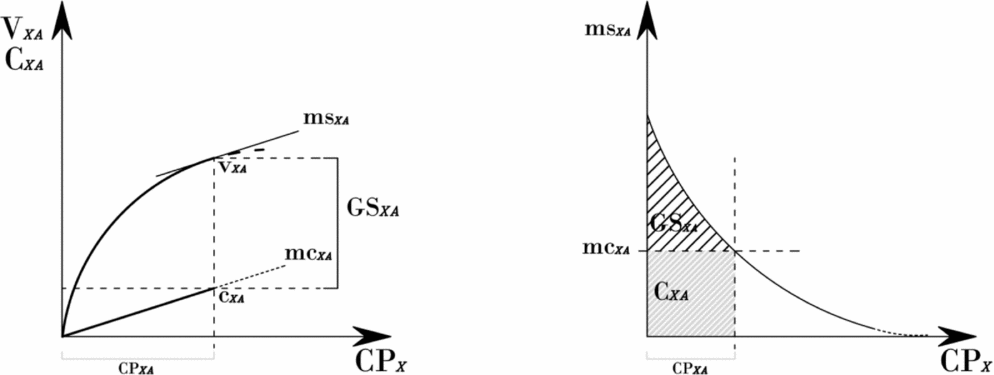
With some simplifications, or in the common case (also assumed by TCE) where the productive capacity of the good is fully dedicated to one single service (m), Austrian subjective value theory can be summarized by the simple (subjective) welfare relation (Figure 4):
 \begin{equation}
GS_{XA} \approx \left( {V_{XA}^* - C_{XA} } \right) = \left( {V_{XAm}^* - ms_{XA\left( {m + 1} \right)} cpu_{XAm} } \right) = \left( {V_{XA}^* - mc_{XA} CP_{XA} } \right).\end{equation}
The subjectivist welfare relation according to Wieser's imputation theory. The new subjective marginal equivalence is now given by (msXA ⩾ mcXA), with  $( {mc_{XA} \mathbin{\lower.3ex\hbox{$\buildrel>\over{\smash{\scriptstyle<}\vphantom{_x}}$}} p_X } )$.
Relation (2) constitutes the equivalent of the Cambridge welfare relation in value theory. However, while the cost term in both the Cambridge and Lausanne schools is a function of the objective market price (pXq*XA), this is no longer the case in the Austrian subjectivist approach, where CXA is now a function of the actor idiosyncratic service set, given the capacity CPXA. In fact, the marginal opportunity cost of using good X (mcXA) is now ms XA(m + 1) (with ‘m’ defining the marginal service) and the latter can now assume any possible value ranging from zero to msXAm, including the relative market price pX. For this reason GSXA can be defined as (subjective) ‘good surplus’ as opposed to the Marshallian (objective) ‘consumer surplus’ CSXA.
The subjectivist interpretation of opportunity cost constitutes the cornerstone of the Austrian ‘opportunity cost doctrine’ which is at the basis of the subjectivist theory of value (in use). Clearly, the distinctive aspect of Mengerian subjectivist approach, compared to Cambridge and Lausanne marginalism, derives from the fact that the unit of analysis for subjectivists is the single (three-dimensional) good, endowed with a given capacity CPX. Thus, actors administer capacity-goods (in consumption or production), and do not purchase infinitesimal quantities of productive services. Not surprisingly, Austrians’ economizing man is first and foremost an administrator, not a consumer.
The role of opportunity costs in Weser's imputation theory and the birth of asset specificity
From equation (2) it is possible to distinguish between different types of goods, based on the value of the resource's opportunity cost for actor A.
Consistent with Wieser (Reference Wieser1930 [1889]: book V) we can distinguish ‘cost goods’ (mcXA > 0) from ‘monopoly goods’ (mcXA = 0), defined by the author as the ones that ‘are specific elements of individual industries’ (1930: 108; emphasis original). In effect, Wieser's ‘monopoly good’ is nothing but Williamson's ‘asset specificity’. To see this, note that GSXA is simply:
 \begin{equation}
{\rm GS}_{{\rm XA}} = \left( {V_{XAm}^* - V_{XA\left( {m + 1} \right)}^* } \right),\end{equation}
where [V*XAm(mcXAm)] is the overall value of the good employed up to the marginal service ‘m’, and (V*XA(m + 1) = ms XA(m + 1)CPXA) is the foregone value obtained by redeploying the good in its second-best service.
Thus, GSXA is a measure of the degree of specificity of good X for actor A, when the marginal employment is given by the service Am. This is consistent with both Williamson's definition of specificity,Footnote 14 and the way mainstream OE defines ‘asset specificity’ (Holmström and Roberts [Reference Holmström and Roberts1998: 76]; Segal and Whinston [Reference Segal, Whinston, Gibbons and Roberts2013: 117]).Footnote 15 If a completely dedicated good has no value outside the specific employment as is the case for Williamson's ‘asset specificity’, then (ms XA(m + 1) = mcXA = 0), which is Wieser's monopoly good. Thus, GSXA is a measure of ‘good-specificity’ for actor A, which is the correct reinterpretation of Marshallian's surplus when actors administer capacity-goods.
Not surprisingly, the first economist to employ the concept of asset specificity to explain how production is organized within a social system was one of Wieser's students: Gottfried Haberler (Reference Haberler1936 [1933]: chapter XII). Haberler employed the concept developed by his teacher in ViennaFootnote 16 to explain when trade, under the DCC, breaks down, namely, when there are specific factors of production that can only be employed by some countries (see also Haberler, Reference Haberler1950).Footnote 17
In conclusion note that the economic problem in value theory (equation (2)) puts in relation two demand-driven values; there is no supply-driven price appearing in it. The original claim by Austrians that demand is the only primitive in economics is thus vindicated.
5. Transaction costs and opportunity costs: an interpretative framework
In contrast to frameworks where actors’ marginal costs are treated in terms of total expenditures in purchase (making value in use identical to value in exchange)Footnote 18 in frameworks where actors can administer capacity-goods, exchange can assume two different meanings depending on the ‘thing’ being transacted on the market.
First, two actors can simply transact a specific service, leaving ‘command’ of the goods (ownership or control rights) untouched, so exchange becomes an additional (valuable) option where A employs the capacity of the good while still keeping it.Footnote 19 In this case a market transaction occurs because A rents (the rights to use) part of the capacity to someone else either directly (if the counterpart uses the spare capacity herself), or indirectly (if A employs the good in order to sell a specific service on the market). The transaction in this case derives from the way (the capacity of) good X is employed by A. For this reason, this type of transaction is part of value theory. Second, the good itself can be re-allocated among actors, with transactions deriving from this redistribution. While the first situation defines allocation of a good to different services (uses), the second implies distribution of a good to different users.
The above retraces the Austrian distinction between subjective and objective exchange values. Although Austrians did not put it in these same terms (Böhm-Bawerk, Reference Böhm-Bawerk1891: 166–169; Wieser, Reference Wieser1930 [1889]: book II), it is useful to maintain the same classification: the former being the subjective satisfaction deriving from the indirect use of the good, while the latter being the objective value of the good, or its market price.
From the above, some interesting considerations follow.
‘Subjective exchange’ in value theory reflects the Coase–Alchian–Cheung ‘property rights approach’ to transactions and TC (Allen, Reference Allen, Bouckaert and Geest2000: 897–900). Thus, it is possible to interpret the set of services/uses as A's use rights on good X. The distinction between objective and subjective exchange retraces the distinction between neoclassical frictions and Coasean TC; while TC in value theory is associated with an actor's specific use rights (as in the property-right approach), TC in exchange theory derives from the ‘transfer of property rights’ between users (Allen, Reference Allen, Bouckaert and Geest2000: 901). Similarly, while opportunity costs in value theory are subjective and derive from the specific way in which a good is employed, opportunity costs in objective exchange theory are associated with the good's market price.
Hence, while neoclassical (ordinal) frictions affect the objective opportunity cost of a resource, Coasean (cardinal) TC affects the subjective opportunity cost of a single service (or use right).
From this, it is possible to provide a coherent framework for the classification and definition of both opportunity cost and transaction cost. In value theory marginal opportunity cost is defined as the subjective value of the most valuable foregone use rights, while TC affects (and adds to) the subjective cost deriving from the transaction of a specific use of the good. In this case, TC is positive if the cost sustained by the ‘purchaser of the service’ is greater than the value of the alternative employment that was scarified by the counterpart in order to implement the required service. In objective exchange theory marginal variables are associated with the market value of the good for the marginal user. In this case, marginal opportunity cost corresponds to the good's objective exchange value, which is its market price. Here, TC derives from the physical transaction of the good between individuals (such as tariffs or transport costs), and add to the cost deriving from the acquisition of the good, not from its use. Thus, while value theory is associated to the allocation of a good's capacity, exchange theory derives from the distribution of the good.
Clearly, distinctions between private and social marginal opportunity costs and between Coasean and neoclassical frictions become meaningless if consumption and purchase are treated as interchangeable concepts (rendering ‘allocation’ a synonym of ‘distribution’). This may explain the usual conflation of ‘frictions’ and ‘transaction costs’, also affecting TCE, as remarked by Langlois (Reference Langlois2006). Moreover, this also clarifies the nature of the difference between Ricardian DCC and Coasean ISP (ΔCAB < TCk); the former deals with ‘objective exchanges’ of goods (involving market prices), while the latter deals with the subjective side of transactions (use rights). Not surprisingly, TCk in the DCC represents proper market frictions such as melting-iceberg-type transport costs.
Though the previous analysis interprets marginal variables as ‘use rights’, consistent with the literature in L&E, the conclusions are exactly the same adopting a managerial perspective that interprets marginal variables in terms of ‘capabilities’. In the first case an actor's opportunity set has legal origins, while in the second it has cognitive or cultural origins. Still, both have institutional origins and ultimately denote the power or status of an actor operating within a socio-institutional system (what she can or is able to do if endowed with a certain resource).
In conclusion, note that GSXA (the degree of asset specificity [V*XA − mcXACPXA]) is not a technological (dis-embedded) concept, differently from Marshall's CSXA. Resource X is specific for actor A in a specific institutional context according to the legal (and ‘cognitive’) status of A, from which her subjective opportunity cost (mcXA) ultimately derives. The same holds for productivity. Ultimately, there is no such thing as ‘technological specificity’.
With these concepts elaborated, I move to analyse Coase's ISP.
6. The institutional structure of production revisited
From here onwards, I switch to production, taking the firm as the unit of analysis. Thus, marginal satisfactions in consumption should now be interpreted as marginal revenues in production (mrX).
To bring the present analysis close to Coase's original description of the firm's problem (Reference Coase1937), I assume there are two firms (A and B) employing the same resource X in production, having market price pX. The former currently implements service A, while the latter employs X in B. A and B are thus interpreted as two firms operating on different layers of the supply chain as is commonly the case. In this simple scenario the economic problems of firms A and B in objective exchange (3) and subjective value (4) theories, are given by:
 \begin{equation}
\mathop {\max }\limits_q \left[ {{\rm V}_{Xf} \left( {q_{Xf} } \right) - {\rm p}_{\rm X} q_{Xf} } \right] \approx \left( {mr_{Xf} - {\rm p}_{\rm X} } \right)q_{Xf} ,\end{equation}
 \begin{equation}
\mathop {\max }\limits_{mr_X } \left[ {{\rm V}_{Xf} \left( {mr_{Xf} } \right) - mc_{Xf} CP_{Xf}^{*} } \right] \approx \left( {mr_{Xf} - mc_{Xf} } \right)CP_{Xf}^{*} ,\end{equation}
where f defines the type of firm considered, whether A or B, equation (3) represents the usual profit function of a firm, and relation (4) defines the subjective marginal problem as described in section 4.
Now, let us assume that a new productive activity k becomes available, with relative marginal revenue (mrXk > mrXf), and that both firms can potentially redeploy their resource X to undertake k. This opportunity can arise because of a change in the economic, institutional or technological context, such as de-regulation. So the problem now becomes: should firm A redeploy resource X from A to k, knowing that A can easily delegate it to B? This ‘ex-post adaptation problem’ is exactly the one described by Coase (Reference Coase1937: 387) who ponders ‘should workman A move from unit X to unit Y?’,Footnote 20 where workman A is resource X and Y is the new productive need the firm faces (the new activity k). Stated differently, we want to understand ‘the way in which [activity k] undertaken within an economic system [is] divided up between firms [A and B]’, or Coase's ISP (Reference Coase and Fuchs1972a: 60) originally defined as: (ΔCAB < TCk).
The ISP in the subjectivist, cardinal framework
In the case where the new productive activity k lies within the set of capabilities (or rights) of firms A and B, both firms may consider redeploying their resource X in the new more valuable activity k if: (mrXk > mrXA) and (mrXk > mrXB). The redeployment of resource X to k will therefore generate a surplus (or profits) of πXA = (mrXk − mrXA)CP*XA for A, or πXB = (mrXk − mrXB)CP*XB for B, where the new marginal costs of production now correspond to the marginal revenues that the firms were obtaining in the previous use of X.
Hence, the Coasean ISP now becomes:
 \begin{equation*}
\left[ {\left({\rm mr}_{{\rm XA}} CP_{XA}^* - {\rm mr}_{{\rm XB}} CP_{XB}^* \right) < {\rm TC}_{\rm k} } \right].
\end{equation*}
Here TCk is commensurable with the actors’ subjective opportunity costs (mrXAand mrXB) for the implementation of activity k. TCk then represents ‘property-right’ TC, consistent with the definition previously provided, and is independent from good X market price that, in fact, does not appear in the ISP relation. In other words, what is exchanged is the performance of the single activity k.
In this case, production costs (ΔCAB) consist of a capacity term (CP*Xf) and the opportunity-cost term (mrXf). ΔCAB is then an economic variable deriving from the firms’ subjective and idiosyncratic capabilities, rights and opportunities. In other words, here we are dealing with institutionally embedded productivities, where TC is never sufficient (and may be unnecessary) to explain the ISP. The heterogeneity of actors’ preferences, capabilities, opportunities and rights, ensuring (mrXACP*XA ≠ mrXBCP*XB), is the necessary (and potentially sufficient) assumption. Note that in value theory a good is productive because it is specific (low mrXf) and efficient (low CP*Xf). Thus, everything else equal, activity k will be undertaken by the least powerful actor (lowest mrXf), which is the one employing X at the highest degree of specificity (VXfk − VXf).
When actors can purchase, and therefore administer, capacity-resources (or multi-service resources for their property to be a bundle of services, or use rights), a change in the status of the actors, deriving from a different allocation of legal rights in the use of resource X, might fundamentally change the way in which activity k is allocated between the firms, for the simple reason that the actors’ subjective opportunity costs might change in turn. Thus, changes in the external environment may affect actors’ respective levels of resource specificity (VXfk − VXf), influencing the way in which production is organized between A and B.
In sum, when productivity (mrXfCP*Xf) is an (institutionally embedded) economic characteristic of a good defined over scope, and not a dis-embedded technological characteristic defined over scale (as a ratio in quantities), the ISP is never independent from the external socio-institutional (legal) context.
The ISP according to the objectivist, ordinal paradigm
In neoclassical price theory, ‘use-stage’ and ‘purchase stage’ conceptually correspond. At equilibrium, both firms are on the Edgeworth contract curve (the equilibrium will be Pareto optimal) and the marginal productivity of good X in all uses for all users will be identical to its market price: mrXA = mrXB = mrX = pX. This is simply the ‘Barone–Bergson’ allocative rule applied to the market for X (see Lerner, Reference Lerner1944: 75–77). Thus, the economic problem reduces to the optimal quantity of productive services (qXf) to be purchased by each firm. In conclusion, the competitive relation (mrX = pX) now only depends on exogenous (dis-embedded) factors such as firms’ production technologies, and the social endowment of good X.
In the case where a new (more valuable) activity k becomes available for resource X, firms will adjust the quantity of their respective stocks QXA and QXB, thus shifting the marginal equality towards a new social equivalence: (mrXk = pXk). The resulting marginal relations for A and B respectively become:
 \begin{equation*}
\left[ {{\rm \pi }_{{\rm XA}} = ({\rm mr}_{{\rm Xk}} - {\rm p}_{{\rm Xk}} ){\rm Q'}_{XA} } \right],\end{equation*}
 \begin{equation*}
\left[ {{\rm \pi }_{{\rm XB}} = ({\rm mr}_{{\rm Xk}} - {\rm p}_{{\rm Xk}} ){\rm Q'}_{XB} } \right].\end{equation*}
The endogenous economic variable is now the quantity purchased by the two firms (their scale of operations) that will shift to the new optimal scale in production (Q′Xf).
In this case, Coase's ISP becomes [(pXQ′XA − pXQ′XB) < TCk], or:
 \begin{equation*}
\left[ {p_X \left( {{\rm Q'}_{XA} - {\rm Q'}_{XB} } \right) < {\rm TC}_{\rm k} } \right].\end{equation*}
Note that TCk now affects the purchase of a certain stock of the variable service (pXQ′XAor pXQ′XB) and is therefore commensurable with (it adds to) its market price pX. Hence, consistent with the definition provided in section 5, TCk now represents ordinal frictions that affect the optimal quantities purchased, thus affecting the scale of operation.From the previous relation, we can distinguish two situations:
First (Q′XA = Q′XB). In this case, firm A internalizes transaction k if and only if (TCk > 0), from which the usual conclusion: firms exist because markets fail. Hence, in the case of identical technological productivities we have that TC is always necessary and sufficient to explain the allocation of activities between firms.
Second (Q′XA ≠ Q′XB). In this case ΔCAB is a technological parameter (K) deriving from scale and scope economies. This is the case of different technological productivities and firm A internalizes transaction k if and only if (TCk > K): TC are always necessary, but not sufficient to enquire the ISP. This is the case considered by TCE (Williamson, Reference Williamson1985: 92; Reference Williamson1988).
In both cases, marginal cost, denoting a firm's productivity, is a technological and dis-embedded parameter of the production process, defined as the optimal quantity of the variable factor to be purchased with respect to another factor. Ultimately, this is the reason why industrial organization ‘tells us almost nothing about the organization of industry’ (Coase, Reference Coase and Fuchs1972a: 59): firms do not administer capacity resources, rather they all share the same objective (dis-embedded) opportunity cost (pXk) and this is why the economic analysis at the firm level remains over scale. This is equivalent to the suggestion that allocation problem (and therefore ‘administration’) remains at the social level (discussed in section 7.1).
In this case, the economic constraints defining cost, scarcity and therefore value, can either be explained by the existence of frictions (or barriers) in the market, or by an insufficient social endowment of the good with respect to the actors’ needs.Footnote 21 In both cases, the constraint is ‘elsewhere’ in the social system, and not firm-specific, consistent with Stigler's definition of ‘cost’ (Reference Stigler1966: 105; emphasis added): ‘the cost of any productive service to use A is the maximum amount it could produce elsewhere’.
In conclusion, it is easy to see that in a framework where all actors have their respective marginal opportunity costs ‘on the market’ (corresponding to the price pX), adaptation will necessarily only happen on the market, by means of market transactions.
7. Ronald Coase, socialist planning and the ISP: discussion
Ordinal microeconomics, rationality and the creation of the black box
The previous discussion can be summarized as follows: if actors’ opportunity costs in the use of a resource are but objective parameters (not idiosyncratic to the actors’ subjective socio-institutional status), then TC become the necessary condition to explain and understand the ISP. Not surprisingly, this is also the necessary condition for the ordinal SHS framework to hold: only if subjective opportunity costs in use coincide with the objective opportunity cost in exchange, will the expenditure curve be inverted into a utility curve and ordinal isoquants become a sufficient tool to conduct the welfare analysis of a socio-economic system. Accordingly, it should be noted that ‘objective opportunity costs’ is also the sufficient precondition to postulate Samuelson's weak axiom, and therefore the presence of ‘rationality’ and rational behaviour. After all, rationality itself must be an objective parameter of a social system for it to make any sense at all.Footnote 22
However, if this is not the case, WEEF breaks down, together with ordinal SHS microeconomics. In this scenario, TC (and the performance of the market mechanism in general) are never sufficient (and might be unnecessary) to explain the ISP and the role of institutions in economic analysis. This is the case of intersecting isoquants, usually interpreted as the result of irrational or inconsistent behaviour. In truth, this simply means that natural value (value in use) and exchange value (market price) do not coincide, or: (mcXf ≠ pX). This returns us to Adam Smith's paradox of value.
But then, what makes (mcXf = pX) for every actor f, thus guaranteeing: (i) rational behaviour (Samuelson's weak axiom), (ii) the univocal inversion of Hicks’ compensated demand functions into non-compensated ones (the univocal mapping of the expenditure curve into the utility curve), and therefore (iii) market frictions as necessary and sufficient elements to explain the ISP in the ordinal SHS framework? The answer is quite simple: under SHS, actors do not own, control, nor transact any resources at all. Variable (and mono-purpose) services are transacted, purchased and allocated, but there is no distribution of resources.
To see this, it is sufficient to isolate the only fundamental relation in economic theory that really describes the ‘relationship between ends and scarce means which have alternative uses’ (Robbins, Reference Robbins1935: 16):
 \begin{equation}
CP_{XA} = q_{A1} a_{XA1} + q_{A2} a_{XA2} + \ldots + q_{Az} a_{XAz} ,\end{equation}
where CPXA is the capacity constraint of resource X controlled by actor A (the scarce mean), qAi represents the quantity of ‘end i’ that actor A wants to satisfy (the total satisfaction that A wants to derive from i), while the coefficients aXAi represent the capacity of resource X to satisfy end ‘Ai’. If the employment of X is sequential (cumulative), relation 5 translates into Figure 3, where marginal satisfactions (respectively, opportunity costs) are given by: (1/aXAi).
In Paretian WEEF the previous relation is never associated with the economic problem of the producers. In fact, it is never assigned to any actor as the reference to ‘A’ is missing. It is sufficient to look at Barone (Reference Barone and Hayek1935: 250; equation (1)) to see that relation 5 in WEEF becomes: (CPX = q 1a X1 + q 2a X2 + . . . + qzaXz) where scarcity is now the social endowment of resource X (CPX), usually represented by the length of the X-axis of the Edgeworth box. Thus, producers do not control X, nor any other resource, but merely purchase the services aXi rendered by it. Most importantly, the marginal coefficients aXi do not denote subjective preferences, but are technological parameters deriving from the producers’ production functions (Barone, Reference Barone and Hayek1935: 250; equation (3)). The allocation of good X thus happens at the social level and is technology driven. Similar remarks were already made by Hayek (Reference Hayek1935: chapter 5).
The same is true in Bergson (Reference Bergson1938: 314–315) and, more generally, in all works consistent with the WEEF approach. Hence, there is no transfer of ownership or control rights in ordinal microeconomics since there is no distribution of goods among the actors; there is a mere transfer of use-rights of socially available and non-appropriable resources. Firms do not transfer, nor administer resources because they do not own any. Ultimately, the lack of appropriable resources is the reason why there is no ‘power’ in ordinal WEEF, and the social status of actors, together with their rights and capabilities in use, become irrelevant.
Thus, it is the Paretian approach that fosters the constant confusion between (i) allocation and distribution, (ii) uses and users, and (iii) neoclassical frictions and property-rights TC. In a world where resources are not privately controlled and actors can only purchase variable services to satisfy their needs, services’ opportunity costs become objective, making any allocation across users also an allocation across uses and vice versa; the result is that the conceptual distinctions discussed in section 5 become practically impossible.
An appropriate normative analysis would thus enquire how socially scarce resources are distributed to alternative users. The latter will then decide how to allocate the scarce capacities they control to alternative uses, according to their respective (socially-embedded) use rights and capabilities (their respective social power). However, ordinal welfare economics, and therefore neoclassical (SHS) price theory, skips this step and instead directly enquires how socially scarce resources are allocated to alternative uses at the social level. Yet, social allocation is legitimate only if one of the following holds: (a) all users are endowed with the same set of rights/capabilities (so that they necessarily share the same subjective opportunity costs), (b) users can only employ the good in one single use (partial equilibrium analysis), or (c) resources are non-appropriable.
If only one of these scenarios holds, natural value in use corresponds to value in exchange, making price theory necessary and sufficient to derive normative conclusions on the allocation of scarce resources within a community. Not surprisingly, while (b) corresponds to the Cambridge/Chicago partial-equilibrium approach adopted in industrial organization (Friedman, Reference Friedman1949; Stigler, Reference Stigler1968), (c) is examined by Paretian WEEF in general equilibrium.
The present discussion can be summarized as follows: the existence of firms’ boundaries depends on the existence of resources’ boundaries.
With no capacity constraints at the single actor-good level, (denoting control or power over the resource) the allocation problem occurs at the social level and firms’ decisions are necessarily by-passed by the economic problem. In this case, it becomes impossible to justify the subjective economic problem of the firm and the black-box is thus introduced into economic theory. In this case, TC remains the sole necessary (and maybe sufficient) element to explaining the ISP (section 6.2).
Conversely, when control (or power) is introduced into the scenario, the ‘boundaries of a good’ are internalized within the boundaries of an economic actor. Then the allocative economic problem shifts from the social level [CPX(qiaXi)] to the actor-level [CPXA(qAiaXAi)], and actor A ceases to be a black-box. However, this shift generates a potential misalignment between actor A opportunity cost (ms XA(m + 1) = mcXA) and good X market price pX. If (mcXA ≠ pX), A can then ‘adjust her utility’ internally, redeploying the resource she already owns (or controls). This internal adjustment decouples the utility curve from the expenditure curve, and thus can be interpreted as a ‘rotation’ of actor A isoquants in the Edgeworth box. In this case, the SHS ordinal approach (and Samuelson weak axiom of rational behaviour) breaks down, depriving the market mechanism of the ‘veto power’ concerning the ISP (section 6.1).
To conclude, note that ‘income’ (IA) is the only resource administered at the individual level in the SHS framework. Actor A ‘scarce budget’ is in fact defined by the well-known relation:
 \begin{equation}
I_A = q_{A1} p_1 + q_{A2} p_2 + \ldots + q_{Az} p_z .\end{equation}
However, as the opportunity cost of the pecuniary resource IA is always defined by an objective market price (pi), we reach the important conclusion that financial institutions exist because financial markets fail.
Ronald Coase, socialist planning and the role of accounting in the ISP
I now attempt to make sense of Coase's path-breaking contributions through the lens of the ordinal–cardinal debate. Among all possible interpretations, one thing is quite clear: Coase's original approach to the ISP was probably subjectivist and cardinal.
Still, more decisive than the debate between ordinalists and cardinalists (after all Coase was not an economist), were Coase's (Reference Coase1990: 3) studies in accounting. As he recalled: ‘[a]t any rate, in the 1930's I was working on both accounting and the theory of the firm’. In fact, the way in which accountants model cost is genuinely cardinal and subjectivist, and certainly not ordinal (objectivist).
This is true for one simple reason: accountants deal with appropriable, three-dimensional resources and treat opportunity costs as those costs deriving from the employment of already-purchased goods. In other words, accountants keep value in use distinct from value in exchange, and usually deal with the former. This is the essence of Coase's (Reference Coase, Buchanan and Thirlby1973) accounting works.
For these reasons, the appropriate way to model ‘whether employee A should move from X to Y’, is quite certainly the cardinal, subjectivist approach [(mrXf − mcXf)CP*Xf] and not the ordinal [(mrXf − pX)qXf]: The single workman will render the service in department X at the expenses of department Y, according to his limited time, energies, capabilities, or rights. The competitive relation is constrained by the ‘productive capacity’ of the workman and there is no ‘elsewhere’, as both services are genuinely subjective (firm-specific). After all, this conclusion reflects the considerations expressed in Coase (Reference Coase1990).
However, to approach the economic problem of the firm in this way is not consistent with how ordinalists (such as Lerner and Lange) justified socialist planning starting from the mid-30s (when Coase's ideas were already well developed). Conversely, Coase's conclusions become much closer to Hayek's position (Reference Hayek1935: chapter 5; Reference Hayek1937, Reference Hayek1945), as already noted by Bylund (Reference Bylund2014).
In brief, the level of analysis of the allocation problem is what matters, together with the way in which an actor's opportunity cost is modelled. Thus, if the opportunity costs of all actors employing a productive factor always correspond to the latter's objective market price, then central planning and decentralized exchange are simply the two extreme mechanisms arising from different levels of transaction cost (0 ⩽ TCk < ∞). After all, this is the essence of the ‘competitive solution’ in socialist economics, as already noted by Barone (Reference Barone and Hayek1935: 274), Bergson (Reference Bergson and Ellis1949: 432), Lerner (Reference Lerner1944: chapter 6), Scitovsky (Reference Scitovsky1951: 305) and, especially, Schumpeter (Reference Schumpeter1954: 987). Thus, for social planning to work, market prices must remain the sole necessary and sufficient informative variable of the system.
Instead of the usual contraposition between markets and organizations (reflecting Williamson's [Reference Williamson2010: 679] distinction between coordinated and autonomous adaptations), I suggest an alternative market-administration dichotomy between: (i) adaptation by means of market transactions (the market), and (ii) adaptation through internal redeployment of the goods (administration). The former occurs when the second best option perceived by the single decision maker in the use of a resource is the market price (pX), while the latter occurs whenever the value deriving from the internal redeployment of the good (the subjective opportunity cost mcXA) is perceived as the second-best alternative. After all, this dichotomy reflects Adam Smiths’ distinction between exchange value and use value and holds if and only if (mcXA ≠ pX).
It is important to note that a single actor can very well administer the goods she owns or control, even in a complete decentralized system. Administration (in use) does not necessarily imply social planning or, more generally, ‘coordinated’ or ‘centralized’ administration at the organizational or social level. Administration simply suggests ‘adaptation outside the market’ by means of internal resources’ redeployment. This makes the ‘market–administration’ dichotomy more general than the ‘market–firm’ one.
8. Concluding remarks: the ISP and recent developments in cardinal value theory
In this paper, I have attempted to show that the 1930s ordinal revolution, which replaced the Marshallian cardinal approach in welfare economics with the ordinal EP one (WEEP), eventually sanctioned the end of institutions as an explanatory element in economic outcomes. Consistent with the ordinal SHS legacy, the role of power and institutions remains absent in neoclassical price theory (and in positive and normative economics in general). This is the case as administration at the firm level can only be understood if market prices are not the relevant marginal opportunity costs when adaptation is undertaken. In other words, in contrast with Demsetz's (Reference Demsetz2011) recent critique of Coase's works, price theory cannot (and will never) say which firm, between A and B, will redeploy its resource in order to perform the new activity k (Coase's ISP). Conversely, this is the task of subjective (cardinal) value theory.
Yet, since the early 1960s, numerous fields in economic theory developed from Coase's original insights in contraposition to ordinal SHS microeconomics, including NIE, TCE, Penrosian resource-based view (RBV), L&E, and the Grossman–Hart–Moore (GHM) approach in OE. These fields share one key characteristic: they deal with capacity constrains at the single actor level, take the single resource (asset) as their unit of analysis, and therefore compute subjective (demand-driven) opportunity costs. In other words, they all shift the allocation problem from the ordinal and socially-defined [(mrXf − pX)qXf] to the cardinal, actor-based [(mrXf − mcXf)CP*Xf]. In this second case, (mcXfCP*Xf) may define: ‘specificity’ (TCE), ‘resource slacks’ (RBV), ‘outside options’ (OE), or private (as opposed to social) costs in L&E. Hence, these frameworks may be grouped together into one single discipline: (cardinal) value theory, as opposed to ordinal exchange (price) theory. After all, this was the lesson of Menger, and Wieser that this paper has tried to vindicate.
Yet, since the rediscovery of Coase (Reference Coase1937) in the early 50s by Stigler (Coase, Reference Coase1988b: 33), TC have acquired a prominent, monopolistic, role in the explanation of institutions in economic analysis. Thus, it becomes necessary to reconsider some aspects of the current literature in cardinal value theory, particularly L&E, TCE, and the GHM approach (Hart, Reference Hart1995).
First, L&E. Though Coase dedicates the final section of his 1960 paper nearly exclusively to a discussion of the role of opportunity cost in economic analysis (pp. 42–44), Stigler attributes the misalignment between private and social costs to the absence of perfect competition: ‘The Coase theorem thus asserts that under perfect competition private and social costs will be equal’ (1966: 113).Footnote 23 This shift to perfect competition is certainly correct in a world where (i) resources are not appropriable or owned (such as ‘air’) such that only variable services (use rights) can be transacted (consistent with WEEF), or (ii) actors are bounded to one single technology, consistent with the Cambridge/Chicago partial equilibrium approach adopted by Stigler (Reference Stigler1968). In either case the assumption of non-intersecting isoquants holds.
Yet, the previous discussion highlights that perfect competition in the factor market should not be sufficient to align private costs in use to the resource's social cost if ‘three-dimensional’ goods are transacted and distributed to heterogeneous actors. Stated differently, it is easily the case that the private (subjective) cost of a particularly ‘powerful’ actor in the use of a certain resource remains greater than the best foregone alternative available elsewhere in the market (mcXA > pX). In other words, Stigler seems to conflate market power with power in control. This difficulty derives from the fact that Stigler's ordinal (SHS) approach transforms Coase's original necessary condition (the absence of costly institutions and transactions to draw normative conclusions) into a necessary and sufficient one. In truth, Coase himself is quite misleading on this, and the same confusion is present in TCE.
Second, TCE. Williamson has the great merit of having reintroduced the Austrian concept of asset specificity into the economic debate. Still, some problems arise from his way of conciliating specificity with production costs, and from his reinterpretation of Coasean ISP in general. Consistent with Stigler, Williamson (Reference Williamson1985: 31–32) associates the absence of asset specificity to perfectly competitive markets. However, competition is an ordinal concept in exchange theory, while specificity is a cardinal concept in value (and imputation) theory. The former does not imply the latter and vice versa as competition derives from the structure of the factor market, while specificity derives from the structure of a single actor's service (opportunity) set. As correctly remarked by Hart (Reference Hart1995: 4), market power is a different concept from power in control (administration).
Still, this interpretation follows from the fact that specificity becomes an exogenous data in TCE, treated as a synonym of ‘technological complexity’. This is the interpretation implied by Williamson's redefinition of Coase's ISP (ΔC = –ΔG), where ΔC is treated as a dis-embedded technological term (see section 6.2). This interpretation is particularly evident in recent theoretical developments, where specificity for the buyer is reduced to mere ‘probabilistic monopoly power’ in the supply market (Bajari and Tadelis, Reference Bajari and Tadelis2001: 392–393; Tadelis and Williamson, Reference Tadelis, Williamson, Gibbons and Roberts2013: 171).
Third, GHM. This development of Coase's original intuition has, certainly the great merit of having clearly highlighted the role of actors ‘private outside options’. GHM thus appropriately separates market power from power in control, although it shifts the attention from ex-post redeployment (adaptation) to ex-ante incentives in investments, which does not reflect Coase's original approach, as noted by Williamson (Reference Williamson2000: 605). Still, GHM treats actors’ outside options as exogenous market-driven expenditures (or sales) and therefore as mere functions of the market price in the ‘outside market’ (Hart, Reference Hart1995: 35–38).
In conclusion, contemporary developments of Coase's main articles share one common characteristic: they all assume actors’ costs in use (mcXfCP*Xf) as exogenously given by technological or market conditions, and not by their subjective (embedded) institutional status (in terms of rights or capabilities). Thus, although actors have idiosyncratic opportunity costs in use (they do administer resources), the outside option necessarily remains ‘elsewhere’. In other words, the choice faced by firm A is not between adaptation by means of market transaction and adaptation through in-house redeployment, but between two (different types of) transactions. This makes administration a by-product of the market mechanism (of market structure) and of technology; consistent with SHS ordinal framework, TC (in the form of actors’ bounded rationality, or incomplete contracts), remain the necessary and sufficient explanatory element for economic governance.
Acknowledgements
I am grateful to the editor, Geoffrey Hodgson, and two anonymous reviewers for their constructive suggestions during the review process. In addition, I thank Jonathan Liebenau for his support, and Samer Abdelnour, who perused drafts of this work.