


%20--%3e%3c!DOCTYPE%20svg%20PUBLIC%20'-//W3C//DTD%20SVG%201.0//EN'%20'http://www.w3.org/TR/2001/REC-SVG-20010904/DTD/svg10.dtd'%3e%3csvg%20version='1.0'%20id='Layer_1'%20xmlns='http://www.w3.org/2000/svg'%20xmlns:xlink='http://www.w3.org/1999/xlink'%20x='0px'%20y='0px'%20width='64px'%20height='64px'%20viewBox='5.5%20-3.5%2064%2064'%20enable-background='new%205.5%20-3.5%2064%2064'%20xml:space='preserve'%3e%3cg%3e%3ccircle%20fill='%23FFFFFF'%20fill-opacity='0'%20cx='37.785'%20cy='28.501'%20r='28.836'/%3e%3cpath%20fill='%23595959'%20d='M37.441-3.5c8.951,0,16.572,3.125,22.857,9.372c3.008,3.009,5.295,6.448,6.857,10.314%20c1.561,3.867,2.344,7.971,2.344,12.314c0,4.381-0.773,8.486-2.314,12.313c-1.543,3.828-3.82,7.21-6.828,10.143%20c-3.123,3.085-6.666,5.448-10.629,7.086c-3.961,1.638-8.057,2.457-12.285,2.457s-8.276-0.808-12.143-2.429%20c-3.866-1.618-7.333-3.961-10.4-7.027c-3.067-3.066-5.4-6.524-7-10.372S5.5,32.767,5.5,28.5c0-4.229,0.809-8.295,2.428-12.2%20c1.619-3.905,3.972-7.4,7.057-10.486C21.08-0.394,28.565-3.5,37.441-3.5z%20M37.557,2.272c-7.314,0-13.467,2.553-18.458,7.657%20c-2.515,2.553-4.448,5.419-5.8,8.6c-1.354,3.181-2.029,6.505-2.029,9.972c0,3.429,0.675,6.734,2.029,9.913%20c1.353,3.183,3.285,6.021,5.8,8.516c2.514,2.496,5.351,4.399,8.515,5.715c3.161,1.314,6.476,1.971,9.943,1.971%20c3.428,0,6.75-0.665,9.973-1.999c3.219-1.335,6.121-3.257,8.713-5.771c4.99-4.876,7.484-10.99,7.484-18.344%20c0-3.543-0.648-6.895-1.943-10.057c-1.293-3.162-3.18-5.98-5.654-8.458C50.984,4.844,44.795,2.272,37.557,2.272z%20M37.156,23.187%20l-4.287,2.229c-0.458-0.951-1.019-1.619-1.685-2c-0.667-0.38-1.286-0.571-1.858-0.571c-2.856,0-4.286,1.885-4.286,5.657%20c0,1.714,0.362,3.084,1.085,4.113c0.724,1.029,1.791,1.544,3.201,1.544c1.867,0,3.181-0.915,3.944-2.743l3.942,2%20c-0.838,1.563-2,2.791-3.486,3.686c-1.484,0.896-3.123,1.343-4.914,1.343c-2.857,0-5.163-0.875-6.915-2.629%20c-1.752-1.752-2.628-4.19-2.628-7.313c0-3.048,0.886-5.466,2.657-7.257c1.771-1.79,4.009-2.686,6.715-2.686%20C32.604,18.558,35.441,20.101,37.156,23.187z%20M55.613,23.187l-4.229,2.229c-0.457-0.951-1.02-1.619-1.686-2%20c-0.668-0.38-1.307-0.571-1.914-0.571c-2.857,0-4.287,1.885-4.287,5.657c0,1.714,0.363,3.084,1.086,4.113%20c0.723,1.029,1.789,1.544,3.201,1.544c1.865,0,3.18-0.915,3.941-2.743l4,2c-0.875,1.563-2.057,2.791-3.541,3.686%20c-1.486,0.896-3.105,1.343-4.857,1.343c-2.896,0-5.209-0.875-6.941-2.629c-1.736-1.752-2.602-4.19-2.602-7.313%20c0-3.048,0.885-5.466,2.658-7.257c1.77-1.79,4.008-2.686,6.713-2.686C51.117,18.558,53.938,20.101,55.613,23.187z'/%3e%3c/g%3e%3c/svg%3e)
%20--%3e%3c!DOCTYPE%20svg%20PUBLIC%20'-//W3C//DTD%20SVG%201.0//EN'%20'http://www.w3.org/TR/2001/REC-SVG-20010904/DTD/svg10.dtd'%3e%3csvg%20version='1.0'%20id='Layer_1'%20xmlns='http://www.w3.org/2000/svg'%20xmlns:xlink='http://www.w3.org/1999/xlink'%20x='0px'%20y='0px'%20width='64px'%20height='64px'%20viewBox='5.5%20-3.5%2064%2064'%20enable-background='new%205.5%20-3.5%2064%2064'%20xml:space='preserve'%3e%3cg%3e%3ccircle%20fill='%23FFFFFF'%20fill-opacity='0'%20cx='37.637'%20cy='28.806'%20r='28.276'/%3e%3cg%3e%3cpath%20fill='%23595959'%20d='M37.443-3.5c8.988,0,16.57,3.085,22.742,9.257C66.393,11.967,69.5,19.548,69.5,28.5c0,8.991-3.049,16.476-9.145,22.456%20C53.879,57.319,46.242,60.5,37.443,60.5c-8.649,0-16.153-3.144-22.514-9.43C8.644,44.784,5.5,37.262,5.5,28.5%20c0-8.761,3.144-16.342,9.429-22.742C21.101-0.415,28.604-3.5,37.443-3.5z%20M37.557,2.272c-7.276,0-13.428,2.553-18.457,7.657%20c-5.22,5.334-7.829,11.525-7.829,18.572c0,7.086,2.59,13.22,7.77,18.398c5.181,5.182,11.352,7.771,18.514,7.771%20c7.123,0,13.334-2.607,18.629-7.828c5.029-4.838,7.543-10.952,7.543-18.343c0-7.276-2.553-13.465-7.656-18.571%20C50.967,4.824,44.795,2.272,37.557,2.272z%20M46.129,20.557v13.085h-3.656v15.542h-9.944V33.643h-3.656V20.557%20c0-0.572,0.2-1.057,0.599-1.457c0.401-0.399,0.887-0.6,1.457-0.6h13.144c0.533,0,1.01,0.2,1.428,0.6%20C45.918,19.5,46.129,19.986,46.129,20.557z%20M33.042,12.329c0-3.008,1.485-4.514,4.458-4.514s4.457,1.504,4.457,4.514%20c0,2.971-1.486,4.457-4.457,4.457S33.042,15.3,33.042,12.329z'/%3e%3c/g%3e%3c/g%3e%3c/svg%3e)
%20--%3e%3c!DOCTYPE%20svg%20PUBLIC%20'-//W3C//DTD%20SVG%201.0//EN'%20'http://www.w3.org/TR/2001/REC-SVG-20010904/DTD/svg10.dtd'%3e%3csvg%20version='1.0'%20id='Layer_1'%20xmlns='http://www.w3.org/2000/svg'%20xmlns:xlink='http://www.w3.org/1999/xlink'%20x='0px'%20y='0px'%20width='64px'%20height='64px'%20viewBox='5.5%20-3.5%2064%2064'%20enable-background='new%205.5%20-3.5%2064%2064'%20xml:space='preserve'%3e%3cg%3e%3ccircle%20fill='%23FFFFFF'%20fill-opacity='0'%20cx='36.924'%20cy='28.403'%20r='28.895'/%3e%3cpath%20fill='%23595959'%20d='M37.442-3.5c8.99,0,16.571,3.085,22.743,9.256C66.393,11.928,69.5,19.509,69.5,28.5c0,8.992-3.048,16.476-9.145,22.458%20C53.88,57.32,46.241,60.5,37.442,60.5c-8.686,0-16.19-3.162-22.513-9.485C8.644,44.728,5.5,37.225,5.5,28.5%20c0-8.762,3.144-16.343,9.429-22.743C21.1-0.414,28.604-3.5,37.442-3.5z%20M12.7,19.872c-0.952,2.628-1.429,5.505-1.429,8.629%20c0,7.086,2.59,13.22,7.77,18.4c5.219,5.144,11.391,7.715,18.514,7.715c7.201,0,13.409-2.608,18.63-7.829%20c1.867-1.79,3.332-3.657,4.398-5.602l-12.056-5.371c-0.421,2.02-1.439,3.667-3.057,4.942c-1.622,1.276-3.535,2.011-5.744,2.2%20v4.915h-3.714v-4.915c-3.543-0.036-6.782-1.312-9.714-3.827l4.4-4.457c2.094,1.942,4.476,2.913,7.143,2.913%20c1.104,0,2.048-0.246,2.83-0.743c0.78-0.494,1.172-1.312,1.172-2.457c0-0.801-0.287-1.448-0.858-1.943l-3.085-1.315l-3.771-1.715%20l-5.086-2.229L12.7,19.872z%20M37.557,2.214c-7.276,0-13.428,2.571-18.457,7.714c-1.258,1.258-2.439,2.686-3.543,4.287L27.786,19.7%20c0.533-1.676,1.542-3.019,3.029-4.028c1.484-1.009,3.218-1.571,5.2-1.686V9.071h3.715v4.915c2.934,0.153,5.6,1.143,8,2.971%20l-4.172,4.286c-1.793-1.257-3.619-1.885-5.486-1.885c-0.991,0-1.876,0.191-2.656,0.571c-0.781,0.381-1.172,1.029-1.172,1.943%20c0,0.267,0.095,0.533,0.285,0.8l4.057,1.83l2.8,1.257l5.144,2.285l16.397,7.314c0.535-2.248,0.801-4.533,0.801-6.857%20c0-7.353-2.552-13.543-7.656-18.573C51.005,4.785,44.831,2.214,37.557,2.214z'/%3e%3c/g%3e%3c/svg%3e)
%20--%3e%3c!DOCTYPE%20svg%20PUBLIC%20'-//W3C//DTD%20SVG%201.1//EN'%20'http://www.w3.org/Graphics/SVG/1.1/DTD/svg11.dtd'%3e%3csvg%20version='1.1'%20id='Layer_1'%20xmlns='http://www.w3.org/2000/svg'%20xmlns:xlink='http://www.w3.org/1999/xlink'%20x='0px'%20y='0px'%20width='64.000977px'%20height='64px'%20viewBox='0%200%2064.000977%2064'%20enable-background='new%200%200%2064.000977%2064'%20xml:space='preserve'%3e%3cg%3e%3ccircle%20fill='%23FFFFFF'%20fill-opacity='0'%20cx='32.064453'%20cy='31.788086'%20r='29.012695'/%3e%3cg%3e%3cpath%20fill='%23595959'%20d='M31.943848,0C40.896484,0,48.476562,3.105469,54.6875,9.314453C60.894531,15.486328,64.000977,23.045898,64.000977,32%20s-3.048828,16.457031-9.145508,22.513672C48.417969,60.837891,40.779297,64,31.942871,64%20c-8.648926,0-16.152832-3.142578-22.513672-9.429688C3.144043,48.286133,0,40.761719,0,32.000977%20c0-8.723633,3.144043-16.285156,9.429199-22.68457C15.640137,3.105469,23.14502,0,31.943848,0z%20M32.060547,5.771484%20c-7.275391,0-13.429688,2.570312-18.458496,7.714844C8.381836,18.783203,5.772949,24.954102,5.772949,32%20c0,7.125,2.589844,13.256836,7.77002,18.400391c5.181152,5.181641,11.352051,7.770508,18.515625,7.770508%20c7.123047,0,13.332031-2.608398,18.626953-7.828125C55.713867,45.466797,58.228516,39.353516,58.228516,32%20c0-7.3125-2.553711-13.484375-7.65625-18.513672C45.504883,8.341797,39.333984,5.771484,32.060547,5.771484z%20M44.117188,24.456055%20v5.485352H20.859863v-5.485352H44.117188z%20M44.117188,34.743164v5.481445H20.859863v-5.481445H44.117188z'/%3e%3c/g%3e%3c/g%3e%3c/svg%3e)
Hospital antimicrobial stewardship program (ASP) plays a pivotal role in optimizing antimicrobial practice in acute care settings. Postprescription review and feedback (PPRF) for broad-spectrum antimicrobials are commonly implemented to reduce the consumption of these agents and promote antimicrobial streamlining practice. Reference Tamma, Avdic and Keenan1 Moreover, syndrome-specific interventions with or without using clinical decision support systems leads to optimizing empiric antimicrobial therapy and duration of therapy. Reference Jenkins, Knepper and Sabel2 However, since these interventions primarily target individual patient-level practice, evaluating the impact of these interventions on overall hospital antimicrobial practice remains challenging. Despite these challenges, measuring antimicrobial consumption is routinely performed, and has been widely used as a surrogate for the progression of ASP activities. Reference Barlam, Cosgrove and Abbo3 The most commonly used metric, days of therapy (DOT) has some limitations, including its inability to account for antimicrobial spectrum. Reference Gerber, Hersh, Kronman, Newland, Ross and Metjian4 To address these limitations, the concept of antibiotic spectrum index (ASI) has been proposed to estimate antimicrobial consumption considering antimicrobial spectrum. Reference Gerber, Hersh, Kronman, Newland, Ross and Metjian4 Recently, the modified ASI, called days of antibiotic spectrum coverage (DASC) has been introduced, and the ratio of DASC and DOT (DASC/DOT) has been suggested as an antimicrobial streamlining process. Reference Kakiuchi, Livorsi and Perencevich5 Combining these three metrics may be more helpful to comprehensively assess antimicrobial consumption. Reference Suzuki, Heintz, Livorsi, Perencevich and Goto6
Our previous study collected antimicrobial consumption data to assess the potential usefulness of DASC per 1,000 patient-days (PD), DOT per 1,000 PD and DASC/DOT by examining differences of these metrics in geographical regions. Reference Honda, Murakami and Kosugi7 This study mainly described changes in the trend of these metrics, however, association between inpatient ASP activities and changes in the trend of these metrics were not investigated.
In the present study, we aimed to evaluate temporal trends in these metrics across participating hospital, assessed which ASPs had been implemented at each institution, and investigated how ASP had impacted antimicrobial consumption data at hospital-level. The purpose of the study was to elucidate the relationship between the implemented ASP and trends in antimicrobial consumption, using data obtained through structured interviews.
Methods
Participating institutions
The authors initially recruited a total of 12 hospitals in Japan, for the previously published study. Reference Honda, Murakami and Kosugi7 Among these hospitals, 10 subsequently agreed to participate in the interview for the present study. The participating sites included two university hospitals and eight community hospitals. All participating hospitals have a medical residency program whereas no pharmacy residency program existed in the participating hospitals. The characteristics of each hospital are shown in Supplementary Table 1.
Study design and data collection
This was a multicenter, retrospective quantitative study (antimicrobial consumption data) combined with a qualitative component using structured interviews. The interview was given to the designated healthcare personnel who were engaged in ASP at each participating hospital. Data on monthly hospital antimicrobial consumption data (ie, DOT per 1,000 PD) from April 2016 to March 2024 were collected. One of the authors (S.M.) converted DOT to DASC using automated calculator with a mathematical function in the Excel. Reference Honda, Murakami and Kosugi7 Monthly DOT per 1,000 PD, DASC per 1,000 PD and DASC/DOT at each hospital were tracked to generate figures illustrating temporal trends in these metrics. The institutional review board (IRB) at Fujita Health University Hospital approved this study (#CI 24-537), and an opt-out option was incorporated into the centralized IRB process.
Statistical analysis
As each participating hospital had 96 data points during an 8-year study period, the changes in trend of DASC per 1,000 PD, DOT per 1,000 PD and DASC/DOT were assessed by one-way linear regression model. A change in slope was expressed as standard coefficients (β) with 95% confidence interval (CI). P < .05 was considered statistical significance. All statistical analyses were performed using Stata/SE version 17.0 (College Station, TX, USA).
Interpretation of trend changes in antimicrobial consumption metrics
An interpretation for the changes in trends of DASC per 1,000 PD, DOT per 1,000 PD and DASC/DOT altogether was proposed based on previous literature. DASC per 1,000 PD reflects the overall antimicrobial consumption with considering antimicrobial spectrum; for instance, a higher DASC suggests greater use of broad-spectrum antimicrobial agents. Reference Kakiuchi, Livorsi and Perencevich5,Reference Suzuki, Heintz, Livorsi, Perencevich and Goto6 In contrast, DOT per 1,000 PD indicated that overall antimicrobial consumption without consideration of antimicrobial spectrum, and therefore provides a simple estimate of overall antimicrobial use. Reference Gerber, Hersh, Kronman, Newland, Ross and Metjian4 The DASC/DOT ratio is likely considered an indicator of antimicrobial streamlining process. Reference Murakami, Akazawa and Honda8 A declining trend in DASC/DOT indicated more advanced streamlining of antimicrobial prescribing. Given our focus on broad-spectrum antimicrobial use, we proposed the initial assessment of DASC per 1,000 PD, followed by DOT per 1,000 PD, and a subsequent assessment of DASC/DOT. The potential scenario reflected by changes in the trend of these three metrics and proposed interpretation are shown in Figure 1.
Proposed interpretation and scenarios of days of antimicrobial spectrum coverage (DASC) per 1,000 patient-days, day of therapy (DOT) per 1,000 patient-days, and DASC/DOT in inpatient settings.

Structured interview
We conducted structured interviews to comprehensively assess the quality and progression of ASP at each participating hospital. First, we performed a questionnaire survey whether the participating hospitals have 6 core ASP intervention structures that impacted antimicrobial consumption, such as postprescription review and feedback (PPRF) for broad-spectrum antimicrobials (potentially influencing DASC > DOT), preauthorization for broad-spectrum antimicrobials (potentially influencing DASC > DOT), beta-lactam allergy de-labeling (potentially influencing DASC > DOT), ASP interventions for surgical antimicrobial prophylaxis (SAP) (potentially influencing DOT > DASC), ASP intervention for prolonged antimicrobial use (influencing DOT > DASC), and ASP intervention for syndrome-specific (eg, urinary tract infection, skin and soft tissue infection) standardized antimicrobial duration (potentially influencing to DOT > DASC). Subsequently, one of the authors (H.H.) conducted virtual interviews with clinical pharmacists engaged in ASP activities at each hospital using a structured questionnaire to assess the efficacy of the implemented ASPs. All interviews were performed by a single investigator to minimize inter-observer variation and a predefined questionnaire was used to minimize an intra-observer variation. Interviews were conducted in Japanese language, and one of authors (H.H.) translated narrative comments into English language. The structured interview questionnaire is provided in Supplementary Table 2.
Results
In total, 10 hospitals agreed to participate in the present study. Each hospital tracked monthly DASC per 1,000 PD, DOT per 1,000 PD, and DASC/DOT, yielding 96 data points per hospital over the 8-year study period. Changes in these metrics at each hospital are shown in Figure 2. Based on the observed trend patterns, hospitals were classified into four groups: (1) hospitals with increasing trends in both DASC per 1,000 PD and DOT per 1,000 PD, and a stable or increasing DASC/DOT (Hospitals 1–5), (2) hospitals with increasing trends in DASC per 1,000 PD and DOT per 1,000 PD, but a decreasing trend in DASC/DOT (Hospital 6), (3) hospital with decreasing trends in DASC per 1,000 PD and DOT per 1,000 PD, but an increasing trend of DASC/DOT (Hospitals 7–9), and (4) a hospital with a decreasing trend in DASC per 1,000 PD, a slightly increasing (stable) trend in DOT per 1,000 PD, and a decreasing trend in DASC/DOT (Hospital 10). The proposed interpretation of these trend patterns is shown in Figure 1, and the relationship between the trends in three metrics and available ASP interventions at each hospital are summarized in Table 1.
Trends of antimicrobial consumption metrics (days of antimicrobial spectrum coverage [DASC] per 1,000 patient-days, day of therapy [DOT] per 1,000 patient-days, and DASC/DOT) at each participating hospital.

Trend changes in three metrics (DASC per 1,000 PD, DOT per 1,000 PD and DASC/DPT) and structured interviews for available antimicrobial stewardship programs at each participating hospital

ASP, antimicrobial stewardship program; DASC, day of antimicrobial spectrum coverage; DOT, day of therapy; PPRF, postprescription review and feedback.
One-way linear regression model in Hospitals 1–5 revealed a statistically significant uptrend in DASC per 1,000 PD and DOT per 1,000 PD. In addition, Hospitals 4 and 5 had a statistically significant uptrend in DASC/DOT. Hospitals 1–5 had progressively increased broad-spectrum and overall antimicrobial use, accompanied by a lack of improvement DASC/DOT, indicating antimicrobial streamlining process despite the presence of ASPs. Although Hospital 6 also showed a similar trend in DASC and DOT seen in Hospitals 1–5, a downtrend of DASC/DOT in Hospital 6 (β = −0.0037 [95% CI −0.0064, −0.0010], P = .007) was observed.
Hospitals 7–10 exhibited downtrends in DASC, indicating a gradual decline in broad-spectrum use; however, with the exception of Hospital 10, these hospitals had relatively high baseline DASC per 1,000 PD at the beginning of the study period. Most hospitals have implemented PPRF for broad-spectrum antimicrobial use, and ASP intervention targeting prolonged antimicrobial use. However, ASPs for syndrome-specific antimicrobial duration and beta-lactam allergy de-labeling were infrequently implemented.
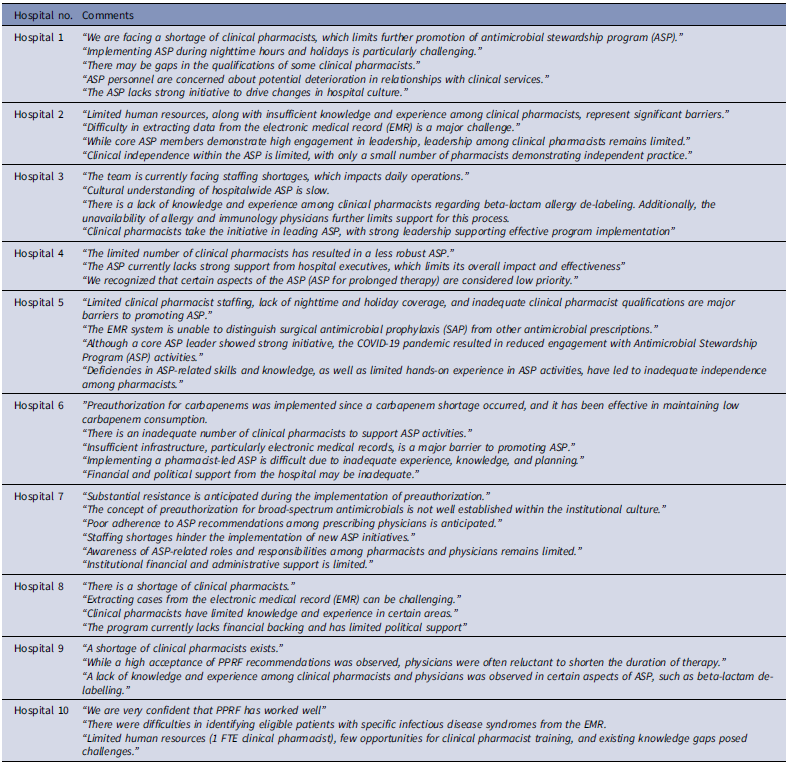
Table 2 shows narrative descriptions of ASP activities at each hospital. Across all hospitals, a shortage of clinical pharmacists dedicated to hospital ASP activities was commonly reported. Representative comments included the following:“We are facing a shortage of clinical pharmacists, which limits further promotion of ASP.” (Hospital 1-pharmacist). “The limited number of clinical pharmacists has resulted in a less robust ASP.” (Hospital 4- pharmacist). Moreover, multiple barriers to sustaining and promoting ASPs were likely present in the majority of institutions. Comments included on suboptimal infrastructures:“Difficulty in extracting data from the electronic medical record (EMR) is a major challenge.” (Hospital 2-pharmacist), cultural challenges: “Substantial resistance is anticipated during the implementation of preauthorization.” (Hospital-7 pharmacist), limited financial or political support:“The ASP currently lacks strong support from hospital executives, which limits its overall impact and effectiveness” (Hospital-4 pharmacist),“The program currently lacks financial backing and has limited political support” (Hospital-8 pharmacist), and inadequate clinical ASP experiences:“Deficiencies in ASP-related skills and knowledge, as well as limited hands-on experience in ASP activities, have led to inadequate independence among pharmacists.” (Hospital 5-pharmacist).
Narrative comments for implementing antimicrobial stewardship program at each participating hospital

Discussion
The present study described trends of three distinct antimicrobial consumption metrics at each participating hospital. Moreover, structured interviews with narrative comments provided further insight into the current status, progressions and challenges relevant to ASP activities. Most hospitals faced insufficient staffing of clinical pharmacists dedicated to ASP activities, resulted in difficulties in promoting various ASPs. Consequently, although ASPs were formally established at all participating hospitals, the structured interviews revealed that many ASPs may not be fully operational. Moreover, the findings suggested that the presence of ASPs did not consistently translate into ideal antimicrobial prescribing practice as reflected by changes in antimicrobial consumption metrics. The present study underscores the importance of ongoing evaluation and continuously monitoring ASP activities.
As seen in Table 1, despite the presence of ASP, most participating hospitals had not implemented concurrent, broad range of ASPs interventions to optimize hospitalwide antimicrobial prescribing; many participating hospitals have implemented PPRF for broad-spectrum antimicrobials (Hospitals 1, 2, 5, 8, 9, and 10) and ASP interventions for prolonged (eg, >2 wk) antimicrobial use (Hospitals 2, 3, 5, 6, 7, 8, 9, and 10) whereas only 2 institutions (Hospitals 6, and 8) implemented preauthorization for broad-spectrum antimicrobials. Moreover, very few institutions have implemented beta-lactam allergy de-labeling and optimizing duration of syndromic-specific antimicrobial therapy. These findings suggest that many hospitals have faced challenges in advancing ASP activities beyond initial PPRF, which was widely adopted during the early phase of antimicrobial stewardship era. Reference Honda, Goto, Uehara and Takamatsu9 Our interviews also revealed a universal shortage of pharmacists engaged in ASP. The finding was consistent with a previous review which demonstrated both a shortage of clinical pharmacists and labor-intensive pharmacist workloads are considered major barriers to promoting ASPs. Reference Jantarathaneewat, Camins and Apisarnthanarak10 Limited opportunities for acquiring advanced ASP-related knowledge and experiences were reported (Hospitals 1, 3, 5, 6, 8, 9, and 10). Notably, a similar phenomenon has been observed even in other high-income countries; a national survey in the United States revealed that various ASP activities were performed by pharmacists without sufficient training in infectious diseases (IDs). Reference Dionne, Wagner, Chastain, Rosenthal, Mahoney and Bland11 Moreover, the concept of beta-lactam de-labeling might be underappreciated because of limited availability of allergy-immunology specialists in Japan. Advancing successful ASP requires an ID physician-pharmacist team effort, which leads to a valuable opportunity to gain hands-on experiences in ASP pharmacists under the guidance and support of ID physicians. Reference Barlam, Childs and Zieminski12
Another challenge against promoting ASP included an inadequate EMR infrastructure to efficiently identify the target population of ASP (Hospitals 2, 5, and 8). Investment in hospital EMR systems to facilitate efficient and effective ASP may be particularly critical for institutions facing ASP clinical pharmacist shortages. While integration of EMR-based ASP tools such as antimicrobial stop orders, clinical decision support system, and prescription alert has progressed, Reference Forrest, Van Schooneveld, Kullar, Schulz, Duong and Postelnick13–Reference Dutcher, Yeager and Gitelman15 the emergence of artificial intelligence-augmented antimicrobial stewardship strategies has a potential to substantially enhance ASP interventions. Reference Marra, Langford, Nori and Bearman16
According to the changes in trends of antimicrobial consumption metrics, hospitals with a larger number of beds (Hospitals 1, 2, 5, and 6) demonstrated an uptrend of DASC per 1,000 PD and DOT per 1,000 PD over time, despite ASP implementation. This pattern may reflect an increasing proportion of patients infected with multidrug-resistant organisms, who are more likely to be treated in large tertiary care centers. Consistent with interpretation, the national antimicrobial resistance (AMR) surveillance in Japan reported rising trends in AMR during the study period, especially among Enterobacterales. 17 Moreover, insufficient interventions focusing on hospitalwide antimicrobial streamlining process and optimization of treatment duration might have contributed to these observed trends. In contrast, Hospitals 7–9, representing acute care hospitals with smaller number of hospital beds (community hospitals) demonstrated decreasing trends in both DASC per 1,000 PD and DOT per 1,000 PD. However, absolute baseline values of DASC and DOT at the beginning of the study period were higher than those observed in larger tertiary care centers. Moreover, an uptrend of DASC/DOT in these hospitals was observed. These findings potentially reflected delayed ASP implementation and less intensive antimicrobial streamlining process.
Among all participating hospitals, Hospital 10 appears to show the most favorable changes in antimicrobial consumption metrics. The observed trends may be attributable to strongly implemented PPRF, which likely promoted antimicrobial streamlining, resulting in a significant decrease in DASC (β = −3.05 [95% CI −4.85, −1.26], P = .001), a slight increase in DOT (β = 0.08 [95% CI −0.15, 0.31], P = .47) and a significant decline in DASC/DOT (β = −0.01 [95% CI −0.015, −0.011], P < .001). In the structured interviews, the clinical pharmacist at Hospital 10 reported high effectiveness of PPRF targeting broad-spectrum antimicrobials: “We are very confident that our PPRF has worked well” (Hospital 10-pharmacist). Similarly, Hospital 6 demonstrated a decreasing trend in DASC/DOT after August 2022, corresponding with the introduction of carbapenem preauthorization: ”Preauthorization for carbapenems was implemented since a carbapenem shortage occurred, and it has been effective in maintaining low carbapenem consumption” (Hospital 6-pharmacist). These findings would be a clear example of measurable changes in antimicrobial streamlining process and limited broad-spectrum antimicrobial following a successful hospital ASP intervention. Reference Kouyama, Uehara and Takamatsu18
The present study has some limitations. Because participating hospitals were selected from specific regions without random selection, selection bias may be present, and the findings may not be representative of hospitals nationwide. Since we did not examine antimicrobial streamlining process at individual patient level, the interpretation of changes in these metrics may not reflect actual antimicrobial prescribing practices, especially a lack of adjustment of case-mix and changes in the incidence of antimicrobial resistance at each institution. We did not assess local antimicrobial susceptibility patterns for specific pathogens at the individual hospital level, which may have influenced antimicrobial selection. The findings from the structured interviews may contain interviewer bias, participant bias, and confirmation bias. Since the baseline antimicrobial consumption in each hospital varied, the magnitude of ASP intervention effect may be higher in hospitals with high baseline antimicrobial consumption (high DASC and DOT) or less intensive antimicrobial streamlining process (low DASC/DOT) at the beginning of the study period (eg, baseline effect). Lastly, this study did not account for the impact of the COVID-19 pandemic on antimicrobial practice, which may have substantially influenced inpatient antimicrobial consumption, particularly increased antimicrobial use associated with healthcare-associated infections during this period. Reference Weiner-Lastinger, Pattabiraman and Konnor19
In conclusion, the present study described long-term trends in inpatient antimicrobial consumptions using DASC per 1,000 PD, DOT per 1,000 PD and DASC/DOT across Japanese hospitals over an 8-year period. Although ASP were present at all institutions, their scope and ASP implementation varied widely, and the establishment of ASP alone did not result in meaningful changes in antimicrobial consumption or streamlining indicators. Structured interviews highlighted persistent barriers to ASP advancement, including shortages of clinical pharmacists, limited educational opportunities, and inadequate infrastructure, particularly EMR integration. Strengthening hospital ASPs will require systematic identification of existing deficiencies and targeted investments in ASP personnel, education, and technological resources.
Supplementary material
The supplementary material for this article can be found at https://doi.org/10.1017/ash.2026.10395.
Author contributions
H.H., and S.M. designed the study. H.H, S.M, and Y.T. recruited the participating institutions. H.H., S.M., T.K., A.I., T.H., Y.S., Y.H., T.W., M.S., K.N., K.K. and H.S. collected the data. S.M. and H.H. analyzed the data. H.H. drafted the manuscript. All the authors have reviewed the manuscript and approved the final version for submission.
Financial support
This work was funded by the Japan Society for the Promotion of Science (JSPS) (23K09588). H.H. was the principal researcher in this study.
Competing interests
All the authors report no conflicts of interest relevant to this article and have submitted the ICMJE Form for Disclosure of Potential Conflicts of Interest. The authors: No reported conflicts of interest. All authors have submitted the ICMJE Form for Disclosure of Potential Conflicts of Interest.




 Open access

