Despite effective therapeutic strategies including heart failure (HF) drugs and devices chronic HF remains a major healthcare problem. In industrialized countries, chronic HF has an estimated prevalence of 2–3 percent and an extremely high morbidity and mortality (1). Heart failure is the most common cause for cardiovascular and all-cause hospitalizations above age 65, and approximately 30 percent are re-hospitalized within 60–90 days (Reference Fonarow, Abraham and Albert2). This not only dramatically impairs quality of life (QoL) but also poses a huge economic burden: HF causes ≈2 percent of total healthcare expenditures, mainly driven by hospitalization costs (Reference Stewart3), with the costs of severe HF being 8–10 times higher than of mild disease (4).
To improve the outcome in chronic HF, various forms of disease management programs have been introduced, most of which involve specialized HF nurse care. Many of these programs have shown to reduce hospitalization and mortality (Reference McAlister, Lawson, Teo and Armstrong5–Reference Inglis, Pearson, Treen, Gallasch, Horowitz and Stewart9), but some inconsistency remains. Beyond differences in usual care, type of program, and definitions of outcomes, this might be associated with variations in the intensity of care. Intensifying disease management programs might increase clinical outcome but the impact on cost-effectiveness is less predictable.
We recently published a randomized, controlled, three-arm trial in patients discharged after heart failure hospitalization demonstrating that intensified, amino-terminal pro-B-type natriuretic peptide (NT-proBNP) -guided nurse- and physician-led multidisciplinary care was superior to nurse-led multidisciplinary care as well as usual care in terms of reducing heart failure hospitalizations and mortality (Reference Berger, Moertl and Peter10). Because these benefits were associated with increased costs, we aimed to present a cost-utility analysis using prospectively collected data of QoL, outcome, and cost estimates from two different healthcare systems.
METHODS
Overview
Cost-utility analysis was conducted from a payer's perspective by combining results from a recently published clinical trial with an extrapolation model, which allowed estimation of long-term costs and health outcomes. The clinical trial provided estimates of costs, survival and QoL up to 18 months for all study participants. Unlike a preliminary per protocol analysis (Reference Adlbrecht, Huelsmann and Berger11), we followed an intention-to-treat strategy, which facilitated assessment from a real-life clinical practice perspective. Data from the trial were used as inputs to a Markov model which simulated HF progression and the associated costs and QoL effects for a 20 year time horizon to generate lifetime costs and outcomes.
Clinical Trial
Methods and results of the clinical trial have been described in detail previously (NCT00355017) (Reference Berger, Moertl and Peter10). Briefly, 278 patients discharged from HF hospitalization (index hospitalization) were randomized to three management arms.
In the usual care group (UC) patients were referred to their primary care physician with a detailed disease management plan. Visits at the outpatient clinic were scheduled as usual but contact with the study HF specialists was discouraged.
Nurse-led multidisciplinary care (MC) included 4 home visits by a specialized HF nurse after 1, 3, 6, and 12 months and optional telephone support. Two consultations with the HF specialist were prescheduled 10 days and 2 months after discharge with optional further visits. Deteriorating patients were immediately reported to the HF specialist or advised to seek consultation.
In the group with NT-proBNP-guided, intensive patient management (BMC), risk stratification was performed upon NT-proBNP discharge levels. In the high-risk group (NT-proBNP level >2,200 pg/ml), ambulatory visits with a HF specialist were performed at least biweekly in addition to MC for rapid optimization of HF medication. When NT-proBNP fell below 2,200 pg/ml 3 or 6 months after discharge, patients were managed similarly to those in the MC group. In patients with an ongoing elevated NT-proBNP >2,200 pg/ml, the biweekly visits were continued until maximal recommended or tolerated dosages of HF therapy were established. Thereafter, the time interval between visits was increased to 3 months.
The study began in July 2003 and ended in September 2005, when the last patient finished the minimally required 12-month follow-up. The maximal observation period was 18 months. All study end points were collected prospectively in a blinded manner, including (i) all-cause mortality; (ii) mortality due to HF; (iii) frequency, length and type of hospitalizations (HF-related and non-HF related); (iv) QoL-scores; and (v) ambulatory visits at HF clinics.
The study conformed to the principles outlined in the Declaration of Helsinki, received approval of the institutional ethics committee and all subjects gave written informed consent.
Clinical Trial Data
Quality-Adjusted Survival
Patients’ QoL was assessed using the disease-specific Minnesota Living with Heart Failure Questionnaire (MLHFQ) during index hospitalization and 1, 3, 6, and 12 months thereafter. According to a previously published algorithm (Reference Havranek, McGovern and Weinberger12), the scores were converted to preference weights (utilities) and applied to the period of survival for calculation of quality-adjusted life-years (QALYs) for the 18 months duration of the trial.
Health Care Costs
Country-specific unit costs were compiled for Austria, where the original clinical trial was performed, and Canada to evaluate the results in another healthcare system. All costs are reported in 2010 values expressed in both Euros (€) and Canadian dollars ($).
The costs of resource use during the trial duration were calculated from patient level data and comprised costs of trial driven NT-proBNP testing, nurse intervention, and total visits at the HF outpatient clinics. Costs for general practitioner (GP) visits and drug costs were not collected and were not included in the analysis of the clinical trial phase. Costs for total and HF-related hospitalizations during the clinical trial were calculated applying the same base cost estimate for HF and non–HF-related hospitalizations.
Because the reimbursement system in Austria does not provide real-life costs for HF hospitalization, the average cost per day for hospitalization in a Viennese hospital was applied, which was derived from the latest report of the Austrian Federal Ministry of Health adjusted to 2010 Euros - €670.93 (Hospitals in figures: http://www.kaz.bmgf.gv.at/; accessed October 1 2010). For the cost of NT-proBNP tests (€25.04/test) and visits at the HF outpatient clinics (€39.04/visit) fees of the Vienna General Hospital, a university teaching hospital, and one of the participating trial centers, were applied. The cost of 1-hour nurse care was calculated to be €90.92 in 2010 values based on the invoices issued during the clinical trial.
Because in Canada real-life costs for HF hospitalizations are collected in a standardized manner, hospitalization costs per day related to the main diagnosis congestive HF were obtained from the Ontario Case Costing Initiative (OCCI, http://www.occp.com; accessed June 7th 2010). This cost estimate was applied for all hospitalization costs within the Canadian analysis. Based on an average total costs per stay ($10,602) and an average length of stay (LoS) of 9.9 days average costs per day were estimated to be $1,070.9. For estimating physician services, the 2010 Ontario's Schedule of Benefits for physician costs was used (http://www.health.gov.on.ca/english/providers/program/ohip/sob/Physserv/a_consul.pdf). Costs for a cardiologist consultation range from $143.4 to $91.35 (the latter for a repeat consultation). The cost of one NT-proBNP test was considered to be $37. Cost estimates for specialized HF nurse care were obtained from a provincial care institution and considered $62.70 per visit corresponding to the costs of one hour nurse care (Manulife home nursing care: https://hermes.manulife.com/canada/repsrcfmdir.nsf/Public/ThecostoflongtermcareinOntario/$File/ONTARIO_LTC_CostReport.pdf, accessed June 7th 2010).
Markov Model
Model Design
A Markov model was developed which was similar in design to previous studies in this area (Reference Delea, Vera-Llonch, Richner, Fowler and Oster13–Reference Gohler, Conrads-Frank and Worrell15). The model was designed to project the costs and benefits from each strategy beyond the 18 months of the clinical trial. Thus, lifetime costs and QALYs are the sum of the outcomes from the analysis of the clinical trial data combined with output from the extrapolation model using a 20-year time horizon.
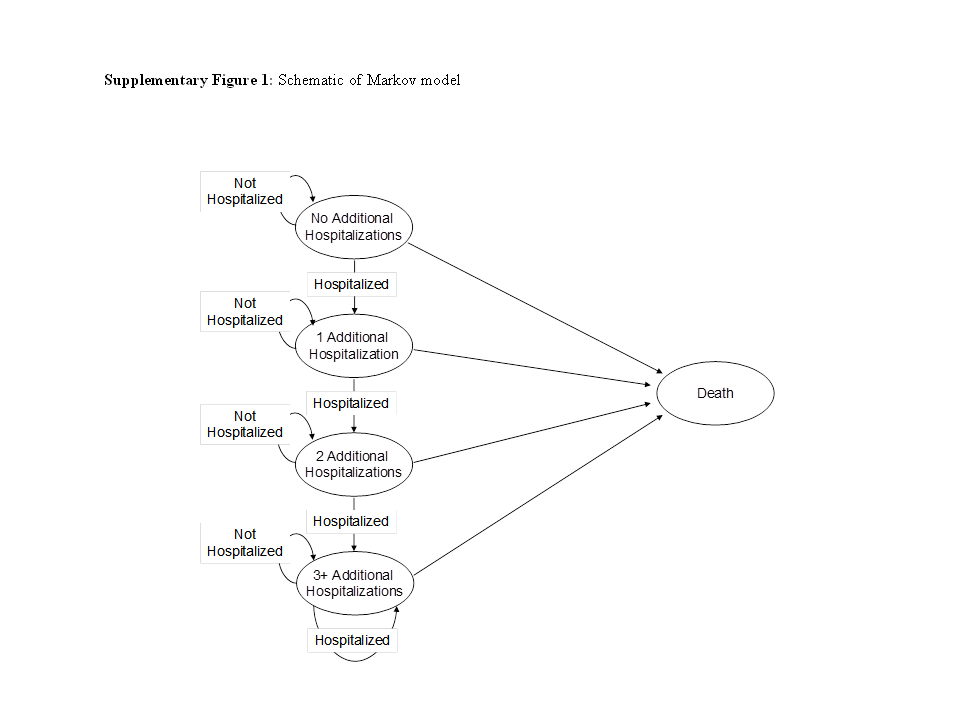
The model simulated disease progression from HF using the number of previous HF hospitalizations as a proxy for disease progression (Supplementary Figure 1, which can be viewed online at www.journals.cambridge.org/thc2013063). Health states within the model were representative of the number of previous HF hospitalizations with the assumption of greater risks of subsequent hospitalizations and mortality the greater the number of previous hospitalizations. In addition, the model incorporated a higher probability of death or re-hospitalization within 1 month after hospital discharge. Risks were assumed to remain constant after three additional hospitalizations. Hospitalizations were counted as additional hospitalizations after discharge from index hospitalization.
Thus, health states within the model were as follows: (i) No additional hospitalizations; (ii-a) First additional hospitalization; (ii-b) Status post one additional hospitalization; (iii-a) Second additional hospitalization; (iii-b) Status post two additional hospitalizations; (iv-a) Third or more additional hospitalization; (iv-b) Status post at least three additional hospitalizations; and (v) Death.
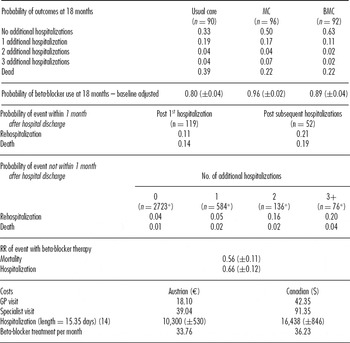
In addition, beyond the 18-month time horizon of the clinical trial, each health state was further dichotomized by whether patients were receiving beta-blocker therapy. The first phase of the model relates to the clinical trial phase. Thus, data were stratified by the three treatment groups, and treatment specific probabilities relating to the number of hospitalizations and probability of death were used directly estimated from the clinical trial data. Costs and utility values were similarly estimated directly from the clinical trial data (Table 2).
Because the usage of beta-blockers markedly reduces risk of HF hospitalization and death, for each strategy the risk of hospitalization was reduced according to the impact of beta-blocker therapy (relative risk [RR] of death = 0.56, RR of hospitalization = 0.66) (Reference Levy, Briggs, Demers and O'Brien14). The relative risk associated with beta-blocker use was only used for the probability of hospitalization beyond the 18-month period as data within the clinical trial are already adjusted for such use (Table 2). Thus, the model incorporated two differences between treatments, the proportional uptake of beta-blocker use as observed at the end of the clinical trial and the distribution of patients by numbers of previous hospitalizations and mortality. Disease progression beyond 18 months would be dependent on the health state at 18 months and the use of beta-blockers but otherwise was independent of the treatment strategy.
The model simulated the progression of disease within a cohort of patients. Each cycle, the cohort transitioned through the model by moving from one health state to another. The model adopted a one month cycle duration. For each health state within the model, there were three pertinent transition probabilities: no further event, a further hospitalization, and death. Data on the probability of each of these events were derived through analysis of the clinical trial data to ensure relevance to the clinical population (Table 2). Sensitivity analysis adopted probabilities of events from previous studies (Reference Delea, Vera-Llonch, Richner, Fowler and Oster13;Reference Gohler, Conrads-Frank and Worrell15;Reference Reitsma, Mosterd and de Craen16).
Costs and Utility Weights
Each health state within the model was assigned both a cost and utility weight. No weights were applied to the death state.
Costs considered were the costs of beta-blocker therapy, GP visits, specialist outpatient visits, and hospitalizations (Table 2). Costs of beta-blocker therapy were applied to the proportion of the patient cohort who was receiving beta-blockers. Cost estimates for beta-blocker treatment as given in Table 2 were based on carvedilol, a recommended and commonly used drug in HF. Prices for treatment with carvedilol at target dosages were derived from the Ontario Ministry of Health formulary for Canada and from the Vienna Health Insurance Fund (Wiener Gebietskrankenkasse) for Austria. Cost estimates for beta-blocker treatment were not modified by hospitalization.
Austrian costs of GP visits were based on the average reimbursement by the Vienna Health Insurance Fund, Canadians cost were derived from the 2010 Ontario's Schedule of Benefits for physician. Cost estimates of specialist visits were the same as for the clinical trial.
Assumptions relating to LoS (15.35 days for each hospitalization), GP and specialist appointments were as used in a previous economic evaluation (Reference Levy, Briggs, Demers and O'Brien14). The costs of hospitalizations per day were based on the cost estimates for the clinical trial analysis. Utility values were derived from the clinical trial data and the patient questionnaire.
For patients with no additional hospitalizations the average utility value per year was 0.86 with a utility decrement of 0.02 with each additional hospitalization. Sensitivity analysis adopted utility values from a previous study, which estimated the average utility weight for patients based on the previous number of HF hospitalizations (Reference Gohler, Geisler and Manne17). Input parameters of the model for long-term analysis are shown in Table 2. Costs and utility values were discounted at a rate of 5 percent per annum.
Analysis
Base Analysis
Within the Markov model outcomes were simply the sum of the costs and utility weights for each health state weighted by the proportion of patients within each health state, each cycle and the relevant discount factor. Lifetime estimates of the costs, life expectancy, and QALYs for each strategy were estimated by combining the estimates from the clinical trial with the extrapolations beyond 18 months.
Deterministic Sensitivity Analysis
Deterministic sensitivity analysis was conducted adopting the following alternate assumptions: (i) Assume no differences in outcomes post the trial period; (ii) Assume no difference in beta-blocker use post 18 months; (iii) Adopt utility weights in the Markov model derived from a previous study (Reference Gohler, Geisler and Manne17); (iv) Adopt alternate estimates of mortality and death from previous studies (Reference Delea, Vera-Llonch, Richner, Fowler and Oster13;Reference Gohler, Conrads-Frank and Worrell15;Reference Reitsma, Mosterd and de Craen16); (v) Adopt alternate time horizons (18 months, 5 years, 10 years); and (vi) Adopt different discount rates.
Probabilistic Sensitivity Analysis
Monte Carlo simulation (MCS) was used to assess the degree of uncertainty concerning the three management strategies (Reference Briggs18). Within MCS, each parameter within the economic model is defined by a probability distribution based on the degree of uncertainty around the expected value and the nature of the parameter. For the probabilities of multiple events (e.g., the probabilities of death, hospitalization, or no event) a Dirichlet distribution was used. For the probabilities of a dichotomous event (e.g., beta-blocker or no beta-blocker use), a Beta-distribution was used. For utility values, a normal distribution was used and for cost and resource use values, a gamma-distribution was used. For all distributions, the level of uncertainty was estimated from data within the clinical trial: Uncertainty around probabilities was based on the number of events and non-events, uncertainty around costs and utilities was based on the respective standard errors.
Over the process of a MCS, a random value is drawn from each of the probability distributions and an estimate of costs and QALYs for each strategy obtained. This is repeated several times to obtain a set of costs and QALYs. In this study, 5,000 replications were conducted. Cost-effectiveness acceptability curves were then derived reporting the proportion of the replications for which each strategy is deemed the most cost-effective based on different values of willingness to pay for an additional QALY (Reference Reitsma, Mosterd and de Craen16). All analyses were performed using Microsoft® Excel® for Windows Version 12.
RESULTS
Clinical Outcome and Quality of Life Measurements
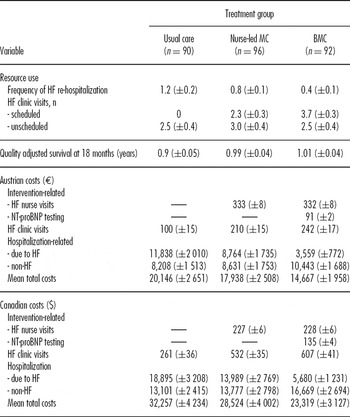
Results of the main study have been reported in detail previously (Reference Berger, Moertl and Peter10). Briefly, mortality was similar between BMC (22 percent) and MC (22 percent) but lower compared with UC (39 percent; p < .02). BMC reduced total and HF-related hospitalization days compared with MC and UC, while UC had significantly less visits HF specialist visits (p < .001; Table 1).
Clinical Trial Outcomes

Note. Data are given as mean, figures in parenthesis are SEM.
MC, multidisciplinary care; BMC, NT-proBNP-guided intensive management; HF, heart failure.
Markov Model Inputs

Note. Figures in parenthesis are SEM. * represents number of months.
RR, risk ratio; GP, general practitioner.
Using Austrian cost estimates, the average costs per patient during the clinical trial including all-cause hospitalizations were €20,146 for UC, €17,938 for MC, and €14,667 for BMC. Using Canadian costs, the average costs per patient added up to $32,257 for UC, $28,524 for MC, and $23,319 for BMC. Average QALYs gained during the 18-month trial duration were 0.90 for UC, 0.99 for MC, and 1.01 for BMC (Table 1).
Economic Analysis (Long-term)
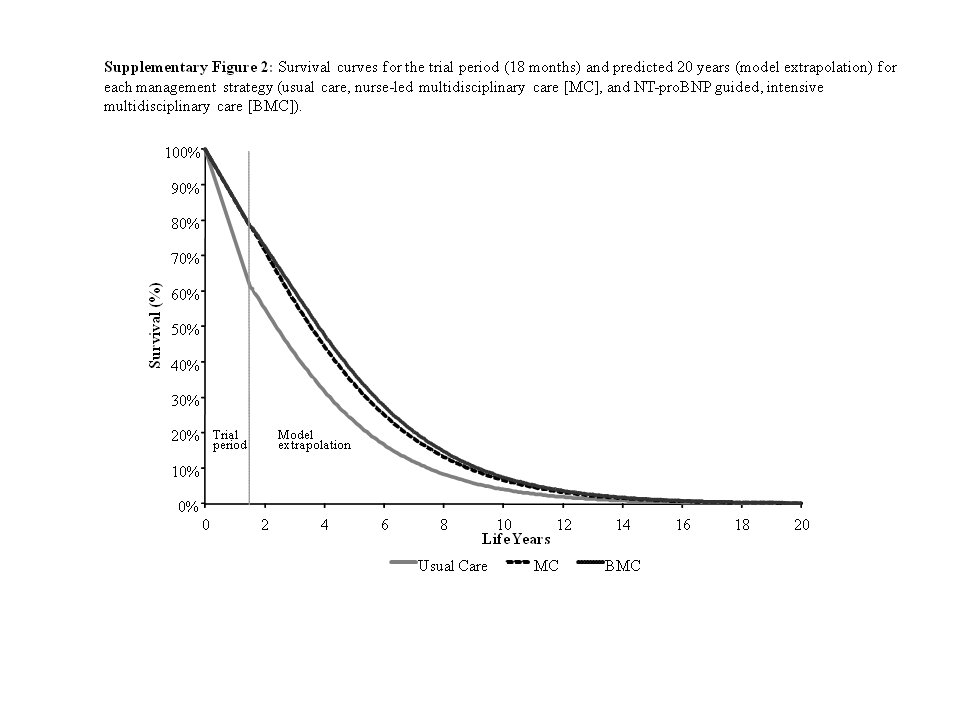
Based on the model, less than 35 percent of patients could be expected to be alive after 5 years and less than 1 percent after 14 years. Survival was similar for the MC and BMC strategies, which were both superior to the UC strategy. Actual survival during the trial and predicted 20 years are depicted in Supplementary Figure 2, which can be viewed online at www.journals.cambridge.org/thc2013064.
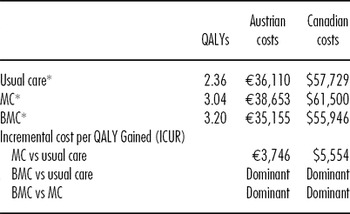
The MC strategy was associated with higher expected lifetime costs and QALYs compared with the UC strategy (Table 3). The associated incremental cost per QALY gained was €3,746 for Austria and $5,554 for Canada.
Economic Analysis Results (Long-term)

*Results are given per patient.
QALY, quality-adjusted life-year; ICUR, incremental cost-utility ratio.
The BMC strategy was dominant over both the MC and UC strategies in that it was on average both less costly and had more QALYs.
Sensitivity Analysis
Results appeared insensitive to changes in parameter values (Supplementary Table 1, which can be viewed online at www.journals.cambridge.org/thc2013065). Estimates of cost-effectiveness based on alternative transition probabilities gave alternative estimates but did not change the overall finding that the BMC strategy was the most cost-effective strategy.
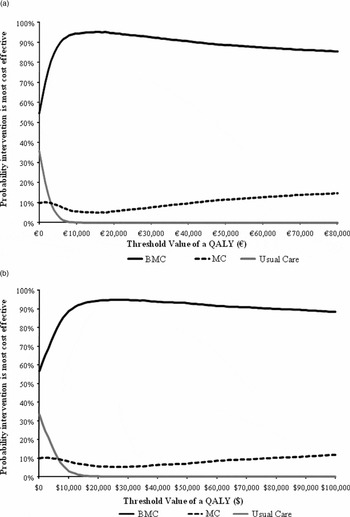
Cost-effectiveness acceptability curves demonstrated by far the highest likelihood for BMC being the most cost-effective strategy. At threshold values of Austrian €40,000 and Canadian $50,000, the probabilities that BMC was deemed the most cost-effective strategy were 92 percent and 93 percent, respectively (Figure 1A and B). These thresholds were chosen as they are in line with the usually accepted benchmark of $50,000 per QALY, commonly used for healthcare interventions in the United States and Canada, and with similar thresholds in Europe (Reference Grosse19).
Cost-effectiveness acceptability curves for Austria (A) and Canada (B), showing the probability that each strategy (usual care, nurse-led multidisciplinary care [MC], and NT-proBNP-guided, intensive multidisciplinary care [BMC]) is deemed the most cost-effective over a range of willingness to pay thresholds for an additional quality-adjusted life-year (QALY).

DISCUSSION
Using data from a controlled randomized trial (Reference Berger, Moertl and Peter10), this study investigates the cost-effectiveness of multidisciplinary HF care at two levels of intensity. We demonstrate that NT-proBNP-guided, intensified HF specialist patient management on top of home-based nurse care is dominant (improving clinical outcome while reducing costs) over home-based nurse care alone and usual care. Based on an increasing level of evidence from the literature (Reference McAlister, Lawson, Teo and Armstrong5;Reference Gonseth, Guallar-Castillon, Banegas and Rodriguez-Artalejo7;Reference Jaarsma, van der Wal and Lesman-Leegte20), the establishment of multidisciplinary management programs to improve clinical outcome in chronic HF is recommended in international guidelines (Reference McMurray, Adamopoulos and Anker21). In addition, the cost-effectiveness of such programs has been previously demonstrated, although the extent differed dependent on resource use and clinical performance of the programs (Reference Gohler, Conrads-Frank and Worrell15;Reference Capomolla, Febo and Ceresa22;Reference Chan, Heidenreich, Weinstein and Fonarow23). Compared with prior studies, this cost-utility analysis is the first to compare two different levels of intensity of multi-disciplinary care using short-term clinical trial data and long-term economic modeling.
By focusing on patients with high NT-proBNP levels, specialist resources were bundled to the patients at the highest risk for re-hospitalization and death. Intensification of a nurse-based disease management program through more HF clinic visits not just improved health outcomes but also reduced costs overall. Reduction of re-hospitalization played a key role for this finding as HF patients are frequently hospitalized, and up to 70 percent of HF healthcare expenditures are related to costs of hospitalizations (Reference Stewart3). Although comparisons across different economic analyses are limited by different techniques of economic modeling in addition to variability arising from heterogeneous populations and different care situations, the incremental cost-utility ratio of nurse-led multidisciplinary care alone compared with usual care as found in our study was similar to or slightly lower than previous analyses (Reference Gohler, Conrads-Frank and Worrell15;Reference Capomolla, Febo and Ceresa22;Reference Chan, Heidenreich, Weinstein and Fonarow23). The dominance of BMC indicates that an individualized patient management might have the potential to further improve the well-documented cost-effectiveness of multidisciplinary care. In a recent analysis using efficacy data from a meta-analysis comprising 36 randomized controlled trials and German healthcare costs, disease management programs in HF patients yielded an incremental cost utility ratio (ICUR) of €8,900 per QALY gained (Reference Gohler, Conrads-Frank and Worrell15).
Alongside a clinical trial, the cost-effectiveness between a HF management program delivered by day-hospital and usual care was studied in 234 patients discharged after HF hospitalization (Reference Capomolla, Febo and Ceresa22). The authors reported a cost/utility ratio for the management program of $19,462. Chan and co-workers assessed incremental life expectancy and costs of providing disease management programs for high-risk to low-risk patients defined through the number of prior hospitalizations (Reference Chan, Heidenreich, Weinstein and Fonarow23). They found that HF management programs are cost-effective and sometimes cost-saving for high-risk patients in the short-term, and likely to be cost-effective also in low-risk HF patients in the long-term.
Cost dynamics can differ substantially between countries, which might result in differences in cost-effectiveness of the same disease management program. In our study, cost-effectiveness was demonstrated in two countries, Canada and Austria, with different approaches for the calculation of hospitalization costs. In Canada, detailed real-life costs of HF hospitalization were used, while a more general estimate of average costs per day in hospital were applied for Austria. Irrespective of the chosen approach, the values for hospitalization costs were comparable to estimates from other European countries and the United States (Reference Gohler, Conrads-Frank and Worrell15;Reference Capomolla, Febo and Ceresa22;Reference Chan, Heidenreich, Weinstein and Fonarow23). Both cost estimates lead to similar results as cost-effectiveness acceptability curves for both countries looked almost identical with an over 90 percent probability that BMC is the most cost-effective strategy at comparatively low thresholds of costs per QALY gained (Reference Grosse19). Notably, we directly estimated transition probabilities for long-term modeling from our clinical trial results instead of using data from the literature. Furthermore, as the risk of HF re-hospitalization is not constant over time but sharply increases shortly after discharge and slowly decreases thereafter (Reference Solomon, Dobson and Pocock24), we incorporated higher transition probabilities in the first month after discharge. Sensitivity analyses applying transition probabilities from the literature (Reference Delea, Vera-Llonch, Richner, Fowler and Oster13;Reference Gohler, Conrads-Frank and Worrell15;Reference Reitsma, Mosterd and de Craen16) supported the validity of our approach. Even when we based our model on the high probabilities of death and re-hospitalization as described in a recent economic analysis using data from the BEST trial (Reference Gohler, Conrads-Frank and Worrell15), BMC was still cost-effective compared with MC and UC. Health state utilities were not elicited directly from the study population but patients completed a disease specific QoL questionnaire enabling deduction of preference weights (Reference Havranek, McGovern and Weinberger12). Results were comparable to previous reports (Reference Fox, Mealing and Anderson25), and one-way sensitivity analysis with preference weights directly elicited from a subsample of the EPHESUS trial corroborated our conclusions (Reference Gohler, Geisler and Manne17).
Additional sensitivity analyses changing values of key model parameters further demonstrated the robustness of our findings. Assuming no difference of beta-blocker usage between the groups after the clinical trial did not change the conclusions of the economic analysis. As in the original trial not only more patients in the BMC and MC groups took any beta-blocker but also at higher dosages, we might even have underestimated the benefits of up-titrated anti-neurohormonal pharmacotherapy in the intervention arms. Furthermore, assuming no differences in clinical outcomes at 18 months or different time horizons did not alter the cost-effectiveness of nurse-led programs in our model either.
As a limitation, we assumed that there would be no difference between the treatment groups with respect to HF specialist visits beyond the 18-month time horizon of the clinical trial. One might suggest that patients with HF specialist visits during the trial will stop or markedly reduce these visits at trial end, while some patients in the usual care group will start receiving specialist management sooner or later, especially after re-hospitalization. Overall, it seems difficult to estimate to what extent a difference in HF specialist care remains after the clinical trial period.
CONCLUSION
In conclusion, our model of NT-proBNP-guided intensified specialized patient management on top of nurse based heart failure management demonstrated long-term improvement of health outcomes at reduced costs.
SUPPLEMENTARY MATERIAL
Supplementary Figure 1: www.journals.cambridge.org/thc2013063
Supplementary Figure 2: www.journals.cambridge.org/thc2013064
Supplementary Table 1: www.journals.cambridge.org/thc2013065
CONTACT INFORMATION
Deddo Moertl, MD (deddo.moertl@stpoelten.lknoe.at), Department of Internal Medicine III (Cardiology), Landesklinikum St. Poelten, Propst-Fuehrer-Straße 4, 3100 St. Poelten, Austria
Sabine Steiner, MD, MSc, Department of Internal Medicine II, Division of Vascular Medicine, Medical University Vienna
Doug Coyle, MD, PhD, Department of Epidemiology and Community Medicine, University of Ottawa
Rudolf Berger, MD, Department of Internal Medicine II, Division of Cardiology, Medical University
CONFLICTS OF INTEREST
Deddo Moertl, Sabine Steiner and Rudolf Berger report payment to their institution for this work from AstraZeneca, Novartis, Roche Diagnostics, Roche Medical, Merck, Medtronic, and Guidant. Doug Coyle reports no conflicts of interest.