1. INTRODUCTION: CONCEPTIONAL ORALITY AND CONCEPTIONAL DISTANCE
Conversational (self-)reformulation is one of the most common phenomena in naturally occurring speech. The linguistic structure of self-reformulation is illustrated in example (1), where the reference expression to be reformulated is represented in boldface, the reformulating treating expression is underlined, and reformulating lexical markers are represented in italics (data and transcription conventions are presented in section 4):
(1) Linguistic marking of self-reformulation
SR On ne peut pas régler un problème, ou plutôt, pour bien régler un problème, il faut examiner la question des dépenses.
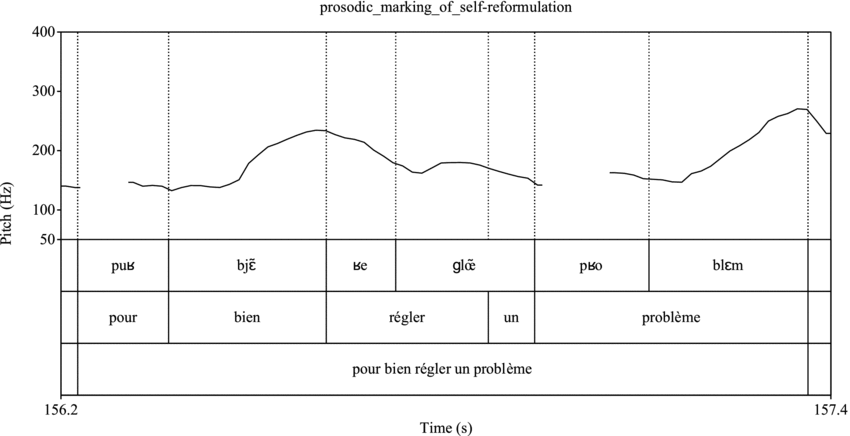
The corrective treating expression (pour bien régler un problème) is syntactically framed by a reprise of part of the reference expression (régler un problème). The lexical marker ou plutôt introduces the treating expression on a metalinguistic (non-truth-conditional) level. Finally, the correction is marked prosodically by an increase in fundamental frequency (f0) and a considerable lengthening of the syllable bien (figure 1), which is typical of syllables at the end of Intonation Phrases (IP) in French (-blème; Jun and Fougeron, Reference Jun, Fougeron and Botinis2000; Delais-Roussarie et al., Reference Delais-Roussarie, Post, Avanzi, Buthke, Di Cristo, Feldhausen, Jun, Martin, Meisenburg, Rialland, Sichel-Bazin, Yoo, Frota and Prieto2015). Other para- and non-verbal signals are not considered here, but very likely to co-occur with linguistic signals (Auer and Di Luzio, Reference Auer and Di Luzio1992; Bergmann et al., Reference Bergmann, Brenning, Pfeiffer and Reber2012).
Prosodic marking of self-reformulation.

Self-reformulations are a typical sign of conceptional orality as opposed to conceptional distance (Koch and Oesterreicher, Reference Koch and Oesterreicher1985; Ágel and Hennig, Reference Ágel, Hennig, Ágel and Hennig2006; Reference Ágel, Hennig, Ágel and Hennig2007). Orality and distance in this sense are conceived as conceptionally ‘oral’ or conceptionally ‘written’ genres or discourse traditions (code parlé/code écrit; Söll, Reference Söll1974) constituted by a number of extra-linguistic communicative conditions. In contrast to the categorical distinction of oral and written media (code phonique/code graphique; Söll, Reference Söll1974), conceptional orality and conceptional distance represent two poles at the ends of a continuum, with various intermediate stages generating more or less oral or distant discourse traditions.
Prototypical conceptional orality is characterized by a high degree of dialogicity, an intimate relation between the interlocutors, a face-to-face interaction in private surroundings, expressivity (e.g. Pustka, Reference Pustka2015), a free and spontaneous discourse development and situational involvement. Linguistic strategies following from these conditions are a low degree of information, progression, complexity, elaboration and planification, which become manifest, for example, in phonological reduction, passe-partout words, paratactic syntactic structures and repair signals (Koch and Oesterreicher, Reference Koch and Oesterreicher2011: 56–59). An example of a conceptionally oral discourse tradition is informal, private conversations.
Prototypical conceptional distance, then, is established by monologic discourse structures, an unfamiliar relation between the interlocutors, a spatio-temporal separation or interaction in public spaces, objectivity, a fixed and pre-planned discourse development and situational detachment. Verbalization in conceptional distance is characterized by a high degree of information, progression, complexity, elaboration and planification, e.g. by careful articulation, lexical diversity, syntactic hypotaxis and off-line repairs. These linguistic strategies are, for instance, typical of political interviews.
Essentially, conceptional orality allows for all kinds of contexts to be exploited, as originally defined by Coseriu (Reference Coseriu1955/56: 48ff.) and subsequently revised and related to conceptional variation by Koch and Oesterreicher (Reference Koch and Oesterreicher2011: 11):
– linguistic context (cotext)
– situational context
– knowledge contexts of speakers (individual, general)
– para- and non-verbal contexts (prosody, gestures)
The situational context is prominent due to possibilities of situational involvement. Since speakers know each other well, they share a common knowledge of each other and of their discursive history. Para- and non-verbal contexts like prosody and gestures are made available by face-to-face interaction and expressivity. In situation-detached conceptional distance, speakers do not rely in the same way on the situational context. The lack of personal relation between the interlocutors makes the shared knowledge of speakers unavailable. Without the face-to-face and expressivity conditions, para- and non-verbal devices remain absent from conceptional distance. Of course, this is not to say that prosody and gestures do not occur in face-to-face conceptional distance (e.g. in political interviews), but only that these contexts are relatively less important. The most relevant context is the linguistic cotext leading to elaborated and complex verbalization strategies. In self-reformulations, these may be expressed by lengthy explanation sequences (example 2a) or subordinate clauses (example 2b):
(2) Linguistic cotext in self-reformulations of conceptional distance
a.
BC Nous le faisons d'ailleurs, nous le faisons pour euh les euh Juifs de France, mais nous le faisons aussi pour tous ceux qui en France peuvent être victimes de discrimination, euh de la xénophobie, du racisme qui se déploie allègrement sur la toile euh euh sans qu'il y ait aujourd'hui de limite et digue, donc par conséquent [. . .].
b.
FR Il faut prendre son bâton de pèlerin comme le fait euh François Hollande [. . .] avec à la fois les grandes puissances, qui sont les grands émetteurs euh de gaz à effet de serre, comme les États-Unis et la Chine.
The Koch and Oesterreicher model was revised by Ágel and Hennig (Reference Ágel, Hennig, Ágel and Hennig2006; Reference Ágel, Hennig, Ágel and Hennig2007) in recent years. Aiming at a more precise definition and operationalization of communicative conditions and verbalization strategies, the authors propose five levels of discourse hierarchy, which are described along the five parameters of communicative role, time, situation, code and modality. The parameters of role, time and situation can be roughly attributed to the communicative conditions of dialogicity, spontaneity and situational involvement in Koch and Oesterreicher's model. Ágel and Hennig (Reference Ágel, Hennig, Ágel and Hennig2006; Reference Ágel, Hennig, Ágel and Hennig2007) locate self-reformulations in the time parameter of conceptional orality (universal axiom), according to which linguistic production and reception are bound in time, while they are free in conceptional distance (time parameter of communication). Consequently, discourse organization is spontaneous in conceptional orality and planned in conceptional distance (time parameter of discourse organization). These differences, in turn, lead to on-line repairs in conceptional orality and to off-line repairs in conceptional distance (time parameter of discourse procedures), which become manifest in corrections, for example (time parameter of discourse features). Ágel and Hennig (Reference Ágel, Hennig, Ágel and Hennig2006; Reference Ágel, Hennig, Ágel and Hennig2007) do not provide a definition of repair or corrections or of context (types). However, their revision has the decisive advantage over the original model that (self-)reformulations (or, more generally, ‘repairs’) can be situated within discourse procedures and explained by the specific communicative conditions of timing in conceptional orality.
The present study represents an attempt to empirically investigate linguistic (lexical and prosodic) differences of conversational self-reformulations in conceptional distance and conceptional orality. The article is organized as follows. In a first step, conversational self-reformulation and its subtypes are defined functionally (section 2). Secondly, lexical and prosodic markers of self-reformulation are introduced (section 3). The empirical part presents the central hypothesis and methodological issues (section 4) before the results of the study are described (section 5) and discussed with respect to the hypothesis (section 6). The final section concludes the article with summarizing remarks and an outlook (section 7).
2. FUNCTIONS OF SELF-REFORMULATION
The perspective taken in this article is based on Gülich and Kotschi's (Reference Gülich, Kotschi and Weydt1983a; Reference Gülich and Kotschi1983b; Reference Gülich, Kotschi and Motsch1987; Reference Gülich, Kotschi and Quasthoff1995) approach to formulating activities in discourse production, which is inspired by studies on spoken language research. Gülich and Kotschi argue that linguistic traces indicate specific types of discourse activities. Examples of traces are reformulating treatment procedures (or: reformulations), which ‘refer to a preceding segment [reference expression] by means of a new utterance [treatment expression], which somehow changes, modifies, reformulates or expands the earlier utterance’ (Gülich and Kotschi, Reference Gülich, Kotschi and Quasthoff1995: 34), and (segmental) markers, ‘creating and specifying relations between discourse constituents’ (Gülich and Kotschi, Reference Gülich, Kotschi and Quasthoff1995: 33). Both reformulations and markers are ‘very common in spontaneous discourse’ (Gülich and Kotschi, Reference Gülich, Kotschi and Quasthoff1995: 35).
The present study takes into account paraphrastic and corrective self-reformulations.Footnote 1 As Gülich and Kotschi (Reference Gülich, Kotschi and Motsch1987: 256) argue, these can be subsumed under the category of self-reformulations due to structural similarities, relating retrospectively to an overtly realized reference expression. At the same time, paraphrases and corrections differ from each other with respect to the ‘change in utterance perspective’ (Gülich and Kotschi, Reference Gülich, Kotschi and Quasthoff1995: 44) in terms of (in)validation of the reference expression. The change in utterance perspective is ‘fairly weak’ (Gülich and Kotschi, Reference Gülich, Kotschi and Quasthoff1995: 50) in paraphrases, by expanding or reducing the reference expression without being invalidated, while corrections are characterized by invalidation, i.e. by cancelling and substituting the reference expression (Gülich and Kotschi, Reference Gülich, Kotschi and Motsch1987: 218). The relations between reference expression and treatment expression can be described along a continuum of semantic equivalence and difference: Equivalence is to be understood as a broad concept ‘to perform a double identification’ (Gülich and Kotschi, Reference Gülich, Kotschi and Quasthoff1995: 42) of referents even when they share ‘only a limited semic basis’ (ibid.). Difference is at hand when the ‘treating expression contains something new, an element of change, of communicative “progression”’ (ibid.).
The change in utterance perspective is achieved by the use of markers, which ‘indicate something which would not be expressed by the discourse structure alone (i.e. without the presence of one of these markers)’ (Gülich and Kotschi Reference Gülich, Kotschi and Quasthoff1995, 44; emphasis original). Accordingly, there is an intrinsic relationship between reformulations on the one hand and lexical markers on the other. In other words, markers are type-distinctive with respect to different reformulating activities. Paraphrastic markers are ‘well characterized’ (Gülich and Kotschi, Reference Gülich, Kotschi and Quasthoff1995: 50), but ‘not indispensable to the signalling and the interpretation of a procedure as a paraphrase’ (ibid.). Corrective markers, on the other hand, are ‘frequently used’ (Gülich and Kotschi, Reference Gülich, Kotschi and Quasthoff1995: 51).
When the self-reformulation is realized implicitly (without any marker), ‘the function markers normally fulfill are instead realized by intonational or paralinguistic means’ (Gülich and Kotschi, Reference Gülich, Kotschi and Quasthoff1995: 43). It is therefore necessary to consider prosodic markers of self-reformulations as well since they are considered to be functionally identical to lexical markers.
To capture spontaneous speech as the prime domain of reformulating activities (s.a.) theoretically, the model of conceptional variation is implemented. Gülich and Kotschi (Reference Gülich, Kotschi and Motsch1987: 257f.) consider reformulating activities as specific to communication type, which may be linked to the discourse traditions along the conceptional continuum. Spontaneous speech is a typical feature of conceptional orality (section 1), so that conceptionally oral discourse traditions serve as appropriate communication types for the study of self-reformulation.
Examples (3) and (4) show a paraphrase and a correction from the database:
(3) Paraphrase
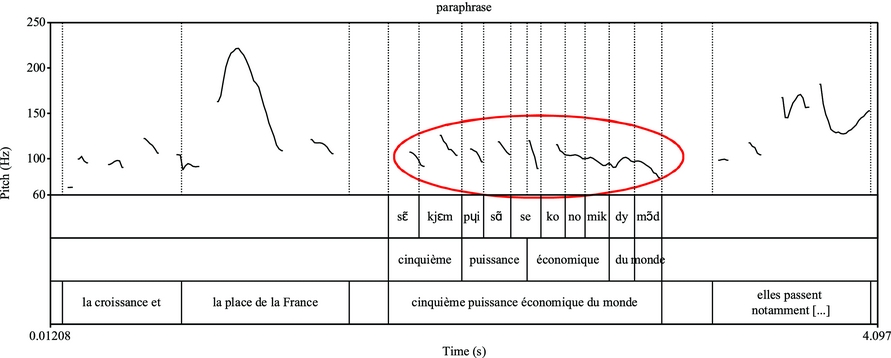
FL La croissance et la place de la France, cinquième puissance économique du monde, elles passent notamment par notre capacité à nous appuyer sur les acteurs français qui sont aujourd'hui à l’étranger.
(4) Correction
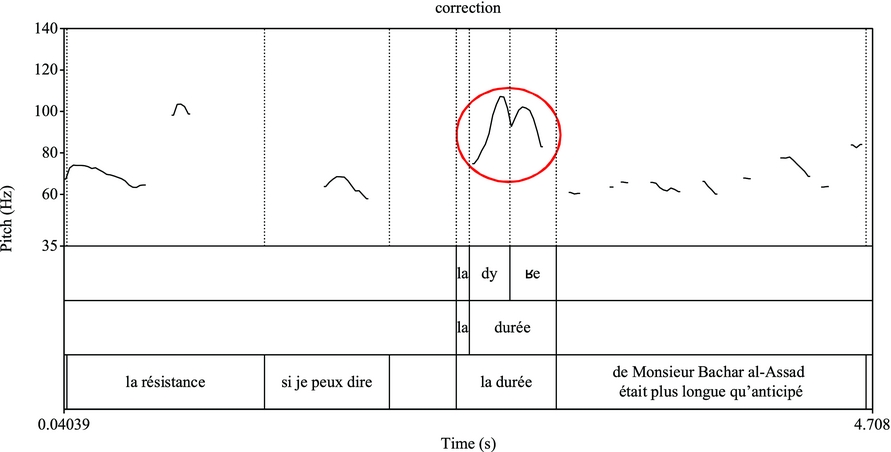
LF La résistance, si je peux dire, la durée de Monsieur Bachar al-Assad était plus longue qu'anticipé.
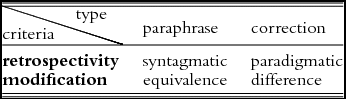
Both types of self-reformulation comply with the retrospectivity criterion (they both reformulate an overt reference expression), but differ from each other with respect to the degree of semantic modification. In the paraphrastic example (3), the reference expression (la place de la France) is specified in the treating expression (cinquième puissance économique du monde) without being canceled altogether. Reference expression and treating expression are referentially identical and semantically equivalent, and the temporary interruption of the ongoing discourse corresponds to an additional piece of information expressed on a syntagmatic axis. In the correction in example (4), the reference expression (la résistance) is plainly deleted and replaced by the maximally modifying treating expression (la durée). Reference expression and treating expression are referentially incompatible, semantically different and related to each other by paradigmatic opposition.Footnote 2
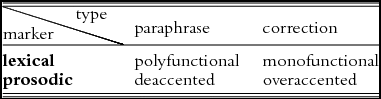
While both reformulating activities shortly interrupt the primary discourse, only corrections importantly ‘intervene’ in the discourse structure because the reference expression is substituted. Accordingly, the correction semantically redirects and possibly formally restructures the discourse. In contrast, paraphrases do not represent an intervention of the same kind, but rather a secondary side sequence (Jefferson, Reference Jefferson and Sudnow1972) before the actual primary discourse string is taken up again, semantically unaffected by the paraphrase. The differences between paraphrases and corrections are summarized in table 1.
Functional differences between paraphrases and corrections

A constitutive feature of natural conversation is turn-taking, which is arrived at by hierarchically organized rules, e.g. ‘current speaker selects next speaker’, ‘self-selection by non-speaker’ and ‘current speaker continues’ (Sacks et al., Reference Sacks, Schegloff and Jefferson1974). Transferred onto the framework outlined here, turn-taking can be defined as a high degree of dialogicity and cooperative negotiation of communicative roles between the interlocutors, which is typical of communicative orality (Koch and Oesterreicher, Reference Koch and Oesterreicher1985; Ágel and Hennig, Reference Ágel, Hennig, Ágel and Hennig2006; Reference Ágel, Hennig, Ágel and Hennig2007) and which can be observed in self-reformulations: When the speaker signals problems in verbalization procedures (e.g. by explicitly stating these problems or by using lexical or prosodic markers) and/or when the treating expression is evident to the interlocutor, the interlocutor may take over in order to complete the reformulation as an instance of other-repair (Schegloff et al., Reference Schegloff, Jefferson and Sacks1977), irrespective of turn-taking rules (square brackets indicate simultaneous speech):
(5) Turn-taking in self-reformulations
FB Un courtage, non, j'en doute pas, pas un courtage
[une co]mmission
CB [ach so]
FB [une commission]
CB [une commission]
In example (5), the speaker FB struggles in finding the lexical item commission, which she eventually realizes in a first attempt. The (French-German bilingualFootnote 3) interlocutor CB, on her part, signals that she has understood the problem (German ach so ‘I see’) and ratifies the solution of the problem by taking over turn and expressing the correction herself simultaneously with FB who realizes the searched item for the second time. However, as the following examples demonstrate, self-reformulations may also be used in order to take over the current turn prematurely and thus illegitimately, either successfully (as in example 6a, where JD's self-reformulation is only accomplished after PX's intervening turn) or unsuccessfully (as in example 6b, where JD's attempt to take over turn is abandoned):
(6) Premature turn-taking in self-reformulations
a.
JD Ils suppriment le nucléaire,
[enfin, ils, la tendance est la]
PX [oui, oui, oui, ils sortent,] ils sortent du
JD tournant énergétique.
b.
PX Véolia où c'est, c'est très loin, c'est l’équivalent, fin, c'est très loin enfin [c'est assez loin, c'est l’équi]valent, je sais pas moi [. . .].
JD [ah oui, c'est p-, c'est, oui]
The turn-taking rules as described by Sacks et al. (Reference Sacks, Schegloff and Jefferson1974) are violated in the examples of premature turn-taking. Interestingly, all examples of premature turn-taking in the data examined stem from the corpus of conceptional orality. Moreover, they are almost always corrections (example 6b). Possible conclusions to be drawn from these examples are that the risk of losing turn is more at stake, firstly, in conceptional orality than in conceptional distance and, secondly, in corrections than in paraphrases. The reason for why conceptional orality is more prone to turn-taking is that a high degree of dialogicity as well as flexible roles between speaker and interlocutor prevail (of course, turn-taking generally takes place more frequently in conceptional orality than in distance, independently of self-reformulation). The second generalization specifically pertains to corrections, which cause a conversationally interventional substitution reflected in semantic difference, while in paraphrases speakers only establish semantic equivalence syntagmatically.
3. LINGUISTIC MARKERS OF CONVERSATIONAL SELF-REFORMULATION
Apart from specific reformulation types (paraphrase, correction), Gülich and Kotschi (Reference Gülich, Kotschi and Weydt1983a; Reference Gülich and Kotschi1983b; Reference Gülich, Kotschi and Motsch1987; Reference Gülich, Kotschi and Quasthoff1995) consider lexical markers as traces of problems in formulating activities. These markers do not carry truth-conditional information, but are used to establish a type-specific relation between reference expression and treating expression (section 2). The functional load of these markers is therefore considerable since specific (classes of) markers are used to indicate paraphrastic and corrective self-reformulations, among others.
Lexical reformulation markers are optional as reference expression and treating expression may immediately follow one another (examples 2 and 3). In explicit structures, the lexical marker is mostly placed in between reference expression and treating expression (examples 1, 4 and 6), but sometimes pre-reference expression or post-treating expression positions can be observed (Gülich and Kotschi, Reference Gülich, Kotschi and Weydt1983a; Reference Gülich and Kotschi1983b; Reference Gülich, Kotschi and Motsch1987).Footnote 4 In comparing paraphrases and corrections with each other, paraphrases have been found to be marked implicitly more frequently than corrections because of less semantic contrast (Gülich and Kotschi, Reference Gülich, Kotschi and Quasthoff1995: 43).
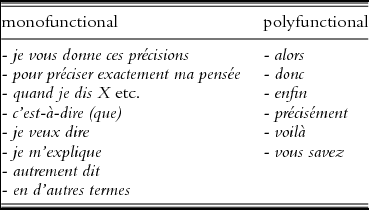
In their study of lexical paraphrastic markers, Gülich and Kotschi (Reference Gülich, Kotschi and Weydt1983a; Reference Gülich and Kotschi1983b; Reference Gülich, Kotschi and Motsch1987) draw a line between ‘idiomatized’ and ‘polyfunctional’ uses: Idiomatized markers are used in clearly paraphrastic contexts (and may therefore be named ‘monofunctional’ in opposition to the ‘polyfunctional’ markers), while polyfunctional markers fulfill a wide range of functions apart from paraphrasing and consequently must be interpreted in context, as summarized in table (2). The authors postulate a relation between prototypical paraphrastic semantic equivalence and polyfunctional lexical markers (Gülich and Kotschi, Reference Gülich and Kotschi1983b: 327):
(7) High degree of paraphrastic equivalence and polyfunctional lexical marker
JM Ils ont pas une position naturelle, fin, tu sens que c'est pas un sommeil naturel.
(8) Low degree of paraphrastic equivalence and monofunctional lexical marker
LF À toute une série de questions précises il répond pas, notamment euh, sur les armes chimiques.
Paraphrastic markers

In (7), an account of the speaker's feelings when her children were put under anesthetic, reference expression (ils ont pas une position naturelle) and treating expression (tu sens que c'est pas un sommeil naturel) are referentially identical and merely formal variations of each other. As a prototypical paraphrase, the lexical marker is polyfunctional (fin < enfin); in (8), the degree of semantic difference is comparably higher: The speaker paraphrases the reference expression (à toute une série de questions précises) by a specifying treating expression (sur les armes chimiques), referentially only representing a part of the reference expression. The paraphrastic relation is less typical and marked by a monofunctional marker (notamment).
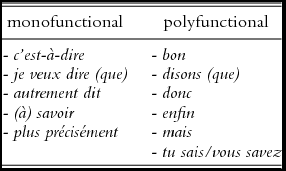
As for lexical corrective markers in French, Hölker (Reference Hölker1988: 108–123) distinguishes primary and secondary markers: Primary markers indicate correction and secondary markers must be interpreted in context, i.e. primary markers correspond to monofunctional uses, whereas secondary markers correspond to polyfunctional uses (table 3). When it comes to typical lexical markers, corrections are, in contrast to paraphrases, preferably introduced by monofunctional markers:
(9) High degree of corrective semantic difference and monofunctional lexical marker
JM Elle aura euhm quatre ans, euh, cinq ans, pardon.
(10) Low degree of corrective semantic difference and polyfunctional lexical marker
MX À pied ou en bateau ?
FS Le bateau, fin, le ferry.
Corrective markers

In (9), the speaker deletes the reference expression (quatre ans) and replaces it by a referentially incompatible treating expression (cinq ans). The strong semantic contrast between the two components is prototypical, and the (post-posed) lexical marker used in this context (pardon) belongs to the monofunctional category. In (10), the correction is less typical since the reference expression (le bateau) is corrected by an element that is not completely incompatible from a purely semantic point view (le ferry). However, as can be reconstructed from the speaker's perspective, pragmatic incompatibility causing a weak correction can be attested.Footnote 5 This type of atypical correction is indicated by a polyfunctional lexical marker (fin < enfin).
To determine how lexically polyfunctional markers of self-reformulation came into being, it is important to take into account the diachronic development of these elements. Hansen (Reference Hansen2005), for example, sketches the development of three core uses of enfin (temporal, synthesizing, repairing), of which only the temporal reading has truth-conditional value. Having developed out of the temporal meaning, the other readings are discourse markers without truth-conditional value. The development of these uses is explained by a process of grammaticalization as semantic bleaching and pragmatic strengthening, which results from the conventionalization of conversational implicature (Hopper and Traugott, Reference Hopper and Traugott2006). Hansen (Reference Hansen2005) argues that the three uses are distributed text-specifically: The temporal use is mostly used in narrative prose, the synthesizing use in argumentational and expository discourse and the repairing use ‘is by far the most frequent in contemporary spontaneous spoken interaction’ (Hansen, Reference Hansen2005: 64f.). This text-specific distribution can be related to the conceptional variation, according to which narrative prose would be mostly conceptionally distant and spontaneous spoken interaction mostly conceptionally oral. Hansen's findings therefore suggest a relation between lexically polyfunctional markers and conceptional orality. The conventionalization of conversational implicature, a process in which speakers express more than what they actually say, results from the communicative condition of expressivity.
As mentioned in section 2, lexical and prosodic markers may serve the same function in marking self-reformulations. In what follows, intonational markers of paraphrases and corrections are conceived as one major prosodic device (Selting, Reference Selting1988; Couper-Kuhlen, Reference Couper-Kuhlen, Auer and Luzio1992; Morel and Danon-Boileau, Reference Morel and Danon-Boileau1998; Simon, Reference Simon2004; Bergmann, Reference Bergmann, Bergmann, Brenning, Pfeiffer and Reber2012), but naturally other prosodic features interacting with each other may contribute to self-reformulation marking as well. Intonation corresponds to the interpolation of metrically accented syllables, as described in the Autosegmental-Metrical (AM-) Model of Intonational Phonology (Pierrehumbert, Reference Pierrehumbert1980).
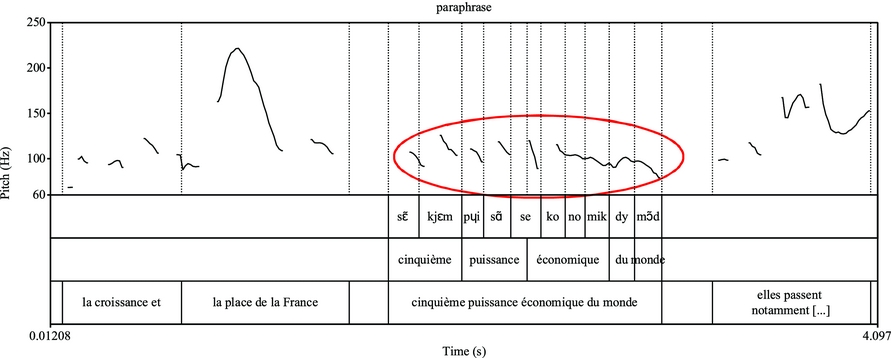
Unlike optional lexical discourse markers, prosody is always present since phonology is co-constitutive in spoken language. Paraphrases (as a subgroup of parentheses, e.g. Bolinger, Reference Bolinger1989; Lampert, Reference Lampert1992; Berrendonner, Reference Berrendonner and Parret1993) in French and other languages have been shown to be prosodically deaccented, yielding a flat, mostly low f0 contour with a reduced pitch range and the possibility of final f0 increase linking up the parenthesis to the following prosodic constituent (Morel and Danon-Boileau, Reference Morel and Danon-Boileau1998: 59–64; Simon, Reference Simon2004: 225–29). Deaccentuation in this sense is not to be understood as a complete deletion of f0 variation, but rather as a reduction of tonal contrasts with downstep of final accents and reduction or elision of initial accents (Di Cristo and Jankowski, Reference Di Cristo and Jankowski1999). In figure (2), the intonational contour of the paraphrase (cinquième puissance économique du monde, example 3) with successive downstep of final accents as well as standard accentuation of the preceding reference expression (la place de la France) and the following discourse (elles passent notamment) can be observed.
Prosodic structure of a paraphrase.
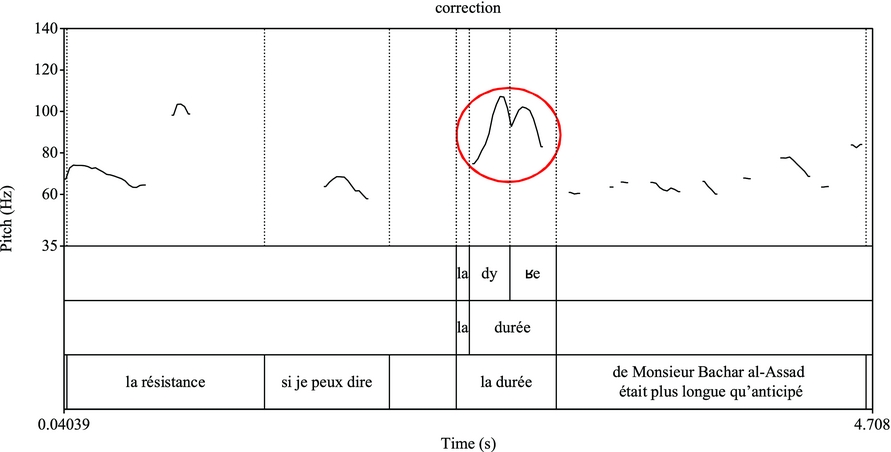
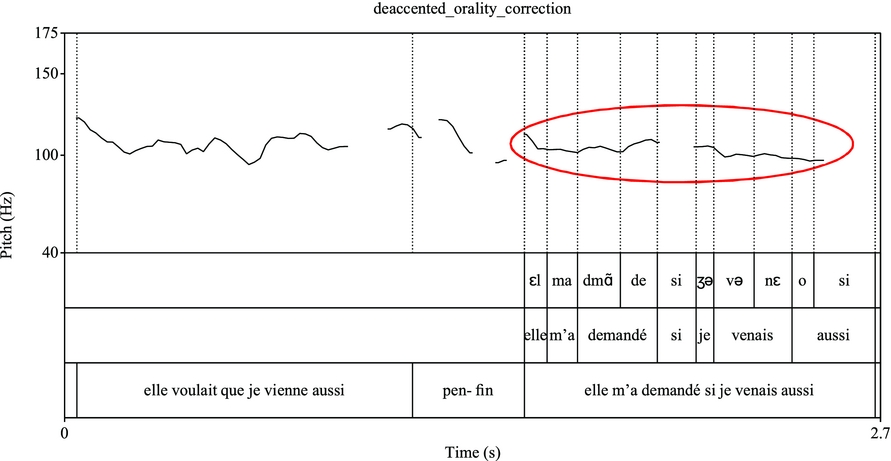
Conversely to paraphrases, corrections (as a subgroup of focus expressions, e.g. Krifka, Reference Krifka2007) are prosodically overaccented and possibly followed by a deaccented structure until completion of the prosodic unit (Morel and Danon-Boileau, Reference Morel and Danon-Boileau1998: 63; Jun and Fougeron, Reference Jun, Fougeron and Botinis2000: 223–30). Figure (3) illustrates the correction (la durée, example 4) with two overaccentuations on each syllable of the lexical item (du-, -rée). The remaining lexical material of the Intonational Phrase (de Monsieur Bachar al-Assad) is deaccented and finally linked up, and the preceding reference expression (la résistance) as well as the reformulation marker (si je peux dire) show standard accentuation. Table (4) summarizes the lexical and prosodic markers of paraphrases and corrections.
Prosodic structure of a correction.
Linguistic markers of conversational self-reformulation

In contrast to lexical markers, it is more difficult to pinpoint the diachronic development of prosodic forms. Apart from the fact that long-term prosodic sources are not available due to technical requirements, research on phonological change has concentrated on segments in Romance languages. Despite some recent work on supra-segmental phonology (Hualde, Reference Hualde2003; Reference Hualde, Auger, Clements and Vance2004; Pešková et al., Reference Pešková, Feldhausen, Kireva, Gabriel, Braunmüller and Gabriel2012; Gabriel, Reference Gabriel, Pustka and Goldschmitt2014), diachronic research on French prosody is largely underrepresented.Footnote 6 A second issue is that prosodic signs do not have the same referential meanings as lexical forms do, i.e. they need to be conceived as co-constitutive devices used in relation to lexical elements.
To summarize, explicit lexical marking is more frequently found with semantic difference (corrections) than with semantic equivalence (paraphrases). Second, semantic difference is preferably introduced by lexically monofunctional markers, while semantic equivalence, if marked explicitly, is typically signalled by lexically polyfunctional markers. The suggested categoriality (e.g. Roulet's, Reference Roulet1980 three classes of marqueurs illocutoires, Hölker's, Reference Hölker, Dausendschön-Gay, Gülich and Krafft1991 three degrees of transparency) is artificial since polyfunctionality and explicitness are gradual;Footnote 7 a continuum rather than a distinct categorization underlies the twofold classification of lexical markers. From a diachronic point of view, polyfunctional markers are a consequence of grammaticalization based on the conventionalization of conversational implicature, which can be attributed to conceptional orality. Prosodically, self-reformulations are always marked by intonational means since these are co-constitutive in spoken language. Paraphrases have been found to be deaccented, while corrections are overaccented in relation to the surrounding discourse. Again, these generalizations are idealizations since prosody is not categorical (Post et al., Reference Post, Delais-Roussarie and Simon2006). Unlike lexical makers, prosodic markers have not been investigated in detail from a diachronic perspective in French.
4. METHODOLOGY
Due to the availability of all kinds of contexts in conceptional orality, including prosody and other non-truth-conditional elements (section 1), it is hypothesized that lexical and prosodic marking of self-reformulations is more important in conceptional orality than in conceptional distance where speakers principally make use of the cotext, e.g. by elaborate syntactic structures. Lexical marking refers to the use of type-specific reformulating markers; prosodic marking refers to the use of type-specific intonation as a function of interpolated accents. Considering both types of self-reformulation, the following hypothesis and sub-hypotheses are examined:
Hypothesis:
The linguistic marking of self-reformulations in conceptional orality differs from the linguistic marking of self-reformulations in conceptional distance.
A) Paraphrases in conceptional orality are more frequently marked by lexically polyfunctional markers and by prosodic deaccentuation.
B) Corrections in conceptional orality are more frequently marked by lexically monofunctional markers and by prosodic overaccentuation.
Lexical and prosodic markers of self-reformulations are just one specific example of the use of non-truth-conditional linguistic elements in conceptional orality. Increased use of discourse markers, prosody and para- and non-verbal signs are expected to be found more frequently in conceptional orality in general when compared to conceptional distance. Self-reformulations are, however, a prominent procedure in unplanned and spontaneous conceptional orality. The reformulating lexical and prosodic markers are therefore taken to be typical of this conception.
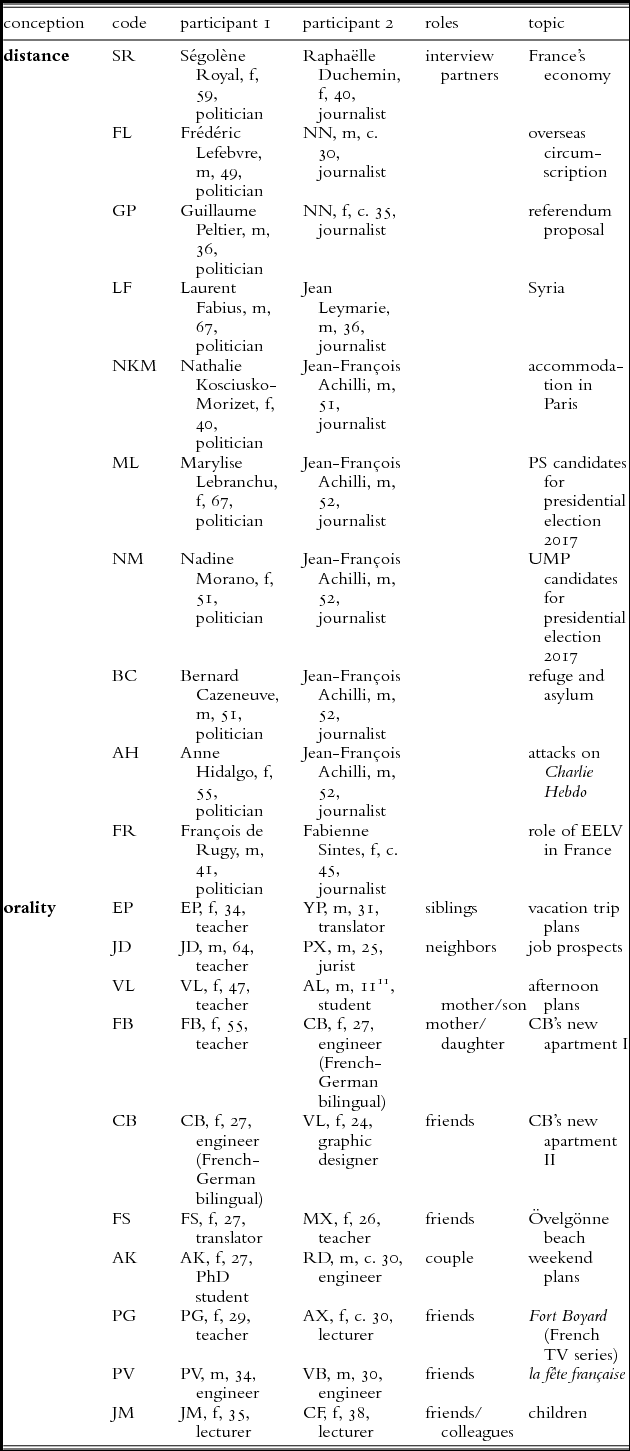
In order to maximally control for the communicative conditions of conceptional variation, two corpora were established: political interviews as instances of conceptional distance and private conversations as instances of conceptional orality. The data were collected in Hamburg (Germany) and Paris (France) between 2013 and 2015. The interviews were taken from the daily series L'invité du matin broadcasted by Radio France (accessible at http://www.franceinfo.fr/videos). The private conversations were recorded between family members or friends with a high-quality recorder (Marantz PMD671); speakers were additionally equipped with microphones (AKG C520). They were asked to talk to each other as spontaneously as possible and were not informed about the research object until after the recordings. All speakers agreed to be recorded for linguistic purposes. The entire corpus is made up of thirty-five subjects taking part in twenty interactions of approximately ten minutes each, yielding a total duration of around 3.5 hours, 55,200 words and 379 analyzable self-reformulations. Table (5) shows the participants coded for sex (m: male, f: female), (estimated) age and profession as well as interactive roles and conversational topics. Both sub-corpora present relatively homogeneous samples at the end poles of the conceptional continuum, respectively.
Data

All recordings were transcribed orthographicallyFootnote 8 before self-reformulations were extracted and fed into Praat (Boersma and Weenink, Reference Boersma and Weenink2017) for prosodic transcription using a slightly adapted version of IVTS (Intonational Variation Transcription System; Post et al., Reference Post, Delais-Roussarie and Simon2006). Contrary to lexical elements, the classification of spoken data into the three prosodic categories of deaccentuation, standard accentuation and overaccentuation is not always uncontroversial. As prosodic categories are contingent, there are borderline cases without a clear threshold between deaccentuation and standard accentuation or between standard accentuation and overaccentuation.Footnote 9 Along with the accentuation of self-reformulations, additional measures were employed to group the data:
– overall f0 movement: When the f0 movement of the self-reformulation was constantly high, mid, or low, it was considered as a potential co-occurrence of deaccentuation.
– relative pitch range: When the pitch range of the treating expression exceeded that of the reference expression, it was considered as a potential co-occurrence of overaccentuation.
– prosodic phrasing: When the self-reformulation was phrased as a segment d'UI (Di Cristo and Hirst, Reference Di Cristo and Hirst1996),Footnote 10 it was considered as a potential co-occurrence of deaccentuation.
– phonetic cues: When the self-reformulation was locally strengthened by phonetic devices like increased intensity or segmental properties (glottalization, aspiration), these were considered as potential co-occurrences of overaccentuation.
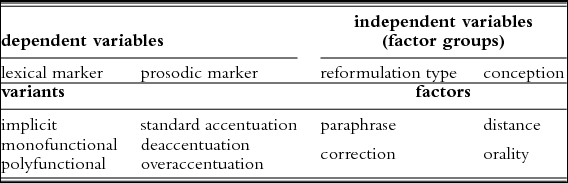
The data were analyzed in a multivariate approach using Variable Rules Analysis (Varbrul), which is specifically adequate for the analysis of natural language in use where no even distribution of variants exists and allows to extract ‘regularities and tendencies from data presumed to have a random component’ (Tagliamonte, Reference Tagliamonte2006: 131). As the hypothesis states, the lexical and prosodic variants in self-reformulations are expected to be influenced by reformulation type (paraphrase/correction) as well as by conception (distance/orality). Table (6) represents the dependent and independent variables with their respective variants used for the analysis. ‘Three lines of evidence’ (Tagliamonte, Reference Tagliamonte2006: 235) were considered for the interpretation of the results: statistical significance, constraint hierarchyFootnote 12 and relative strength. These kinds of evidence allow to state if one or more factor groups determine the occurrence of type-specific marking at a statistically significant level. Secondly, the influence of several factor groups can be compared with each other (relative strengthFootnote 13). Finally, the factors and their potential impact on linguistic marking can be ranked within a factor group by comparing their respective factor weightsFootnote 14 (constraint hierarchy). Although conditions for a multivariate analysis are met, absolute numbers are occasionally quite small.
Dependent and independent variables

5. RESULTS
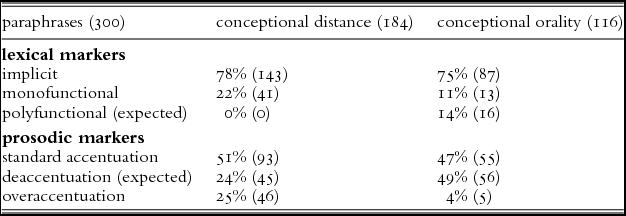
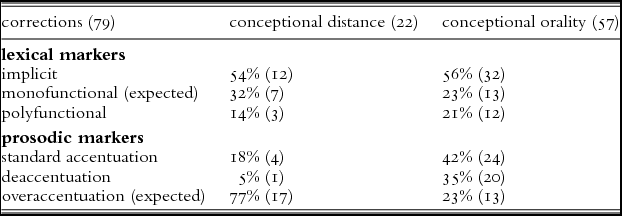
The linguistic markers of paraphrases and corrections are presented in Tables 7 and 8. Looking at absolute numbers, one first observation is that there are more paraphrases in conceptional distance (n=184) than in conceptional orality (n=116) and, inversely, more corrections in conceptional orality (n=57) than in conceptional distance (n=22). Paraphrases are the preferred type of self-reformulation since they make up the majority in both corpora. This may be due to a tendency to avoid conversational intervention and redirection (section 2). Within corpora, corrections represent one third of all self-reformulations in conceptional orality (n=57) and only 11% of all self-reformulations in conceptional distance (n=22). The difference is highly statistically significant (p<0.001) in the data and can be explained as a result of little pre-planning and reflexion in conceptional orality leading to paradigmatic conversational intervention.
Linguistic marking of paraphrases (absolute numbers in parentheses)

Linguistic marking of corrections (absolute numbers in parentheses)

As for paraphrases, lexically polyfunctional and prosodically deaccented structures are expected, and more frequently so in conceptional orality than in conceptional distance (Hypothesis A). In both corpora, the lexically implicit variant represents the clear majority (78% in conceptional distance, 75% in conceptional orality). In explicit structures, all distance paraphrases are introduced by a monofunctional marker (22%; example 8), while polyfunctional markers are completely absent. In explicit paraphrases of conceptional orality, the monofunctional (11%) and the expected polyfunctional variants (14%; example 7), are roughly evenly distributed. Both the reformulation-type and the conceptional factor groups significantly influence the polyfunctional variant (both p<0.001). Within the conceptional factor group, orality is the favoring factor (factor weight: 0.78), but counter to the hypothesized paraphrastic influence, corrections favor polyfunctional structures within the reformulation-type factor group (factor weight: 0.67). Among factor groups, the conceptional group (range: 52) is relatively stronger than the reformulation-type group (range: 22).
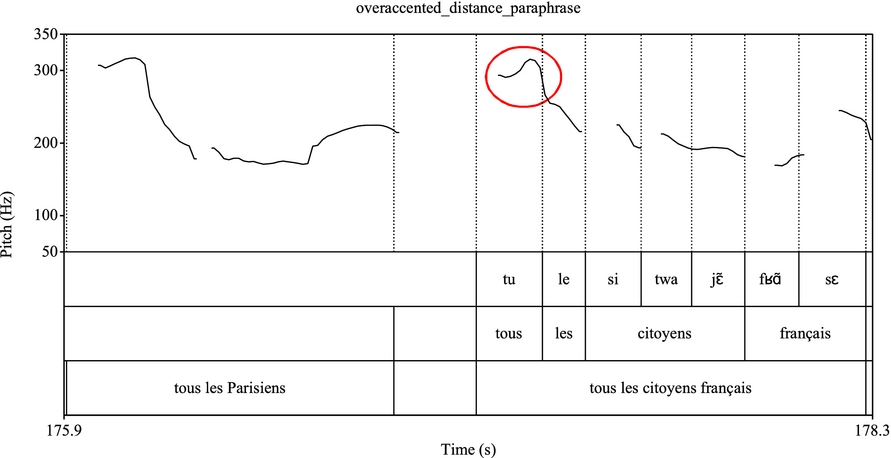
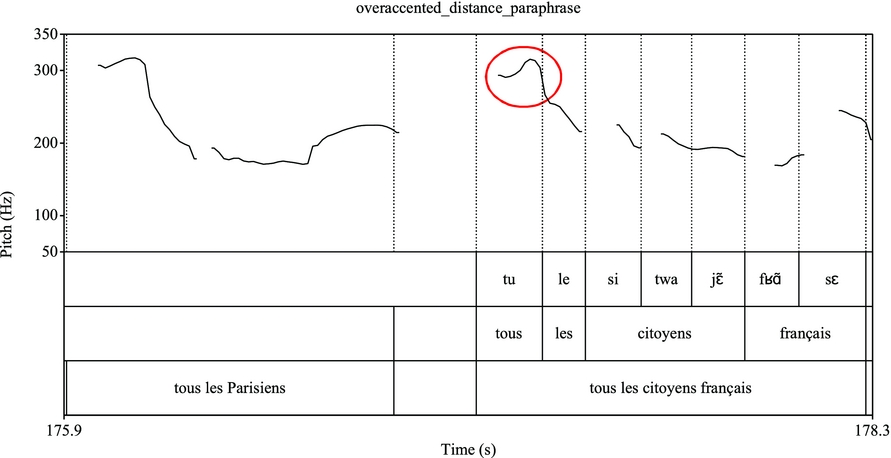
Regarding the prosodic variable, around half of all paraphrases are standardly accented (51% in conceptional distance, 47% in conceptional orality). In conceptional orality, the remaining paraphrases are generally deaccented (49%), while only a minor proportion is overaccented (4%). In contrast, distance paraphrases show equal proportions of deaccentuation (24%) and overaccentuation (25%; example 11/figure 4):
(11) Overaccented distance paraphrase
AH Il y avait tous les Parisiens, tous les citoyens français dans la rue.
Overaccented distance paraphrase.
Deaccentuation is influenced by the conceptional factor group at a statistically significant level (p<0.001), with conceptional orality as the favoring factor (factor weight: 0.65). The reformulation-type factor group does not have a significant effect on deaccentuation (p=0.229).Footnote 15
Table (8) summarizes the variants of corrections for which lexically monofunctional and prosodically overaccented markers are hypothesized, especially in conceptional orality as compared to conceptional distance (Hypothesis B). Like paraphrases, but to a lesser degree, corrections are preferably realized implicitly in both corpora (54% in conceptional distance, 56% in conceptional orality). Even though a number of explicit distance corrections is introduced by a polyfunctional marker (14%), these instances are clearly outweighed by monofunctional markers (32%, examples 1 and 4). As for conceptional orality, the distribution of both monofunctional (23%; example 9) and polyfunctional markers (21%; example 10) is balanced. The statistical analysis of the monofunctional variant shows significant influence of the conceptional factor group (p=0.044), but not of the reformulation-type factor group (p=0.163).Footnote 16 In contrast to the polyfunctional variant, the monofunctional structures are favored by conceptional distance (factor weight: 0.58).
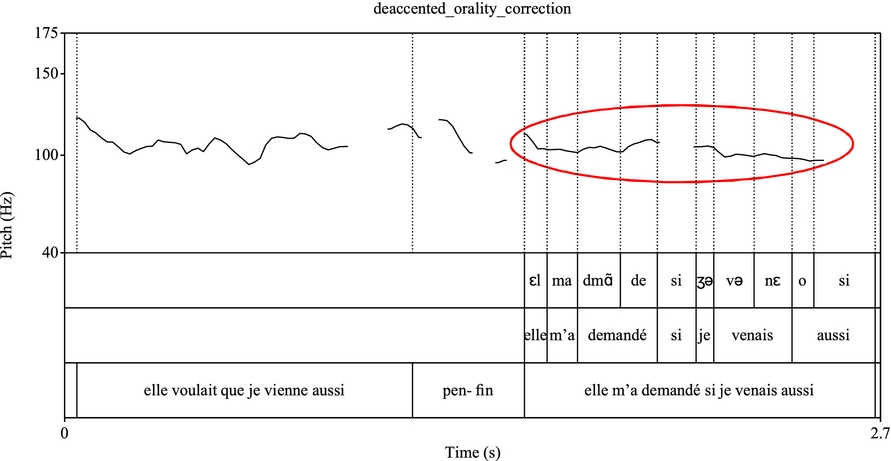
Regarding the prosodic structure of corrections, the distance corpus broadly confirms the findings reported in the literature: The majority of corrections is prosodically overaccented (77%; figures 1 and 3), while few cases show standard (18%) or deaccentuation (5%; n=1). In conceptional orality, however, the expected overaccented variant represents the smallest proportion (23%), and the remaining corrections are either standardly accented (42%) or deaccented (35%; example 12/figure 5):
(12) Deaccented orality correction
YP Elle voulait que je vienne aussi pend-, fin, elle m'a demandé si je venais aussi.
Deaccented orality correction.
The overaccented variant is significantly influenced by conceptional and reformulation-type variation (both p<0.001). Within factor groups, conceptional distance (factor weight: 0.73) and corrections (factor weight: 0.84) favor overaccentuation. The conceptional factor group (range: 50) is stronger than the reformulation-type factor group (range: 45).
Leaving implicit structures and standard accentuation aside (which are not considered to be type-distinctive), the cross-tabulations of lexical and prosodic markers represented in absolute numbers (table 9) indicate that there is no instance of a lexically polyfunctional and prosodically deaccented paraphrase in conceptional distance, but that corrective structures (monofunctional and overaccented markers) coincide in this conception (n=6). In conceptional orality, the combined lexical and prosodic markers show that paraphrases with a polyfunctional marker and deaccented prosody are most frequent (n=8), while all combinations in corrections are evenly distributed (n=3 each). These cross-tabulations corroborate corrective marking in conceptional distance and paraphrastic marking in conceptional orality.
Cross-tabulations of lexical and prosodic markers (absolute numbers)

Summarizing the results, the conceptional factor group is more important than the reformulation-type group, either because it is the only group with a significant influence on the dependent variants (lexical monofunctionality, prosodic deaccentuation) or the relatively stronger factor group when both independent variables are significant (lexical polyfunctionality, prosodic overaccentuation). Regarding the favoring factors, conceptional orality is only prevalent in the paraphrastic structures of polyfunctionality and deaccentuation, while conceptional distance favors the corrective monofunctional and overaccented structures. One generalization is that, as a tendency, self-reformulations in conceptional orality are generally marked by lexical polyfunctionality and prosodic deaccentuation. Distance self-reformulations seem to be complementarily realized by lexically monofunctional and prosodically overaccented structures. Instead of the expected type-specific structure according to the paraphrase/correction variation, a conception-specific marking along the distance/orality continuum can be concluded. This generalization only holds when the dependent variants are considered. Apart from these variants, self-reformulations without lexical markers and with standard accentuation need to be accounted for, given their large proportions in both conceptions, which in many cases represent the majority. Possible explanations will be considered in section 6.
6. DISCUSSION
As far as paraphrases are concerned, the hypothesis of a more important linguistic marking in conceptional orality compared to conceptional distance can be confirmed. The statistical analysis verifies that both lexically polyfunctional markers and prosodic deaccentuation are favored by conceptional orality.Footnote 17 When it comes to corrections, however, the hypothesis does not hold: Contrary to expectations, the lexically monofunctional as well as the prosodically overaccented variants are favored by conceptional distance. The results therefore fully confirm paraphrastic marking (Hypothesis A), but falsify corrective marking (Hypothesis B).
In view of this apparently conceptionally determined variation, communicative conditions, which constitute these conceptions must be of major importance. Turning to the dynamics of turn-taking and dialogicity in conceptional orality, a model of routinization (Lehmann, Reference Lehmann1985; Reference Lehmann and Foley1993; Detges and Waltereit, Reference Detges, Waltereit, Fischer and Gabriel2016) offers a suitable explanation of the results. Routines are understood as speaker-strategic solutions to frequently occurring problems in communication. When routines are ratified and taken over (routinized) by other speakers, their routinization degree steadily increases and may lead to linguistic variation and change. In the first place, routines are individual and intentional actions, which, in the long run, provide explanations of the invisible hand in collective and unintentional language change (Keller, Reference Keller1994).
As was induced from the data presented in section 2, corrections are conversationally more interventional than paraphrases and therefore possibly present opportunities for premature turn-taking (example 6). These problems are specifically related to conceptional orality where dialogicity and turn-competition are massively underway. Detges and Waltereit (Reference Detges, Waltereit, Schmid, Detges, Gévaudan, Mihatsch and Waltereit2011) demonstrate how premature turn-taking as a consequence of turn-competition and times constraints leads to the illegitimate use of imperatives as turn-taking signals (as exemplified by Italian guarda ‘look’). The same procedure can be found in the corpus underlying this study:
(13) Illegitimate use of imperatives as turn-taking signals
FS: Mais, François de Rugy, est-ce que vous ne risquez pas de vous faire piquer l’écologie [en fait] ?
FR: [(rire)]
FS: Regardez: François Hollande qui est converti à, à la diplomatie climatique.
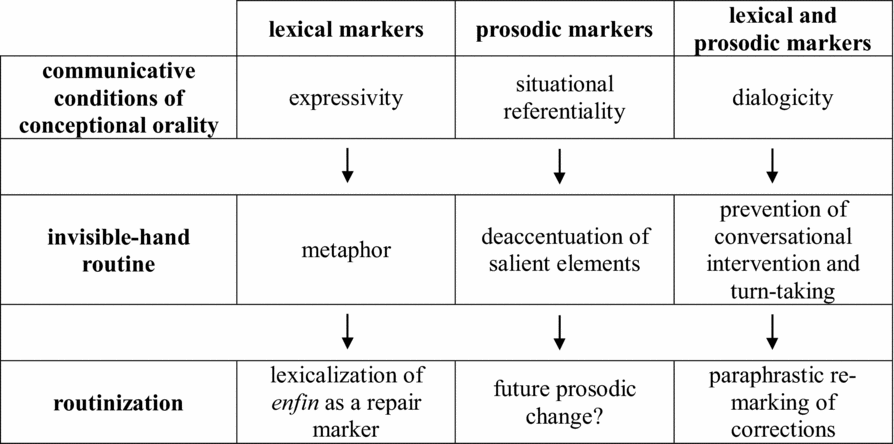
In this example, a political interview with the green politician François de Rugy, the interviewer's (FS) turn is at stake while developing her argument (ecology may no longer be an exclusive topic of the green party), as is signalled by the politician's intervening laughter, which may indicate disagreement, but may also be used to take over turn. The interviewer reacts by introducing her following turn by regardez, morphologically an imperative of the second person plural used in its politeness function. From a conversational perspective, regardez certainly is not to be interpreted in its original sense ‘look’ (since the addressee is supposed to listen to the speaker rather than to physically look at the speaker), but used illegitimately in metaphorical abstraction to maintain turn. It is therefore no coincidence that the same lexical source is found in Italian and numerous other languages (cf. English look, German schau/guck (mal) and many others). The process which causes these uses is the conventionalization of conversational implicature, as was demonstrated for the development of enfin (section 3). In the same vein, speakers in conceptional orality may intentionally develop routines to cope with undesired interventional corrections and illegitimately mark them as paraphrases using lexically polyfunctional markers and prosodic deaccentuation of corrective focus.
Expressivity as one important communicative condition of conceptional orality may explain lexical change from a diachronic point of view: As shown above, lexically polyfunctional markers have undergone a number of related stages away from their truth-conditional forms, which sets them apart from their monofunctional counterparts with a more direct relation to their original sources. When used for reformulating activities, polyfunctional markers like enfin are in the first place more unconventional and thus more expressive than monofunctional markers such as si je peux dire. This expressive use may lead to conversational implicature, which in turn may become conventionalized and, in the long run, routinized. In the debate on whether the emergence of discourse markers is a case of grammaticalization (Traugott, Reference Traugott1995; Hansen, Reference Hansen2005), pragmaticalization (Erman and Kotsinas, Reference Erman and Kotsinas1993; Mroczynski, Reference Mroczynski2012), or other processes (Detges and Waltereit, Reference Detges, Waltereit, Fischer and Gabriel2016), the routinization perspective allows for an appropriate concept in the context of conceptional variation since it captures the communicative causes (instead of the results) of variation and change.
However, it is not so much the conception as a whole that establishes the possibility for a lexical element to become routinized, but specific communicative conditions. There are, for example, discourse traditions like political discussions, typically said to belong to the distance conception, in which the degree to expressivity is very pronounced and may lead to ad-hoc innovations, which represent opportunities for linguistic change to occur (Koch and Oesterreicher, Reference Koch and Oesterreicher1996). The use of the illegitimate imperative regardez as a turn-taking marker taken from the distance corpus is example of this fact. Even though the political interviews are characterized by a high degree of monologicity, the example displays a sequence in which dialogicity is locally high and therefore gives rise to conversational implicatures. Fine-grained differences within discourse traditions (e.g. political interviews, political discussions) incorporate stylistic (as well as social and regional) variation.Footnote 18 Therefore, the different types of variation must be considered as interdependent, and the conclusions drawn in this article only refer to private conversations and political interviews as prototypical discourse traditions at the extreme poles of the conceptional continuum.
Prosodic deaccentuation as the second feature of self-reformulations of conceptional orality may be explained by situational involvement as a further typical communicative condition. In numerous languages, deaccented forms are associated with situationally derivable items (Pierrehumbert and Hirschberg, Reference Pierrehumbert, Hirschberg, Cohen, Morgan and Pollack1990; Wennerstrom, Reference Wennerstrom2001).Footnote 19 Since the situational context is highly salient in conceptional orality, deaccentuation of corrective elements may be used when these elements are situationally inferable to start off with and then generalize onto corrective focus.
Without using the term routinization, a similar phenomenon has been described by Selting (Reference Selting1987) in her study of different types of communicative problems and their prosodic forms in German. She shows that due to preferential conversational structures, specific communicative problems can be re-categorized by means of type-distinctive intonational structures. Likewise, Couper-Kuhlen (Reference Couper-Kuhlen, Auer and Luzio1992) in her investigation of interactive repair in English convincingly argues that acoustic repairs can be masked as content-related repairs and vice versa for conversational reasons like face-saving by manipulating the prosodic parameters of speech rhythm and tempo (prosodic camouflage). Again, situational involvement is not restricted to conceptional orality as there may be discourse traditions of conceptional distance in which the situational context is available. In these cases, prosodic deaccentuation of corrective focus would not be unexpected.
Considering lexical and prosodic markers altogether, speakers in conceptional orality may apply a routine of paraphrastic re-marking to corrections. From an onomasiological perspective, this routine is very efficient: Discourse interventions and subsequent redirections caused by corrections are welcome opportunities to take over turn, especially in conceptional orality where the roles of speaker and interlocutor change dynamically. In the context of linguistic change, therefore, the conversational strategy of paraphrastic re-marking of corrections can be interpreted as an invisible-hand routine of speakers who wish to maintain their current turn. The routine may be taken over by other speakers, increase in frequency and lead to language change, for example lexicalization, prosodic change, or global re-marking on different linguistic levels, all of which may be captured by the notion of routinization. Figure (6) summarizes possible processes involved in orality-induced variation and change of the linguistic marking of self-reformulations in French. As these conclusions rely on a very small database, they are of course only tentative. Yet, similar processes have been observed in the diachronic development of the French periphrastic future (Detges, Reference Detges, Lang and Neumann-Holzschuh1999), of negative constructions (Detges, Reference Detges, Blank and Koch2003) and, as described above, of turn-taking discourse markers (Detges and Waltereit, Reference Detges, Waltereit, Schmid, Detges, Gévaudan, Mihatsch and Waltereit2011).
Communicative conditions of conceptional orality and routinization.

Turning to other results, the majority of paraphrases (78% in conceptional distance, 75% in conceptional orality) and corrections (54% in conceptional distance, 56% in conceptional orality) is not lexically marked (Tables 7 and 8). This ratio confirms Gülich and Kotschi's (Reference Gülich, Kotschi and Quasthoff1995) postulate of the correlation between semantic difference and explicit marking (section 3). The statistical analyses confirm that both monofunctional and polyfunctional markers are favored by corrections. This correlation seems to be largely independent of conceptional variation since the distributions are comparable in both corpora.
Another open question regards the weak difference between lexically monofunctional (11%) and polyfunctional markers (14%) of paraphrases in conceptional orality, especially under the result of the absolute difference found in distance paraphrases where no polyfunctional markers are used. The relatively high proportion of monofunctional markers could be explained by the number of various subtypes of paraphrases (e.g. specification/precision, explanation, variation, summary, denomination), which prefer explicit and unambiguous lexical markers, such as plus précisément for the subtype ‘specification/precision’ or en d'autres mots for the subtype ‘variation’ (Gülich and Kotschi, Reference Gülich, Kotschi and Quasthoff1995).
Standard accentuation is mostly found in paraphrases (51% in conceptional distance, 47% in conceptional orality) and in corrections of conceptional orality (42%). When compared to corrections, paraphrases show less semantic contrast with respect to the reference expression, which may more likely lead to standard (non-reformulating) accentuation, independently of conception. In corrections of conceptional orality, a conflict between the corrective (overaccented) variant favored by conceptional distance and the paraphrastic (deaccented) variant favored by conceptional orality may explain the high score of standard accentuation as the medium form between de- and overaccentuation. This argumentation is supported by the fact that there is interaction between the factor groups, as the Varbrul analysis reveals (section 5). The same conflict may be in place in order to account for the balanced proportion of deaccented (24%) and overaccented paraphrases (25%) in conceptional distance (deaccentuation is favored by paraphrases, overaccentuation is favored by conceptional distance) as well as for the balanced proportion of monofunctional (23%) and polyfunctional markers of corrections (21%) in conceptional orality (monofunctionality is favored by corrections, polyfunctionality is favored by conceptional orality).
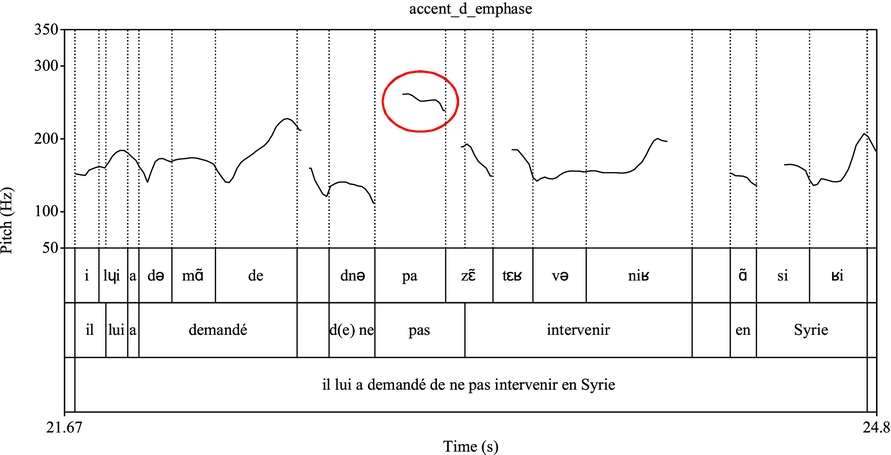
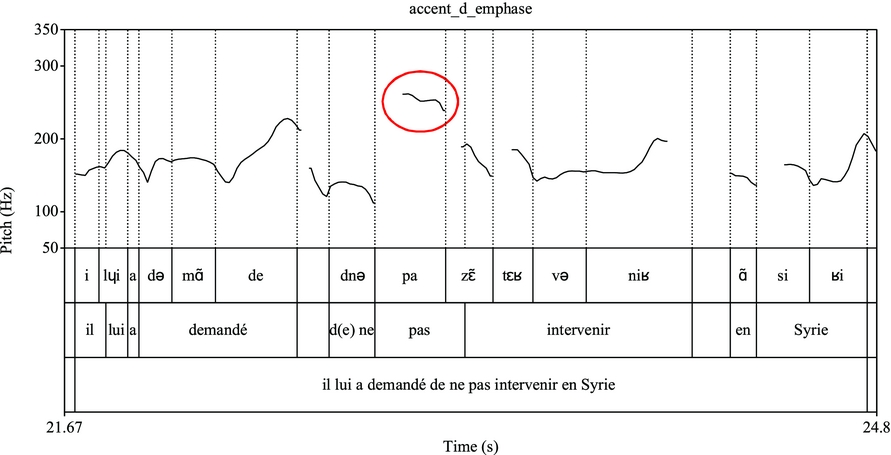
Finally, the unexpectedly high proportion of overaccented paraphrases in conceptional distance (25%), which equals the expected deaccented variant (24%), challenges the traditional view of paraphrastic prosody. One particularity in the study of political discourse traditions in general is that these speakers are highly trained for speaking in public. Also, this kind of overaccentuation can be interpreted as a generalization of the stable and well-attested accent d'emphase ‘emphatic accent’ of French distance speakers, especially in the media (e.g. Carton et al., Reference Carton, Hirst, Marchal and Seguinot1976). The data show that this type of accent is used throughout the entire distance corpus, also outside of self-reformulations (example 14/figure 7). Therefore, it has to be attributed to other influences than those accounting for deaccentuation in conceptional orality, which seems to occur only in specific contexts such as self-reformulation (example 12/figure 5).
(14) Accent d'emphase in distance outside reformulation
JL Il lui a demandé de ne pas intervenir en Syrie.
Accent d'emphase in conceptional distance outside of self-reformulation.
7. CONCLUSIONS AND OUTLOOK
The study presented takes the functional and formal descriptions of self- reformulation as a starting point for the confrontation of the findings with empirical data of French. While both represent retrospective reformulation activities, paraphrases and corrections can be distinguished from each other by their degree of semantic modification. Paraphrases establish semantic equivalence; corrections entail semantic difference and massively intervene in and restructure the ongoing discourse with important consequences for turn-taking. Paraphrases tend to take lexically polyfunctional markers and prosodically deaccented forms, while corrections are by and large marked by monofunctional and overaccented structures. Self-reformulations are typically found in conceptional orality as opposed to conceptional distance. One major difference between both conceptions is that the various context types used for verbalization are predominantly available in conceptional orality. Assuming that both the reformulation-type and the conceptional variation influence the linguistic marking of reformulation, self-reformulation is expected to be more importantly marked by lexical and prosodic markers in conceptional orality than in conceptional distance. This hypothesis is verified for paraphrases of conceptional orality, but falsified for corrections of conceptional orality, which are significantly realized as paraphrases, both lexically and prosodically. These results are interpreted in the light of language change grounded in a routinization model. Speakers possibly develop techniques to overcome corrections, which represent communicative intervention and redirection and, consequently, the conversational threat of losing the right to speak. In conceptional orality, these issues are multiplied by a high degree of dialogicity and turn-taking between the interlocutors.
One decisive advantage of this approach is that it provides explanations for variation within a theoretical framework of routinization in conceptional orality. The routinization approach incorporates lexical and prosodic markers and allows for a synchronic as well as for a diachronic perspective. With respect to phonological research, the diachronic perspective is an important asset since prosodic change in Romance has only been studied to a very little extent so far (section 3). Insights from both synchronic description and traditional research on language change complement each other in this way.
At the same time, the study has limitations, one of which regards methodology. To attribute the observed tendencies to conceptional distance and conceptional orality, other (socio-)linguistic factors need to be ruled out, for instance speaker-specific linguistic strategies. To this end, the same speakers would have to be analyzed in both conceptions, for example politicians in conceptional orality and private individuals in conceptional distance. This procedure was not undertaken due to demands of authentic data representing natural language in natural contexts. Necessarily, these flaws are complicated by the complexity of factors constituting conceptional variation and other interactional factors.
Further, a number of questions remains unanswered within the scope of this study: Apart from non-verbal markers of self-reformulation, other prosodic devices, such as intensity, pausing, speech rate, glottalization, creaky voice etc. should be examined for a necessary completion of the picture. A follow-up study on phonetic correlates of conversational self-reformulations points towards a co-occurrence of paraphrastic deaccentuation and laryngealization and a compensation of absent corrective overaccentuation by means of glottalized break-offs in conceptional orality (Stahnke, to appear).
Turning to the specific functions of self-reformulation, both paraphrases and corrections contain subtypes (section 6), the realization of which is yet open to systematic description. Moreover, interaction between linguistic markers can be expected (as provisionally indicated in section 6, table 9) and needs to be investigated in more detail.
Finally, for a refined analysis of routinization, the spectrum of discourse traditions, of conversational activities other than self-reformulation, of other possible independent factors and of other languages should be diversified in future research.