1. Introduction
Second language (L2) learners who encounter sentences such as those in (1) must determine whether (1a) and (1b) are merely variants with the same meaning or whether the two sentences differ in the message they convey.
-
(1)
-
a. I saw the children in front of the house.
-
b. In front of the house I saw the children.
-
Although the content of the two sentences is the same and both are considered grammatical, the way in which the information is presented differs. In addition to varying the syntax of utterances such as those in (1), speakers are also able to place emphasis on words in the utterance to make them prominent. Whereas in a neutral context the emphasis would be placed on the last content word in each sentence (i.e. house in (1a) or children in (1b)) (e.g. Chomsky & Halle, Reference Chomsky and Halle1968), it is possible for a speaker to make use of cues including pitch and loudness to highlight an important word or phrase. For example, if a speaker would like to stress that s/he was the person who saw the children, I would be emphasized. Similarly, if the children were the most important component in the sentences, that noun phrase would be highlighted or put into focus.
Focus is a semantic notion and is understood here in the sense of Krifka (Reference Krifka2008): the focus is the part of the sentence which is highlighted and can serve as an answer to an explicit or implicit question. At a more technical level, it “indicates the presence of alternatives that are relevant for the interpretation of linguistic expressions” (Krifka, Reference Krifka2008, p. 248). In Germanic languages, including German and English, focus can be achieved in a number of ways. In this paper we will primarily consider the morphosyntactic and phonological means by which native and intermediate-to-advanced L2 speakers of these languages highlight “discourse-new” information when they speak. It is important to acknowledge that the notions of focus and of newness often fall together, but they are not equivalent, since a new referent is not necessarily focused, and a focused constituent is not necessarily new (see Krifka, Reference Krifka2008 for examples). The terminological choice allows us to limit ourselves to discourse properties of the referents under consideration rather than to semantic properties. In this paper, it is often the case that the two notions fall together.
The other notion that is crucial for the current study is “givenness”. In Krifka's wording (Reference Krifka2008, p. 262): “A feature X of an expression α is a Givenness feature iff X indicates whether the denotation of α is present in the Common Ground (CG) or not, and/or indicates the degree to which it is present in the immediate CG”. The CG is understood as a way to model the information that is shared among interlocutors and that is continuously modified in communication. Givenness can be defined in semantic and discourse terms. Here we are interested in the grammatical marking of new and given constituents (in discourse) in the two languages under consideration: German and English.
The communicative choices one makes in the packaging of information – or information structure (IS) – are based on communicative needs of both speaker and hearer in a particular situation. In spite of the communicative importance in appropriately marking IS, even very advanced L2 learners may show difficulty especially in the situationally appropriate use of cues to mark newness and givenness (e.g. Gut, Reference Gut2009; Hopp, Reference Hopp2004; Reichle, Reference Reichle2010). Researchers have primarily investigated the syntactic means by which learners mark information structure roles (e.g. Bohnacker, Reference Bohnacker, Bohnacker and Westergaard2010; Bohnacker & Rosén, Reference Bohnacker and Rosén2008; Carroll, Murcia-Serra, Watorek & Bendiscioli, Reference Carroll, Murcia-Serra, Watorek and Bendiscioli2000), and a few have investigated phonological marking thereof (e.g. Gut, Reference Gut2009; Ramírez Verdugo, Reference Ramírez Verdugo2002). To date only Donaldson's (Reference Donaldson2011) study examining right dislocation in spontaneous utterances among near-native L2 learners of French has investigated both syntactic and phonological marking of information structure roles. Unlike Donaldson’s, however, the current study employs a methodology that controls for information structure roles. The marking of IS roles involves the coordination of cues – syntactic and phonological as well as article use – in order to highlight information in discourse. As such, IS marking falls at the interfaces; that is, it involves mapping between levels of linguistic representation. Research investigating interface phenomena has shown that some L2 mappings are especially difficult to acquire in a native-like way.
In this paper, we report on the results of a dynamic localization experiment involving native and L2 speakers of German and English. Participants were presented with a series of twelve configurations of toy animals. Each configuration featured the introduction or changed position of one animal, the new element of each utterance. Participants were instructed to describe each configuration after the new animal was introduced or the given animal changed position, in a fixed order of presentation and with controlled status (given vs. new) of the animals being described. This dynamic localization task provides participants with a clear indication of discourse-new elements. The new element is usually the focus of the sentence. It enables us to precisely determine the means by which speakers highlight these elements when they speak and compare L2 patterns to those produced by native speakers. Because speakers completed the task in both their L1 and in their L2, transfer effects may also be investigated.
2. Grammatical reflexes of information structure
Based on a speaker's assumptions of what the listener knows (the Common Ground), s/he packages information to highlight relevant information in the discourse (Krifka, Reference Krifka2008; Prince, Reference Prince and Cole1981). Information structure phenomena are classified as existing at the interface of morphosyntax/phonology and discourse (Chafe, Reference Chafe and Li1976; Lambrecht, Reference Lambrecht1994; Prince, Reference Prince and Cole1981).Footnote 1 That is, speakers make use of morphosyntactic (Section 2.1) and phonological cues (Section 2.2) at their disposal to draw attention to particular elements. Gussenhoven (Reference Gussenhoven2008) and Krifka (Reference Krifka2008), among others, note that speakers may rely on a number of structural devices – either alone or in combination with others – to express IS. For example, they make use of syntactic marking of IS by moving highlighted information to a sentence position designated as the focus position. Similarly, they may use focus particles or affixes. Often, speakers also mark information structure roles through the use of articles: new items are often marked with indefinite articles, and given or reintroduced material is usually marked with definite articles. Finally, a focused element may also be marked phonologically (i.e. through the use of a pitch accent or prosodic phrasing) to increase its prominence (Krifka, Reference Krifka2008, p. 384).
There is a universal tendency for given items (i.e. those items that exist in the Common Ground) to appear before discourse-new items (e.g. Clark & Haviland, Reference Clark, Haviland and Freedle1977); however some languages show a subject-first preference. In many languages, including English and German, given items are phonologically less prominent than new and focused items. The way in which the roles of focus and givenness are encoded depends on the context of the utterance. Despite similarities across languages, the precise means by which speakers of a particular language mark focus may differ.
In intonation languages like German and English, speakers have a similar set of possibilities to choose from (Cruttenden, Reference Cruttenden1986, p. 149; Grabe, Reference Grabe1998). Phonologically they rely primarily on placement and type of pitch accent (i.e. a particular intonational contour on a stressed syllable) and phrasing (i.e. dividing speech into chunks) (Grice & Baumann, Reference Grice, Baumann, Trouvain and Gut2007; Gussenhoven, Reference Gussenhoven2008; Selkirk Reference Selkirk and Goldsmith1995). In spite of similarities, differences have been reported across the two languages. Most importantly, syntactic marking of focus via movement to a structurally prominent position is more common in German, due to its relatively free word order (e.g. Gibbon, Reference Gibbon, Hirst and di Cristo1998; Hopp, Reference Hopp2004; Lenerz, Reference Lenerz1977).
2.1 Morphosyntactic marking of information structure in German and English
Canonical word order is the same in German and English: subject/locatum (Loc) before prepositional phrase/locative expression (Lx) (e.g. Lenerz, Reference Lenerz1977; McCawley, Reference McCawley, Jacobs, von Stechow, Sternefeld and Vennemann1991). In both languages it is possible to highlight elements through a number of syntactic devices including topicalization/left dislocation, passivization and clefting. German speakers have one additional option: scrambling. Speakers of English are therefore more restricted in their syntactic choices and, although it is grammatical, movement to the preverbal position in English is relatively rare (Lightfoot, Reference Lightfoot1999).
Féry, Skopeteas and Hörnig (Reference Féry, Skopeteas and Hörnig2010) performed a cross-linguistic study investigating how native speakers of various languages (i.e. English, Finnish, French, Georgian, German and Mandarin Chinese) mark focus and givenness in a dynamic localization task in which one new item was localized in relation to items that were already present. The goal was to determine how native speakers of a variety of languages syntactically mark information structure roles, specifically given and new. In addition to speakers of the other languages, 16 English native speakers and 30 German native speakers completed the task. The tendency among English native speakers was to produce subject-first structures in which the discourse-new item appeared before the locative expression (i.e. a prepositional phrase containing given information that locates this information relative to the other item), for example, as in (2). All examples come from our current experiment.
-
(2) A dog is to the right of the bear.
German native speakers, on the other hand, preferred to place the locative expression containing the given referent, in the first position of the sentence and the discourse-new referent at the end of the sentence, as in (3).
-
(3) Rechts neben dem Bär ist ein Hund.
“To the right of the bear is a dog”.
Thus, although native speakers of both languages are able to produce both types of constructions and although both are considered grammatically correct, in this task Féry et al. (Reference Féry, Skopeteas and Hörnig2010) observed a clear difference in preferred syntactic marking of information structure roles. This may be due in part to the difference in means by which speakers are able to move elements into the preverbal position in the two languages. Movement of the prepositional phrase (PP) to the preverbal position in English involves locative inversion, but in German the process involves scrambling, which is common in German (Féry et al., Reference Féry, Skopeteas and Hörnig2010). In other words, German is a scrambling language, which means that the locative PP may be scrambled to a position higher than the subject in order to satisfy discourse preferences. By contrast, the corresponding construction in English involves Ā‑movement (i.e. an operation that leads to an operator position outside the thematic layer of the clause). In sum, then, both German and English have some freedom in their word order, but whereas scrambling in German is an A-movement, which readily applies, English can only move its constituent at the price of Ā‑movement, a more limited and ‘costly’ operation. In terms of article use, native speakers of both German and English in Féry et al. (Reference Féry, Skopeteas and Hörnig2010) preferred to make use of indefinite articles to mark new information.
2.2 Phonological marking of information structure in German and English
In the current paper we investigate pitch accent as the phonological means by which speakers mark focus. Bolinger (Reference Bolinger1958) proposed two types of accents in English: A, a falling accent and B, a fall-rise accent. Since then Jackendoff (Reference Jackendoff1972) and Liberman and Pierrehumbert (Reference Liberman, Pierrehumbert, Aronoff and Oehrle1984) proposed that A accents are used to mark focus and that B accents mark topics in English. Gussenhoven (Reference Gussenhoven1983, Reference Gussenhoven2004) analyzes a falling contour (H*L L%) as “addition”, a fall-rise (H*L H%) as “selection” and a rising one (L*H H%) as “testing”. Steedman (Reference Steedman2000) distinguishes between theme (more or less equivalent to topic) and rheme (more or less equivalent to focus) and observes that these two discourse functions are typically accompanied by different tonal contours. A theme has a falling-rising accent LH* L-H%, and a rheme has a falling accent H* L-L%. In Example (4) from Jackendoff (Reference Jackendoff1972) and Steedman (Reference Steedman2000), the topic (theme) has a falling-rising accent (‘selection’ for Gussenhoven, Reference Gussenhoven1983, Reference Gussenhoven2004) and the focus (rheme) has a falling accent (‘addition’ for Gussenhoven, Reference Gussenhoven1983, Reference Gussenhoven2004). Steedman (Reference Steedman2000) notes that the falling-rising can be simplified to a rising accent without much difference in meaning. Breen, Fedorenko, Wagner and Gibson (Reference Breen, Fedorenko, Wagner and Gibson2010), in an investigation into the acoustic correlates of IS in English, found consistency among speakers in the cues used to mark focus (i.e. greater intensity, longer duration and higher mean and maximum F0). In sum, authors agree to recognize a divide in the use of pitch accents in English. A pitch accent signaling focus is generally falling, and a pitch accent signaling a given topical entity is generally rising or falling-rising.
-
(4)


The same kind of functions for falling and rising accents have been proposed for German (e.g. Jacobs, Reference Jacobs1997; Büring, Reference Büring1997). Previous research has shown that speakers are consistent in their prosodic marking of information structure roles in German (e.g. Baumann, Reference Baumann2006 for givenness; Büring, Reference Büring2003, for topic; Féry & Kügler, Reference Féry and Kügler2008 for focus); however the consistency of the focus marking is limited to the nuclear accent (i.e. the last accent in a sentence). Although Féry et al. (Reference Féry, Skopeteas and Hörnig2010) found that German speakers tend to mark focused constituents with a falling contour and topics with rises, they argue that this has more to do with word order than with information structure roles: given information precedes new information. Thus, it is the fact that pre-final pitch accents in German rise and final pitch accents in German fall – and not phonological invariance of information structure roles – that leads to the general patterns found in German.
Given material in both German and English is generally assumed to be deaccented, although deaccenting is a feature that is found primarily in postnuclear position (see for instance Gussenhoven, Reference Gussenhoven1983, Reference Gussenhoven2004 for English and Féry & Kügler, Reference Féry and Kügler2008 for German). In sum, then, previous studies investigating the phonological marking of IS roles in English and German show some important differences, especially in terms of the contours used to mark focused elements. Whereas English tends to make use of a falling contour to mark focused elements, the contours used by German native speakers may have more to do with sentence position. In addition, English native speakers have been reported to show more variability in the phonological cues to mark focus than German native speakers.
2.3 The acquisition of information structure in an L2
Relatively few studies have investigated the marking of information structure roles in an L2. Those that have looked at the phenomenon have primarily focused on syntax,Footnote 2 and the general findings are mixed. Whereas some offline studies indicate native-like performance among very advanced learners, others report that even the most advanced L2 learners fail to perform like native speakers, in spite of the fact that they have mastered the formal areas of grammar including narrow syntax (Bohnacker, Reference Bohnacker, Bohnacker and Westergaard2010; Coppieters, Reference Coppieters1987; White, Reference White2011a). Hopp (Reference Hopp2004) investigated the acceptability judgments of scrambled sentences by Japanese–German and English–German L2 learners (i.e. native speakers of Japanese and native speakers of English who learned German as an L2). The L2 learners were found to transfer their L1 strategies to their L2 German, regardless of proficiency level. On the other hand, Ivanov (Reference Ivanov2012) found evidence for the contribution of proficiency in a grammaticality judgment task among English–Bulgarian L2 learners. The near-native, as opposed to the less advanced, participants showed native-like judgments of clitic doubling in Bulgarian, a process that involves topics. Reichle (Reference Reichle2010) examined how end-state English–French L2 learners living in a French-speaking environment compared to French native speakers in their judgments of French question–response pairs containing expected or anomalous IS marking. The results indicate a significant effect of age of arrival: those participants who had been living in a French-speaking environment since a younger age performed in a more native-like manner than those who arrived when they were older.
Additional studies have sought to determine whether there are differences in processing IS marking among native and non-native speakers. As a follow-up study to the acceptability judgment task described above, Reichle (Reference Reichle2010) investigated whether highly proficient learners perform similarly to native speakers on a task making use of the event-related potential (ERP) technique. Even the very advanced participants in the study did not perform like native speakers, and their performance on the task was not significantly different from that of low-proficiency L2 learners. Wilson (Reference Wilson2009) utilized eye tracking with the visual world paradigm to determine how English–German L2 learners process pronominalization violations related to IS roles. Although he did not find evidence for direct transfer, Wilson discovered that even advanced English–German L2 learners experienced difficulty in processing object–verb–subject (OVS) word order.
Studies investigating spoken language generally show deviation from native norms. Very advanced French L2 learners in Bartning, Forsberg and Hancock (Reference Bartning, Forsberg and Hancock2009) experienced difficulty in producing syntactic structures indicating IS roles in French preambles. In fact, Bartning et al. (Reference Bartning, Forsberg and Hancock2009) found no difference between the very advanced and the less advanced participants in the study. Bohnacker (Reference Bohnacker, Bohnacker and Westergaard2010) and Bohnacker and Rosén (Reference Bohnacker and Rosén2008) investigated the spoken productions of verb-second (V2) declaratives among Swedish–German and German–Swedish L2 learners, respectively. The results of both studies indicate that although the L2 learners produced syntactically acceptable utterances indicating mastery of formal syntax, IS marking produced by even the most advanced speakers was significantly different from that of native speakers.
Carroll et al. (Reference Carroll, Murcia-Serra, Watorek and Bendiscioli2000) used a picture description task in which English–German L2 learners and German native speakers were asked to describe a town square. All L2 learners had been living in Germany for between eight and 22 years. As was found by Féry et al. (Reference Féry, Skopeteas and Hörnig2010) in the dynamic localization task described above, German native speakers made use of scrambling in that they produced locative-first expressions. In the same Carroll et al. (Reference Carroll, Murcia-Serra, Watorek and Bendiscioli2000) study, English–German L2 speakers preferred to describe the pictures by using existentials in sentence-initial position. Thus, even the advanced English–German L2 learners in the study who had been living in Germany for extended periods of time did not acquire native-like syntactic marking of IS in German.
We know of only one study investigating IS marking in an L2 that has shown native-like patterns among L2 learners in spoken productions. The near-native English–French L2 learners in Donaldson (Reference Donaldson2011) did not differ from native speakers in their intuitions about or productions (both types and content) of right-dislocations in French. That is, the near-natives’ productions contained qualitatively similar syntactic cues to those of the native speakers. The only area of difference between the native speakers and the L2 learners was in the overall quantity of right-dislocations: native speakers produced them more frequently than did L2 learners.
Whereas L2 learners may be successful at producing native-like syntactic structures in their L2, nearly all studies investigating the acquisition of L2 prosody indicate transfer of L1 patterns, even at the most advanced levels (e.g. Gut, Reference Gut2009; Ramírez Verdugo, Reference Ramírez Verdugo2006).Footnote 3 Although it has been argued that intonation is redundant to syntax, especially in an L2, Chun (Reference Chun2002) counters these claims by noting that intonational contours often carry their own meanings and that L2 learners who wish to make themselves understood, and to comprehend native speakers, must know the intonational patterns of the L2 and produce them in a way that is recognized by native speakers. The correct use of intonational patterns by L2 leaners has been shown to affect the intelligibility of utterances (e.g. Holm, Reference Holm2008; Young-Scholten, Reference Young-Scholten1993). Thus, the production of correct phonological cues to mark information structure roles may aid listeners in understanding the utterances produced by L2 learners.
Studies investigating intonational focus marking among L2 learners are limited, but the general finding is that L2 learners show more variability than native speakers. Investigations have shown that L2 learners often misplace pitch accents or that they produce more accents than native speakers do (e.g. Backman, Reference Backman1979; Grosser, Reference Grosser, James and Leather1997; Juffs, Reference Juffs1990). In her study looking at the production of pitch accents among German–English L2 learners, Gut (Reference Gut1995) found that the L2 learners produce the same number of pitch accents as the English native speakers but that the placement of the pitch accent often differs such that L2 learners and native speakers place pitch accents on different words, indicating transfer of L1 focus patterns. Similarly, Grosser's (Reference Grosser, James and Leather1997) German–English L2 learners differed from English native speakers in their placement of pitch accents. The L2 learners in Gut (Reference Gut2009) and Kim and Kim (Reference Kim and Kim2001) also produced non-native-like pitch accents, indicating a transfer of L1 pitch patterns to their L2s.
Investigations specifically into phonological IS marking have shown similar results. The L2 learners of English (L1 = Japanese, Spanish and Thai) in Wennerstrom (Reference Wennerstrom1994) failed to produce pitch accents to indicate information status in a read-aloud task and instead produced all items with equal prominence. The Chinese–English L2 learners in Wennerstrom (Reference Wennerstrom1998) failed to use intonation to mark the difference between new and given information when they were giving lectures in English. Similarly, the L2 learners of English and German from a variety of L1 backgrounds in Gut (Reference Gut2009) failed to produce pitch accents on new information. The Spanish–English L2 learners in Ramírez Verdugo (Reference Ramírez Verdugo2002) often produced pitch accents on given information, and they produced intonational patterns that differed from those of English native speakers. Whereas English native speakers produced a fall on new information and a low rise on given information, the Spanish–English L2 learners failed to mark information status via intonation and produced a fall on both new and given information. The one study that has provided evidence of successful acquisition of phonological marking of information structure roles is Donaldson (Reference Donaldson2011). The results presented in the study only provide a detailed acoustic analysis of the one advanced English–French L2 learner who did not produce the anticipated intonational contours in French dislocations. The remaining nine speakers, however, were reported to produce native-like prosody in their L2 French. In summary, the results of a multitude of studies indicate that L2 learners have difficulty in acquiring native-like cues to IS.
2.4 The acquisition problem: Coordinated cue use at the interfaces
Whereas some studies indicate that highly proficient learners or those with extended immersion experience may be able to acquire the syntactic and/or prosodic means to mark IS, the results of processing studies (e.g. Reichle, Reference Reichle2010; Wilson, Reference Wilson2009) indicate that even advanced and/or end-state learners differ from native speakers in their underlying representations of cues to marking IS roles.
One reason why marking IS roles may be so difficult in an L2 is because this falls at the interfaces of several modules of grammar: morphosyntax, phonology and discourse. Sorace and Filiaci's (Reference Sorace and Filiaci2006) Interface Hypothesis predicts that although L2 learners may acquire some formal syntactic features to native-like levels, those areas in which formal grammar interacts with other cognitive domains (i.e. semantics or discourse) may not be acquired in a native-like manner. The hypothesis appeals to a variety of factors including underspecification (i.e. situations in which the L2 – and not the L1 – system contains a complex morphosyntactic or phonological setting that depends on a particular discourse situation),Footnote 4 cross-linguistic influence, processing limitations and input variability to provide insight into the difficulty faced by L2 learners when acquiring structures at the interfaces (Sorace & Serratrice, Reference Sorace and Serratrice2009). This difficulty has been referred to as non-convergence, optionality, instability, indeterminacy and long-term L1 effects (Sorace, Reference Sorace2011; White, Reference White2011a, Reference Whiteb), and processing studies like those cited above show that L2 learners are often unable to integrate various levels of information at the interfaces. That is to say, when faced with a parametric choice – for example, whether to use one syntactic structure (e.g. subject-first) or another (e.g. given-before-new) as in Example (1) – L2 learners may interpret the two as equivalent structures and may therefore use them interchangeably. This usage may differ from that of native speakers, who show a clear preference for a given syntactic structure in a particular discourse situation.
In the discussion of the experimental results in Section 6, the Interface Hypothesis and the concepts of underspecification and optionality will be important. While the Interface Hypothesis may provide insights into the variable acquisition of interface phenomena, an investigation of the factors proposed by Sorace and Serratrice (Reference Sorace and Serratrice2009) and Yuan (Reference Yuan2010) that affect the acquisition of interface phenomena may be more helpful. Moreover, because the current study investigates the morphosyntactic and phonological cues to mark newness and givenness in L2 English and German, it is essential to unpack – and understand the complexity of – the learning problem.
It is wise to begin by looking at the language pairing in question to determine whether cross-linguistic influence is expected. Underspecification relies upon examinations of cross-linguistic influence. For example, although English–German L2 learners are able to locate prepositional phrases in the sentence-initial position, they rarely do so, and the process involved (locative inversion) differs from the German process (scrambling), as explained in Section 2.1. Hopp (Reference Hopp2004, p. 74) notes that the learning task involves three stages: determining whether scrambling is obligatory or optional, mastering the constraints on optionality and recognizing whether the word orders are interchangeable. As such, we could expect that these learners might consider scrambling as one possibility but may not realize its particular function in specific discourse situations. German–English L2 learners, on the other hand, may understand that highlighting via syntactic movement is marginal in English and may not realize that the preferred structure is subject-first. The coexistence of seemingly synonymous forms in the systems of L2 learners is what Sorace (Reference Sorace2000) refers to as optionality: whereas native speakers have a clear preference for a specific form in a particular discourse situation, L2 learners whose L1 system is a subset of the L2 system often view the two options as equally good choices.
An appeal to processing limitations might predict that L2 learners, regardless of their L1s, may have difficulty coordinating all of the potential cues at their disposal when producing structures at the interface. As such, in the marking of IS roles, it may be that L2 learners rely on a particular default strategy (e.g. making use of a single syntactic or phonological structure or the same article, regardless of discourse status) as the result of their being unable to integrate all of the types of information in real time. Therefore, we may expect less variability overall in the speech of L2 learners.
Finally, we know that the input received by L2 learners is highly variable in terms of quality and quantity. Thus, non-native-like performance even among the most advanced L2 learners may be accounted for by varying levels of target language input due to length of immersion in the target language environment (e.g. Bohnacker, Reference Bohnacker, Bohnacker and Westergaard2010), age of exposure (e.g. Unsworth, Argyri, Cornips, Hulk, Sorace & Tsimpli, Reference Unsworth, Argyri, Cornips, Hulk, Sorace and Tsimpli2010) or proficiency (e.g. Ivanov, Reference Ivanov2012). It is therefore essential that we investigate these additional factors in order to understand whether there is indeed a developmental trajectory in the acquisition of the various cues to marking newness and givenness.
2.5 Research questions and hypotheses
The literature reviewed provides evidence that L2 learners deviate from native speakers when it comes to marking IS roles. The goal of the current study is to determine the extent to which L2 learners compare to native speakers in a spoken task in which the roles of given and new are clear. The following research questions are investigated:
-
(1) To what extent do native speakers and L2 learners of German differ in their use of articles and in their syntactic and prosodic marking of newness and givenness in German?
-
(2) To what extent do native speakers and L2 learners of English differ in their use of articles and in their syntactic and prosodic marking of newness and givenness in English?
We expect all speakers will perform similarly in their article use to mark discourse given vs. new information. That is, we expect that they will mark discourse-new animals by using indefinite articles and reintroduced (i.e. discourse-old) animals via definite articles, as shown by Féry et al. (Reference Féry, Skopeteas and Hörnig2010) for German and English. Given that the patterns are the same in both languages, we expect this pattern to positively transfer across languages regardless of proficiency and immersion experience in the L2.
Syntactically and prosodically, however, we expect the patterns to differ according to the L1 as well as the L2 proficiency and immersion experience of participants. A typical example appears in (5). The horse is the (new) object to be located and it is the subject of the sentence; it is the locatum (Loc). The locative expression (Lx) consists of a prepositional phrase containing the relatum (Rel) which is, in most cases, a given element that was present in the preceding constellation. The relatum is the toy animal relative to which the locatum is located in discourse: in (5) it is the gorilla relative to which the horse is located. In English it usually comes after the locatum (Loc) due to the relatively rigid word order of English (see, among others, McCawley, Reference McCawley, Jacobs, von Stechow, Sternefeld and Vennemann1991). As such, we expect English native speakers to prefer this Loc ≺ Lx structure in their L1 based on the results of Carroll et al. (Reference Carroll, Murcia-Serra, Watorek and Bendiscioli2000) and Féry et al. (Reference Féry, Skopeteas and Hörnig2010). This structure follows the subject-first syntactic rule.
-
(5) A horseLoc is [to the right of the gorillaRel]Lx.
German native speakers are expected to produce the structure Lx ≺ Loc as in (3) above in their L1, which corresponds to the preference of given before new information. This preference in German may be due to the fact that the word order of German is flexible (e.g. Lenerz, Reference Lenerz1977).
It is possible to make predictions about the syntactic structures that English–German L2 participants will produce in their L2 by appealing to underspecification (Sorace & Serratrice, Reference Sorace and Serratrice2009). We expect that the English–German L2 learners’ productions of the preferred German pattern will be variable, since they may consider the preferred L2 pattern (Lx ≺ Loc) to be equivalent to their L1 pattern (Loc ≺ Lx). That is to say, they may show an equal preference for – and thus an indeterminacy in their productions of – Lx ≺ Loc and Loc ≺ Lx because they may be unaware that native speakers of German prefer Lx ≺ Loc utterances in a particular discourse situation (i.e. when the content of the Lx belongs to the Common Ground). Cross-linguistic influence may result in transfer of the participants’ preferred subject-first preference. An account based in processing limitations would predict that these learners choose a preferred strategy from which they do not deviate.
On the surface, German–English L2 learners may consider scrambling and locative inversion to be similar processes. Thus, although their L2 systems are not underspecified, they may show indeterminacy in their productions of Lx ≺ Loc vs. Loc ≺ Lx because they may consider subject-first and given-before-new to carry equal weight in English. If their preferred strategies are the result of L1 transfer, we expect them to prefer Lx ≺ Loc structures in English. If processing limitations affect their performance, we expect them to choose one particular structure and use it across their productions.
Although much of the previous work shows that proficiency and immersion in the target language may not affect L2 learners’ ability to produce native-like cues to indicate IS roles (e.g. Bartning et al., Reference Bartning, Forsberg and Hancock2009; Carroll et al., Reference Carroll, Murcia-Serra, Watorek and Bendiscioli2000), some research does indicate that these variables contribute significantly (e.g. Bohnacker, Reference Bohnacker, Bohnacker and Westergaard2010; Donaldson, Reference Donaldson2011; Wilson, Reference Wilson2009). Therefore, it is essential to determine whether proficiency and/or immersion predict learners’ ability to produce native-like cues to indicate newness and givenness. We expect that the English–German L2 learners’ preferred syntactic patterns may depend more on proficiency and/or immersion, since the production of the preferred German pattern (Lx ≺ Loc) results in a more marked structure.
In terms of their prosodic marking of information structure roles, we expect that German native speakers will produce a rising accent followed by a falling accent in their L1, disregarding the given-new pattern of the accented elements, following Féry et al. (Reference Féry, Skopeteas and Hörnig2010). The preference for a falling accent for focus relates to its preferred location at the end of a declarative sentence, and the preference for rising accent for a given or topical element relates to its preferred non-final position in the sentence (see for instance Büring, Reference Büring1997, Reference Büring2003 for a stricter relationship between information structure roles and forms of accents). English native speakers, however, are expected to produce a falling pitch accent on the new toy animal (locatum) and a fall-rise or a rise on the given element (relatum, that is, the given toy animal of the locative expression) regardless of the word order (see the predictions of Jackendoff, Reference Jackendoff1972; Steedman, Reference Steedman2000; Wagner, Reference Wagner2012, summarized above) in their L1 English.
Because the use of prosodic cues to mark focus falls under a discourse function of language, and based on previous research that has shown the difficulty L2 learners experience in the acquisition of prosodic cues to IS (e.g. Gut, Reference Gut2009), it is expected that participants will show greater variability in their acquisition of native-like prosodic cues. An account based on underspecification and/or cross-linguistic influence would predict that learners in both groups might produce non-native-like prosodic cues. English–German L2 learners, who have been reported to show a preference for assigning a particular accent based on the discourse function of a particular element (i.e. falling for new material, rising for given information) may be unaware that the preferred German pattern is based on word order. German–English L2 learners may likewise be unaware of the discourse-related restrictions on the preferred English pattern. Because of processing limitations, learners from both groups may show less variability in their L2 than in their L1. Although most previous research has shown that L2 learners exhibit a general inability to produce native-like prosodic cues to mark information structure roles (e.g, Gut, Reference Gut2009; Ramírez Verdugo, Reference Ramírez Verdugo2002; Wennerstrom Reference Wennerstrom1994, Reference Wennerstrom1998), it is important to take both immersion and proficiency into consideration in the examination of the results.
3. Methodology
3.1 Participants
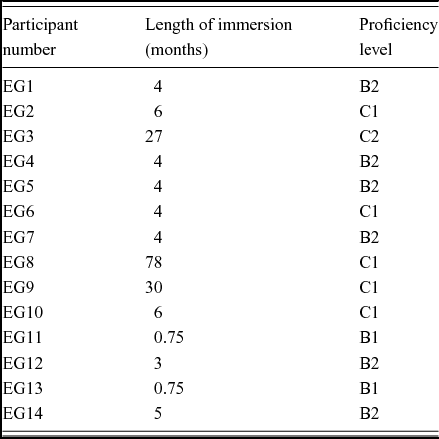
Participants in the study were 28 university students living in Central Germany who spoke both English and German. Fourteen (nine females) were English native speakers between the ages of 20 and 28 years (M = 21.6 years). These English–German L2 learners were from Western Pennsylvania and had been living in Germany for between three weeks and six-and-a-half years at the time of testing (M = 1.03 years). As a measure of their L2 German proficiency, all of the participants completed a 30-point multiple-choice German grammar and vocabulary test (Goethe Institut, 2004). They scored between 13 and 27 points on the task (M = 19.94, SD = 3.80), indicating intermediate (CEFR levels B1 or B2) to advanced (CEFR levels C1 or C2) proficiency in German.Footnote 5 English–German L2 learners’ immersion experience and proficiency levels are provided in Table 1.
English–German L2 learners’ immersion experience and proficiency levels by participant number.

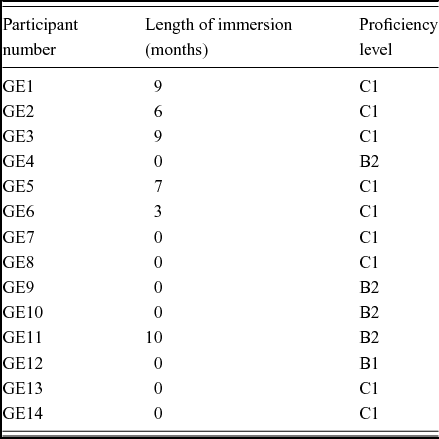
The remaining 14 participants (13 females) were German native speakers who grew up and resided in Hessen, Germany at the time of the study. These German–English L2 learners, who were between the ages of 18 and 26 years (M = 22.5 years), all reported speaking Standard German. Seven of these participants had lived in English-speaking regions around the world for an average of three months (range: 0–10 months), and the remaining seven had not spent time living in a country where English is spoken. They all scored at least 56 points (M = 81.2, SD = 12.6) on the Oxford Online Placement Test (Oxford University Press, 2009),Footnote 6 indicating intermediate (B1 or B2) to advanced (C1 or C2) L2 English proficiency. German–English L2 learners’ immersion experience and proficiency levels are provided in Table 2. Unlike the English–German L2 learners, German–English participants were not immersed in an English-speaking environment at the time of testing, and they also had, on average, less immersion experience.
German–English L2 learners’ immersion experience and proficiency levels by participant number.

L2 proficiency of participants in the two groups is equivalent, and we base the comparison of the two groups of speakers on proficiency. By contrast, participants in the two groups differ in terms of immersion. Since the experiment is limited to a laboratory task aimed at eliciting phonological and syntactic correlates of newness and givenness in a tightly controlled setting, we have controlled for proficiency and are able to investigate the potential contribution of both proficiency and immersion experience.
3.2 Task
Participants completed a dynamic localization task inspired by Féry et al. (Reference Féry, Skopeteas and Hörnig2010) and available as part of the Questionnaire on Information Structure (Skopeteas, Fiedler, Hellmut, Schwarz, Stoel, Fanselow, Féry & Krifka, Reference Skopeteas, Fiedler, Hellmut, Schwarz, Stoel, Fanselow, Féry and Krifka2006). The task uses twelve constellations of toy animals presented to the participants on MSPowerPoint slides. Each constellation differs from the one that came before it: a toy animal is either newly introduced or not newly introduced but rather changes position relative to other (given) toy animals in the constellation. In all instances, the new or moved animal is the locatum (Loc). In most productions, one of the given animals is the relatum (Rel) and is realized as part of a locative expression (Lx), usually a prepositional phrase. In (6) the scenes from the first three constellations are presented. All of the constellations are provided in the appendix.
-
(6)

In the constellations above, (6a) sets the scene. In the second constellation (6b), the horse is the new animal. It is thus expected that this newly introduced animal is the locatum, and also the subject of the sentence containing the localization (see Harris, Reference Harris1975). When the horse is the subject, syntactically it might be expected to appear first, as in (5) above, where Loc precedes Lx. However, according to the given-before-new rule of IS, speakers might produce a sentence such as (7) below, in which the locative expression appears before the locatum, thus Lx ≺ Loc. There is thus a conflict between the preference of the discourse (given-before-new) and those of the grammar (subject first).
-
(7) [To the right of the gorillaRel]Lx there is a horseLoc.
Notice that (7) is the result of locative inversion, and it is followed by an expletive construction. The equivalent in German is illustrated in (8), showing Lx ≺ Loc. The prepositional phrase is at the beginning of the sentence as a result of scrambling, an operation that just moves one constituent to the pre-verbal position, and it involves no further changes in the sentences. In particular no expletive can follow a scrambled constituent.
-
(8)

The subject-first order Loc ≺ Lx is also possible in German. It is shown in (9).
-
(9)

Because one animal is introduced or changes position in each constellation, it is expected that participants will highlight this new information by using a particular article, syntactically, prosodically or through some combination of the three. In order to mitigate potential L1 transfer effects, participants first completed the task in their second language, and at a second meeting that took place two weeks later, they completed the same task in their first language, along the lines of Fernández (Reference Fernández2005).
4. Data analysis
Each of the utterances produced by the participants in the L1 and the L2 was first transcribed and then coded for morphological and syntactic marking of IS roles. Specifically, discourse-new animals were coded for their marking via an indefinite or definite article. For those utterances containing only previously mentioned animals, it was noted whether the locatum was marked via a definite or indefinite article. In terms of syntax, the word order in each sentence was logged as (i) Loc ≺ Lx or (ii) Lx ≺ Loc. Once the utterances were divided according to word order, the intonational contour on the locatum and locative expression were noted as a fall or a rise in German and a fall or a rise (A or B accents) in English. We did not analyze the pitch accents in detail. The pitch accents differed greatly in their excursion. Some involved larger registers than others. This can be due to individual differences or to the location of the accents in the sentence. Generally, accents at the beginning of an utterance involve a greater pitch excursion than those at the end, due to downstep and declination. The prosodic results are thus limited to the direction of the pitch accents as falling or rising. We only consider the accents on the locatum and the locative expression (generally the relatum), and ignore occasional additional accents on other constituents.
Each of the twelve utterances produced by each participant in the L1 and the L2 was coded for article use and syntactic marking of IS roles by the first author, and the prosodic marking of IS roles was carried out by the second author. Forty percent of the data was checked by the other author to ensure consistency in coding. There was an 87% agreement rate. Any disagreements were discussed, and a final decision was agreed upon.
We began with a total of 671 utterances for analysis (335 in German, 336 in English). Some participants produced incomplete utterances or those in which the locatum did not appear with an article (e.g. those only containing a locative expression such as unten Affe “down ape”). In some instances participants produced neither a rise nor a fall on a locatum or a locative expression, and they showed a level tonal shape. Such utterances were not completely removed from all analyses. Instead, the utterances were only included in the analyses in which the element under investigation could be evaluated. It is for this reason that the Ns reported (number of items analyzed) vary from one analysis to the next.
This is a repeated measure design with binary outcome variables. The data were analyzed using a Generalized Estimating Equation (i.e. GEE under Genlin procedures in SPSS v 20) to determine whether native and L2 speakers of German and English differ in their production of articles and syntactic and prosodic cues to mark information structure roles. In addition, the model allows for the addition of predictor variables, in this case immersion experience and proficiency. We applied a α = 0.05 level for all tests.
5. Results
5.1 German productions
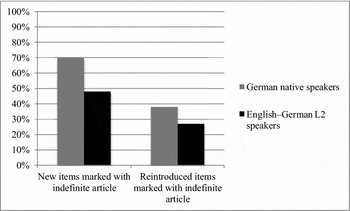
A total of 323 utterances was analyzed for article use to mark new items, and 98 utterances were analyzed for article use with reintroduced animals. Native and English–German L2 speakers did not differ significantly in their article use to mark new or reintroduced items. General patterns are shown in Figure 1. Whereas German native speakers made use of indefinite articles to introduce new material 70% of the time, English–German L2 learners only used indefinite articles 48% of the time. When reintroducing toy animals, German native speakers used indefinite articles 38% of the time, and English–German L2 learners did so 27% of the time.
Article use in German by group.

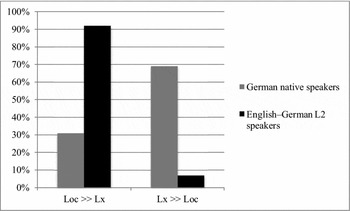
The same number (i.e. 323) of German utterances was analyzed for syntactic structure. As shown in Figure 2, the two groups of speakers differed with respect to the preferred word order they used to introduce the constellations of animals. Whereas German native speakers preferred to produce utterances corresponding to the given-before-new structure 69% of the time (i.e. locative expressions before locata: Lx ≺ Loc), English–German L2 speakers showed a subject-first preference (i.e. Loc ≺ Lx), and they produced this structure in 92% of their utterances.
German word order by group.

German native speakers were significantly more likely to make use of the Lx ≺ Loc structure (B = 3.336, SE = .7665, χ2(1) = 18.945, p < .001), and English–German L2 speakers were more likely to make use of the Loc ≺ Lx structure (B = 3.062, SE = .7391, χ2(1) = 17.167, p < .001). Since the Lx ≺ Loc is the preferred structure for the German native speakers, we looked to parameter estimates to determine whether immersion experience or proficiency scores independently predicted English–German L2 participants’ likelihood to produce this pattern. Although immersion experience did not predict English–German L2 learners’ use of this preferred syntactic structure, proficiency score did (B = 0.232, SE = .0979, χ2 = 5.604, p = .018). More proficient English–German L2 learners produced the Lx ≺ Loc structure more often than less proficient learners.
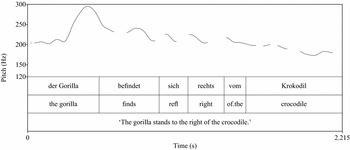
In terms of prosodic cue use, we looked independently at the word orders. A summary of the patterns is provided in Table 3.Footnote 7 In the preferred German word order, Lx ≺ Loc, the largest proportion of utterances produced by native speakers was produced with a so-called ‘hat pattern’, a rising contour on the first constituent and a falling contour on the second one with a plateau in between. This can be seen in Figure 3.
Prosodic patterns in German utterances.

Hat pattern (rise-plateau-fall) in German utterance produced by a German native speaker.

The remaining Lx ≺ Loc sentences produced by German native speakers primarily contained a rise-rise pattern.
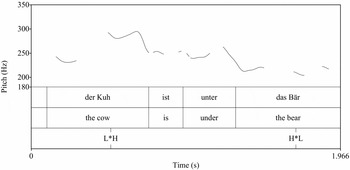
The Lx ≺ Loc utterances produced by the English-German L2 learners primarily contained the rise-fall pattern (hat pattern), but there were so few Lx ≺ Loc utterances produced by English–German L2 learners that it is little use to make statistical comparisons across groups (see Figure 2). The English–German L2 learners’ preferred prosodic pattern in the word order Loc ≺ Lx was a rise on the locatum followed by either a rise or a fall on the locative expression. See Figure 4 for the latter realization.
Rise on locatum followed by fall on locative expression produced by an English–German L2 learner.

This contour followed the same pattern as those produced by the German native speakers. Of the few utterances produced by German native speakers containing the Loc ≺ Lx word order, the majority had the rise-fall pattern, and the remainder was produced with a rise-rise pattern. In short, the preferred prosodic pattern for both groups of speakers in both syntactic word orders was a rising contour followed by a falling contour, as expected in the declarative sentences elicited. Rise-rise contours were also quite common across speaker groups. Neither proficiency nor immersion experience predicted English-German L2 learners’ prosodic cue use.
The main difference in prosodic contours between the two groups was the presence of a small but non-negligible number of utterances with a falling pitch accent on the first position by the English–German L2 learners (N = 18). This possibility was nearly absent from the contours produced by the German native speakers (N = 2). The main difference between the two groups correlates with the word order, which was the given-new word order in 69% of the cases in the utterances of the German native speakers (Lx ≺ Loc) and nearly always the canonical word order (Loc ≺ Lx) in the utterances produced by the English–German L2 learners.
5.2 English productions
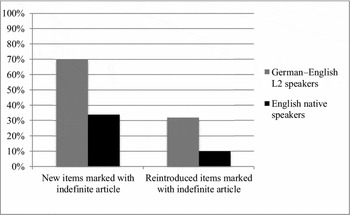
A total of 333 sentences was analyzed for article use to mark new items, and a total of 83 sentences was analyzed for article use to present reintroduced animals. The pattern that emerges for the use of articles to mark with new and reintroduced animals in English is shown in Figure 5. Native English and German–English L2 speakers differed in their likelihood to make use of the indefinite article when introducing an animal for the first time (B = −1.517, SE = .5260, χ2(1) = 8.314, p = .004), such that English native speakers were more likely to mark new animals by making use of the definite article (66% of the time for English native speakers vs. 30% for German–English L2 learners). The groups did not differ significantly in their likelihood to mark reintroduced items with the definite article.
Article use in English by group.

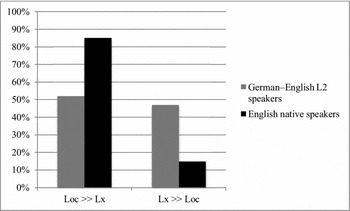
A total of 334 utterances was analyzed for syntactic structure in English. The preferred syntactic marking by group in English can be seen in Figure 6. Both English native speakers and German–English L2 learners in the current study preferred the Loc ≺ Lx word order in their English productions, but English native speakers were significantly more likely to produce this structure (85%) in English than were German native speakers (52%) (B = 1.625, SE = .6870, χ2(1) = 5.598, p = .018). Neither immersion experience nor proficiency predicted German–English L2 participants’ likelihood to make use of the Loc ≺ Lx word order.
Word order in English by group.

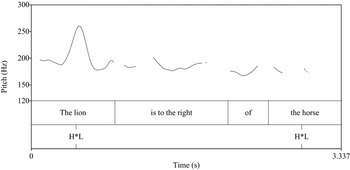
The prosodic patterns produced by participants in both groups in their English utterances are presented in Table 4. Since the preferred word order in English is Loc ≺ Lx, we begin by examining the prosodic patterns produced by speakers in both groups for utterances with this word order. As is evident in Table 4, English native speakers did not show a clear preference for one prosodic pattern. In the 129 Loc ≺ Lx realizations, there are 81 rises and 48 falls on the locatum. A fall on the locatum followed by a fall on the locative expression is illustrated in Figure 7.
Prosodic patterns in English utterances.

Fall on locatum followed by fall on locative expression produced by an English native speaker.

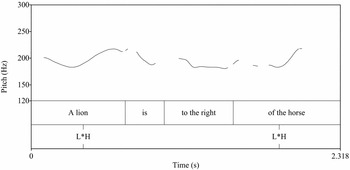
English native speakers only produced 26 Lx ≺ Loc sentences in English (as compared to 59 produced by the L2 speakers).Footnote 8 In these sentences the rise-rise pattern predominated. German–English L2 learners showed more consistency in their prosodic patterns in English, however. In their Loc ≺ Lx sentences they preferred to produce a rise on the locatum, and they showed no real preference for falls or rises on the locative expressions. A rise on both the locatum and the locative expression is illustrated in Figure 8.
Rise on locatum followed by rise on locative expression produced by a German–English L2 learner.

Only 12 Loc ≺ Lx sentences produced by German native speakers contained a fall on the locatum (as compared to 48 produced by the English native speakers). Among the German–English L2 speakers who produced the Lx ≺ Loc word order in English, the general trend was to produce the expected rise-fall hat pattern.
The prosody produced in the English sentences shows the same broad pattern for native speakers of both languages: a rising pattern followed by a falling contour for the Loc ≺ Lx word order. Nonetheless, we see divergence according to L1. Whereas German–English L2 speakers produced a rise-fall hat pattern 45% of the time in English, the native English speakers only produced this pattern 30% of the time.Footnote 9 English native speakers produced a fall on the locatum followed by a fall on the locative expression 26% of the time, a pattern seen in only six of the English utterances produced by German–English L2 speakers. This is the one significant difference in intonational pattern according to group (B = 2.455, SE = .6538, χ2(1) = 14.106, p < .001). Neither proficiency nor immersion experience predicted German–English L2 learners’ prosodic cue use.
6. Discussion and conclusion
Speakers from both groups in the current study did not differ significantly in their morphological cues to mark new and reintroduced locata in German: they tended to make use of indefinite articles when they located an animal for the first time, and they used definite articles when they reintroduced the same animals. This pattern was similar to that reported by Féry et al. (Reference Féry, Skopeteas and Hörnig2010) for native German speakers. Participants differed by group in their likelihood to make use of the indefinite article to mark new animals in English: whereas German–English L2 speakers showed the expected pattern (i.e. they introduced new animals with ‘a’), English native speakers were more likely to use the definite article. This result stands in opposition to that of Féry et al. (Reference Féry, Skopeteas and Hörnig2010), in which speakers from both groups did not differ significantly in their use of the indefinite article to mark new animals or the definite article to reintroduce animals across languages. In spite of the general trend for English native speakers to mark new animals with ‘the’ in English, they did not use the definite article more often in English than in German.
German–English L2 speakers positively transferred their article use from their L1 to their L2, as they produced this general pattern in both languages. English native speakers, however, marked newly introduced animals with definite articles more often than with indefinite articles in both languages. They were more likely to use the indefinite article in German than in English, which may be taken as evidence that they did not simply transfer across languages. A less robust difference between English and German native speakers’ use of indefinite articles was also present in the data of Féry et al. (Reference Féry, Skopeteas and Hörnig2010).Footnote 10
Native speakers of both languages differed in their use of a particular word order depending on the language they were speaking. Whereas German-English L2 speakers were more likely to use the preferred Loc ≺ Lx structure in English than in German (B = 0.756, SE = .2920, χ2(1) = 6.710, p < .010), English native speakers were equally likely to produce utterances with Loc ≺ Lx word order in both languages. As such, German native speakers were also more likely to produce the Lx ≺ Loc structure in German than in English (B = −0.933, SE = .3126, χ2(1) = 8.902, p = .003).
English native speakers in the current study showed an overall tendency to produce the subject-first Loc ≺ Lx word order, regardless of the language they were speaking. This preference in English is well established in the literature (McCawley, Reference McCawley, Jacobs, von Stechow, Sternefeld and Vennemann1991 among others). That these participants showed the same strong tendency to produce the Loc ≺ Lx word order in German is a sign that they have not yet acquired scrambling, the preferred syntactic means by which German native speakers mark given and new information. These results are in line with those of previous production studies, which have shown transfer effects and a general inability for participants to syntactically mark IS roles in a native-like manner (e.g. Bartning et al., Reference Bartning, Forsberg and Hancock2009; Bohnacker & Rosén, Reference Bohnacker and Rosén2008; Carroll et al., Reference Carroll, Murcia-Serra, Watorek and Bendiscioli2000). Whether this is a result of underspecification, cross-linguistic influence or processing limitations is difficult to determine, since participants neither acquired the preferred German structure nor showed a great deal of variation in their productions. In spite of this, proficiency predicted the likelihood of English–German L2 learners to produce the preferred German Lx ≺ Loc word order: the more proficient English–German L2 learners were more likely to produce Lx ≺ Loc in German than were less proficient learners, thereby supporting the results of Ivanov (Reference Ivanov2012), whose most proficient English–Bulgarian L2 learners showed native-like judgments of Bulgarian clitic doubling, a process that involves topics.
Unlike the English native speakers, who tended to transfer their L1 syntactic patterns to their L2 German speech, German native speakers produced clearly different patterns in their L1 and L2. As in previous studies (e.g. Féry et al., Reference Féry, Skopeteas and Hörnig2010), they preferred the Lx ≺ Loc structure in German. Although they differed quantitatively from English native speakers in their preference for the Loc ≺ Lx structure, they were more likely to make use of this structure in English, where it is clearly preferred, than in German. This finding may thus support the results of previous studies that have shown the ability of language learners to acquire formal syntax (Bohnacker, Reference Bohnacker, Bohnacker and Westergaard2010; Coppieters, Reference Coppieters1987). More likely, however, considering German–English L2 learners’ near-equal preference for the two word orders in English, it is quite possible that they interpret the two as equivalent structures and may therefore use them interchangeably, thereby exhibiting indeterminacy in their L2 English, as outlined in Section 2.4 above. That is, the participants view subject-first as an option equal to given-before-new in English. This indeterminacy shown by the German–English L2 learners is therefore evidence of “optionality” at this interface of syntax and discourse (Sorace, Reference Sorace2011, p. 1).
The English–German L2 learners showed evidence of direct transfer of the Loc ≺ Lx word order from their L1 English to their L2 German. The only potential significant predictor variable in this study was proficiency: more proficient English–German L2 learners were more likely to produce the more marked German Lx ≺ Loc word order than were less proficient speakers. This finding is unlike those reported in previous studies investigating scrambling preferences among English–German L2 learners (e.g. Hopp, Reference Hopp2004; Iwasaki, Reference Iwasaki and Karimi2003; Schreiber & Sprouse, Reference Schreiber and Sprouse1998), which showed no effects of proficiency on learners’ acceptance (Hopp, Reference Hopp2004; Schreiber & Sprouse, Reference Schreiber and Sprouse1998) or production (Iwasaki, Reference Iwasaki and Karimi2003) of scrambled utterances. It may be that increased proficiency in German enables learners to begin to unravel the underspecified L2 syntactic system. However, English–German L2 learners produced this word order infrequently (7% of the time) in German. This can therefore be taken as evidence of “non-convergence” (Sorace, Reference Sorace2011, p. 1) with native syntactic norms. That is to say, the English–German L2 learners showed an overall subject-first preference, whereas the German native speakers preferred the given-before-new structure in German.
As a final step, it is important to determine whether participants differed in their intonational contours according to the language being spoken. Given the large number of potential combinations of word orders and intonational contours across languages, it makes little sense to look at all of the possibilities. As such, we will focus on the preferred contours in the preferred word orders. German native speakers showed a general preference for hat patterns, thus a rise followed by a fall and for Lx ≺ Loc word order. They were less likely to produce this combination in English than they were in German (B = −0.826, SE = .2895, χ2(1) = 8.150, p = .004). Regardless of the language being spoken or the word order produced, German native speakers tended to produce the rise-fall hat pattern that has been reported in previous research (e.g. Grabe, Reference Grabe1998). Thus, Féry et al.'s (Reference Féry, Skopeteas and Hörnig2010) prediction that this pattern is due to the fact that, in general, pre-final accents rise and final accents fall – and not that a particular intonational pattern is produced on given or new information – is borne out. That is to say, even when German native speakers produced the Loc ≺ Lx word order, they preferred the rise-fall pattern. An interesting observation is the fact that this group of speakers did produce a few falling patterns on the locata in English, although they did not produce as many as the English speakers.
English native speakers showed more variability in their English prosodic patterns. Although they were expected to produce a falling pitch accent on the locata as predicted for English (e.g. Büring, Reference Büring1997, Reference Büring2003; Jackendoff, Reference Jackendoff1972; Steedman, Reference Steedman2000; Wagner, Reference Wagner2012), they were more likely to make use of a rise on the new toy animal. Their utterances also did not conform to the rising falling-rising pattern predicted by Grabe (Reference Grabe1998) in either language, but they did make use of non-final falls more often than the German speakers. There are two reliable significant differences in intonational contours for English native speakers by language. First, they produced a rise-rise contour in Loc ≺ Lx utterances more often in German than in English (B = −0.796, SE = .3728, χ2(1) = 4.563, p = .033). Secondly (and certainly relatedly), they were significantly more likely to produce the fall-fall contour in Loc ≺ Lx sentences in English than in German (B = 1.195, SE = .5008, χ2(1) = 5.691, p = .017).Footnote 11
In the case of prosody, we suspect that German has the unmarked pattern: both languages realize a rise followed by a fall, but only English can have a fall in the non-final position on a regular basis. The presence of sentence-initial falls may be interpreted as a true difference between the two languages. German only admits pre-final H*L exceptionally. Whereas German is sensitive to position of the accented words in the intonation phrase, and prefers the rise-fall pattern in most cases, English speakers show a tendency to distinguish between the roles of the constituents and assign a falling accent to a new constituent more often than the German speakers, regardless of its position in the sentence, thereby partly supporting previous literature (Liberman & Pierrehumbert, Reference Liberman, Pierrehumbert, Aronoff and Oehrle1984). The second fall is related to the finality of a declarative utterance, which may be more stable than the rising contour predicted by Jackendoff (Reference Jackendoff1972).
In terms of intonational contours, participants in the two groups reversed in their likelihood to transfer their L1 patterns to their L2s. Whereas German native speakers showed a general tendency to produce the rise-fall or rise-rise contour in both languages, English native speakers showed this same general trend in German, in spite of more varied intonation in their L1. This ability among the English–German L2 learners to produce more appropriate prosodic cues to mark focus stands counter to those studies that show a general tendency among L2 learners to rely upon different cues from those produced by native speakers (e.g. Gut, Reference Gut2009; Hopp, Reference Hopp2004; Reichle, Reference Reichle2010; Wennerstrom, Reference Wennerstrom1994). An investigation of potential predictor variables (i.e. proficiency and immersion experience) indicates that neither predicted L2 learners’ use of prosodic cues. The task for the English–German L2 learners differed from that of the German–English L2 learners, however. Whereas to achieve native-likeness, the English–German L2 learners’ productions depended on syntax (and not on givenness vs. newness), the German–English L2 learners’ productions depended on the marking of IS roles. It is therefore important to remember how difficult it is to make direct comparisons across participant groups, given the potential interactions between syntax and prosody.
Despite the need to signal the declarative nature of the utterances, speakers in both groups tended to produce rising intonation at the ends of their utterances. Whether this trend is driven by phonology or by the task itself, which may have been perceived by subjects as the production of a series of similar sentences and thereby encouraged the production of list intonation, is a matter to be taken up in future research. In some cases, it seemed to be motivated by the insecurity of the speakers, especially when they were not sure of the name of a toy animal in their L2, and they may have produced declarative question patterns (i.e. declarative word orders with utterance-final rises). Nonetheless, the relatively high proportion sentences produced with this marked intonational pattern (115 English utterances, 108 German utterances) cannot be ignored.
The results of the current study indicate that participants’ immersion experience did not predict their likelihood to use more native-like morphosyntactic or phonological cues to indicate givenness vs. newness in a dynamic localization task. While it may be that the contribution of immersion is minimal, it may also be that participants in the current study had not been immersed long enough in the target language for immersion effects to show themselves. The reader is reminded of Bohnacker's (Reference Bohnacker, Bohnacker and Westergaard2010) findings indicating that participants who had been immersed for six and nine (but not for three) years produced the most native-like cues to focus. Only one participant in the current study (EG8) had spent more than six years in the target-language environment.
Although native speakers of both English and German share the same potential repertoire of morphosyntactic and prosodic cues, when it comes to marking givenness and newness there are some clear differences in the ways in which native speakers of the two languages use them. German–English L2 learners showed the ability to apply grammatical rules in the marking of new animals via the indefinite article. However, whether this was the application of a rule or transfer from the L1 cannot be determined. Participants deviated from native norms in their use of syntactic and phonological cues affecting discourse structure. Although we cannot establish whether non-native-like performance is due to underspecification, L1 transfer or processing limitations, the results of the current study support those of previous research, which has shown that the acquisition of native-like cues at external interfaces in an L2 is problematic (e.g. Sorace & Serratrice, Reference Sorace and Serratrice2009; White, Reference White, Ritchie and Bhatia2009). This is in spite of the fact that English and German are similar in the cues that they have to offer. Future studies will make use of this dynamic localization task among advanced L2 learners of typologically distinct languages to examine in greater detail the contribution of the L1 in the production of cues to IS.
Appendix. Animal constellations with new/reintroduced animals marked in capitals