INTRODUCTION
Pediatric healthcare providers (PHCPs) may find themselves caring for children with such life-limiting illnesses (LLIs) as incurable cancer, neurodegenerative disease, organ failure, and genetic and metabolic disorders that are characterized by varied life expectancies and trajectories (Hain et al., Reference Hain, Devins and Hastings2013). Pediatric palliative care best practices recommend that clinicians who care for children with a LLI be adept at optimizing function, minimizing suffering, and providing psychosocial, spiritual, grief, bereavement, and self-care (Liben et al., Reference Liben, Papadatou and Wolfe2008; Rapoport et al., Reference Rapoport, Beaune and Weingarten2012). However, the extant literature suggests that PHCPs who care for dying children continue to identify ongoing issues that arise in the workplace—for example, disenfranchised grief, a gap in the skills and training required for the challenging conversations that occur at the end of life, and inadequate support within the healthcare organization, including providing the opportunity and time for self-care (McConnell et al., Reference McConnell, Scott and Porter2016). Recent studies suggest that workplace satisfaction among PHCPs is a key factor in improving the efficacy and quality of end-of-life care (Morgan, Reference Morgan2009; Clarke & Quin, Reference Clarke and Quin2007), so that a deeper understanding of both the negative and positive experiences involved in this caregiving role is certainly warranted.
As part of a larger study (Muskat et al., Reference Muskat, Beaune and Anthony2014) that examined the experiences and coping skills of healthcare professionals who cared for seriously ill and dying children, the present paper focuses on a secondary analysis of the interview transcripts in order to explore whether positive outcomes—especially that of personal growth—were reported as an outcome of the caring process.
BACKGROUND
Concerns about mental health risks, organizational stress, and the potential for negative impacts on personal relationships have been noted among those who work in stressful healthcare situations and for whom unresolved grief and loss may become problematic (Papadatou et al., Reference Papadatou, Martinson and Chung2001; Morgan, Reference Morgan2009; McCloskey & Taggart, Reference McCloskey and Taggart2010; Woolley et al., Reference Woolley, Stein and Forrest1989; Vachon et al., Reference Vachon, Lyall and Freeman1978). The experience of caring for children with a LLI and coping with their death is frequently described as fraught with stress, depression, burnout, posttraumatic stress, vicarious trauma, and compassion fatigue (Clarke-Steffen, Reference Clarke-Steffen1998; Maytum et al., Reference Maytum, Heiman and Garwick2004; Davies et al., Reference Davies, Clarke and Connaughty1996; Sinclair & Hamill, Reference Sinclair and Hamill2007; Granek et al., Reference Granek, Tozer and Maxxotta2012). However, many PHCPs have little or no training in palliative and end-of-life care, limited experience with self-care, and minimal if any workplace support systems, leaving them vulnerable to compassion fatigue, burnout (Clarke-Steffen, Reference Clarke-Steffen1998; Maytum et al., Reference Maytum, Heiman and Garwick2004), and moral distress (Davies et al., Reference Davies, Clarke and Connaughty1996). A recent mixed-methods review of the experiences of PHCPs conducted by McConnell and colleagues (2016) pointed to ongoing concerns about the well-being and ability to cope of those caring for seriously ill children and reemphasized the need for education, peer debriefing, and organizational support.
Personal Growth
An emerging body of research within adult healthcare has shown that healthcare professionals may experience positive outcomes while undertaking challenging caregiving roles, including personal, spiritual, and professional growth, as well as high levels of compassion satisfaction (Schaefer & Moos, Reference Schaefer, Moos and Carpenter1992; Brady et al., Reference Brady, Guy and Poelstra1999; Arnold et al., Reference Arnold, Calhoun and Tedeschi2005; Harrison & Westwood, Reference Harrison and Westwood2009; Cohen & Collens, Reference Cohen and Collens2013). Many of these studies employed qualitative and/or mixed methods of inquiry where participants were asked to reflect on the positive outcomes and/or stressors involved in their work. For example, 21 psychotherapists were interviewed by Arnold et al. (Reference Arnold, Calhoun and Tedeschi2005) to explore the impact of traumatic work, and they reported both negative consequences and psychological growth. Personal growth is commonly referred to as a positive psychological change that occurs following adversity and is generally described within the following five domains developed by Tedeschi and Calhoun (Reference Tedeschi and Calhoun2004): (1) enhanced interpersonal relationships, (2) an increased appreciation of life, (3) an increased sense of personal strength, (4) a deeper sense of spirituality, and (5) positive changes in terms of life priorities and goals. More recently, benevolence has been identified as a new construct to be included on the list of positive outcomes of caregiving. This concept speaks to the feeling of being rewarded by the work, a shift toward altruism, and the desire to improve care for particular patient groups (Bance & Stermac, Reference Bance and Stermac2014; Vishnevsky et al., Reference Vishnevsky, Quinlan and Kilmer2015). After interviewing 30 nurses who cared for cancer patients, Vishnevsky and colleagues (2015) found that they had all experienced feelings of growth, wisdom, and benevolence.
Personal Growth in Pediatric Palliative Care
Understanding such positive outcomes as personal growth is a newly explored phenomenon for PHCPs working in acute care pediatric settings. We found a handful of studies that identified positive outcomes related to the domains of personal growth as a result of caring for seriously ill children. Whether they utilized quantitative, qualitative, or mixed methods, these studies reported negative consequences as well as such positive growth outcomes as enhanced meaning in life, increased optimism, improved professional self-esteem, self-enrichment, renewed perspectives, spiritual rewards, and compassionate behavior (Taubman-Ben-Ari & Weintroub, Reference Taubman-Ben-Ari and Weintroub2008; Kaplan, Reference Kaplan2000; Macpherson, Reference Macpherson2008; McCloskey & Taggart, Reference McCloskey and Taggart2010; Korzeniewska-Eksterowicz et al., Reference Korzeniewska-Eksterowicz, Przysło and Grzelewski2010; Plante & Cyr, Reference Plante and Cyr2011; Klassen et al., Reference Klassen, Gulati and Dix2012; Cook et al., Reference Cook, Mott and Lawrence2012; Reid, Reference Reid2013; Conte, Reference Conte2014; Morrison & Morris, Reference Morrison and Morris2017). Plante and Cyr (Reference Plante and Cyr2011) utilized two standardized questionnaires to retrospectively assess 101 healthcare professionals' grief intensity and coping skills following the death of a child and found that they reported having learned to be more compassionate. Semistructured interviews were employed in another study with interdisciplinary oncology healthcare providers (HCPs) about their work experiences (Klassen et al., Reference Klassen, Gulati and Dix2012). Their key findings included the rewards of their work, especially long-term relationships established with the children and their families and the satisfaction obtained through helping families with their child's cancer journey, up to and including the death. However, the limitations of these studies involved their predominant focus on pediatric oncology, their use of measurement tools that did not specifically target the dimensions of personal growth, and their retrospective nature.
The aim of our present work was to explore the potential for personal growth in non-palliative care (nPCSs) while caring for children with a wide range of LLIs. We report the results of a secondary analysis of data derived from interviews recorded during our larger qualitative study, the Health Care Coping (HCC) study, which examined the experiences and coping strategies of PHCPs. The results of the HCC study were published elsewhere (Muskat et al., Reference Muskat, Beaune and Anthony2014). The present paper explores participants' experiences with respect to various constructs of personal growth specific to their role as caregivers for seriously ill and dying children.
METHODS
Background to the Healthcare Coping Study
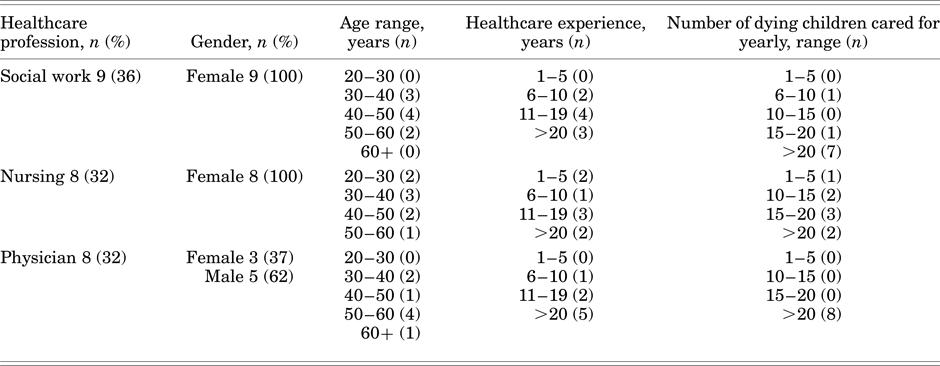
Participants were recruited from an urban area in southeastern Ontario, Canada. We employed a snowball sampling technique (Miles & Huberman, Reference Miles and Huberman1994), where participants were recruited and then recommended if they were interdisciplinary HCPs (i.e., social workers, nurses, and physicians)—including those working in critical care, neonatology, oncology, transplant, complex care, and genetics/metabolism–who had been caring for patients with a high risk of mortality. These programs were selected based on institutional mortality statistics and data describing Canadian children receiving pediatric palliative care (Widger et al, Reference Widger, Davies and Drouvin2007). PHCPs were excluded from the study if they bore the designation of “palliative care specialist.” This criterion was deemed important as our intent was to gather the experiences of PHCPs who had worked with many, but not exclusively, dying children as part of their job. A maximum-variation sample was sought, especially with respect to age and years of experience caring for children with a LLI (see Table 1).
Participant demographics

PHCPs who the met inclusion criteria were contacted via a personalized email by a research team member. An experienced qualitative researcher was given the names of the PHCPs who had agreed to be contacted and obtained their written consent, including permission to be audiotaped. A 25-question semistructured interview guide was employed that was based on a review of the literature and the clinical experience of the members of our research team. The interview guide was continually revised throughout the data collection and analysis stages. Participants were asked to reflect on their experiences of caring for dying children and on their own coping strategies. Interviews were conducted in private locations within the hospital setting, were audiotaped, and lasted between 40 and 120 minutes. They were audiotaped and transcribed verbatim for purposes of the analysis. The data were collected between July of 2010 and June of 2012.
Ethical approval for our study was granted by the Hospital for Sick Children's Research Ethics Board (approval no. 1000018388). All participants provided written consent.
A secondary analysis was performed in order to explore the clinical phenomenon of personal growth. The methods that we employed in the secondary analysis were adapted from Stewart and Kamins (Reference Stewart and Kamins1993). All 25 transcripts from a larger dataset derived from the authors' “health care coping” study were reviewed and analyzed once again by the authors using search criteria that focused on any of the personal growth constructs described by Tedeschi and Calhoun (Reference Tedeschi and Calhoun2004) and Vishnevsky et al. (Reference Vishnevsky, Quinlan and Kilmer2015).
ANALYSIS
The data analysis was guided by interpretive description, a commonly utilized framework for qualitative research of clinical phenomena (Thorne et al., Reference Thorne, Reimer Kirkham and O'Flynn-Magee2004). We employed constant comparative analysis techniques, including interpretation of common and diverse perceptions of PHCPs and references to the literature, which is a common and objective method for evaluating clinical phenomena (Sandelowski, Reference Sandelowski1995). Two of the researchers (L.B. and S.J.A.) developed the coding framework, which was then applied to the transcripts. Another researcher (B.M.) reviewed the coding framework, and discrepancies and amendments were discussed and new codes applied until the research team agreed that data saturation had been achieved and that no new codes were required. We used NVivo 9 software (QSR International, 2007) to support qualitative data organization and management and followed several well-established techniques to ensure methodological rigor and trustworthiness, including prolonged engagement, reflexivity, negative case analysis, and peer debriefing (Lincoln & Guba, Reference Lincoln and Guba1985; Cresswell, Reference Cresswell1998; Charmaz, Reference Charmaz2006; Strauss & Corbin, Reference Strauss and Corbin1994).
RESULTS
In total, 25 PHCPs consented to be interviewed (9 social workers, 8 nurses, and 8 physicians). Most participants were women (80%, n = 20) who had more than 10 years of clinical experience in pediatric care (76%, n = 19). The nursing and social work participants were all women. Most had cared for 15 or more dying children over the course of their careers (84%, n = 21). Participants ranged between 20 and 60 years of age (Table 1).
Themes Identified
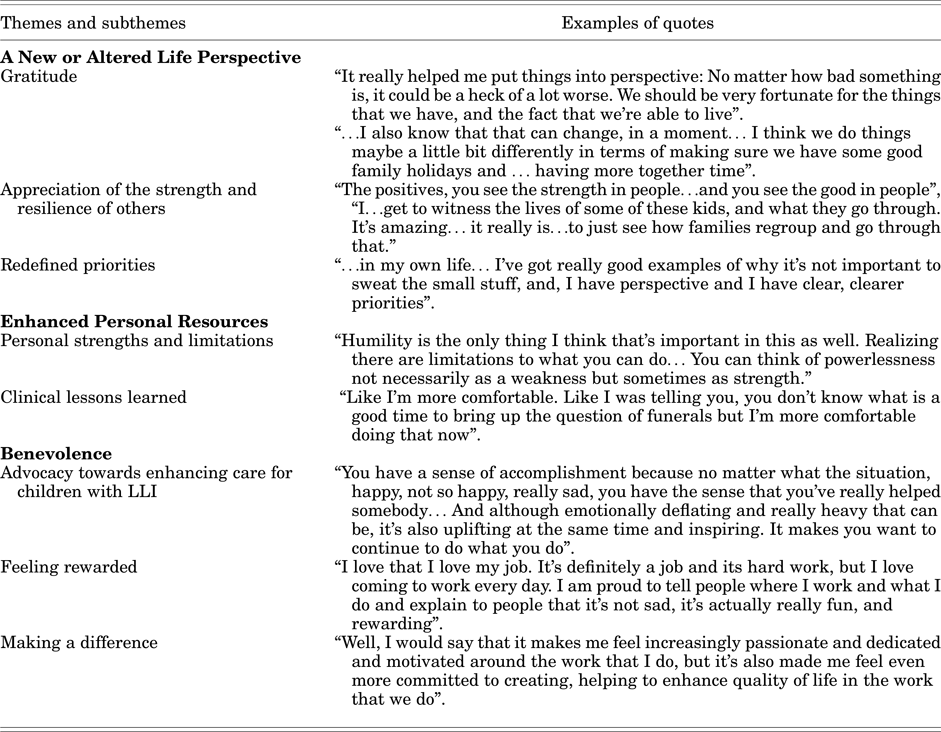
Compelling accounts of personal growth were identified across all three PHCP disciplines. Analysis of narratives resulted in identification of three major themes related to the construct of personal growth: (1) a new or altered life perspective, (2) enhanced personal resources, and (3) benevolence. The themes, subthemes, and participant quotes are presented in Table 2.
Themes and subthemes related to personal growth

A New or Altered Life Perspective
The most common theme that emerged from PHCP accounts was developing a new or altered perspective on life, which was interwoven across three subthemes: (1) gratitude, (2) appreciation of the strength and resilience of others, and (3) redefined priorities.
Pediatric healthcare providers were overwhelmingly grateful for their own health and life, appreciating what is “good in life,” “being thankful,” and “not taking things for granted.” One noted that her clinical experience reminded her of how bad things can get and that this reconnected her with being grateful for her healthy life.
PHCPs also expressed gratitude and appreciation for the growth and intimacy they experienced within their various personal and professional relationships. One described how she made sure to show her appreciation for her daughter each day after work: “I go home, I squeeze my daughter every day, and know every minute that she's healthy … [that's] the most important thing.” Another spoke of the effort that she made to ensure that her family spent more time together given her awareness of how quickly things could change.
Another finding was represented by the shared accounts of meaningful and intimate relationships that had developed between PHCPs and the families they had cared for:
I love the caring part of it, and making connections with the kids, and making those connections with the family.
and
So when I see that I did something good for them, they say, “Thank you for being there and for helping me,” and … that bonding with the family … that's something that's positive.
Feeling connected and developing long-term bonds with patients even after the death of the child appeared to make the challenging and potentially distressing work more manageable.
The development of more meaningful relationships among colleagues was also a frequently reported finding. Participating in and/or observing the compassionate and intimate care provided by colleagues was described as “highly satisfying,” “energizing,” “supportive,” and “rewarding.” A strong bond was reported to have developed as colleagues worked together through highly emotional and difficult times, as described by one participant: “I think probably the depth of relationships with some of my colleagues is there because we've lived through these special situations together.” Most of the reported experiences reflected the importance of close collegial relationships, which often acted as a buffer against the potential negative outcomes associated with their challenging work.
Grappling with life-and-death issues along with observing the strength and resilience of children and families led all PHCPs to describe profound feelings of hope, inspiration, and privilege. They marveled at the strength of seriously ill children and their families and recognized personal growth in others as they navigated an extremely difficult situation. One described this appreciation as follows:
I enjoy watching families at their worst and watching them change and develop and find skills within them[selves] that they never thought they had.
Participants also described changes in their perspective about what was truly important to them and that these redefined priorities shaped their lives in diverse ways:
It has really revolutionized how I feel about the material things in life, and sometimes I let that slip in terms of it getting in the way or [being] frustrated about other situations, but that has been a positive thing.
Enhanced Personal Resources
Some participants made frequent references to having learned from the children and families that they had worked with, which is reflected in the second theme of enhanced personal resources. The subthemes of this theme included the following: personal strengths and limitations, and clinical lessons learned.
Some described having gained insight into changes related to their own personal identity and strength. One reported that he felt that his work with this group of children “had made him a better person.” There were also reflections on the importance of recognizing the limitations of self in the context of the complex work of dying.
The sentiment about learning from children and families was consistently described by all PHCPs, as illuminated by these quotes:
I've learned a lot. I think I've probably learned more from my families and kids I've worked with than I have from any textbook.
and
I learn something from each and every kid I take care of, especially at the end of life.
Learning how to regulate one's emotions by remaining calm, expressing and sharing one's own sadness, and/or developing compassion were consistently described as being associated with emotional growth.
A number of PHCPs also spoke about learning specific skills, such as when and how to have difficult conversations. One expressed how she had learned over time to speak with families about funeral planning, a skill that requires a high degree of comfort when speaking about difficult issues.
Healthcare providers also sensed how important it was to do their work well, given the tremendous impact that a “good death” would have on helping families grieve and function over the long term, as well as taking into account how families would remember these interactions and interventions for the rest of their lives. Many spoke about the desire to learn how to provide a “good death,” as exemplified by one who spoke about the end-of-life experience thus:
What is a good death? You know, surrounded by a loving family, pain-free, full explanations, parents fully understanding, with whatever religious ceremonies they want. That's what we need to work towards.
Benevolence
Benevolence was the third theme expressed by participants. They described feeling that they had contributed something of value and significance through their work. They often referred to feeling that they had “given everything they possibly could” for a child and his or her family.
Feeling satisfied and proud of their work seemed to help PHCPs manage the emotional toll of caring for children who were likely to die and was linked to professional self-esteem and job satisfaction. The subthemes that emerged within benevolence included: (1) advocacy for enhancing care for children with an LLI, (2) feeling rewarded, and (3) making a difference.
Participants described their experiences as advocates for improving palliative and end-of-life care for all children with an LLI and their families, both clinically and systemically. They reported being engaged in reflective learning, as illustrated by one PHCP who posed the following questions:
What do we know about parents' reactions? What do we know about physicians' reactions? How does the team react? Can we do it differently? Can we do it better?
They defined improving quality of care in the following ways: (1) providing a pain-free end of life, (2) ensuring that parents were fully informed and engaged in care, (3) incorporating religious/spiritual beliefs, (4) fostering collaboration among and within teams, and (5) providing opportunities for clinical learning. One PHCP talked about her increasing passion to improve the quality of life for children with LLIs.
Although many participants described caring for children with LLIs as demanding, they also acknowledged that it was intrinsically highly rewarding and fulfilling, as illustrated by this participant:
I love that I love my job. It's definitely a job, and its hard work, but I love coming to work every day. I am proud to tell people where I work and what I do and explain to people that it's not sad. It's actually really fun, and rewarding.
They also expressed an understanding of the duality of their work, recognizing that they can make a positive difference in the midst of death and dying:
I do find it satisfying, especially when you can do good work in that area and you can see that it's made a difference.
I would never say that I'm anything more than I am, but I feel like I make a difference.
By experiencing these rewards, PHCPs remained satisfied and committed to continuing their difficult work, even when the possibility for optimal health or a cure for their patients was not in the cards:
If I can make one little piece better for them, then that's good … The children are so brave and strong and in many ways as kids when they are suffering and I can be there, and if I can really have affected that process in any way positive, then that's a strong piece. When you go home at the end of the day, you know that you've made a difference.
DISCUSSION
Our study makes several important contributions to the existing literature. To the best of our knowledge, this is the first research to specifically examine the experiences of personal growth expressed by Canadian PHCPs who work with seriously ill and dying children who have life-limiting illnesses in an acute care setting. The Canadian healthcare setting is unique in that it is both a universal (including hospitalization and end-of-life care) and socialized system that is provided at no cost to Canadian families. In addition, healthcare is provided by a culturally diverse workforce to a very culturally diverse population. Canada's demographic composition is ethnically heterogeneous, as it has a large immigrant population, making up 20% of the population of Canada and 50% of the City of Toronto, resulting in a mosaic of ethnocultural backgrounds, linguistic characteristics, and religious persuasions (Statistics Canada, 2013). It is well known that diverse cultures have unique beliefs, perspectives, responsibilities, methods of service utilization, and wishes with respect to palliative and bereavement care (Williams et al., Reference Williams, Donovan and Stajduhar2015), which in turn can influence how PHCPs experience their work. Although our analysis did not examine the influence of cultural diversity on the experiences of PHCPs, this would be an important factor to consider in future research. Our study built on our original investigation that explored the experiences of nPCS PHCPs and found that HCPs experience a delicate and tenuous balance between the rewards and costs of their work (Muskat et al, Reference Muskat, Beaune and Anthony2014). Our present study adds to the growing body of evidence that personal growth can occur alongside distress in healthcare professionals (Liben et al., Reference Liben, Papadatou and Wolfe2008; Conte, Reference Conte2014; Muskat et al., Reference Muskat, Beaune and Anthony2014; McConnell et al., Reference McConnell, Scott and Porter2016).
Our PHCPs who cared for children with LLIs were aware of their own growth as a result of caring for this vulnerable population, a finding similar to much of the current pediatric-related research (Taubman-Ben-Ari & Weintroub, Reference Taubman-Ben-Ari and Weintroub2008; Conte, Reference Conte2014; Plante & Cyr, Reference Plante and Cyr2011). Our participants experienced many of the key components of personal growth outlined by Tedeschi and Calhoun (Reference Tedeschi and Calhoun2004) specifically with respect to enhanced personal resources and interpersonal relationships, greater appreciation for life, and changes in personal worldview. Consistent with other studies, our PHCPs described being transformed by the tremendous resilience and strength exhibited by the dying children and their families, which deepened participants' gratefulness and appreciation for their own lives and for those around them (Brady et al., Reference Brady, Guy and Poelstra1999; Arnold et al., Reference Arnold, Calhoun and Tedeschi2005). Caring for dying children and their families resulted in feelings of intimacy, satisfaction, and meaningfulness within these relationships for our PHCPs. Attachment or closeness with patients has been described as the “best and worst” parts of caregiving, as it often contributes both to feeling satisfied and to feeling intense grief, pain, and/or failure, and signals the importance of HCP awareness of their own emotional response to patients and to patient loss (Granek, Reference Granek2015; Morgans & Schapira, Reference Morgans and Schapira2015).
The finding that physicians, nurses, and social workers experienced professional growth through reflective learning is important to note. The majority of our PHCPs reported that they did not have any previous education or clinical training in palliative and end-of-life care. This likely reflects the reality for most nPCS PHCPs, but it is somewhat concerning in that nPCSs often report learning on the job. A strong skillset related to communication at the end of life and management of pain and other symptoms is a key factor when it comes to patient satisfaction (Heller & Solomon, Reference Heller and Solomon2005) and patient care outcomes (Back et al., Reference Back, Young and McCown2009; Mori et al., Reference Mori, Shimizu and Ogawa2015), but this is something that is difficult to learn on the job. Many studies have reported about the dissatisfaction that bereaved families experience with physicians and their healthcare teams with regard to poor communication about end-of-life issues (Heller & Solomon, Reference Heller and Solomon2005), and about the fact that they often feel abandoned by their healthcare teams after the patient's death (Back et al., Reference Back, Young and McCown2009). Reflective learning and appreciation for the learning offered by each child and family cared for may be an opportunity that healthcare settings can further build upon through supervision, mentorship, peer support, case reviews, formal training, and self-care strategies—to name a few.
Unlike other studies that examined experiences with patient death and found that physicians were apprehensive about speaking openly with colleagues about patient loss due to concerns about being perceived as weak or vulnerable or about unloading additional emotional burden onto colleagues (Granek et al., Reference Granek, Krzyzanowska and Tozer2013; Reference Granek, Ariad and Shapira2016), we found that more deeply collegial relationships were formed as a result of caring for seriously ill and dying children. However, it is unclear whether such relationships included disclosure of feelings related to a child's death or if it was more of a self-protective maneuver needed to deal with such difficult work. There is a substantial and well-documented body of literature on disenfranchisement of grief among HCPs (Doka, Reference Doka1989) and the negative impacts of grief following patient loss on the personal and professional lives of physicians, which can in turn result in poor patient satisfaction with care (Granek et al, Reference Granek, Krzyzanowska and Tozer2013). Our present study further reinforces the importance of understanding how to nurture and support the individual staff members and teams who provide end-of-life care in order to ensure the personal well-being of healthcare professionals while optimizing patients' and family members' experiences of end-of-life care.
Although purposeful sampling was utilized to ensure variation within the sample and to enhance the internal validity of our study, the sample was primarily a highly experienced group of professionals, mainly women, recruited from a single tertiary care institution, who may not represent the experiences of other PHCPs from this or other institutions (including PHCPs who have left this field of work). In addition, the limitations inherent to a secondary analysis can arise, given that the original study and research questions did not specifically ask participants about their experiences of personal growth. Experiences were only explored at one timepoint, and future studies could benefit from a longitudinal design and employment of mixed methods. Lastly, while the theme of personal growth is evident across all three disciplines within our study sample, a larger investigation is clearly necessary in order to conduct between-group analyses, which should be considered when designing future research.
Given that understanding personal growth among PHCPs is a relatively new phenomenon, it is important that future studies explore the potential links among personal growth, staff well-being, and workplace satisfaction. Future research might also focus more thoroughly on the personality traits and resources that help PHCPs to maintain or balance well-being in their work with children who have a life-limiting illness. It is possible that there are unique attributes that PHCPs who remain in the field (perhaps active optimism and positive self-esteem) bring with them or learn along the way that contribute to their ability to experience such unimaginable grief along with the positives and rewards of their work. Future research could benefit from investigating the differences between PHCPs and other HCPs to explore what may be unique about caring for dying children and its relationship to personal growth.
We encourage healthcare organizations to foster dialogue and collaboration regarding interventions in order to enhance the personal well-being of staff who care for dying children. They need to provide opportunities for their staff members to openly discuss disenfranchised grief, patient loss, and compassion fatigue, to foster engagement in reflective learning, and to have access to supportive resources (e.g., palliative care teams and strategies for self-care). We encourage healthcare organizations to promote and encourage recognition of the great value of this most difficult work. Creating learning pathways for staff who are interested in turning their altruistic feelings and behaviors into patient advocacy and systemic improvement may also prove useful in supporting professional growth and counterbalancing compassion fatigue.