Introduction
CHDs are the most common congenital abnormalities, affecting 6 to 8 per 1000 live births.Reference Sadowski1 CHDs are responsible for 3% of all infant deaths and 46% of deaths from all congenital malformations.Reference Knowles, Griebsch, Dezateux, Brown, Bull and Wren2 Among CHDs, transposition of the great arteries accounts for approximately 5% of all CHDs, with an incidence of 1 in 2300 to 1 in 5000 live births.Reference Samánek3,Reference Gutgesell, Garson and McNamara4
Surgical correction may achieve definitive treatment of transposition of the great arteries. The current gold standard is the arterial switch operation, first performed by Jatene in 1975.Reference Mbuagbaw, Forlemu-Kamwa, Chu, Thabane and Dillenberg5–Reference Kiener, Kelleman, McCracken, Kochilas, St Louis and Oster7 Surgical correction performed early in the neonatal period, ideally in the first 2 weeks of life,Reference Lim, Porayette and Marini8 leads to improvements in the quality of life and development of newborns with transposition of the great arteries as well as reduced mortality rates.Reference Rudra, Mavroudis and Backer9–Reference Lalezari, Bruggemans, Blom and Hazekamp11 However, neurodevelopment impairments in patients with transposition of the great arteries have been reported during childhood,Reference Marino, Lipkin and Newburger12,Reference Wernovsky13 as transposition of the great arteries has been associated with impairments in psychomotor, mental, learning, memory, and language development, leading to social-cognitive and social-communication deficits.Reference Ibuki, Watanabe and Yoshimura14–Reference Park, Yoon and Min17 A wide variety of factors have been associated with adverse neurodevelopment outcomes in patients with transposition of the great arteries, such as the presence of brain lesions detected by MRI before and/or after surgery,Reference Peyvandi, Chau and Guo18–Reference Bertholdt, Latal and Liamlahi21 as well as the timing of surgery, the surgical technique and conditions: intraoperative hyperglycaemia, hypothermic circulatory arrest, and low-flow cardiopulmonary bypass.Reference De Ferranti, Gauvreau and Hickey22–Reference Bellinger, Jonas, Rappaport and Med24
Many studies have assessed the impact of surgical correction of transposition of the great arteries in the neonatal period on neurodevelopmental outcomes, but the results are conflicting.Reference Andropoulos, Easley and Brady25–Reference Brosig, Mussatto, Kuhn and Tweddell27 Additionally, although a systematic review on this matter has been previously published,Reference Kordopati-Zilou, Sergentanis and Pervanidou28 this systematic review assessed a more selective population, showed some methodological limitations, and was performed using a single database. Additionally, no quantitative synthesis was performed. As a result, we set off to perform a systematic review and meta-analysis on the neurodevelopment outcomes in the first 5 years of the life of children with transposition of the great arteries surgically corrected in the neonatal period.
Methods
This study is reported according to the Preferred Reporting Items for Systematic Reviews and Meta-Analyses (PRISMA) guidelines.Reference Liberati, Altman and Tetzlaff29
Literature search
We conducted a systematic literature search in three electronic databases: Medline via OVID, Scopus, and Web of Science. The last search was performed in April 2022. We screened the reference list of included studies and relevant reviews for potentially eligible studies. We did not apply restrictions based on language or publication date. The search query for each database is available in Supplementary Tables 1, 2, and 3.
Study selection
We included all prospective studies assessing the neurodevelopmental outcomes (assessed through Bayley Scales of Infant and Toddler Development (BSID) and Wechsler Intelligence Scale for Children (WISC)), until 5 years of age, in children with transposition of the great arteries surgically corrected during the neonatal period.
After eliminating duplicate results, two reviewers independently screened article titles and abstracts. Two reviewers independently read and analysed the full texts of articles not excluded in the screening phase. Attempts were made to contact the authors of articles not accessible by other means. In any phase, disagreement between reviewers was solved by the decision of a third independent reviewer. All efforts were made to identify published articles assessing one same group of participants; in such cases, non-duplicate data (e.g., data on the outcome assessment at different periods in time) were retrieved from the articles.
Data extraction
We collected the following information, whenever available: (1) study characteristics – year of publication, study design, setting (number of centres and countries involved in the study), inclusion and exclusion criteria, sampling method, method of randomisation (if adequate), and follow-up duration; (2) participant number (total and per group) and characteristics, including demographic data (gestational age and sex), data before surgery (gestational age and birth weight), surgical information (age at surgery, type of procedure, duration of deep hypothermic circulatory arrest, and total bypass time), data after surgery (duration of hospital stay); and (3) neurodevelopment outcomes – cognitive, gross and/or fine motor, speech, language and behaviour outcomes, and time of assessment. Regarding neurodevelopment outcomes, we extracted mean scores and standard deviations (SD), as well as the proportion of children whose score was more than 1 SD below the normative mean; when data on proportions were not available, we modelled a normal distribution using the reported mean and SD to estimate the number of children whose score was below 1 SD from the normative mean. In some cases, times at which neurodevelopment was assessed were clustered; namely, assessments performed at the age of 1.5 years, 2.5 years, 3.5 years, and 4.5 years were considered along with those performed at the age of 2, 3, 4, and 5 years, respectively. When results were reported separately by subgroups, and no aggregate data could be obtained from the authors, data from different groups were combined as recommended by Cochrane.Reference Higgins, Thomas and Chandler30
Data were independently collected by two reviewers in a prespecified form. When data were only available in graphic form, and no additional information was obtained from the authors, Plot Digitizer 2.6.9 was used to estimate raw data, as previously done in other systematic reviews.Reference Koh, Bogich and Siegel31–Reference José-Vieira, Ferreira, Menéres, Sousa-Pinto and Figueira33
Quality assessment
Two reviewers independently performed quality assessment of the included articles using Cochrane’s RoB 2 Tool for randomised control trialsReference Sterne, Savović and Page34 and Cochrane’s ROBINS-I Tool for nonrandomised studies.Reference Sterne, Hernán and Reeves35
Quantitative synthesis
We performed random effects meta-analyses weighted by the inverse variance (using the method of DerSimonian and Laird, which considers both within and across-studies heterogeneityReference DerSimonian and Laird36). For each outcome and time point, weighted averages were calculated with the respective 95% confidence intervals (95% CI). Heterogeneity was evaluated using I2 and Cochran Q statistics – an I2 > 50% and a Cochran Q test p value <0.10 were considered to represent severe and significant heterogeneity, respectively. In the presence of significant/severe heterogeneity, subgroup analyses based on clinical criteria were planned to be performed. All statistical analyses were performed using the meta package for R.Reference Balduzzi, Rücker and Schwarzer37
Results
Search results
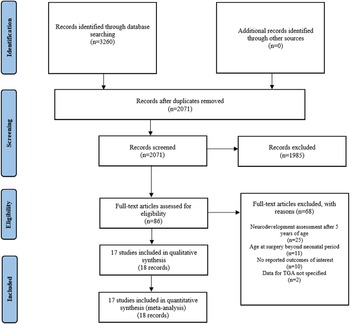
Our search in electronic bibliographic databases returned a total of 3260 results (Fig. 1). After duplicate removal and selection by title and abstract screening, we obtained 86 articles. Sixty-eight reports were excluded after full-text reading. A list of reports excluded, with reasons, can be found in Supplementary Table 4. Overall, 18 reports from 17 studies were included in our systematic review.Reference Lim, Porayette and Marini8,Reference Ibuki, Watanabe and Yoshimura14–Reference Peyvandi, Chau and Guo18,Reference Bellinger, Jonas, Rappaport and Med24–Reference Toet, Flinterman and Laar26,Reference Cheng, Wypij and Laussen38–Reference Mackie, Alton and Dinu46
Preferred Reporting Items for Systematic Reviews and Meta-Analyses (PRISMA) flow diagram illustrating the studies’ selection process.

Quality assessment
Risk of bias summaries are shown in Supplementary Figure 1. Nonrandomised studies (n = 13) had an overall moderate risk of bias,Reference Lim, Porayette and Marini8,Reference Ibuki, Watanabe and Yoshimura14–Reference Peyvandi, Chau and Guo18,Reference Andropoulos, Easley and Brady25,Reference Toet, Flinterman and Laar26,Reference De Silvestro, Kruger and Steger40–Reference Freed, Robertson and Sauve43,Reference Mackie, Alton and Dinu46 except for one study with serious risk of bias.Reference Hicks, Sauve and Robertson41 Confounding and selection of the reported results were the main causes of bias. Confounding was mainly due to the multiple factors assessed in the different studies, making it difficult to establish an association between corrective transposition of the great arteries surgery in the neonatal period and neurodevelopment. Nevertheless, all known important confounding domains were appropriately measured and controlled for, except for one studyReference Hicks, Sauve and Robertson41 where the reliability of the measurement of important domains was low enough, potentially allowing for residual confounding. Regarding the selection of the reported results, in the majority of the studies, the outcome measurements and analyses were consistent with an a priori plan, except for one studyReference Hicks, Sauve and Robertson41 where assessment by a speech-language pathologist was not possible at all sites, which may affect the outcome. Risk of bias was low mainly in the classification of the interventions and deviations from intended interventions.
For randomised controlled trials (n = 5),Reference Bellinger, Jonas, Rappaport and Med24,Reference Cheng, Wypij and Laussen38,Reference Andropoulos, Brady and Easley39,Reference Bellinger, Wypij and du Plessis44,Reference Bellinger, Wypij and Kuban45 we found some concerns mainly due to missing outcome data and selection of reported results. Outcome data were only available for some, or nearly all, randomised participants. Therefore, there is a risk of bias due to missing outcome data, primarily due to losses to follow-up.
Characteristics of included studies
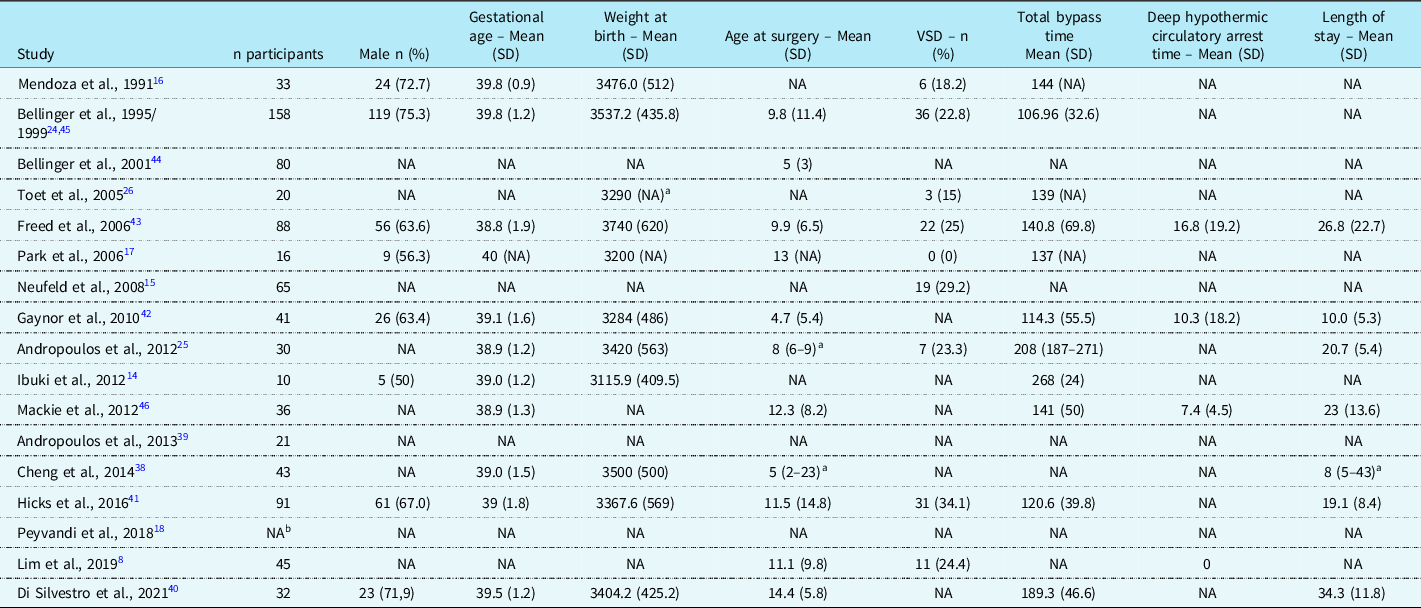
The demographic characteristics of the included studies are depicted in Table 1. The included studies were published from 1983 to 2020, assessing populations mainly from North America and Europe as well as South Korea and Japan. The included publications assessed a total of 809 individuals with transposition of the great arteries (from 10Reference Ibuki, Watanabe and Yoshimura14 to 158Reference Bellinger, Wypij and Kuban45 participants per study). The majority of the patients (n = 652) were submitted to the arterial switch operation, but there were some exceptions.Reference Mendoza, Wilkerson and Reese16,Reference Peyvandi, Chau and Guo18,Reference Freed, Robertson and Sauve43 Freed et al.Reference Freed, Robertson and Sauve43 reported that 52 patients were submitted to arterial switch operation and 22 were submitted to arterial switch operation with ventricle septal defect repair, but other complex types of procedures were performed in 14 patients; similarly, Mendoza et al.Reference Mendoza, Wilkerson and Reese16 reported that 30 patients were submitted to arterial switch operation and 3 were submitted to arterial switch operation and ventricle septal defect repair. Additionally, Peyvandi et al.Reference Peyvandi, Chau and Guo18 did not specify how many patients were submitted to arterial switch operation or other types of surgery. Gestational age, on average, ranged from 38 weeksReference Freed, Robertson and Sauve43 to 40 weeks,Reference Park, Yoon and Min17 and mean weight at birth was within the reference values for gestational age, ranging from 3116 gReference Ibuki, Watanabe and Yoshimura14 to 3740 g.Reference Freed, Robertson and Sauve43 Eight studiesReference Lim, Porayette and Marini8,Reference Neufeld, Clark and Robertson15,Reference Andropoulos, Easley and Brady25,Reference Toet, Flinterman and Laar26,Reference Cheng, Wypij and Laussen38,Reference Andropoulos, Brady and Easley39,Reference Bellinger, Wypij and du Plessis44,Reference Mackie, Alton and Dinu46 did not report the sex distribution of participants. Age at surgery was, in most cases, within the first 2 weeks of life (mean: 9.37 days). Concerning surgical characteristics, the total bypass time mean of the overall studies ranged from 106.96 minutesReference Bellinger, Wypij and Kuban45 to 268 minutes,Reference Ibuki, Watanabe and Yoshimura14 and the deep hypothermic circulatory arrest time was only reported in four studies ranging from 7.4Reference Mackie, Alton and Dinu46 to 16.8Reference Gaynor, Gerdes and Nord42 minutes. The mean length of stay was variable from 8Reference Cheng, Wypij and Laussen38 days to 34.3Reference De Silvestro, Kruger and Steger40 days. All included articles assessed neurodevelopment either with BSID8Reference Ibuki, Watanabe and Yoshimura14,Reference Mendoza, Wilkerson and Reese16–Reference Peyvandi, Chau and Guo18,Reference Bellinger, Jonas, Rappaport and Med24–Reference Toet, Flinterman and Laar26,Reference Cheng, Wypij and Laussen38–Reference Hicks, Sauve and Robertson41,Reference Freed, Robertson and Sauve43,Reference Bellinger, Wypij and du Plessis44,Reference Mackie, Alton and Dinu46 or WISC.Reference Neufeld, Clark and Robertson15,Reference Gaynor, Gerdes and Nord42,Reference Bellinger, Wypij and Kuban45
Demographic characteristics of included studies

TGA = transposition of the great arteries; VSD = ventricle septal defect; NA = not available; aMedian (range); b No data at baseline (84 at 12 months and 56 at 30 months).
Meta-analytic results: Neurodevelopment assessment at 1 year of age
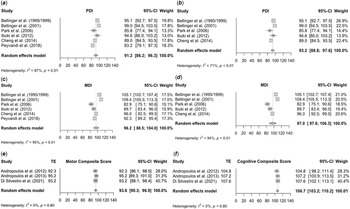
Overall, nine studiesReference Ibuki, Watanabe and Yoshimura14,Reference Park, Yoon and Min17,Reference Peyvandi, Chau and Guo18,Reference Bellinger, Jonas, Rappaport and Med24,Reference Andropoulos, Easley and Brady25,Reference Cheng, Wypij and Laussen38–Reference De Silvestro, Kruger and Steger40,Reference Bellinger, Wypij and du Plessis44 assessed neurodevelopment outcomes at 1 year of age, including a total of 390 children. The BSID-II and III were used to assess neurodevelopment in included studies at 1 year of age (Fig. 2). The results from studiesReference Ibuki, Watanabe and Yoshimura14,Reference Park, Yoon and Min17,Reference Peyvandi, Chau and Guo18,Reference Bellinger, Jonas, Rappaport and Med24,Reference Cheng, Wypij and Laussen38,Reference Bellinger, Wypij and du Plessis44 using BSID-II are depicted in Fig. 2b, 2c, and 2d. The estimated mean Psychomotor Development Index (PDI) was 91.2 (95% CI 86.2–96.3), albeit with important heterogeneity (I2 = 87%, p < 0.01). Similar results, with high heterogeneity, were also found when we restricted the meta-analysis to studies in which all patients (total of 382) had been submitted to the arterial switch operationReference Ibuki, Watanabe and Yoshimura14,Reference Park, Yoon and Min17,Reference Bellinger, Jonas, Rappaport and Med24,Reference Cheng, Wypij and Laussen38,Reference Bellinger, Wypij and du Plessis44 (mean PDI = 93.2 [95% CI 88.8–97.6], I2 = 71% [p < 0.01]). Regarding the Mental Developmental Index (MDI) score of the studies included in the meta-analysis,Reference Ibuki, Watanabe and Yoshimura14,Reference Park, Yoon and Min17,Reference Peyvandi, Chau and Guo18,Reference Bellinger, Jonas, Rappaport and Med24,Reference Cheng, Wypij and Laussen38,Reference Bellinger, Wypij and du Plessis44 mean MDI was 96.2 (95% CI 88.5–104.0), with high and significant heterogeneity (I2 = 95%, p < 0.01) (Fig. 2c), even when restricting the analysis to studies in which all patients (total of 382) had been submitted to the arterial switch operationReference Ibuki, Watanabe and Yoshimura14,Reference Park, Yoon and Min17,Reference Bellinger, Jonas, Rappaport and Med24,Reference Cheng, Wypij and Laussen38,Reference Bellinger, Wypij and du Plessis44 (mean MDI = 97.0 [95% CI 87.6–106.3], I2 = 94% [p < 0.01]). Figure 2e and 2f depict the results from studies using BSID-III.Reference Andropoulos, Easley and Brady25,Reference Andropoulos, Brady and Easley39,Reference De Silvestro, Kruger and Steger40 The estimated mean motor composite score was 93.6 (95% CI 90.3–96.9) (Fig. 2e) and the cognitive composite score was 106.7 (95% CI 103.2–110.2) (Fig. 2f), both analyses showing no heterogeneity (I2 = 0%, p = 0.80).
Neurodevelopment assessment at 1 year of age with BSID-II and III: a – PDI score (BSID-II), b – PDI score for ASO patients only (BSID-II), c – MDI score (BSID-II), d – MDI score for ASO patients only (BSID-II), e – Motor Composite Score (BSID-III), and f – Cognitive Composite Score (BSID-III).

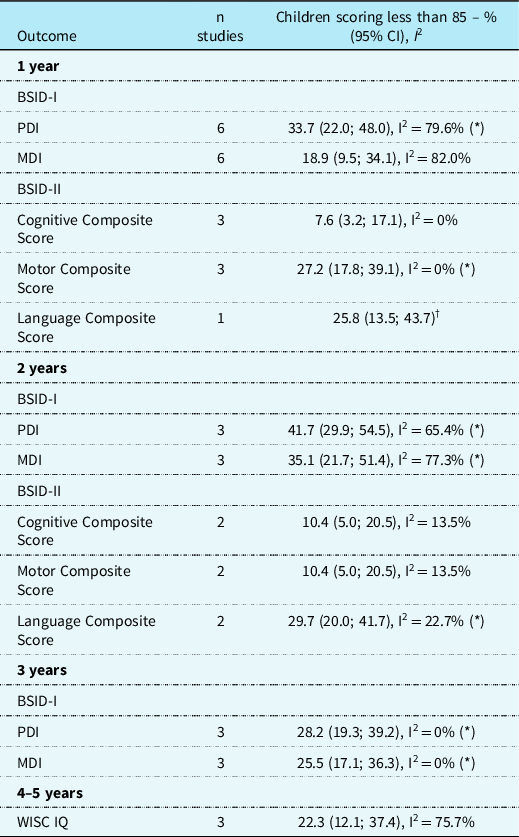
In Table 2, we summarise the meta-analytical results of percentage of children scoring more than 1 SD below the normative mean. At 1 year of age, 33.7% (95% CI = 22.0–48.0) of children scored less than 85 at PDI and 27.2% (95% CI = 17.8–39.1) also scored less than 85 at motor composite score. This significantly differs from the proportion of children scoring less than 85 in the general population.
Meta-analytical results of percentage of children scoring more than 1 standard deviation below the normative mean

BSID-I = Bayley Scales of Infant and Toddler Development version I; BSID-II = Bayley Scales of Infant and Toddler Development version II; PDI = Psychomotor Development Index; MDI = Mental Development Index; WISC = Wechsler Intelligence Scale for Children (WISC); IQ = intelligence quotient; N = number of studies. * Marks outcomes in which the proportion of children scoring less than 85 in studied population significantly differs from the proportion of children scoring less than 85 in the general population (16%).
Meta-analytic results: Neurodevelopment assessment at 2 years of age
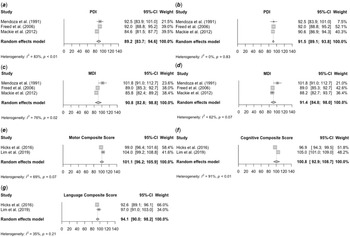
Overall, five studiesReference Lim, Porayette and Marini8,Reference Mendoza, Wilkerson and Reese16,Reference Hicks, Sauve and Robertson41,Reference Freed, Robertson and Sauve43,Reference Mackie, Alton and Dinu46 assessed neurodevelopment at 2 years of age, including a total of 293 children. At 2 years of age, both BSID-II and III were used to assess neurodevelopment outcomes in the included studies (Fig. 3). The results from studies using BSID-IIReference Mendoza, Wilkerson and Reese16,Reference Freed, Robertson and Sauve43,Reference Mackie, Alton and Dinu46 are shown in Fig. 3a, 3b, 3c, and 3d. The estimated mean PDI was 89.2 (95% CI 83.7–94.6), but heterogeneity was substantial (I2 = 83%, p < 0.01) (Fig. 3a). Importantly, heterogeneity was reduced after restricting the analysis to studies in which all patients had been submitted to the arterial switch operationReference Mendoza, Wilkerson and Reese16,Reference Freed, Robertson and Sauve43,Reference Mackie, Alton and Dinu46 (mean PDI = 91.5 [95% CI 89.1–93.8], with heterogeneity I2 = 0% [p = 0.83]) (Fig. 3b). Mean MDI was 90.8 (95% CI 82.8–98.8), with high and significant heterogeneity (I2 = 76%, p = 0.02) (Fig. 3c), even after restricting the analysis to those studies in which all patients had been submitted to the arterial switch operationReference Mendoza, Wilkerson and Reese16,Reference Freed, Robertson and Sauve43,Reference Mackie, Alton and Dinu46 (mean MDI = 91.4 [95% CI 84.8-98.0], I2 = 62% [p = 0.07]) (Fig. 3d). Figure 3e, 3f, and 3g show the results from studies using BSID-III.Reference Lim, Porayette and Marini8,Reference Hicks, Sauve and Robertson41 The estimated mean motor composite score was 101.1 (95% CI 96.2-105.9), with high heterogeneity (I2 = 69%, p = 0.07) (Fig. 3e). The mean cognitive composite score was 100.8 (95% CI 92.9-108.7), also with high heterogeneity (I2 = 91%, p < 0.01) (Fig. 3f). Finally, the mean language composite score was 94.1 (95% CI 90.0-98.2), with moderate heterogeneity (I2 = 35%, p = 0.21) (Fig. 3g).
Neurodevelopment assessment at 2 years of age with BSID-II and III: a – PDI score (BSID-II), b – PDI score for ASO patients only (BSID-II), c – MDI score (BSID-II), d – MDI score for ASO patients only (BSID-II), e – Motor Composite Score (BSID-III), f – Cognitive Composite Score (BSID-III), and g – Language Composite Score (BSID-III).

At 2 years of age, 41.7% (95% CI = 29.9–54.5) of children scored less than 85 at PDI, 35.1% (95% CI = 21.7–51.4) scored less than 85 at MDI, and 29.7% (95% CI = 20.0–41.7) also scored less than 85 at language composite score (Table 2). This significantly differs from the proportion of children scoring less than 85 in the general population.
Meta-analytic results: Neurodevelopment assessment at 3 years of age
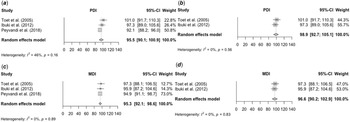
Three studiesReference Ibuki, Watanabe and Yoshimura14,Reference Peyvandi, Chau and Guo18,Reference Toet, Flinterman and Laar26 assessed neurodevelopment at 3 years of age, including a total of 30 children. Studies assessing neurodevelopment outcomes of patients with surgically corrected transposition of the great arteries at 3 years of age used the BSID-IIReference Ibuki, Watanabe and Yoshimura14,Reference Peyvandi, Chau and Guo18,Reference Toet, Flinterman and Laar26 (Fig. 4). The mean PDI was 95.5 (95% CI 90.1–100.9), with moderate heterogeneity (I2 = 46%, p = 0.16) (Fig. 4a), which was reduced by performing subgroup analysis on those studiesReference Ibuki, Watanabe and Yoshimura14,Reference Toet, Flinterman and Laar26 including only patients (total of 30 patients) submitted to arterial switch operation (mean PDI = 98.9 [95% CI 92.7–105.1], with low heterogeneity [I2 = 0%, p = 0.56])) (Fig. 4b). The estimated mean MDI was 95.3 [95% CI 92.1–98.6], with low heterogeneity (I2 = 0%, p = 0.89) (Fig. 4c). Similar results were found on subgroup analysis restricting for studies,Reference Ibuki, Watanabe and Yoshimura14,Reference Toet, Flinterman and Laar26 reporting that all patients (total of 30 patients) had been submitted to arterial switch operation (mean MDI = 96.6 [95% CI 90.2–102.9], I2 = 0% [p = 0.83]) (Fig. 4d).
Neurodevelopment assessment at 3 years of age with BSID-II: a – PDI score (BSID-II), b – PDI score for ASO patients only (BSI-D-II), c – MDI score (BSID-II), and d – MDI score for ASO patients only (BSID-II).

At 3 years of age, 28.2% (95% CI = 19.3–39.2) of children scored less than 85 at PDI and 25.5% (95% CI = 17.1–36.3) scored less than 85 at MDI (Table 2). This significantly differs from the proportion of children scoring less than 85 in the general population.
Meta-analytic results: Neurodevelopment assessment from 4 to 5 years of age
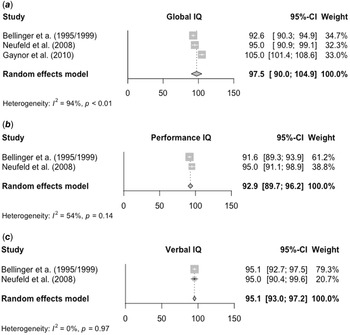
Three studiesReference Neufeld, Clark and Robertson15,Reference Gaynor, Gerdes and Nord42,Reference Bellinger, Wypij and Kuban45 assessed neurodevelopment from 4 to 5 years of age, including a total of 264 children. From 4 to 5 years of age, neurodevelopment was assessed with WISC, including full-scale global, verbal, and performance intelligence quotient (IQ) scores (Fig. 5). Regarding the global IQ score, the mean from three studiesReference Neufeld, Clark and Robertson15,Reference Gaynor, Gerdes and Nord42,Reference Bellinger, Wypij and Kuban45 was 97.5 (95% CI 90.0–104.9), with severe and significant heterogeneity (I2 = 94%, p < 0.01) (Fig. 5a). Two studies reported on the performance IQ score.Reference Neufeld, Clark and Robertson15,Reference Bellinger, Wypij and Kuban45 Its mean was 92.9 (95% CI 89.7–96.2), with severe heterogeneity (I2 = 54%, p = 0.14) (Fig. 5b). Finally, the mean verbal IQ score estimated from two studiesReference Neufeld, Clark and Robertson15,Reference Bellinger, Wypij and Kuban45 was 95.1 (95% CI 93.0–97.2), with low heterogeneity (I2 = 0%, p = 0.97) (Fig. 5c).
Neurodevelopment assessment from 4 to 5 years of age with WISC: a – Global IQ score, b – Performance IQ score, and c – Verbal IQ score.

From 4 to 5 years of age, 22.3% (95% CI = 12.1–37.4) of children scored less than 85 at IQ (Table 2). This does not significantly differ from the proportion of children scoring less than 85 in the general population.
Discussion
In our study, a meta-analysis of 809 patients with surgically corrected transposition of the great arteries during the neonatal period, we found that these patients exhibit modest development deficits until 3 years of age, but at the age of 5 years they do not display significant impairments in mean neurodevelopment scores. Indeed, cognitive, motor, and language scores were within the average values, although, except for the latter, heterogeneity was found to be significant. Overall, MDI and PDI were within the average values (mean between 90 and 109)Reference Del Rosario, Slevin, Molloy, Quigley and Nixon47 from 1 to 3 years of age. However, from 1 to 3 years of age, the proportion of children scoring less than 85 in the studied population in scores as PDI, MDI, motor, and language composite scores was significantly higher than in the general population. From 4 to 5 years, full-scale global, verbal, and performance IQ scores were within the reference range and the percentage of children scoring more than 1 SD below the normative mean did not significantly differ from the general population. These results suggest that transposition of the great arteries surgically corrected in the neonatal period does not seem to significantly impact early neurodevelopment components, namely cognitive, motor, and language development scores. However, it is important to notice that even if these scores are within the reference range, they may be in the low end of this interval, particularly until 3 years of age, which may still impact the neurodevelopment of these children and have implications for their follow-up. Heterogeneity was high for most of our meta-analytical results, which may be partially due to the heterogeneous designs of the studies included in this systematic review. Importantly, in an attempt to reduce heterogeneity, we performed subgroup analyses, including only those studies in which all the patients with transposition of the great arteries had been submitted to arterial switch operation. However, except for neurodevelopment outcomes at 3 years of age, heterogeneity remained high.
We should notice that there are some conflicting results between studies. For instance, the majority of the studies show no impact on language development, confirmed by our meta-analysis, but one study suggests poor language development at 2 years of age, highlighting the need for focused post-operative early language interventions.Reference Hicks, Sauve and Robertson41 However, in the referred study, assessment by a speech-language pathologist was not possible at all sites, which may have affected the outcome.
The American Heart Association, in its 2015 statement, recommends that surveillance should be performed in all children with CHD, placing children with transposition of the great arteries requiring open-heart surgery in the neonatal period at high risk for development disorders and disabilities, namely in the areas of intelligence, academic achievement, executive functioning, language, and fine and gross motor skills.Reference Marino, Lipkin and Newburger12 Indeed, transposition of the great arteries is one of the most studied CHD with regard to neurodevelopment outcomes, and previous reviews have shown neurodevelopment impairment in these patients during their lifespan. However, our results are consistent with a recently published reviewReference Kordopati-Zilou, Sergentanis and Pervanidou28 which showed a low rate of adverse outcomes until 5 years of age and a rate of adverse outcomes at school age twice the rate at the age of 5 years. Additionally, in adolescents with dextro-transposition of the great arteries, lower than anticipated scores were found in academic achievements, visuo-spatial skills, memory, psychosocial, and executive functions. Another literature reviewReference Kasmi, Bonnet and Montreuil48 also reported that early development was characterised by mild to moderate neurodevelopment delays, but more recent reports showed improvement in these early outcomes. However, the authors found impairment in later cognitive outcomes, particularly executive functioning.
We did not assess the prevalence of autism spectrum disorders, but it is essential to notice that deficits in social cognition have been reported,Reference Kasmi, Bonnet and Montreuil48 and other studiesReference Neufeld, Clark and Robertson15 reported higher rates of autism among transposition of the great arteries patients below 5 years of age.
Additionally, some of the reports included in our systematic review addressed interesting associations. For instance, one study shows that pre- and post-operative white matter injuries detected by MRI are associated with a lower score in MDI and PDI at 3 years.Reference Peyvandi, Chau and Guo18 Additionally, brain hypoxia seems to negatively affect the PDI score at 1 and 3 years,Reference Ibuki, Watanabe and Yoshimura14,Reference Cheng, Wypij and Laussen38,Reference De Silvestro, Kruger and Steger40 which suggests that better neurodevelopment outcomes may be achieved by improving O2 cerebral saturation and blood flow velocity during the early neonatal period in patients with transposition of the great arteries. This draws attention to the importance of prenatal diagnosis,Reference Calderon, Angeard, Moutier, Plumet, Jambaqué and Bonnet49 which may allow for the optimisation of surgical conditions. However, while some studies showed that neurocognitive deficits were more prevalent and more severe in children with a postnatal diagnosis,Reference Calderon, Angeard, Moutier, Plumet, Jambaqué and Bonnet49 this finding was not consistent in the literature and Bartlett et al. found that, although infants with transposition of the great arteries with and without prenatal diagnosis differ among perinatal and perioperative variables, their development at 1 year of age was similar.Reference Bartlett, Wypij and Bellinger50 The surgical techniques may also play an important role in outcomes, as circulatory arrest as the predominant support strategy seems to be associated with a higher risk of delayed motor development at both 1 and 4 years of age than with surgery with a low-flow bypass strategy.Reference Bellinger, Jonas, Rappaport and Med24,Reference Bellinger, Wypij and Kuban45 Given the heterogeneity between studies, we were unable to perform a meta-analysis comparing these variables.
This is, to our knowledge, the first systematic review of the literature with meta-analysis on the neurodevelopment outcomes in pre-school age children with transposition of the great arteries, adding, therefore, additional insight on this crucial issue. According to these results and considering the studies addressing school-aged children and adolescents, we would emphasise that assessments in infancy and school-aged children with transposition of the great arteries, while important to plan early intervention programmes, should be regarded with caution as they might not adequately predict long-term outcomes.
This study has some limitations, mostly due to the characteristics of the primary studies included in this systematic review. Heterogeneity between studies was substantial, including in their designs and characteristics of assessed populations. As previously mentioned, some studies assessed the association between brain lesions and neurodevelopment,Reference Peyvandi, Chau and Guo18 while others assessed the impact of surgical conditions, such as hypoxia,Reference Ibuki, Watanabe and Yoshimura14,Reference Toet, Flinterman and Laar26,Reference Cheng, Wypij and Laussen38,Reference De Silvestro, Kruger and Steger40 pH,Reference Bellinger, Wypij and du Plessis44 and support strategies.Reference Bellinger, Jonas, Rappaport and Med24,Reference Andropoulos, Brady and Easley39,Reference Bellinger, Wypij and Kuban45 However, we were unable to perform a meta-analysis comparing these variables, as they were not consistently reported across studies. It should be highlighted that not all the components of children’s neurodevelopment were assessed in this systematic review, such as visual-motor integration, executive functions, pre-academic skills, adaptive skills, and social, emotional, and behavioural functioning, due to heterogeneity in reported outcomes in the included studies. However, we aimed to assess crucial and global neurodevelopment components such as mental, psychomotor, performance, language, and verbal components. Furthermore, while most of the studies assessed all different components of neurodevelopment,Reference Lim, Porayette and Marini8,Reference Neufeld, Clark and Robertson15,Reference Mendoza, Wilkerson and Reese16,Reference Andropoulos, Easley and Brady25,Reference Gaynor, Gerdes and Nord42,Reference Freed, Robertson and Sauve43 one only assessed language development.Reference Hicks, Sauve and Robertson41 Additionally, some of the included studies assessed a small sampleReference Ibuki, Watanabe and Yoshimura14,Reference Park, Yoon and Min17,Reference Andropoulos, Easley and Brady25 and, for some studies, the surgical approach was not reported.Reference Peyvandi, Chau and Guo18,Reference Andropoulos, Brady and Easley39,Reference Gaynor, Gerdes and Nord42 Although we included a large number of patients, some were extracted from clinical research studies and therefore may not be representative of the population with D-transposition of the great arteries. Furthermore, most studies did not directly report on the proportion of children scoring more than 1 SD from the normative mean, so we estimated this proportion assuming a normal distribution of the scores with the reported mean and SD. There is, therefore, a need for more studies reporting absolute and relative frequencies of children scoring more than 1 or 2 SDs below the normative mean. Despite this, some strengths can be pointed out. We attempted to maximise study inclusion by performing a thorough search of the literature in three different databases, with no language or date restrictions, checking the reference lists of included studies and relevant reviews, and contacting authors when data needed to be clarified. Additionally, overall included studies did not show a high risk of bias. Finally, this is the first meta-analysis to attempt to aggregate the results from several studies to estimate the proportion of children scoring more than 1 SD below the normative mean.
Conclusion
This systematic review and meta-analysis provides an overview of neurodevelopment outcomes up to 5 years of age in patients with transposition of the great arteries surgically corrected during the neonatal period. Overall, from 1 to 5 years of age, cognitive, motor, and language scores were within the normal range, although from 1 to 3 years of age the proportion of children scoring less than 1 SD from the normative mean significantly differed from the general population. However, heterogeneity between studies was high, limiting the evaluation of other specific components of the neurodevelopment. Additionally, these early outcomes may not adequately predict long-term outcomes. Further, well-designed studies are needed to gather more consistent evidence of risk factors for neurodevelopment outcomes and early markers of later impairment to guide the establishment of early interventions.
Supplementary material
The supplementary material for this article can be found at https://doi.org/10.1017/S104795112300375X.
Acknowledgements
None.
Financial support
This research received no specific grant from any funding agency, commercial, or not-for-profit sectors.
Competing interests
Authors have no conflicts of interest to disclose.