Financial capacity, a crucial aspect of independent living, is sensitive to early neurodegenerative changes in later life, and relatively understudied given its importance (Marson et al., Reference Marson, Sawrie, Snyder, McInturff, Stalvey, Boothe and Harrell2000). Financial capacity is conceptualized as the cognitive and reasoning abilities required to effectively manage finances independently – specifically, planning and organization, memory, judgment, and calculation (Marson, Reference Marson2016). There is growing recognition that financial capacity assessment among older adults with mild cognitive impairment and dementia has utility as part of neuropsychological assessment to inform care planning and prevent victimization (Marson et al., Reference Marson, Sawrie, Snyder, McInturff, Stalvey, Boothe and Harrell2000). However, rates and cognitive correlates of financial incapacity among other cognitively at-risk populations, specifically older adults with major depressive disorder (MDD), have received limited attention.
MDD is a debilitating illness, and the leading cause of lifetime disability worldwide (Murray, Lopez, & Organization, Reference Murray, Lopez and Organization1996). Mild cognitive impairments are noted in 40–60% of older adults with MDD (Butters et al., Reference Butters, Whyte, Nebes, Begley, Dew, Mulsant and Pollock2004). These deficits have been noted most prominently in domains of executive functioning and information processing speed (Koenig, Bhalla, & Butters, Reference Koenig, Bhalla and Butters2014) – areas likely to impact complex reasoning abilities associated with financial management. Given that MDD is associated with disability burden, which may impede independent living, assessing the impact of depression on financial capacity in older adults in the absence of neurodegenerative disorders is of vital importance.
To our knowledge, no work has been conducted in this area since the first study addressing this gap in the literature nearly 10 years ago, in which cognitive deficits associated with financial capacity in a sample of older adults with MDD were assessed (Mackin & Arean, Reference Mackin and Arean2009). In this study, considerably higher rates of financial incapacity were found in the depressed subjects (22%) relative to controls (6%). Specifically, deficits in executive functioning and attention (as measured by the Controlled Oral Word Association Test and Wechsler Adult Intelligence Scale – 3rd edition (WAIS-III) Letter Number Sequencing) were most associated with lower rates of financial capacity, accounting for an additional 27% of the variance in Independent Living Scale (ILS) – Managing Money score beyond age and education.
The current study aims to extend earlier research by assessing financial incapacity in a larger sample of depressed participants compared to controls, as well as associations of cognition domains with financial capacity in the depressed sample, controlling for age, gender, education, depression severity, and the impact of other cognitive measures. We hypothesize that our findings will be similar to those of Mackin and Arean Reference Mackin and Arean(2009), with depressed participants demonstrating more financial incapacity than controls. Additionally, we predict that poorer executive functioning and attention will be associated with lower financial capacity in this group.
METHODS
Participants
Participants included 136 adults over the age of 65: 95 with MDD and 41 age-matched controls that participated in a study on cognition in late-life MDD. MDD was diagnosed using the Structured Clinical Interview (SCID-IV) for the Diagnostic and Statistical Manual of Mental Disorders, 4th Edition (First, Gibbon, Spitzer, & Williams, Reference First, Gibbon, Spitzer and Williams1996), with symptom severity of ≥15 on the 17-item Hamilton Depression Rating Scale (HDRS) required in the initial screening for inclusion (Hamilton, Reference Hamilton1960). Thereafter, the HDRS-24 was used to measure depressive symptom severity. Trained clinical research associates administered the HDRS-24, and final diagnoses of MDD were reviewed at a consensus meeting that included a neuropsychologist, a psychiatrist, and other research staff. Those with significant history of or current neurologic disease including dementia were excluded, as were individuals who scored below normal limits on a cognitive screener (<25 on Mini Mental State Exam, shown to be a sensitive and specific cutoff in older community-dwelling samples (Creavin et al., Reference Creavin, Wisniewski, Noel-Storr, Trevelyan, Hampton, Rayment and Milligan2016)). The research was approved by the institutional review board of the University of California, San Francisco, and all participants provided informed consent.
Measures
Financial Capacity
Financial capacity was assessed using the Managing Money scale from the ILS (Loeb & Fe, Reference Loeb and Fe1996). The scale consists of 17 items, assessing a participant’s ability to pay bills, count money, make monetary calculations, and take precautions with money. Each item is rated on a scale of 0–2. Standard scores are calculated based on a diverse validation sample (Loeb & Fe, Reference Loeb and Fe1996). Raw scores were utilized for primary analyses, with standard score cutoffs used to assess prevalence of impairment for both groups. The standard cutoff for impairment suggested by the ILS manual is a T-score of 40 (Loeb & Fe, Reference Loeb and Fe1996), with scores below 40 indicating impairment. However, proportions of impairment at cutoff T-scores below 45 and 50 were also reported, to assess whether more sensitive measures of lower financial capacity were associated with cognition.
Cognitive Functioning
Cognitive domains assessed included executive functioning, attention, verbal learning and memory, visual learning and memory, expressive language, visual spatial functioning, and information processing speed. Individual measures were scored using normative data based on age, with scaled scores on each test utilized as the unit of analysis. Impairment on a given task was defined as a scaled score one standard deviation below the mean for age-matched peers (ss < 7), given the high level of education in this sample.
Executive functioning was assessed using the number of words generated in 180 s across three trials on the Controlled Oral Word Association Test (Reitan & Wolfson, Reference Reitan and Wolfson1993), completion time on Trail Making Test Part B (Reitan & Wolfson, Reference Reitan and Wolfson1993), and number of correct items read in 45 s on the Color Word trial of the Stroop test (Golden & Freshwater, Reference Golden and Freshwater2002). Attention was assessed using the total score on Digit Span, and total score on Letter Number Sequencing from the WAIS-III (Wechsler, Reference Wechsler1981). Verbal learning and memory were assessed using the total recall and delayed recall on the Hopkins Verbal Learning Test – Revised (HVLT-R) (Brandt, Reference Brandt1991) and immediate recall and delayed recall scores on the Wechsler Memory Scale – Revised Logical Memory Test (WMS-R) (Wechsler, Reference Wechsler1987). Total recall and delayed recall on the Brief Visuospatial Memory Test – Revised (BVMT-R) were used to measure visual learning and memory (Benedict, Reference Benedict1997). A semantic fluency task (number of animals named in 60 s) (Reitan & Wolfson, Reference Reitan and Wolfson1993) and the Boston Naming Test (BNT), a measure of confrontation naming (Kaplan, Goodglass, & Weintraub, Reference Kaplan, Goodglass and Weintraub1983) were used as measures of expressive language. Abstract reasoning was assessed using the Similarities subtest of the WAIS-III (Wechsler, Reference Wechsler1981). Visual spatial functioning was measured with the Benton Judgment of Line Orientation task (Benton, Reference Benton1983), with number of correct responses as the outcome. Finally, information processing speed was assessed using completion time on Trail Making Test Part A (Reitan & Wolfson, Reference Reitan and Wolfson1993), and number of correct symbols drawn in 120 s on the Digit Symbol Coding subtest of the WAIS-III (Wechsler, Reference Wechsler1981).
Depression Severity
Severity of current depression symptoms was assessed using the 24-item Hamilton Depression Rating Scale (HDRS-24), a measure commonly used to assess symptom severity in older adults due to its sensitivity to change (Nelson, Clary, Leon, & Schneider, Reference Nelson, Clary, Leon and Schneider2005), with higher scores indicating greater severity of current symptoms.
Data Analysis
Independent samples t tests were conducted, comparing depressed and control group on demographic variables, financial capacity, cognitive measures, and depression severity, with a chi-square test conducted to assess group differences in gender. Pearson correlations between financial capacity and cognitive measures were obtained. Finally, a linear regression analysis was conducted in the depressed sample, assessing the relationship of several cognitive variables with financial capacity, controlling for age, gender, education, depression severity, and the impact of other cognitive measures. The cognitive variables used in this analysis were chosen based on the five tests most correlated with ILS (r value > .33), consistent with methodology used by Mackin & Arean Reference Mackin and Arean(2009) wherein most strongly related tests were used in the regression. Specifically, HVLT-R Delayed Recall, WMS-R Logical Memory immediate recall, WAIS-III Digit Span, Stroop Color Word Test, and WAIS-III Similarities were included. Demographic variables were entered into the first step of the regression, depression severity added in the second step, and cognitive variables added in the third step.
RESULTS
Descriptive Statistics
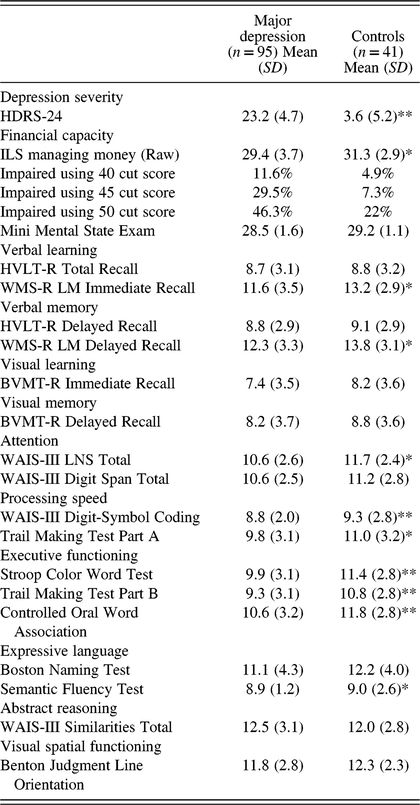
Participants were 136 older adults with a mean age of 71.5 (SD = 6.4), with 15.9 (SD = 2.5) years of education. There were 90 females in the sample and 46 males. The sample was 75% Caucasian, 11% Asian, 6.6% African American, 4.4% American Indian, 1.5% Pacific Island, and 1.5% reporting other race, with 9.6% endorsing Hispanic ethnicity. Depressed participants were not different from controls with respect to age, education, or race/ethnicity. There were more female participants in the depressed sample (X 2 = 4.1, p < .05). Descriptive statistics for depression severity, and cognitive and financial capacity measures in both groups are presented in Table 1. In the depressed group, 60% of participants had an impaired score on at least one cognitive test.
Descriptive statistics of depression severity, financial (raw score), and cognitive measures (scaled score) by group

Note. HVLT-R = Hopkins Verbal Learning Test – Revised; WMS-R = Wechsler Memory Scale – Revised; BVMT-R = Brief Visuospatial Memory Test – Revised; WAIS-III = Wechsler Adult Intelligence Scale – Third Edition; LNS = Letter Number Sequencing; ILS = Independent Living Scale. *significant difference between depressed and controls at p < .05, **significant difference between depressed and controls at p < .01.
Group Comparisons
An independent samples t test showed depressed participants had significantly lower financial capacity than controls (t = 2.98, p < .01), with over twice as many depressed participants impaired at each cutoff score recommended in the manual (Loeb & Fe, Reference Loeb and Fe1996). At the least sensitive cutoff for impairment, a T-score of 40, 11.6% of the depressed sample was impaired compared to 4.9% of controls. At a cutoff score of 45, 29.5% of depressed participants were impaired compared to 7.3% of controls. Finally, at the most sensitive cutoff, a T-score of 50, 46.3% of depressed, compared to 22% of controls, were impaired (Loeb & Fe, Reference Loeb and Fe1996).
Controls endorsed significantly less depression severity (t = −21.61, p < .001). On cognitive measures, depressed participants performed significantly worse than controls on measures of verbal learning and memory, attention, processing speed, one measure of expressive language, and measures of executive functioning (see Table 1 for significant groups differences on individual cognitive measures).
Correlations
ILS score was most strongly correlated (r > .3) with a measure of verbal learning (WMS-R Logical Memory Immediate; r = .35, p =.001), a measure of verbal memory (HVLT-R Delayed Recall; r = .48, p = .001), visual learning (BVMT-R Immediate; r = .31, p = .001), a measure of attention (WAIS-III Digit Span; r = .34, p = .001), executive functioning (Stroop Color Word trial; r = .33, p = .001), confrontation naming (BNT; r = .32, p = .001), and an abstract reasoning task (WAIS-III Similarities; r = .39, p < .001). See supplementary table 1 for correlations between ILS and cognitive tests by group.
Hierarchical Regression
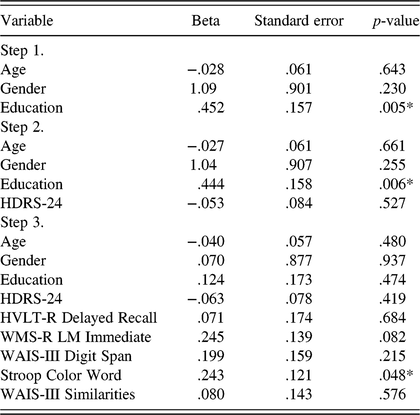
In a hierarchical linear regression analysis conducted for the depressed sample (see Table 2), the model accounted for 31% of the variance in financial capacity (F = 3.6, p = .001). Inclusion of cognitive measures added an additional 20% variance compared to the model limited to age, gender, education, and depression severity. In this model, only a measure of executive functioning (Stroop Color Word trial; B = .25, p = .04) was significantly associated with financial capacity, while age, gender, education, depression severity, and other cognitive measures were no longer associated with financial capacity.
Hierarchical regression analysis predicting ILS in depressed (n = 95)

Note. ILS = Independent Living Scale – Managing Money Subscale; HDRS-24 = Hamilton Depression Rating Scale – 24 item; HVLT-R = Hopkins Verbal Learning Test – Revised; WMS-R = Wechsler Memory Scale – Revised; WAIS-III = Wechsler Adult Intelligence Scale – Third Edition. *significantly associated with ILS MM.
Step 1 R 2 Δ = .104.
Step 2 R 2 Δ = .005.
Step 3 R 2 Δ = .202.
DISCUSSION
Our results show that depressed older adults without dementia had significantly lower scores than controls on a measure of financial capacity and proportions of impairment twice as high at every cutoff score. A measure of executive functioning, specifically the Stroop Color Word trial, was associated with financial capacity among depressed participants, independent of depression severity. Though these were not the same measures most associated with financial capacity in older depressed adults in Mackin and Arean’s study (Reference Mackin and Arean2009), where Controlled Oral Word Association Test and Letter Number Sequencing were most strongly associated with financial capacity, significant findings in both studies capture aspects of attention and executive functioning domains associated with financial capacity. Specifically, in terms of the present findings, mental flexibility and effective inhibition are related to aspects of financial functioning, and understanding of multistep financial decision-making and avoidance of fraud.
Though on average, performance on cognitive tests was within normal limits among depressed participants, when taken individually, 60% of participants had impairment on at least one cognitive test. It is unclear whether these impairments represent prodromal neurodegeneration or sequelae of clinically significant depression, or whether a single impaired score is more likely to reflect statistical error. Future longitudinal studies will help to clarify these associations.
This study in a larger sample of older adults with MDD is particularly important given that, to our knowledge, no other research has been conducted on financial capacity in older depressed adults without dementia since Mackin and Arean’s initial publication 10 years ago (Reference Mackin and Arean2009). Overall, the proportion of impairment on financial capacity for both depressed and control participants was lower in this study than in Mackin and Arean Reference Mackin and Arean(2009) at a cutoff score of 40, the standard cutoff for impairment on the ILS money management scale, which may be due to differences in sample characteristics present by chance, indicating a need for future research with larger sample sizes that also better identify depression history or other factors which might be related to financial capacity in this population.
In this study, however, like Mackin and Arean Reference Mackin and Arean(2009), depressed participants evidenced significantly more impairment in financial capacity compared to controls on a continuous measure of financial capacity, and showed higher rates across several cut points – an extension of Mackin and Arean’s (Reference Mackin and Arean2009) study where only the most stringent cut point for impairment was assessed. Assessing several cut points is of clinical significance even among those who are generally cognitively intact, especially given the increasingly complex technological demands of maintaining financial capacity, it is likely that a more subtle and sensitive measure of difficulty in these domains may capture individuals who are at risk for exploitation or difficulty maintaining their finances, even in the absence of frank impairments in calculation and organization.
Our data do not address whether these impairments are reversible with depression treatment or if cognitive impairments persist, possibly in association with early neurodegenerative disease. In any case, knowledge of the increased potential for financial capacity impairment in older adults with MDD might encourage providers to obtain assessment of financial capacity. This may help to ensure the appropriate oversight of independent activities of daily living, preserving functional independence and identifying those vulnerable to fraud and abuse.
There are several limitations to note. This study was cross-sectional, and thus it is not possible to assess whether depression in some participants might represent a prodromal neurodegenerative process. It is also unclear if financial capacity worsens over time in these participants. The participants in this study were also highly educated which in some respects bolsters the strength of the findings in a nondemented sample, since it would be expected that with more education and cognitive reserve, impairments on individual cognitive tests might not affect real-world functioning to such a great extent. However, it is also possible that these participants might have declined more substantially from a higher baseline to receive an impaired score on a cognitive test. Aspects of depression history, such as age of onset, may also be related to financial capacity given research suggesting late onset depression may represent a dementia prodrome (Mackin et al., Reference Mackin, Nelson, Delucchi, Raue, Satre, Kiosses and Arean2014). Expanding future studies to include depression history and characteristics, and larger samples that include a wide range of educational backgrounds will address these questions. Additionally, the choice of the ILS money management scale as the financial capacity measure may have limited some of the domains of financial competency that could be assessed (e.g. real-world performance on financial tasks).
Our results showed that depressed older adults had significantly lower financial capacity than controls, with executive functioning associated with capacity independent of depression severity for depressed participants. Given the prevalence of lower financial capacity and impairments on individual cognitive measures, it will be important to determine whether financial capacity improves when depression remits with treatment. Additionally, since financial incapacity contributes to disability among older adults, financial capacity assessment may be beneficial as part of routine geriatric care even in the absence of dementia. Further study of financial capacity in late-life MDD and associated risk for financial abuse as well as the role of neuropsychology in assessing these domains is warranted. Hopefully, greater awareness of deficits in financial capacity in older depressed adults without significant cognitive impairment will aid in early detection and intervention to safeguard patients from financial abuse.
ACKNOWLEDGMENTS
This research is supported by the Department of Veterans Affairs Office of Academic Affiliations Advanced Fellowship Program in Mental Illness Research and Treatment, Sierra Pacific Mental Illness Research Education and Clinic Centers, San Francisco VA Medical Center, and the Department of Psychiatry, University of California, San Francisco, and K08 grant MH081065.
CONFLICTS OF INTEREST
Dr. Nelson reports personal fees from Otsuka, Lundbeck, Assurex, Janssen, Eisai, Corcept, Sunovion, and UpToDate, outside the submitted work. The other authors have no conflicts of interest to report.
SUPPLEMENTARY MATERIAL
To view supplementary material for this article, please visit https://doi.org/10.1017/S1355617719000705.