The period of 3 weeks before and 3 weeks after parturition, defined as the transition period (Grummer, Reference Grummer1995), is the time of marked changes in the endocrine and metabolic status of dairy ruminants. Changes which accommodate parturition and lactogenesis influence tissue metabolism and nutrient utilisation (Drackley, Reference Drackley1999). The aetiology of most production diseases which occur during the first weeks of lactation can be traced back to inappropriate management during the peripartum period (Mulligan & Doherty, Reference Mulligan and Doherty2008). The adoption of intensive husbandry methods in dairy goat farming is likely to increase the incidence of metabolic diseases among high-yielding goats (Celi, Reference Celi2010).
Metabolic demands in the last week of gestation shift from foetal and uterine metabolism towards high milk production (Vazquez-Anon et al. Reference Vazquez-Anon, Bertics, Luck and Grummer1994); together with depression in feed intake during the last weeks of pregnancy (Bertics et al. Reference Bertics, Grummer, Cadorniga-Valino and Stoddard1992), negative energy balance (NEB) can occur (Adewuyi et al. Reference Adewuyi, Gruys and Van Eerdenburg2005). NEB results in the release of large amounts of non-esterified fatty acids (NEFA) from adipose tissue, increased plasma concentration of beta-hydroxybutyrate (BHB), decreased concentration of glucose, insulin, insulin growth factor-I (IGF-1) and a fatty liver (Adewuyi et al. Reference Adewuyi, Gruys and Van Eerdenburg2005). Elevated NEFA serum concentration indicates higher fat mobilisation rate, while BHB reflects completeness of lipid oxidation (LeBlanc, Reference LeBlanc2010). Both serve as specific parameters for the prediction of individual or collective peri-parturient disease events.
During the peripartum period, due to characteristic metabolic changes, reactive oxygen and nitrogen metabolites are produced in excess (Celi, Reference Celi, Mandelker and Vajdovich2011b). When produced faster than they can be neutralised by antioxidant mechanisms, it may result in oxidative stress, as found in dairy cows (Bernabucci et al. Reference Bernabucci, Ronchi, Lacetera and Nardone2005; Castillo et al. Reference Castillo, Hernandez, Bravo, Lopez-Alonso, Pereira and Benedito2005) and goats (Celi et al. Reference Celi, Di Trana and Quaranta2008, Reference Celi, Di Trana and Claps2010). Numerous methodologies for evaluating oxidative stress have been developed lately, including both direct and indirect measurement of oxidants and antioxidants. However, there are no standardised reference panels for different biomarkers of oxidative stress for ruminants (Celi, Reference Celi2011a). Serum level of MDA, a degradation product of lipids which are most susceptible to peroxidation (Grotto et al. Reference Grotto, Santa Maria, Valentini, Paniz, Schmitt, Garcia, Pomblum, Rocha and Farina2009) is one of the indices widely used for assessing oxidative stress (Dotan et al. Reference Dotan, Lichtenberg and Pinchuk2004) since biomarkers of lipid peroxidation are considered the best indicators of oxidative stress (Celi, Reference Celi, Mandelker and Vajdovich2011b). Measuring blood enzymatic antioxidants (catalase, glutathione peroxidase and superoxide dismutase) together with MDA values may give more accurate information on oxidative stress level, rather than using such data separately.
The effect of parity on milk yield in goats shows an almost steady growing trend from the first to the fourth lactation (Pavliček et al. Reference Pavliček, Antunović, Senčić and Šperanda2006; Goetsch et al. Reference Goetsch, Zeng and Gipson2011) and the maximum milk yield is usually attained in the fifth lactation (Crepaldi et al. Reference Crepaldi, Corti and Cicogna1999; León et al. Reference León, Macciotta, Gama, Barba and Delgado2012; Magistrelli & Rosi, Reference Magistrelli and Rosi2014). So, the aim of this paper was to research the differences in the level of metabolic burden between goats of different parity, and its influence on the occurrence of peripartal oxidative stress. The hypothesis was that multipartal goats were required to sustain higher oxidative stress levels due to their higher milk yield and metabolic burden. We also wanted to monitor changes in both metabolic and oxidative status occurring during the peripartum period, end of pregnancy, parturition and first month of lactation.
Materials and methods
Animals, husbandry, nutrition
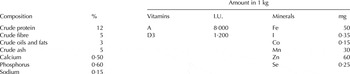
The study was carried out on 60 healthy Saanen goats housed indoors at a commercial farm in continental Croatia in the period from January until March, when the climate conditions are not supposed to increase the production of ROS because of heat stress (Chauhan et al. Reference Chauhan, Celi, Ponnampalam, Leury, Liu and Dunshea2014). The animals were subdivided into three balanced groups according to their parity, 20 goats in each group. The first group comprised primiparous goats (PRIM), the second goats that kidded the 2nd or the 3rd time (MID), and the third goats that kidded 4 or more times (MULTI). All goats kidded without assistance. Animals were kept indoors in a large group on a deep littered floor. They were fed with homemade concentrate (44% of corn, 24% of wheat bran, 10% of soybean meal, 10% of sunflower meal, 6% of dehydrated alfalfa, 2% of chalk, 1% of NaCl and 1% of fodder yeast, 2% of Ovisan (Sano International) – vitamin-mineral supplement (Table 1). The goats were given approx. 2 kg per goat a day throughout the course of this study. The nutrient analysis of the concentrate feed as well as hay composition was performed by accredited laboratory for physio-chemical analysis of animal feed, Faculty of Agriculture, University of Zagreb. The feed consisted of 125 g/kg of ash, 70 g/kg of crude fat, 16·39% of moisture, 26 g/kg of crude protein and 54 g/kg of crude fiber. The hay was available daily ad libitum. All animals had ad libitum access to water and salt blocks. The goats were milked manually twice a day, at 7·00 a.m. and 6·00 p.m. Body condition score was evaluated at the beginning of the research period for all goats using the lumbar system by Morand-Fehr et al. (Reference Morand-Fehr, Amaro, Rubino and Branca1992). The goats were homogenous for BCS (PRIM goats: 1·85 ± 0·16, MID goats 2·16 ± 0·13 and MULTI goats 2·35 ± 0·16) in the beginning of the research with no statistically significant difference between the groups.
Composition of vitamin-mineral supplement for sheep Ovisan (Sano International)

Sample collection and analytical procedures
Blood samples were collected by jugular venipuncture from all goats between 9·00 and 11·00 a.m. at −7–10 (±0·16), −1–3(±0·13), 1–3(±0·15), 14 and 28 d from the delivery (shown with ± se). Samples were collected into evacuated tubes (Vacutainer) without anticoagulant, kept in a cool place and centrifuged within 3 h of bleeding at 1500 g and for 15 min. The harvested serum was frozen and stored at −70 °C until the time of analysis. The concentrations of β-hydroxybutyrate (BHB), non-esterified fatty acids (NEFA), activity of superoxide dismutase (SOD; E.C.1·15·1·1) and glutathione peroxidase (GSH-Px; E.C. 1·11·1·9.) enzymes in serum samples were determined using Randox Laboratories LTD, Ardmore, UK kits on SABA 18 (AMS, Italy) while reagents by Herbos, Croatia were used for albumin, glucose, triglycerides and urea concentrations on the same instrument, SABA 18 (AMS, Italy). The milk samples were obtained by an authorised body, Croatian agricultural agency (HPA) 1 month after the delivery of each goat, and the official report was used for analysing milk yield and milk composition (Table 2).
Least square means (LSM ± se) values of milk yield, amount of fat and protein in milk samples obtained 1 month in lactation in PRIM (primiparous), MID (2nd and 3rd time kidding goats) and MULTI (multiparous) goats

a,bWithin rows, LSM followed by different letters are significantly different (P < 0·01).
Samples for total serum malondialdehyde (MDA) concentration were prepared and measured by method of Grotto et al. (Reference Grotto, Santa Maria, Boeira, Valentini, Charão, Moro, Nascimento, Pomblum and Garcia2007) using high performance liquid chromatography (HPLC) with UV detection on TSP-130 system (Thermo Separation Products, Inc., Thermo Fisher Scientific, Inc., Waltham, MA, SAD).
Statistical analysis
Statistical analyses were performed using SAS 9·3 software (2002–2010 SAS Institute Inc., Cary, NC, USA). The general linear model (PROC GLM) was used to evaluate the number of goat kids and milk parameters between the groups. The generalised linear mixed model (PROC GLIMMIX) was used to analyse oxidative and blood metabolic parameters. The statistical model included the fixed effects of group, time, number of goat kids and their interactions. The animal effects on repeated measures over time were included in the model by RANDOM statement with RESIDUAL option and heterogeneous compound-symmetry structure. Multiple comparison test of least-squares means with Bonferroni correction was performed using SLICE option to compare each level of group within each level of time and conversely. Results are expressed as least square means ± standard error (LSM ± se). Spearman coefficient of correlations between different variables was performed using SAS correlation procedure (PROC CORR). The level of statistical significance was set at P < 0·05.
Results
Litter size and body condition score
The litter size did not significantly differ (P < 0·05) between the groups. PRIM group had 1·29 ± 0·16 kids, MID group kids 1·77 ± 0·13 and MULTI group 1·8 ± 0·16 kids per goat.
Milk yield
The results of average milk yield (l), average milk and protein fat (%) per group are shown in Table 2. Milk yield 1 month in lactation was significantly (P < 0·05) higher in MID and MULTI group than in PRIM group. No statistical difference was found between fat and protein content between the groups.
Metabolic parameters
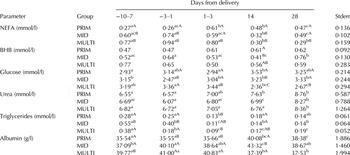
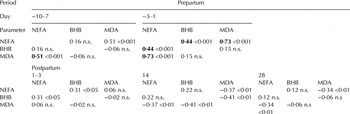
The results for metabolic parameters in PRIM, MID and MULTI goats (data for each stage) are shown in Table 3. NEFA serum concentrations were higher (P < 0·05) in MID and MULTI goats than in PRIM goats prepartally. They significantly increased (P < 0·05) 3 d postpartally in PRIM goats while significantly decreasing in MID and MULTI goats 14 d postpartally (P < 0·001). Postpartally, NEFA in PRIM goats were significantly higher (P < 0·01) than in MULTI goats. BHB concentrations in MID goats were significantly (P < 0·05) higher 28 d postpartally than in their prepartal period. No statistical significance was found in MULTI group during the peripartum even though the values varied from 0·50 ± 0·04–0·77 ± 0·13 mmol/l, with the highest ones found 10–7 d prepartally. Albumin values were prepartally significantly higher (P < 0·05) in MULTI than in PRIM goats until 3 d postpartally (P < 0·01). But, 14 d postpartally, that relation changed; in MULTI group albumin concentration decreased significantly (P < 0·01) while increasing in PRIM and all groups; values found 28 d post-p in those groups were significantly (P < 0·001) higher than the values found prepartally. Glucose levels were in a narrow window 10–7 d prepartally in all groups (2·93 ± 0·09–3·19 ± 0·10). But, 14 d postpartally they significantly increased in PRIM group (P < 0·01) and decreased (P < 0·01) in MULTI goats. Glucose levels were postpartally (14 and 28 d) higher (P < 0·01) in both PRIM and MID groups than in MULTI group. Triglycerides concentrations prepartally showed an apparent decrease in all groups; lowest values for all of them were found 1–3 d postpartally. Significant positive correlation (r = 0·45; P < 0·001) between NEFA and BHB was found 3–1 d prepartally, but not postpartally. NEFA values were also significantly correlated positively with MDA values prepartally with strong correlation (r = 0·51 and r = 0·73; P < 0·001, respectively) (Table 5).
Least square means (LSM) and pooled standard error (Stderr) values of metabolic parameters within and between PRIM (primiparous), MID (2nd and 3rd time kidding goats) and MULTI (multiparous) goats during the peripartum period.

a,bWithin rows, values followed by different letters are significantly different (P < 0·05); A,Bbetween rows, values followed by different letters are significantly different (P < 0·05); n.s. – not significant.
Oxidative status indicators
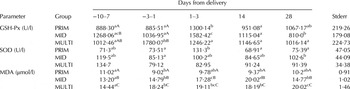
The results of anti-oxidative status markers values in PRIM, MID and MULTI goats (data for each stage) are shown in Table 4. The highest urea values postpartally were found in PRIM group. GSH-Px activity increased significantly in MULTI group 1–3 d prepartally (P < 0·01), decreased significantly 1–3 d postpartally (P < 0·001), continuing to decrease until the end of the study. The trend was postpartally reverse in MID group; GSH-Px activity significantly increased 1–3 postpartally (P < 0·0001) and then significantly decreased (P < 0·01) 28 d postpartally. There was no significant difference in serum SOD activity between the groups during the trial. But, SOD activity within PRIM group increased significantly 1–3 d postpartally (P < 0·05) and then significantly declined on 14th and 28th day postpartally (P < 0·05).
Least square means (LSM) and pooled standard error values of oxidative status parameters within and between PRIM (primiparous), MID (2nd and 3rd time kidding goats) and MULTI (multiparous) goats during the peripartum period

a,bWithin rows, values followed by different letters are significantly different (P < 0·05); A,Bbetween rows, values followed by different letters are significantly different (P < 0·05); n.s. – not significant.
MDA concentrations were significantly higher in MID and MULTI groups than in PRIM goats (P < 0·001) throughout the experimental period. The highest MDA values in this research were found in MULTI group postpartally (20·02 ± 0·65 mmol/l). Within PRIM goats, the highest MDA was found 7–10 d prepartally (11·02 ± 0·39 µmol/l) and then it declined. Conversely, in MID and MULTI it increased significantly (P < 0·001) 1–3 prepartally and remained high (above 14 µmol/l) throughout the postpartum period. In MID group MDA level significantly dropped 28 d postpartally (P < 0·001).
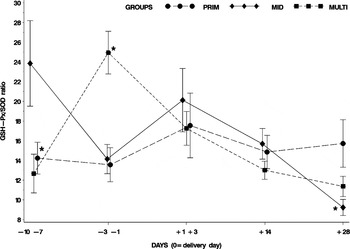
GSH-Px/SOD activity ratio prepartally increased in MULTI group, only to decline immediately after the delivery (1–3 d). In PRIM group the ratio stayed balanced throughout all of the research period, declining slightly immediately after the delivery. At this point we also saw the most prominent rise of the ratio for MID group. It declined towards the end of the research period (28th day postpartally) in MID and MULTI group, while it stayed relatively close to the ratio values from the beginning (10–7 d prepartally) in PRIM group.
Discussion
This study indicated that the multipartal goats are exposed to elevated metabolic burden and consequently oxidative stress during the peripartum period. Observed changes in NEFA concentrations, GSH-Px and SOD activities and correlations found between NEFA and MDA concentrations indicate that changes in metabolic status may be associated with different levels of oxidative stress.
Changes in NEFA concentrations reflect the fat mobilisation rate from storage (LeBlanc, Reference LeBlanc2010). To our knowledge, there are no published data of cut-off levels or reference range for NEFA in dairy goats; Kaneko et al. (Reference Kaneko, Harvey and Bruss2008) mentions a (very wide) range for cows (0·378–3·78 mmol/l), but none for sheep and goats. The research on precalving cows (Drackley, Reference Drackley1999; Quiroz-Rocha et al. Reference Quiroz-Rocha, Leblanc, Duffield, Wood, Leslie and Jacobs2009; LeBlanc, Reference LeBlanc2010) found the range to be between 0·4–1·0 mmol/l. Prepartal NEFA for goats which presented no clinical problems in this research ranged from 0·27–0·94 mmol/l, and between 0·29–0·80 mmol/l postpartally. Elevated NEFA around delivery in this study are consistent with results obtained in cows (Seifi et al. Reference Seifi, Gorji-Dooz, Mohri, Dalirnaghadeh and Farzaneh2007), ewes (Taghipour et al. Reference Taghipour, Seifi, Mohri, Farzaneh and Naserian2011) and goats (Magistrelli & Rosi, Reference Magistrelli and Rosi2014). Given the fact that NEFA values in MULTI group reached 0·94 ± 0·1 mmol/l prepartally, we can assume that the goats in this group experienced moderate lipomobilisation without showing clinical signs of disease during the first 28 d after kidding. NEFA values in MULTI group decreased to 0·3 ± 0·03 mmol/l quickly after kidding (2 weeks postpartally) which probably reflects the utilisation of NEFA by the mammary gland for milk fat synthesis (Bell, Reference Bell1995).
BHB concentration reflects the completeness of oxidisation of fat in the liver; as the supply of NEFA to liver exceeds its ability to completely oxidise the fatty acids to supply energy, ketone production rises (LeBlanc, Reference LeBlanc2010). This relationship is shown through significant positive correlation (r = 0·45; P < 0·05) between NEFA and BHB we found 3–1 d prepartally. Both Ramin et al. (Reference Ramin, Siamak and Macali2007) and Duehlmeier et al. (Reference Duehlmeier, Fluegge, Schwert, Parvizi and Ganter2011) consider BHB values below 1·0 mmol/l to be physiological in the transition period for ewes, while LeBlanc (Reference LeBlanc2010) consider BHB serum values around 1·2 mmol/l to be associated with an 8-times risk of left displaced abomasums in postparturient cows. Even though BHB concentrations reached 0·77 ± 0·13 mmol/l in MULTI goats and 0·76 ± 0·06 mmol/l in MID goats during peripartum, none of the goats from these groups showed clinical signs of disease. Since ketone bodies in circulation are taken up by the mammary gland and incorporated into milk fat, the postpartal decrease found in MID and MULTI goats isn't unexpected, even though not significant in MULTI group.
In this research serum glucose concentrations were higher in early lactation compared to late pregnancy in PRIM and MID goats which is in agreement with Sadjadian et al. (Reference Sadjadian, Seifi, Mohri, Naserian and Farzaneh2012) for Saanen goats. Conversely, glucose concentration in MULTI goats significantly decreased 14 d after parturition, as found by Seifi et al. (Reference Seifi, Gorji-Dooz, Mohri, Dalirnaghadeh and Farzaneh2007) for cows. The decrease found in MULTI goats is probably the consequence of high energy demands for lactation and production of milk lactose in multiparous high-yielding goats (Ingvartsen & Andersen, Reference Ingvartsen and Andersen2000).
The decline of triglycerides concentration started prepartally in all of the groups, but then decreased significantly only after the parturition. The decrease observed postpartally could be explained as the effect of enhanced mammary gland uptake for the milk fat formation during lactation (Piccione et al. Reference Piccione, Caola, Giannetto, Grasso, Calanni Runzo, Zumbo and Pennisi2009; Sadjadian et al. Reference Sadjadian, Seifi, Mohri, Naserian and Farzaneh2012). Urea's is an important source of protein synthesis in ruminants. The udder uses large amounts of protein for milk production during lactation (Quiroz-Rocha et al. Reference Quiroz-Rocha, Leblanc, Duffield, Wood, Leslie and Jacobs2009), which could explain increased albumin levels 14 d postpartally in PRIM and MID groups as well as elevated urea levels in all groups 28 d postpartally. The decreased levels of albumin in metabolically challenged MULTI group could signify the reduction in liver function which is usually observed in the early postpartum period (Celi, Reference Celi, Mandelker and Vajdovich2011b).
Since there is no consensus on methods to precisely measure oxidative stress (Dotan et al. Reference Dotan, Lichtenberg and Pinchuk2004), the variations of methods found in the literature make it difficult to make a meaningful comparison. Given the lack of reference values for both oxidants and anti-oxidants, the level of oxidative stress in different physiological stages of ruminants’ life is difficult to identify (Celi, Reference Celi, Mandelker and Vajdovich2011b).
The increase in the oxidative metabolism (oxidation of NEFA in the liver) implies peroxidation of fatty acids that leads to the formation of lipid peroxides (Halliwell & Gutteridge, Reference Halliwell and Gutteridge2007). Significantly higher serum levels of MDA observed in MULTI goats during the whole research suggest those goats produced higher levels of free radicals which caused lipid peroxidation, contrary to findings of Castillo et al. (Reference Castillo, Hernandez, Bravo, Lopez-Alonso, Pereira and Benedito2005) who found no significant differences in MDA concentrations for multiparous Holstein cows within peripartum period. The lack of statistical significance in that research is probably due to high variability caused by a small sample (n = 10); the rise in MDA 7d prepartally and postpartally is quite evident (Castillo et al. Reference Castillo, Hernandez, Bravo, Lopez-Alonso, Pereira and Benedito2005).
Our study showed that lipid peroxidation can be related to the intensity of metabolic changes as seen from significant differences between groups and supported by significant positive correlation found between MDA and NEFA concentrations 10 and 3 d prepartally (r = 0·51 and r = 0·73; P < 0·05, respectively) (Table 5). It also showed that lipid peroxides formation (MDA) increased prepartally in older animals (MID, MULTI) to continue its increase in the postpartum period, contrary to findings within PRIM group, where MDA concentration remained relatively constant after significantly decreasing 3 d prepartally.
Correlation between NEFA (non-esterified fatty acids), BHB (β-hydroxybutyrate) and MDA (malondialdehyde) parameters in peripartum period; significance set at P < 0·05

n.s., not significant.
In order to better understand antioxidative protection, the ratio between GSH-Px and SOD was considered (Amicarelli et al. Reference Amicarelli, Ragnelli, Aimola, Bonfigli, Colafarina, Di Ilio and Miranda1999) and it is shown in Fig. 1. Its increase might indicate an activation of the antioxidant enzyme defence against reactive oxygen species (ROS), while a decrease may be indicative of a lower scavenging efficiency, when an oxidative damage may occur (Amicarelli et al. Reference Amicarelli, Ragnelli, Aimola, Bonfigli, Colafarina, Di Ilio and Miranda1999). In both PRIM and MID groups GSH-Px/SOD ratio decreased 1–3 d prepartally and peaked 1–3 d postpartally. Such change suggests an adaptive response of antioxidative system in PRIM and MID goats to oxidative stress provoked by parturition and start of lactation. Contrary to those groups, antioxidant ratio in MULTI group peaked 1–3 d prepartally parallel with MDA concentrations, which suggests that the antioxidant system efficiently coped with lipoperoxides production during this critical period, thus protecting against oxidative stress. The ratio then decreased immediately after kidding, and continued to decline until the end of the research. The observed decrease in antioxidant enzymes’ activity as lactation progressed probably happened due to the depletion of antioxidants by milk (Castillo et al. Reference Castillo, Hernandez, Valverde, Pereira, Sotillo, Löpez Alonso and Benedito2006). The observed postpartal (2–4 weeks) decrease in GSH-Px activity in all groups is in accordance with results obtained by Celi et al. (Reference Celi, Di Trana and Quaranta2008, Reference Celi, Di Trana and Claps2010) in goats. This decrease might suggest that another antioxidant enzyme, i.e. catalase assumed the decomposition of a major oxidant – hydrogen peroxide, but this conclusion is beyond the scope of this study.
GSH-Px /SOD activity ratio (means ± se) within and between PRIM (primiparous), MID (2nd and 3rd time kidding goats) and MULTI (multiparous) goats during the peripartum period. Values marked with asterisk are significantly (P < 0·05) different with other two groups.

Even though all of the metabolic parameters mostly stayed within reference limits (when available) we clearly noticed that most intensive metabolic adaptations were pronounced in MULTI goats, seen by significant changes in NEFA concentration, and their correlation with MDA and BHB. If we consider antioxidant depletion to be the consequence, and not the cause of oxidative stress we can conclude that MULTI goats experienced a higher level of oxidative stress than goats in other groups in the first month after kidding. Since the goats recruited in this study had no health issues, the observed changes in oxidative status can be ascribed to physiological responses triggered by metabolic changes occurring during the peripartum period. Discrepancies between suggested cut-off NEFA and BHB levels in literature and values found for healthy goats in this study assume the need for further research of their applicability in metabolic periparturient profiling for milk goats.
This research was partially funded from grants by the Ministry of Science, Education and Sports, Croatia (Nos: 053-0531854-1866 and 053-1780469-2110). The authors also wish to extend their gratitude to Dr Pietro Celi for his advice during the writing of this paper.
Conflict of interest statement
None of the authors of this paper has a financial or personal relationship with other people or organisations that could inappropriately influence or bias the content of the paper.