Introduction
The question of how people can maintain their health as they age is an important question in our aging society. As older age is associated with an increase in morbidity, both acute and chronic pains are frequent stressors for older adults. Epidemiologic studies show that between 45% and 80% community-dwelling individuals suffer from persistent pain (Maxwell et al., Reference Maxwell2008), which is predominantly caused by chronic conditions (Helme and Gibson, Reference Helme and Gibson2001; Yonan and Wegener, Reference Yonan and Wegener2003; Weiner, Reference Weiner, Colvin and Fallon2012). On the other hand, it is well established that psychological factors play a crucial role in dealing with this type of stressor (e.g. Turner et al., Reference Turner, Holtzman and Mancl2007) and largely affect pain perception (e.g. Gibson and Helme, Reference Gibson and Helme2000; Keefe et al., Reference Keefe, Rumble, Scipio, Giordano and Perri2004). In this study, the phenomenon of pain in older individuals is investigated within the Antonovsky (Reference Antonovsky1987) salutogenic framework, which has often been applied in the context of successful aging (Wiesmann and Hannich, Reference Wiesmann and Hannich2008; Reference Wiesmann and Hannich2010; Reference Wiesmann and Hannich2011a; Reference Wiesmann and Hannich2013a; Reference Wiesmann and Hannich2013b; Wiesmann et al., Reference Wiesmann, Niehörster and Hannich2009). This salutogenetic perspective is relevant in the study of aging individuals because it pays special attention to how people use their life-strengths to maintain their health. In this context, Fry and Debats (Reference Fry, Debats, Fry and Keyes2010) summarize in their review article: “Relatively little is known about the sources of life-strengths and the related psychosocial resources that nurture the capacity of human resilience, and that lead some older adults to continue to strive, thrive, and flourish in the face of numerous challenges (. . .)” (p. 16). One major challenge in later life is to deal with chronic illness and its associated internal stressors such as pain.
The salutogenic model focuses on people's resources and potentials to generate and maintain positive health and to effectively cope with negative consequences of stressors. Within this framework, the individual is considered to be a complex self-regulative system that, to a certain extent, can stimulate integration, and thus health in the bio-psycho-social dimensions of the system. However, the salutogenic credo is that self-regulative efforts are limited, and this becomes especially apparent for the older individual: “Aging is understood as the individual time dimension on which negative and unavoidable changes take place. With advancing age the individual is losing his or her capability to produce bio-psycho-social integrity, and this increasing insufficiency will finally result in the individual's death” (Wiesmann and Hannich, Reference Wiesmann and Hannich2008, p. 57). Two concepts within the salutogenic framework explain how adaptation to adversity might be possible: generalized resistance resources and the sense of coherence.
To stay healthy, it is important to have access to supportive resources. The term generalized resistance resources (GRRs) alludes to those salutary forces that are “effective in combating a wide variety of stressors” (Antonovsky, Reference Antonovsky1987, p. xii). They have the potential to create long-lasting life experiences that enhance a state of balance between stress underload and overload, and that allow for participation in social encounters (involvement and commitment). In contrast, the term generalized resistance deficits (GRDs) refers to stressors that cause conflicts and other forms of disintegrity. Both GRRs and GRDs shape the sense of coherence (SOC) – a global orientation, which represents an individual's self-creating, self-organizing, and self-preserving competence (Wiesmann et al., Reference Wiesmann, Rölker and Hannich2004).
The sense of coherence is a global orientation that expresses the extent to which one has a pervasive, enduring though dynamic feeling of confidence that (1) the stimuli deriving from one's internal and external environments in the course of living are structured, predictable, and explicable; (2) the resources are available to one to meet the demands posed by these stimuli; and (3) these demands are challenges, worthy of investment and engagement (Antonovsky, Reference Antonovsky1987, p. 19).
According to Antonovsky, sense of coherence is a way of seeing the world that facilitates successful coping with stressors. It offers manageability, comprehensibility, and meaningfulness. Applied on elderly persons, we can assume that persons holding a strong sense of coherence can draw upon a spectrum of resources that might outweigh the deficits that are accompanied by chronic conditions, such as pain. Contrary, elderly holding a weak sense of coherence will perceive their world as more chaotic and will have only limited resources, increasing the chance to succumb to illness-related pain.
Empirical findings consistently linked sense of coherence with different aspects of bio-psycho-social resources as well as with subjective health (Lindström and Eriksson, Reference Lindström and Eriksson2005; Eriksson and Lindström, Reference Eriksson and Lindström2006; Reference Eriksson and Lindström2007). Although clearly related, sense of coherence proved to be a unique (or non-redundant) concept in line with the Antonovsky (Reference Antonovsky1992) idea that sense of coherence is “not just another variable that contributes to an explanation on the same level as self-esteem, social supports, high social class, or cultural stability. I see such variables as generalized resistance resources” (p. 36). In this regard, Wiesmann and colleagues (e.g. Wiesmann and Hannich, Reference Wiesmann and Hannich2008; Reference Wiesmann and Hannich2010; Reference Wiesmann and Hannich2013a; Reference Wiesmann and Hannich2013b; Wiesmann et al., Reference Wiesmann, Niehörster and Hannich2009) confirmed the salutogenic hypothesis that this life orientation is a mediator of the resistance resource-subjective health relationship in older age.
Overall, the sense of coherence proved to be stronger associated with mental health than physical health (Eriksson and Lindström, Reference Eriksson and Lindström2006). With respect to pain as an aspect of subjective physical health, the empirical evidence is mixed. On the one hand, several cross-sectional studies involving elderly patients suffering from various chronic conditions (Callahan and Pincus, Reference Callahan and Pincus1995; Svebak et al., Reference Svebak, Sondenaa, Hausken, Soreide, Hammar and Berstad2000; Veenstra et al., Reference Veenstra, Moum and Roysamb2005; Hävermark and Langius-Eklöf, Reference Hävermark and Langius-Eklöf2006; Drageset et al., Reference Drageset, Nygaard, Eide, Bondevik, Nortvedt and Natvig2008; Cederlund et al., Reference Cederlund, Ramel, Rosberg and Dahlin2010; Nilsson and Kristenson, Reference Nilsson and Kristenson2010; Barthelsson et al., Reference Barthelsson, Nordstrom and Norberg2011; Schrier et al., Reference Schrier2012; Benz et al., Reference Benz, Angst, Lehmann and Aeschlimann2013) and population-based surveys (Savolainen et al., Reference Savolainen2005; Nilsson and Kristenson, Reference Nilsson and Kristenson2010) show that sense of coherence and pain are negatively associated, disclosing small to medium effect sizes. On the other hand, some researchers did not find significant associations in different patient groups (Chamberlain et al., Reference Chamberlain, Petrie and Azariah1992; Ekman et al., Reference Ekman, Fagerberg and Lundman2002; Malmgren Olsson and Braenholm, Reference Malmgren Olsson and Braenholm2002; Motzer et al., Reference Motzer, Hertig, Jarrett and Heitkemper2003; Lillefjell and Jakobsen, Reference Lillefjell and Jakobsen2007) or reveal inconsistent results (Cohen et al., Reference Cohen, Musgrave, Munsell, Mendoza and Gips2005; Dezutter et al., Reference Dezutter, Robertson, Luyckx and Hutsebaut2010). In this study, our intention is to further clarify this relationship in a sample of older adults. Moreover, we investigate the relative contribution of the sense of coherence and GRRs/GDRs in the prediction of pain. In this regard, we focus on Taylor and Stanton's (Reference Taylor and Stanton2007) four specific coping resources: dispositional optimism, self-efficacy, self-esteem, and social support. These four coping resources are supposed to enhance the stress management process and influence the pain experience (e.g. Gibson and Helme, Reference Gibson and Helme2000; Keefe et al., Reference Keefe, Rumble, Scipio, Giordano and Perri2004).
Dispositional optimism is defined as generalized outcome expectancies that good things rather than bad things will happen to the self, whereas pessimism is associated with negative expectations for one's future (Scheier and Carver, Reference Scheier and Carver1985; Reference Scheier and Carver1992). Several gerontological studies confirm the association between optimism and pain (Ferreira and Sherman, Reference Ferreira and Sherman2007; Wong and Fielding, Reference Wong and Fielding2007; Kurtz et al., Reference Kurtz, Kurtz, Given and Given2008; Wright et al., Reference Wright, Zautra and Going2008; Luger et al., Reference Luger, Cotter and Sherman2009; Rosenberger et al., Reference Rosenberger, Kerns, Jokl and Ickovics2009). The term generalized self-efficacy implies optimistic self-beliefs to cope with a variety of difficult demands in life (Bandura, Reference Bandura1997). There is evidence confirming its associations with pain (Barlow et al., Reference Barlow, Williams and Wright1996; Denison et al., Reference Denison, Åsenlöf and Lindberg2004). Self-esteem represents an individual's global appraisal of his or her own worth (DuBois and Flay, Reference DuBois and Flay2004). There is also evidence for the association between self-esteem and pain (Nagyova et al., Reference Nagyova, Stewart, Macejova, van Dijk and van den Heuvel2005; Cannella et al., Reference Cannella, Lobel, Glass, Lokshina and Graham2007; Bode et al., Reference Bode, van der Heij, Taal and van de Laar2010). The term social support includes the individual's perception that he or she is esteemed and cared for by others, and that others will provide helpful resources (Taylor, Reference Taylor, Friedman and Silver2007). Recent research supports the notion that social support and pain are related (Evers et al., Reference Evers, Kraaimaat, Geene, Jacobs and Bijlsma2003; Ferreira and Sherman, Reference Ferreira and Sherman2007; Luger et al., Reference Luger, Cotter and Sherman2009; Motl et al., Reference Motl, McAuley, Snook and Gliottoni2009; Chan et al., Reference Chan, Hadjistavropoulos, Carleton and Hadjistavropoulos2012).
The first aim of this study is to test the relative contribution of three classes of independent variables in the prediction of bodily pain. We, therefore, focus on chronic morbidity as an age-related GRD, on self-esteem, self-efficacy, optimism, and social support (Taylor and Stanton, Reference Taylor and Stanton2007) as four psychological GRRs, and on the sense of coherence. A second aim of this study is to test the mediating role of sense of coherence in the relationship between GRRs/GRDs and bodily pain. Based on earlier findings (see above) and framed within the theorizing of Antonovsky, we assume that (a) both psychological coping resources (GRRs) and age-related chronic morbidity (a GRD) are related with bodily pain through the sense of coherence, and that (b) morbidity has both a direct and indirect effect (via the sense of coherence) on bodily pain.
Methods
Participants
Our final sample consisted of 387 older adults. Participants were predominantly women (73.4%), with a mean age of 73.8 years (SD = 7.58, range: 57–96 years). Sex and age were independent of each other, r pbis = –0.04, p = 0.48, n = 387. With respect to marital status, the majority was married (51.2%) or widowed (35.4%). With respect to education, 27.7% had either a high school degree or a college degree of higher education, while 52.6% had a certificate of secondary education.
Procedure
Participants were recruited within a time span of ten weeks through sports clubs and social clubs for older people, and through residential home activity groups in a small town in northeast Germany. Data were collected by a survey that could be completed in writing. Four female students distributed 600 questionnaires entitled “Healthy Aging” (response rate: 64.5%). Our participants were invited to give personal information on health issues voluntarily and anonymously. All information was confidential to the researchers, and individually identifiable data were not available. Participants could withdraw at any time if they wished to. Older persons not eligible for this study were individuals with dementia or other geriatric cognitive disorders, and individuals who were critically or terminally ill (e.g. individuals undergoing in-patient treatment). Overall, our participants were called in groups, and volunteers were not paid.
Measures
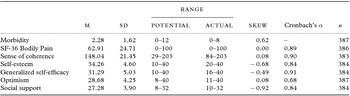
With respect to this paper, only pertinent measures are described. Table 1 contains the psychometric properties of the study variables that will be described in the following. Cronbach's α values ranged from 0.68 to 0.91, indicating sufficient to very good internal consistency.
Psychometric properties of the major study variables

Bodily pain
We used the Bodily Pain subscale of the SF-36 Health Survey (Bullinger, Reference Bullinger1995) that is based on two items, assessing pain intensity and pain interference, respectively: “How much bodily pain have you had during the last four weeks?” on a 6-point scale and “During the past four weeks, how much did pain interfere with your normal work (either at your job or at your house)?” on a 5-point scale. The conventional-transformed sum score was used as an index, a higher score representing a lower extent of pain (i.e. a high score represents “positive” health).
Morbidity
Participants were asked to indicate (1 = yes vs. 0 = no) if they suffered from 12 common chronic conditions (e.g. heart disease/stroke, rheumatism/arthritis/dysfunctions of the motor system, diabetes mellitus, urological diseases) that have been diagnosed by a physician. The sum score was used as an estimate of morbidity (Wiesmann et al., Reference Wiesmann, Niehörster and Hannich2009; Wiesmann and Hannich, Reference Wiesmann and Hannich2010; Reference Wiesmann and Hannich2011b).
Sense of coherence
The Antonovsky (Reference Antonovsky1987) Sense of Coherence Scale consists of 29 items that are evaluated on 7-point bipolar scales (e.g. “How often do you have feelings that there is little meaning in the things you do in your daily life? Very often versus very seldom or never”). The sum score was used as an index. A higher score represents a higher sense of coherence.
Self-esteem
We used the Rosenberg (Reference Rosenberg1965) Self-Esteem Scale. Subjects indicated their degree of agreement to ten items on a 4-point scale (e.g. “I feel that I am a person of worth, at least on an equal plane with others”). A higher sum score reflects higher self-esteem.
Optimism
The Life Orientation Test (Scheier and Carver, Reference Scheier and Carver1985) assesses generalized outcome expectancies and consists of eight items that are evaluated on a 5-point scale (e.g. “I am always optimistic about my future”). The higher the sum score, the higher the dispositional optimism.
Generalized self-efficacy
The Generalized Self-Efficacy Scale (Schwarzer and Jerusalem, Reference Schwarzer, Jerusalem, Weinman, Wright and Johnston1995) consists of ten items evaluated on a 4-point scale (e.g. “I can always manage to solve difficult problems if I try hard enough”). The higher the sum score, the higher the self-efficacy.
Social support
The Schwarzer (Reference Schwarzer1993) Expected Social Support Scale consists of eight items rated on a 4-point scale (e.g. “When I am in need, I can rely on other people around me”). A high score reflects a high extent of social support.
Data analyses
For our hypothesis testing, we selected an α-level of 0.05. Using SPSS 19 (Norusis, Reference Norusis2011), we computed Pearson correlations to test bivariate relationships between all study variables or point-biserial correlations to test bivariate relationships between type of chronic condition and pain. We performed multivariate analyses of variance to investigate group differences in study variables and sociodemographic variables with respect to gender and independent versus dependent living. We performed hierarchical regressions with z-transformed variables to test relationships between one criterion variable and multiple predictor variables. Multicollinearity was low as indicated by variance inflation factor and tolerance values, VIF < 2.01 and Tol > 0.49.
We used path analysis as an exploratory tool for examining the hypothesized indirect (mediation) effects of SOC in the relationship between the GRRs/GRDs and pain (AMOS 21; Arbuckle, Reference Arbuckle2012). As Shrout and Bolger (Reference Shrout and Bolger2002) and MacKinnon et al. (Reference MacKinnon, Lockwood and Williams2004) recommend, we applied a maximum likelihood technique and a bootstrapping procedure, using listwise deletion. The adequacy of the model was assessed by χ 2, a non-significant χ 2 statistic indicating a good fit. Additionally, CFI, RMSEA, and SRMR fit indexes were used: A CFI close to 0.95 or greater, a RMSEA close to 0.05 or less (at least lower than 0.10), and a SRMR close to 0.08 or less are regarded as desirable (Kline, Reference Kline2011). We estimated direct and indirect effects using k = 2.000 bootstrap samples of n = 377 cases with replacement from the original sample and calculated 95% bias-corrected percentile bootstrap confidence intervals (see also Cheung and Lau, Reference Cheung and Lau2008; Preacher and Hayes, Reference Preacher and Hayes2008). In all cases, we rejected the null hypothesis of no direct or indirect effect if a respective confidence interval did not include zero.
Results
Preliminary analyses
Compared with participants living independently, nursing home residents (22.2%) were older, more frequently female, more morbid, suffered from more pain, were less resourceful (except for social support), and less coherent. In an exploratory regression analysis, independent versus dependent living was not significant (β-weight was zero) in the prediction of pain when chronic morbidity was entered into the regression equation. Therefore, we do not take dependent living as a possible confounding variable in further analyses.
As Table 1 shows, answers on our study variables covered a rather broad range, and mean values revealed a largely positive appraisal of sense of coherence and psychological GRRs. Our participants indicated to suffer from two chronic conditions on average. The mean level of pain reported corresponded to the German reference value for persons at the age of 70+ years (Bullinger and Kirchberger, Reference Bullinger and Kirchberger1998), t(385) = –1.03, p = 0.30, mean difference = –1.29. About a fifth (20.7%) claimed to have no pain in the last two weeks, and about a third (31.1%) indicated that pain did not interfere in their daily work, whereas only 14.3% suffered from strong or very strong pain, and 5.4% experienced strong pain interference. Overall, no gender differences were found in our seven key measures, F(7, 369) = 1.14, Wilks’ λ= 0.98, p = 0.34.
The most frequent self-reported chronic conditions were rheumatism/arthritis/dysfunctions of the motor system (48.8%), heart disease/stroke (42.4%), vision disorders/ophthalmologic diseases (34.4%), sleep disorders (22.5%), urological diseases (18.1%), diabetes mellitus (15.2%), and respiratory diseases (15.2%). Other conditions were less frequently reported (digestive diseases (10.9%), dermatological diseases (7.8%), or cancer (7%)). Nearly 12% was free from morbidity specified in this list. Several chronic conditions were linked with pain experience. Point-biserial correlations revealed that especially rheumatism (r pbis = −0.40), heart disease (−0.23), vision disorders (−0.19), and respiratory diseases (−0.19) were pain-associated, p < 0.001.
Primary analyses
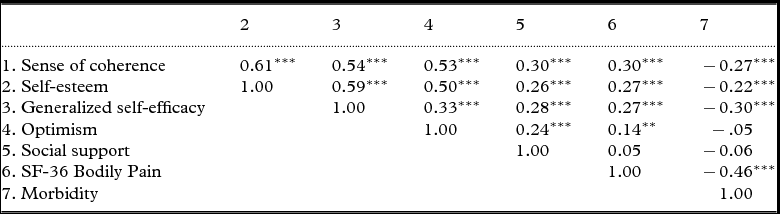
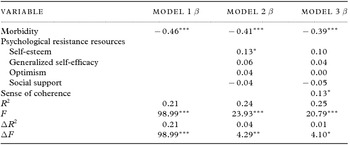
As shown in Table 2, virtually all psychological resistance resources as well as morbidity (as deficit) were significantly associated with both the sense of coherence and pain; most correlations were significant. Exceptions were the lack of any relationship between social support and pain as well as between morbidity and both social support and optimism. To determine the relative importance of morbidity, GRRs and sense of coherence in predicting pain, hierarchical multiple regression analyses were performed. In a first set of analyses, morbidity was entered in Step 1, GRRs in Step 2, and sense of coherence in Step 3 (see Table 3). Model 1 revealed that morbidity was a strong predictor for pain, F(1, 375) = 98.99, p < 0.0001, R = 0.46, R2 = 0.21. Entering GRRs (Model 2) accounted for additional variance, F(4, 370) = 4.30, p = 0.002. Adding the sense of coherence (Model 3) also accounted for additional variance, F(1, 370) = 4.10, p = 0.043. However, the significant effect of self-esteem in Model 2 became insignificant. Because we wanted to determine the relative contribution of our core variables in the prediction of pain, a second set of analyses was performed in which we entered sense of coherence in Step 2 and GRRs in Step 3. Entering GRRs in the last step did not account for additional variance, F(4, 370) = 1.21, p = 0.31.
Associations between study variables (n = 377)
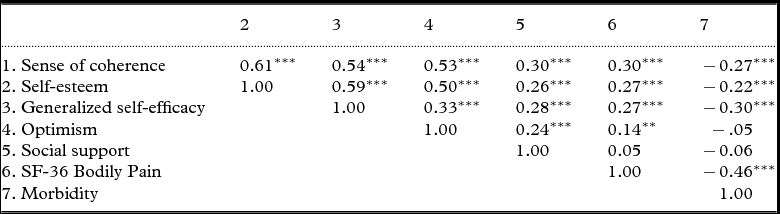
**p < 0.01. ***p < 0.001.
Summary of hierarchical regression analyses for morbidity, sense of coherence, and psychological resistance resources predicting SF-36 Bodily Pain

*p < 0.05. **p < 0.01. ***p < 0.001.
Note. n = 377. The higher the SF-36 Bodily Pain score, the more healthy (i.e. the less the extent of pain).
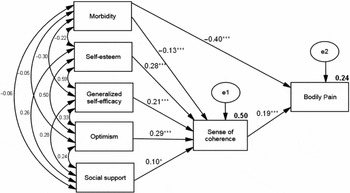
In order to clarify the mediating role of the sense of coherence in the relationship between GRR/morbidity and pain, we formulated an exploratory salutogenic mediation model. Our model consisted of five exogenous variables (morbidity, self-esteem, self-efficacy, optimism, and social support), the sense of coherence as mediator and pain experience as criterion variable. According to our regression results, morbidity and sense of coherence were the only variables to be allowed to have a direct effect on pain. In Figure 1, the standardized parameter estimates are presented, which were all significant. The model fitted our data well, χ2(4, n = 377) = 4.89, p = 0.298, RMSEA = 0.02 (90% CI (0.00, 0.09)), SRMR = 0.02, and CFI = 0.999.
Salutogenic mediation model: influence of morbidity, psychological resistance resources, and sense of coherence on pain. The SF-36 Bodily Pain measure assesses “positive” health (i.e. the higher the value, the less pain). The values above the right upper corner of the rectangles represent squared multiple correlations. Estimated standardized path coefficients are provided.
*p < 0.05. ***p < 0.001.

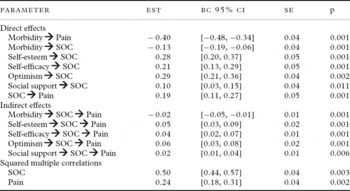
In Table 4, the bootstrapped standardized parameter estimates for our model are shown along with bias-corrected (BC) 95% confidence intervals (CIs) and standard errors, and significance tests for the BC 95% CI. All direct and indirect effects were significant. Looking at the bootstrapped 95% BC CI of direct effects, the CIs did not include zero.
Bootstrapped standardized maximum likelihood estimates for morbidity, psychological resources, and sense of coherence predicting pain experience

Note. n = 377. Est = Estimate; BC = bias-corrected; CI = confidence interval; SOC = sense of coherence. We generated 2.000 bootstrapped samples. The higher the SF-36 Bodily Pain score, the more healthy (i.e. the less the extent of pain).
Discussion
The purpose of this salutogenic inquiry was to examine the relative contribution of resistance deficit (i.e. morbidity), resistance resources (i.e. self-esteem, optimism, self-efficacy, and social support), and sense of coherence in the prediction of pain in a sample of older persons. Our participants represented an age-heterogeneous sample, who suffered from typical health problems that are common in older age, especially rheumatism (including arthritis and other dysfunctions of the motor system), heart disease/stroke, and vision disorders being the most frequent disease categories. As our respondents were multimorbid in that they suffered from two chronic conditions on average, we have the case of a collection of individuals in need of geriatric care. In view of that broad morbidity spectrum, we found that pain is an experience that four out of five older individuals share. The extent of pain was dependent on the type of chronic condition, rheumatism being particularly pain-staking.
Furthermore, we found women to be clearly over-represented, which is a common phenomenon in health surveys. As Lee and Owens (Reference Lee and Owens2002) concede, male stereotypes seem to deter men to engage in health-related subjects, which seem to be especially true for older generations of men. As we did not find gender differences, we did not analyze our data for men and women separately.
On a bivariate level, we found that the number of chronic conditions, psychological resources, and sense of coherence were associated with pain. Among these variables, the GRD morbidity showed the strongest association, suggesting that disease processes are an important determinant of pain. In line with other researchers, we could show that sense of coherence (Chamberlain et al., Reference Chamberlain, Petrie and Azariah1992; Callahan and Pincus, Reference Callahan and Pincus1995; Svebak et al., Reference Svebak, Sondenaa, Hausken, Soreide, Hammar and Berstad2000; Cohen et al., Reference Cohen, Musgrave, Munsell, Mendoza and Gips2005; Veenstra et al., Reference Veenstra, Moum and Roysamb2005; Hävermark and Langius-Eklöf, Reference Hävermark and Langius-Eklöf2006; Dezutter et al., Reference Dezutter, Robertson, Luyckx and Hutsebaut2010; Goulia et al., Reference Goulia, Voulgari, Tsifetaki, Drosos and Hyphantis2010), self-esteem (Nagyova et al., Reference Nagyova, Stewart, Macejova, van Dijk and van den Heuvel2005; Cannella et al., Reference Cannella, Lobel, Glass, Lokshina and Graham2007; Bode et al., Reference Bode, van der Heij, Taal and van de Laar2010), generalized self-efficacy (Barlow et al., Reference Barlow, Williams and Wright1996; Denison et al., Reference Denison, Åsenlöf and Lindberg2004), and optimism (Ferreira and Sherman, Reference Ferreira and Sherman2007; Wong and Fielding, Reference Wong and Fielding2007; Kurtz et al., Reference Kurtz, Kurtz, Given and Given2008; Wright et al., Reference Wright, Zautra and Going2008; Luger et al., Reference Luger, Cotter and Sherman2009; Rosenberger et al., Reference Rosenberger, Kerns, Jokl and Ickovics2009) were also significantly associated. However, in contrast to findings of other researchers (Evers et al., Reference Evers, Kraaimaat, Geene, Jacobs and Bijlsma2003; Ferreira and Sherman, Reference Ferreira and Sherman2007; Luger et al., Reference Luger, Cotter and Sherman2009; Motl et al., Reference Motl, McAuley, Snook and Gliottoni2009; Chan et al., Reference Chan, Hadjistavropoulos, Carleton and Hadjistavropoulos2012), social support turned out to be unrelated with pain, at least on a bivariate level.
Testing the relative contribution of resources/deficits and the sense of coherence in our regression model, we found that morbidity and sense of coherence were the only independent variables to predict pain. Morbidity turned out to be the strongest predictor, accounting for 21% of the variance in the first step. This is not surprising, because pain is predominantly caused by chronic conditions (Helme and Gibson, Reference Helme and Gibson2001; Yonan and Wegener, Reference Yonan and Wegener2003; Weiner, Reference Weiner, Colvin and Fallon2012). However, the experience of pain is not fully determined by chronic physical illness. We found that psychological resistance resources in the second step and the sense of coherence in the third step accounted for additional variance. In the final model, the previously significant self-esteem effect (Model 2) became insignificant. The sense of coherence seems to be a measure representing an individual's capacity to cope with illness-associated pain. Thus, this is the first study to show that the sense of coherence has a stronger impact on pain experience than psychological resistance resources. Moreover, this pattern of results suggests that the sense of coherence has a mediating function, which we scrutinized in our exploratory path analytical mediation model.
Our model fitted our data well. For the first time, we could show that the sense of coherence mediated influences of psychological GRRs and morbidity (as a GRD) on pain experience. The five indirect effects were significant; all confidence intervals did not include zero. More specifically, our data showed that the sense of coherence proved to be only a partial mediator of the relationship between morbidity and pain. As expected, the direct effect of morbidity on pain proved to be the strongest. What is more interesting is the finding that illness experiences, as indicated by our morbidity measure, also impair an individual's sense of coherence to some extent and influence pain experience indirectly. At the same time, psychological GRRs facilitate life experiences that strengthen the sense of coherence, which in turn is helpful for coping with pain by modifying pain perception.
Limitations of this study
First, our findings are limited by the cross-sectional nature of our data. Therefore, we do not conclude that the causal paths specified in our mediation model correspond to “real” causal relations. We strongly recommend a longitudinal design in order to study the causal directionality of resources, sense of coherence, and pain. Evidently, the experience of chronic pain is a condition that might weaken the sense of coherence.
Furthermore, our sample is a fairly healthy convenience sample of older individuals who were female by the majority. Thus, we apply our interpretations to rather “successfully” aging individuals. We also strongly recommend drawing a more representative sample of older individuals in future research.
Finally, our self-report measures of morbidity should be more detailed, assessing diagnoses within a category in a more detailed way. The same holds true for pain assessment. The SF-36 Bodily Pain measure should be complemented by a standardized pain inventory and also a disability measure. Ideally, physicians’ ratings should be obtained in order to compare subjective and objective illness appraisals. Research from the Berlin Aging Study showed that older individuals underestimate their number of chronic conditions (Steinhagen-Thiessen and Borchelt, Reference Steinhagen-Thiessen, Borchelt, Baltes and Mayer1999).
Conclusions
In this salutogenic study, we highlighted the importance of the sense of coherence, “a generalized orientation toward the world which perceives it, on a continuum, as comprehensible, manageable and meaningful” (Antonovsky, Reference Antonovsky1996, p. 15), for alleviating pain in older individuals. An exploratory mediational model involving five exogenous variables (morbidity, self-esteem, self-efficacy, optimism, and social support), sense of coherence as mediator and pain experience as criterion variable, showed that the sense of coherence mediated influences of all five exogenous variables on pain experience. Bearing the limitations of this study in mind, these findings have several implications.
Different chronic conditions were associated with the experience of pain. Therefore, the maintenance of good physical health and the prevention of chronic diseases and disability are main objectives. We therefore recommend regular medical check-ups in terms of geriatric assessments. In case of chronic disease, older individuals should be enabled to take part in pain management programs that strengthen psychological resources and the sense of coherence.
We found that a strong sense of coherence and its pooling of psychological resources help to alleviate pain experiences associated with chronic morbidity. Consequently, it is important not only to improve the somatic conditions of older people but also to consider the way they interpret, evaluate, and deal with illness and associated pain. Professionals should be trained in bolstering an older individual's sense of coherence in order to facilitate “successful coping with the inherent stressors of human life” (Antonovsky, Reference Antonovsky1996, p. 15), such as chronic morbidity and pain.
Future salutogenic research should also investigate other psychological resources (such as psychological control, goal pursuit, or spirituality) as well as sociocultural assets (such as education/knowledge, income/money, tenure, or political and social stability) (see Fry and Debats, Reference Fry, Debats, Fry and Keyes2010; Wiesmann and Hannich, Reference Wiesmann and Hannich2013b). Furthermore, we would recommend to make amends on theoretical grounds by studying the salutogenic model in the context of other resource approaches such as the Hobfoll (Reference Hobfoll1989) conservation of resources theory or Baltes and Baltes’ (Reference Baltes, Baltes, Baltes and Baltes1990) model of selective optimization with compensation (Wiesmann and Hannich, Reference Wiesmann and Hannich2013b).
Conflict of interest
None.
Description of authors’ roles
U. Wiesmann designed the study and wrote the paper. He supervised the data collection and was responsible for the statistical design of the study and for carrying out the statistical analyses. J. Dezutter wrote the paper with special emphasis on the introduction and discussion section. H.-J. Hannich supervised the study.