Introduction
Although a wide range of cognitive deficits has been demonstrated in unipolar depression (Austin et al. Reference Austin, Mitchell and Goodwin2001; Airaksinen et al. Reference Airaksinen, Larsson, Lundberg and Forsell2004), research has thus far provided very little information regarding the effect of psychiatric co-morbidity on depression-related cognitive dysfunction. This is despite the fact that depression is highly co-morbid with other mental disorders (Aalto-Setälä et al. Reference Aalto-Setälä, Marttunen, Tuulio-Henriksson, Poikolainen and Lönnqvist2001), that the risk factor profiles differ considerably between pure and co-morbid depressive disorders (de Graaf et al. Reference de Graaf, Bijl, Smit, Vollebergh and Spijker2002), and that psychiatric co-morbidity is related to increased risk for recurrence of depression (for a review, see Burcusa & Iacono, Reference Burcusa and Iacono2007). Some studies have found evidence of pronounced cognitive dysfunction in depression with versus without co-morbid anxiety (Kizilbash et al. Reference Kizilbash, Vanderploeg and Curtiss2002; DeLuca et al. Reference DeLuca, Lenze, Mulsant, Butters, Karp, Dew, Pollock, Shear, Houck and Reynolds2005; Basso et al. Reference Basso, Lowery, Ghormley, Combs, Purdie, Neel, Davis and Bornstein2007), but other psychiatric co-morbidity has undergone little investigation. Additionally, psychiatric co-morbidity is often inadequately controlled for in studies of depression-related cognitive impairments, and may accordingly serve as a confounding variable and explain some of the contradictory results (for a review, see Castaneda et al. Reference Castaneda, Tuulio-Henriksson, Marttunen, Suvisaari and Lönnqvist2008a).
Although the incidence and prevalence rates of depression are high in early adulthood (Newman et al. Reference Newman, Moffitt, Caspi, Magdol, Silva and Stanton1996; Kessler et al. Reference Kessler, Berglund, Demler, Jin, Merikangas and Walters2005), and depression is substantially undertreated among young adults (Aalto-Setälä et al. Reference Aalto-Setälä, Marttunen, Tuulio-Henriksson, Poikolainen and Lönnqvist2002; Haarasilta et al. Reference Haarasilta, Marttunen, Kaprio and Aro2003; Wang et al. Reference Wang, Aguilar-Gaxiola, Alonso, Angermeyer, Borges, Bromet, Bruffaerts, de Girolamo, de Graaf, Gureje, Haro, Karam, Kessler, Kovess, Lane, Lee, Levinson, Ono, Petukhova, Posada-Villa, Seedat and Wells2007), only a few studies (e.g. Smith et al. Reference Smith, Muir and Blackwood2006) have investigated depression-related cognitive dysfunction with an age range strictly defined as young adults (e.g. 18–35 years). Furthermore, it has been hypothesized that early onset is a sign of a more serious form of depression because it may leave more psychosocial scars (Rohde et al. Reference Rohde, Lewinsohn and Seeley1994) and cause substantial human capital loss (Berndt et al. Reference Berndt, Koran, Finkelstein, Gelenberg, Kornstein, Miller, Thase, Trapp and Keller2000), and it is associated with a lifetime pattern of greater depression chronicity and disability (Parker et al. Reference Parker, Roy, Hadzi-Pavlovic, Mitchell and Wilhelm2003), a greater number of co-morbid mental disorders (Rohde et al. Reference Rohde, Lewinsoh and Seeley1991; Klein et al. Reference Klein, Schatzberg, McCullough, Dowling, Goodman, Howland, Markowitz, Smith, Thase, Rush, LaVange, Harrison and Keller1999), a higher risk of recurrence (Klein et al. Reference Klein, Schatzberg, McCullough, Dowling, Goodman, Howland, Markowitz, Smith, Thase, Rush, LaVange, Harrison and Keller1999), and a shorter time to relapse and more residual symptoms (Gollan et al. Reference Gollan, Raffety, Gortner and Dobson2005) when compared to late-onset depression.
Our recent study (Castaneda et al. Reference Castaneda, Suvisaari, Marttunen, Perälä, Saarni, Aalto-Setälä, Aro, Koskinen, Lönnqvist and Tuulio-Henriksson2008b) reported only minor evidence of cognitive impairments among a population-based sample of young adults with a history of non-co-morbid non-psychotic unipolar depression when compared to a healthy control group derived from the same population. Building on the previous study, we set out to compare verbal and visual short-term memory, verbal long-term memory and learning, attention, processing speed, and executive functioning among depressed young adults with versus without lifetime psychiatric co-morbidity, and a random sample of healthy peers. The study further investigated whether co-morbidity and also other disorder characteristics, such as age at onset, psychotropic medication and received treatment, are related to cognitive dysfunction among depressed participants.
Method
Participants
The study samples were drawn from the Mental Health in Early Adulthood in Finland (MEAF) study (Suvisaari et al. Reference Suvisaari, Aalto-Setälä, Tuulio-Henriksson, Härkänen, Saarni, Perälä, Schreck, Castaneda, Hintikka, Kestilä, Lähteenmäki, Latvala, Koskinen, Marttunen, Aro and Lönnqvist2009). The MEAF study is a follow-up study of the young adults included in the Health 2000 Study (Aromaa & Koskinen, Reference Aromaa and Koskinen2004), a health survey based on a nationally representative two-stage cluster sample, in which the young adult cohort included 1894 Finnish inhabitants aged 18–29 years (Koskinen et al. Reference Koskinen, Kestilä, Martelin and Aromaa2005). In the MEAF study, a pre-examination questionnaire gathering information on demographic factors and health status, including several screening scales for mental disorders, was sent to all members of the original sample who had not refused further contact during the baseline phase (n=1863) 2–4 years after the baseline survey, with 1316 (70.6%) respondents. Participants were invited for a more detailed psychiatric examination if they were screen positives (i.e. reported psychiatric symptoms in the pre-examination questionnaire or had had previous hospital treatment due to any psychiatric disorder according to the Finnish Hospital Discharge Register). In addition, a random sample (n=500) was drawn from the original young adult cohort of the Health 2000 Study, and all the questionnaire respondents were invited for the examination. A total of 982 individuals were invited, with a participation rate of 55.6% (n=546). The MEAF study has been approved by the Ethics Committee (Institutional Review Board) of the Hospital District of Helsinki and Uusimaa. Written informed consent was obtained from all participants after a complete description of the study. A more detailed description of the population and the methods has been provided elsewhere (Aromaa & Koskinen, Reference Aromaa and Koskinen2004; Koskinen et al. Reference Koskinen, Kestilä, Martelin and Aromaa2005; Suvisaari et al. Reference Suvisaari, Aalto-Setälä, Tuulio-Henriksson, Härkänen, Saarni, Perälä, Schreck, Castaneda, Hintikka, Kestilä, Lähteenmäki, Latvala, Koskinen, Marttunen, Aro and Lönnqvist2009).
The depressive disorder (DD) group of the present study comprised 149 examined participants fulfilling the DSM-IV (APA, 1994) criteria for lifetime unipolar depressive disorders. Twenty-three depressed participants were excluded due to other native language than Finnish (n=12), neurological disorders (n=7), distraction in the neuropsychological testing situation (n=2), dyslexia (n=1), or suspected current intoxication considered to affect neuropsychological testing (n=1). Hence, the final DD group comprised 126 participants, and was further divided into subgroups of pure depressive disorder (PDD) and co-morbid depressive disorder (CDD).
In the PDD group (n=69) 47 participants had major depressive disorder (MDD; single episode n=33, recurrent n=14; mild n=10, moderate n=30, severe n=7; with psychotic features n=1), of whom two had concurrent dysthymia, and 11 had depressive disorder not otherwise specified (NOS), and another 11 adjustment disorder with depressed mood or with anxiety and depressed mood. According to the definition, no one met the criteria for other lifetime DSM-IV Axis I or II psychiatric disorders. At the time of examination nine PDD participants were in the acute depressive phase and 60 were in remission. Age at depression onset averaged 23.9 years (s.d.=4.7, range=12–32; data missing for two participants). One PDD participant had ever received in-patient treatment, 44 had received out-patient treatment, and 24 had no treatment contacts. Six PDD participants were using psychotropic medication at the time of examination.
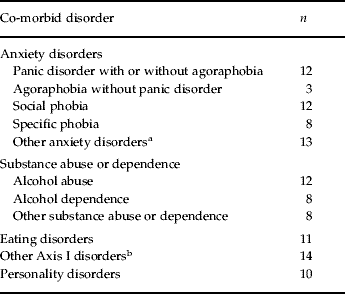
In the CDD group (n=57) 42 participants met the DSM-IV criteria for MDD (single episode n=28, recurrent n=14; mild n=9, moderate n=24, severe n=9; with psychotic features n=0), 13 for depressive disorder NOS, one for dysthymia, and one for adjustment disorder with depressed mood. In addition, the CDD participants met the DSM-IV criteria for other current or lifetime Axis I psychiatric disorders, as summarized in Table 1 and Table A1 (see online Appendix). The number of diagnoses averaged 3.0 (s.d.=1.2, range=2–7), and 39 of the CDD participants had depression as a primary diagnosis. Twenty-six CDD participants had depressive disorder and only one additional Axis I diagnosis, whereas 31 had depressive disorder and two or more additional Axis I or II diagnoses. At the time of examination one CDD participant had depression in the acute phase but other disorders in remission, 25 had other disorders but not depression in the acute phase, four had depression and other disorders in the acute phase, and 27 had all disorders in remission. Age at onset of the first disorder averaged 19.9 years (s.d.=6.7, range=3–33). Six CDD participants had ever engaged in in-patient treatments, 48 had received out-patient treatment, and three had no treatment contacts. Thirteen CDD participants were using psychotropic medication at the time of examination.
Number of co-morbid disorders in the co-morbid depressive disorders (CDD) group

a Obsessive–compulsive disorder, post-traumatic stress disorder, anxiety disorder not otherwise specified (NOS), and adjustment disorder with anxiety.
b Schizophrenia, delusional disorder, psychotic disorder NOS, substance-induced psychotic disorder, somatoform disorder, sleep disorder, impulse–control disorder, and disorder in infancy/childhood/adolescence.
The control (CTRL) group (n=77) comprised the screen-negative (i.e. reporting no psychiatric symptoms in the pre-examination questionnaire) participants of the random sample who attended the detailed psychiatric examination and fulfilled no lifetime DSM-IV Axis I diagnosis based on the Structured Clinical Interview for DSM-IV-TR (SCID-I; First et al. Reference First, Spitzer, Gibbon and Williams2001). Six CTRL participants were excluded due to neurological disorders (n=1), dyslexia (n=1), other native language than Finnish (n=1), distraction in the neuropsychological testing situation (n=1), or academic studies in psychology considered to affect neuropsychological testing (n=2). Hence, the final CTRL group comprised 71 healthy control participants. None of the CTRL participants had ever received psychopharmacological treatments.
Clinical evaluation
The detailed psychiatric examination was conducted individually by one examiner: a psychologist, a psychologist trainee or a well-trained psychiatric nurse, blind to the presence of diagnosis prior to examination. The examination took place in one session of 2 h on average, beginning with the neuropsychological test battery, and followed by the SCID-I. All sections, except somatoform disorders, of the research version of the SCID-I were used to assess current and lifetime DSM-IV-TR psychiatric disorders. Information regarding sociodemographic background and mental health treatments was also obtained. The Global Assessment of Functioning (GAF) score was used as a measure of current psychosocial functioning. Current symptom severity was measured with the K-10, a screening method for general psychological distress (Kessler et al. Reference Kessler, Andrews, Colpe, Hiripi, Mroczek, Normand, Walters and Zaslavsky2002, Reference Kessler, Barker, Colpe, Epstein, Gfroerer, Hiripi, Howes, Normand, Manderscheid, Walters and Zaslavsky2003), with the delay between the K-10 assessment and the psychiatric examination averaging 26 days (s.d.=42.3, range=0–181). All case-notes from hospital and out-patient treatments were collected. The final best-estimate diagnoses, based on all available, systematically evaluated information from the interview and case records, were defined using DSM-IV-TR criteria by four experienced clinicians (J.S., J.P., S.I.S., T.A.-S.). Unweighted κ values between each pair of raters were 0.90–1.0 for any depressive disorder, based on 40 cases rated by all four clinicians (Suvisaari et al. Reference Suvisaari, Aalto-Setälä, Tuulio-Henriksson, Härkänen, Saarni, Perälä, Schreck, Castaneda, Hintikka, Kestilä, Lähteenmäki, Latvala, Koskinen, Marttunen, Aro and Lönnqvist2009).
Neuropsychological assessment
The neuropsychological test battery, including internationally used, validated test methods administered in a fixed order, was used to compare verbal and visual short-term memory, verbal long-term memory and learning, attention, processing speed, and executive functioning between the study groups. Tests were scored following standardized procedures by one psychologist (A.E.C.) blind to the diagnosis.
The California Verbal Learning Test (CVLT; Delis et al. Reference Delis, Kramer, Kaplan and Ober1987), in which the examinee is required to learn a 16-item word list over five trials and to recall and/or recognize it after short and long delays, was used to measure various aspects of verbal learning and memory. The following variables of the CVLT were included in the statistical analyses: Total Recall from Trials 1–5 (learning performance), Short-Delay Recall versus Trial 5 (retention during the short delay), Long- versus Short-Delay Recall (retention during the long delay), Discriminability (recognition performance taking into account both hits and false positives), Perseverative Repetition Errors, Intrusion Errors, Semantic Clustering (the use of the active learning strategy of reorganizing target words into categorical groups), and Learning Slope (the increment in recalled words per trial over trials 1–5). Auditory attention and verbal working memory were assessed with the Digit Span Forward and Backward subtests respectively of the Wechsler Memory Scale, Revised (WMS-R; Wechsler, Reference Wechsler1987). The Letter-Number Sequencing subtest of the Wechsler Adult Intelligence Scale, Third Edition (WAIS-III; Wechsler, Reference Wechsler1997), was used as another measure of verbal working memory. Visual attention and working memory were measured with the Visual Span Forward and Backward subtests respectively of the WMS-R (Wechsler, Reference Wechsler1987). Visuomotor performance and processing speed were assessed with the Digit Symbol subtest of the Wechsler Adult Intelligence Scale, Revised (WAIS-R; Wechsler, Reference Wechsler1981). The Trail Making Test (TMT; Reitan & Wolfson, Reference Reitan and Wolfson1993), given in two parts, was administered to evaluate attentive and executive functioning. Part A measures visuospatial attention and performance speed, whereas Part B requires more mental flexibility, ability to shift attention, and strategy. Possible errors made by the examinee were not corrected by the examiner. Time to complete parts A and B and the difference score B–A (the executive aspect of the task when the speed component is removed) were used in the statistical analysis. General intelligence was estimated with the Vocabulary subtest of the WAIS-R (Wechsler, Reference Wechsler1981), which is considered one of the best single measures of general pre-morbid intellectual functioning (Lezak et al. Reference Lezak, Howieson and Loring2004). A higher score indicates better performance in all tests, except in the TMT and in Perseverative and Intrusive Errors of the CVLT.
Statistical analyses
All analyses were conducted with SPSS version 16.0 (SPSS Inc., 2007). Pearson's χ2 tests were used to compare gender and educational (highest completed degree; low versus high) differences between the study groups, and one-way analysis of variance (ANOVA) was used to compare age, current psychosocial functioning (GAF), current symptom severity (K-10; log transformed), and estimated general intelligence.
The main data analyses were conducted in three sets. First, the DD (n=126) and CTRL (n=71) groups were compared with each other. Second, the subgroups of the DD group, PDD and CDD, were compared with each other and with the CTRL group. In these group comparisons, univariate analyses of variance were performed separately for each test score (dependent factors; n=17) with group membership, gender and education defined as independent factors. Bonferroni post-hoc tests were conducted in analyses comparing the three groups. Third, linear regression analyses with the Enter method were performed within the DD group to evaluate the associations between the neuropsychological test scores and clinical variables, with psychiatric co-morbidity (pure depression versus depression plus one additional diagnosis versus depression plus several additional diagnoses), age at first disorder onset, current psychosocial functioning (GAF), psychotropic medication (yes versus no), received treatment (yes versus no), gender and education as independent factors (simultaneously), and each test score as dependent factors in separate analyses. The group comparisons were also conducted when participants in the acute depressive phase at the time of examination (n=14) were excluded. Additional statistical analyses included ANOVAs comparing subgroups of DD participants with (n=38) versus without (n=88) co-morbid anxiety disorders and the CTRL group (n=71), with gender and education as additional independent variables. In all analyses, raw test scores were used, and scores not normally distributed were transformed (CVLT: Long- versus Short-Delay Recall, Discriminability, Perseverations, Intrusions; TMT: A, B, B–A). A p value <0.05 was defined to indicate statistically significant results throughout the study.
Results
Demographic information
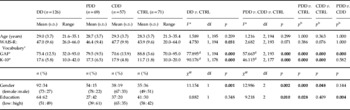
The study groups did not differ in age (Table 2). The proportion of females was higher in the depressed groups than in the CTRL group. The DD and CTRL groups did not differ in education but the PDD group differed from two other groups in including more participants with higher education. The DD group scored higher than the CTRL group in estimated general intelligence but the three groups did not differ from each other. Both depressed groups scored lower than the CTRL group in current psychosocial functioning (GAF), with the CDD group scoring even lower than the PDD group. Both depressed groups scored higher in current symptom severity (K-10) than the CTRL group but the depressed groups did not differ from each other.
Demographic and clinical characteristics of the groups of pure and co-morbid unipolar depressive disorders and healthy controls

DD, Depressive disorder group; PDD, pure depressive disorder group; CDD, co-morbid depressive disorder group; CTRL, control group; WAIS-R, Wechsler Adult Intelligence Scale, Revised; GAF, Global Assessment of Functioning; df, degrees of freedom; s.d., standard deviation.
The data in bold are statistically significant p values (p<0.05).
a Analysis of variance (ANOVA).
b Post-hoc test: Bonferroni.
c Data missing for one PDD participant.
d Levene's test of homogeneity of variances p<0.05.
e Data missing for three PDD, four CDD and 10 CTRL participants.
f Pearson's χ2.
Group comparisons
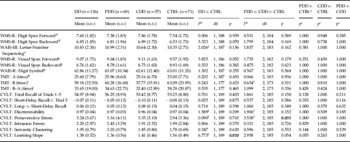
The first set of analyses (Table 3) revealed that the DD group scored statistically significantly lower in the Learning Slope index and almost statistically significantly lower in the Visual Span Forward when compared to the CTRL group, but no other significant differences emerged. In the comparisons between the PDD, CDD and CTRL groups, the difference in the Learning Slope did not remain statistically significant. A statistically significant difference in the Perseverative Errors emerged; however, the post-hoc tests did not reveal any differences between the three groups. No other statistically significant differences in test performance emerged between the three groups. When participants in the acute depressive phase were excluded from the analyses, the differences remained statistically significant in the Learning Slope index between the two groups (F=4.633, df=1, 175, p=0.033) and in the Perseverative Errors between the three groups (F=3.335, df=2, 171, p=0.038), and a statistically significant difference between the two groups also emerged in the Visual Span Forward, with the DD group performing poorer than the CTRL group (F=4.651, df=1, 172, p=0.032), but no other differences occurred (see Table A2 in online Appendix). In the additional ANOVAs comparing subgroups of DD participants with versus without co-morbid anxiety disorders and the CTRL group, the only statistically significant result between the groups was in the Learning Slope index, with the depressed group without co-morbid anxiety disorders performing poorer than the CTRL group (F=4.313, df=2, 185, p=0.015; with anxiety versus CTRL p=1.000, without anxiety versus CTRL p=0.011, with versus without anxiety p=0.182).
Means and standard deviations (raw scores) of the neuropsychological tests among participants with pure and co-morbid unipolar depressive disorders and healthy controls, and the results of the analyses of variance

DD, Depressive disorder group; PDD, pure depressive disorder group; CDD, co-morbid depressive disorder group; CTRL, control group; WMS-R, Wechsler Memory Scale, Revised; WAIS-III, Wechsler Adult Intelligence Scale, Third Edition; WAIS-R, Wechsler Adult Intelligence Scale, Revised; TMT, Trail Making Test; CVLT, California Verbal Learning Test; df, degrees of freedom; s.d., standard deviation.
The data in bold are statistically significant p values (p<0.05).
a This comparison was presented in our previous work (Castaneda et al. Reference Castaneda, Suvisaari, Marttunen, Perälä, Saarni, Aalto-Setälä, Aro, Koskinen, Lönnqvist and Tuulio-Henriksson2008b), with slight changes in the study samples.
b Analysis of variance (ANOVA) (group, gender and education as independent variables).
c Post-hoc test: Bonferroni.
d Data missing for one CTRL participant.
e Data missing for one PDD and one CDD participant.
f Levene's test of equality of error variances p<0.05.
g Data missing for one CDD and two CTRL participants.
h Data missing for one CDD and one CTRL participant.
i Data missing for one PDD, four CDD and seven CTRL participants.
j Calculated only for those with scores in both TMT A and TMT B.
Associations of clinical variables with cognitive performance
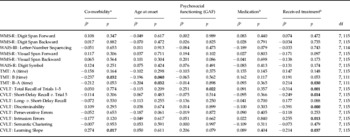
The results of the regression analyses within the DD group are presented in Table 4. Co-morbidity had a statistically significant negative relationship with the B part of the TMT and a positive relationship with the Learning Slope index of the CVLT. Age at onset of the first disorder explained statistically significantly the performance in the B and B–A parts of the TMT, with younger age at onset predicting poorer performance. High GAF scores predicted statistically significantly better scores in the Total Recall of Trials 1–5 in the CVLT. Received treatment predicted performance in the TMT B–A and the Total Recall of Trials 1–5, Short-Delay Recall versus Trial 5, Discriminability, Intrusive Errors, and Learning Slope of the CVLT, with those who had received treatment performing poorer. Current medication had no statistically significant associations with any of the neuropsychological test variables.
The associations of clinical variables with cognitive performance within the depressive disorders group

GAF, Global Assessment of Functioning; WMS-R, Wechsler Memory Scale, Revised; WAIS-III, Wechsler Adult Intelligence Scale, Third Edition; WAIS-R, Wechsler Adult Intelligence Scale, Revised; TMT, Trail Making Test; CVLT, California Verbal Learning Test; df, degrees of freedom.
The data in bold are statistically significant p values (p<0.05).
a Pure depression=0; depression plus one other diagnosis=1; depression plus two or more other diagnoses=2.
b No=0, Yes=1.
c Standardized β coefficients.
Discussion
The aim of the present study was to investigate the effect of psychiatric co-morbidity on cognitive functioning in a population-based sample aged 21–35 years with a lifetime history of unipolar depressive disorders. The groups of pure and co-morbid depressive disorders did not differ in any of the cognitive measures. Furthermore, the results of the present study do not support the previous findings of pronounced cognitive dysfunction in depression with co-morbid anxiety disorders (DeLuca et al. Reference DeLuca, Lenze, Mulsant, Butters, Karp, Dew, Pollock, Shear, Houck and Reynolds2005; Basso et al. Reference Basso, Lowery, Ghormley, Combs, Purdie, Neel, Davis and Bornstein2007). An explanation for these findings might be that, in the present study, although many of the depressed participants had residual symptoms, the majority of the PDD participants and nearly half of the CDD participants were in remission. However, recent studies indicate that some cognitive deficits in depression may persist despite clinical recovery (Airaksinen et al. Reference Airaksinen, Wahlin, Larsson and Forsell2006; Smith et al. Reference Smith, Muir and Blackwood2006). Another explanation might be that the majority of the depressed participants in the present study had suffered only a single depressive episode, as it has been reported previously that verbal memory deficits are associated with recurrent depression when compared to single-episode depression (Basso & Bornstein, Reference Basso and Bornstein1999; Fossati et al. Reference Fossati, Harvey, Le Bastard, Ergis, Jouvent and Allilaire2004).
Unimpaired verbal and visual short-term memory, verbal long-term memory, attention, processing speed, and executive functioning were detected in both pure and co-morbid depressive disorder groups, and also when compared to the healthy control group. Only some suggestion of mildly compromised performance in verbal learning in the DD group in total was observed when compared to the control group, a finding that we reported in our previous study (Castaneda et al. Reference Castaneda, Suvisaari, Marttunen, Perälä, Saarni, Aalto-Setälä, Aro, Koskinen, Lönnqvist and Tuulio-Henriksson2008b) of young adults with a lifetime history of non-co-morbid non-psychotic unipolar depressive disorders in the MEAF study. The absence of significant cognitive deficits among relatively young out-patients with mild to moderate depression has been reported previously (Grant et al. Reference Grant, Thase and Sweeney2001; Wang et al. Reference Wang, Halvorsen, Sundet, Steffensen, Holte and Waterloo2006), although more consistent are findings of impairments observed even among adults younger than 50 years of age (Fossati et al. Reference Fossati, Amar, Raoux, Ergis and Allilaire1999; Merriam et al. Reference Merriam, Thase, Haas, Keshavan and Sweeney1999; Egeland et al. Reference Egeland, Rund, Sundet, Landrø, Asbjørnsen, Lund, Roness, Stordal and Hugdahl2003; Hill et al. Reference Hill, Keshavan, Thase and Sweeney2004; Stordal et al. Reference Stordal, Lundervold, Egeland, Mykletun, Asbjørnsen, Landrø, Roness, Rund, Sundet, Oedegaard and Lund2004; Mahurin et al. Reference Mahurin, Velligan, Hazleton, Davis, Eckert and Miller2006; Smith et al. Reference Smith, Muir and Blackwood2006; for a review, see Castaneda et al. Reference Castaneda, Tuulio-Henriksson, Marttunen, Suvisaari and Lönnqvist2008a).
The present study also investigated whether co-morbidity and also other disorder characteristics, such as age at onset, psychotropic medication and received treatment, are associated with cognitive dysfunction among depressed young adults. Younger age at onset of the first disorder predicted more deficits in executive functioning, which accords with previous findings regarding depression (Grant et al. Reference Grant, Thase and Sweeney2001), and seems to support the hypothesis that early-onset mental disorder represents more serious forms of the disorder (Rohde et al. Reference Rohde, Lewinsoh and Seeley1991, Reference Rohde, Lewinsohn and Seeley1994). Received treatment was associated with more impaired executive functioning and verbal learning and memory, which may indicate that those depressed young adults who exhibit cognitive deficits also need and seek treatment. Furthermore, these associations were not explained by current psychosocial functioning measured with GAF or by current usage of psychotropic medication. Accordingly, depression-related cognitive deficits might be related to more distress and therefore be a manifestation of clinical significance of the disorder. This finding is of particular interest because it is known how important it is to establish the clinical significance of disorders when estimating treatment need (Narrow et al. Reference Narrow, Rae, Robins and Regier2002). This result may also explain some of the inconsistent findings observed in studies conducted in clinical versus population-based samples.
This study was performed in a well-defined population-based setting, where sample characteristics were reported explicitly and possible confounding variables closely controlled for. Psychiatric co-morbidity was assessed with a lifetime time-frame rather than only for current co-morbidity, which often is the case. The effects of demographic variables (e.g. gender and education) and other disorder characteristics (e.g. usage of psychotropic medication) were taken into account. The study sample was representative of the Finnish population, whereas most previous studies have used hospitalized samples and therefore may represent a more severe form of depression or be otherwise selected. In addition, the present study used a non-biased control group representing the same population-based sample as the depressed group. The age range was defined rigorously to cover a clear-cut group of young adults, and a relatively large sample size was provided.
However, attrition of participants may have affected the results of the present study. The analysis of drop-out demonstrated that participants with hospital treatment due to mental disorders were less likely to participate in the psychiatric examination of the MEAF study (Suvisaari et al. Reference Suvisaari, Aalto-Setälä, Tuulio-Henriksson, Härkänen, Saarni, Perälä, Schreck, Castaneda, Hintikka, Kestilä, Lähteenmäki, Latvala, Koskinen, Marttunen, Aro and Lönnqvist2009). However, there were no differences in the K-10 or other screening scales of the pre-examination questionnaire between screen-positive participants and non-participants. Assuming that the most severe cases did not return the pre-examination questionnaire, the results may slightly underestimate the true association between depressive disorders and cognitive dysfunction in the young adult population. Furthermore, the problem of multiple testing must also be borne in mind, although Bonferroni post-hoc tests were conducted in the analysis comparing the three groups. Accordingly, the difference detected in the Learning Slope index between the DD and CTRL groups should be considered as only indicative. The usefulness of the K-10 as a measure of current symptom severity may also be limited slightly because of the delay of 26 days on average between the K-10 assessment and the neuropsychological examination.
In summary, the findings of the present study indicate that a lifetime history of unipolar depressive disorders among young adults with or without psychiatric co-morbidity may be associated with only minimal cognitive deficits, even when some residual depressive symptoms are present. However, those depressed patients who exhibit impairments in cognition seem to receive treatment, and accordingly, depression-related cognitive deficits may be a manifestation of clinical significance of the disorder.
Acknowledgements
This work was supported by the Emil Aaltonen Foundation, the Academy of Finland, and the Graduate School of Psychology in Finland.
Declaration of Interest
None.
Note
Supplementary material accompanies this paper on the Journal's website (http://journals.cambridge.org/psm).