Introduction
The population is ageing, entailing new challenges and demands that will require a change in mindset at both societal and organisational levels. A labour shortfall is an inevitable result of this demographic change and organisations will need firstly to attract and then to retain older workers to ensure they are able to operate at full capacity (Access Economics Pty Ltd 2001; Auer and Fortuny Reference Auer and Fortuny2000; Swan Reference Swan2010). This study examines some of the current literature on retirement and the predictors of intention to retire, and presents results from a study of public service employees and their retirement intentions, focusing on the influence of work environment factors on individuals' plans to retire.
The Australian literature on retirement proposes two key strategies as options to offset the labour shortage resulting from the ageing population. The first option is to increase the current skilled migration programme; however, the required increase in numbers of immigrants is too large to present a viable option (Productivity Commission 2005). The alternative proposal is to encourage workers to remain employed for longer, and this strategy is ultimately a more sustainable and practical measure (Australian Government 2007). However, this strategy makes two assumptions: that individuals are able to work for longer, and that they have the desire to continue working. Both assumptions require more in-depth examination than has currently been undertaken.
An ageing population is not uniquely Australian; all Organisation for Economic Cooperation and Development (OECD) countries face a changing demographic with increasing dependency ratios, meaning proportionately greater numbers of older people who are not working in comparison to the numbers of people active in the labour force (OECD 2006). Two critical factors are behind this demographic change: a decreasing fertility rate and increased longevity. The extent of the ‘ageing issue’ varies between countries, with Japan facing enormous challenges in the immediate future, while the United States of America is still some time away from an ‘ageing crisis’ (Rix Reference Rix and Taylor2008). European countries vary greatly in their current and projected dependency ratios with some, such as France and Norway, facing more imminent challenges. Some countries, such as Sweden and Denmark, have sustained higher employment levels of older workers, thereby improving their dependency ratios (von Nordheim Reference von Nordheim2004).
Retirement and the decisions about when to retire are complex and formulated over many years (Ekerdt, Kosloski and DeViney Reference Ekerdt, Kosloski and DeViney2000; Kohli and Rein Reference Kohli, Rein, Kohli, Rein, Guillemard and van Gunsteren1991). In order to encourage workers to remain at work for longer, an understanding of work and its meaning to mature-age employees is necessary. In the near future more research is required to improve understanding of the baby-boomers who are starting to retire, as this large cohort will significantly impact the retirement patterns for the next 20 years (Humpel et al. Reference Humpel, Loughlin, Wells and Kendig2009; Quine and Carter Reference Quine and Carter2006).
An individual's relationship with work changes as they age, but little detailed exploration of this shift has been undertaken (Griffiths Reference Griffiths, Lorretto, Vickerstaff and White2007; Rhodes Reference Rhodes1983). Griffiths argued that the current literature on work has been developed with ‘age-free’ models and therefore does not account for any changes in work requirements as we age. She added that current models of the way in which we attribute meaning and value to work fail to address many questions, and that new models are required that accurately encapsulate the factors that predict retirement and retirement intentions. Shacklock, Brunetto and Nelson (Reference Shacklock, Brunetto and Nelson2009) also claimed that new conceptual frameworks are needed that focus on why people choose to stay at work rather than retire. These models are necessary to support policy developments intended to improve the retention of mature-age workers in the workplace.
The nature of work
In Western society, work is of central importance; many people choose to work, to give their lives purpose and direction. Employees report better levels of physical and psychological health than people who are unemployed, provided that the work is healthy and involves performing meaningful and productive tasks (Clark and Oswald Reference Clark and Oswald1994; Griffiths Reference Griffiths, Lorretto, Vickerstaff and White2007; Winefield et al. Reference Winefield, Montgomery, Gault, Muller, O'Gorman, Reser and Roland2002).
The characteristics that define the quality of work as high or low vary between individuals. For all employees, individuals are able to perform at their best when there is ‘optimal fit’ between job performance demands and individual characteristics. Optimal job performance demands depend on individual characteristics, and will change with ageing, but not necessarily with negative consequences on performance; older employees adopt different strategies which offer more efficient approaches to work in comparison to their younger colleagues (Macdonald Reference Macdonald and Peterson2003a; Warr Reference Warr, Snel and Cremer1994). High-quality work should have the capacity to provide this optimal fit and create an environment that promotes high levels of employee health and wellbeing (Sparks, Faragher and Cooper Reference Sparks, Faragher and Cooper2001).
The relationship between the work environment (physical and psycho-social) and adverse health outcomes, such as poor mental health or musculoskeletal disorders, has been explored by others (Dollard and Bakker Reference Dollard and Bakker2010; Warren Reference Warren2001), but examination of the impact of work factors on retirement intentions has received much more limited attention (Ilmarinen Reference Ilmarinen2005; Shacklock, Brunetto and Nelson Reference Shacklock, Brunetto and Nelson2009). Organisations have the ability to modify work characteristics, such as job demands, amount of control that employees can exert, and social support, all of which contribute to overall satisfaction with work. The relationship between these factors and retirement intentions is the primary focus of the current study.
Having good quality work is beneficial for individuals, organisations and society (Warr Reference Warr2002). In an ageing society experiencing increasing pressure on health systems, it is imperative that mature-aged workers be provided with work that is productive and promotes good health if we are to extend working lives (Hancock Reference Hancock2000; Mackinnon, Ranzijn and Le Sueur Reference Mackinnon, Ranzijn and Le Sueur2003). This goal should not be seen as burdensome: good work design benefits the entire workforce, ensuring better conditions for all and improving the long-term employability of younger workers as well as older ones.
Little is known about the motivation for older workers to work, and developing a greater understanding of such motivations is needed to identify the key issues related to influencing retirement intentions (Ginn and Arber Reference Ginn and Arber2005; Kooij et al. Reference Kooij, de Lange, Jansen and Dikkers2008). A literature review by Kooij et al. (Reference Kooij, de Lange, Jansen and Dikkers2008), which examined potential age differences in motivation to work, found little consensus on which specific aspects of their work motivate older workers to stay in employment. While the review showed that with age intrinsic motivation to work increases while achievement motivation decreases, no conclusions regarding motivation and retirement intentions could be drawn.
Retirement
Feldman (Reference Feldman1994) defined retirement as the exit from an organisational position or career path of considerable duration, taken by individuals after middle age and with the intention to reduce their commitment to work thereafter. Accurately encapsulating all dimensions of retirement in a comprehensive definition is difficult; however, Feldman's definition emphasises that retirement is an event that occurs not just at a single point in time but often over a long period. Others have also acknowledged that retirement should be considered a process that involves changing contributions from different factors depending upon its proximity (Atchley Reference Atchley1982; Beehr Reference Beehr1986; Maestas Reference Maestas2010; Taylor and Shore Reference Taylor and Shore1995). In attempting to distinguish between retirement and ordinary job turnover (i.e. leaving one's job for other employment), Feldman highlighted a reduced psychological commitment to work among retirees. This distinction is potentially problematic, as some retirees who continue to work on a reduced basis may resent being described as having low commitment to their jobs. Nevertheless, for most people, commitment to work differentiates between job turnover and retirement.
Marshall stated that retirement is a social institution; it is created by human beings (Marshall Reference Marshall, Gee and Gutman1995). Therefore, the factors that influence retirement intentions are subject to change. Such change can occur at a broad policy level or at the employee/organisation interface. Many OECD countries (2006) have implemented policy changes to their pension structures, in an attempt to reduce incentives for early retirement. Several strategies have been tried, such as increasing the age of access to pensions and instituting bonus schemes that offer rewards for delaying receipt of benefits. These initiatives have met with mixed success (Mackinnon, Ranzijn and Le Sueur Reference Mackinnon, Ranzijn and Le Sueur2003; OECD 2007). Alternative strategies are required to encourage and enable mature-age workers to remain employed. Examination of the factors which are involved in the retirement decision-making process could be used to inform organisational policy and to develop strategies that encourage individuals to delay retirement.
The literature has proposed two broad groups of factors influencing intention to retire: push and pull factors (Kohli and Rein Reference Kohli, Rein, Kohli, Rein, Guillemard and van Gunsteren1991). Push factors move individuals towards retirement and include poor health, organisational factors and work fatigue. Typically, push factors are negative (Shultz, Morton and Weckerle Reference Shultz, Morton and Weckerle1998). In contrast, pull factors are usually positive factors that tend to increase a person's interest in seeking retirement, including outside work interests, partner's retirement status, and caring responsibilities. Push and pull factors interact in complex ways to influence a person's intention to retire (Shultz, Morton and Weckerle Reference Shultz, Morton and Weckerle1998). This study is focused on organisational factors – push factors – and retirement intentions.
Features of the work environment as predictors of retirement intentions
A small number of studies have examined the relationship between the psycho-social work environment and the intention to retire. The current study focuses on four factors identified in the literature as potentially salient factors of influence on an individual's intention to retire: job satisfaction, job control, job demands and social cohesion at work.
Job satisfaction
Job satisfaction is a complex construct and therefore hard to define concisely. The best definitions of job satisfaction are multi-factorial. Kalleberg and Loscocco (Reference Kalleberg and Loscocco1983) defined job satisfaction as having two main features: structural determinants, which include work-related factors (both organisational and occupational), and psycho-social determinants (i.e. self-valuation of job characteristics and the importance of work to an individual). The interplay between these two broad features is dynamic and changes over time.
The relationship between job satisfaction and age is U-shaped (Clark, Oswald and Warr Reference Clark, Oswald and Warr1996; Kalleberg and Loscocco Reference Kalleberg and Loscocco1983; Warr Reference Warr1992); older workers demonstrate higher levels of job satisfaction than their middle-aged colleagues. High levels of job satisfaction have been associated with decreased turnover, but the impact of job satisfaction on intention to retire has not been comprehensively explored (Wright and Bonett Reference Wright and Bonett2007). High job satisfaction has been assumed to result in delayed intention to retire, but there are too few studies to support or refute this. Griffeth, Hom and Gaertner (Reference Griffeth, Hom and Gaertner2000), in a large meta-analysis, found some support for the notion that higher levels of job satisfaction lead to a delayed retirement.
Mein et al. (Reference Mein, Martikainen, Stansfeld, Brunner, Fuhrer and Marmot2000), reviewing data from the Whitehall studies of civil servants, found that low job satisfaction was a significant indicator of early retirement among both men and women. Among those who were dissatisfied with their jobs, men were more than twice as likely as women to retire early. Similarly, Sibbald, Bojke and Gravelle (Reference Sibbald, Bojke and Gravelle2003) studied a population of general practitioners and found that high job satisfaction reduced the likelihood of taking early retirement. In contrast, Adams (Reference Adams1999) found no association between intended timing of retirement and job satisfaction.
Job demands and job control
Features of the job such as job demands and job control have been studied in relation to occupational stress (Macdonald Reference Macdonald and Peterson2003b), but there is little research on their impact on an individual's intention to retire. Sparks, Faragher and Cooper (Reference Sparks, Faragher and Cooper2001) outlined the importance of perceived job control for employee wellbeing and this is well supported by many other studies. Job demands can be appraised either positively or negatively, and the level of control that a worker has over their work can compensate to a certain extent for high job demands. This theory underpins Karasek and Theorell's (Reference Karasek and Theorell1990) job demand–job control model, which is well described in the literature but has seldom been applied to retirement intentions. More recently, Bakker and Demerouti (Reference Bakker and Demerouti2007) have suggested that the quantity and quality of resources (physical, psychological, social or organisational) available to an employee in their work environment is critical in any examination of the relationship between job demands and their impact on an individual's wellbeing. Although outside the scope of the current study, the impact of resources on retirement intentions should be explored further, given the changing capacities of older workers. It is likely that for some aspects of work, older workers will need extra support; it would be useful for organisations to know whether such supports encourage mature-age workers to remain employed for longer than they otherwise would.
Elovainio et al. (Reference Elovainio, Forma, Kivimaki, Sinervo, Sutinen and Laine2005) found that employees with low job control and high job demands were most likely to consider early retirement, with age and low educational level functioning as additional weak predictors. Similarly, Harkonmaki et al. (Reference Harkonmaki, Rahkonen, Martikainen, Silventoinen and Lahelma2006) found that a combination of high job demands and low control predicted early retirement. Poor health has also been associated with undertaking work with high demands and low control (Siegrist Reference Siegrist1996) and evidence suggests that poor health is one of the strongest predictors of early retirement (Mein et al. Reference Mein, Martikainen, Stansfeld, Brunner, Fuhrer and Marmot2000).
Blekesaune and Solem (Reference Blekesaune and Solem2005) reported that men in jobs with low control are more likely to retire early than men with greater job flexibility. Among employees in jobs with low autonomy, men are also more likely to retire early than women. Blekesaune and Solem proposed that this gender difference may be due to the different amounts of time that men and women spend in the workforce; women may need to stay at work for financial reasons, because they have spent less time in employment and so have accumulated fewer savings, or because they are not ready to retire. In addition, women might be more tolerant of low-control jobs because they are often part-time and enable a balance between work and care-giving roles and duties.
Social cohesion
Social networks have been cited as important in the workplace (Frese Reference Frese1999; Kristensen Reference Kristensen1996), particularly as a mechanism for reducing work stress. The limited research on the relationship between opportunities for socialisation at work and intention to retire is unclear and has yielded inconsistent results (Kubiecek et al. Reference Kubiecek, Korunka, Hoonakker and Raymo2010). Beehr et al. (Reference Beehr, Glazer, Nielson and Farmers2000) reported that interaction with others (a form of socialisation) has a negative influence on intention to retire; that is individuals with low sociability at work are likely to delay their retirement, while those with higher levels of socialisation at work are more likely to consider early retirement. This somewhat counter-intuitive result has been supported by other studies (Elovainio et al. Reference Elovainio, Kivimaki, Vahtera, Ojanlatva, Korkeila, Suominen, Helenius and Koskenvuo2003; Henkens and Tazelaar Reference Henkens and Tazelaar1994). In contrast, Kosloski et al. (Reference Kosloski, Ekerdt and DeViney2001) and Mein et al. (Reference Mein, Martikainen, Stansfeld, Brunner, Fuhrer and Marmot2000) found that workers who reported positive social relations at work were significantly less likely to intend to retire early.
From this review it is evident that the links between psycho-social factors and retirement intentions is unclear. It is the aim of the current study to examine these organisational factors specifically in relation to their impact on the intended timing of retirement. Clearly there is a need for conceptual frameworks to underpin this rapidly changing area and we propose a number of hypotheses, which this study will address. Using these findings we will suggest practical applications that organisations can utilise to potentially influence their employees' retirement intentions, thereby encouraging an extended working career.
This literature review has shown the need for further exploration of the impacts of work characteristics on retirement intentions. In the current study, we focused on the four work characteristics featured in the review. Several hypotheses were proposed for the study:
1. High job satisfaction is positively related to a delayed intention to retire.
2. High levels of job demands predict an intention to retire soon.
3. Low levels of job control predict an intention to retire soon.
4. Low levels of social cohesion at work predict an intention to retire soon.
Methods
A large public service organisation in Victoria, Australia, initiated the study reported here; the organisation's managers acknowledged they had an ageing employee population and wished to examine and develop strategies to retain workers who may otherwise have been considering retirement. A questionnaire distributed in 2007 to all employees via the company's intranet site elicited 332 respondents (47.4% response rate). An e-mail was sent to employees explaining the project with a link to the company intranet inviting them to respond to the survey. Due to the nature of the work undertaken in the organisation, all employees had regular access to the company intranet.
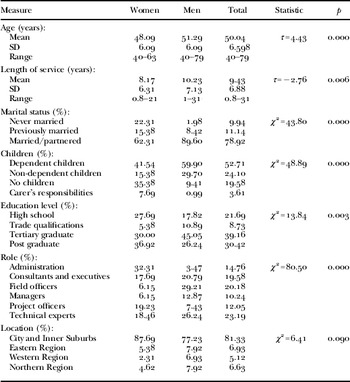
The organisation employed equal numbers of men and women, but respondents comprised 130 (39%) women and 202 (61%) men. The mean age of the survey respondents was 42.1 years, in comparison to the organisation average of 43.5 years. Seventy per cent of respondents had tertiary qualifications, and 39% indicated that they had accumulated ten or more years of service with the organisation (see Table 1).
Participant demographics

Note: SD: standard deviation.
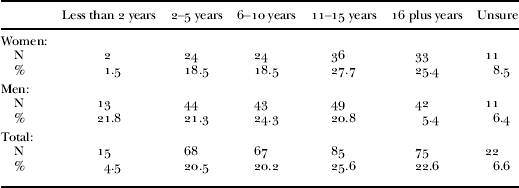
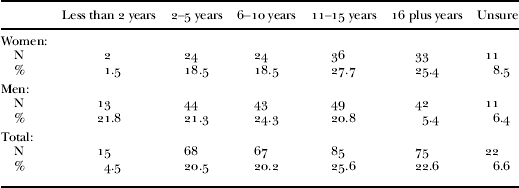
The dependent variable, intention to retire, was measured through the item, ‘What is your intended timing of retirement?’ Respondents chose a response from the following alternatives: ‘less than 2 years’, ‘2–5 years’, ‘6–10 years’, ‘11–15 years’, ‘16 years plus’, and ‘unsure’ (see Table 2). Preliminary analyses of intention to retire indicated that relationships with several potential predictors were non-linear; there was a sharp differentiation between respondents who intended to retire within the next 5 years (2 years or 2–5 years), and those who intended to retire later (in 6–10 years, 11–15 years, or 16 or more years). For this reason, the independent variable was dichotomised at 5 years.
Intended timing of retirement by gender
A modified version of the Copenhagen Psychosocial Questionnaire (COPSOQ) was used to measure the psycho-social work environment (Kristensen et al. Reference Kristensen, Hannerz, Hogh and Borg2005). Forty-six items taken from the COPSOQ were subject to a factor analysis with varimax rotation, which resulted in the emergence of four factors. The first factor, Job satisfaction (Cronbach's alpha=0.91), was a 15-item scale reflecting an individual's satisfaction with their work, including job content, career structure and the work environment. The second factor, Job demands (Cronbach's alpha=0.84), was a 12-item scale which described the perceived demands of the work, and included physical, cognitive, quantitative and emotional demands. The third factor was Social cohesion (Cronbach's alpha=0.86), a nine-item scale reflecting the opportunities for social networks provided by the work environment. The fourth factor was Job control (Cronbach's alpha=0.82), a seven-item scale describing the perceived level of control available to an individual in their work. Scales were constructed using the weighted factor-based scale method (de Vaus Reference de Vaus2002); all had a mean of zero and a standard deviation of 1.
Analysis strategy
First, bivariate relationships between intention to retire soon (within five years) and the work factors were examined. Subsequently, hierarchical logistic regression with backward deletion of variables was used to test whether the four work factors (job satisfaction, job demands, job control and social cohesion) were predictors of intention to retire soon, having controlled for significant socio-demographic factors. Variables representing socio-demographic factors (age, gender, length of service, marital status and dependent children) were entered first, followed by the four measures of work characteristics. The analysis was repeated with forward selection to determine whether the resulting models were stable.
Results
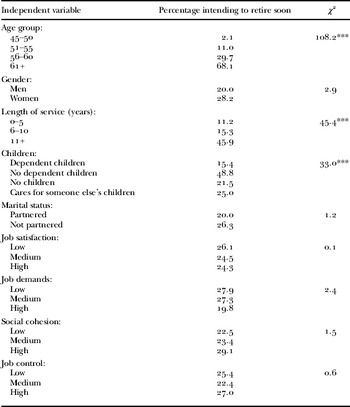
Bivariate analysis indicated no relationship between any of the work factors by themselves and intention to retire soon (see Table 3). However, age, length of service and having dependants were highly significant bivariate predictors of intention to retire soon.
Bivariate analysis of Retire soon by independent variables

Significance levels: * p<0.05,
** p<0.01,
*** p<0.001.
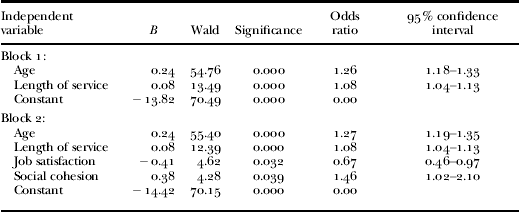
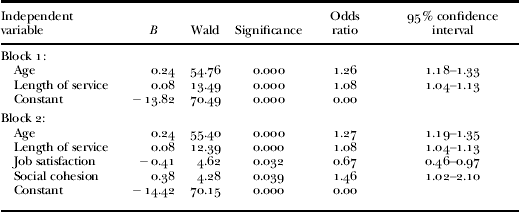
Multivariate logistic regression analysis was undertaken to determine whether intention to retire soon was associated with any of the work factors once age, length of service and having dependants were taken into account. Results indicated that age and length of service were highly significant independent predictors of intention to retire soon; older workers indicated they were much more likely to intend to retire soon than younger ones, and the longer workers had been employed by the organisation the more likely they were to intend to retire soon. None of the other socio-demographic variables remained in the regression equation. When the four work factors were added to the model in the second block, two work factors (job satisfaction and social cohesion) were significant independent predictors of intention to retire soon, after controlling for age and length of service.
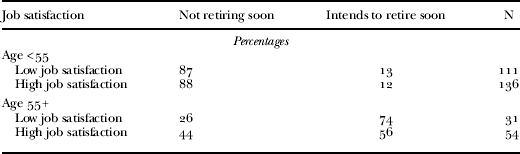
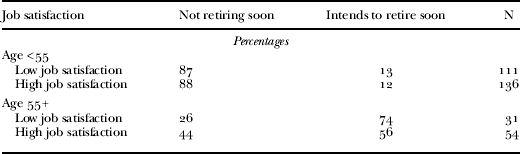
Further analysis found that for respondents under 55 years of age, job satisfaction had no impact on intention to retire soon (see Table 4). However, for respondents 55 years or older there was tendency (p<0.1) for high job satisfaction to predict lower intention to retire soon. Whilst this result was not statistically significant, it is reported here to encourage other studies to pursue the issue with a larger sample size.
Intention to retire soon by age and job satisfaction
The study hypotheses are each addressed below.
1. High job satisfaction is positively related to a delayed intention to retire
Job satisfaction predicted intention to remain at work for five years or longer. For every decrease in Job satisfaction of one standard deviation, the odds ratio for intention to retire soon increased by approximately 33% (having controlled for age and length of time in the workforce, see Table 5). Therefore, the hypothesis that job satisfaction would predict delayed intention to retire was supported.
Multivariate analysis of Intention to retire soon by work factor variables, age and length of service
2. High levels of job demands predict an intention to retire soon
Intention to retire soon was not associated with job demands in either the bivariate or multivariate analyses; therefore, this hypothesis was not supported.
3. Low levels of job control predict an intention to retire soon
Intention to retire soon was not associated with job control either in the bivariate or multivariate analyses, and this factor did not remain in the regression shown in Table 5; therefore, this hypothesis was not supported.
4. Low levels of social cohesion at work predict an intention to retire soon
Intention to retire soon was associated with social cohesion; however, the relationship between intention to retire and social cohesion was in the opposite direction to that predicted. High levels of social cohesion predicted intention to retire within the next five years. An increase in social cohesion score of one standard deviation resulted in the odds ratio for retiring within the next five years increasing by about 45% (having controlled for age and length of time in the workforce).
Other findings
Other variables entered in the logistic regression model included marital status, length of service, having dependants and gender. Of these, length of service was the only variable that remained significant after controlling for age. Individuals of the same age who had been employed at the organisation for longer were more likely to intend to retire within the next five years.
Discussion
The study of older public servants reported here found employees were more likely to intend to retire soon if they belonged to older age groups, had been in the workforce longer, had low job satisfaction and reported high sociability. Based on the findings of the study, several key areas need to be addressed by organisations to improve retention of older workers and these will be discussed further below.
Age
The strong relationship found in this study between intention to retire and age supports the results of several previous studies (Ekerdt, Kosloski and DeViney Reference Ekerdt, Kosloski and DeViney2000; Kooij et al. Reference Kooij, de Lange, Jansen and Dikkers2008; Kosloski, Ekerdt and DeViney Reference Kosloski, Ekerdt and DeViney2001; Taylor and Shore Reference Taylor and Shore1995). Despite Australia abandoning mandatory retirement in the early 1990s, strong expectations of retiring prior to the age of 65 remain. Such expectations are a strong barrier to the retention of older workers. Despite this being a predictable finding, it raises some very important issues. Shifting cultural expectations related to the anticipated age of retirement will require persistence and some very good role models. Some organisations have developed policies related to specifically attracting and retaining older workers, but these remain a minority (Stoney and Roberts Reference Stoney and Roberts2003), and more societal change is needed to extend working lives further.
Some key issues in the retention of older workers arise from the current study and prior literature. Firstly, despite much evidence in the literature about the knowledge about the characteristics of older workers and the significant strengths that they can offer to the workplace, organisations are reluctant to engage proactively in recruitment and retention of older workers. Although some loss of physical strength occurs with ageing and may cause some problems in work of a physical nature, in contrast, cognitive changes with age are minor and likely to cause no problems with work (Shephard Reference Shephard1999). Older workers usually develop more strategic ways of completing tasks, which would easily offset any potential decline in memory and other cognitive functions (Warr Reference Warr, Snel and Cremer1994).
Secondly, older workers are often viewed as a burden, and their employment is falsely thought to increase labour and other associated costs (Brooke Reference Brooke2003). Employers often presume that older workers have a relatively short time left in the workforce (Borowski, Encel and Ozanne Reference Borowski, Encel and Ozanne2007). This assumption can lead to a reluctance to train older workers to ensure they maintain the necessary skills to participate productively in the workplace. Training of older workers needs to be appropriate to their learning styles, which may be different from those of younger workers (Moseley and Dessinger Reference Moseley and Dessinger2007).
Thirdly, some superannuation or pension schemes still favour early retirement (some at 55) through providing significant financial incentives to leave the workforce rather than remain working. In Australia these types of funds are mostly closed and will be phased out as individuals retire.
Job satisfaction
Job satisfaction was the only measure, in the current study, of job characteristics that emerged from the analysis as a potential point of intervention. Work factor scores showed that job satisfaction was a significant negative predictor of retirement intentions. In this study, the central principle in our measure of job satisfaction related to employees being able to make a valued contribution through their work, with particular reference to feeling appreciated, and that their specific skills and abilities were utilised. Job satisfaction became increasingly important as the age of participants increased. Organisations can intervene to offer work environments that are conducive to higher levels of job satisfaction and would benefit from improved recognition of the special contributions that their older employees make.
Job demands and job control
The other work factor measures (job control and job demands) were found to have no significance as predictors of intention to retire soon. In the Job Demands Resources module (JD-R) model (Bakker and Demerouti Reference Bakker and Demerouti2007), resources are defined as the physical, psycho-social, social or organisational aspect of the job that: are functional in achieving work goals; reduce job demands and the associated costs (physiological and psychological costs); or stimulate personal growth, learning and development. One explanation for the current study's negative finding is that the mature-age workers who participated may have achieved a balance between demands and control and therefore did not consider these of significance in their retirement intentions.
Social cohesion
We originally hypothesised that high social cohesion in the workplace would encourage mature-age workers to delay their retirement. However, we found that individuals with high social cohesion were more likely than those with low social cohesion to intend to retire soon. It may be that individuals with high social cohesion at work also possessed lively social networks in their private lives.
The positive relationship between intention to retire within the next five years and social cohesion should not be taken to imply that promoting high social cohesion in the workplace is counter-productive. For people with low social cohesion in their private lives, being involved in an affirming social environment at work might just be the factor that persuades them to stay. This possibility has been identified before (Beehr et al. Reference Beehr, Glazer, Nielson and Farmers2000; Shacklock, Fulop and Hort Reference Shacklock, Fulop and Hort2007); however, more research is required on the issue of social support, as this is a potential point of intervention for organisations. Firstly, employers can provide a work environment that is conducive to the development of strong social networks at work and encourages all employees to participate. Secondly, workplaces can enable individuals who already possess strong social networks to manage the competing demands of work and their private lives through offering more flexible work practices and thus improve retention of a valuable resource. This study makes a useful contribution to the debate around the impact of social cohesion on retirement intentions through this unexpected finding.
Extending the working life
Negative attitudes towards older workers persist (Bird and Fisher Reference Bird and Fisher1986; Kite et al. Reference Kite, Stockdale, Whitley and Johnson2005; Taylor and Walker Reference Taylor and Walker1998) and it will require a concerted effort from employees and employers working together to effect change. Good communication and working relationships between the parties involved are central to these changes. Brooke has shown that cost advantages can result from delaying the retirement of mature-age workers (Brooke Reference Brooke2003), but, despite increasing difficulties in recruitment, this possibility has not been widely acknowledged by organisations.
Maximising productivity of mature-age workers is achievable by appropriate allocation of work that capitalises on the specific skills and experience of these employees. Enabling a better fit between employee and work is likely to improve the relationship between employer and employee and lead to higher job satisfaction, which may then lead to delayed retirement, as the current study showed. In addition, optimising work conditions is likely to enhance productivity for workers of all ages.
Paying attention to person–environment fit should be a fundamental part of organisational planning. D'Amato and Zijlstra (Reference D'Amato and Zilstra2007) proposed a model linking productivity and employee behaviour with organisational climate. They measured organisational climate (encompassing psychological climate, policies and job procedures) and organisational citizenship behaviour (OCB; also defined as work behaviour). OCB or work behaviour refers to the extent to which employees comply with organisational expectations and then their actual work performance. D'Amato and Zijlstra found organisational influences are much stronger influences on work behaviour than individual factors (such as personality and self-efficacy). When working environments are supportive and have clear objectives, good management practices and constructive organisational policies, they are also able to report better performance outcomes, which include lower employee turnover, higher productivity and lower stress scores. These findings concur with those of the current study, which found support for high levels of job satisfaction as a significant predictor of intention to delay retirement. Organisations with good working conditions create situations where high degrees of job satisfaction are achievable, encouraging employees to delay their intended retirement (Rhoades and Eisenberger Reference Rhoades and Eisenberger2002).
Implications for organisations
In considering new directions in employment policy, organisations must balance the needs and requirements of employees in all age groups. While retention of older workers needs to be an integrated part of organisational management, focusing exclusively on developing policy for older workers may potentially create age discrimination (Walker Reference Walker1999). Some of the policies outlined in this section have implications for all age groups and constitute best practice in personnel management.
Based on the literature presented and results from the present study, organisations looking to improve the retention of their mature-age workers could consider incorporating some of the following goals in their policies:
• To develop an organisational climate that encourages high levels of satisfaction through providing work that is good quality, productive and meaningful.
• To allow workers to participate in decision-making activities that involve their work.
• To provide more education for employees and employers about job design so that organisations are able to provide work that is attractive and safe to perform.
• To adopt more flexible work practices so that employees can incorporate social and work activities into their lifestyles.
• To undertake more regular monitoring of employees' expectations, plans and capacities to ensure policy development is more accurately mapped to the demographics of the workforce, rather than using a more generic framework.
The future
The intention of this study was to contribute to the literature on extension of working lives through examination of employees' retirement intentions. The study's key findings highlight the importance of job satisfaction in encouraging the retention of mature-age workers. In addition, the study's counterintuitive findings regarding social cohesion have contributed to the debate on the role of socialisation in the workforce. As the focus of this study was on a public-sector organisation, care should be taken in interpreting the results for other sectors.
It is inevitable that there will need to be a change in the way we work to maximise the capacity of our labour pool. Longitudinal studies are required to examine retention strategies, and to identify which policies are most effective in retaining mature-age employees. Some of these studies are starting to contribute to the literature on older workers in Australia (e.g. HILDA http://melbourneinstitute.com/hilda/). The impact of the global financial crisis on work factors and retirement intentions is also not fully understood, and as the aftershocks continue, new evidence will be required to assess the impact this event has had, and will continue to have.
Age remains a significant barrier to staff retention, and this situation requires new approaches so that mature-age workers can continue to work as long as they feel they are able. Our findings suggest that maximising job satisfaction through being able to make positive and interesting contributions to work is fundamental. Clever organisations have identified that retention of staff of all ages, not only mature-age employees, makes good sense for many reasons; a good relationship between employees and organisations is beneficial for all age groups.