Introduction
The concept of relative poverty was developed by Peter Townsend in opposition to ‘absolute poverty’, which classes people as poor if they do not have enough material resources to physically function properly (for a detailed discussion see, for example, Alcock, Reference Alcock2006). Relative poverty categorises as ‘poor’ all whose income falls seriously behind national material standards:
Individuals, families and groups in the population can be said to be in poverty when they lack the resources to obtain the types of diet, participate in the activities and have the living conditions and amenities which are customary, or at least widely encouraged and approved, in the societies to which they belong. Their resources are so seriously below those commanded by the average individual or family that they are, in effect, excluded from ordinary living patterns, customs and activities. (Townsend, Reference Townsend1979: 31)
This article argues that while relative poverty is undoubtedly a useful and important concept in social science, the widespread view that ‘poverty’ necessarily means ‘relative poverty’, which is most pronounced in mainstream social policy academic writing, has led to incomplete portrayals of the experience of people near the bottom of the British income distribution. The first part examines two unanswered criticisms of relative poverty – both of which concern its inability to properly demarcate a particular level of hardship brought about by a lack of material resources. As I explain, these criticisms are overlooked or treated dismissively in much mainstream British social policy writing; when people below the relative poverty line claim they are not in ‘poverty’, they are often said to be in a state of ‘denial’, despite their reasons for taking that view echoing the aforementioned unanswered criticisms of relative definitions. The second part continues the argument by drawing upon findings about public attitudes and experience from recent British Social Attitudes surveys and interviews with forty unemployed Jobseeker's Allowance (JSA) claimants and thirty employed people (ten building site workers, ten teachers and ten retail workers). This research shed further light on people's attitudes towards, and experience of, life on a relatively low income, in ways relevant to the main arguments in debates about poverty definition. A conclusion reflects upon the article's main points.
Criticisms of defining ‘poverty’ as ‘relative poverty’
Peter Townsend's (Reference Townsend1954, Reference Townsend1979) relative poverty recognises that people have social needs, and that more shame, embarrassment and feelings of being excluded tend to result from an inability to buy things if those around you have them. Moreover, in identifying people whose standard of living is seriously behind that of the average citizen, it aids debates about unequal opportunities and outcomes. But while relative poverty is a useful and important concept, its use as a definition of the word ‘poverty’ has been subjected to two criticisms, which have not been adequately countered.Footnote 1
Criticism 1: Sen and ‘absolute’ conditions
Amartya Sen (Reference Sen1983) argued that entirely relative definitions like Townsend's do not properly demarcate those in genuine material hardship (as poverty definitions should) because they neglect ‘absolute’ conditions. To illustrate, people at the relative poverty line in one of the world's richest countries are in a far better condition than those at the relative poverty line in one of its poorest because, while both are in the same condition in one respect (as their income is about the same proportion of their nation's average), those in the richer country have far greater ‘absolute’ purchasing power and are much further from starvation. Townsend's (Reference Townsend1985) detailed response to Sen's (Reference Sen1983) article did not offer a counter-argument on this issue, and neither has anyone else.
Criticism 2: Piachaud and nationwide normal material standards
The second unanswered criticism is that what are considered ‘normal’ (or ‘customary’, in Townsend's definition of poverty, see above) activities and material standards vary considerably within countries. This criticism emerged when David Piachaud (Reference Piachaud1981) challenged Townsend's (Reference Townsend1979) claim that poverty can be measured objectively. Piachaud noted that individuals’ spending patterns differ considerably and that people often go without items Townsend (Reference Townsend1979) considered indicative of not being poor or deprived through choice, such as a cooked breakfast. Moreover, the British population has become even more diverse in its consumer choices since Piachaud's (Reference Piachaud1981) article (see, for example, Ransome, Reference Ransome2005), so it is arguably now even less appropriate to talk of nationwide ‘customary’ activities. Indeed, consumer choices and what people consider normal material standards vary so much in countries like Britain because they are so unequal, and the British income distribution is far more unequal now than it was when Piachaud was writing (see, for example, Cribb et al., Reference Cribb, Hood, Joyce and Phillips2013). Millions of people buy (and are therefore accustomed to) the more expensive clothes, food, and cars, while millions of others buy clothes and food at a fraction of that cost and travel by bus or walk – yet both groups’ expenditure patterns are normal in Britain today. McKay's (Reference McKay2004) quantitative analysis found that people's views on what constitutes normal material standards do indeed vary considerably, and my in-depth research on a diverse sample presented here can shed further light. In short, Townsend's poverty definition is reliant upon society-wide material standards, which are unlikely to exist.
If the two main criticisms of relative definitions of poverty are considered together, it might be suggested that people living at the relative poverty line in richer countries like Britain are not only certainly better off than their counterparts in poorer countries, they will also, in general, have lower self-perceived normal income standards than most other people in their own country because they are likely to have lived in poorer households and neighbourhoods (if I am correct to assume that poorer people have these lower normal income standards). Hence, it might be argued that authors who overlook the two main criticisms of entirely relative definitions risk overestimating the subjective hardship experienced by poorer British people. The rest of this article argues that this is the case. I first examine social policy writing about poverty and then present my own evidence.
Politics, poverty definition and British social policy writing
The weaknesses of the relative definition described above are well known, but politics is important to understanding why some commentators consider them sufficient to render the definition worthless, while others insist they are merely minor imperfections. All (or nearly all) commentators, regardless of how they define poverty, agree that poverty is a terrible problem that should be solved as a matter of urgency. How poverty is defined determines the scale of the problem that must be solved. Those on the political left, who want more vertical redistribution of income and wealth, will perhaps be more inclined to support broader definitions (like relative poverty), which show larger numbers of poor people. Moreover, people on state out-of-work benefits are usually in ‘relative’ but not ‘absolute’ poverty; under the relative definition, those (often conservatives) who allege that many claimants are work-shy can appear callous for not instead focusing purely upon lifting them from their dreadful plight. Furthermore, poverty rates are unquestionably a key yardstick against which countries are judged, so it is important to note that different definitions can portray particular socio-economic systems more negatively or positively. The relative definition overlooks capitalist countries’ typically high average incomes per head and their success in virtually eradicating manifestations of ‘absolute poverty’ such as hunger, yet it highlights their inherent inequalities – unless these inequalities are strictly limited by state interventions near the bottom of the income distribution. As Banting (Reference Banting1979) noted, socialist Townsend redefined poverty as relative poverty in order to put inequalities in income and wealth back on the political agenda in historically affluent post-war Britain.Footnote 2 Given these points, it is unsurprising that some conservative commentators have strongly objected to the relative definition (examples include Joseph and Sumption, Reference Joseph and Sumption1979; Green, Reference Green1990; Marsland, Reference Marsland1996). While it is widely agreed that relative poverty is a useful concept which nevertheless has weaknesses, those on the political right often portray its weaknesses as catastrophic flaws, while those on the left often portray them as insignificant.Footnote 3
These are important considerations, as British social policy academia (where debates about poverty mainly take place) is left-dominated and has noted links with ‘poverty lobby’ organisations, such as the Child Poverty Action Group, which campaign to increase poorer people's incomes (see Deacon, Reference Deacon2002; Welshman, Reference Welshman2012; Dunn, Reference Dunn2014). Therefore, it is perhaps unsurprising that academics tend to consider it acceptable to use the terms ‘poverty’ and ‘relative poverty’ interchangeably. While relative poverty is accepted and ‘taken as read’ as the meaning of the word ‘poverty’ in much social science writing, some mainstream social policy academics who write about poverty have gone further by implying that those who do not take this view are necessarily misguided. This becomes clear in these authors’ discussion of people below the relative poverty line who say they are not poor. For example, Townsend (Reference Townsend1979: 425) wrote of his respondents’ ‘personal denials of poverty’. More recently, Shildrick and MacDonald (Reference Shildrick and MacDonald2013: 293) wrote of their respondents’ ‘denial of poverty’, commenting that ‘despite living in sometimes severe, material hardship our [60] interviewees [from Teesside] denied that “poverty” described their conditions of life’ (p. 286).
This apparent view that relatively poor people who say they are not in ‘poverty’ are necessarily wrong persists despite some social policy authors expressing a desire to include their perspectives in poverty discourse (see Beresford and Croft, Reference Beresford and Croft1995; Beresford et al., Reference Beresford, Green, Lister and Woodard1999; Lister, Reference Lister2004: 2; Patrick, Reference Patrick2014), and despite the public's other views being taken seriously by poverty authors (particularly their views on what constitutes a ‘necessity’, which have been considered useful enough to derive ‘consensual’ measures of ‘poverty’ from [see Pantazis et al., Reference Pantazis, Gordon and Levitas2006; Lansley and Mack, Reference Lansley and Mack2015]). Most strikingly, Beresford et al.’s (Reference Beresford, Green, Lister and Woodard1999) choice of book title showed no regard for their interviewees’ views on poverty definition. In fact, one of its authors (Beresford and Croft, Reference Beresford and Croft1995: 77) had earlier noted the ‘irony’ that a book entitled ‘Excluding the poor’ (Golding (ed.), Reference Golding1986) had failed to include contributions from ‘poor people’.
Importantly, the reasons members of the public give for rejecting the view that poverty should be defined as relative poverty tend to closely fit the two unanswered academic criticisms of relative poverty I described earlier. For example, while none of Shildrick and MacDonald's (Reference Shildrick and MacDonald2013) interviewees said they found life on state benefits comfortable, they nevertheless tended to associate the term ‘poverty’ with more extreme conditions, notably famines (other major studies have found the same, including Golding and Middleton, Reference Golding and Middleton1982, and Beresford et al., Reference Beresford, Green, Lister and Woodard1999):
For many, it was TV images of absolute poverty in Asia and Africa that sprang to mind when we initially asked them about their views on poverty. They were quick to reject the term as having relevance to their own lives. (Shildrick and MacDonald, Reference Shildrick and MacDonald2013: 289)
As these authors noted, their respondents perhaps sought to distance themselves from the stigma the word ‘poverty’ carries. Nevertheless, it is noteworthy that their respondents’ implied view, that the word ‘poverty’ means something more stable across times and places than Townsend's definition allows for, is at least broadly consistent with that of Sen.
The second criticism of relative poverty – that nationwide, normal material standards do not exist – emerged strongly in Shildrick and MacDonald's (Reference Shildrick and MacDonald2013) interviewees’ accounts. These respondents’ perceived that ‘normal’ material standards were heavily influenced by the standards of people they came into contact with most; as the authors put it, ‘socially and geographically close points of comparison diminish a sense of relative poverty and deprivation’ (p. 301). Runciman's (Reference Runciman1966) survey first established this, and Golding and Middleton's (Reference Golding and Middleton1982) interviews found the same. Similarly, Townsend (Reference Townsend1979: 426) found that those below his relative poverty line whose fathers were in the lower social classes were less likely to consider themselves poor. Yet because Townsend, and latterly Shildrick and MacDonald, have taken the view that their interviewees ‘denied’ their ‘poverty’, they offered no discussion either about how their respondents’ belief that their income was fairly normal by local standards (and perhaps even impressive by global standards) might have impacted upon how unhappy they felt about that income, or about how outside observers should view the severity of their suffering. Disregarding the unanswered criticisms of the relative definition, these authors have persisted in writing about the plight of those in relative poverty as if it almost inevitably constitutes severe hardship. The following extract from Townsend's (Reference Townsend1981) response to Piachaud (Reference Piachaud1981) illustrates this connection between a rigid commitment to defining poverty as ‘relative poverty’ and a particularly negative portrayal of life on a relatively low income in Britain:
On the basis of the national evidence, I would reject his view that poverty ‘no longer (my italics) conforms to a picture of Dickensian destitution, with the pauper in a pitiable state’, and, elsewhere in his article, that the poor are ‘not outcasts’. This is fundamentally to misperceive the relativity of the condition of poor people. They are living in the society of the 1980s rather than that of 1840–70; and in this context the conditions of some at least are as bad, or worse, than those which Dickens observed more than a hundred years ago. (Townsend, Reference Townsend1981, quoted in Gordon, Reference Gordon, Walker, Gordon, Levitas, Phillimore, Phillipson, Salomon and Yeates2010: 236)
Methods
The research presented here aims to shed more light on the experience of people on a relatively low income in Britain. In-depth interviews examined forty unemployed JSA claimants’ and thirty employed people's views and experiences in detail, and British Social Attitudes Surveys (BSAS) provided statistically representative patterns of attitudes.
The interviews, sponsored by the British Academy, took place in 2011, when the number of JSA claimants was always around 1.5 million, much higher than the 0.8–0.9 million figure for 2007 before the recession (Office for National Statistics data, see BBC, 2015). The interviews were semi-structured in order to ask some questions to all respondents while exploring their perspectives. While questioning was largely about respondents’ attitudes towards being employed and towards being unemployed and living on benefits, as well as their actual labour market choices and reasons for those choices, investigating their attitudes towards the monetary rewards of being in paid work, as opposed to being on state benefits, played an important part. In particular, I was interested in whether or not respondents would be tempted into employment by the prospect of receiving £30 per week more than they would on state unemployment benefits. The interviews lasted between thirty-five and eighty minutes, and most were aged between fifty and sixty-five. There were seven groups of ten respondents:
-
Ten JSA claimants (Canterbury, in south-east England)
-
Ten JSA claimants (Lincoln, in the east-midlands of England)
-
Ten JSA claimants (Paisley, in the west of Scotland)
-
Ten JSA claimants (Partick, in Glasgow, in the west of Scotland)
-
Ten building site workers (Paisley)
-
Ten retail workers (Paisley)
-
Ten secondary school teachers (Paisley)
The employed groups were chosen mainly for their contrasting educational attainment levels, which had emerged as important to employment attitudes in an earlier project (Dunn, Reference Dunn2013). The locations were chosen to ensure a diverse sample, mainly in terms of social class-based experience. Three of the locations are similarly sized settlements (all have >40,000 and <100,000 residents) yet they vary dramatically in prosperity, with Canterbury the most prosperous, Paisley the least, and Lincoln occupying a middling position; Partick was chosen for being near to Paisley yet in one of the more prosperous parts of the industrial city of Glasgow. The building site workers and teachers were the groups most likely to have grown up in places more than ten miles from where they were employed or ‘signed on’. Respondents’ ages ranged from seventeen to fifty-nine; the mean was thirty-eight and all groups had a mean age of between thirty-six and forty, except for the retail workers (thirty). The thirty-nine men and thirty-one women were distributed approximately equally between groups, except that all the building site workers were male. Around a third had dependent children, and the figure was highest amongst the teachers (six) and builders (five). All but two of the seventy were white and Scottish/English-born, and all but nine (six teachers and three [all young] retail workers) had experienced life on JSA. The unemployed respondents had lived on JSA for a mean total of 2.9 years over their whole lives, which is unsurprisingly higher than the mean figure for building site workers (1.8), retail workers (0.7) and teachers (0.2).
The JSA claimant respondents were approached outside jobcentres, the employed groups through visits to building sites, pubs/cafés and schools. All potential respondents were offered a £10 high-street shop voucher and drink in a café to take part, and virtually all who participated accepted the payment. About a quarter of approaches resulted in an interview; I suspected that participants differed generally from non-participants in their greater interest in the money offered and in the discussion topic.
For the survey research, the BSAS was used because it provides useful questions for shedding light on people's attitudes towards the definition of poverty and towards the material hardship or otherwise of life on a relatively low income. All relevant survey questions from the last decade of the BSAS were used.
Results
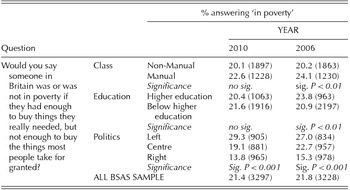
Consistent with BSAS findings (see Table 1), the relative definition of the word ‘poverty’ was rejected by a majority of interview respondents who expressed an opinion (albeit by only a narrow majority), although many did not clearly support or reject it. Interviewees’ reasons for rejecting it broadly match earlier studies’ findings (see above). Respondents usually said or implied that the word ‘poverty’ meant material conditions more miserable and desperate than those at, or immediately below, the current UK relative poverty line. For example, Lincoln, male, thirties, described his current experience of being on JSA: ‘it's not easy, it's tough, in fact it's very tough, but I wouldn't call it poverty’. As in existing studies, people drew upon global and historical comparison when arguing that life on benefits in Britain does not entail ‘poverty’; Africa and past centuries in Britain were both cited by several respondents as having large numbers in ‘real poverty’. Respondents tended to assign the word ‘poor’ a more relative meaning than the word ‘poverty’; ‘poor’ often meant poor in relation to those in close social and geographical proximity to themselves (Shildrick and MacDonald [Reference Shildrick and MacDonald2013] found the same).
Percentage of social categories agreeing with defining ‘poverty’ as ‘relative poverty’

Notes: Response options were ‘in poverty’, ‘not in poverty’ and ‘don't know’ (‘don't knows’ comprised fewer than 3% of responses in both 2006 and 2010) and all were included in calculating the above percentages. Figures in brackets are the total number of respondents in the social category. ‘Politics’ is derived from the BSAS left-right scale and scores are cut to deliver similarly-sized groups (Left = <2.4, Centre = between 2.4 and 2.8, Right = >2.8).
Source: British Social Attitudes Survey data, 2006/2010.
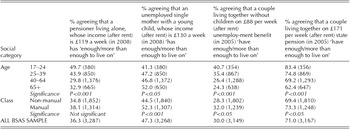
Respondents who stood out as being most likely to define poverty as relative poverty were those who had experienced more middle class/non-manual backgrounds and occupations, graduates, and those who expressed egalitarian opposition to mainstream political parties. In the middle class respondents’ case, this appeared to be connected to their tendency to regard living standards at around the UK relative poverty line as unusually tough in comparison with their own experiences. University degree holders were most likely to be already aware of relative poverty (some mentioned their knowledge of it, while others appeared to allude to it more vaguely), and this seemed to account for some of their sympathy towards it. Respondents who bemoaned the extent of inequality in Britain seemed to imply that this consideration impacted on their decision to support a relative definition; two respondents (Lincoln JSA, female, fifties; Paisley JSA, male, forties) who even said that they found life on benefits tolerable strongly supported defining poverty as relative poverty, seemingly as a consequence of their stated objection to the extent of inequalities in income and wealth. These interview findings on politics (though not those on education and class) are strongly echoed by the BSAS findings (Table 1). However, in the case of class, the lack of similarity between BSAS and interview findings might be a consequence of the survey item's wording. Perhaps ‘things they really needed’ is defined more broadly by more middle class survey respondents in the same way that, as Clery et al. (Reference Clery, Lee and Kunz2013: 7) suggested, it might be defined more broadly by respondents in more prosperous times. Indeed, Table 2 uses survey questions that are explicit about the living standards respondents must have in mind, and here we see that the lower classes tend to be more likely to consider relatively low incomes ‘enough to live on’Footnote 4 – a theme that emerged strongly from the interviews, and which I pursue later.
Percentages of social categories agreeing that people on particular incomes have enough/more than enough to live on

Notes: Percentages agreeing are calculated by combining those who answered ‘has/have more than enough to live on’ or ‘enough to live on’ (as opposed to ‘is/are hard up’ or ‘is/are really poor’). Figures in brackets are the total number of respondents in the social category. Amounts of money quoted in the survey questions match the typical state benefit entitlement of the social categories.
Source: British Social Attitudes Survey data, 2005/2008.
I asked respondents how they felt/would feel about living on JSA, which was £67.50 per week for over twenty-fives in 2011 (most people on this income would be classed as poor by popular relative poverty measures). I gave them a scenario in which they did not have to pay council tax and housing costs (though in reality housing benefit, which JSA claimants are usually entitled to, does not always fully cover rent) but they would have to pay for other expenditures including food, electricity and gas out of the £67.50. None of the seventy said that this amount provided a truly comfortable standard of living. Respondents mostly came at least close to the view that while living on the amount was ‘doable’ (as several put it) or enough to ‘scrape by and survive’ (retail, male, twenties) as it paid for basic necessities such as food and fuel, it was not an adequate amount for funding participation in social events (which often meant one ‘night out’ per week). Partick JSA, female, forties, for example, said ‘it's a real pain. It just allows you to live, you can't explore anything, you can't go away, you can't go to the theatre [or] the cinema’; similarly, Lincoln JSA, female, forties, summed up many respondents’ sentiments when she commented ‘you can get by, but you can't have any nights out’.
Thus, the respondents implied their subscription to some key tenets of Townsend's argument for the relative definition of poverty – they agreed that people have social needs which are specific to time and place, and which require more income to fulfil in some societies than they do in others. Respondents tended to say that around £30 was required for the ‘night out’, and many said that an income about £30 above the JSA level was adequate or comfortable. For example, retail worker, female, twenties, echoed many respondents’ sentiments:
In the past when my rent was paid I always ended up with 100 quid a week, and I've always felt that's enough, it's quite a nice lifestyle. Sixty-five is OK for the basics, you know, your food, your electricity, but I think everyone has a right to a bit of social life, you know, a few nice things, but I think on 100 quid I never felt particularly rich but it was nice, it was comfortable.Footnote 5
Yet conversely, when I asked respondents to choose between living on JSA and increasing their weekly net income by £30 by undertaking a job in present-day Britain which they considered unattractive, only a minority said they would choose the job. Indeed, people tended to say they would undertake a job they liked for around the same net income as benefits, but not a job they disliked; thus, the type of work, not the income difference, appeared to be their key consideration. While attitudes towards employment (and debates surrounding them) are not this article's central focus, it is nevertheless noteworthy that respondents did not, in general, consider the predicament of living on JSA and related benefits to be so desperate that they wanted to escape it as a matter of great urgency. Indeed, given that the extra £30 would, in some cases at least, propel them over the relative poverty line, the finding contradicts the claims of some mainstream social policy writers, for example Spicker (Reference Spicker2007: 115), who insisted that ‘when people have a choice they do not stay poor’. Earlier evidence from Ireland also suggests that people sometimes choose to remain in relative poverty in preference to undertaking jobs they consider unattractive (Nolan and Whelan, Reference Nolan and Whelan1996). Nevertheless, while interviewees were not usually enticed by the prospect of relatively small economic gains, their lengthy descriptions of their lives in the labour market showed that virtually all had been willing to work when the wages were much higher than state benefits, even in jobs they did not like.
Having noted general patterns in the seventy accounts, I now focus on differences between sub-groups. People who had grown up in the most deprived households and locations were most likely to consider a JSA-level income at least fairly normal and to report being able to cope fairly comfortably on it (which matches the social class findings in Table 2). Two female, Paisley JSA claimants, both over forty, fitted this description more than anyone else. For example, female, forties, was asked if she believed that JSA was enough to live on:
It is enough, of course it is . . . [food is] just for me a tenner [per week] . . . my gas is a tenner and that might do me a week and a half, electricity is a tenner and that might do me a week and a half . . . I don't really eat much . . . ten pound, go to ASDA, buy your food [for the week].
However, money was usually of paramount importance to these and other more working class respondents, so they were the most attracted by small economic enticements. For example, Lincoln JSA, male, fifties, spoke of placing high importance on money and of his moving from job to job in the same industry as a consequence of being offered slightly higher wages.
At the other end of the spectrum were those who said they considered JSA an ‘unthinkable’ amount to live on (teacher, female, thirties) or ‘a joke’ (building site worker, male, fifties), and those who spoke bitterly about the daily financial struggle they faced on JSA (e.g., ‘there's no money for the last four days of the fortnight’, Partick JSA, female, forties, which matches one of Patrick's, Reference Patrick2014, findings). Those from more middle class backgrounds who had experienced lengthy periods in well-paid jobs were the most likely to view JSA income as completely intolerable, an attitude they usually attributed to being accustomed to a much higher income. For example, Partick JSA, female, thirties, who had recently ‘signed on’ for the first time said ‘I've been used to . . . going out to dinner three times a week . . . I'd have to have a lobotomy to live on [JSA] . . . it just limits your choices’; Likewise, Canterbury JSA, female, forties, also a first-time JSA claimant, said ‘I've never had to budget, now having to budget it cannot be done’ – both said they were currently spending savings. The sharp contrast between these respondents’ comments and those of people who had lived more working class lives was reflected in the rest of their accounts, which showed that their perceived ‘normal’ living standards could be attributed to their own lived experiences and the living standards of those around them, as Runciman (Reference Runciman1966) and Shildrick and MacDonald (Reference Shildrick and MacDonald2013) also found.
A few of the youngest JSA claimants who were, as yet, unaccustomed to full-time wages and were used to living on a lower rate of JSA (£53.45 in 2011), were also among the small minority who said that living on £67.50 would not be difficult. Past studies of the young unemployed have found that they are most likely to consider unemployment benefits adequate for these reasons (see Pahl, Reference Pahl, Bryson and McKay1994), and Table 2 shows that younger people tend to be the most likely to consider benefit-level income adequate. Lincoln JSA, female, teenager, explained:
I could live off [£67.50] easily, [my boyfriend] always says I can live off peanuts.Footnote 6 I think it depends on the person because some people could [live on that] and some people would really struggle . . . But I think it's about what you deem necessary to live on . . . I'd quite happily buy Value 20p shower gel, but I'd eat decent food. If you just don't spend money on things you don't really need, you can do it.
A group of six with a distinctly low interest in material possessions and more counter-cultural attitudes was identified. Four of this sub-group had fairly normal expenditure patterns, but none could be described as consumerist, and while all six considered living on JSA to be far from ideal, it did not hurt them enough to encourage them to apply for the wide variety of minimum wage jobs they considered unpleasant or uninteresting. Indeed, this sub-group illustrated (in exaggerated form) many respondents’ view that escaping relative poverty was not an urgent priority. For example, Paisley JSA, male, forties, a university graduate, said of the offer of a £30 net gain to do an unattractive job, ‘that's not an incentive, that's nothing’. Another, Partick JSA, male, thirties, was also a graduate and had been on JSA for a total of three of the last six years. He said that he was applying only for jobs in computing, and that he preferred living on benefits to undertaking all attainable non-computing jobs (though he acknowledged that he would try to obtain a more substantial income through employment if he had a dependent child, as did the previous respondent I quoted). His comments show implicit support, which was also found outside this sub-group (albeit to a far lesser extent), for Sen's (Reference Sen1983) criticism of the entirely relative definition of poverty in its neglect of absolute standards:
Money for me is not the major motivator in my life . . . I see the whole cost of basically the 40 hours or whatever a week . . . you are losing like a 70 per cent quality of life for a 30 per cent increase in finances which might only increase your quality of life by 10 per cent or something . . . I've got internet non-stop, 24/7 entertainment, I have friends, I don't have to think about violence, wars, repression, I have almost zero stress whatsoever, and all just so that I, for all that I just have to give up a holiday abroad once a year and, say, some new clothes every couple of month, and I think it's a fair trade, but there's other people, obviously, find it difficult to live like that . . . To me I think I live like a king, and compared to how a king lived in the last century, I think I live better, so I find it hard to consider myself below the poverty line . . . If you are frugal with your cash you can actually live quite well . . . 20 pound a week on food maybe, and then electricity bills are maybe about 10 or 15 pound and that leaves about 25 to 30 pound.
This quotation illustrates another recurring theme of the interviews, that beyond the few items respondents considered essential (these were society-specific basics, mainly gas/electricity, food and rent), there were very few items that respondents said they would suffer considerably without; as a consequence, they were able to focus their expenditure on purchases that really mattered to them (in the above respondent's case, access to the internet). This approach to budget management could entail buying cheaper versions of particular items they considered relatively unimportant (examples include the Lincoln JSA teenager quoted earlier, and a Canterbury JSA, male, forties, who said that during a lengthy past unemployed spell he had ‘lived on beans on toast so I could afford enough alcohol in the pub’). For these reasons, while JSA claimant respondents acknowledged that missing out on many of the items they could have bought if they had lived on national median income (or missing out on better quality versions of the items they did presently buy) was undoubtedly regrettable, few reported it as a major source of distress. Indeed, people on incomes near the median in richer countries are perhaps now spending a growing proportion of their income on products and services which many people do not have (and which are, therefore, items whose absence is unlikely to cause serious distress) – see also McKay's (Reference McKay2004) discussion of these issues. Hence, it might be suggested that, as countries like Britain become richer, it becomes easier to avoid shame, misery and a sense of exclusion at, say, 60 per cent of median income (i.e. where the most favoured relative poverty line is positioned). Others might counter this suggestion by pointing out that society-wide essentials (perhaps we might call them ‘era-specific basics’) one would feel bereft without are increasing both in number (e.g., the internet, as we enter an era in which the vast majority of the British population are online) and in cost (e.g., electricity bills have risen dramatically this century). Certainly, it would be interesting to investigate further how rising average incomes and increasingly diverse consumer spending patterns might have changed the experience of being relatively poor in Britain.
Conclusion
Poverty was redefined as relative poverty by Townsend in order to garner support for more redistribution of income and wealth. Both the existing empirical evidence and new findings presented here exposed aspects of public attitudes and experience which resonate with unanswered criticisms of defining poverty in that way. The public usually associate the word ‘poverty’ with harsher conditions than those found just below the British ‘60 per cent of median income’ relative poverty line. While people do take into account their fellow nationals’ incomes when defining poverty and when deciding how economically well off they consider themselves to be, they tend to make comparisons with those in close social and geographical proximity to themselves (not with national standards). Furthermore, when they live on an income that is low by national standards they often find that forgoing what they consider non-essentials, in order to save money for the few items that are important to them, enables them to cope at least fairly well. So the evidence suggests that, while living slightly below the poverty line in Britain is far from comfortable, it does not usually entail the level of extreme hardship that the word ‘poverty’ usually evokes.
Despite relative definitions’ noted flaws, social policy academics routinely use the terms ‘poverty’ and ‘relative poverty’ interchangeably, and when poorer British people say they do not live in ‘poverty’ academics often characterise them as misguided. Yet the same academics willingly give poorer people a ‘voice’ when they make more politically palatable comments. Only when academics include aspects of lived experience that do not sit comfortably with their ideologically driven definition of poverty will anything like a complete picture of the lives of the poorer citizens of richer countries emerge.
Acknowledgements
I am grateful to Steve McKay and the anonymous reviewers for their helpful comments on earlier versions of this article. I also thank the British Academy for a small grant (SG110099) which funded the interview research.