INTRODUCTION
Productivity of crops grown for human consumption is at risk due to the incidence of pests, especially weeds, pathogens and animal pests: for instance, without crop protection almost 75% of attainable potato production would be lost to pests (Oerke Reference Oerke2006). Climatic conditions have a significant influence on the population dynamics, life-cycle duration, infestation pressure and overall occurrence of the majority of agricultural pests and diseases. This is particularly true for pest species whose development is directly linked with the climatic conditions and for whom a shift in their climatic niche or their infestation capability is expected during changing climate. Changes in climate may result in alterations in the geographical distribution of the species, increased overwintering, changes in population growth rates, increases in the number of generations per season, extension of the development season, changes in crop-pest synchrony, changes in interspecific interactions and increased risk of invasion by migrating pests (Porter et al. Reference Porter, Parry and Carter1991). An increase in the number of generations per season means an increase in the number of reproductive events per year. If the mortality per generation does not change, then the population of thermophile insects will potentially become larger under global warming (Yamamura & Yokozawa Reference Yamamura and Yokozawa2002). This could play an important role in the case of multivoltine species (Pollard & Yates Reference Pollard and Yates1993). The infestation areas of most of these species are expected to widen to higher latitudes and altitudes, as has been seen for butterflies (Pollard et al. Reference Pollard, Moss and Yates1995; Parmesan et al. Reference Parmesan, Ryrholm, Stefanescu, Hill, Thomas, Descimon, Huntley, Kaila, Kullberg, Tammaru, Tennent, Thomas and Warren1999; Hill et al. Reference Hill, Thomas and Huntley1999, Reference Hill, Thomas, Fox, Telfer, Willis, Asher and Huntley2002). A higher survival rate during the overwintering period could result in an increase in the overwintering population and consequently a greater abundance of insects on crops in the summer. At the same time, the increasing temperature could probably support an earlier diapause termination of overwintering species which will consequently appear earlier. This will influence the intensity of crop–insect interactions (Yamamura & Yokozawa Reference Yamamura and Yokozawa2002).
The current study estimates the impact of climate change on two pests: the Colorado potato beetle (Leptinotarsa decemlineata Say) and the European corn borer (Ostrinia nubilalis Hübner). According to Hare (Reference Hare1990), L. decemlineata is one of the most important insect pests of potato crops around the world; it is present and widespread in the countries covered in the present study (European and Mediterranean Plant Protection Organization (hereafter EPPO) 2007). The occurrence of O. nubilalis across some of the regions in the present study has also been recorded by the EPPO (2007). The EPPO database is based on occurrence data collected in 1991–93 and does not cover countries such as Slovenia and the independent Slovakia. The lack of EPPO data in Slovenia and Slovakia can be mitigated using the results of some studies such as those of Gomboc et al. (Reference Gomboc, Milevoj and Celar1996) or Carlevaris et al. (Reference Carlevaris, Gomboc and Milevoj2003), which covered the distribution and control of O. nubilalis in Slovenia. In Slovakia, the harmful occurrence of O. nubilalis led to the implementation of protective measurements in 1970 (Birova et al. Reference Birova, Brestovsky, Jakubcin and Longauerova1990).
No other interacting factors, such as crop and pest management, crop rotation or crop acreage, all of which can have a significant impact on the occurrence of pests, are considered in the present study. However, these two species are expected to gain new territory and lead to an increase in infestation pressure under climate change because their survival is closely related to climate conditions and, in particular, temperature. Under the current climate conditions, O. nubilalis has one to three generations per year, depending on the latitude and temperature conditions. The number of Colorado potato beetle (L. decemlineata) generations varies between four in the warmer parts of its habitat to one full and one partial generation in cooler parts.
Modelling the life stages of insect species is most often done using accumulated degree-days, while so-called climate matching is a common modelling tool for estimating the impact of climate change on the extension of the range of a species. Climate matching identifies locations currently not invaded that could be colonized by a potential invasive species on the basis of similarity to climates found in the species’ native range (Rodda et al. Reference Rodda, Reed, Jarnevich, Witmer, Pitt and Fagerstone2007). Several models that belong to the group of climate matching tools have been developed and applied in the past. For example, BIOCLIM (Nix Reference Nix and Longmore1986) is a general model for the assessment of the favourability of a given climate for the occurrence of a species. HABITAT is a model for the analysis of the environmental conditions related to the distribution of plants and animals (Walker & Cocks Reference Walker and Cocks1991). DOMAIN is a flexible tool for the modelling of the potential distribution of plants and animals (Carpenter et al. Reference Carpenter, Gillison and Winter1993). ANN and SPECIES are used for the estimation of the impact of climate change on plant species in the UK (Berry et al. Reference Berry, Dawson, Harrison and Pearson2002; Pearson et al. Reference Pearson, Dawson, Berry and Harrison2002, Reference Pearson, Dawson and Liu2004). The assessment of climate favourability for univoltine and bivoltine population of the European corn borer is performed by ECAMON (Trnka et al. Reference Trnka, Zalud, Dubrovsky, Muska, Semeradova, Kocmankova, Roznovsky and Litschmann2005). Régnière & Sharov (Reference Régnière and Sharov1998) used the stochastic generator BioSIM in the model of the geographical distribution of the gypsy moth to obtain the daily temperature data (Régnière et al. Reference Régnière, Cooke and Bergeron1995). BioSIM has also been applied in other studies (Carrol et al. Reference Carrol, Régnière, Logan, Taylor, Bentz and Powell2006) and, with the mechanistic model of overwintering of the pine beetle (Dendroctonus ponderosae), is an instrument for the estimation of overwintering and population survival in current and changed climate conditions.
Mechanisms by which climate conditions affect the development of a species can also be analysed with the CLIMEX software tool. CLIMEX is a world-renowned software that has recently been applied in various scientific studies considering the potential distribution and spread of animal or plant species (Sutherst Reference Sutherst, Mooney and Hobbs2000a, Reference Sutherst, Hammer, Nicholls and Mitchellb; Bell & Willoughby Reference Bell and Willoughby2003; Kriticos et al. Reference Kriticos, Sutherst, Brown, Adkins and Maywald2003; Lockett & Palmer Reference Lockett and Palmer2003; Pethybridge et al. Reference Pethybridge, Nelson and Wilson2003; Rafoss & Sæthre Reference Rafoss and Sæthre2003; Zalucki & Furlong Reference Zalucki and Furlong2005; Olfert & Weiss Reference Olfert and Weiss2006, among many others).
MATERIALS AND METHODS
CLIMEX version 3.0 can be used for the expression of the favourability of climate conditions for species’ survival, and can further be used to compare the climate conditions in different locations. It can also be used for comparing climate conditions in a particular location over time. It is a dynamic model operating with input data on a monthly scale (minimum and maximum temperature, relative humidity at 09.00 and 15.00 h and precipitation), which are generally readily available. Knowing the climatological requirements of the given species allows the suitability of the given area for the population's growth and the stress exposure due to unsuitable climatic conditions to be assessed. These are expressed in terms of the Ecoclimatic index (EI), which describes the climate and enables conclusions to be drawn on the possible development and survival of the species (Sutherst & Maywald Reference Sutherst and Maywald1985; Sutherst et al. Reference Sutherst, Maywald, Bottomley and Bourne2004):

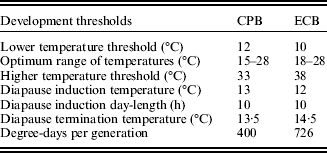
where GIA is an annual growth index describing the population growth during favourable conditions, SI is the annual stress index describing survival during unfavourable periods and SX is the stress interactions. The calculation of GI and stress indices is based on the intervals of threshold parameters for species development adjusted by the user (Table 1). Temperature parameters include the lower and upper thresholds and the optimal range of air temperature for development, similar to soil moisture (SM). In the present study, the SM thresholds were set to values representing the optimal moisture conditions for the pests’ development, these values are 0 for lower threshold, 0 and 8 as an optimal range of SM and 10 as an upper threshold; SM=8 indicates water content 0·8 of the soil holding capacity (Sutherst et al. Reference Sutherst, Maywald, Bottomley and Bourne2004). In the model validation, this was determined to be the right approach through the obviation of incorrectly estimated high dry/wet stress, which would cause an undesirable decrease in EI.
Threshold parameters for the development of Colorado potato beetle (CPB, Leptinotarsa decemlineata) and European corn borer (ECB, Ostrinia nubilalis)
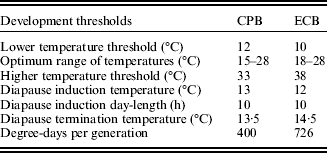
In addition to the temperature and moisture limitations, CLIMEX also takes into account the process of diapause, which is driven by temperature (initiation and termination temperature) and day-length thresholds. The number of generations is calculated based on the number of degree-days above the lower temperature threshold per generation.
Model validation can be carried out by comparing the modelled and currently observed occurrence of the pest, obtained from field observations. In the present study, the CLIMEX model was first validated using observed data of the European corn borer and Colorado potato beetle occurrences in the Czech Republic.
The validated model was applied within the domain of the regional climate model (RCM) ALADIN, which covers the Central European area between 45° and 51·5°N and 8° and 27°E and includes Austria, the Czech Republic, Hungary, Poland, and parts of Germany, Romania, Slovakia, Switzerland, and Ukraine, Slovenia and northern parts of Serbia, parts of Croatia and northern Italy. The ALADIN model was run at a resolution of 10 km over the whole domain and the final maps were interpolated to 1 km resolution using a digital terrain model. The control run used observed boundary conditions (ERA40, ECMWF project, the 45-year re-analysis of the global atmosphere and surface conditions) and covered the period of 1961–2000.
The input weather series for the CLIMEX model was prepared by a weather generator (WG; Dubrovsky et al. Reference Dubrovsky, Zalud and Stastna2000, Reference Dubrovsky, Buchtele and Zalud2004), which was calibrated with the RCM-simulated weather series (for the period of 1961–90). To generate weather series representing possible climate conditions in 2050, the WG parameters were modified according to climate change scenarios (Dubrovsky et al. Reference Dubrovsky, Nemesova and Kalvova2005). In this approach, the scenario is defined as a product of a standardized scenario related to a 1 K rise in global mean temperature and change in the global mean temperature (ΔT G). The standardized scenarios were derived from the outputs of three global climate models (GCMs) from an IPCC-AR4 database (HadCM3, NCAR-PCM and ECHAM5). The value of ΔT G was determined by the Model for the Assessment of Greenhouse-gas Induced Climate Change (MAGICC) assuming high climatic sensitivity (4·5 K) and the high emission scenario SRES-A2. The model estimate for these settings is ΔT G=2·3 K, which is slightly lower than the change in global mean temperature for 2100, assuming middle climate sensitivity (2·6 K) and middle emission scenarios (ΔT G=2·7 K for SRES-B2, ΔT G=3·0 K for SRES-A1B). As a result, the present impact prediction for 2050 (assuming ‘high’ versions of GCM-based scenarios) are about the same as those for the end of 21st century assuming ‘middle’ versions of the climate change scenarios. The MAGICC model is simple and one-dimensional; it is a climate model comprising a suite of coupled gas-cycle, climate and ice-melt models integrated into a single software package. It allows determination of changes in greenhouse gas (GHG) concentrations, global-mean surface air temperature and sea level resulting from anthropogenic emissions of GHG. It compares the global mean temperature and sea level implications of two different emissions scenarios and determines the sensitivity of the temperature and sea level results for any chosen emissions scenario (Harvey et al. Reference Harvey, Gregory, Hoffert, Jain, Lal, Leemans, Raper, Wigley, De Wolde, Houghton, Meira Filho, Griggs and Maskell1997; Hulme et al. Reference Hulme, Wigley, Barrow, Raper, Centella, Smith and Chipanshi2000). It has been used in many impact studies (Goldammer & Price Reference Goldammer and Price1998; Kont et al. Reference Kont, Jaagus and Aunap2003) and in the Second and Third IPCC Assessment Reports (Gates et al. Reference Gates, Henderson-Sellers, Boer, Folland, Kitoh, McAvaney, Semazzi, Smith, Weaver, Zeng, Houghton, Meira Filho, Callander, Harris, Kattenberg and Maskell1996; Houghton et al. Reference Houghton, Ding, Griggs, Noguer, Van Der Linden, Dai, Maskell and Johnson2001).
The major innovation introduced by the present study comes not only from its spatial resolution and the area covered but also from the methodology used. The regional circulation models were used as the primary source of weather data (as key inputs for the CLIMEX based pest models that rely on the monthly data); these data are combined with an approach using a WG. The methodology enables a large territory to be covered with high spatial resolution, allowing for better regional assessments. The findings are crucial for tailoring the right adaptation responses to the expected changes at the regional level.
RESULTS
Colorado potato beetle (L. decemlineata)
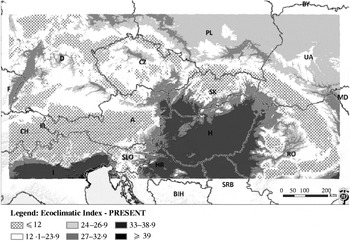
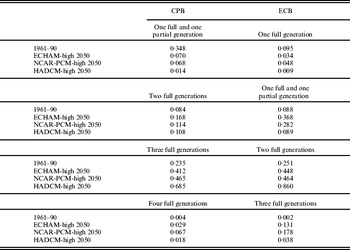
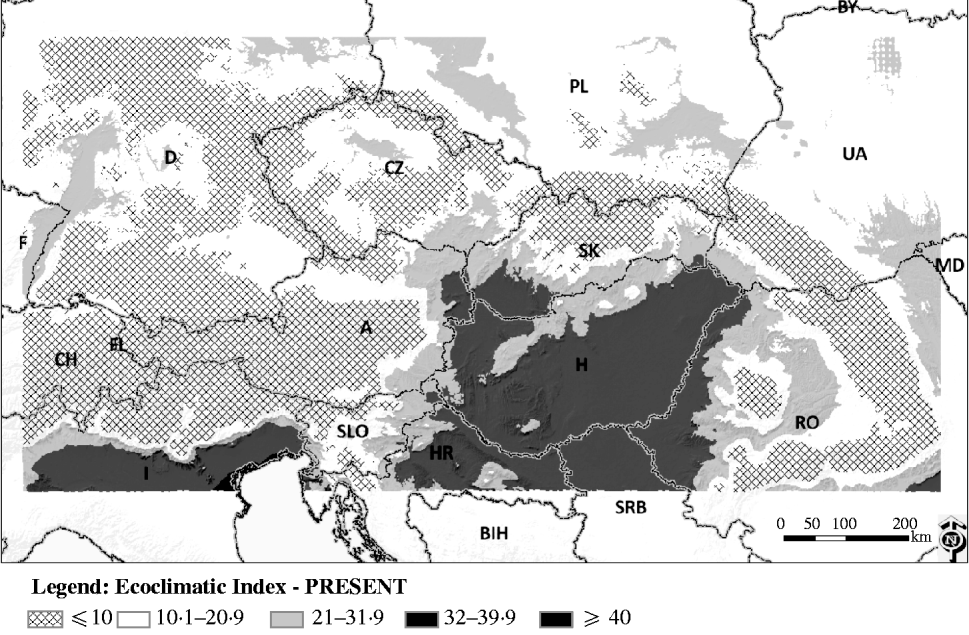
The current climate conditions in the European region examined in the present study, represented by meteorological data from 1961 to 1990, resulted in simulated values of EI that allow for the occurrence of one to four pest generations. Four generations currently occur in a small area in the north of Italy (Fig. 1), while only one generation is found in the northern and eastern part of the region, mainly in Poland and Ukraine. Populations in the lowlands of Germany, the Czech Republic and Slovakia can produce a partial second generation. The main areas with the climate conditions suitable for the development of three generations include Hungary, northern parts of Serbia, Croatia, Italy and the eastern part of Romania. Relative to agricultural production, the simulations of baseline climate conditions indicate that 0·35 of arable land is threatened by L. decemlineata with one complete generation of the pest, 0·08 with two generations and 0·24 with three generations (Table 2). In altitudes higher than 600 m asl, the number of degree-days for the completion of one generation of the pest is not reached, which makes these areas unfavourable for the development and survival of a viable pest population.
Potential geographical distribution of the Colorado potato beetle (L. decemlineata) in current climate conditions expressed by meteorological data between 1961 and 2000. The light grey colour (EI 24–26·9) represents the area occupied by first generation of the pest, grey (EI 27–32·9) is the second generation, dark grey (EI 33–38·9) third generation and black (EI>39) indicates the fourth generation. D, Germany, CZ, Czech Republic, PL, Poland, UA, Ukraine, SK, Slovakia, Moldova, BY, Belarus, R, Romania, H, Hungary, A, Austria, CH, Switzerland, F, France, I, Italy, SLO, Slovenia, HR, Croatia, BIH, Bosnia and Herzegovina, SRB, Serbia.

The proportion of arable land (from total arable land in the area) occupied by a particular number of generations of the Colorado potato beetle (CPB, Leptinotarsa decemlineata) and European corn borer (ECB, Ostrinia nubilalis) in current and expected climate conditions according to the HadCM-high, NCAR-PCM-high, and ECHAM-high scenarios in 2020 and 2050

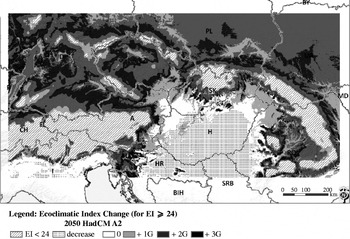
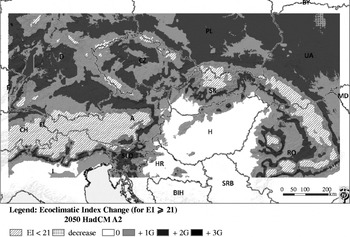
The results of the simulations for the expected climate scenarios show an apparent widening of the pests’ climatic niche and an increase in the number of generations per year based on the temperature increase predicted by various scenarios. Figure 2 shows the change in the number of L. decemlineata generations according to the HadCM-high scenario in 2050. In this scenario, there is an increase of about one generation per year in the northern part of Europe up to an altitude of 800 m asl. In addition, there is a marked increase of about two generations per year in the lowlands, with a significant occurrence of three generations per year. This constitutes an increase of c. 45% in the area of arable land affected by the occurrence of a third generation of Colorado potato beetle in 2050 (the difference between the present and expected states according to a given scenario, Table 2).
Potential geographical distribution of the Colorado potato beetle (L. decemlineata) in the expected climate conditions expressed by meteorological data according to the HadCM-high scenario in 2050. Hatched areas represent the area without an occurrence of the pest due to the incomplete first generation, dotted areas show a recorded decrease in EI, i.e., the shift to less favourable climate conditions for the pest development, white colour marks the areas without any change and the grey scale points the increase in the number of particular generations. Abbreviations as in Fig. 1.

According to the ECHAM-high scenario in the 2050s (Table 2), there is likely to be a decrease in the area of arable land affected by only one full and one partial (second) generation of the pest, from 0·35 in the current climate to c. 0·07. This decrease is caused by a shift of the bivoltine population, which replaces the univoltine one. The complete bivoltine population would occupy 0·17 of arable land, while the area occupied by the third generation increases to 0·69 (HadCM-high). In contrast, a marked decrease in the climate conditions favourable for L. decemlineata development under ECHAM-high is simulated in northern Serbia (Vojvodina region), where the significant temperature increase, according to this scenario, causes the high-temperature limitation for the pest's development and subsequent decrease of about one generation per year. A similar trend in the increase of the high temperature limitation is also seen in the NCAR-PCM-high and HadCM-high scenarios, which show all of Hungary, Croatia and the north of Italy having a decrease in the number of generations per year.
European corn borer (O. nubilalis)
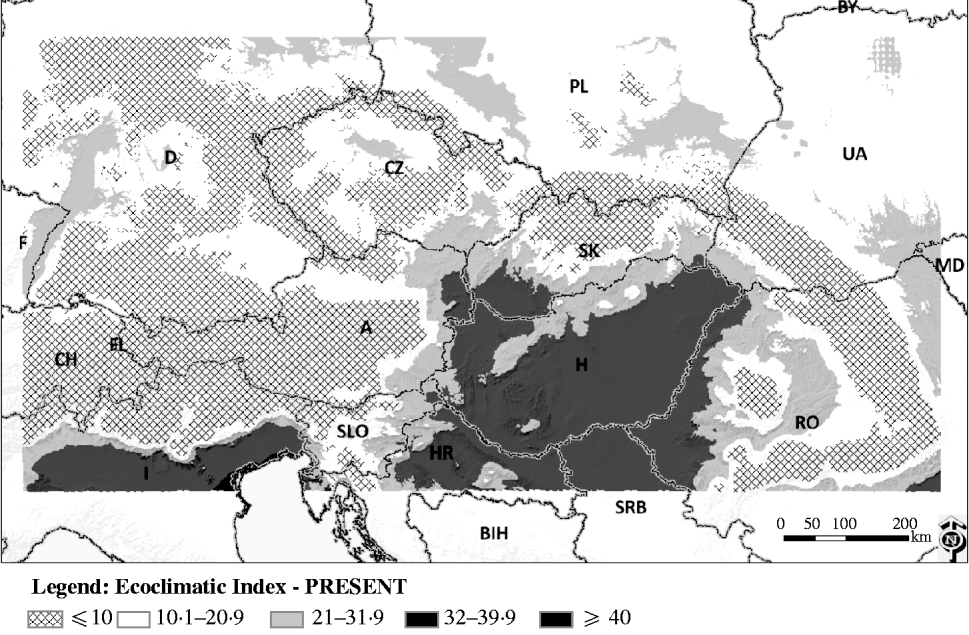
In the European region examined in the present study, the model indicates the presence of one or two generations per year of O. nubilalis under the reference climate conditions (1960–90). A higher number of generations are found in the southern part of the domain, in areas more climatically favourable for the development of O. nubilalis (Hungary, the northern part of Croatia, Serbia and Italy and the eastern part of Romania) (Fig. 3).
Potential geographical distribution of the European corn borer (O. nubilalis) in current climate conditions expressed by meteorological data of the period 1961–2000. Grey (EI 21–31·9) corresponds to first generation, dark grey (EI 32–39·9) the second generation and black (EI>40) represents third generation of the pest. Abbreviations as in Fig. 1.
Under future climate conditions, with their expected temperature increase and prolonged vegetative season, the widening of the area of univoltine population is simulated. At the same time, the emergence of bivoltine populations and a further increase to a third generation per year in the warmest areas is indicated. Figure 4 depicts the expected change in the number of generations according to the HadCM-high scenario in the 2050s. It clearly shows that the pest would, for example, colonize areas recently unoccupied by the univoltine population, up to an altitude of c. 800 m asl. The lowland areas presently occupied by the univoltine population are likely to be replaced by a bivoltine population, which only slightly exceeds the original areal of univoltine one. The occurrence of a second generation per year of O. nubilalis is nearly 61% higher according to HadCM-high 2050 compared to the present period (Table 2).
Potential geographical distribution of the European corn borer (O. nubilalis) in the climate conditions according to the HadCM-high scenario in 2050. Hatched areas indicate a lack of occurrence of the pest due to an incomplete first generation, dotted areas represent a decrease of EI, i.e., the shift to less favourable climate conditions for the pest's development, white colour marks the areas without any change and the grey scale points the increase in the number of particular generations. Abbreviations as in Fig. 1.

HadCM-high presumes a prevailing increase of about one generation, which will probably result in the presence of a third generation in the eastern part of Austria, the north of Italy and the western part of Germany (Rhine valley), where there are currently two generations per season. The NCAR-PCM-high scenario assumes a wider spread, covering a major part of Hungary, Croatia and the whole simulated part of Italy.
The proportion of arable land endangered by a higher number of generations per year is expressed in Table 2, which shows the simulated depletion of the pest's univoltine areas due to substitution by the bivoltine population (i.e. decrease to 0·009 according to HadCM-high scenario) and the overall increase of the area established by completed bivoltine population (0·86 for HadCM-high). Significantly, a third generation is predicted to emerge in 0·18 of arable land in the domain (NCAR-PCM-high), which has serious implications for production.
DISCUSSION
Under the expected future climate conditions in Central and Eastern Europe, as expressed by selected climate change scenarios, crop damage by both the Colorado potato beetle (L. decemlineata) and European corn borer (O. nubilalis) is likely to increase. The increase in temperature will relocate the pests’ development limitations and enable the pests to colonize higher altitudes, thus widening the area over which they occur. In the case of L. decemlineata, there will probably be a decrease in the number of generations per year in the warmest areas, due to the limitations of high temperature, which negatively influence the pest population.
According to one of the first studies to focus on the impact of climate change on O. nubilalis populations in Europe (Porter et al. Reference Porter, Parry and Carter1991), a temperature increase associated with ongoing climate change would lead to a shift of the area affected by O. nubilalis to the north and possibly lead to the occurrence of a second generation per year in the presently univoltine areas. The results of the present study are also supported by estimates based on the more detailed ECAMON model (Trnka et al. Reference Trnka, Muska, Semeradova, Dubrovsky, Kocmankova and Zalud2007). However, the comparison of the potential occurrence of O. nubilalis as assessed by both the ECAMON and CLIMEX models in the study of Kocmankova et al. (Reference Kocmankova, Trnka, Zalud, Semeradova, Dubrovsky, Muska and Mozny2008) showed that CLIMEX tended to underestimate the potential geographical distribution assessment compared to ECAMON, which seemed to be a more sensitive tool for O. nubilalis occurrence estimation and was supported by a better fit with actual observations. This superiority of ECAMON over CLIMEX is caused by a very detailed developmental module and the use of the daily time step compared to the crude climatology used in CLIMEX.
The detailed evaluation of the model has demonstrated ECAMON's capability to estimate accurately the initiation and persistence of crucial phenological stages. However, the main advantage of CLIMEX is that it has far lower input data requirements and still yields relatively reliable results. In the case of an expected increase in temperature and seasonal shift (Dubrovsky et al. Reference Dubrovsky, Nemesova and Kalvova2005), both models estimated the O. nubilalis expansion into higher altitudes according to chosen SRES scenarios. One of the main conclusions was that both models indicated that the climate is a significant factor determining the development and survival of O. nubilalis. However, the CLIMEX results shown in the present study could therefore also be seen as underestimates of the potential future risk of this pest.
The simulated geographical distribution represents the potential occurrence of the pest's infestation, or the area with suitable conditions for the O. nubilalis occurrence with a viable population, which is usually associated with economically significant densities. The present study did not take the host presence into account because of the wide range of possible host species for O. nubilalis. Thus, host presence is not thought to be a severely limiting factor, although it may significantly slow down developmental rates (Anderson et al. Reference Anderson, Kennedy and Stinner1982).
Baker et al. (Reference Baker, Sansford, Jarvis, Cannon, Macleod and Walters2000) adopted the CLIMEX approach to study the effect of climate change on the potential distribution of L. decemlineata. Their study confirmed the widening of the L. decemlineata area in the climate change conditions predicted by the CLIMEX simulation of climate suitability assessment in the UK and Europe. The EI estimates the suitability of the location for the establishment of the Colorado potato beetle in Europe The increase in EI for the Colorado potato beetle was predicted by CLIMEX under the mean HadCM2 GHG climate change scenario in Europe. For the UK, it was found that this climate change scenario would provide 79 additional 0·5° latitude×0·5° longitude grid cells climatically suitable for colonization by the Colorado potato beetle, representing a potential range expansion of 120% and a mean northerly increase of 3·5° latitude (400 km). This expected distribution covered practically all (except for 0·006) of the current potato production area. The greatest increases in the suitability for Colorado potato beetle, according to Baker et al. (Reference Baker, Sansford, Jarvis, Cannon, Macleod and Walters2000), lie from 50°N to 65°N in northern Europe. The present study also concluded that potential geographical distributions cannot be accurately predicted without taking dispersal and species interactions, such as competition and the effect of natural enemies, into account. It also concluded that attempts to predict the ‘real’ potential future distributions of organisms solely using climatic mapping are mistaken and invalid. The identification and modelling of an organism's responses to climate, whether based on deductive or inductive methods, will contain errors and uncertainties. Nevertheless, in many cases, climatic mapping provides the only method that can be used for the climate-related risk potential due to insufficient data on other factors (Baker et al. Reference Baker, Sansford, Jarvis, Cannon, Macleod and Walters2000), keeping the aforementioned limitations in mind.
Simulations of the occurrence of the L. decemlineata as an exotic pest in Norway made by Rafoss & Sæthre (Reference Rafoss and Sæthre2003) indicated that the current climate is not suitable for long-term establishment of this species. The climate change scenarios clearly indicate that a temperature increase could provide a shift in the establishment conditions from non-favourable to favourable for L. decemlineata in several locations.
The differences between three projections used in this study are listed in the Table 2. The high variability between individual projections is primarily caused by considerable differences between applied scenarios as HadCM-high implies much sharper increase of summer temperatures accompanied by a decrease in summer rainfall. On the other hand NCAR-PCM-high assumes a much milder temperature rise over summer with a relatively small reduction in precipitation, while ECHAM-high projections are intermediate. One should also realize that the areas of the occurrence of particular number of generations expected in the future are not geographically identical under individual projections that arise from different patterns of the used GCM in combination with the magnitude of predicted change. This further intensifies the differences between the final values of affected arable land. Future research and application of the proposed methodology should therefore include higher number of GCMs as well as RCMs in order to identify areas that are most at risk. Overlapping of individual projections will allow better detection of those areas where estimates are in agreement in term of the pest's shift and its magnitude.
In general, climatic mapping plays an important role in the estimation of the species’ occurrence depending on their climate niche requirements, but the method is limited by its lack of field- or population-level interactions. Climatic mapping may therefore be a very useful tool in the pest risk analyses under changing climate as it allows us to estimate the risk of introduction, colonization and spread of various pest species and their economic impacts. However, the present study also demonstrates, through the example of two pests, that any long-term pest risk analysis must take climate change into account because of the possible changes in the climate niches.
For a regional evaluation of potential pest risks under changing environmental conditions additional factors, such as crop and pest management, crop acreage and land use, must be considered. This requires expert local knowledge. However, more specific pest models, as already applied or improved for the operational level for pest management decision-making, where data are available, could also be used for long-term assessments. In addition, there is a significant application potential of pest risk monitoring, not only for now casting but also for long-term projections, which results in a demand for further research in order to develop more sophisticated models.
The study was supported by the 6th FP EU research projects CECILIA (number GOCE 037005), by the 6th FP EU project ADAGIO (Adaptation of Agriculture in European Regions at Environmental Risk under Climate Change) SSPE-CT-2006-044210 and by the Research Plan No. MSM6215648905 ‘Biological and technological aspects of sustainability of controlled ecosystems and their adaptability to climate change’.