

Introduction
By the use of direct-fed microbials (DFM) such as yeast and lactobacilli, it is possible to modulate rumen fermentation and microbiota, and thus improve feed digestibility and the performance of dairy cattle (Desnoyers et al., Reference Desnoyers, Giger-Reverdin, Bertin, Duvaux-Ponter and Sauvant2009). Live cultures of Saccharomyces cerevisiae, like brewer's and baker's yeast, are the most commonly used DFMs in ruminant production. Saccharomyces cerevisiae supplementation has been shown to stabilise ruminal pH and increase the concentration of volatile fatty acids (VFAs), as well as to increase the feed intake and milk yield in dairy cows (Desnoyers et al., Reference Desnoyers, Giger-Reverdin, Bertin, Duvaux-Ponter and Sauvant2009).
The action of yeast hydrolysate in the bovine rumen appears to differ from live yeast, because its cell wall structures and intracellular organs are exposed to ruminal microbes. Rossi et al. (Reference Rossi, Di Luccia, Vincenti and Cocconcelli2004) observed that peptidic fractions of Saccharomyces cerevisiae stimulated the growth of lactate-utilising bacterium Megasphaera elsdenii. According to Meissner et al. (Reference Meissner, Henning, Leeuw, Hagg, Horn, Kettunen and Apajalahti2014), a Saccharomyces cerevisiae yeast hydrolysate product (YHP) increased the growth of Megasphaera elsdenii and stimulated fermentation by bovine ruminal microbes in vitro. In a trial with neonatal Holstein calves, YHP enhanced the production of immune-related serum proteins, suggesting an improved immunocompetence against infectious diseases (Kim et al., Reference Kim, Seo, Yun, Kang, Ko and Ha2011). Recently, the same product was observed to increase milk yield and decrease somatic cell counts in dairy cows (Gaffney et al., Reference Gaffney, Sheehy, Vuorenmaa and Fahey2014).
In the following trial the effect of YHP on ruminal fermentation in vitro was studied in detail. The dose-dependency of the effects of YHP and different ratios of concentrate feed (CF) to grass silage (GS) were investigated. The production of gas and short chain fatty acids (SCFAs), and the increase in microbial cell density were used as determinants of the microbial fermentation and growth rate. SCFAs are here referred to as the sum total of lactic acid and volatile fatty acids (VFAs). By modifying the fermentation procedure or sampling time points between the experiments we aimed to find the most consistent effects of YHP.
Materials and methods
The patented yeast hydrolysate product YHP (Progut® Rumen, patent no EP 1387620, Suomen Rehu, Hankkija Ltd, Hyvinkää, Finland) was used in all experiments. YHP is a free flowing powder which includes 66% Saccharomyces cerevisiae, 14.5% sodium phosphates, 16.5% extracts from barley and barley malts, and 3% anti-caking agent sepiolite. The nutritional properties of YHP are 5% moisture, 34% crude protein, 1.8% crude fat, and 25% ash. The concentrate feed (CF) used in the fermentation for lactating dairy cows (Lypsy-Krossi®, Suomen Rehu, Hankkija Ltd, Hyvinkää, Finland) was based on oats, barley, wheat bran, rapeseed meal, sugar beet pulp, vitamins and minerals, and contained 18.4% crude protein, 30.1% starch, 27.2% non-digestible fibre, and 12.4 MJ/kg dry matter (DM). The grass silage (GS) was a mixture of timothy (Phleum pratense) and meadow fescue (Festuca pratensis). Immediately after sampling the GS was anaerobically packed into glass containers and stored at + 4 °C until used, to prevent aerobic spoilage. GS was cut into ~1 cm pieces and CF was milled to ensure homogenous particle size, the DM was determined, and the feeds were dosed into simulation vessels based on DM.
The in vitro protocol was modified from that of Meissner et al. (Reference Meissner, Henning, Leeuw, Hagg, Horn, Kettunen and Apajalahti2014). Rumen-cannulated dairy cows were used as donors of rumen fluid. The use of the animals was authorised by the National Animal Experiment Board of Finland. The inoculum was collected using a vacuum pump from the middle part of rumen, before the first daily feeding of the cow. The ruminal fluid was immediately sealed in air-tight thermos container and transported to the laboratory of Alimetrics Ltd (Espoo, Finland) at 37 °C, and used as an inoculum within one hour of collection. Before the inoculation, rumen fluid was strained through a 3-mm steel mesh under protective anoxic gas flow to remove large solid particles.
Glass serum bottles (120 ml) were used as the fermentation vessels. Feed components and YHP were weighed directly into the vessels. The vessels were then flushed with CO2 gas which had been passed through a hot copper catalyst to remove any residual O2, and sealed with butyl rubber stoppers and aluminium seals. The fermentation was initiated by adding temperature-adjusted, anaerobic artificial saliva (Goering and Van Soest, Reference Goering and Van Soest1970) and fresh ruminal fluid into the vessels to the total volume of 40 ml under CO2 gas flow. The size of fresh rumen fluid inoculum was 2.5%. The inoculation of the vessels was done in random order to avoid systematic shifts caused by the inoculation order. The vessels were continuously shaken in a gyratory shaker at 100 rpm. and kept at +37 °C. The total duration of each experiment and the intermediate sampling points are given below.
At chosen time points, the production of gas in the fermentation vessels was measured, and samples for the analysis of pH, SCFA profile, and microbial cell density were withdrawn. Gas production was measured by puncturing the rubber stopper with a needle connected to an accurate glass syringe with a sensitive ground plunger, and recording the volume of gas released from the bottles. A 1 ml sample of the fermentation medium for the other analyses was drawn from each vessel through the rubber stopper with a syringe and a needle and introduced into a numbered plastic microcentrifuge tube. The pH of the medium was measured immediately with a pH-meter, and the microbial cell density (i.e. population) and SCFA profile were measured as described below. Due to sampling, the total 40 ml volume of the fermentation medium was reduced by 2 ml in Experiments 1 and 2. This systematic error caused by the sampling was considered negligible and did not affect the between-treatment comparison, as each vessel was treated in the same way.
In experiment 1 the dose-dependency of the effects of YHP was studied. The total feed DM was 1 g/vessel, with 1:1 ratio of CF and GS on a DM basis. Three doses of YHP were added on top of the feed: 0 (Control), 25, and 50 mg/vessel. The control treatment was replicated ten times and the other treatments five times. The sampling time points were 6, 9, and 12 hours post-inoculation.
Experiment 2 measured the effect of YHP on ruminal fermentation with different ratios of CF to GS, representing different feeding regimens of lactation phases of dairy cows. The amount of fresh rumen fluid inoculum was 2.5%. The three diets used were constructed by weighing different ratios of CF to GS (DM) into the vessels as follows: 1) 0.25 g of CF and 0.75 g of GS (CF 25%), 2) 0.50 g of CF and 0.50 g of GS (CF 50%), 3) 0.75 g of CF and 0.25 g of GS (CF 75%). When present, YHP was introduced at one dose, 50 mg/vessel on top of the feed. The total feed DM was set to 1 g/vessel. Each treatment was replicated five times with sampling time points at 6, 12, and 24 hours post-inoculation.
In experiment 3 a six-day semi-continuous fermentation procedure was designed. The total feed DM was 0.5 g DM/vessel (0.25 g of CF and 0.25 g of GS/vessel). YHP was introduced at 25 mg/vessel on top of the feed. After 6 and 24 hours gas production was measured, and the total production of gas/day was calculated. At the 24 h time point, a 1 ml sample was taken for the analysis of pH, SCFA profile and microbial cell density. Following this, 8 ml of the grown culture was transferred into a new vessel with the same quantity of feed and YHP and 32 ml of buffer solution. The 8 ml inocula acted as a starter culture for the next 24 hours. This ‘fed-batch’ procedure was repeated five times.
All SCFA profiles were analysed as free acids by gas chromatography as described in Kettunen et al. (Reference Kettunen, Vuorenmaa, Rinttilä, Grönberg, Valkonen and Apajalahti2014). The total bacterial numbers in the samples were measured by flow cytometry as described in Apajalahti et al. (Reference Apajalahti, Kettunen, Kettunen, Holben, Nurminen, Rautonen and Mutanen2002).
One-way analysis of variance (ANOVA; Experiments 1 and 3) and two-way ANOVA (Experiment 2) were used for the statistical evaluation of the data, using the general linear model procedure of the SPSS software (IBM, version 22). Data for bacterial cell density was log-transformed (log10) prior to statistical analysis. Effects were considered significant at P < 0.05 and as trends at P < 0.10. In Experiment 1, Tukey's honest significant difference (HSD) test was used to separate means when the treatment effect was significant. Means that differed significantly according to Tukey's HSD are denoted in the tables with a different letter superscript.
Results and Discussion
Laboratory model systems of bovine ruminal fermentation have been used both for the nutritional research of dairy cows and for biotechnological purposes (e.g. Weimer et al., Reference Weimer, Russell and Muck2009). Compared to in vivo trials, the advantages of artificial rumen techniques include better control of experimental conditions and less variation between the replicate samples. The short batch-type fermentation model used in the present experiment allowed using fresh rumen fluid with authentic microbiota as inoculum. However, in this approach, the use of high doses of test substance was necessary to detect measurable effects during three to four doublings of the native microbiota which had not encountered the test substance before.
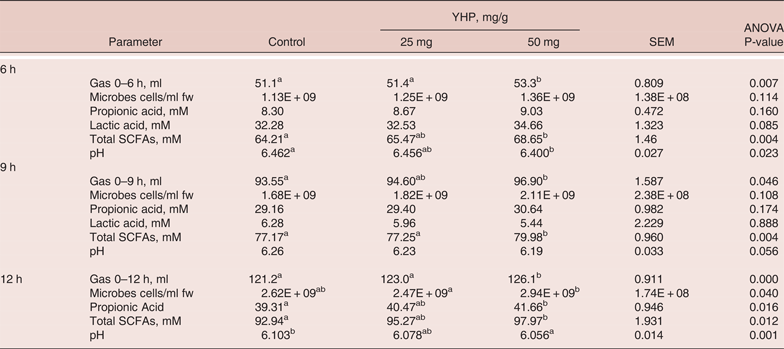
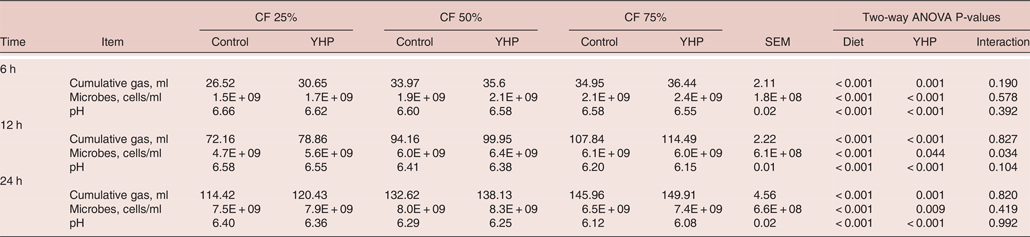
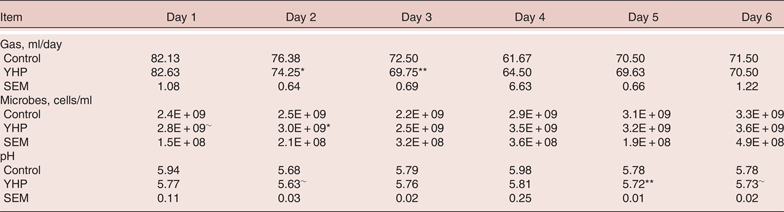
Production of gas is a good indicator of overall rate of microbial fermentation in rumen. In experiment 1, YHP significantly increased the cumulative production of gas at all the time points: 6, 9 and 12 h (Table 1). In experiment 2, with all CF to GS ratios, gas production and microbial cell density were significantly increased by YHP inclusion (Table 2). However, the effect of YHP on gas production in experiment 3 was inconsistent, ranging from no effect to small but statistically significant decrease (days 2 and 3, P < 0.05; Table 3). Overall, these experiments supported the earlier findings of Meissner et al. (Reference Meissner, Henning, Leeuw, Hagg, Horn, Kettunen and Apajalahti2014) which suggested that YHP stimulates the rate of gas production by ruminal microbiota.
Effect of adding YHP to in vitro rumen fermentation on gas, VFA and SCFA production and pH over a 12 hour period

Means not sharing a superscript differ significantly (P < 0.05)
Gas production, microbial cell density, and pH for three dietary treatments: concentrate feed (CF) 25%, CF 50% and CF 75%

Gas production, microbial cell density and pH in rumen fermentation conducted with or without addition of YHP over a six day period

*P = 0.05; *P = 0.01; ***P = 0.001
Microbial biomass is the main source of protein for dairy cows and thus essential for their performance. Wiedmeier et al. (Reference Wiedmeier, Arambel and Walters1987) observed that cultures of Saccharomyces cerevisiae and Aspergillus oryzae increased the density of cellulolytic bacteria in the rumen of non-lactating dairy cows by 40%. In the present study, YHP stimulated the production of microbial cell density statistically significantly at all the time points of experiment 2. The maximum increase of microbial cell density in experiment 2 was 18–20% in the CF 25% treatment and 9–12% in the CF 50% and CF 75% treatments. Significant increases in microbial cell numbers was further observed in day 2 of experiment 3 (P < 0.05; Table 3). In most other treatments of these experiments, YHP numerically increased microbial cell density. The study thus indicated that YHP increases microbial density in this in vitro model system.
In the bovine rumen, pH is decreased by microbial fermentation products like SCFAs (Mills et al., Reference Mills, Crompton, Ellis, Dijkstra, Bannink, Hook, Benchaar and France2014). Since the simulation vessels of the present model system lack an absorptive surface, pH decreases through time as the fermentation products accumulate in the medium. We monitored pH to ensure that it remained at acceptable range to represent ruminal fermentation. Indeed, pH stayed above 6.0 in the first two experiments (Tables 1 and 2) and varied between 5.68 and 5.98 in Experiment 3; Table 3). pH was slightly but significantly decreased by YHP in these experiments, likely because of YHP-induced stimulation in the fermentation rate. Previously, in vivo studies have demonstrated an average increase of rumen pH by approximately 0.03 units as a response to Saccharomyces cerevisiae supplementation (Desnoyers et al., Reference Desnoyers, Giger-Reverdin, Bertin, Duvaux-Ponter and Sauvant2009). In contrast, in an in vitro batch fermentation model, the same product either increased or decreased pH depending on the forage type (Mao et al., Reference Mao, Mao, Wang, Liu and Yoon2013). In vivo studies are needed to evaluate the true effect of YHP on the pH of bovine rumen.
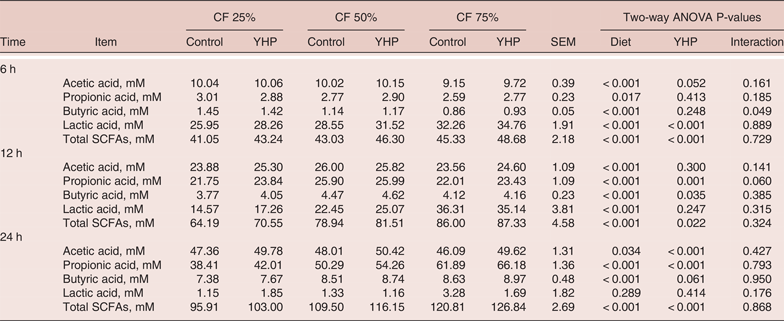
It has been previously reported that the concentration of lactic acid rapidly rises in the bovine rumen after a meal, and is positively correlated with the proportion of CF in the meal (Counotte et al., Reference Counotte, Lankhorst and Prins1983; Mills et al., Reference Mills, Crompton, Ellis, Dijkstra, Bannink, Hook, Benchaar and France2014). Lactic acid was the first individual SCFA to rise also in the present study, as demonstrated by the 6 h time points of experiments 1 and 2 in which the proportion of lactic acid was 50–70% of the total SCFAs (Tables 1 and 4, respectively). However, lactic acid concentration remained below 3 mM in the 12 and 24 h timepoint samples. In experiment 3, lactic acid was not detected at all. The results suggested that lactic acid was a transient metabolite, as is the case in bovine rumen in vivo (Mills et al., Reference Mills, Crompton, Ellis, Dijkstra, Bannink, Hook, Benchaar and France2014). YHP further increased the lactic acid concentration in the 6-h time point from experiment 2 (P < 0.001; Table 4). As expected, the increased dietary CF content in experiment 2 significantly increased the lactate in the fermentation medium (Table 4).
Concentration of SCFAs in the three dietary treatments: concentrate feed (CF) 25%, CF 50% and CF 75%

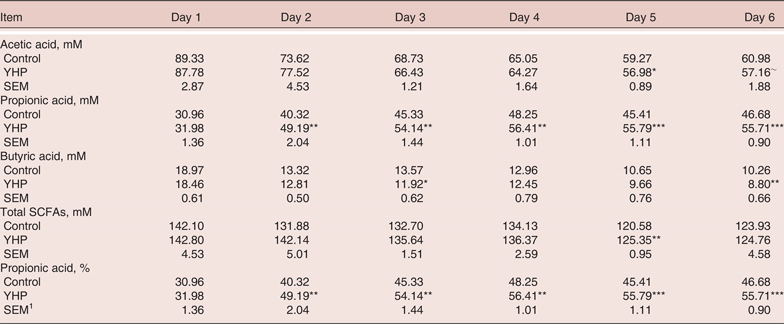
CF ratio of the diet and the ruminal microbial population affected the SCFA profiles in ruminal fluid (Morvay et al., Reference Morvay, Bannink, France, Kebreab and Dijkstra2011). Propionic acid contributes to blood glucose levels in cows whereas butyric and acetic acids contribute to milk fat (Morvay et al., Reference Morvay, Bannink, France, Kebreab and Dijkstra2011). An increase in the production of propionate as a response to live Saccharomyces cerevisiae in continuous culture fermentation has been observed by Miller-Webster et al. (Reference Miller-Webster, Hoover, Holt and Nocek2002). In the present study, the most consistent effect of YHP to ruminal fermentation was the increase in the concentration of propionic acid in the simulation vessels. In the control group of experiment 1, the relative proportion of propionic acid increased from 12.9% at 6 h to 37.8% at 9 h and 42.3% at 12 h, reflecting the microbial conversion of lactic acid into other organic acids. YHP further increased the concentration of propionic acid significantly at the 12-h time point (P < 0.05; Table 1). In experiment 2, both YHP and the increase in CF resulted in significantly higher propionic acid concentration at the 9 and 12 h time points (Table 4). The increase in propionic acid concentration by YHP was the most prominent in experiment 3, where the difference between the control and YHP treatments was 13–18% on days 2–6 (P < 0.01; Table 5).
Concentration of SCFAs from in vitro rumen fermentation with and without YHP supplementation over as six day period

*P = 0.05; *P = 0.01; ***P = 0.001
The effect of YHP on the production of propionic acid suggests that YHP may increase the lactation performance of dairy cows. In fact, an increase in milk yield and decrease in somatic cell scores by dietary amendment of YHP was observed in a trial with 248 Holstein-Friesian cows (Gaffney et al., Reference Gaffney, Sheehy, Vuorenmaa and Fahey2014). Previously, lower milk somatic cell counts and increased lactation by dietary Saccharomyces cerevisiae supplementation have been observed by Zaworski et al. (Reference Zaworski, Shriver-Munsch, Fadden, Sanchez, Yoon and Bobe2014), and Zinn et al. (Reference Zinn, Alvarez, Rodriguez and Salinas1999). Eicher et al. (Reference Eicher, Wesley, Sharma and Johnson2010) suggested improved disease resistance in young cattle by yeast-based products, and indeed, YHP was observed to increase the immune responses of neonatal calves (Kim et al., Reference Kim, Seo, Yun, Kang, Ko and Ha2011).
The effects of YHP on the total concentration of SCFAs or the concentration of acetic or butyric acids differed between the experiments. Results of butyric and acetic acids are given for experiments 2 and 3 in Tables 4 and 5, respectively. In experiment 1, depending on the time point, YHP either slightly increased or had no effect on the concentration of acetic acid, and either increased or had no effect on the concentration of butyric acid (data not shown). In Meissner et al. (Reference Meissner, Henning, Leeuw, Hagg, Horn, Kettunen and Apajalahti2014), YHP increased the concentrations of butyric and valeric acids, but did not affect the total VFA concentration or the concentration of propionic acid. The availability of substrates is known to affect the production of individual SCFA types (Sullivan and Martin, Reference Sullivan and Martin1999). In the present study the most consistent effect of YHP to ruminal fermentation was the increase in the production of propionic acid. YHP stimulated the fermentation in general, which was manifested as a higher production rate of gas or microbial biomass and/or increased concentration of lactate, butyrate, acetate, or total SCFAs, depending on the specific situation.
Conclusions
YHP increased the rate of microbial fermentation of bovine ruminal fluid in all three experiments, as demonstrated by enhanced production of SCFAs, gas and microbial biomass. Most noteworthy was the consistent stimulation of propionic acid production by YHP. The results suggested that YHP may act as a microbial modulator and ruminal stimulant in all the different dietary regimens of lactating dairy cows. Studies with live animals are needed to verify the observations of the present trial.
Acknowledgements
The research was funded by Hankkija Ltd.
Declaration of Interest
J. Vuorenmaa and D. Gaffney are employed by Hankkija Ltd.