1. INTRODUCTION
The diversity of thinking among members of design teams can be capitalized upon through individuals establishing “shared understanding” (Kleinsmann & Valkenburg, Reference Kleinsmann and Valkenburg2007), which enables teams to handle the inherent ambiguity and complexity of design problems. A major challenge for design teams is, therefore, to ensure that members interact and communicate in ways that facilitate group collaboration and cohesion so as to permit maximal knowledge integration. In this paper, we hypothesize that successful collaboration and cohesion in design teams is supported by the deployment of two important reasoning strategies: analogizing and mental simulation. Analogizing is a powerful heuristic for idea generation that promotes an understanding of unknown situations in terms of familiar ones (Holyoak & Thagard, Reference Holyoak and Thagard1995); mental simulation is a cognitive mechanism that enables reasoning about how physical systems might behave without the need actually to construct such systems (Gentner, Reference Gentner, Smelser and Bates2002). While research on analogizing and mental simulation abounds, little is known about how these strategies support team collaboration and cohesion. The study we report is a first step toward bridging this gap in our theoretical understanding.
In addressing the aforementioned issues, we drew upon the DTRS7 data set (McDonnell & Lloyd, Reference McDonnell and Lloyd2009), focusing on the transcripts of two meetings held by an engineering design team in a technology development company. The meetings concerned the generation of ideas for the design and use of an innovative product: a “digital pen” exploiting novel print-head technology, which was to be conceptualized by the team as something akin to an artist's tool or a child's toy. The design issues discussed centered on potential functional and behavioral aspects of the pen (e.g., its operational characteristics when used) and aspects of its structure (e.g., its mechanical and electronic components, and software and interface features). The first team meeting lasted 1 h 38 min and involved seven members: three mechanical engineers, an expert in electronics and business development, an ergonomics/usability expert, a business consultant who facilitated the meeting, and an industrial design student on an internship who was managing the project. The second team meeting lasted 1 h 41 min and also involved seven members. In this meeting, two of the mechanical engineers and the business consultant from the first meeting were replaced by three new members with expertise in electronics and software systems.
1.1. Analogical reasoning, mental simulation, team collaboration, and team cohesion
Analogizing involves the access, retrieval, and transfer of prior knowledge from a familiar situation (the source) to a situation in need of elucidation (the target). Establishing correspondences between known relations in the source and possible relations in the target enables the new situation to be understood in terms of a known situation (Holyoak & Thagard, Reference Holyoak and Thagard1995). Depending on the distance between source and target, it is possible to classify analogies into those that are “within domain” (source and target domains are close) or “between domain” (source and target domains are distant). Analogizing is viewed as essential for creative cognition (Holyoak & Thagard, Reference Holyoak and Thagard1995), scientific discovery (Dunbar & Blanchette, Reference Dunbar and Blanchette2001), and innovative design (e.g., Casakin & Goldschmidt, Reference Casakin and Goldschmidt1999, Reference Casakin and Goldschmidt2000; Ball et al., Reference Ball, Ormerod and Morley2004; Casakin, Reference Casakin2004; Tseng et al., Reference Tseng, Moss, Cagan and Kotovsky2008; Ball & Christensen, Reference Ball and Christensen2009; Helms et al., Reference Helms, Vattam and Goel2009; Casakin, Reference Casakin2010). In conceptual design, analogizing can be especially useful in providing an initial point of departure into problem-solving activity (Goldschmidt, Reference Goldschmidt, Koutamanis, Timmermans and Vermeulen1995). Casakin (Reference Casakin2004) has also shown that expert designers make recourse to many between-domain visual sources, while novices tend to identify and retrieve analogies from within-domain visual sources. Analogizing has been studied in design teams as well as in individuals, with evidence indicating its frequent use to support problem identification, problem solving, solution generation, function finding, and explaining (Christensen & Schunn, Reference Christensen and Schunn2007; Ball & Christensen, Reference Ball and Christensen2009). Christensen and Schunn (Reference Christensen and Schunn2007) also showed that within-domain analogies dominate problem identification, while between-domain analogies dominate in explanations.
In general, analogizing in design helps to enrich the search space of ideas and can be viewed as a strategy that contributes to the attainment of a shared understanding among team members with regard to the task at hand. The role of analogizing in facilitating this shared understanding will itself be mediated by the occurrence of communicative exchanges between team members in relation to each other's knowledge, and it is well known that effective design teams are adept at fluent information exchange (e.g., Stempfle & Badke-Schaub, Reference Stempfle and Badke-Schaub2002; Den Otter & Emmitt, Reference Den Otter and Emmitt2008), which also serves a vital role in promoting team cohesion (Owen, Reference Owen1985; Badke-Schaub et al., Reference Badke-Schaub, Neumann, Lauche and Mohammed2007, Reference Badke-Schaub, Neumann, Lauche, Boos, Kolbe, Kappeler and Ellwart2011). Recent evidence also suggests that analogies reduce cognitive dissonance within design teams so as to propel members toward a particular point of view (Goel & Wiltgen, Reference Goel, Wiltgen, Lamontagne and Plaza2014). Such a dissonance-reduction role presumably also serves to engender team cohesion by bringing members' divergent perspectives into alignment. Based on the assumption that analogizing will have a positive impact on enhancing information exchange and on dissonance reduction, we predicted that it will also be strongly associated with the promotion of team collaboration and cohesion. To our knowledge, this prediction has not previously been investigated.
Mental simulation is another strategy that is considered an efficient aid to problem solving (Gentner, Reference Gentner, Smelser and Bates2002; Trickett & Trafton, Reference Trickett and Trafton2002; Clement, Reference Clement2008; Nersessian, Reference Nersessian2008). It is characterized by a sequence of interdependent events or actions that are envisioned within a dynamic “mental model” with the aim of establishing cause–effect relations, thereby enabling the reasoner to predict potential outputs. The mental models underpinning mental simulation are held in working memory and are structural analogues of physical systems (Johnson-Laird, Reference Johnson-Laird1983; Richardson & Ball, Reference Richardson and Ball2009). Mental simulation can help designers imagine creative ideas and assess their viability, generally serving to aid in managing and resolving uncertainties. Research has corroborated that mental simulation arises in situations associated with uncertainty and reduces such uncertainty, while also enabling designers to test ideas and evaluate and enrich possible solutions (Christensen & Schunn, Reference Christensen and Schunn2007, Reference Christensen and Schunn2009; Ball et al., Reference Ball, Onarheim and Christensen2010). The various roles of mental simulation in design suggest that it should be important in enhancing communication and information exchange connected with task clarification and shared understanding. As with analogizing, we make the novel prediction that mental simulation will likewise be associated with increased collaboration and team cohesion.
2. SUMMARY OF RESEARCH HYPOTHESES
2.1. Analogical reasoning, mental simulation, and team cohesion
As summarized above, we conjecture that analogizing will not only facilitate problem understanding and solution generation in design but also enhance team cohesion by virtue of its capacity to enable fluent information exchange. Mental simulation is likewise known to have an important influence on idea generation and evaluation in design, and we again conjectured that this strategy would also make a measurable contribution to team cohesion. Our view is that a social group such as a design team will be in a state of cohesion when its members possess bonds linking them to one another, thereby preventing group fragmentation. More specifically, cohesion can be defined as the tendency for the group to be in unity while working toward a common goal (Carron & Brawley, Reference Carron and Brawley2000; Beal et al., Reference Beal, Cohen, Burke and McLendon2003; Forsyth, Reference Forsyth2010). This definition reflects a multiplicity of factors, such as the way in which team cohesion is dynamic (i.e., it changes over time in its strength), is instrumentally based (i.e., it is directed toward a purpose, whether this relates to the completion of a task or some social goal), and is emotionally charged (i.e., it is pleasing for members).
An important role of teamwork in design concerns the creation and maintenance of a cohesive team climate (Badke-Schaub et al., Reference Badke-Schaub, Neumann, Lauche, Boos, Kolbe, Kappeler and Ellwart2011) such that members want to stay together to achieve ongoing and future work. Badke-Schaub et al. (Reference Badke-Schaub, Neumann, Lauche and Mohammed2007, Reference Badke-Schaub, Neumann, Lauche, Boos, Kolbe, Kappeler and Ellwart2011) refer to signals of group cohesiveness being expressed through communicative acts (e.g., confirmations) and note that such signals “seem to be akin to the vocalization in non-human primates to coordinate group movements” (Badke-Schaub et al., Reference Badke-Schaub, Neumann, Lauche, Boos, Kolbe, Kappeler and Ellwart2011, p. 182). More specifically, Badke-Schaub et al. (Reference Badke-Schaub, Neumann, Lauche, Boos, Kolbe, Kappeler and Ellwart2011) define three communicative acts as vital for a cohesive climate: informal talk (i.e., communication that is not task related); expressions of appreciation (e.g., “thanks, that's an interesting idea”), which are positive, affective statements directed at a team member; and expressions of confirmation (e.g., “yeah” or “agreed”), which present a positive evaluation, reinforcing conversational flow. Our key prediction was that such conversational markers, particularly confirmatory and appreciative statements, would be significantly higher during or immediately after episodes of activity involving analogizing or mental simulation in comparison to transcript segments where analogizing is absent. Note that we coded transcripts for conversational markers of team cohesion immediately after an analogizing or mental simulation episode on the assumption that such markers might be slightly delayed in relation to the occurrence of the analogy or simulation. What “immediately after” means in practice is that we included the five transcript segments following the analogy or mental simulation as if they were actually part of the analogy or mental simulation.
Our operationalization of team cohesion in terms of increases in utterances signaling appreciation, confirmation, and the like is based on an assumption that such utterances have a functional role beyond the mere indication of engaged listing. This assumption is not uncontentious, because traditionally a view has prevailed that confirmatory utterances such as “mm-hm” can only be interpreted as nonlexical, “backchannel” behaviors that register a listener's acknowledgment of a speaker's statements (Gardner, Reference Gardner1997). More recent evidence, however, supports a functional role for confirmatory utterances, whereby they designate a listener's comprehension (e.g., Wolf, Reference Wolf2008) and facilitate idea generation (e.g., Sannomiya et al., Reference Sannomiya, Kawaguchi, Yamakawa and Morita2003), although we concede that these two studies were restricted to Japanese speakers, such that the extension of these findings to Western speakers remains unsupported at present. Nevertheless, we also note that the concept of backchannel responses has now broadened beyond a focus on simple, nonlexical, vocalized sounds (e.g., “mm-hm” and “uh-huh”) to include brief phrases or statements (e.g., “really” and “is that so?”) and even substantive requests for clarification or repetition (e.g., Young & Lee, Reference Young and Lee2004).
Such evidence suggests that it is legitimate to draw links between confirmatory and appreciative statements and the concept of cohesion in design teams (cf. Badke-Schaub et al., Reference Badke-Schaub, Neumann, Lauche and Mohammed2007, Reference Badke-Schaub, Neumann, Lauche, Boos, Kolbe, Kappeler and Ellwart2011). We also note that the frequency of backchannel utterances will vary, dependent on levels of confusion or misunderstanding (Badke-Schaub et al., Reference Badke-Schaub, Neumann, Lauche and Mohammed2007; Wolf, Reference Wolf2008; Badke-Schaub et al., Reference Badke-Schaub, Neumann, Lauche, Boos, Kolbe, Kappeler and Ellwart2011), again suggesting that these utterances provide valuable data when analyzing shared understanding and team cohesion. In this respect, we emphasize that a key focus of our study was to measure changes in team cohesion that align with the emergence and deterioration of shared understanding in team design activity. We contend that measuring confirmatory and affirmatory utterances is highly suited to this goal and is superior to self-report measures (e.g., Bollen & Hoyle, Reference Bollen and Hoyle1990) that capture group cohesion over long time frames (even years).
As well as predicting associations between measures of team cohesion and the presence of analogizing or mental simulation, we also predicted that analogizing will be associated with lower levels of information exchange and shared understanding than simulation, such that conversational markers of team cohesion should be lower in (or immediately after) analogizing than simulation episodes. This speculative hypothesis derived from our assumption that analogizing seems to be a more “individualistic” strategy than simulation, with the latter arguably benefiting more readily from the contribution of others.
2.2. Analogical reasoning, mental simulation, and team collaboration
In operationalizing the concept of team collaboration for our analysis, we drew heavily on Kleinsmann and Valkenburg (Reference Kleinsmann and Valkenburg2007), where team collaboration refers to “actors” (not necessarily just designers) integrating their knowledge through communication in order to create shared understanding and effective design outcomes, rather than to attain the multifaceted goals associated with team cohesion, which typically embody emotional, social, and cultural elements as well as possible task-focused components. In our analysis, we assume that whether analogizing or mental simulation contribute to team collaboration is specifically related to whether more than a single member participated in an episode of design activity involving either of these strategies. We therefore implemented a dichotomous categorization of team collaboration in terms of its presence versus absence. This enabled us to determine whether simulation was associated with increased collaboration relative to analogizing, in line with our assumption that analogizing seems a more individualistic strategy.
2.3. Analogical distance, analogical purpose, team cohesion, and team collaboration
As explained earlier, analogical reasoning typically involves establishing relationships between apparently unconnected source and target domains. However, as the distance between these domains increases, the mapping of relations becomes less evident (e.g., Bearman et al., Reference Bearman, Ball and Ormerod2007). We therefore hypothesized that as the source to target distance increases during analogizing, then shared understanding arising through the evocation of the analogy will reduce. Very remote analogies might abstract objects and relations so far away from the target domain as to have little value in enhancing team understanding. As such, we predicted that episodes involving within-domain analogies would be associated with higher levels of team cohesion compared to episodes involving between-domain analogies. For equivalent reasons, we also predicted that more information exchange and therefore increased collaboration would arise during within-domain than during between-domain analogizing.
Below we clarify our scheme for coding analogies in terms of the purpose that they appeared to serve, such as explaining an issue, generating a solution idea, or identifying novel design functions (cf. Ball & Christensen, Reference Ball and Christensen2009; Helms et al., Reference Helms, Vattam and Goel2009; Vattam et al., Reference Vattam, Helms and Goel2010). Evoking an analogy for the sake of explanation would seem to involve less mutual exchange of information than developing an analogy for generating a solution or for function finding. That is, while the purpose of an explanatory analogy is certainly to enhance the understanding of other team members (i.e., the end goal is collaborative in nature), the fact that a single individual conveys this explanation to others means that episodes of explanatory analogizing are (paradoxically) likely to be coded as “noncollaborative.” For this reason, we predicted lower levels of team collaboration and cohesion in the case of explanation analogies than for other analogy types. In relation to analogies linked to solution generation versus function finding, we had no grounds to make a directional prediction regarding the association between these analogy types and team cohesion or collaboration.
3. TRANSCRIPT CODING
A line-based segmentation scheme provided in the meeting transcripts was used to break up the meetings into discrete units of spoken discourse. A total of 3886 line segments were analyzed to address our research hypotheses. In the following subsections, we present a description of the methodology employed to code the transcripts for occurrences of analogies and mental simulations as well as for instances of team cohesion and team collaboration.
3.1. Coding of analogies
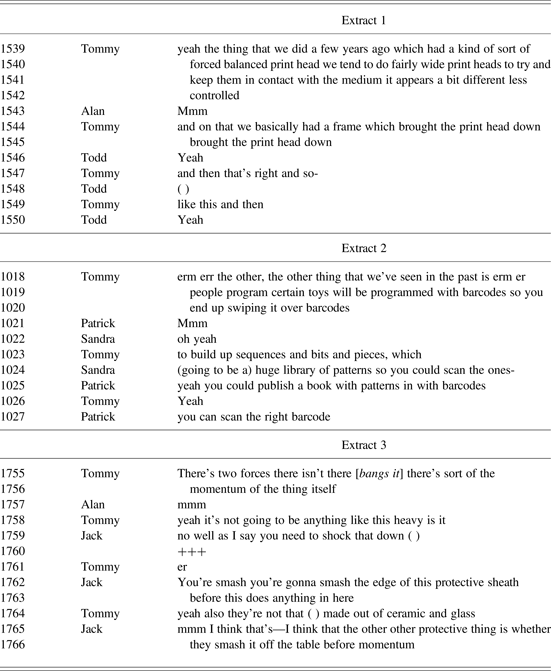
Analogies were coded using Ball and Christensen's (Reference Ball and Christensen2009) approach (see also Christensen & Schunn, Reference Christensen and Schunn2007). When a designer mentioned a knowledge source that was different from the problem at hand and tried to transfer concepts from that source to the target domains, then the source was coded as an analogy. In addition, all analogies identified in the transcripts were coded for analogical distance by applying a binary categorization scheme that included within-domain analogies, in reference to mappings from sources belonging to the problem domain (in the present transcripts the problem domain concerned processes, mechanisms, and artifacts relating to graphical production and printing; see Extract 1 in Table 1 for an example); and between-domain analogies, indicating mappings from sources that that were remote from the problem domain (i.e., sources having nothing to do with graphical production and printing; see Extract 2 in Table 1 for an example).
Transcript extracts showing examples of within-domain analogizing (Extract 1), between-domain analogizing (Extract 2), and mental simulation (Extract 3)

Analogies were also coded for analogical purpose in reference to the analogy's “function” or “goal.” The code for analogical purpose involved Ball and Christensen's (Reference Ball and Christensen2009) scheme (cf. Christensen & Schunn, Reference Christensen and Schunn2007), which included four categories: problem identification (noticing a possible problem in the design, where the problem was taken from an analogous source domain); function finding (mapping new functions to the design via analogy); explanation (considering a concept retrieved from a source domain to explain an aspect of the target domain); and solution generation (transferring potential solution concepts from a source to the target domain; for examples, see Ball & Christensen, Reference Ball and Christensen2009).
3.2. Coding of mental simulations
We coded for mental simulation using Ball and Christensen's (Reference Ball and Christensen2009) scheme, which was adapted from Christensen and Schunn (Reference Christensen and Schunn2009) and Trickett and Trafton (Reference Trickett and Trafton2002). Mental simulation is viewed as involving a succession of modifications to a mental representation, commencing with the construction of an initial representation (e.g., of a solution idea), followed by the modification and spatial transformation of that representation, and ending with the generation of a changed representation (e.g., an adjustment to the solution idea). Typically, the initial representation, simulation run, and changed representation extend over several transcript segments (Ball & Christensen, Reference Ball and Christensen2009). An example of a mental simulation episode is shown in Table 1 (Extract 3). A key characteristic of mental simulation is that it encourages reasoning about the novel states of solutions through a focus on their attributes, visual qualities, or functions. Mental simulation can also enable reasoning about possible interactions between artifacts and end users (Ball et al., Reference Ball, Onarheim and Christensen2010).
3.3. Coding of cohesion
Members of cohesive groups are more likely to engage in active communication, to pursue enhanced levels of information exchange, and to contribute to the development of a shared understanding of the task (Owen, Reference Owen1985). Cohesion was coded using an extended version of Badke-Schaub et al.'s (Reference Badke-Schaub, Neumann, Lauche, Boos, Kolbe, Kappeler and Ellwart2011) scheme, and included utterances expressing appreciation such as statements approving of team members, including thanking them for ideas or explanations (e.g., “yeah OK that's a good idea Tony” and “that's an interesting point”); utterances expressing confirmation, that is, affirming team members' contributions or reinforcing the conversational flow (e.g., “yeah no problem … stabilizers … like a bicycle yeah that's a good idea” and “that's true that works as well”); utterances expressing rejection such as disapproval about an idea (e.g., “yeah but I think there are other things that we might like to do as well” and “no, no, no, you can just calibrate it you know”); and utterances associated with giving help (e.g., “one of those [tablet] things that you write on is that what you mean?”). The cohesion measure was found to involve primarily confirmation utterances, which comprised 91.8% of all cohesion statements, with 3.7% expressing appreciation, 2.6% expressing rejection and 1.8% expressing help. The uneven distribution of coherence codes made it impossible to pursue a detailed analysis of cohesion data at the level of different types of cohesion utterances, because expected counts were less than 5% for chi-square tests, prohibiting their application. We therefore focused solely on analyzing measures that aggregated across all team cohesion codes (831 instances in total).
3.4. Coding of collaboration
Transcripts were coded for the presence or absence of collaboration in order to analyze how team members work as a social group (Casakin & Badke-Schaub, Reference Casakin, Badke-Schaub, Antonietti, Colombo and Memmert2013). To code for collaboration, it was necessary to define an “episode” as a unit of analysis during which collaboration may or may not have arisen. In the present study, the unit of analysis related to analogizing and mental simulation episodes, with each being coded using a binary scheme designating either collaboration (when two or more team members interacted during the episode) or no collaboration (when only one member was identified during the episode, and therefore utterances were restricted to those produced by one individual).
3.5. Intercoder reliability checks
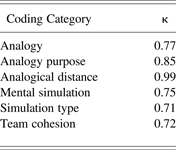
For analogy and simulation codes, the third author acted as the primary coder, while an individual who was not associated with the research coded 1 h of data as a second coder. This secondary coder had received general training in the analysis of design transcripts and was also given some familiarization and practice with the present coding categories. For the team cohesion codes, the first and last authors served as primary and secondary coders. Kappa reliability coefficients are reported in Table 2, where it can be seen that coding categories reached satisfactory levels of reliability (i.e., greater than 0.70), with almost perfect reliability for analogical distance. Note that the coding of team collaboration was in all cases unequivocal, such that it was unnecessary to subject this to a reliability check.
Kappa coefficients for intercoder reliability
4. RESULTS
4.1. Analogical reasoning and team cohesion
A total of 147 analogies were identified in the transcripts, which ranged from 1 to 20 segments per analogy (mean = 3.5 segments). Because analogies represent 13% of all segments, it would appear that team members were fluent at using them. To examine whether analogies are associated with team cohesion, we constructed a contingency table capturing the percentage of cohesion utterances arising in coded segments where analogies were present relative to coded segments where analogies were absent. The data indicated that 24.9% of segments arising during analogies (including the five segments immediately afterward) were associated with team cohesion, whereas only 19.8% of segments not linked to analogizing were associated with team cohesion. This difference was highly reliable [χ2 (1) = 12.91, p < 0.001], supporting our hypothesis that analogizing is a strategy that enhances team cohesion.
4.2. Mental simulation and team cohesion
To examine the relation between mental simulation and team cohesion, we constructed another contingency table to capture the percentage of cohesion utterances arising in coded segments where simulations were present relative to coded segments where simulations were absent. These data showed that 22.7% of segments arising during mental simulations (including the five segments immediately afterward) were associated with team cohesion, whereas 20.1% of other segments not linked to mental simulation were associated with team cohesion. This difference was significant [χ2 (1) = 4.09, p < 0.044], supporting our hypothesis that mental simulation is another strategy that contributes to boosting team cohesion.
We note that the difference in team cohesion utterances arising in mental simulation versus nonsimulation activity was of modest magnitude, despite its statistical reliability. To gain further insight into the link between mental simulation and enhanced team cohesion, we analyzed whether team cohesion was higher during the segments where mental simulation was present or during the five segments following the simulation episode. This analysis showed that it was the segments subsequent to the simulation that were driving the difference in team cohesion; that is, team cohesion in the five segments after each simulation (29.18%) was reliably higher than team cohesion during simulations [20.1%; χ2 (1) = 17.22, p < 0.001].
As a further analysis of the association between mental simulation and team cohesion, we examined whether there was a developmental progression over time with regard to instances of cohesion in the different component stages of a mental simulation. As discussed, a mental simulation is structured temporally, progressing from an initial representation (Stage 1), to a mental model run (Stage 2), to a change of representation (Stage 3). Analyzing cohesion over the time course of the simulation revealed significant differences across the component stages [χ2 (2) = 8.54, p < 0.014], with the three stages being associated with an increasing percentage of segments involving cohesion utterances, where Stage 1 = 15.7%, Stage 2 = 21.5%, and Stage 3 = 23.7%. Follow-up 2 × 2 χ2 tests showed that initial representations had fewer instances of team cohesion compared to mental model runs [χ2 (1) = 4.87, p < 0.027] and changes of representation [χ2 (1) = 8.39, p < 0.004]. However, no difference was observed between mental model runs and changes of representations [χ2 (1) = 0.79, ns].
4.3. Contrasting analogizing and mental simulation in terms of team cohesion
Out next analysis aimed to establish which of either analogizing or mental simulation encourages a greater level of team cohesion. To pursue this analysis, we removed overlapping transcript segments containing evidence of both analogizing and simulation. The prediction that we articulated earlier in relation to this analysis was that analogizing would seem to be a more individualistic strategy than simulation, which might be expected to show a weaker association with team cohesion. Our analysis failed to support this prediction [χ2 (1) = 3.13, p = 0.07], with the marginally significant result supporting the opposite effect, with more team cohesion arising during analogizing (26.7%) than simulation (22.9%). We concede that the statistical difference is weak and should be treated with caution, although we stress that the limitations of this analysis in no way undermine the statistical evidence reported earlier that was central to our thesis concerning a predicted positive association between the respective strategies of analogizing and mental simulation and team cohesion.
4.4. Contrasting analogizing and mental simulation in terms of team collaboration
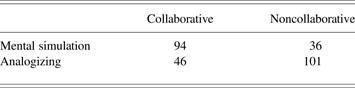
We also examined which of either analogizing or mental simulation is associated with a greater degree of team collaboration, following the same line of reasoning applied above for team cohesion. Again, any overlapping segments containing instances of both analogizing and simulation were removed from the analysis. Furthermore, this analysis was restricted to segments arising during actual analogizing or simulation episodes (i.e., the five subsequent segments were omitted). In addition, segments involving simple utterances expressing team cohesion (e.g., “yeah”) were omitted, because such segments were not considered to contribute to design collaboration in any key way. The prediction that greater team collaboration would arise during mental simulation episodes than during analogizing episodes gained strong support [χ2 (1) = 46.43, p < 0.0001]. The majority of mental simulation episodes were collaborative, whereas the majority of analogizing episodes were noncollaborative (Table 3).
Number of collaborative versus noncollaborative episodes for the mental simulation category and for the analogizing category
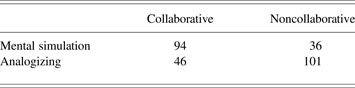
Analogizing episodes in the present transcripts usually involved fewer segments than mental simulation episodes, which means that there is a confound between the type of strategy (simulation vs. analogizing) and episode length. This confound needs to be taken seriously given that longer chains of natural dialogue may entail more frequent conversational shifts between speakers. To examine this issue, we split all analogizing and mental simulation episodes according to their number of segments to form two categories: those with fewer than five segments and those with equal to or more than five segments. Subsequent analyses showed that for episode segment sizes fewer than five segments, analogies were significantly less collaborative (20% collaborative) compared to mental simulations [52% collaborative; χ2 (1) = 11.01, p < 0.0001]. For event segment sizes of equal to or more than five segments, analogies were likewise less collaborative (69% collaborative) compared to mental simulations (77% collaborative), although this effect was not reliable [χ2 (1) = 0.75, ns]. These findings lend support to the claim that the differences in collaboration arising between analogizing and simulation are not merely attributable to a confounding with episode length.
4.5. Analogical distance, team cohesion, and team collaboration
An analysis of the 147 analogies in the transcripts revealed that whereas 84% were between domain, only 16% were within domain. Remote, between-domain analogies are considered to have a positive impact on the novelty of design ideation (Dahl & Wand Moreau, Reference Dahl and Wand Moreau2002; Christensen & Schunn, Reference Christensen and Schunn2007). The predominance of such analogies in the present transcripts may indicate that a high level of creative activity was being undertaken, which would align with the remit of the meetings, which concerned brainstorming and innovative product development (McDonnell & Lloyd, Reference McDonnell and Lloyd2009). The present results, however, are not in line with those of Christensen and Schunn (Reference Christensen and Schunn2007), who studied design meetings in the medical plastics domain and found that within-domain and between-domain analogies were distributed fairly equally across the meetings. The inconsistency across studies may reflect differences in design domains, task goals, or the backgrounds of team members.
To examine whether analogical closeness is associated with team cohesion, we compared within-domain versus between-domain analogies in terms of the percentage of segments they contained that involved cohesion utterances. Our prediction that analogical closeness contributes to enhanced team cohesion was not supported because within-domain analogies contained approximately the same amount of cohesion segments (16.6%) as between-domain analogies [16.2%; χ2 (1) = 0.002, ns]. To determine whether analogical closeness is associated with team collaboration, we likewise compared within-domain versus between-domain analogies in terms of their level of collaborative involvement. The analysis revealed that within-domain analogies were more frequently collaborative (58%) than between-domain analogies [35%; χ2 (1) = 4.28, p < 0.04], supporting our prediction.
4.6. Analogical purpose, team cohesion, and team collaboration
The coding of analogies in terms of their purpose showed that 37% concerned solution generation, 33% concerned function finding, and 27% concerned explanation, while only 3% related to problem identification. The latter proportion of analogy-based problem identification episodes is manifestly lower than that reported by Christensen and Schunn (Reference Christensen and Schunn2007). It is possible that in our study problem identification was not a major concern for designers, given that numerous problems had already been assigned to the engineering design team as part of their design brief (McDonnell & Lloyd, Reference McDonnell and Lloyd2009). In light of the very low number of problem identification analogies, these were omitted from any further analyses. To examine which categories of analogizing episodes were associated with team cohesion utterances, we compared the three remaining analogy categories in terms of the percentage of segments they contained that involved cohesion utterances. The analysis showed no significant differences among these three analogy categories [χ2 (2) = 2.62, ns]. We therefore failed to find support for our prediction that there would be reduced levels of cohesion in the explanation-oriented analogies compared to solution-generation or function-finding ones.
To examine the association between analogical purpose and team collaboration, we compared the analogy categories in terms of their levels of collaborative involvement. The prediction that analogy types would differ was supported [χ2 (2) = 14.17, p < .001]. To ascertain where differences resided, we partitioned the overall analysis and conducted a series of 2 × 2 χ2 tests. These clarified that a significantly greater percentage of analogies concerned with solution generation (50%) were collaborative versus analogies concerned with either explanation [19%; χ2 (1) = 9.77, p < 0.002] or function finding [21%; χ2 (1) = 9.35, p < 0.003]. However, no significant differences arose between analogies concerned with explanations versus function finding [χ2 (1) = 0.04, ns]. These results partially support our prediction that solution-generation analogies would be more likely to be associated with collaborative activity than would explanation analogies, although this prediction did not generalize to the contrast between function finding and explanation analogies.
5. GENERAL DISCUSSION
Our analysis of two product design meetings (McDonnell & Lloyd, Reference McDonnell and Lloyd2009) revealed that analogizing and mental simulation facilitated team cohesion, despite these strategies involving very different underlying reasoning processes. Perhaps a key reason for this is that each strategy promotes fluent communication exchanges among team members, bearing in mind that previous studies have shown how such fluent communication can play a significant role in the attainment of team cohesion (e.g., Badke-Schaub et al., Reference Badke-Schaub, Neumann, Lauche and Mohammed2007, Reference Badke-Schaub, Neumann, Lauche, Boos, Kolbe, Kappeler and Ellwart2011). Presumably, too, such fluent communication facilitates the integration of individual knowledge to support the development of a shared understanding of the design task. Such observations also complement our previous findings, showing that analogizing and mental simulation resolve situations of epistemic uncertainty in design (Ball & Christensen, Reference Ball and Christensen2009).
Detailed analyses of the mental simulation strategy showed significant differences in team cohesion across the three sequential stages associated with enacting a simulation. The initial representation (Stage 1) had fewer instances of team cohesion compared to the mental model run (Stage 2) and the change of representation (Stage 3), which supports the existence of a temporal development to team cohesion during the implementation of a mental simulation. In this respect, it seems reasonable to suggest that a greater shared understanding of the task was achieved by team members as the simulation unfolded over time.
Detailed analyses of analogizing indicated that this strategy was beneficial for team cohesion no matter whether the analogical distance between the source and the target was close (within domain) or distant (between domain). We had predicted that close analogies would be more beneficial to team cohesion than would distant analogies, given that the latter involve source-to-target relational mappings that would be likely to be less immediately evident to all team members. It seems, however, that the contribution of analogizing to team cohesion is such that differences in analogical distance have little relevance. In relation to analogical purpose, we found that all analogy types (function finding, solution generation, and explanation) showed similar associations with team cohesion. If anything, it might have been expected that the focus of the meetings on innovative design would have promoted higher levels of team cohesion for analogies involving the creative processes of function finding and solution generation as opposed to explanation. Instead, however, all types of analogizing appear to have value in enhancing team cohesion and, presumably, shared understanding.
In relation to team collaboration, we found that mental simulation had a larger influence than analogizing. Reasoning by analogy, which is based on identifying, retrieving, mapping, and transferring structural relations, is a mechanism that demands a high level of precision that can best be attained by an individual, limiting the participation of other team members in the analogizing process. In contrast, simulations are characterized by the dynamic development of mental models that are not based on exact estimations (Gentner, Reference Gentner, Smelser and Bates2002), which may encourage the participation of team members in the process, thereby engendering the strong association that we observed between simulation and collaboration.
Further analyses revealed that a larger number of collaborations were observed to develop during analogizing episodes characterized by solution generation than during those related to function finding or explanation. This finding confirms the power of solution-oriented analogical reasoning in creative design, with such analogizing acting as a potent strategy for idea generation that benefits from the synergetic, collaborative participation of team members. Analogical distance was also observed to influence team collaboration, with within-domain analogies enhancing collaboration significantly more than between-domain analogies. This finding is not so surprising given that the domain-specific nature of the analogy implies that more team members could share their domain-based knowledge and expertise with one another during the development of the analogy.
Although we have presented evidence that analogizing and mental simulation have important associations with team cohesion and collaboration, we nevertheless acknowledge that our results may not generalize beyond the product design meetings examined. Domain-specific factors and the detailed dynamics of differently constituted teams might well engender alternative patterns of findings. For example, there are important domain-specific biases in the use of visual versus verbal representations, such as evidence indicating that biologists working in design teams are more comfortable with textual representations of biological systems, whereas engineers working in the same teams prefer diagrammatic representations of the same systems (Helms et al., Reference Helms, Vattam and Goel2010). Such preferences may also extend to analogizing and simulation and impact on team cohesion and collaboration. The representativeness of our results can only be addressed through research exploring the boundary conditions of our findings (e.g., studying different teams and design domains).
A question of practical importance concerns whether design teams can be encouraged to utilize analogies and mental simulations to benefit the establishment of a cohesive team climate and collaborative success. Although we are not aware of research that has investigated whether mental simulation can be promoted as a design strategy, when it comes to analogizing, some prior research has examined the possibility of encouraging analogy use by design teams. For example, Ormerod et al. (Reference Ormerod, Mariani, Ball, Lambell, Sasse and Johnson1999; see also Ball et al., Reference Ball, Lambell, Ormerod, Slavin and Mariani2001) report the development of a computer-based support tool to aid “design reuse” by facilitating the employment by design teams of within-domain and cross-domain analogies. A key aspect of their design reuse system was to introduce an element of “perturbation” into the design process through the triggering of occasional “remote” analogies to previous products that possessed only deep structural associations with a current design problem. Promoting analogy use in design is also a key aspect of research on so-called design rationale (Ball et al., Reference Ball, Lambell, Ormerod, Slavin and Mariani2001), which is concerned with capturing design decision making and creative design development to inform subsequent projects relating to similar tasks. Although the take-up of design rationale methods has been fraught in commercial design practice, it is increasingly the case that design companies are implementing design-capture processes that can benefit subsequent activity by promoting analogical reasoning based on prior design concepts.
A related issue to that of promoting analogizing and mental simulation in design practice concerns the possibility of educating design students in the application of these strategies. Casakin (Reference Casakin and Helie2012) has extoled the virtues of analogy in design education, arguing that students are not always aware of the utility of analogical reasoning in design such that its appropriation and implementation require training. Casakin (Reference Casakin and Helie2012) has proposed an intervention program whose goal is to help students progressively develop the abilities required to use analogies spontaneously. The approach includes a number of training phases that involve gaining skills in basic cognitive operations (e.g., analysis of design principles from visual examples and finding commonalities between visual stimuli) as well as gaining expertise in complex problem-oriented tasks (e.g., experiencing similar situations to the problem at hand). Of course, in design education, the discrepant knowledge and skills held by teachers versus students suggests that analogy-based training may need to be based on constructs that students can relate to. In this respect, we note that the research of Casakin and Goldschmidt (Reference Casakin and Goldschmidt1999; see also Casakin, Reference Casakin2004) has directly compared the value of presenting a wide range of visual analogies to experienced architects and trainee students. The findings indicate that exposure to such analogies can be beneficial for students and professionals alike, lending further support to the view that training in analogy use can be a powerful tool in design education, and presumably in subsequent design practice too.
It would be fascinating to examine how cueing analogizing or mental simulation in educational or practice-based contexts might interact with other interventions, such as those aimed at facilitating group idea generation (Linsey et al., Reference Linsey, Clauss, Kurtoglu, Murphy, Wood and Markman2011), collaborative idea-combination (Kohn et al., Reference Kohn, Paulus and Choi2011), or team convergence upon a single design solution (Fu et al., Reference Fu, Cagan and Kotovsky2010). One technique that may enhance the effectiveness of idea generation in group brainstorming is the decomposition of the task so that aspects of the problem are considered sequentially rather than simultaneously (Coskun et al., Reference Coskun, Paulus, Brown and Sherwood2000). The potential for problem decomposition to benefit idea generation when combined with analogizing or mental simulation represents an important avenue of investigation.
6. CONCLUSION
There is little doubt that the strategies used by team members will have an influence on the team's social processes. We aimed here to determine how analogizing and mental simulation strategies impact two key aspects of design team dynamics, that is, team cohesion and team collaboration. Our findings attest to the association between these two strategies and the emergence of team cohesion and collaboration, thereby extending previous work on team mental models, team cohesion, and collaboration in design (Badke-Schaub et al., Reference Badke-Schaub, Neumann, Lauche, Boos, Kolbe, Kappeler and Ellwart2011) and research on analogizing and mental simulation in design (Christensen & Schunn, Reference Christensen and Schunn2007; Ball & Christensen, Reference Ball and Christensen2009; Wiltschnig et al., Reference Wiltschnig, Christensen and Ball2013). We have suggested that our findings have important implications for design education and practice, although we concede that further research is essential to test the benefits of triggering analogizing and mental simulation in such contexts.
Hernan Casakin is a Senior Lecturer in the School of Architecture, Ariel University, Israel. He holds a BA in architecture and town planning from University of Mar del Plata, Argentina, and an MS and a DS in Architecture from the Technion IIT. He had appointments as a Research Fellow in the Department of Cognitive Sciences, Hamburg University, and the Environmental Simulation Laboratory, Tel Aviv University, and recently in the Faculty of Industrial Design Engineering, and the Faculty of Architecture, Delft University of Technology. Dr. Casakin is a board member of several international journals. His research interest and publications are in design thinking and creativity.
Linden J. Ball is Dean of the School of Psychology at the University of Central Lancashire, Preston. He conducts laboratory-based experiments to investigate fundamental reasoning processes as well as real-world studies of expertise in domains such as design.
Dr. Ball is Associate Editor of Thinking & Reasoning and the Journal of Cognitive Psychology and is a member of the editorial boards of Design Studies and CoDesign. He is also Editor for the Current Issues in Thinking & Reasoning book series published by Psychology Press. His research interests relate to the psychology of thinking, reasoning, and problem solving.
Bo T. Christensen is an Associate Professor at Copenhagen Business School, where he studies creative processes. A cognitive psychologist by training, his research interests focus on creative cognitive processes such as analogy and simulation in a variety of creative industries. He uses ethnographic methods to study professionals performing creative tasks in their normal work environment, and then he analyzes the conversations for cognitive operations. He also studies how consumers come to perceive creativity in objects. Bo has published in such international journals as Memory & Cognition, Creativity Research Journal, the Journal of Applied Cognitive Psychology, the Journal of Engineering Design, and Design Studies.
Petra Badke-Schaub is a Professor of design theory and methodology at Delft University of Technology. She has a background in cognitive and social psychology and attained her PhD at the University of Bamberg. Her main research aim is to understand designers and support design activity by embedding the social–cognitive context within designer-centered methodology. Dr. Badke-Schaub's publications encompass topics such as critical situations, problem solving and decision making of individuals and design teams in complex environments, sketching and the development of team mental models, and experience and creativity in design. She is an editorial board member of several design journals.