Insertion in the labor market depends as much on the dynamics of the labor market and economy as on individual aspects regarding the work-related competencies of potential employees (Cesario, Guillén Gestoso, & Montalbán Peregrín, Reference Cesario, Guillén Gestoso and Montalbán Peregrín2012; Mishra & Mishra, Reference Misra and Mishra2011). According to the Facts and Figures of the Spanish University System 2014/15, the unemployment rate among university graduates rose from 5.3% in 2007 to 16.2% in 2013, three times more than in other countries of the Organisation for Economic Co-operation and Development (Ministerio de Educación, Cultura y Deporte, 2015). This report also shows that entry into the labor market does not occur immediately on graduation but some time later. Thus, one year after graduation, 43.4% are registered with the Social Security system, 55.6% the second year, 58.6% the third, and 64.4% the fourth.
At the individual level, not only do potential employees need a high level of knowledge and professional skill, they also need to have other qualities that facilitate their adaptation to a complex and changing workplace. Along these lines, the development of transversal competencies is considered a key resource to satisfy the demands of the labor market (Atlay & Harris, Reference Atlay and Harris2000; Cranmer, Reference Cranmer2006; González & Wagenaar, Reference González and Wagenaar2003).
The transversal competencies that are considered to be the most relevant in the employment world have been widely described by various authors. For example, Hartshorn and Sear (Reference Hartshorn and Sear2005) highlight key characteristics like pro-activity, innovation, ability to take risks, autonomy and creativity. García, Díaz, Ramírez, and Castro (Reference García, Díaz, Ramírez and Castro2009) confirmed, using a sample of 223 employers, that autonomy and adaptability to new demands, ability to work in teams, motivation and continuous learning are especially valued. Regardless of what the transversal competencies may be, the interest in their development is due to the assumption that those having or fostering these competencies are likely to increase their employability. The aim of this work is to evaluate the efficacy of an intervention program designed to improve transversal skills and competencies required to increase the employability of university students.
The construct of employability
The evolution of the construct of employability from its beginnings until today has been considerable. It has changed from referring almost exclusively to socio-demographic characteristics to include a range of competency and attitudinal aspects (Rentería-Pérez & Malvezzi, Reference Rentería-Pérez and Malvezzi2008). Employability has become a psycho-social construct that refers to the probability a person has of obtaining an attractive employment in a specific socio-labor context (Fugate, Kinicki, & Ashforth, Reference Fugate, Kinicki and Ashforth2004; Thijssen, van der Heijden, & Rocco, Reference Thijssen, van der Heijden and Rocco2008).
Although there are numerous definitions of employability, the same idea underlies most of them: the probability that a person has to obtain or keep a job. Similarly, Forrier and Sels (Reference Forrier and Sels2003) define employability as the employment opportunities of a person in an internal and/or external labor market, van der Heijden and van der Heijden (Reference van der Heijden and van der Heijden2006) understand employability as the acquisition or maintenance of a job through the adequate use of competencies and the active adaptation of the employee. Similarly, Rothwell and Arnold (Reference Rothwell and Arnold2007) conceive it as the degree to which a person possesses the various skills and characteristics that facilitate finding and staying in a job.
Other authors have understood employability by observing its components. Thus, Wittekind, Raeder, and Grote (Reference Wittekind, Raeder and Grote2009) and Thijssen et al. (Reference Thijssen, van der Heijden and Rocco2008) consider three key components of employability: the qualifications related to the job; personal competencies like the interest in learning and ability to face changes with a positive attitude; and contextual factors, such as knowledge of the labor market. Furthermore, dimensions like flexibility, commitment or adaptability, among others, have been considered (Fugate et al., Reference Fugate, Kinicki and Ashforth2004; van der Heijden & van der Heijden, Reference van der Heijden and van der Heijden2006). Even when there are differences among the nomenclature of employability components, there is some consensus with respect to the essential ones: knowledge and skills, learning ability, career and employment achievements, professional knowledge and personal effectiveness.
Among employability definitions, the subjective dimension of the concept is the one that most stands out. From this perspective, perceived employability is defined as an individual’s own perception of his or her possibilities to get a job (Vanhercke, De Cuyper, Peeters, & De Witte, Reference Vanhercke, De Cuyper, Peeters and De Witte2014). In this line, Gamboa, Gracia, Ripoll, and Peiró (Reference Gamboa, Gracia, Ripoll and Peiró2007) highlight that employability is the perception that people have about the possibility of gaining a job they desire depending on their characteristics and behavior, as well as the context of their settings. Taking this subjective dimension of employability into account is relevant given that perceptions have a direct effect on emotions and behavior (Roskies & Louis-Guerin, Reference Roskies and Louis-Guerin1990). Thus, it is this perception and not objective employability that determines the reaction of a person when facing a specific context (Silla, De Cuyper, Gracia, Peiró, & De Witte, Reference Silla, De Cuyper, Gracia, Peiró and De Witte2009). Some research has linked perceived employability to objective employability results, in terms of professional success (De Cuyper, van der Heijden, & Wittekind, Reference De Cuyper, van der Heijden and De Witte2011) or well-being at work (Berntson & Marklund, Reference Berntson and Marklund2007; De Cuyper, Bernhard-Oettel, Berntson, De Witte, & Alarco, Reference De Cuyper, Bernhard-Oettel, Berntson, De Witte and Alarco2008). Clearly, the concept of employability covers a set of personal characteristics and competencies, knowledge about the work setting and labor market resources, as well as the evaluation that the person makes of these elements. Therefore, the concept of perceived employability brings together other approaches to the construct, such as the competence-based and the dispositional approach to employability. According to Vanhercke et al. (Reference Vanhercke, De Cuyper, Peeters and De Witte2014), both the abilities from the competence-based approach and the attitudes from the dispositional approach are inputs to employability, while perceived employability can be understood as a result of these inputs.
Intervention to improve employability
In the current socioeconomic situation, the need to improve employability of potential workers is especially relevant, and has resulted in it being of great political interest (McQuaid & Lindsay, Reference McQuaid and Lindsay2005). Specifically, the low rate of graduate insertion in the labor market has meant that interventions aimed at increasing employability have become a priority at universities (Belt & Richardson, Reference Belt and Richardson2005; Chan, Reference Chan2012; Harvey, Reference Harvey2005; Hennemann & Liefner, Reference Hennemann and Liefner2010; García et al., Reference García, Díaz, Ramírez and Castro2009; González & Wagenaar, Reference González and Wagenaar2003; Robertson, Teoh, McMurray, Robert, & Sochos, Reference Robertson, Teoh, McMurray, Robert and Sochos2011).
Although a certain degree of consensus exists regarding the skills and competencies that need to be developed to improve employability, there have been few studies that investigate whether training in these areas actually modifies employability. Thus, evaluating the results of an intervention is a key strategy, both as a final diagnosis as to the success of the program and to gain greater insight into the concept, methodology and appropriateness of the instruments used, as well as the assessing the professional practices developed (Fitzpatrick, Sanders, & Worthen, Reference Fitzpatrick, Sanders and Worthen2004).
Some studies carried out with workers show that the development of transversal skills promote employability and other related variables. For example, Juhdi, Pa’Wan, Akmar, and Moksin (Reference Juhdi, Pa’Wan, Akmar and Moksin2010) evaluate the effect that training in formal professional practices and interpersonal skills has on the employability of 260 employees. The results show that professional practice is significantly related to external and internal employability, whereas interpersonal skills are related to external employability.
Salmela-Aro, Mutanen, and Vuori (Reference Salmela-Aro, Mutanen and Vuori2012) highlight the importance of intrinsic motivation and self-efficacy at work, performance and work satisfaction. They carried out an intervention aimed at providing training in career management skills and inoculating participants against setbacks, emphasizing the use of active learning methods. They used a sample of workers consisting of one intervention group (n = 369) and a comparison group (n = 349). The results demonstrate that the intervention, based on Social Cognitive Theory, promoted professional preparation and intrinsic motivation at work.
Using university students, Gokuladas (Reference Gokuladas2011) evaluated the predictive capacity of a series of skills related to employability on the number of job offers received by participants. The 559 participants, as well as having training in engineering, voluntarily received training in verbal reasoning, aptitude development, logical reasoning, problem resolution, non-verbal reasoning, as well as presentation and interpersonal skills, team-working, group discussion and interview skills. These complementary training activities were developed over a period of an academic year. The results showed that the number of offers received are significantly predicted by academic knowledge and verbal skills, such as knowledge of English and verbal reasoning. However, changes in other areas of training were not significant predictors of employment offers received.
Other studies have used self-efficacy as an indicator of the effectiveness of interventions aimed at developing employability, as it is believed to be a good predictor of job searching behavior (Wenzel, Reference Wenzel1993). Self-efficacy is defined as the confidence that people have in their capacity to face certain situations, which is particularly relevant when people have to adapt to a new stage in their lives, such as entering the labor market (Bandura, Reference Bandura1997). Making changes in the self-efficacy of unemployed people has been shown to have an effect on job searching behavior (Albion, Fernie, & Burton, Reference Albion, Fernie and Burton2005; Creed, Bloxsome, & Johnston, Reference Creed, Bloxsome and Johnston2001; Eden & Aviram, Reference Eden and Aviram1993; van Ryn & Vinokur, Reference van Ryn and Vinokur1992).
The few studies carried out on the efficacy of interventions focusing on improving employability and other related variables, like self-efficacy, show promising but inconclusive results for various reasons. First, different variables have been used to measure the efficacy of interventions, rarely using measures of employability and other related constructs. Second, it is uncommon to compare the effects of one group undergoing an intervention with another not subjected to it. Third, papers published on this subject do not usually describe the type of intervention carried out to improve employability. Finally, many of the studies have used active workers or ones that have lost their jobs, paying less attention to those who are incorporating into the labor market for the first time. Therefore, it is necessary to perform more studies directed at evaluating interventions that attempt to promote employability among students, as well as making sure such research complies with the methodological requirements to be able to assert that the reason for any change is due to the intervention.
The aim of this study was to evaluate the efficacy of an intervention program focusing on improving employability of university students. The initial hypothesis is that the intervention will produce an increase in these variables as perceived employability, openness to learning, self-efficacy, and knowledge about the labor market, among the group of participants that undergo the intervention compared to the group that does not. In addition, the satisfaction of the participants with the program is also evaluated.
Method
Participants
Initially, the sample was composed of 308 students from the University of La Laguna (Tenerife), of which 37 were dropouts, all belonged to the intervention group. Of the total number of dropouts, 18 were through labor insertion and the rest were people who did not complete the program and failed to report the reason. The t test for independent samples showed no significant differences in the pre-intervention measurements between people who abandoned the program and those who completed it. Out of the remaining 271 people, 130 students made up the intervention group, and 141 did not participate in any employment orientation activities during the academic year as the comparison group.
In the intervention group, the average age was 24.45 years old (SD = 2.98, minimum = 19, maximum = 30) and 23.1% were men and 76.9% women. There were 56.4% of the sample that had finished their university education, 30.6% were in their final year, and 12.9% were in their penultimate year. In the comparison group, ages ranged between 19 and 30 years old, with the mean being 22.62 years old (SD = 2.46). By sex, 20 (14.2%) were male and 121 (85.8%) were female. In this group, 65% were in their penultimate year of their university degree, and 35% were in their last year.
In both groups, most participants were studying or had studied social sciences (e.g., economics, business administration, tourism, labor relations and psychology).
Design
A repeated measurement design was used with two measurement times (before and after the intervention) and two groups were measured (intervention and comparison). Intervention group was formed with participants voluntarily enrolled in a training program for job search. Comparison group was formed with students that were finishing their degree and they had not participated in any orientation program for employment. The dependent variables or evaluation criteria used were: a) Perceived employability, b) Openness to learning, c) Self-efficacy for labor market insertion, d) Self-efficacy for team working, and e) Knowledge of employment resources. Furthermore, a measurement of the satisfaction with the program was included for the intervention group.
It is important to highlight that the design of the evaluation is characterized by being independent. Thus, the evaluation was carried out by external assessors that did not belong to the institution promoting the program, nor were the assessors involved in carrying it out or in its contents.
Description of the intervention programme
The Programa de Orientación para el Empleo ITINERA (Employment Orientation Program) is managed by the Fundación Empresa of the University of La Laguna (FEULL) and subsidized by the Canarian Employment Service and European Social Funds. It was implemented with the aim of promoting the development of skills and competencies to increase the employability of university students. That is, the program was designed by Fundación’s technicians around the competence-based approach to employability (van der Heijde & van der Heijde, Reference van der Heijden and van der Heijden2006) and the dispositional approach (Fugate & Kinicki, Reference Fugate and Kinicki2008). The intervention program consisted of three types of actions: training in the active search for employment, training in skills for employability, and, thirdly, personalized career orientation. The first two actions were carried out in workshops based on active learning techniques (Caplan, Vinokur, & Price, Reference Caplan, Vinokur, Price, Albee and Gullotta1997; Vuori, Price, Mutanen, & Malmberg-Heinonen, Reference Vuori, Price, Mutanen and Malmberg-Heinonen2005) and were carried out by five psychologists. The third action, personalized career orientations, was organized as individual tutorials with two specialized psychologists.
The program was aimed at university students who were finishing their studies or had recently finished them. To attract participants, the program was publicized through the webpage of the Fundación, and on information screens throughout the university campus, as well as via informative talks given in the various faculties and schools of the university. The intervention lasted 31 hours, which the participant could distribute throughout the academic year. The average time invested by participants to complete the program was three months. In the following sections, the actions carried out are described in greater detail.
a) Training in the active search for employment: the aim of the workshop was for participants to gain knowledge of the labor market and ways of gaining access to it. The specific objectives were the following: a) getting to know the labor market and the ways of entering it, b) using different tools to search for employment, c) gaining knowledge of the different phases of personnel selection and the tests used in each of them, and d) promoting the development and use of skills to deal with job interviews. The workshop involved blended learning, with 12 hours of classroom-based training and 4 hours via the Moodle virtual platform. The classroom sessions were given to groups with an average of 20 people in them.
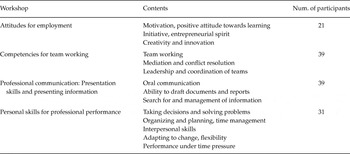
b) Training in skills for employability: the contents of these workshops were aimed at reducing the disconnection proposed by Belt and Richardson (Reference Belt and Richardson2005) between the skills that university students possess and those that businesses value. Training activities were designed around the competencies most highly valued by businesses in the local setting (García et al., Reference García, Díaz, Ramírez and Castro2009), and which coincided largely with those identified in Project Tuning (González & Wagenaar, Reference González and Wagenaar2003). Thus, four workshops were designed: Attitude for Employability, Competencies for Team-working, Professional Communication and Personal Skills for Work. They were all classroom-based and each lasted for 10 hours. Each participant had to choose one of these workshops to complete the intervention program. The sessions were held in groups with an average of 10 participants. In Table 1, the contents of each workshop and the number of participants are given.
Number of participants and contents of each of the workshops on skills for employability

c) Personalized Career Orientation: The aim of these orientation tutorials was for participants to be able to carry out a plan of improvement of employability adapted to their needs. Each participant received five orientation sessions of approximately an hour. In the first session, the different actions of the program were explained and a diagnosis of individual needs and interests was carried out, as well as an analysis of strong and weak points to be able to achieve participants’ objectives. In the second session, there was a review of actions carried out and new issues arising from the first tutorial. Participants were guided towards self-awareness with the aim of jointly designing a Personalized Labor Market Insertion Plan, which consisted of a guide containing the actions to be developed in the following months with the aim of improving employability. Moreover, depending on the weaknesses detected, a skills’ workshop was suggested to the participant. The third session was carried out via an online platform, in which participants had to prepare their curriculum vitae and a covering letter to a real company in the sector they wanted to work. The online career advisor gave some feedback on aspects to be corrected until the user had both documents correctly prepared. The fourth session was also online and consisted of jointly establishing actions to search for employment or training and then giving feedback depending on the success or failure of these. Finally, the fifth session involved revising the previously designed Insertion Plan analyzing any problems that had arisen and giving advice and suggestions on the next steps to take.
Instruments
A questionnaire was used consisting of five measures of change: perception of employability in university students, openness to learning, self-efficacy in relation to behavior directed at labor market insertion, self-efficacy regarding teamwork, and knowledge of resources and tools for searching for employment. Furthermore, a scale to evaluate participants’ satisfaction with the program was developed. In the next section, each of the scales is described. In the Appendix, the items in each are shown.
Perceived employability scale for university student
This scale, developed by Hernández-Fernaud, Ramos-Sapena, Negrín, Ruiz de la Rosa, and Hernández (Reference Hernández-Fernaud, Ramos-Sapena, Negrín, Ruiz de la Rosa and Hernández2011), consists of eight items on the self-perception of competencies, skills and social resources to enter the labor market. These items refer to the probability of finding work after having finished studying, professional skills and competencies, and to employment opportunities. Participants had to indicate their level of agreement with each statement on a scale that ranged from “Totally disagree” (0) to “Totally agree” (10).
Scale of Openness to Learning
This scale was devised for this research. It consists of five items about learning capacity in a work setting and the willingness to adapt to a professional situation. The items refer to the importance of upgrading and recycling oneself at work, the ability to adapt oneself to working circumstances and willingness to learn new things. Participants had to indicate their level of agreement with each statement on a scale that ranged from “Totally disagree” (0) to “Totally agree” (10).
Scale of Self-Efficacy for Labor Market Insertion
This scale, developed by Hernández-Fernaud et al. (Reference Hernández-Fernaud, Ramos-Sapena, Negrín, Ruiz de la Rosa and Hernández2011), is made up of five items about the perception of confidence in being able to carry out different actions aimed at searching for employment, such as adapting a curriculum to the characteristics of a job offer, managing time efficiently, asking questions about doubts in a job interview, visiting a company to offer professional services and highlighting one’s professional qualities in a selection process. Participants had to evaluate to what degree they would be able to do any of these actions described on a range that goes from “Not at all” (0) to “Totally” (10).
Scale of Self-efficacy for Team Working
This scale is composed of four items that cover different behaviors that are part of working in teams, such as being involved in a team, presenting and communicating ideas, resolving conflictive situations and providing novel ideas. Participants had to evaluate to what degree they would be able to do any of these actions on a range that goes from “Not at all” (0) to “Totally” (10). This scale was devised for this study.
Scale of Knowledge about Resources for Employment
To evaluate participants’ knowledge about the resources available for looking for employment a questionnaire developed by the Employment Area of the Fundación was used. This scale is composed of 18 items that refer to the situation of the labor market, resources available for searching for employment, the job selection process and the personal resources required for this search. Participants evaluate their knowledge on each aspect on a dichotomy of “Yes” or “No”. These responses are transformed into a score ranging from zero to ten for each participant. To do this, the number of correct answers was multiplied by 10 and then divided by the total number of items.
Scale of Satisfaction with the Intervention Program
To evaluate the level of satisfaction with the intervention, a scale composed of eight statements that described different aspects of the program was developed for this study (e.g., whether the workshops and tutorials were adequate, whether the career orientation tutorials were adapted to the needs of the participant). Participants were also asked to evaluate the overall program. They had to indicate their level of agreement on a scale from zero, “Totally disagree”, to 10, “Totally agree”.
Procedure
The evaluation of the program was carried out from October 2010 to July 2011. The evaluation team held three meetings with the members of the program responsible for the intervention (seven psychologists): an initial session to present the evaluation plan; an informative session and monitoring of preliminary results four months from the start; and a final session where the definitive results were presented.
Data were collected over nine months. Each participant had to complete the rating scales at two separate times. In the intervention group, participants completed the scales in their first and last career orientation tutorials, always before beginning the intervention and after completing it. The comparison group completed them in the first semester and then again in the second. The average time between the two measurements was three months for both groups.
In all cases, the questionnaire was in paper and pencil format and was completed individually and without any personal details to identify participants. To identify and match the responses from the two measurement times, participants had to indicate the last four digits of their national identification document, age, degree and year they were studying or had studied. The average time to complete the questionnaire was 15 minutes each time. In the last tutorial of the program, the intervention group filled out the satisfaction scale individually and anonymously. The average time to do this was a minute.
Ethics statement
Because the study did not involve risk to participants, the oral informed consent was obtained from the study participants. Participants were clearly informed that the participation was voluntary. Participants were not compensated for participation. This study has been approved by the University of La Laguna Ethics Committee in Tenerife (Spain).
Data analyses
Analyses of the results were carried out using the SPSS v19. First of all, the absence of multivariate outliers was tested using Mahalanobis distance. Secondly, differences between means were analyzed with a t test for independent samples between the intervention and comparison groups in the age variable, and a contrast of χ2 was used to contrast gender distribution in both groups. Thirdly, the unidimensional structure of the scales for perceived employability, openness to learning, self-efficacy for labor market insertion and for team working, and satisfaction with intervention were tested using confirmatory factor analysis, as well as for the internal consistency of each scale. Fourthly, the score for each participant in each of the measurement times was calculated: perception of employability, openness to learning, self-efficacy for labor market insertion and for team working and knowledge of employment resources. Fifthly, the presence of significant differences between the intervention and comparison groups in the pre-intervention measurement of the dependent variables was checked using ANOVA. Finally, an analysis of repeated measures for each dependent variable was carried out, considering the intervention/comparison group as an inter-subject variable.
Results
Significant differences in age were obtained when the socio-demographic characteristics of the intervention and comparison groups were contrasted (t(269) = –5.501; p < .001). The mean age of the intervention group was 1.83 years more than for the comparison group. No statistically significant differences were obtained in the gender distribution of either group.
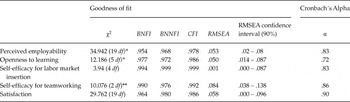
The unidimensional structure of the scales for perceived employability, openness to learning, self-efficacy for labor market insertion and for team working, and satisfaction with intervention were tested. In Table 2, the goodness of fit of the models and the alpha values are shown. All these scales are unidimensional and factorial loads of the items were high and significant (p < .05). Knowledge of employment resources obtained a Cronbach’s alpha of 0.82. However, unlike the other scales, it was not subjected to confirmatory factor analysis as the indicators that it is composed of are independent of each other.
Goodness of fit of the unidimensional models for each of the scales, and internal consistency values

* p < .05; **p < .01.
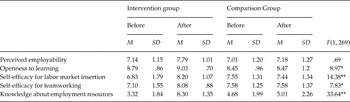
In Table 3, the measurements and standard deviations for each of the variables at both times for each group are shown. Furthermore, the average satisfaction with the program was calculated for the intervention group, which was 9.11 (SD = .80; min = 6.38, max = 10).
Means and standard deviations for each variable (before and after the intervention) for the intervention and comparison group, and mean differences between groups in pre-intervention measures

* p < .01; **p < .001.
Table 3 shows the F value and the significance of each ANOVA test between the intervention and comparison groups in the pre-intervention measurements. As can be seen, the intervention group began with lower scores in the majority of the dependent variables than the comparison group. Only in the case of Openness to learning, the difference in scores was in favor of the intervention group, possibly due to the fact this group voluntarily applied for the program, showing a positive attitude to learning new material.
The analysis of repeated measures for each dependent variable showed a significant interaction between the Group variable and the pre- and post-intervention measures of Perception of employability (F(1, 269) = 17.49, p < .001; η2 = .06), Openness to learning (F(1, 269) = 4.24, p < .05; η2 = .02), Self-efficacy for labor market insertion (F(1, 269) = 75.70, p < .001; η2 = .22), Self-efficacy for team working (F(1, 269) = 39.43, p < .001; η2 = .13) and Knowledge of resources for the search for employment (F(1, 269) = 512.89, p < .001; η2 = .66). In all cases, there is a significant increase in the variable in the group that underwent the intervention program with respect to the comparison group. Thus, the intervention group improved vis-à-vis the comparison group in their perception of competencies, skills and resources they have for labor market insertion, in their capacity to adapt and learn new things, in their confidence to carry out actions aimed at searching for employment and behavior in a team, and in their knowledge of the labor market and their resources to obtain a job. Age was considered a covariate in all the repeated measures analyses, but its effect was not statistically significant in any of the cases.
Discussion
Employability, understood as the possibility of obtaining an attractive job, is a highly important construct in the current socioeconomic situation (Fugate et al., Reference Fugate, Kinicki and Ashforth2004; Thijssen et al., Reference Thijssen, van der Heijden and Rocco2008; Vanhercke et al., Reference Vanhercke, De Cuyper, Peeters and De Witte2014). In the case of university students, its development is especially relevant, given that their labor market insertion does not occur immediately on graduation and is not stable over time (Chan, Reference Chan2012; Hennemann & Liefner, Reference Hennemann and Liefner2010; Robertson et al., Reference Robertson, Teoh, McMurray, Robert and Sochos2011).
The aim of this study is to evaluate the efficacy of an intervention program designed to improve employability among university students. Evaluating the results of interventions is important because of the contribution it can make to the theoretical and methodological development of this field, as well as the information it contributes regarding professional practices (Fitzpatrick et al., Reference Fitzpatrick, Sanders and Worthen2004).
The intervention program evaluated focused on the improvement of key transversal competencies required in different employment settings, and on skills and knowledge specifically related to the search for employment and about the labor market (Atlay & Harris, Reference Atlay and Harris2000; Cranmer, Reference Cranmer2006; Wittekind et al., Reference Wittekind, Raeder and Grote2009). To evaluate the results, an external evaluation with an experimental design involving two groups and two measurement times was used. Five indicators of the efficacy of the program have been considered paying attention to the competences and skills that have been highlighted in the literature as necessary for facilitating labor market insertion (García et al., Reference García, Díaz, Ramírez and Castro2009; Hartshorn & Sear, Reference Hartshorn and Sear2005; Thijssen et al., Reference Thijssen, van der Heijden and Rocco2008; van der Heijden & van der Heijden, Reference van der Heijden and van der Heijden2006). The instruments developed to measure these indicators use good psychometric properties.
The results obtained show that the people who participated in the intervention program, compared to those who did not, consider more positively their competence to obtain employment, their knowledge of the labor market, their ability to search for a job and work in teams, as well as their ability to learn and adapt to new situations. Thus, among university students the intervention program improves perceived employability, openness to learning, self-efficacy for labor insertion, self-efficacy for team working and knowledge about resources for the search for employment. Furthermore, it can be observed that participants in the program show a high level of satisfaction with the training and counseling received.
It is worth highlighting the independence of the evaluation team from the professionals that implemented the program, as well as the use of a comparison group with similar characteristics to the intervention one. Both aspects contribute validity to the results obtained. Nevertheless, there are some limitations of this study that need to be mentioned. The size of the sample is not very large, owing to the fact registration for the program was voluntary and also to some participants entering the labor market during the study. Furthermore, the data used, based on self-reporting, lacks indicators of behavior (e.g., activities searching for employment) or the success of this behavior (e.g., number of interviews held, jobs obtained).
Future studies could focus on evaluating the impact that interventions have on the success of the labor market insertion process considering contextual factors that could affect it, such as the unemployment rate or the available industrial fabric. It would also be interesting to investigate the duration of the effects of the intervention by carrying out a follow-up study over the long-term. Similarly, an evaluation of the contribution to employability and other related variables that each component of the intervention program made would be useful to target personal and economic resources more optimally.
In conclusion, this work makes a contribution to knowledge in this field by demonstrating the efficacy of an intervention program to improve the employability of university students, which encompasses components described by various authors. Moreover, it contributes methodologically by presenting various scales to evaluate variables related to employability. Finally, the results of this study have made an advance in the applied field as they demonstrate an efficient intervention program for improving employability, openness to learning and self-efficacy.
Appendix: Items in the measurement instruments used.