Introduction
Over the course of many decades, numerous scholars have studied the impact of bilingualism on children's language and cognition (e.g., Bialystok, Reference Bialystok2001; Hakuta, Reference Hakuta1986; Peal & Lambert, Reference Peal and Lambert1962; Saer, Reference Saer1923). This research interest stems mainly from the fact that, unlike monolinguals, bilinguals must learn and manage two linguistic systems, which arguably affects their verbal ability and their cognitive development.
In the area of verbal ability, studies show that bilingual children have significantly lower performance on receptive vocabulary tests in each language than monolingual counterparts (e.g., Bialystok, Luk, Peets & Yang, Reference Bialystok2010; Mahon & Crutchley, Reference Mahon and Crutchley2006; Oller & Eilers, Reference Oller and Eilers2002). This finding does not imply that bilingual children are poor vocabulary learners; rather, their words may be encoded in one language but not the other (e.g., Oller, Pearson & Cobo-Lewis, Reference Oller, Pearson and Cobo-Lewis2007). Conversely, in the area of cognitive development, studies indicate that bilingual children outperform monolingual peers in a number of cognitive tasks (for a review, see Bialystok, Reference Bialystok2001, Reference Bialystok2009a). The prevailing explanation for this finding is that bilinguals constantly need to appropriately use one of two languages depending on different linguistic contexts; with habitual practice coordinating two languages, bilinguals exercise domain-general skills that lead to advances in different areas of cognition. In particular, the bilingual experience may benefit two major aspects of cognition: (a) executive functioning (EF), which is an umbrella term referring to higher cognitive functions (e.g., inhibition, working memory) necessary for the conscious control of thought and actions (Welsh, Pennington & Groisser, Reference Welsh, Pennington and Groisser1991) and (b) theory of mind (ToM), which is the ability to ascribe mental states to oneself and others, and to predict people's behaviour on the basis of their mental states (Premack & Woodruff, Reference Premack and Woodruff1978).
Prior studies have shown relations between (a) bilingualism and EF (for a review, see Bialystok, Reference Bialystok2001), (b) bilingualism and ToM (Berguno & Bowler, Reference Berguno and Bowler2004; Bialystok & Senman, Reference Bialystok and Senman2004; Goetz, Reference Goetz2003; Kovács, Reference Kovács2009), and (c) EF and ToM (for a review, see Moses & Tahiroglu, Reference Moses, Tahiroglu, Sokol, Müller, Carpendale, Young and Iarocci2010; Perner & Lang, Reference Perner and Lang1999). Despite substantial literature in each of these areas, no study has yet been conducted to support a model that encompasses all three components: bilingualism, EF, and ToM. The present study will review the relations between bilingualism, EF, and ToM and suggest a mediation model that considers these relations.
ToM and its relation to EF
A major stage in ToM is the emergence of false-belief understanding, or the recognition that people act on the basis of their desires and beliefs even when these beliefs are inaccurate. Typically, the understanding of false belief is measured through the change-in-location and unexpected-contents tasks. In the change-in-location task, created by Wimmer and Perner (Reference Wimmer and Perner1983), children are asked where a protagonist will look for her toy, after it was moved in her absence. To succeed in this task, children must answer that the protagonist would look for the toy in its original location (because it was moved while she was away), rather than in its actual location. In the unexpected-contents task, originally developed by Perner, Leekam and Wimmer (Reference Perner, Leekam and Wimmer1987) and Gopnik and Astington (Reference Gopnik and Astington1988), children are shown a familiar box containing unexpected contents (e.g., box labeled with a crayons brand but containing elastics) and then asked (a) what they thought was inside before the box was opened and (b) what someone else, who had not seen the contents, would think was inside. To respond correctly to these two questions, the children must answer with the usual contents (e.g., “crayons”).
False-belief understanding has often been inextricably linked to EF, and there have been many debates over the nature of this relation (for a review, see Moses & Tahiroglu, Reference Moses, Tahiroglu, Sokol, Müller, Carpendale, Young and Iarocci2010; Perner & Lang, Reference Perner and Lang1999). For example, some scholars argue that ToM is a pre-requisite to EF (e.g., Perner & Lang, Reference Perner and Lang1999), but most contend the opposite (e.g., Carlson, Moses & Breton, Reference Carlson, Moses and Breton2002; Hughes & Ensor, Reference Hughes and Ensor2007; Moses, Reference Moses2001; Russell, Reference Russell1996). Some say that EF affects the expression of pre-existing ToM capacities, but others believe that it explains the very emergence of ToM (Moses, Reference Moses2001). Another major question is: which aspect of EF might explain ToM development?
A major component of EF is inhibition, and though there are various ways of defining different types of inhibition (see Carlson & Moses, Reference Moses2001; Friedman & Miyake, Reference Friedman and Miyake2004; Martin-Rhee & Bialystok, Reference Martin-Rhee and Bialystok2008), a number of scholars suggest that inhibition tasks with a working memory component are those that are highly related to false-belief understanding (e.g., Carlson & Moses, Reference Moses2001; Carlson et al., Reference Carlson, Moses and Breton2002; Hala, Hug & Henderson, Reference Hala, Hug and Henderson2003). For example, Carlson et al. (Reference Carlson, Moses and Breton2002) argue that (a) there are two types of inhibition tasks: conflict tasks (tasks requiring a novel response in the face of a conflicting prepotent response) and delay tasks (tasks that require a delay of a prepotent response), (b) conflict tasks require working memory, whereas delay tasks do not, and (c) false-belief tasks are more similar to conflict tasks in that they both require working memory and inhibition. For instance, in false-belief tasks, children must simultaneously hold in mind two representations (the actual state of affairs and the protagonist's representation of the affair; working memory) and select the representation and corresponding behavioural response that directly conflicts with the actual state of affairs, which needs to be actively suppressed (inhibition); similarly, the Day–night Stroop task (a conflict task according to Carlson & Moses, Reference Moses2001) requires children to hold in mind two rules (say “day” when seeing a picture of the moon and say “night” when seeing a picture of the sun; working memory) and to inhibit a dominant response (say “night” for a picture of the moon and say “day” for a picture of the sun). In support of these claims, Carlson et al. (Reference Carlson, Moses and Breton2002) tested preschool children on various EF tasks and found that (a) the conflict battery significantly correlated with the working memory battery even after age and IQ were partialled out, (b) the delay task did not significantly correlate with the working memory battery, and (c) conflict tasks, but not delay tasks, significantly correlated with false-belief performance above and beyond age and IQ.
Despite the role of working memory in false-belief tasks, Carlson et al. (Reference Carlson, Moses and Breton2002) argue that both inhibition and working memory (as reflected in conflict tasks), not working memory alone, are central to false-belief understanding; in their study, the conflict battery significantly predicted false-belief performance over and above age, IQ, the delay task and the working memory battery. Working memory was not a significant predictor in this analysis. Similarly, a study by Hala et al. (Reference Hala, Hug and Henderson2003) showed that tasks requiring both inhibition and working memory significantly predicted false-belief performance beyond age and verbal mental age; tasks involving working memory alone did not significantly predict false-belief performance in this analysis.
However, a study by Mutter, Alcorn and Welsh (Reference Mutter, Alcorn and Welsh2006) shows a different pattern; in their study, working memory predicted false-belief understanding more strongly than inhibition. Yet, it is worth noting that Mutter et al. acknowledged that (a) their measure of inhibitory control (perseveration in a visual search task) involved little or no working memory, and was in a sense similar to a delay inhibition task and (b) their working memory measure, the Mr. Circui task, may also have involved inhibitory control because children must avoid perseverating correct responses. With this view, Mutter et al.'s data may still fit with the proposal that conflict inhibition (involving both inhibition and working memory) is linked to false-belief understanding (see Kloo, Perner & Giritzer, Reference Kloo, Perner, Giritzer, Sokol, Müller, Carpendale, Young and Iarocci2010, and Peskin & Ardino, Reference Peskin and Ardino2003, who after controlling for children's age, found no significant correlation between false-belief performance and the Day–night Stroop task – a conflict task).
Bilingualism's impact on EF and ToM
Bilingual children have been found to be at an advantage in many EF tasks, including conflict inhibition tasks, after statistically controlling for age, verbal ability, parental education and income (Carlson & Meltzoff, Reference Carlson and Meltzoff2008) or tasks that require the inhibition of irrelevant or misleading aspects of stimuli (for a review, see Bialystok, Reference Bialystok2001, Reference Bialystok2009a). To name a few examples, bilingual children have been found to be at an advantage in: ignoring misleading features of a number concept task (Bialystok & Codd, Reference Bialystok and Codd1997), ignoring formal linguistic conventions in favor of an alternative set of rules (Cromdal, Reference Cromdal1999), ignoring a previously relevant dimension of a stimulus in a card sorting task (Bialystok & Martin, Reference Bialystok and Martin2004), and ignoring an image to identify the alternative image in a reversible figure (Bialystok & Shapero, Reference Bialystok and Shapero2005). Several recent studies have also investigated mono–bilingual differences in ToM (e.g., Bialystok & Senman, Reference Bialystok and Senman2004) and found an advantage for bilingual children over monolingual peers on false-belief task performance (Berguno & Bowler, Reference Berguno and Bowler2004; Goetz, Reference Goetz2003; Kovács, Reference Kovács2009). For example, Kovács (Reference Kovács2009) found that 3-year-old Romanian–Hungarian bilingual children significantly outperformed Hungarian monolingual counterparts on the standard and modified change-in-location tasks, but the two groups were equivalent on a control task involving physical reasoning.
One theory has been particularly popular for explaining the bilingual advantage on cognitive tasks, such as EF and false-belief tasks. In her comprehensive review of the literature on the cognitive effects of bilingualism, Bialystok (Reference Bialystok2001) argued that bilingual children are better than monolingual counterparts at inhibiting attention to misleading information of greater salience. Following this view, bilinguals are better than monolinguals on false-belief tasks because they are more successful at inhibiting salient reality (e.g., the real location of the toy or the real contents of the box) and attending to a person's representation of that reality.
To explain why bilingualism would improve such inhibitory capacity, Bialystok (Reference Bialystok2001) contended that studies show that both languages remain active during bilinguals’ language processing (e.g., Chee, Reference Chee2006; Crinion, Turner, Grogan, Hanakawa, Noppeney, Devlin, Aso, Urayama, Fukuyama, Stockton, Usui, Green & Price, Reference Crinion, Turner, Grogan, Hanawaka, Noppeney, Devlin, Aso, Urayama, Fukuyama, Stockton, Usui, Green and Price2006; Kaushanskaya & Marian, Reference Kaushanskaya and Marian2007; Kroll, Bobb & Wodniecka, Reference Kroll, Bobb and Wodniecka2006; Marian, Spivey & Hirsch, Reference Marian, Spivey and Hirsch2003; Rodriguez-Fornells, Van Der Lugt, Rotte, Britti, Heinze & Munte, Reference Rodriguez-Fornells, Van Der Lugt, Rotte, Britti, Heinze and Munte2005) and that this distributed activation increases the chances of interference from the non-relevant language. She argued that bilinguals constantly avoid language intrusions by holding in mind the relevant language and inhibiting the non-relevant language and that, with such practice, bilinguals become better at inhibiting irrelevant or misleading aspects of stimuli in other cognitive tasks.
“Doing more with less”
Some recent studies found that bilinguals significantly outperformed monolinguals on EF or false-belief tasks, but only after statistically controlling for confounding variables such as verbal ability. For example, Carlson and Meltzoff (Reference Carlson and Meltzoff2008) found that, even with significantly lower verbal ability scores and parental education/income level, Spanish–English native bilingual children were not significantly different from English monolingual counterparts on raw conflict task scores. Moreover, after statistically controlling for verbal ability, parental education/income, and age, the bilinguals performed significantly better than the monolinguals on the conflict battery. The authors thus concluded that bilinguals are “doing more with less” verbal ability and socio-economic resources; with relatively little verbal ability and low socio-economic status, bilingual children were able to do as well as monolingual counterparts on the conflict tasks.
Similarly, Chan (Reference Chan2004) found no bilingual advantage in raw false-belief scores in a sample of 3-to-5-year-old Chinese–English bilingual children and English monolingual counterparts, but when he statistically controlled for confounding variables such as verbal ability, bilingual children significantly outperformed monolingual peers in false-belief understanding. Thus, similar to the argument made by Carlson and Meltzoff (Reference Carlson and Meltzoff2008), bilinguals seemed to be “doing more with less” verbal ability; that is, bilinguals did just as well as monolinguals when looking at raw or unadjusted false-belief scores even though (a) bilinguals had lower scores on the verbal ability task and (b) the verbal ability task significantly correlated with false-belief performance.
Considering a large literature showing that (a) bilingual children have significantly lower performance on receptive vocabulary tests in each language than monolingual counterparts (e.g., Bialystok, Luk, et al., Reference Bialystok2010; Mahon & Crutchley, Reference Mahon and Crutchley2006; Oller & Eilers, Reference Oller and Eilers2002) and (b) language ability and false-belief understanding are closely related to each other (e.g., Astington, Reference Astington and Astington2000; de Villiers, Reference de Villiers, Baron-Cohen, Tager-Flusberg and Cohen1999; Milligan, Astington & Dack, Reference Milligan, Astington and Dack2007), verbal ability needs to be considered in any research examining mono–bilingual differences in false-belief tasks. If one finds no mono–bilingual difference on EF or false-belief scores (e.g., Carlson & Meltzoff, Reference Carlson and Meltzoff2008; Chan, Reference Chan2004), this does not necessarily imply that the bilingual experience does not affect EF or false-belief understanding; instead, bilingualism may bring about positive cognitive changes that are cancelled by lower vocabulary in each language.
Limitations of prior research
Prior studies that have investigated the effects of bilingualism on cognition have two major limitations. First, the bilingual advantage in cognitive tasks may be confounded with socio-economic status (for the same argument, see Morton & Harper, Reference Morton and Harper2007). Children become bilingual in different contexts or for various kinds of reasons, such as immigration, education, or living in an area where bilingualism is the norm. Bialystok (Reference Bialystok2009b) argues that, in her studies comparing monolinguals and bilinguals, no detailed data on socio-economic status needed to be collected because the children came from the same schools and neighborhoods and were, therefore, likely of the same socio-economic level. Perhaps this is so, although it is not necessarily the case. It would be useful to include these data because research shows that socio-economic status has a positive relation with executive functions (Ardila, Rosselli, Matute & Guajardo, Reference Ardila, Rosselli, Matute and Guajardo2005; Hughes & Ensor, Reference Hughes and Ensor2005; Mezzacappa, Reference Mezzacappa2004; Morton & Harper, Reference Morton and Harper2007; Noble, Norman & Farah, Reference Noble, Norman and Farah2005) and false-belief understanding (Cutting & Dunn, Reference Cutting and Dunn1999; Holmes, Black & Miller, Reference Holmes, Black and Miller1996; Hughes & Ensor, Reference Hughes and Ensor2007; Shatz, Diensendruck, Martinez-Beck & Akar, Reference Shatz, Diesendruck, Martinez-Beck and Akar2003). To our knowledge, all of the studies that have examined mono–bilingual differences in false-belief understanding (e.g., Berguno & Bowler, Reference Berguno and Bowler2004; Chan, Reference Chan2004; Goetz, Reference Goetz2003; Kovács, Reference Kovács2009) did not formally account for possible socio-economic differences between bilingual and monolingual groups. Thus, to examine the unique impact of bilingualism on cognition, one must empirically show that the monolingual and bilingual groups are equivalent on socio-economic measures; if they are not equivalent, socio-economic status should be controlled statistically.
Second, the bilingual advantage in cognitive tasks may not be due to advances in inhibiting attention to misleading information of greater salience, as originally proposed by Bialystok (Reference Bialystok2001). In fact, recent studies with bilingual and monolingual samples that were similar on socio-economic measures failed to show a bilingual advantage in tasks requiring the inhibition of misleading aspects of a stimulus. For example, Morton and Harper (Reference Morton and Harper2007) and Namazi and Thordardottir (Reference Namazi and Thordardottir2010) were unable to replicate a finding by Martin-Rhee and Bialystok (Reference Martin-Rhee and Bialystok2008), which is that bilingual children have significantly faster reaction times than monolingual peers on both congruent and incongruent trials of the Simon task. In fact, they found no mono–bilingual differences on both types of trials; Morton and Harper controlled for SES and found no differences, while Namazi and Thordardottir controlled for both visual and working memory, nonverbal cognition, and language exposure and also found no differences. Furthermore, the inhibitory control hypothesis may be called into question because, on closer inspection of the hypothesis, there should be a bilingual advantage only on incongruent trials – not congruent trials of the Simon task. In incongruent trials, two aspects of a stimulus conflict with each other (thus requiring the child to inhibit the irrelevant aspect), whereas in congruent trials, they do not (thus inhibition is not necessary). In fact, Bialystok herself (with colleagues) has stated more recently: “Inhibitory control would not explain why bilinguals perform congruent trials more rapidly than monolinguals in studies that include both congruent and incongruent trials” (Bialystok, Barac, Blaye & Poulin-Dubois, Reference Bialystok, Barac, Blaye and Poulin-Dubois2010, pp. 487–488). Since bilinguals outperform monolinguals on both incongruent and congruent trials in Martin-Rhee and Bialystok's study, the inhibitory control hypothesis is debatable.
An alternative hypothesis that may have been overlooked is that working memory plays a role in the bilingual advantage in false-belief performance. As mentioned earlier, a number of researchers argue that working memory (in conjunction with inhibition) is involved in false-belief tasks (e.g., Carlson et al., Reference Carlson, Moses and Breton2002; Hala et al., Reference Hala, Hug and Henderson2003), but other scholars have emphasized working memory as the key player in false-belief understanding (Davis & Pratt, Reference Davis and Pratt1995; Gordon & Olson, Reference Gordon and Olson1998; Halford, Reference Halford1993; Keenan, Reference Keenan1998; Keenan, Olson & Marini, Reference Keenan1998). These scholars typically define working memory as the system that involves both the maintenance of information and the manipulation of this information (see also Baddeley, Reference Baddeley2000; Cowan, Elliott, Saults, Morey, Mattox, Hismjatullina & Conway, Reference Cowan, Elliott, Saults, Morey, Mattox, Hismjatullina and Conway2005; Engle, Reference Engle2010). For example, Halford (Reference Halford1993) contends that, in the change-in-location false-belief task, children need to recall or maintain the premises of the story (where the toy was and where the toy is now) and to re-organize these premises to represent them simultaneously (manipulation). That is, children need to model the protagonist's mental state, in which a false belief (i.e., “toy at first location”) misrepresents the real situation (i.e., “toy at second location”). In accordance with the claim that working memory is required in false-belief understanding, Davis and Pratt (Reference Davis and Pratt1995) demonstrated that children's false-belief performance was significantly predicted by the Backward Digit Span, a working memory task, even after controlling for age and verbal ability.
Most studies have shown no significant differences between monolingual and bilingual children on working memory (e.g., Abu-Rabia & Siegel, Reference Abu-Rabia and Siegel2002; Bialystok, Reference Bialystok2010, Study 3; Bialystok & Feng, Reference Bialystok and Feng2009, Study 1; da Fontoura & Siegel, Reference da Fontoura and Siegel1995; Gutiérrez-Clellen, Calderón & Weismer, Reference Gutiérrez-Clellen, Calderón and Weismer2004), which appears to go against the proposal that working memory may explain the bilingual advantage in false-belief performance. For example, Bialystok's (Reference Bialystok, Luk, Peets and Yang2010) Study 3 and Bialystok and Feng's (Reference Bialystok and Feng2009) Study 1 showed no mono–bilingual differences in scores on the Backward Digit Span and the Sequencing Span, respectively. However, Bialystok (Reference Bialystok2009a; Bialystok & Feng, Reference Bialystok and Feng2009) has previously pointed out that the absence of a bilingual advantage in working memory tasks may be due to the fact that children must retain and manipulate verbal material (i.e., digits or words) in these tasks. In fact, bilinguals’ disadvantage in vocabulary (Bialystok, Luk, et al., Reference Bialystok, Barac, Blaye and Poulin-Dubois2010; Mahon & Crutchley, Reference Mahon and Crutchley2006; Oller & Eilers, Reference Oller and Eilers2002) may explain why bilinguals did not outperform monolinguals in these tasks. By measuring children's verbal ability and partialling out its effects or by administering a non-verbal working memory task, one may find that bilingual children have a significant advantage over monolinguals in working memory. To our knowledge, only one study has done this; in Feng, Diamond and Bialystok's (Reference Feng, Diamond and Bialystok2007) study, variations of a non-verbal task (the Frog Matrix Span task, which involves visual, not verbal stimuli) were administered and there was a significant bilingual advantage in the more difficult variations that required the active manipulation of temporarily held information (i.e., working memory). Thus, bilingual children outperformed monolinguals on a task involving working memory and non-verbal stimuli. A bilingual advantage may also emerge in working memory tasks with verbal stimuli, but only when the effects of verbal ability are partialled out.
Goals and hypotheses of the present study
To summarize the gaps in the literature: the bilingual advantage in false-belief performance may be confounded with socio-economic status, and it remains unclear the extent to which this bilingual advantage is explained by advances in conflict inhibition or working memory. The first goal of the present study was to determine whether the bilingual advantage in false-belief understanding is replicated when controlling for socio-economic status. If a bilingual advantage is replicated, the second goal was to assess how EF may underlie the advantage – is it through conflict inhibition and/or working memory? If the bilingual advantage is not replicated with raw false-belief scores despite lower verbal ability, the alternate second goal of the current study was to determine which of the EF measures helped bilingual children perform similarly to monolinguals on the false-belief tasks; that is, what helped bilinguals “do more with less” verbal ability, as described by Carlson and Meltzoff (Reference Carlson and Meltzoff2008)?
To address these goals, the present study compared monolingual and bilingual children on false-belief tasks and verbal ability while (a) assessing participants’ socio-economic status and (b) systematically comparing mono–bilingual differences in conflict inhibition and working memory. If bilingual children have significantly higher scores on socio-economic measures such as parental income and education than the monolingual participants, the bilingual advantage in false-belief understanding (if any) may be confounded with socio-economic status. Conversely, if the language groups are not significantly different on socio-economic measures, the bilingual advantage in false-belief performance (if any) is not attributable to socio-economic status.
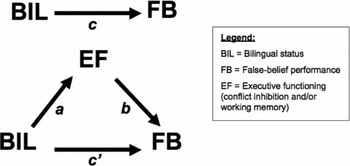
For a given aspect of EF (i.e., conflict inhibition or working memory) to explain mono–bilingual differences in false-belief performance, (a) the EF measure must significantly correlate with false-belief performance after controlling for age and verbal ability and (b) there must be a significant difference between bilinguals and monolinguals in performance on the EF measure. If a given EF measure fulfills both of these criteria, a subsequent analysis can be performed to assess whether the performance on the EF measure mediates the relation between bilingualism and false-belief understanding, as proposed in Figure 1. To our knowledge, no prior study has tested a mediation model that encompasses all three factors: bilingualism, EF (i.e., conflict inhibition and/or working memory), and false-belief understanding. Using Preacher and Hayes’ (Reference Preacher and Hayes2004, Reference Preacher and Hayes2008) mediation test procedure, we will assess whether bilingualism indirectly affects false-belief performance through the EF measure – to put it differently, is the indirect effect (path ab in Figure 1) significantly different from zero?
Hypothesized mediation model of the relation between bilingual status (BIL), executive functioning (EF) and false-belief performance (FB). Path c in the upper part of the figure is BIL's total effect on FB. In the lower part of the figure, the total effect of BIL on FB is comprised of BIL's indirect effect on FB through EF (product of paths a and b, that is, path ab) and BIL's direct effect on FB (path cʹ) after accounting for path ab.

Method
Participants
The participants were 72 children from the Greater Montreal area between the ages of 3 years; 0 months (3;0) and 5 years; 0 months (5;0). This age range was chosen because previous studies show that false-belief understanding emerges between 3 and 5 years (for a review, see Wellman, Cross & Watson, Reference Wellman, Cross and Watson2001). The participants were separated into two language groups: monolingual children (24 English monolinguals and 24 French monolinguals; 26 females and 22 males) and bilingual children (24 English–French bilinguals; 13 females and 11 males).
Bilingual children were (a) exposed to both English and French from birth or before 8 months of age and (b) generally exposed to each of these two languages for a minimum of 30% of the time, according to parental report.Footnote 1 Monolingual children were (a) exposed only to English or to French from birth and (b) generally exposed to English or to French for a minimum of 90% of the time from birth to the present day, according to parental report. In addition to these criteria, all children were required to have a minimum score on verbal ability tests. Monolinguals were required to have an age equivalent no lower than 20 months below their chronological age on the Peabody Picture Vocabulary Test–III (PPVT–III, a test of English receptive vocabulary; Dunn & Dunn, Reference Dunn and Dunn1997) or on the Échelle de Vocabulaire en Images Peabody (ÉVIP, a test of French receptive vocabulary; Dunn, Thériault-Walen & Dunn, Reference Dunn, Thériault-Walen and Dunn1993). Bilinguals were required to meet this criterion on both tests to ensure they were sufficiently proficient in both English and French.
Tasks and materials
PPVT–III and ÉVIP
The PPVT–III (Peabody Picture Vocabulary Test–III; Dunn & Dunn, Reference Dunn and Dunn1997) is a standardized measure of receptive vocabulary, and the ÉVIP (Échelle de Vocabulaire en Images Peabody; Dunn et al., Reference Dunn, Thériault-Walen and Dunn1993) is its French version. Both versions of the PPVT–III and ÉVIP, A and B, were used in the present study. These tests were specifically chosen as measures of verbal ability in the present study because: (a) they are both standardized, (b) they have frequently been used in prior research to compare the verbal ability of English–French bilinguals, English and/or French monolinguals (e.g., Bialystok, Reference Bialystok1997; Bialystok, Barac, et al., Reference Bialystok2010; Martin-Rhee & Bialystok, Reference Martin-Rhee and Bialystok2008; Morton & Harper, Reference Morton and Harper2007), and (c) the PPVT test has frequently been used to control for the effect of language ability on false-belief task performance, including in studies assessing monolingual/bilingual differences in performance (Goetz, Reference Goetz2003; Happé, Reference Happé1995; Milligan et al., Reference Milligan, Astington and Dack2007).
False-belief (FB) tasks
False-belief understanding was assessed with the change-in-location task (Wimmer & Perner, Reference Wimmer and Perner1983) and the unexpected-contents task (Gopnik & Astington, Reference Gopnik and Astington1988; Perner et al., Reference Perner, Leekam and Wimmer1987). In the change-in-location task, children watched an animation on a laptop computer in which (a) a protagonist placed an object in one location, (b) the object was moved to another location while the protagonist was away from the scene, and (c) the protagonist returned. The children were asked where the protagonist would first look for the object as well as memory check questions about its initial and current location. Then the experimenter asked the children to explain why the protagonist looked for the object in the initial location.
In the unexpected-contents task, children were shown a familiar container (e.g., crayon box) and were asked what was inside. After they responded with the usual contents (e.g., “crayons”), they were shown that it actually contained something else (e.g., elastics). The experimenter then placed the unusual contents back inside the container and asked a memory check question about the contents. Children were then asked what their friend, who had not seen inside the box, would think was inside before opening it. Children were also asked what they had thought was inside the container before opening it.
Stroop task
Children's conflict inhibition was assessed using the Stroop task adapted from Gerstadt, Hong and Diamond's (Reference Gerstadt, Hong and Diamond1994) Day–night task. In the training phase, children were asked to say “sun” when seeing a picture of the moon and to say “moon” when seeing a picture of the sun, and they had to respond correctly on two consecutive trials to pass this phase. Children then received 16 test trials: eight “sun” cards and eight “moon” cards shown in fixed random sequence with no feedback for responses. The Stroop task was chosen in the present study because it is traditionally seen as a conflict inhibition task (Carlson & Moses, Reference Moses2001) and such type of task has previously been found to predict false-belief scores (Carlson et al., Reference Carlson, Moses and Breton2002).
Backward Word Span (BWS)
This task was used to assess the children's working memory – that is, their ability to remember and manipulate information. The task followed the same procedure as the backward digit span in the Wechsler Intelligence Scale for Children–III (WISC–III; Wechsler, Reference Wechsler1991), except that it asked participants to reverse the order of words (as in Carlson et al.’s, Reference Carlson, Moses and Breton2002 study) instead of digits. The experimenter used a puppet to demonstrate the repetition of a set of words in reverse order and then asked the children to do as the puppet had done. Children were given a two-word practice trial with feedback, and then the test trials, which consisted of seven levels with two sets of words for each level, starting with two words and increasing in difficulty by one word at each level to a maximum of eight words. The task was stopped when the child failed both sets of words of the same level. The backward span test was administered in this study because it has traditionally been used as a measure of working memory in prior studies with preschool children (e.g., Carlson et al., Reference Carlson, Moses and Breton2002; Davis & Pratt, Reference Davis and Pratt1995) and such type of test has been found to significantly correlate with false-belief understanding even after controlling for age and verbal ability (Davis & Pratt, Reference Davis and Pratt1995).
Parental questionnaire
A background questionnaire, adapted from Oshima-Takane, Guerriero, and Genesee (Reference Oshima-Takane, Guerriero and Genesee2006) was used to control for parental education level and income.Footnote 2 Education level was assessed by the highest level of education achieved by either parent, which was then converted to a 7-point scale. Income level was assessed using a 10-point scale of annual family income (after taxes), ranging from less than $15,000 to more than $90,000.
The parental questionnaire and all instructions of the children's tasks (except the PPVT–III) were translated into French by a native English–French bilingual and a person with native-like proficiency in both English and French. The tasks and questionnaire were then back-translated by two other adult bilinguals, one who was a native speaker of both languages and another who had native-like proficiency in both languages. Bilingual parents could complete the parental questionnaire in their preferred language.
Design and procedure
Two test sessions, one week apart, took place in a quiet university playroom. For bilingual participants, one test session was conducted in English and the other in French with the order of the language of the test sessions counterbalanced across participants. For monolingual participants, both test sessions were conducted in their native language. In both test sessions, all children underwent the same tasks but with different versions/forms (i.e., different materials) in each session, with version order counterbalanced across participants. Thus overall, each child was given each task twice with different versions. Children first underwent the PPVT–III if the test session was in English or the ÉVIP if the test session was in French; therefore, bilinguals were given the PPVT once and the ÉVIP once, and English and French monolinguals were given the PPVT or ÉVIP twice, in a different version each time (A or B, with order counterbalanced across participants). Subsequently, children performed the cognitive tasks (FB, Stroop, and BWS) in a randomized order, with each participant receiving the same task order in the first and second test sessions.
All children were tested by two of four different experimenters; they met one experimenter in the first test session and a different experimenter in the second test session. The four experimenters were native speakers or had native-like proficiency in both English and French. Parents completed the background questionnaire prior to the first session, or during the time that the child was being tested in the playroom.
Scoring
PPVT/ÉVIP
Raw scores were converted into age equivalents, which are the age in years and months at which a given raw score is the median score in the standardization sample. The scores were kept separately in the data analyses as PPVT/ÉVIP–1 (score in first test session) and PPVT/ÉVIP–2 (score in second test session) rather than as an aggregate score for the two test sessions because bilinguals underwent a different task (PPVT or ÉVIP) in each test session.
False belief (FB)
There were four test questions per test session: search-prediction and explanation test questions in the change-in-location task, and friend's belief prediction and own belief questions in the unexpected-contents task. Responses were scored 1 or 0 (pass/fail) and the corresponding memory check questions had to be correct to count as passing. Children passed the explanation test question if they talked about the protagonist's mental state or relevant story facts (e.g., protagonist's absence), as in Wimmer and Mayringer (Reference Wimmer and Mayringer1998). FB score was the sum of correct responses across the two test sessions (possible range = 0–8), with a test–retest reliability (Pearson correlation coefficient across sessions) of .72, p < .001.
Stroop
The score was the total number of correct responses in the test phase across the two test sessions (possible range = 0 to 32). The test–retest reliability was .58, p < .001.
Backward Word Span (BWS)
The BWS score was the sum of the number of sets of words correctly re-ordered across the two test sessions, regardless of the length or number of words in the set (possible score range = 0 to 28). The test–retest reliability was .73, p < .001.
Results
Preliminary analyses
Demographic characteristics
An independent samples t-test showed that monolinguals and bilinguals did not differ significantly in terms of age, t(70) = 0.24, ns. Independent samples t-tests also demonstrated no significant difference between the language groups on each aspect of socio-economic status: (a) annual parental income, t(63) = –1.78, ns, and (b) highest level of education achieved by either parent, t(70) = –0.19, ns. Together, these findings suggest that the groups were comparable in terms of demographic and socio-economic characteristics.
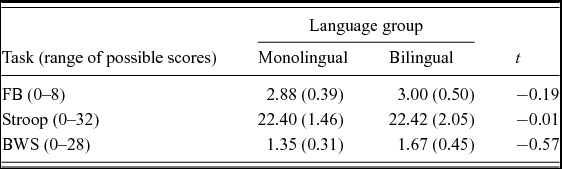
Means (and Standard Errors) on cognitive tasks by language group.

Notes: n = 48 for the monolingual group; n = 24 for the bilingual group.
Verbal ability
Independent samples t-tests revealed that bilinguals had lower scores than monolinguals on PPVT or ÉVIP in the first test session (PPVT/ÉVIP–1; t(70) = 2.68, p < .01) and on PPVT or ÉVIP in the second test session (PPVT/ÉVIP–2; t(70) = 3.55, p < .001).Footnote 3
Language group effects on cognitive tasks
ANOVAs were conducted in order to assess whether monolinguals and bilinguals differed on FB, Stroop and BWS. Table 1 shows means and standard errors of the three cognitive tasks. There was no significant language group effect for any of the cognitive tasks.Footnote 4
Effects of age, language, parental income and education
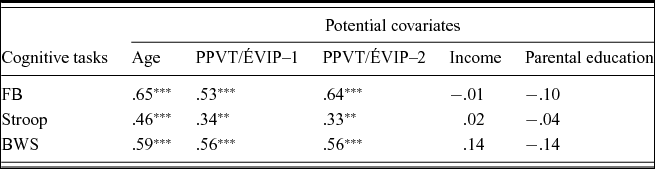
Table 2 shows Pearson correlations between possible covariates (age, PPVT/ÉVIP–1, PPVT/ÉVIP–2, parental income, and highest level of education achieved by either parent) and the three cognitive tasks (FB, Stroop, and BWS). Age, PPVT/ÉVIP–1, and PPVT/ÉVIP–2 were significantly and positively correlated with all three cognitive tasks. On the other hand, income and highest level of education achieved by either parent had no significant correlations with the cognitive tasks; this may be explained by the fact that there was little variation in socio-economic status as most of the sample came from upper-middle–class families (Mincome = 7.46 out of maximum score of 10, SEincome = 0.25; median for highest level of education achieved by either parent is “Bachelor”). Considering these findings, only age and verbal ability (PPVT/ÉVIP–1 and PPVT/ÉVIP–2) were used as covariates in the following analyses on the cognitive tasks.
Pearson correlations of potential covariates with cognitive tasks.

***p < .001; **p < .01
Notes: n = 72 for correlations involving age, PPVT/ÉVIP–1, PPVT/ÉVIP–2, or highest level of education achieved by either parent; n = 65 for correlations involving income.
Cognitive tasks results controlling for age and verbal ability
Correlations among cognitive tasks
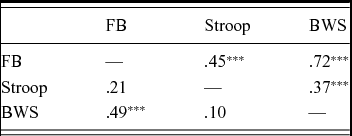
Table 3 shows the zero-order correlation coefficients among cognitive tasks, and the correlations after age, PPVT/ÉVIP–1, and PPVT/ÉVIP–2 were partialled out. All of the zero-order correlations were significant. However, after age and verbal ability were accounted for, the only significant correlation was between FB and BWS, r(67) = .49, p < .001. Subsequently, to ensure that the relation between FB and BWS was not confounded with inhibitory control, Stroop was also partialled out; the correlation remained significant after controlling for age, PPVT/ÉVIP–1, PPVT/ÉVIP–2, and Stroop, r(66) = .48, p < .001.
Pearson correlations among all cognitive tasks (N = 72).

***p < .001.
Notes: Zero-order correlations are above the diagonal. Partial correlations controlling for age, PPVT/ÉVIP–1, and PPVT/ÉVIP–1 are below the diagonal.
Language group effects controlling for age and verbal ability
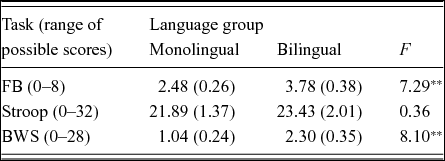
ANCOVAs were performed in order to assess whether monolinguals and bilinguals differed on FB, Stroop and BWS after controlling for age, PPVT/ÉVIP–1, and PPVT/ÉVIP–2. The results are shown in Table 4. Bilinguals had significantly higher adjusted scores on FB, F(1,67) = 7.29, p < .01, and BWS, F(1,67) = 8.10, p < .01, but not on Stroop.
Means (and Standard Errors) on cognitive tasks by language group, controlling for age, PPVT/ÉVIP–1, and PPVT/ÉVIP–2.

**p < .01.
Notes: n = 48 for the monolingual group; n = 24 for each language group.
Mediation results
Considering that (a) BWS significantly correlated with FB and (b) like FB, BWS showed a bilingual advantage pattern after controlling for age and PPVT/ÉVIP scores, Preacher and Hayes’ (Reference Preacher and Hayes2004, Reference Preacher and Hayes2008) mediation test procedure was subsequently used to formally assess whether BWS mediated the relationship between bilingual status (BIL) and FB performance. BIL was coded by giving a value of 0 to the monolingual group and a value of 1 to the bilingual group.
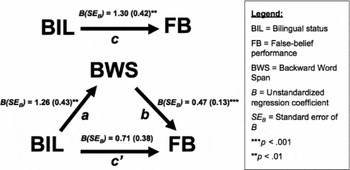
Figure 2 shows unstandardized regression coefficients (B) and standard errors (SEB ) of the relations between BIL (independent variable), BWS (mediator), and FB (dependent variable); please note that each and every relation controls for age, PPVT/ÉVIP–1, and PPVT/ÉVIP–2. The total effect of BIL on FB (path c) was significant, B(SEB ) = 1.30 (0.42), p < .01. The paths from BIL to BWS (path a) and from BWS to FB while controlling for BIL (path b) were also significant, B(SEB ) = 1.26 (0.43), p < .01, and B(SEB ) = 0.47 (0.13), p < .001, respectively. Thus, the two paths that comprise the indirect effect of BIL on FB (path ab) were significant. The direct effect of BIL on FB (path cʹ) was not significant, B(SEB ) = 0.71 (0.38), ns.
Mediation of the relation between BIL and FB performance by BWS, after controlling for age, PPVT/ÉVIP–1, and PPVT/ÉVIP–2. All coefficients (B) represent unstandardized regression coefficients while controlling for age, PPVT/ÉVIP–1, and PPVT/ÉVIP–2.

Though these results may be informative, they were not direct tests of the mediation effect by BWS. The indirect effect of BIL on FB through BWS was estimated through the calculation of the product of regression coefficients of paths a and b (i.e., 1.26 × 0.47 = 0.59). In order to examine whether this indirect effect was significantly different from zero, 5,000 bootstrapped samples were used to estimate the bias corrected confidence intervals (CI) of the indirect effect. This analysis revealed that BWS mediated the relationship between BIL and FB, Indirect effect ab = B(SEB ) = 0.59 (0.27), 95% CI = 0.24–1.12. Since the 95% CI did not contain zero, one may conclude that the indirect effect of BIL on FB through BWS, after controlling for age and PPVT/ÉVIP scores, was significantly different from zero.
Discussion
The first goal of the present study was to determine whether the bilingual advantage in FB is replicable when accounting for socio-economic status. After establishing that there were no significant mono–bilingual differences on the socio-economic measures (parental income and highest level of education achieved by either parent), the bilingual advantage was not found when examining raw FB scores. Nevertheless, bilinguals were not at a disadvantage in FB even though (a) their verbal ability scores (PPVT/ÉVIP–1 and PPVT/ÉVIP–2) were significantly lower than the monolingual groups’ scores and (b) verbal ability measures were significantly and positively correlated with FB. Because of the significant correlation between age and verbal ability measures with FB performance and EF tasks, the effect of language group on the three cognitive tasks was re-examined controlling for the effects of age and verbal ability. This analysis yielded a significant language group effect for FB; bilingual participants significantly outperformed the monolingual group on FB, after partialling out the effects age and verbal ability.
The second goal of the present study was to determine the aspect of EF that underlies the bilingual advantage in FB. Was it conflict inhibition, working memory, or both? Because there was no mono–bilingual difference in raw FB scores despite lower verbal ability in bilinguals, we reformulated our second goal as determining what helped bilingual children maintain FB scores that were similar to monolingual scores, despite lower verbal ability. We found that conflict inhibition, as measured by the Stroop task was an unlikely compensatory factor because (a) Stroop did not correlate significantly with FB after partialling out the effects of age and verbal ability scores and (b) there was no bilingual advantage in the Stroop task both in terms of raw and adjusted means. Conversely, working memory, as measured by the BWS task, was a likely compensatory factor because (a) BWS had a significant positive correlation with FB after controlling for age and verbal ability scores and (b) there was a significant bilingual advantage over both monolingual groups in BWS after adjusting for age and verbal ability scores.
Comparisons with previous research
Results of the current study replicate some findings in prior research and contradict others. Despite the fact that children needed to have a minimum performance level on the PPVT and ÉVIP in order to be eligible as bilingual participants, the present study corroborates the finding that bilingual children's receptive vocabulary is significantly lower than that of their monolingual peers in each language (e.g., Bialystok, Luk, et al., Reference Bialystok2010; Mahon & Crutchley, Reference Mahon and Crutchley2006; Oller & Eilers, Reference Oller and Eilers2002). Furthermore, with the significant correlation between PPVT/ÉVIP scores and FB, the present study supports the claim that language ability and false-belief understanding are closely related to each other (e.g., Astington, Reference Astington and Astington2000; de Villiers, Reference de Villiers, Baron-Cohen, Tager-Flusberg and Cohen1999; Milligan et al., Reference Milligan, Astington and Dack2007). Although the bilingual advantage in raw FB scores (found in Berguno & Bowler, Reference Berguno and Bowler2004; Goetz, Reference Goetz2003; Kovács, Reference Kovács2009) was not replicated, the present study corroborates Chan's (Reference Chan2004) finding, which is that a bilingual “advantage” appears when FB scores are adjusted for age and verbal ability. To put it differently, bilinguals are “doing more” in FB “with less” language proficiency (for the same argument in the context of conflict inhibition tasks, see Carlson & Meltzoff, Reference Carlson and Meltzoff2008).
The claim that bilinguals are “doing more with less” is, however, not without its limitations. One possible alternative is that bilingualism lowers performance on language proficiency tests but has no effect on false-belief understanding. This may be so, though a vast amount of research suggests that false-belief understanding depends on language development (for a review, see Milligan et al., Reference Milligan, Astington and Dack2007); thus, bilingualism (or some other factor) would have to compensate for the needed language proficiency to reach false-belief scores that are comparable to that of monolinguals. Nevertheless, the results of the present study clearly show that bilingual children's advantage in FB after controlling for age and verbal ability cannot be attributed to socio-economic status because monolinguals and bilinguals were equivalent on parental education and income. Instead, the bilingual advantage is attributable to bilingualism per se or bilingual culture. This is an important finding because previous studies comparing monolingual and bilingual children on false-belief understanding did not include socio-economic measures (e.g., Berguno & Bowler, Reference Berguno and Bowler2004; Chan, Reference Chan2004; Kovács, Reference Kovács2009).
The present study did not find a significant correlation between the Stroop task and FB after controlling for age and verbal ability scores, unlike in Carlson and Moses’ (Reference Carlson and Moses2001) study, where the Stroop task significantly correlated with the FB change-in-location task even after controlling for age, gender, and verbal ability. This is despite the fact that the percentage of correct responses in the Stroop task in the present study (70% correct in total sample, N = 72) was reasonably similar to that in Carlson and Moses’ study (62% correct, N = 107). However, in hindsight, our non-significant correlation may not be unusual considering that some research, such as Kloo et al.'s (Reference Kloo, Perner, Giritzer, Sokol, Müller, Carpendale, Young and Iarocci2010) and Peskin and Ardino's (Reference Peskin and Ardino2003) studies, indicated that Stroop and false-belief performance were not significantly correlated when age was partialled out. The reliability of these findings could be assessed in future studies that include FB and Stroop tasks.
The present study also showed no mono–bilingual difference in Stroop, but this may be due to (a) its lower test–retest reliability (.58, p < .001) in comparison with other measures such as the BWS (.73, p < .001) and/or (b) bilinguals simply not having an advantage in this type of inhibitory control. We initially expected a bilingual advantage in Stroop task because Carlson and Meltzoff (Reference Carlson and Meltzoff2008) showed a bilingual advantage in conflict tasks (i.e., inhibitory tasks requiring a novel response in the face of a conflicting prepotent response) after partialling out the effects of age, verbal ability, and parental education (and the Stroop task is viewed as a conflict task – for instance, refer to Carlson & Moses, Reference Moses2001). However, Martin-Rhee and Bialystok (Reference Martin-Rhee and Bialystok2008) argue that bilingual children outperform monolinguals on tasks involving “interference suppression” (e.g., the Simon task) but not on tasks involving “response inhibition” (e.g., the Stroop task). Interference suppression tasks have a bivalent display, which involves two conflicting perceptual cues (e.g., in the Simon task, one must ignore the square's position and press the button based on the square's color). Conversely, response inhibition tasks have a univalent display; for example, in the Stroop task, “there is no conflict between conflicting perceptual cues (because each picture only shows one kind of display) but there is need to overcome the habitual response which is to name the display” (Martin-Rhee & Bialystok, Reference Martin-Rhee and Bialystok2008, p. 86). According to Martin-Rhee and Bialystok, response inhibition involving univalent displays (such as the Stroop task) does not capture the bilingual experience: “Bilinguals do not refrain from speaking in the manner indicated by response inhibition, but must select between two competing linguistic systems for language production” (p. 85).
Thus, there are debates as to whether bilingualism should promote performance on the Stroop task, even among scholars who argue that bilingual experiences are linked to greater inhibitory control. Carlson and colleagues’ studies suggest that there should be a bilingual advantage, because the Stroop task is classified as a conflict task (e.g., Carlson & Moses, Reference Moses2001), but Martin-Rhee and Bialystok's (Reference Martin-Rhee and Bialystok2008) study suggests that no advantage should be found, because the task is a response inhibition task with a univalent display. Regardless of the type of inhibitory control involved in the Stroop task, the current study clearly shows no mono–bilingual effect on this task; therefore, inhibitory control (as measured here) was not a compensatory factor in bilingual children's FB performance. Future studies could assess more clearly whether there are mono–bilingual differences on some or all types of inhibitory control tasks (as defined by both Carlson & Moses, Reference Moses2001, and Martin-Rhee & Bialystok, Reference Martin-Rhee and Bialystok2008), and whether some or all of these types of inhibitory control tasks explain false-belief performance.
Bilingualism, working memory, and false-belief understanding
The significant correlation between BWS and FB in the present study is in line with the claim that false-belief understanding requires working memory (e.g., Davis & Pratt, Reference Davis and Pratt1995; Gordon & Olson, Reference Gordon and Olson1998; Halford, Reference Halford1993; Keenan, Reference Keenan1998; Keenan et al., Reference Keenan, Olson and Marini1998; Mutter et al., Reference Mutter, Alcorn and Welsh2006). This relation is unlikely to be confounded with inhibition because BWS and FB continued to be significantly correlated after partialling out the effects of age, PPVT/ÉVIP scores, and Stroop. Moreover, the significant bilingual advantage in BWS after controlling for age and verbal ability is in accordance with Feng et al.'s (Reference Feng, Diamond and Bialystok2007) study, which also showed a bilingual advantage in variations of a non-verbal task – the Frog Matrix Span task – that involved working memory. In Feng et al.'s study, the bilingual advantage was found by using a task that involved visual stimuli and not verbal material, whereas in the current study, the advantage was demonstrated after partialling out the effects of verbal ability on a verbal task. Furthermore, using a mediation analysis, we also confirmed that BWS was a significant mediator; there was a significant indirect effect of bilingualism on FB through BWS while controlling for age and verbal ability.
Though the significant mediation may appear to counter Carlson and Meltzoff's (Reference Carlson and Meltzoff2008) argument that bilinguals have a specific advantage on conflict inhibition tasks and that such tasks predict false-belief understanding (Carlson et al., Reference Carlson, Moses and Breton2002), it is not a contradiction if we interpret the BWS task as one that involves both working memory and inhibitory control (like conflict tasks). EF tasks rarely assess only one aspect of executive functioning; the backward test is traditionally viewed as a measure of working memory (e.g., Bialystok, Reference Bialystok2010; Carlson et al., Reference Carlson, Moses and Breton2002; David & Pratt, Reference Davis and Pratt1995), but it would be reasonable to argue that the BWS requires the child not only to remember the list of words and to re-order them (working memory), but also to inhibit the tendency to repeat the list of words in a forward manner (inhibition). Nevertheless, our present study suggests that bilingualism promotes the kinds of cognitive skills involved in the backward span, and that such skills predict false-belief understanding.
But how does bilingualism promote working memory – or at least the kind of cognitive skill(s) measured by the backward span? In the backward span, children keep a list of words in mind (maintenance of items) and re-order this list (manipulation of items). Similarly, when English–French bilinguals converse with individuals, they have two mental lexicons in mind, one in English and one in French (maintenance of items) and select the appropriate words given the language of their interlocutor (manipulation of items). Conversely, monolinguals do not need to consider language contexts as bilinguals do; thus, they have less practice with maintaining and simultaneously operating on items of information.
The present study has some limitations. First, verbal ability was measured with single receptive vocabulary measures. Vocabulary is just one of many aspects of language proficiency and it is possible that the language proficiency measure used in this study may have under- or over-estimated bilinguals’ language ability. Future studies could better address this issue by including a wider range of measures of language proficiency (e.g., syntax, semantics, memory for complements, general language, etc.). Second, it is possible that differences in general intelligence or nonverbal cognitive skills underlie the differences between monolinguals and bilinguals. Participants were not tested on a general intelligence test or a non-verbal cognitive test, thus we cannot control for their potential effects. However, mono–bilingual differences in working memory and false-belief understanding are not likely due to such confounding factors because prior studies usually indicate that (a) bilinguals have an advantage over monolinguals on specific EF measures, not general intelligence (for a review, see Bialystok, Reference Bialystok2001) and (b) EF measures are more highly predictive of false-belief understanding than general intelligence/non-verbal cognitive ability measures are (e.g., Carlson et al., Reference Carlson, Moses and Breton2002; Chan, Reference Chan2004; Hughes & Ensor, Reference Hughes and Ensor2007).
To summarize: we suggest that bilingualism may promote working memory (that is, the ability to actively manipulate information held in mind) because bilinguals must continuously refer to their two mental lexicons stored in long-term memory and retrieve the appropriate word given their linguistic context. This view differs from Bialystok's (Reference Bialystok2001) theoretical account, in that inhibitory control is not necessarily required to select or retrieve the appropriate response/language; for native or near-native bilinguals who are fluent in both languages, the non-relevant language is not intrusive or more tempting than the relevant language. Furthermore, our present study shows that bilingualism may promote false-belief understanding through advances in working memory (after controlling for age and verbal ability). To our knowledge, this is the first study that empirically supports a mediation model that encompasses all three factors: bilingualism, EF, and ToM. The current study corroborates the claim that bilingual upbringing has positive cognitive outcomes; bilingual environments induce children to use information held in mind in appropriate situations, which compensates for their poorer performance on verbal ability tests. Considering our increasingly bilingual world, more studies on bilingualism's impact on cognitive and linguistic development are needed to continue to evaluate these claims.