The construct of social competence in childhood and adolescence has a long tradition in psychology (Goldstein, Sprafkin, Gershaw, & Klein, Reference Goldstein, Sprafkin, Gershaw and Klein1980; Hundert, Reference Hundert1995; Michelson, Sugai, Wood, & Kazdin, Reference Michelson, Sugai, Wood and Kazdin1983; Ross & Fabiano, Reference Ross and Fabiano1985). It has been applied in social and academic spheres and its importance for psychological, academic and social adjustment as well as for establishing friendly relations and a positive school climate has been confirmed in the Spanish context (Caballo, Reference Caballo2006; Garaigordobil, 2004; Inglés, Reference Inglés2009; López, Garrido, Rodríguez, & Paíno, Reference López, Garrido, Rodríguez and Paíno2002; Monjas, García, Elices, Francia, & de Benito, Reference Monjas, García, Elices, Francia and de Benito2004; Ortega & Del Rey, Reference Ortega and Del Rey2003; Segura, Reference Segura2002).
Social and personal competence provides a person with tools to grow as a person and to learn to get on well with others. We refer generically to social competence, although we also include personal competence in this concept. Social competence includes four aspects (Segura & Mesa, Reference Segura and Mesa2011): (a) Cognitive aspect: learning to think before acting through the tools of psychosocial analysis, which are: causal thinking, alternative thinking, consequential thinking, perspective-taking and means-end (Spivack & Shure, Reference Spivack and Shure1974); (b) Development of moral judgment: justifying our behavior according to what we consider fair/correct or unfair/incorrect in an interpersonal relation (Kohlberg, Power, & Higgins, Reference Kohlberg, Power and Higgins1989; Segura, Reference Segura2002); (c) Affective-emotional aspect, which leads to self-knowledge, expression and self-regulation of one’s emotional life (Gardner, Reference Gardner1991; Goleman, Reference Goleman1995; Seligman, Reference Seligman1990); and lastly, (d) Interpersonal relational styles, which are three forms of learned social response: assertive, aggressive, and inhibited (Michelson et al., Reference Michelson, Sugai, Wood and Kazdin1983), which we shall comment on in more detail below. These authors maintain that deficits in social competence are observed in the absence of an assertive relational style.
Teaching social competence at school has therefore become one of the essential goals of the educational system (Eurydice, 2002; LOE, 2006; Richen & Tiana, Reference Richen and Tiana2004). This challenge, which schools are required to address systematically and without delay, requires the development and validation of simple and efficacious instruments that allow educators to determine the initial and the final levels of students’ social competence, once the teaching-learning processes have been set up.
The assessment of social competence is complex, but it can be assessed indirectly through social skills and performance style. To have instruments that help to assess social competence within the school setting would improve not only our knowledge of this area but also our interventions to improve the climate and social relations within the school center. However, in order to assess this and other competences, it is important to adapt appropriately to the common methods of school culture (Mesa, Reference Mesa2010) and this means using self-applied questionnaires or scales, which are well accepted by teachers. Such scales must be simple, suitable for group application and require little time to complete and correct.
The CABS (Michelson & Wood, Reference Michelson and Wood1982) is a questionnaire created to measure, through self-report, the assertive, aggressive, and inhibited behaviors of students. According to Michelson et al., Reference Michelson, Sugai, Wood and Kazdin1983), social competence, social skills, and assertiveness are synonyms. These authors emphasize the importance of three types of response in terms of social or interpersonal relational styles, and note that they are learned. The assertive relation style is characterized by the expression of one’s own feelings, needs, rights, and opinions, while respecting other people’s rights, and it is related to an affirmative, confident, and prosocial style. The inhibited style is characterized by not expressing one’s own feelings, thoughts, and opinions, and it is related to a passive, conformist, and submissive style. The aggressive style is characterized by defending one’s own rights but disregarding others’ rights and it is related to an authoritarian and dominant style.
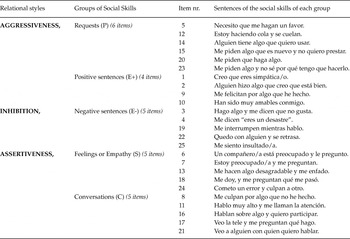
The CABS has 27 items, each one with 5 response options on a passive-assertive-aggressive response continuum, from which the students choose the one that best reflects their habitual way of responding to that situation. The items are grouped into the following five large groups of social skills.
-
- Requests: assessed through items that reflect social skills such as doing or asking a favor, asking for help, etc., with a total of 6 items.
-
- Positive comments: for example, how to pay a compliment, with a total of 4 items.
-
- Negative comments: such as making a complaint, criticizing someone, etc., with 6 items.
-
- Feelings of empathy: such as getting angry, feeling concern about someone, etc., with 6 items.
-
- Conversations: such as listening, starting, or maintaining a conversation, etc., with 5 items.
The CABS also offers the possibility of contrasting individuals’ self-rating of relational styles with hetero-rating by significant adults and peers, in coherence with investigations that advocate the measurement of social competence from diverse sources (Caballo Reference Caballo2006; De Los Reyes & Kazdin, 2005; Dirks, Treat, & Weersing, Reference Dirks, Treat and Weersing2010; Trianes et al., Reference Trianes, Blanca, Muñoz, García, Cardelle-Elawar and Infante2002).
With regard to the psychometric aspects of the CABS, review of the scarce literature on these aspects, in general, shows values of internal consistency ranging between .78 and .80. For test-retest reliability, the data range between .66 and .86 for a 4-week interval. Lastly, discriminant and convergent validity, in general, have been satisfactory (Groot & Prins, Reference Groot and Prins1989; Hobbs & Walle, Reference Hobbs and Walle1985; Michelson & Wood, Reference Michelson and Wood1982). Specifically, for convergent validity, Wood, Michelson, and Flynn (1978), in a sample of 149 Primary Education students, compared the scores obtained in the CABS with behavioral observations and appraisals carried out by the teachers (hetero-assessment) finding significant although variable correlations.
The adaptation of this scale to the Spanish-speaking population was carried out by Segura, Mesa, and Arcas (Reference Segura, Mesa and Arcas1997), and called the Cuestionario para Evaluar la Asertividad (CEA) [the Questionnaire to Assess Assertiveness]. Studies of the psychometric properties of the CEA carried out to date are limited to the investigations of Mesa (Reference Mesa2010) and Monjas et al. (Reference Monjas, García, Elices, Francia and de Benito2004). In both cases, the values of reliability are within the above-mentioned range for the CABS, both for internal consistency and for test-retest reliability.
To conclude, although the CEA questionnaire is broadly used by professionals both in primary and in secondary education to measure relational styles in social competence, few studies have assessed the reliability and validity of this instrument from a methodological viewpoint. Thus, one of our goals for this study is to contribute new data about the psychometric properties of the CEA, in terms of both its internal consistency and its stability in a representative sample of the adolescent population of Catalonia.
With regard to the goodness of fit of the factor structure of the CABS, the data in general show that the tridimensional structure proposed by the original authors has been questioned both in the original version of the CABS (Groot & Prins, Reference Groot and Prins1989), and in the Spanish CEA version (De la Peña, Hernández, & Rodríguez, 2003; Monjas et al., Reference Monjas, García, Elices, Francia and de Benito2004; Segura, Mesa, & Arcas, Reference Segura, Mesa and Arcas1997, 1998 ). Thus, Groot and Prins’s (Reference Groot and Prins1989) study reveals a scale that discriminates between assertive versus aggressive style in students. However, the scale is not sensitive enough to discriminate students with an inhibited style. This lack of sensitivity of the Inhibition subscale was attributed to possible gender effects in the elaboration of the items of the questionnaire. On the other hand, the studies that have used the CEA to measure assertive, inhibited, and aggressive styles in school children also report difficulties in maintaining this structure of assertiveness, inhibition, and aggressiveness. Segura, Mesa, and Arcas and De la Peña, Hernández and Rodríguez developed a brief scale based on the CEA questionnaire for Primary Education (CEA-Primary). The data show the bidimensional behavior of assertiveness at the start of obligatory schooling in boys and girls from 6 to 12 years of age, indicating that the degree of adjustment of the children—even the aggressive ones—is a function of the balance between competent and unskilled solutions. But these authors also acknowledge the difficulty of maintaining this bipolarity in some cases, due to the lack of distance between the different styles. Monjas et al. (Reference Monjas, García, Elices, Francia and de Benito2004) applied the CEA for Compulsory Secondary Education (CEA-ESO [Translator’s note: in Spanish, the abbreviation of Compulsory Secondary Education is ESO]) to a sample of 550 students from Secondary Compulsory Education (CSE). These authors maintain that aggressiveness and inhibition are two independent dimensions with regard to assertiveness, and that assertiveness only reflects low scores in aggressiveness and inhibition. Specifically, in CSE students, they identified two dimensions: aggressiveness-nonaggressiveness and inhibition-noninhibition. We can therefore conclude that investigation of the internal structure of the CABS and the CEA raises doubts about whether or not there is, in effect, a dimension of inhibition. Therefore, as a second goal of this study, we propose to analyze the factor (dimensional) structure of the adaptation to the Spanish population of the CABS carried out by Segura et al. (Reference Segura, Mesa and Arcas1997). This will be tested in a sample of Catalonian adolescents who completed the self-report version of the CEA (CEA-ESO), with the aim of empirically confirming whether the scale can discriminate inhibition, assertiveness, and aggressiveness (Michelson & Wood, Reference Michelson and Wood1982), or whether it only discriminates between assertiveness and nonassertiveness (De la Peña et al., Reference De la Peña, Hernández and Rodríguez2003; Monjas et al., Reference Monjas, García, Elices, Francia and de Benito2004).
The main goal of this study is, thus, two-fold: on the one hand, to provide evidence of the reliability (internal consistency) and stability of the CEA-ESO in a representative population of adolescents of Catalonia. And secondly, to provide data about the dimensionality of the instrument in order to shed light on the evidence presented in prior investigations about whether this is an instrument that discriminates aggressive versus assertive styles or aggressive, inhibited, and assertive styles. Given the relevance of assessing adolescents’ interpersonal relation styles, we consider that it is very important to provide the professionals who carry out such assessment with reliable and valid instruments for this purpose (Caballo, Reference Caballo2006). The CEA is one of the most broadly-used self-reports to assess social competence in school settings. Our purpose is to offer the educational community a useful and easy-to-use instrument to assess the efficacy of school programs aimed at the promotion of social competence in CSE.
Method
Participants
Data was collected from 640 adolescents from 1st, 2nd, and 3rd year of CSE from six school centers distributed in four municipalities of the province of Barcelona. The age range of the sample was between 11 and 16 years (M = 13.4, SD = 1.006). Of the sample, 56.1% were male and 43.8% were female. The socioeconomic level of their families is very low in 0.4% of the families, low in 17.3%, medium in 39.4% and high in 42.9%.
Instruments
The Cuestionario de Evaluación de la Asertividad (CEA) (Segura et al., Reference Segura, Mesa and Arcas1997) is an adaptation of the CABS (Michelson et al., Reference Michelson, Sugai, Wood and Kazdin1983) to the Spanish population and presents levels of reliability and validity similar to those of the original scale (Mesa, Reference Mesa2010). It is a self-rating instrument that allows classification of adolescents according to their assertive, inhibited, and aggressive behavior. It has 25 items, categorized in three types of responses to diverse real life situations (i.e., giving or receiving a compliment, criticizing someone, asking about something, asking for help, complaining, maintaining a conversation, etc.). Responses are rated on an inhibition-assertiveness-aggressiveness continuum.
The process of translating and adapting the CABS for the population of Spanish-speaking children and youths was carried out with the help of five educational psychologists and ten Primary and Secondary school teachers. The five groups of social skills tapped by the original questionnaire regarding expression/reception of positive and negative comments, requests, feelings, and initiating and ending conversations were maintained. However, when performing the content analysis of the items from English to Spanish, certain items were considered redundant and, in order to make the administration faster and simpler, one item from the group of Conversation and one item from Feelings were eliminated. Thus, it had a total of 25 items with three response options: assertive, aggressive, and inhibited.
Although the original CABS scale had 5 response options, we decided to change this to a scale with 3 response options. This decision was based on three aspects: (a) to increase the simplicity of scale correction for teachers and guidance counselors; (b) because, even in the reduced scale (Monjas et al., Reference Monjas, García, Elices, Francia and de Benito2004), the authors’ original idea of an inhibition-assertiveness-aggressiveness continuum, on which it is important to measure response tendencies in social situations, was maintained; (c) because this 3 option scale is simpler to work with and makes it easier to identify the knowledge that the students have about Social Competence. As noted by Michelson et al. (Reference Michelson, Sugai, Wood and Kazdin1983), self-reports, above all, provide knowledge about what a person knows.
Procedure
This study of the psychometric properties and dimensionality of CEA-ESO was part of a macro study that comprises an intervention program not reported in this paper. The macro study program was performed in accordance with the Helsinki Declaration, the investigation was presented to the educational authorities and was approved by the Departament d’Ensenyament de la Generalitat de Catalunya, as well as by those in charge of the Program of Getting on Well with Each Other in the school centers, the School Management Team of each centre, and the consent and authorization of the families, and of the students themselves.
We selected six schools: two peripheral-urban schools and 4 central-urban schools, with a total of 27 classrooms (14 of 1st and 2nd grade of CSE and 13 of 3rd grade of CSE). The data were collected at the beginning and the end of the school course.
After informed consent had been obtained from the educational community of each center, the CEA-ESO was collectively administered in the classrooms, in the presence of the tutor and one of the investigators. After receiving instructions and clarification on how to respond, the students needed about 30 minutes to complete the questionnaire.
Results
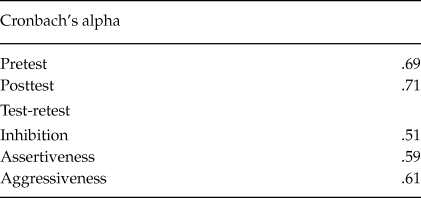
Data analysis was carried out with the statistical analysis package R. A study of the reliability of the CEA was performed on the 178 participants (who are the control group in the macro study), both for internal consistency and test-retest reliability with a 28-week interval. Likewise, homogeneity analysis (multidimensional scaling) was conducted with the Homals package R. Reliability analysis was calculated with Cronbach’s alpha, and test-retest stability at 28 weeks was calculated with Pearson’s correlation coefficient. Cronbach’s alpha at pretest and posttest was .69 and .71, respectively. In the case of the test-retest stability, it was .51, .59, and .61 for the scales of inhibition, assertiveness, and aggressiveness, respectively.
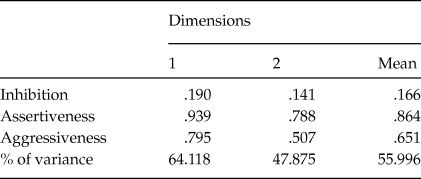
The study of the factor structure (dimensions) of the CEA was conducted through homogeneity analysis (multiple correspondences). This technique allows performance of a principle component analysis when the variables are categorical and each variable has different levels of nominal categories (Gifi, Reference Gifi1981, Reference Gifi1990; Michelson & Wood, Reference Michelson and Wood1982). The purpose of homogeneity analysis is to represent in the n-dimensional space the solution that best separates the categories from each other. In this case, the analysis revealed a bi-dimensional structure of the CEA. This solution was obtained after 39 iterations with a loss function equal to 535.96. The first dimension, which explained 61% of the variance, is related to a bipolar construct of aggressiveness-assertiveness. The second dimension is related to an inhibition-aggressiveness construct, and it explained 47% of the variance. Table 3 shows the discriminant matrix for each variable in each dimension.
CEA-ESO Questionnaire: Items and sentences

Taken from Mesa (Reference Mesa2010) with permission.
Reliability indexes of the CEA-ESO at pretest and posttest

Discrimination Measures of the Dimensions by Variable

Note:
Mean discrimination is the explained variance of each construct.
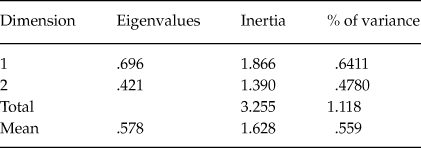
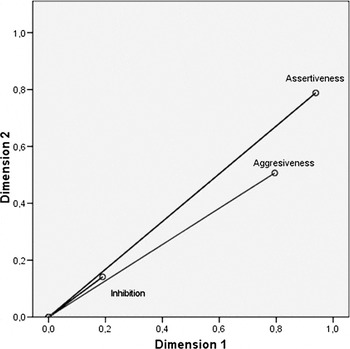
The bidimensional solution of our data presents eigenvalues of .69 and .42, respectively, for Dimensions 1 and 2. Likewise, the inertia values for both dimensions are similar, 1.8 for Dimension 1, and 1.3 for Dimension 2. Taking these criteria into account, it seems that Dimension 1 differentiates the response categories more than Dimension 2 (see Table 4).
Summary of the Model taking into account the Eigenvalues and the Inertias by Dimension

Lastly, the graphic inspection of the multidimensional solution can be seen in Figures 1 and 2. As shown in Figure 1, the graph of the discrimination measures reflects the percentage of variable variance explained by each dimension and shows that both Dimension 1 and Dimension 2 can discriminate the variable assertiveness (and its response categories) from the variable aggressiveness. In this case, the variable assertiveness had a higher discrimination value in Dimension 1. The graph also shows the scarce discrimination of the model for the variable inhibition and its response categories in the two isolated dimensions.
Discrimination graph for the variables in the dimensions.

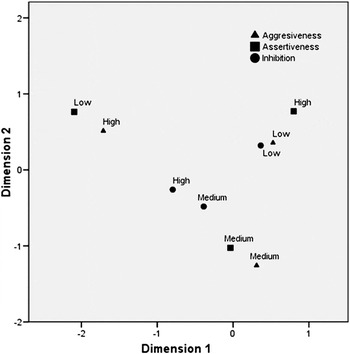
Dot diagram of the categories. The centroids are represented by category.

With regard to the dispersion of the categories, it is noteworthy that Dimension 1 shows a pattern of maximum separation between high and low assertiveness. The opposite pattern was observed for the category of aggressiveness. There was no satisfactory interpretation for the category of inhibition either in Dimension 1 or in Dimension 2. The pattern for this category seemed diffuse when we attempted to separate its levels.
Altogether, this questionnaire seems to present a bipolar construct of aggressiveness-assertiveness (De la Peña et al., Reference De la Peña, Hernández and Rodríguez2003). Dimension 2 separated responses of aggressiveness and assertiveness but only for high and medium values, not for low values. At the same time, the behavior of inhibition in Dimension 2 was confusing. Therefore, taking into account the special representation of our data, Dimension 1 obviously separated individuals who scored high in assertiveness from those who scored low. Dimension 2 separated those who scored medium and high in assertiveness from those who scored low and medium in aggressiveness. The model did not make any predictions for inhibition that matched the three response categories of this variable. Comparing the three variables, we observed that both in assertiveness and in aggressiveness, the response categories were considerably dispersed. However, this dispersion was lower in inhibition. We remind readers that a higher discrimination index indicates higher dispersion of the response categories.
To conclude, the homogeneity analysis of the CEA-ESO seemed to indicate a bidimensional solution. This solution isolated a bipolar construct of aggressiveness-assertiveness in which the response categories were well separated. For the variable inhibition, the analysis was inconclusive if both the values and the graph of the discrimination data are taken into account.
Discussion
The main goal of this investigation was to analyze, on the one hand, the psychometric properties of the Spanish adaptation of the CABS for adolescents (CEA-ESO), and, on the other, its factor structure. The results of the analyses yielded satisfactory levels of internal consistency and test-retest reliability, similar to those obtained in the original scale (Groot & Prins, Reference Groot and Prins1989; Hobbs & Walle, Reference Hobbs and Walle1985; Michelson & Wood, Reference Michelson and Wood1982) and in the previous study carried out with Spanish population (Mesa, Reference Mesa2010). Therefore, the questionnaire has adequate psychometric properties, as the scale, originally designed for students of over 15 years of age, also presents correct internal consistency for the age range between 12 and 14 years, and the advantages of using a single measuring instrument across the entire period of CSE are obvious. This could simplify the work of teachers and counselors and result in the development of more positive attitudes towards the systematic incorporation of the teaching and assessing of social competence in school settings, as prescribed in the European Parliament (2006) and the Organic Law of Education (LOE, 2006).
With regard to the factor structure, the results did not agree with the original scale and they did not isolate the three relational styles—inhibition, assertiveness, and aggressiveness—or place them on a continuum, as in the pioneer study of Michelson and Wood (Reference Michelson and Wood1982). Instead, the homogeneity analysis of the CEA reveals a bidimensional structure, with the instrument sensitive to differentiating students who self-rate themselves as assertive from those who do not, in agreement with the studies carried out by Monjas et al. (Reference Monjas, García, Elices, Francia and de Benito2004) with students from CSE and studies by De la Peña et al. (Reference De la Peña, Hernández and Rodríguez2003) with students from Primary Education. This result is an invitation to examine more closely the construct of assertiveness understood as a continuum between aggressiveness and inhibition, and may support the idea that assertiveness and aggressiveness are two independent dimensions, so a person could simultaneously present high scores on both of them (Trianes et al., Reference Trianes, Blanca, Muñoz, García, Cardelle-Elawar and Infante2002). However, more extensive studies are needed to reach a final conclusion on this topic.
In our case, we found a bipolar construct of assertiveness-aggressiveness, in which inhibition was only weakly represented and the scale had little capacity to discriminate it from aggressiveness and assertiveness. We could attribute this result to the fact of not having taken gender differences into account when creating the items of the questionnaire, insofar as girls may associate inhibition with assertive relations, whereas boys may associate inhibition with aggressiveness. To disentangle the possible effect of gender in our data, we performed a new homogeneity analysis (multidimensional scaling) but this time, using only the girls’ data. In this sense, if there is any bias in the elaboration of the items, the structure can be expected to show this at some point by generating diffuse discriminability values and by not finding a clear pattern of separation of the categories for aggressiveness. The results showed discriminability rates for assertiveness in both dimensions of .925 and .735. These values are similar to those found for the entire sample of boys and girls. Likewise, the values of explained variance are similar, maintaining a two-dimensional structure in which inhibition does not seem to emerge significantly compared with the findings in the total sample. Similarly, the categories of aggressiveness and assertiveness are still shown to be those with the highest discriminability power. It has been previously observed that not only should diverse perceptions be taken into account as a function of gender (Galen & Underwood, Reference Galen and Underwood1997), but also the fact that adolescents and young people may disagree with adults about what is considered aggressive, inhibited, or assertive. It has therefore been suggested, on the one hand, that students participate in the development of the items of self-rating scales and, on the other hand, that measures from diverse sources, both of adults and peers, be included in the assessment of social competence (Dirks et al., Reference Dirks, Treat and Weersing2010; De Los Reyes & Kazdin, Reference De Los Reyes and Kazdin2005; Kenrick & Stringfield, Reference Kenrick, Stringfield, Asher and Coie1980; Hudley, Reference Hudley1993; Trianes et al., Reference Trianes, Blanca, Muñoz, García, Cardelle-Elawar and Infante2002).
To sum up, we conclude that the CEA can be considered a useful instrument to assess adolescents’ level of self-perceived social competence. Nevertheless, although the factor structure of the Spanish adaptation of the CABS is very stable, it yields a bidimensional model of assertiveness that is not in accordance with the original scale (De la Peña et al., Reference De la Peña, Hernández and Rodríguez2003; Monjas et al., Reference Monjas, García, Elices, Francia and de Benito2004). Thus, we suggest the need for some changes to improve the instrument, especially those related to rephrasing the items that are intended to identify students who score in inhibition.
This study presents some limitations that should be taken into account in future research. One of them is the fact that the participants were exclusively from the province of Barcelona; Hence, the sample should be extended to other geographical contexts in order to obtain more representative data of the Spanish context. Another limitation involves not having applied other self-report measures that would allow analysis of the construct validity of the scale. Moreover, we did not take into account other sources in order to contrast the students’ self-appraisals of their relational styles. Despite these limitations, we consider that the study makes a worthwhile contribution to the assessment of social competence in school settings.