Implications
The application of intermittent suckling in the final period of lactation to Iberian suckling piglets suggests that solid feed intake can be increased during lactation, which is potentially beneficial for piglet feed intake and growth performance after weaning. In the present experimental conditions, the practice of IS may enhance suckling growth rate and body fat content at weaning, and facilitate the weaning process. The positive effects of this practice for Iberian farms productivity should be analysed along with the additional cost that the implementation of this kind of management implies.
Introduction
In pig husbandry, weaning implies an abrupt dietary change usually associated with reduced nutrient intake, reduced growth rate and greater susceptibility to diarrhoea. Solid feed is often provided to piglets during lactation to stimulate the development of digestive enzymes and prevent these drawbacks (Sloat et al., Reference Sloat, Mahan and Roehrig1985). However, creep feed intake is usually low and highly variable among suckling piglets (Pajor et al., Reference Pajor, Fraser and Kramer1991). It is generally accepted that the separation of sows and piglets during a period of the day in the second half of lactation (intermittent suckling (IS)) stimulates preweaning feed intake and enhances performance shortly after weaning (Berkeveld et al., Reference Berkeveld, Langendijk, van Beers-Schreurs, Koets, Taverne and Verheijden2007; Kuller et al., Reference Kuller, Soede, van Beers-Schreurs, Langendijk, Taverne, Kemp and Verheijden2007).
The effects of IS on the performance of conventional piglets have been extensively studied. However, very few data have been reported on the implementation of IS in the Iberian pig, an autochthonous obese breed, widely appreciated because of the special organoleptic characteristics of its products (Lopez-Bote, Reference Lopez-Bote1998). Recent studies have shown that when Iberian piglets are subjected to IS, their solid feed intake tends to increase during the milk restriction, although no significant improvement in the post-weaning digestibility of the starter diet was found (Gómez-Carballar et al., Reference Gómez-Carballar, Aguinaga, Nieto and Aguilera2009). Body composition at weaning might be a determinant for the effects in the early postweaning and later development (Williams, Reference Williams2003); however, information on the effects of IS on the body composition of weaned Iberian piglets is lacking.
Data reported in this paper are part of a large experimental programme aimed at improving litter growth before weaning. Within this programme, the effects of nutritional management of the suckling Iberian piglet on performance and digestive efficiency have been reported elsewhere (Gómez-Carballar et al., Reference Gómez-Carballar, Aguinaga, Nieto and Aguilera2009). In a parallel experiment, the Iberian sow milk production and composition, and the use of milk nutrients by the suckling piglet have also been investigated (Aguinaga et al., Reference Aguinaga, Gomez-Carballar, Nieto and Aguilera2011a and Reference Aguinaga, Gomez-Carballar, Nieto and Aguilera2011b; Castellano et al., Reference Castellano, Aguinaga, Nieto, Aguilera, Haro and Seiquer2013a). The purpose of this study was to determine in Iberian piglets the influence of IS applied in the last week of a 34-day lactation on (1) body composition at weaning, and (2) energy and nutrient retention throughout the lactation period. The information provided could be valuable in the design of appropriate feeding and management practices to improve the performance of the weaned Iberian piglet.
Material and methods
The experimental protocol was approved by the Bioethical Committee of the Spanish National Research Council (CSIC), Spain. The sows and piglets were cared for following Spanish Ministry of Agriculture guidelines (Boletín Oficial del Estado, 2005).
Animals and experimental design
Main details of animals and experimental procedures have been previously published (Gómez-Carballar et al., Reference Gómez-Carballar, Aguinaga, Nieto and Aguilera2009; Castellano et al., Reference Castellano, Aguinaga, Nieto, Aguilera, Haro and Seiquer2013b). Briefly, 20 purebred Iberian sows (Silvela strain, from Huelva, Spain) were used in two consecutive trials (n=10 sows per trial) separated by a 3-month interval, following the same experimental protocol and facilities. From 1 week before farrowing until weaning on day 35 of lactation, sows were individually housed in a ventilated room, at an environmental temperature of 27±2°C in the first trial, and 22±2°C in the second one. In the farrowing room, the sows were fed a conventional lactation feed (ME 12.76 MJ/kg, CP 144 g/kg and Lys 6.8 g/kg) at 1% of BW, following FEDNA recommendations (FEDNA, 2006), as described by Castellano et al. (Reference Castellano, Aguinaga, Nieto, Aguilera, Haro and Seiquer2013b).
Litter size at birth was standardized to seven piglets by cross fostering, using additional sows when necessary. Shortly after birth, the piglets were administered 200 mg Fe–dextran complex (Imposil Forte®; Alstoe Ltd, York, UK) via i.m. injection. From 15 days of age onwards, the piglets had free access to solid feed (ME 16.6 MJ/kg, CP 193 g/kg and Lys 14 g/kg; see Castellano et al. (Reference Castellano, Aguinaga, Nieto, Aguilera, Haro and Seiquer2013b) for full description of the pre-starter feed). At 29 days of age, the litters were randomly assigned to one of the two management treatments: conventional suckling (CS, n=10; five in each trial) or IS (n=10; five in each trial). Piglets in the CS treatment had free access to the dam 24 h per day. In the IS treatment, the piglets were separated from the sow according to the following schedule: day 29 and 30, from 0800 h to 1400 h (6 h); day 31 and 32, from 0800 h to 1600 h (8 h); day 33 and 34, from 0800 h to 1800 h (10 h). Pigs were weaned at 35 days of age. An additional fence placed within the pen was used to separate the litter from the dam, in an area of 0.70×2.40 m.
All piglets were weighed individually at birth and on 15, 28 and 35 days of age. Solid feed intake per litter from day 15 onwards was weighed and registered daily. Spillage was collected daily from a metallic sheet placed below the feeder, weighed with an accuracy of ±1 g and replaced by pelleted feed.
Within each litter, both at birth (six piglets per litter remaining for the rest of the assay) and at weaning (day 35), one piglet was used to study body composition. Energy and nutrient retention were calculated from the difference between body composition at weaning and at birth, using the comparative slaughter procedure. The chemical composition at the beginning of the experiment was estimated from the mean of the piglets slaughtered at birth, assuming identical body composition for the rest of the piglets. Selected piglets were anaesthetized by intraperitoneal puncture of 40 mg/kg BW sodium pentobarbital (Sodium Penthotal®; Abbott Lab, Abbott Park, IL, USA) and subsequently exsanguinated. Blood was quantitatively collected and after opening the body and emptying the gut, viscera, carcass, and the head–feet–tail (HFT) fraction were weighed and stored at −20°C until analysis, as described by Conde-Aguilera et al. (Reference Conde-Aguilera, Aguinaga, Lara, Aguilera and Nieto2011a). The empty-BW (EBW) at slaughter was calculated as the sum of hot carcass, HFT, blood and viscera, including the empty gastrointestinal tract. Viscera, carcass and HFT fractions were ground and homogenized using a mincer and a cutter (Talleres Cato, Sabadell, Spain), and representative aliquots of all body fractions (~100 g for blood and 400 g for the rest of body components) were lyophilized (TDS-3; FTS System Inc., New York, USA). After freeze-drying, samples were ground (Retsch ZM-100; Biometa S.A., LLanera, Spain) under refrigeration with liquid N before chemical analysis. Samples were analysed separately for dry matter (DM), ash, protein (total N×6.25), energy and mineral composition. Body fat was calculated assuming an energy content of 23.8 and 39.8 kJ/g for protein and fat, respectively (Wenk et al., Reference Wenk, Colombani, van Milgen and Lemme2001).
Chemical analysis
All analyses of the piglet tissues were performed in triplicate. The DM content, total ash and total N were determined by standard procedures (AOAC, 1990). Gross energy was measured in an isoperibolic bomb calorimeter (PARR 1356; Biometa, IL, USA). The DM determination was performed in sample aliquots to establish the residual water content after freeze-drying. Ca and P were analysed after complete digestion by the addition of concentrated HNO3 : HClO4 (1 : 4) and by heating to high temperatures (180°C to 220°C) in a sand beaker (Block Digestor Selecta S-509; J.P.Selecta, Barcelona, Spain). The analysis of Ca was carried out by flame–atomic–absorption spectroscopy in a Perkin–Elmer Analyst 700 Spectrophotometer (Norwalk, CT, USA). A standard solution was prepared from stock Tritisol solution of Ca (CaCl2 in 6.5% HCl, 1000 mg Ca; Merck, Darmstadt, Germany). Lanthanum chloride (Merck) was added to samples and standards in a final concentration of 0.3 g/kg to avoid interferences. Total P was determined colorimetrically at 820 nm in a Shimadzu spectrophotometer (UV-1700, Model TCC-240A; Columbia, USA) by the vanadomolybdate procedure (AOAC, 1990). Pools of biological samples were used as an internal control to assess analysis precision. The inter-assay coefficient of variation (CV %) in the body tissues was 2.05 for Ca and 1.07 for P. To test mineral analysis accuracy, skim milk powder (BCR 063R; Community Bureau of Reference, Brussels, Belgium) was used as a certified external standard. The certified values were: 13.49±0.10 mg/g (Ca) and 11.10±0.13 mg/g (P). Measured values (mean±s.d. of 10 determinations) were: 13.47±0.04 mg/g (Ca) and 11.04±0.03 mg/g (P).
Statistical analysis
Data are presented as means±s.e.m. Piglet performance, body composition, and energy and nutrient retention during lactation were analysed by a two-way ANOVA, according to a randomized design, which included treatment and trial as fixed factors, and their interaction. The experimental unit was the litter for all the variables analysed. For BW and average daily gain data (Table 1) individual weights of six piglets from each litter were considered (5 litters×2 treatments×2 trials=20 litters; 20×6=120 piglets in total) and the analysis was performed using the MIXED procedure of SAS. For feed intake data (Table 1), the average litter consumption was used (n=20). For organ weight (Table 1), body composition and nutrient retention data (Tables 2 and 3), each litter was represented by one animal killed at weaning (n=20; five piglets slaughtered per treatment and trial). The analyses were performed using the GLM procedure of SAS. Statistical significance was established at P<0.05.
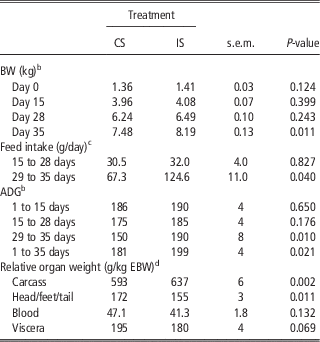
Performance data from birth to weaning (35 days) and relative weight of body components at weaning of Iberian piglets using conventional (CS) or intermittent suckling (IS)Footnote a

ADG=average daily gain; EBW=empty-BW (fresh matter).
a Two consecutive trials separated by a 3-month interval were conducted (n=10 sows per trial). Effects of treatment, trial and their interaction were analysed by two-way ANOVA. The trial and trial×treatment effects were never significant (P>0.05).
b Mean values of litters with 60 piglets per treatment (six piglets per litter, five litters per treatment and trial).
c Mean values of the litters (n=20, five litters per treatment and trial).
d Mean values of one piglet slaughtered per litter (n=20, five litters per treatment and trial).
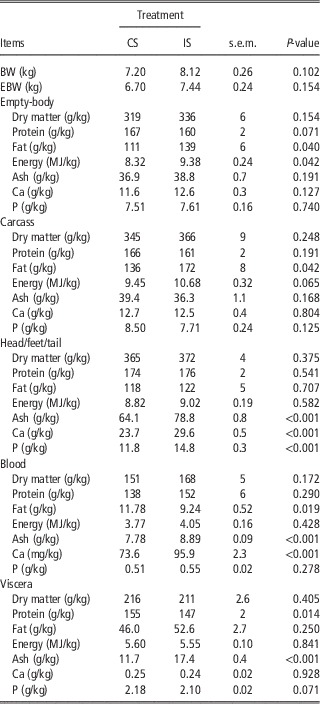
Dry matter, protein, fat, energy and mineral content in the whole-body and body components of the Iberian piglets using conventional (CS) or intermittent suckling (IS), weaned at 35 days of ageFootnote a

EBW=empty-BW (fresh matter).
a Two consecutive trials separated by a 3-month interval were conducted (n=10 sows per trial). Mean values of 1 piglet slaughtered per litter (n=20, five litters per treatment and trial). Effects of treatment, trial and their interaction were analysed by two-way ANOVA. The trial and trial×treatment effects were never significant (P>0.05).
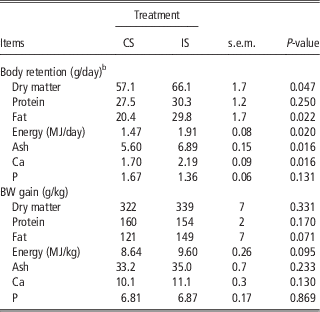
Retention and composition of the BW gain of dry matter, protein, fat, energy, total ash, Ca and P of the Iberian piglets using conventional (CS) or intermittent suckling (IS) weaned at 35 days of ageFootnote a

a Two consecutive trials separated by a 3-month interval were conducted (n=10 sows per trial). Mean values of 1 piglet slaughtered per litter (n=20, five litters per treatment and trial). Effects of treatment, trial and their interaction were analysed by two-way ANOVA. The trial and trial×treatment effects were never significant (P>0.05).
b Nutrient and energy retention for the whole period of lactation (0 to 35 days of age).
Results
Statistical analysis revealed no significant effect of the trial and trial×treatment on any of the variables analysed. Thus, only results obtained for the different treatments (CS and IS) are presented in the corresponding tables.
Piglet performance
Data are shown in Table 1. No difference was found in the number of piglets at birth before treatments were imposed: 7.4±0.3 and 7.7±0.4 for total born piglets and 7.1±0.3 and 7.3±0.5 for live born piglets, for CS and IS, respectively. BW at birth was similar for both groups of piglets. During the experimental period, average BW did not differ significantly between groups up to 28 days of age (P>0.05), although average values for IS piglets were numerically higher. At weaning, the IS piglets were heavier than the CS piglets (8.19 v. 7.48 kg, P=0.011). No differences in creep feed intake were observed before the IS was imposed, that is, days 15 to 28. During restriction to the dam (29 to 35 days), solid feed consumption was greater for IS litters than for CS litters (P=0.040).
Average daily gain (ADG) was similar for the treatment groups before the IS treatment was imposed at day 28 (P>0.05). During the IS week (29 to 35 days), the IS piglets grew faster than the CS piglets (190 v. 150 g/day, respectively, P=0.010). The difference in ADG during the whole 35-day suckling period was also significant between groups (181 and 199 g/piglet for the CS and IS treatments, respectively, P=0.021).
Piglet body composition and retention of energy and nutrients
At birth, overall body content of energy and nutrients per kg EBW was as follows: protein 129±3.3 g, fat 26.4±0.80 g, water 806±2.9 g, ash 40.0±0.19 g, energy 4.13±0.064 MJ, Ca 14.0±0.12 g and P 7.8±0.13 g.
Although the EBW for the piglets slaughtered at weaning was not different between the CS and IS piglets, these treatments caused significant differences in the relative weight of the body components at weaning (Table 1). Piglets in the IS group had larger carcasses relative to their BW, whereas the proportion of HFT was smaller in the IS than in CS piglets. No differences were observed for proportions of the rest of body components.
Table 2 presents values for DM, protein, fat, energy and mineral content in the empty-body and in the different body components, that is, carcass, HFT, blood and viscera, of the piglets slaughtered immediately after weaning, at 35 days of age. No significant differences were found for protein content, either in the empty-body (P=0.071) or in the body compartments, except for protein concentration in the viscera, which was slightly higher in the CS group. Values for whole-body fat, whole-body energy and carcass fat were higher in the IS group (P<0.05).
Whole-body ash content at weaning was similar for both groups, although higher values were observed in HFT, blood and viscera for IS litters compared with CS litters (P<0.001). Ca content was higher in HFT and blood compartments from the IS piglets (P<0.001). No differences for P content between litters were observed, except for higher HFT values in the IS group. Whole-body Ca : P ratio did not vary between groups (1.56 v. 1.65 in CS and IS, respectively, P=0.28). Approximately 63% to 64% of total body Ca and 65% to 67% of total P was located in the carcass. The HFT fraction contributed 35% to 36% to total body Ca and 27% to 30% to total P. Minor contributions were found for the blood (~0.03% of Ca and 0.30% of P) and viscera (0.38% of Ca, 5.2% of P). Body concentration of ash correlated well with Ca levels (r=0.921, P=0.0000), but not with P levels.
No differences were observed between groups for daily protein and P retention during the suckling period (Table 3). Daily retention of DM, fat, energy, total ash and Ca was significantly higher for the IS litters. Although no significant differences between treatment groups were observed for body gain composition for any of the variables studied, fat and energy content tended to be higher in the IS group compared with the CS piglets (by 19% and 11%, respectively, P<0.10).
Discussion
Stimulating solid feed intake before weaning is proposed as a strategy to mitigate the abrupt transition between maternal milk supply and creep feed consumption, with an expected positive effect on the rate of weight gain and the prevention of intestinal disorders (Van Beers-Schreurs et al., Reference Van Beers-Schreurs, Nabuurs, Vellenga, Kalsbeek-van der Valk, Wensing and Breukink1998; Berkeveld et al., Reference Berkeveld, Langendijk, van Beers-Schreurs, Koets, Taverne and Verheijden2007). In assays studying effects of IS on conventional porcine breeds, access to the sow was drastically limited during 10 or 12 h from the onset of the treatment (Berkeveld et al., Reference Berkeveld, Langendijk, van Beers-Schreurs, Koets, Taverne and Verheijden2007 and Reference Berkeveld, Langendijk, Soede, Kemp, Taverne, Verheijden, Kuijken and Koets2009; Kuller et al., Reference Kuller, Soede, van Beers-Schreurs, Langendijk, Taverne, Kemp and Verheijden2007). In the current study, separation from the dam was progressively imposed, increasing the number of hours per day from 6 to 10, to overcome the negative effects of transition to a non-milk diet.
In the present study, the IS regime had a positive effect on the intake of creep feed, with the IS litters consuming 80% more solid feed (g/day) during the IS period. Moreover, all litters on IS had a cumulative total feed intake before weaning >600 g/piglet, an amount that can improve postweaning performance (English, Reference English1980), whereas four of 10 CS litters did not attain this recommended quantity. Previous studies have also shown greater creep feed intake during lactation in the IS piglets with a 12 h/day separation period compared with conventionally weaned piglets, although high variability in creep feed intake was observed among animals (Kuller et al., Reference Kuller, Soede, van Beers-Schreurs, Langendijk, Taverne, Verheijden and Kemp2004 and Reference Kuller, Soede, van Beers-Schreurs, Langendijk, Taverne, Kemp and Verheijden2007; Berkeveld et al., Reference Berkeveld, Langendijk, van Beers-Schreurs, Koets, Taverne and Verheijden2007). When sows and piglets were separated for shorter periods, such as 10 h/day, from days 19 to 26 (Berkeveld et al., Reference Berkeveld, Langendijk, Soede, Kemp, Taverne, Verheijden, Kuijken and Koets2009) or 7 h/day, from days 14 to 28 (Millet et al., Reference Millet, Aluwe, De Brabander and Van Oeckel2008) a lack of feed intake stimulation was observed. Thus, the success observed in the present study concerning solid feed intake, despite the short separation period imposed (from 6 to 10 h), may be because of the late onset of the IS (at 28 days), as it has been shown that its effect is enlarged when prevention of free access to the dam is postponed (Berkeveld et al., Reference Berkeveld, Langendijk, Verheijden, Taverne, van Nes, van Haard and Koets2008). Moreover, IS during an extended lactation period contributed to stimulate eating behaviour without causing behavioural stress in piglets (Berkeveld et al., Reference Berkeveld, Langendijk, van Beers-Schreurs, Koets, Taverne and Verheijden2007). Therefore, weaning at a later age (35 days), which implies an advanced development of the gastrointestinal tract, and the gradual separation of the dam, have both probably contributed to stimulating solid feed intake in the IS piglets. This increased feed intake in the IS litters observed in the present study was also reflected in higher ADG during the IS period and higher BW at weaning. Other authors have reported reduced growth and BW of piglets at weaning (Kuller et al., Reference Kuller, Soede, van Beers-Schreurs, Langendijk, Taverne, Verheijden and Kemp2004 and Reference Kuller, Soede, van Beers-Schreurs, Langendijk, Taverne, Kemp and Verheijden2007; Berkeveld et al., Reference Berkeveld, Langendijk, Soede, Kemp, Taverne, Verheijden, Kuijken and Koets2009), suggesting that feed intake in the IS period might still be too small to compensate for the milk deficit caused by separation from the sow. When separation takes place for shorter periods (6 h/day), no negative effect on weight gain was observed (Newton et al., Reference Newton, Stevenson and Davis1987).
In the present experiment, an estimation was made of piglet’s milk intake in days 28 to 35. For that purpose, we assumed for the gain to creep feed ratio the value of 0.793 obtained for the BW gain to milk total solid intake ratio by Aguinaga et al. (Reference Aguinaga, Gomez-Carballar, Nieto and Aguilera2011a) in Iberian piglets fed exclusively on milk. This ratio of 0.793 was used to estimate the ADG resulting from creep feed consumption during this period, whereas the remaining ADG was assumed to reflect the milk intake of the piglets. Assuming a conversion of milk to ADG of 0.142 (Aguinaga et al., Reference Aguinaga, Gomez-Carballar, Nieto and Aguilera2011a), a similar intake for IS and CS piglets of 716 and 711 g/day, respectively, was derived. Consequently, under the conditions of this study, milk intake did not seem to be reduced in the IS piglets, as reported by other authors (Kuller et al., Reference Kuller, Soede, van Beers-Schreurs, Langendijk, Taverne, Verheijden and Kemp2004). When the Iberian piglets were exclusively suckled for 34 days, the average growth rate was 168 g/day (Aguinaga et al., Reference Aguinaga, Gomez-Carballar, Nieto and Aguilera2011a), a value close to that found for the CS piglets in the current assay, although lower than 199 g/day observed for IS piglets, which reinforce the positive effect of the IS treatment on pre-weaning growth performance.
It is known that Iberian pigs differ widely from lean pigs in terms of nutrient retention (Nieto et al., Reference Nieto, Miranda, García and Aguilera2002; Conde-Aguilera et al., Reference Conde-Aguilera, Aguinaga, Aguilera and Nieto2011b), but no data have been found in the literature concerning the possible effects of the IS on the body composition of Iberian or conventional piglets at weaning. It has been shown that providing additional nutrients to conventional piglets (by supplemental milk before weaning) has a positive effect on ADG and BW at weaning (Wolter et al., Reference Wolter, Ellis, Corrigan and DeDecker2002; Miller et al., Reference Miller, Collins, Smits, Thomson and Holyoake2012), although information on the effects of additional nutrient intake during the nursery period on nutrient retention and body composition at weaning is very scarce. In CS pigs, supplemented or not from 4 to 28 days of age (weaning) with liquid cow milk or a synthetic milk supplement (King et al., Reference King, Boyce and Dunshea1998), no differences in body composition at weaning were detected, despite supplemented pigs growing 15% to 24% faster than non-supplemented pigs. In artificially reared neonatal piglets, the replacement of lactose for two sources of partially hydrolyzed corn syrup solids did not affect body composition after 20 days of treatment (Oliver et al., Reference Oliver, Mathews, Phillips, Jones, Odle and Harell2002). In contrast, differences in body composition and nutrient accretion rates have been found in piglets fed liquid milk-replacer diets containing different protein sources from 2 to 19 days of age; piglets fed a whey diet contained a higher percentage of fat and ash at 19 days of age than piglets fed vegetable protein diets, although they accreted protein at a slower rate (Ebert et al., Reference Ebert, Berman, Harrell, Kessler, Cornelius and Odle2005). Disregarding differences between studies, the Iberian suckling piglets of the present study showed similar (Oliver et al., Reference Oliver, Mathews, Phillips, Jones, Odle and Harell2002) or higher (King et al., Reference King, Boyce and Dunshea1998; Ebert et al., Reference Ebert, Berman, Harrell, Kessler, Cornelius and Odle2005) body protein, whereas body fat was within the range of the values reported for the piglets in the aforementioned studies. Iberian piglets deposited less protein (29 v. 37 to 61 g/day) and fat (31 to 30 v. 58 to 51 g/day) than the control piglets described by Ebert et al. (Reference Ebert, Berman, Harrell, Kessler, Cornelius and Odle2005) and Oliver et al. (Reference Oliver, Mathews, Phillips, Jones, Odle and Harell2002). The present findings show some significant effects of IS on the body composition of weaned Iberian piglets, especially in the amounts of fat and energy deposited daily. The increase in empty-body fat deposition found in the IS litters was because of the greater fat deposition in the carcass (CS 15.0, IS 23.9 g/day, P=0.006) as the main lipid store of the body. As a consequence, fat content increased in the carcass of the IS piglets compared with CS piglets (by 21%). Young piglets, particularly after weaning, spare their body protein and preferentially metabolize fat under situations of nutritional shortage (Williams, Reference Williams2003), and significant fat losses take place early after weaning (Whittemore et al.,Reference Whittemore, Aumaitre and Williams1978; Whang et al., Reference Whang, McKeith, Kim and Easter2000). The increased fat depots at weaning could be particularly important for the Iberian piglet, which under some management systems is reared in harsh outdoor conditions. The present results indicate that no significant modification on protein body concentration or retention was produced by the IS treatment; therefore, and in agreement with previous data (Aguinaga et al., Reference Aguinaga, Gomez-Carballar, Nieto and Aguilera2011a), Iberian piglets seem to achieve their maximum potential for protein deposition at 27.4 to 29.6 g/day, in the range of values reported for conventional piglets (Noblet and Etienne, Reference Noblet and Etienne1986).
The IS feeding did not lead to alterations in ash body concentration and, accordingly, no differences between treatments were observed for Ca and P body levels. Analysis of the mineral distribution among the major body compartments revealed that only the HFT fraction was significantly enriched in Ca and P in the IS piglets. Ca and P concentration in the carcass were unaffected, which may indicate that the higher relative weight of this body constituent found in the IS piglets is because of components other than the bone, in which these elements are the main mineral components (99% and 80% of body Ca and P, respectively, are located in the skeleton). Thus, the increased relative carcass weight detected in the IS pigs could be related to the increase in carcass fat deposition. Increased ash retention (g/day) was observed in the IS piglets compared with the CS piglets, although because of the higher BW reached by the IS group, no differences were noticed in body ash content at weaning (Table 2) or in ash content per kg of BW gain (Table 3). In milk-fed Iberian piglets, a mean content of 40 g ash/kg BW gain has been observed (Castellano et al., Reference Castellano, Aguinaga, Nieto, Aguilera, Haro and Seiquer2013a), a higher value than that found in the present assay.
The increase in solid feed intake observed in the Iberian piglets as a consequence of the progressive IS management imposed, resulted in changes in growth rate and body composition at weaning, mainly related to a higher fat deposition in the carcass. Further research is required to clarify the potential benefits of this practice in management systems under which piglets are reared outdoors and the availability of additional body energy reserves could be critical.
Acknowledgements
The authors thank Junta de Andalucía for supporting this study (grant no. AGR-3078). Rosa Castellano was recipient of a grant from Junta de Andalucía. They also thank Sánchez Romero Carvajal Jabugo, S.A. (Seville, Spain) for their helpful collaboration.