1. Introduction
The relationship between folding and fractures has being deeply studied in the last 50 years (e.g. Price, Reference Price1966; Stearns, Reference Stearns, Baer and Norris1969; Ramsay & Huber, Reference Ramsay and Huber1987; Pollard & Aydin, Reference Pollard and Aydin1988; Barchi et al. Reference Barchi, Bernasconi, Brozzetti, Lavecchia, Menichetti, Minelli, Nardon, Pialli and Spencer1993; Cosgrove, Reference Cosgrove, Richards, Richardson, Rippington, Wilson and Bond2015; Watkins et al. Reference Watkins, Butler, Bond and Healy2015, Reference Watkins, Healy, Bond and Butler2018; Francioni et al. Reference Francioni, Coggan, Eyre and Stead2018 a). Price (Reference Price1966), Stearns (Reference Stearns, Baer and Norris1969) and Watkins et al. (Reference Watkins, Butler, Bond and Healy2015, Reference Watkins, Healy, Bond and Butler2018) developed conceptual fold-related fracture models showing that fold geometry and kinematics are the most important factors that control the possible fracture sets expected in an anticline fold structure. These authors proposed fold-related fracture models including longitudinal and transverse joint sets striking longitudinally and transversely to the fold hinge, respectively, and two conjugate shear fracture sets developed obliquely with their obtuse angle intersecting the fold-axial trend. Several studies have shown that there are many factors controlling the distribution and spatial variation of fractures within the folds, revealing that the use of conceptual fold-related fracture models tends to oversimplify the fracture distribution, which is assumed to be homogeneous (McQuillan, Reference McQuillan1973; Gorham et al. Reference Gorham, Woodland, Calender and Greer1979; Bergbauer & Pollard, Reference Bergbauer and Pollard2004; Wennberg et al. Reference Wennberg, Azizzadeh, Aqrawi, Blanc, Brockbank, Lyslo, Pickard, Salem, Svånå, Lonergan, Jolly, Rawnsley and Sanderson2007; Watkins et al. Reference Watkins, Healy, Bond and Butler2018). Bergbauer & Pollard (Reference Bergbauer and Pollard2004) documented that pre-folding fractures govern the orientation of syn-folding fractures as well as the mode of fracturing. Gorham et al. (Reference Gorham, Woodland, Calender and Greer1979) and Watkins et al. (Reference Watkins, Healy, Bond and Butler2018) demonstrated that fracture intensity is usually higher in the areas of maximum curvature of folds. Wennberg et al. (Reference Wennberg, Azizzadeh, Aqrawi, Blanc, Brockbank, Lyslo, Pickard, Salem, Svånå, Lonergan, Jolly, Rawnsley and Sanderson2007) showed that fracture intensity is strictly dependent on the mechanical stratigraphy of the involved multilayer. Watkins et al. (Reference Watkins, Healy, Bond and Butler2018) highlighted that the factors controlling fracture density in fold-and-thrust belts include structural position, strain and length of deformation history, as well as lithological control.
In contrast, Bellahsen et al. (Reference Bellahsen, Fiore and Pollard2006), Ahmadhadi et al. (Reference Ahmadhadi, Daniel, Azzizadeh and Lacombe2008), Amrouch et al. (Reference Amrouch, Lacombe, Bellahsen, Daniel and Callot2010), Beaudoin et al. (Reference Beaudoin, Bellahsen, Lacombe and Emmanuel2011, Reference Beaudoin, Leprêtre, Bellahsen, Lacombe, Amrouch, Callot, Emmanuel and Daniel2012, Reference Beaudoin, Koehn, Lacombe, Lecouty, Billi, Aharonov and Parlangeau2016), Lacombe et al. (Reference Lacombe, Bellahsen and Mouthereau2011), Branellec et al. (Reference Branellec, Callot, Nivière and Ringenbach2015), Hernández & Franzese (Reference Hernández and Franzese2017) and Tavani et al. (Reference Tavani, Storti, Lacombe, Corradetti, Muñoz and Mazzoli2015, Reference Tavani, Corradetti, Sabbatino, Morsalnejad and Mazzoli2018) have described fracture sets within folds as originating prior to or in the early stages of folding, being either reopened, sheared or passively tilted during folding.
The distribution of joints, veins and shear fractures from the Montagna dei Fiori (MdF) overturned anticline (outer sector of the Central Apennines) is documented in this study in order to reconstruct their pre-, syn- and post-folding development and to define a fold-related fracture model suitable for foreland-verging regional-scale overturned anticlines characterized by a marked hinge-line culmination.
2. Regional geological framework
The Apennines of Italy are a Neogene fold-and-thrust belt that developed following the closure of the Mesozoic Tethys Ocean and the collision between the African and the European plates during the Alpine Orogeny (Carminati & Doglioni, Reference Carminati and Doglioni2012). Episodes of pre- and post-orogenic extension have been widely recognized to have affected this thrust belt (e.g. Tavarnelli, Reference Tavarnelli1996a,b; Tavarnelli & Peacock, Reference Tavarnelli and Peacock1999; Di Domenica et al. Reference Di Domenica, Turtù, Satolli and Calamita2012; Pace et al. Reference Pace, Di Domenica and Calamita2014, Reference Pace, Pasqui, Tavarnelli and Calamita2017; Scisciani et al. Reference Scisciani, Agostini, Calamita, Pace, Cilli, Giori and Paltrinieri2014; Cardello & Doglioni, Reference Cardello and Doglioni2015; Pace & Calamita, Reference Pace and Calamita2015; Calamita et al. Reference Calamita, Di Domenica and Pace2018).
The MdF overturned anticline is a fault-related fold cropping out in the external portion of the Central Apennines foreland thrust belt of Italy (Fig. 1a). This structure developed during Early Pliocene time and involves the Jurassic–Miocene Umbria-Marche pelagic carbonate succession and the Messinian foredeep siliciclastic deposits of the Laga Formation (Mattei, Reference Mattei1987; Calamita et al. Reference Calamita, Pizzi, Ridolfi, Rusciadelli and Scisciani1998; Scisciani et al. Reference Scisciani, Tavarnelli and Calamita2002; Scisciani & Montefalcone, Reference Scisciani, Montefalcone, Mazzoli and Butler2006; Di Francesco et al. Reference Di Francesco, Fabbi, Santantonio, Bigi and Poblet2010; Storti et al. Reference Storti, Balsamo and Koopman2016; Francioni et al. Reference Francioni, Stead, Sciarra and Calamita2018 b; Fig. 1b). This foreland-verging overturned anticline has a NNW–SSE axial trend and a prominent hinge-line culmination related to a marked NNW plunge (30–40° dip), and is characterized by a blind thrust with a tip line in the Cretaceous–Tertiary limestones (Fig. 1a–d).
(a) Tectonic sketch of Central Italy with the Montagna dei Fiori area highlighted in the box. (b) Geological map of the Montagna dei Fiori area. (c) Cross-section (modified from Scisciani et al. Reference Scisciani, Agostini, Calamita, Pace, Cilli, Giori and Paltrinieri2002). (d) Montagna dei Fiori hinge-line culmination, with a main NNW plunge.

A regional SW-dipping normal fault affects the backlimb of the MdF structure. This fault juxtaposes the Jurassic–Cretaceous carbonate sequence and the Miocene hemipelagic succession with a WSW-downthrow of c. 900 m (Calamita et al. Reference Calamita, Pizzi, Ridolfi, Rusciadelli and Scisciani1998). According to Calamita et al. (Reference Calamita, Pizzi, Ridolfi, Rusciadelli and Scisciani1998) and Scisciani et al. (Reference Scisciani, Tavarnelli and Calamita2002), this structure represents a Miocene pre-thrusting normal fault, whereas Storti et al. (Reference Storti, Balsamo, Mozafari, Koopman, Swennen and Taberner2018) envisaged this fault to have Pliocene syn-thrusting activity in agreement with Ghisetti & Vezzani (Reference Ghisetti and Vezzani2000), who related the normal fault development along the backlimb of the MdF anticline to the final stages of shortening during Middle–Late Pliocene times.
The overall asymmetry of the fold and the shortcut trajectory of the thrust across the pre-existing normal fault allow us to relate the MdF anticline to a fault-propagation shortcut mechanism (Scisciani et al. Reference Scisciani, Tavarnelli and Calamita2002; Calamita et al. Reference Calamita, Satolli, Scisciani, Esestime and Pace2011, Reference Calamita, Pace and Satolli2012). Di Francesco et al. (Reference Di Francesco, Fabbi, Santantonio, Bigi and Poblet2010) defined the MdF structure as a regional-scale anticline with an overturned forelimb associated with a simple fault-propagation folding model.
The excellent exposures around the MdF structure allow the investigation of the distribution of fractures in this foreland-verging overturned anticline involving a mechanically heterogeneous carbonate multilayer and characterized by a marked hinge-line culmination.
3. Structural analysis of the fracture network
3.a. Methods
The fracture sets characterizing the MdF overturned anticline were analysed with particular focus on their relative timing and the factors controlling their distribution, such as mechanical stratigraphy and structural position.
The fractures (joints, veins and shear fractures) in the different formations of the Umbria-Marche pelagic carbonate sequence have been surveyed in the most significant outcrops (Fig. 2). Data on a total of 807 fracture measurements and c. 200 bedding planes were collected, and the attitudes, spacing, persistence and apertures were measured.
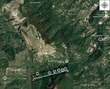
Study area with the main stops highlighted and trace of the geological section A–A′ of Figure 3.

This dataset was used to estimate geomechanical indices along scanlines, such as the weighted joint density (Wjd)
 $${\rm {Wjd}} = 1/{\rm{L}}^* \sum {\rm{n}}^* \phi$$
where L is the length of the scanline, n is the number of discontinuities encountered for each set and ϕ is the correction factor (intersection angle between the scanline and the individual discontinuity).
Joint intensity (Ji), expressed as length of joints per unit area (L-1) (Dershowitz & Herda, Reference Dershowitz and Herda1992; calculated using 1 and 2 m circular sampling windows) and fracture spacing ratio (FSR), which is the bed thickness divided by the median spacing, were calculated for every lithology and structural position in the fold.
Furthermore, in order to define the unfolded state of the fractures, we have restored the bedding planes to the horizontal. The abutting relationship between the joint sets and their high-angle relationship to bedding pressure-solution cleavage and veins, allowed us to reconstruct the timing of joint development and their correlation with the layer-parallel shortening (LPS) and folding processes.
The data obtained were then compared with other studies carried out on periclines (Lavecchia et al. Reference Lavecchia, Minelli and Pialli1983; Barchi et al. Reference Barchi, Bernasconi, Brozzetti, Lavecchia, Menichetti, Minelli, Nardon, Pialli and Spencer1993; Beaudoin et al. Reference Beaudoin, Koehn, Lacombe, Lecouty, Billi, Aharonov and Parlangeau2016) and on regional-scale anticlines (Di Naccio et al. Reference Di Naccio, Boncio, Cirilli, Casaglia, Morettini, Lavecchia and Brozzetti2005) from the Northern Apennines. Such comparison allowed us to identify a fold-related fracture model suitable for hinge-line culminations in periclines and in regional-scale anticlines.
3.b. Results
The geological data and bedding plane measurements collected across the hinge-line culmination of the overturned anticline (Figs 2, 3a, b) were used in the β and π diagram to define the orientation of the fold axis, which plunges at 7° towards the NNW (N339°) (Fig. 3c).
(a) Geological sketch of the study area inspired by the geological map of Mattei (Reference Lavecchia, Minelli and Pialli1987) with geological section A–A′ and measurements of bedding planes. (b) Stratigraphic column of the Umbria-Marche succession: CM – Calcare Massiccio Fm; COI – Corniola Fm; RAM – Rosso Ammonitico Fm; CDU – Formazione di Salinello and Calcari Diasprigni Fms (1* represents the Jurassic condensed succession); MAI – Maiolica Fm; FUC – Marne a Fucoidi Fm; SR – Scaglia Rosata and Scaglia Cinerea Fms; MCERR – Bisciaro, Marne con Cerrogna and Marne a Orbulina Fms; LAGA – Laga Fm. (c) β and π diagrams.

The already mentioned NW–SE-trending normal fault, cropping out for about 15 km in the backlimb of the anticline (Figs 1, 3a), dips 80° towards the WSW and it is characterized by a core represented by a 15–20 cm thick crush-microbreccia. A damage zone of c. 40 m in width involves the Jurassic limestones of the Corniola Formation in the footwall block, frequently including fault breccia. Conversely, a penetrative S-C fabric represented by high-angle shear planes (C) and spaced sub-horizontal pressure-solution cleavage (S) is well developed in the 5–10 m thick hanging-wall fault damage zone within the Oligocene–Miocene marls.
In the footwall block of this regional normal fault, the following units of the Umbria-Marche succession are exposed: Corniola Formation (COI, Lower Jurassic, overlying the older Lower Jurassic Calcare Massiccio, CM), Rosso Ammonitico Formation (RAM, Lower Jurassic), Formazione del Salinello and Calcari Diasprigni formations (CDU, Upper/Mid Jurassic), Maiolica Formation (MAI, Lower Cretaceous), Marne a Fucoidi Formation (FUC, Lower Cretaceous) and the Scaglia Rosata and Scaglia Cinerea formations (SR, Upper Cretaceous–Oligocene).
The blind thrust cropping out along the Salinello Valley has a tip line within the Scaglia Rosata Fm. This structure, characterized by a gently SW-dipping (20–30°) fault plane, juxtaposes the Jurassic–Lower Cretaceous carbonate succession of the upright forelimb (Calcare Massiccio Fm – Marne a Fucoidi Fm) onto the Scaglia Rosata Fm belonging to the overturned forelimb.
The structural and geomechanical surveys performed along the Macchia di Sole road (backlimb and upright forelimb), Grotta Sant’Angelo area (overturned forelimb) and near San Giacomo Village (crestal zone in the northern plunging sector; Fig. 2) allowed us to characterize the discontinuities (fractures and bedding) in all the lithologies cropping out in the different structural positions of the anticline.
Two main joint sets are developed from the backlimb through the upright and overturned forelimb of the MdF anticline. An ENE–WSW-striking transverse set (J1) and a NNW–SSE-striking longitudinal set (J2) are perpendicular and sub-parallel to the fold-axial trend, respectively. Two fractures sets, S1 and S2 (NE–SW and WNW–ESE oriented, respectively), are also developed oblique to the anticline axial trend.
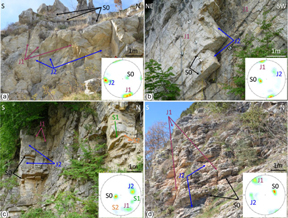
In the hinge-line culmination, the transverse joint set (J1) is the prevailing set across the different structural positions of the anticline. J2 abuts against J1 forming a T-node, and both sets are always perpendicular to the bedding. Some examples of the T-node relationship between J1 and J2 are shown in Figure 4, which highlights this relationship in the backlimb (Marne con Cerrogna (MCERR) Fm; Fig. 4a), upright forelimb (MAI, COI and SR Fms; Fig. 4b, c) and overturned forelimb (SR Fm; Fig. 4d). The fracture sets S1 and S2 abut against the joint sets J1 and J2 (Fig. 4c).
The longitudinal joint set (J2, NNW–SSE trending) abuts against the transverse joint set (J1, ENE–WSW trending) forming a T-node. (a) MCERR Fm, anticline backlimb. (b) MAI Fm, upright forelimb. (c) COI Fm, upright forelimb, with the low persistence oblique fracture sets (S1 and S2), subordinate to J1 and J2, also highlighted. (d) SR Fm, overturned forelimb.

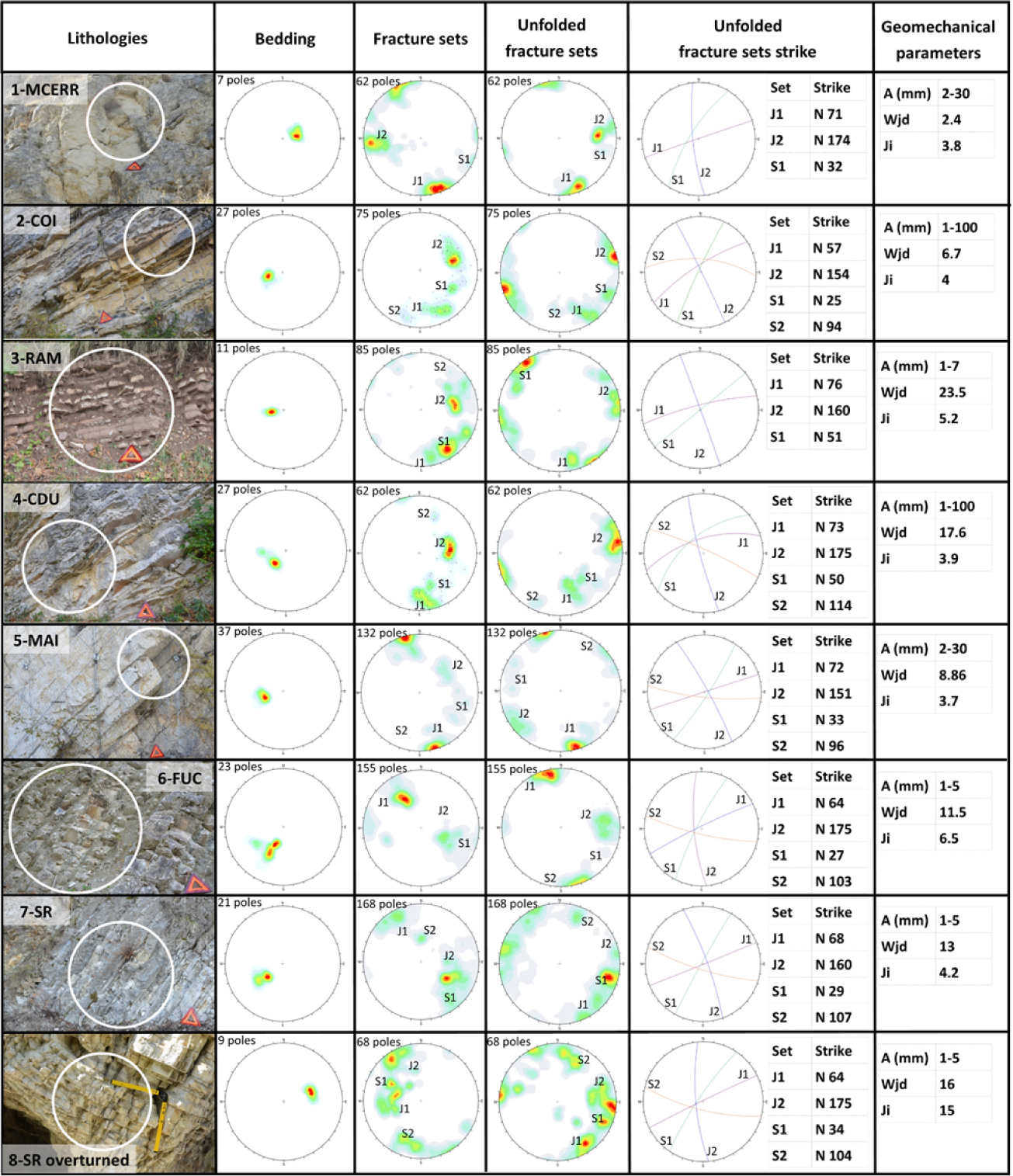
The following results obtained from the geomechanical analysis carried out in different lithologies are represented in Figure 5, where it is possible to observe the present-day attitude of the bedding planes and fracture sets; the unfolded state of the fracture sets; the joint aperture (A); the intensity (Ji); and the weighted joint density (Wjd). The two fractures sets, S1 and S2, are characterized by acute angle values of between 60° and 70° in the unfolded state. We infer that such fracture sets can represent a conjugate system of shear fractures.
Present-day and unfolded attitude of the fracture sets (joints J1 and J2; oblique fracture sets S1 and S2) and bedding represented by stereonets: 1 – Marne con Cerrogna (backlimb); 2 – Corniola (upright forelimb); 3 – Rosso Ammonitico (upright forelimb); 4 – Calcari Diasprigni (upright forelimb); 5 – Maiolica (upright forelimb); 6 – Marne a Fucoidi (upright forelimb); 7 – Scaglia Rosata (upright forelimb); 8 – Scaglia Rosata (overturned forelimb). Geomechanical parameters (A = joint aperture; Wjd = weighted joint density) have been measured along scanlines, whereas joint intensity (Ji) is related to circular sample windows. For scale, the length of the side of the triangle is 42.5 cm, while the length of the side of the level in 8-SR is 60 cm. Photographs 1 and 8 taken looking towards the NW; photographs 2–7 towards the SE.
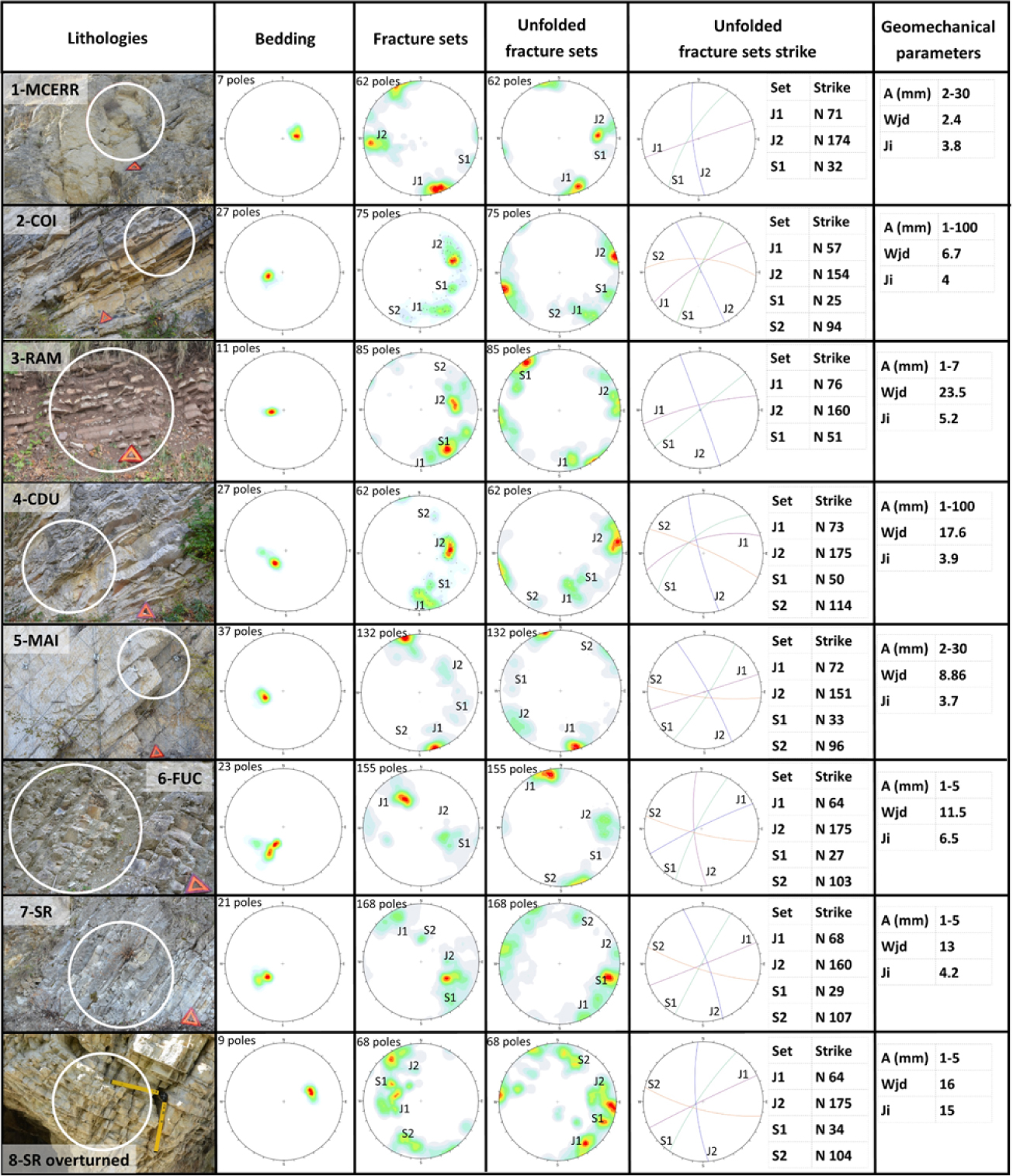
Formations characterized by thin-bedded (10–30 cm thick) limestone or limestone alternating with marls (such as Rosso Ammonitico and Marne a Fucoidi Fms) present higher Wjd (23.5 and 13.8, respectively) and Ji (5.2 and 6.5, respectively) values. In more homogeneous formations of mudstone (Corniola and Maiolica Fms) or grainstone (Marne con Cerrogna Fm) with thick beds (30 cm up to 3 m thick), lower Wjd (6.7, 8.86 and 2.4, respectively) and Ji (4, 3.7 and 3.8, respectively) values are calculated.
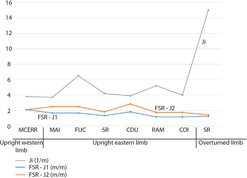
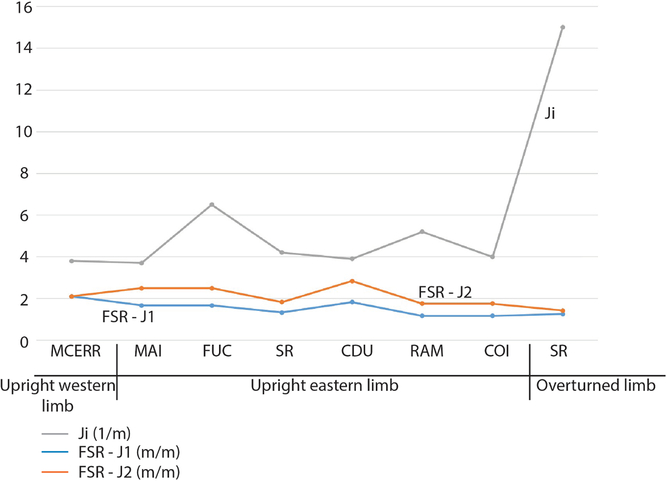
The Ji value of the Scaglia Rosata Fm is higher in the overturned forelimb (15) than in the upright forelimb (4.2). However, the FSR values are comparable for the normalized fracture spacing in the different structural positions of the anticline (Fig. 6).
Joint intensity (Ji) and fracture spacing ratio (FSR) values across the MdF anticline. The Ji value of the Scaglia Rosata Fm is higher in the overturned forelimb than in the upright forelimb. The FSR values show comparable values of the normalized fracture spacing in the different structural positions of the anticline: COI – Corniola Fm; RAM – Rosso Ammonitico Fm; CDU – Formazione di Salinello and Calcari Diasprigni Fms; SR – Scaglia Rosata and Scaglia Cinerea Fms; FUC – Marne a Fucoidi Fm; MAI – Maiolica Fm; MCERR – Marne con Cerrogna Fm.
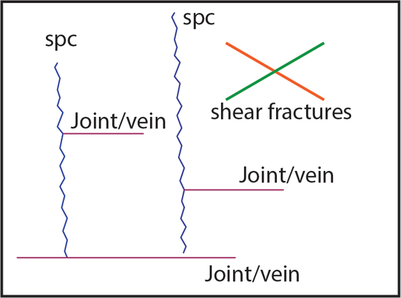
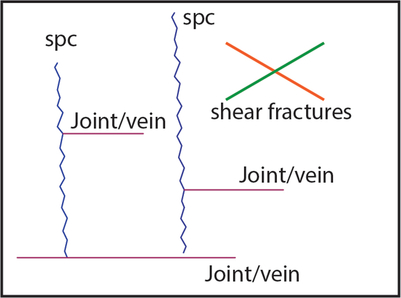
The Scaglia Rosata Fm is characterized by calcite-coated joints (mainly related to J1), veins parallel to the main joint sets J1 and J2 and pressure-solution seams parallel to the bedding. Moreover, stylolitic pressure-solution cleavage, trending NNW–SSE, is orthogonal both to the bedding and the joints/veins oriented ENE–WSW (Fig. 7a, b). The mutual overprinting relationship between the cleavage and ENE–WSW joints/veins suggests their contemporaneous development during LPS, which has been interpreted by Lavecchia (Reference Lavecchia1985) and Tavarnelli (Reference Tavarnelli1997) as a pre-folding process. Furthermore, the pressure-solution cleavage overprints the NNW–SSE-oriented veins developed pre-LPS (Fig. 7b).
(a) Stylolitic pressure-solution cleavage (sps) and veins (v), parallel and perpendicular to the bedding, respectively, developed during foreland compaction and flexuring (Scaglia Rosata Fm, Stop 9 in Figure 2). (b) Scaglia Rosata Fm in the anticline crestal zone of the NNW-plunging sector (Stop 10 in Figure 2) with the transversal joint set J1, the longitudinal joint set J2 and the bedding plane S0 highlighted. The white rectangle highlights a more specific area where it is possible to distinguish the stylolitic pressure-solution cleavage (spc), trending NNW–SSE orthogonal both to bedding and joints/veins oriented ENE–WSW. The pressure-solution cleavage overprints the NNW–SSW-trending veins.

4. Discussion
This paper analyses the distribution of fractures in the MdF foreland-verging overturned anticline, located in the external part of the Central Apennines. The anticlinal fold is characterized by a NNW–SSE axial trend with an evident hinge-line culmination and a NNW plunge at 30–40°. The thrust-related fold development occurred during Early Pliocene time and the backlimb is characterized by the occurrence of a regional normal fault parallel to the fold-axial trend.
Two joint sets, J1 and J2, transverse and longitudinal to the fold hinge, respectively, and a conjugate system of shear fractures, S1 and S2, with an obtuse bisector parallel to the anticline axial trend, were recognized. This is coherent with the conceptual fold-related fracture models proposed by Price (Reference Price1966), Stearns (Reference Stearns, Baer and Norris1969) and more recently by Watkins et al. (Reference Watkins, Healy, Bond and Butler2018). Moreover, according to Watkins et al. (Reference Watkins, Butler, Bond and Healy2015), the longitudinal set, parallel to the fold hinge, may be associated with outer-arc stretching during folding, whereas joint sets cross-striking the fold hinge can be related to the hinge-line parallel extension developed in the culmination zone of double-plunging anticlines. Transverse joints/veins are usually associated with an along-axis elongation recognized in fold-and-thrust belts by Price & Cosgrove (Reference Price and Cosgrove1990). Hennings et al. (Reference Hennings, Olson and Thompson2000) considered the fractures developed in higher strain fold areas as syn-folding and the open fractures in the backlimb as pre-dating folding.
Several studies documenting the joint distribution in thrust-related anticlines have been carried out in the Central–Northern Apennines, showing joint sets compatible with Price’s model. However, different timings and prevalence between the transverse and longitudinal sets have been proposed. Similar to the MdF anticline, a dominant transverse joint set was recognized by Lavecchia et al. (Reference Lavecchia, Minelli and Pialli1983) and Barchi et al. (Reference Barchi, Bernasconi, Brozzetti, Lavecchia, Menichetti, Minelli, Nardon, Pialli and Spencer1993) in the periclines of the Northern Apennines. Barchi et al. (Reference Barchi, Bernasconi, Brozzetti, Lavecchia, Menichetti, Minelli, Nardon, Pialli and Spencer1993) suggested that the nucleation of longitudinal joints in such areas occurred in a late-folding stage, subsequent to the transverse joints. In contrast, in a regional-scale anticline of the Northern Apennines characterized by a horizontal hinge line, Di Naccio et al. (Reference Di Naccio, Boncio, Cirilli, Casaglia, Morettini, Lavecchia and Brozzetti2005) defined the longitudinal joints as the prevailing set. Such a joint set has been considered by the authors to be release jointing, post-dating the Apennines compressional phase.
Different again, pre-/early-folding fracture patterns have been recognized in the anticlines of the Zagros orogenic system by Lacombe et al. (Reference Lacombe, Bellahsen and Mouthereau2011), who suggested considering pre-existing fractures, unrelated to folding, in more realistic conceptual fold-fracture models. Recently, Tavani et al. (Reference Tavani, Storti, Lacombe, Corradetti, Muñoz and Mazzoli2015) described the structural assemblages developed in different sectors of foreland fold-and-thrust belts, with the purpose of discussing the role of inherited extensional structures as related to the foreland flexural process and foredeep formation. Hernández & Franzese (Reference Hernández and Franzese2017) interpreted the fractures in the Tin Tin anticline, located in the southern part of the eastern Cordillera of Argentina, to have been formed before or during an early stage of folding.
Tavani et al. (Reference Tavani, Corradetti, Sabbatino, Morsalnejad and Mazzoli2018) reconstructed the role of rifting, differential compaction and convergence in the development of fracture patterns in the Zagros Belt. These authors emphasized that the convergence has caused the development of LPS-related structures, post-dating extensional structures developed during Jurassic rifting, Late Cretaceous–Eocene foreland flexuring and along-foredeep stretching. Beaudoin et al. (Reference Beaudoin, Koehn, Lacombe, Lecouty, Billi, Aharonov and Parlangeau2016) attributed the development of a stylolite-joint/vein network analysed in the Monte Nero anticline of the Umbria-Marche ridge (Northern Apennines) to LPS as well as to folding and post-folding processes. A pre-folding or syn-folding origin has also been reported for the different fracture sets in the Malargue fold-and-thrust belt (Argentina) by Branellec et al. (Reference Branellec, Callot, Nivière and Ringenbach2015). Bellahsen et al. (Reference Bellahsen, Fiore and Pollard2006) related the transverse joint set to LPS and the longitudinal set to hinge development in the Sheep Mountain Anticline, Wyoming.
Moreover, the development of regional systematic joint sets related to the Pliocene–Quaternary foreland flexural process have been recognized by Billi & Salvini (Reference Billi and Salvini2003) and Panza et al. (Reference Panza, Agosta, Zambrano, Tondi, Prosser, Giorgioni and Janiseck2015) in the Apulian forebulge of the Southern Apennine belt.
In the hinge-line culmination of the MdF anticline, the transverse joint set (J1) is dominant from the backlimb through the upright and overturned forelimbs. The longitudinal joint set (J2) abuts against the J1 set forming a T-node, suggesting that the nucleation of the transverse joint set (J1) pre-dates longitudinal joint set (J2) development. In this pronounced hinge-line culmination, the prevalence of the transverse joint set is associated with a fold-hinge parallel extension, which has caused the reopening of the transverse joint set developed during the pre-folding LPS.
In the crestal zone of the NNW-plunging sector of the fold near stop 10 (Fig. 2), the remote sensing analysis of fractures using Google Earth images allowed us to recognize the same unfolded orientation of fracture sets measured in the field (Fig. 8a–d). However, the mutual cross-cutting and abutting relationships between the fracture sets suggest a multiple reactivation of the longitudinal and transverse joint sets (Fig. 8b, c).
(a) Remote sensing analysis of fracture sets using Google Earth images in the crestal zone of the NNW-plunging sector of the anticline. (b, c) Mutual cross-cutting and abutting relationships between the fracture sets suggesting a multiple reactivation of the longitudinal and transverse joint sets. (d) Conjugate system of shear fractures.

The conjugate shear fractures are consistent with the pre-folding LPS process, as suggested by their unfolded orientation, which is invariable in the different structural positions.
The spread of the fractures in all the structural positions of the anticline, the development of J1 and J2 before the LPS-related shear fractures and the negligible variability in FSR across the anticline suggest a foreland/foredeep flexural process for the joint sets J1 and J2, which were later reopened during LPS and hinge fold development.
Moreover, two joint sets oriented ENE–WSW and NNW–SSE have been found in the travertines (Mid Pleistocene deposits according to Farabollini et al. Reference Farabollini, Materazzi, Miccadei and Piacentini2004) exposed around Civitella del Tronto village (Fig. 9 and Stop 11 in Fig. 2). These joint sets, sub-parallel to the J1 and J2 joint sets of the MdF anticline, suggest a post-folding reactivation of the joint sets related to the pre-/syn-folding development. This reactivation can be associated with the Quaternary extensional tectonics and related uplift involving the mountain ridge of the Apennines and the inner sector of the Adriatic foothills documented by Calamita et al. (Reference Calamita, Coltorti, Pieruccini and Pizzi1999), D’Agostino et al. (Reference D’Agostino, Jackson, Dramis and Funiciello2001) and Pizzi (Reference Pizzi2003).
Joint sets recognized in the Mid Pleistocene travertines of Civitella del Tronto town (Stop 11 in Figure 2).

5. Conclusions
In this paper, we document the distribution of fractures in the foreland-verging MdF anticline, located in the outer sector of Central Apennine foreland thrust belt. The considered anticline is characterized by a marked hinge-line culmination and a pronounced NNW plunge.
Two bed-perpendicular joint sets oriented longitudinally and transversely to the fold-axial trend and a conjugate system of shear fractures, oblique to the anticline axial trend, were recognized. The abutting relationship between the fracture sets allowed us to recognize the transverse joint set as the prevailing one in all the different lithologies and structural positions (backlimb, upright forelimb and overturned forelimb) in the hinge-line culmination of the MdF anticline. The longitudinal joint set terminates against the transverse joint set forming a T-node, suggesting an early-stage development for the transverse joints. The NNW–SSE-trending pressure-solution cleavage, the transverse ENE–WSW-oriented joints/veins and the conjugate shear fractures are associated with pre-folding LPS (Fig. 10). Moreover, the pressure-solution cleavage overprints the veins oriented NNW–SSE, suggesting a pre-LPS development of these longitudinal veins/joints, related to the foreland flexure and along-foredeep stretching. Within this context, the early development of the transverse joints/veins is also related to the pre-LPS foreland flexuring and along-foredeep stretching. Therefore, the transverse (J1) and longitudinal (J2) joint sets, most likely developed during the pre-folding foreland/foredeep flexure, have been reopened during LPS (J1), outer-arc extension during folding (J2) and fold-axial parallel extension during the development of the hinge-line culmination of the MdF overturned anticline (J1).
The structural association composed by the NNW–SSE-trending pressure-solution cleavage (spc) and ENE–WSW-oriented joints/veins compatible with the pre-folding LPS process.
Nevertheless, the fold-related fracture model proposed in this study highlights the dominance of the transverse joint set in all the structural positions of the hinge-line culmination of a foreland-verging overturned anticline (Fig. 11). Within this context, the case here presented from a foreland-verging overturned anticline further documents the prevalence of transverse joint sets as a distinctive characteristic of hinge-line culminations within both periclines and regional-scale anticlines developed in foreland thrust belts.
Conceptual fold-related fracture model inferred for the hinge-line culmination of the Montagna dei Fiori overturned anticline. The dominant transversal joint set (J1) affects the different lithologies and structural positions around the fold, within the culmination zone.

Author ORCIDs
Mirko Francioni 0000-0001-6358-374X, Paolo Pace 0000-0001-9982-9414
Acknowledgements
Stereographic projections of structural data were performed using DIPS v7 (Rocscience, https://www.rocscience.com/). This research was financially supported by MIUR ex-60% grant awarded to F. Calamita. The authors wish to thank Nicolas Beaudoin, Stefano Tavani and the Editor, Olivier Lacombe, for their criticisms and very constructive suggestions, which greatly improved the quality of the paper.