Introduction
In 1755, a Franciscan friar from the Apostolic College of Guadalupe Zacatecas, identified as Padre Garza, reminisced about an extraordinary event that occurred while conducting a popular mission through an undisclosed location.Footnote 1 In his recollection, Father Garza and his companions had been walking in the countryside when, suddenly, they were “caught by a heavy rain.” In their attempt to escape from what seemed to be quite a flood, the missionaries reached a group of cabins that formed a small rancheria [rural village]. They knocked on the closest door asking for shelter, but, to their dismay, the woman who had answered the door “not only did not want to let us in, but she also told us to go away.” The Franciscans kept walking, disquieted, according to Garza. Not long after, as they had barely taken a few steps away from that place, “lightning struck, taking down that house, destroying it to its very foundations [no dejó en ella Piedra sobre Piedra], and it was never inhabited again.”
It has been more than two centuries since this group of Franciscan missionaries allegedly witnessed a series of wonders that pointed out the significance of missionary work in colonial Mexico. Although this incident lacked the drama and eloquence of other well-known examples of the hardships, sacrifices, and even deaths associated with life in and around the missions, it illustrates the ways in which missionary lore operated as a device tailored at creating and reproducing collective memory and identity. By selecting anecdotes that highlighted the significance of the Franciscan endeavors—conducting popular missions among the faithful, as in the abovementioned example—or by emphasizing the Almighty’s protection and blessing bestowed upon those serving him—as suggested by the divine wrath punishing those who rejected the mission described in Garza’s narrative—this mode of recollectionFootnote 2 intertwined collective memory and identity as it enabled readers and listeners not only to recall events from the past, but to share specific ways of remembering them. This article aims to demonstrate how, in such a capacity, missionary lore was a cultural practice that enabled Franciscan chroniclersFootnote 3 and senior members of Franciscan communities to compose edifying tales, and to draw the line between “ordinary” and “extraordinary” events while teaching novices and younger missionaries what to make of them.
An important body of academic literature has emphasized the significance of Franciscan chronicles, hagiographies, and biographies, as well as correspondence and judicial records, as effective means for celebrating the exemplary lives and deaths of many missionaries, for addressing the grievances and confrontations between Franciscans and members of the political and religious elites, and for reproducing institutional memory, identity, and traditions.Footnote 4 Chronicles, in particular, have been considered the ultimate written testimony of “community-minded” authors inspired by “apologetic and edifying” purposes.Footnote 5 However, as this study contends, the awareness of belonging to a religious community and the sense of continuity of time and purpose were not shaped by the chronicle itself; on the contrary, they can be found in a great deal of formats in Franciscan writing, more succinct and sparse than the memorials and reports from which the chronicles draw their inspiration. Rosa Camelo was right when she argued that the friar-chronicler shared with his brethren the abovementioned feelings, which in turn enabled him to share with a broader audience the importance of his order’s achievements and challenges.Footnote 6 Continuity and awareness of belonging to a close-knit community were also reproduced in other forms of Franciscan writing, including testimonies documenting casos sucedidos [incidents] and ocurrencias [occurrences], which enable us to analyze how minuscule details in daily life, as well as everday (or cyclical) activities and extraordinary incidents, were transformed by language into the aforementioned characteristics of apologetic and institutional texts.
Although keeping record of remarkable events associated with the popular missions, and gathering testimonies about “occurrences” within the convent, were not intended to reach readers outside the religious community, the resulting narratives were of paramount importance in recreating memory and identity by addressing ties between the convent and the people in the outside world, and by creating a sense of place and time that was unique to members of the religious community. After all, casos sucedidos and ocurrencias shared an internal didactic purpose, aiming to chart navigational coordinates for old and new Franciscans within the convent and outside its walls—unlike chronicles, memorials, and reports, which were intended to reach external, even larger, audiences.
Analyzing those sources—in this case, pertaining to the history of the college of Guadalupe—makes it necessary to provide some context on two well-defined settings: popular missions conducted by Franciscan friars from the apostolic college of Guadalupe (Zacatecas) during the late colonial and early republican period, and the community of friars living there in the early nineteenth century. It must be remembered that the itinerant missions conducted by members of the apostolic colleges of Propaganda Fide—also called misiones entre fieles [missions among the faithful] or popular missions—were one of the pillars of that branch of the Franciscan order—the others being the instruction of friars specialized in the propagation of Christianity, and the conversion to Catholicism of non-Christian populations.Footnote 7
This article identifies three threads in the fabric of missionary lore. Two of them relate to a set of recurrent topics in the texts analyzed in what follows: the treatment of the ordinary and the unexpected, and the intertwining of self-representation, collective memory, and identity. The third thread is a didactic intent implicit in the selection of texts under discussion. Recent scholarship has shown how within Franciscan apostolic colleges a “missionary pedagogy” was central to the formation of young friars, and how the supervision of seasoned preachers and lecturers directing daily meetings [conferencias] was part of a rigorous mentoring process.Footnote 8 As this article suggests, the sources here examined pertain to that tradition, as they aimed to explain how Franciscan missionary activities and ordinary life had been organized and conducted, as an anonymous friar stated, “following in our elders’ footsteps, because that is how they left us accustomed.”Footnote 9
Concerning the topic of the ordinary and the extraordinary, it is clear that, beyond the many situations that both experienced and novice missionaries could anticipate, there was always room for what might be dubbed “the test of the unexpected.” Natural phenomena, accidents, diseases, disagreement among friars, and even misunderstandings and outright rejection by those who were supposed to benefit from a popular mission were conspicuous occurrences in that respect. Franciscans commenting on such incidents, as we will see, described them in terms of extraordinary events; although the language of the marvelous or the supernatural was by no means alien to late colonial chroniclers writing for members of their own communities,Footnote 10 the focus seemed to be distinguishing between the ordinary—indistinctly labeled as “quotidian,” “customary,” or “normal”—and the extraordinary. Different sections of this article provide glimpses of the interplay between the instilling of conformity with the expected–anticipated and the furnishing of examples of how to grasp with uncertainty, or what to discern from the unexpected. As this article moves toward its conclusions, such combination of elements—part of the missionary training in Propaganda Fide colleges—is incorporated into a general argument that emphasizes the didactic purpose of missionary lore.
The second thread relates to Franciscans’ responses to adversity, and what they found worth recording in daily life; those subjects are analyzed here as forms of self-representation: they were part of a process that generates ideology, speaks of the relation between self and others, and aims to compose discourses about one’s history and purpose. In Franciscan forms of self-representation, the realms of the ordinary and the remarkable both coalesce and are separated, providing glimpses of what a community of friars—and individual missionaries—expected from themselves and from others, and shedding light on the minuscule details that made life better or, at least, more bearable within the walls of a convent.Footnote 11 That is what I understand in this article as the properties of Franciscan missionary lore. Reflecting upon its making and recording, we can gain a better understanding of the gaps and bridges between religious rituals as prescribed by regulations and tradition, and religious practices as conducted in the field. Focusing on its structure and purpose enables us to ask questions about what traversing the countryside meant for eighteenth- and nineteenth-century people: what their expectations were, how they understood—and prepared for—the risks associated with long journeys through diverse climates, how they processed people’s varying attitudes towards their presence, and, ultimately, what missionaries made of those experiences and how they passed on that knowledge. Ultimately, what this analysis aims to demonstrate is that Franciscan missionary lore was the vehicle that translated pieces of (self-)awareness of being part of a community—of having missions in common, of belonging to a place and time—and the sense of completing something when leaving the convent into broader narratives that reinforced identity and tradition. For ocurrencias and casos sucedidos might be interpreted as the raw material for broader discourses, as texts that show glimpses of what Propaganda Fide Franciscans would later contend was their institutions’ distinctive features.
The Ordinary and the Unexpected: A Note on Primary Sources
Compilations of what Franciscan lore identifies as sucesos notables [remarkable happenings] or casos sucedidos, as well as institutional records of the ocurrencias during the calendar year within the college, allow us to learn some of the details behind the day-to-day challenges in the interactions between Franciscans and the people they were trying to reach within a popular mission. They are also interesting in how they shed light on the ways in which Franciscan writers transformed anecdotes, personal recollections, and tales of marvel and wonder into collective memory and identity. These sources are better understood when read alongside other conventional forms of Franciscan narrative such as chronicles—of colleges of Propaganda Fide in this case—and instructions for the organization of the popular missions.
In the case of the chronicles and institutional documents providing missionaries with specific instructions, scholars agree that those texts can be read as sources of information, but also as well-crafted attempts to celebrate the merits of Franciscan works and/or the personal trajectories of individual missionaries by recounting their deeds or by describing the marvels and wonders associated with Franciscan evangelization. In this same vein, political motivations are also a part of this type of writing, as they were also intended to demonstrate the falsehood of the charges made against the order and/or to prove the importance of Franciscan activities for the expansion of Christianity and the Spanish empire.Footnote 12
Compilations of anecdotes and casos sucedidos constitute a genre that combined oral tradition, historical narratives, identity formation, and didactic intent. Within apostolic colleges of Propaganda Fide, they were normally produced in response to requests from the guardian of the college or the friar serving as chronicler. They would ask any of their brethren who had lived in missionary settings, or had participated in popular missions, to write about any extraordinary events they might have witnessed—or they might have learned about—that were worth retelling as part of the history of the college, or as a means of inspiring preachers and the faithful alike.Footnote 13 Although some chroniclers such as college of Guadalupe’s José Alcocer discredited this kind of testimony, their very existence suggests the continuity of an oral tradition within the college that reproduced stories of wonder associated with missionary work.Footnote 14
As the nineteenth century evolved, another form of written testimony gained importance within the apostolic colleges, as guardians and/or chroniclers registered random ocurrencias worth commenting on during the calendar year or the three-year span that comprised the tenure of a friar as father guardian. Among other miscellaneous things—such as the friars going out for thermal bath treatments, or the arrival of long-awaited treats such as chocolate and fresh fruits—occurrences were registered as yet another form of production of collective memory.Footnote 15 The ordinary and the extraordinary were recorded, letting other generations of friars know how community was fostered, what friars would normally do and expect, but also what kind of surprises or news they found around the corner now and then.
It is in their capacity as didactic texts and identity-formation devices that the narratives included in these sources provide glimpses of the missionary lore that drew its inspiration from the medieval florilegia—texts like the Fioretti, or Little Flowers of Saint Francis—that provided accounts of the lives of Francis and his followers by selecting anecdotes, miracles, and other pious examples.Footnote 16 By commenting on personal virtues, inexplicable situations, and/or recurrent hardships, these texts offered cautionary tales for the edification of new generations of friars within the colleges and for the laypersons who learned about these stories.
The power of ambiguity serves the purpose of connecting those stories with multiple locations and audiences; thus, place and time were often second to the morals of any given situation depicted in such narratives, as was also the case in the long tradition of hagiographic discourse—like in the Flos sanctorum or lives of the saints, as well as in the martyrologies or lives of the martyrs.Footnote 17 After all, when compiling such stories, ecclesiastical writers did not attempt to convince their readers about indisputable facts. As one Franciscan author put it, writing vidas ejemplares [exemplary lives] and chronicles of religious orders aimed to foster “certainties other than the purely humane.”Footnote 18 Following the observation of Jay T. Harrison, we can agree that what these writers wrote “was a historiography with links to the medieval and early Iberian Franciscan centuries, the reformed Observants viewpoints of the Spanish Franciscans, and the colonial Church’s history in Spanish America. All of those elements could be found within the narratives of friars’ (saintly) lives and missions.”Footnote 19
Franciscan authors such as Isidro Félix de Espinosa, to name but one, carry on this tradition when they describe anecdotes and wonders associated with the difficulties that missionaries had to overcome in their religious endeavors. Setting their stories in unspecific places, or lending a voice to unnamed Franciscans, was instrumental for achieving those goals, as the reader would go through episodes that happened “in a certain place,” “in one vain and haughty widow’s hacienda,” or “on a certain occasion [when] a group of missionaries arrived in an Indian town.”Footnote 20
Apostolic Colleges for the Propagation of the Faith
Since the thirteenth century, a number of attempts were made at establishing in Rome a missionary center that could take care of the propagation of the faith in the name of the pope. It was not until 1622, when Pope Gregory XV founded the Congregation for the Propagation of the Faith, that this project came to fruition; one of its goals would be to go out and evangelize among non-Christian peoples.Footnote 21 Sixty years later, on March 12, 1682, the Minister General of the Franciscans authorized Fray Antonio Linaz to establish a seminar modeled according to the spirit of this Congregation. This project came to life in 1683 with the founding of the College of Queretaro, the first institution of its type in the Americas. These seminar-like institutions were to serve as places where Franciscans would be trained to bring nonbaptized Indians—especially those living along the northern frontier of New Spain—into Christianity, but also as a center where “apostolic missionaries might go to learn how to further their work among the faithful.”Footnote 22 Over time, apostolic colleges would multiply in Mexico, with new ones being established well into the nineteenth century.Footnote 23
While all the colegios conducted popular missions intended to reinforce Christian doctrine among the population in rural and urban parishes, as discussed in the following section, not all of them became involved in the propagation of the faith among non-Christian peoples—as the Franciscan constitutions prescribed.Footnote 24 Querétaro’s missions in northwestern Mexico and the Texas region, and the evangelizing efforts of fernandinos (from San Fernando, Mexico City) in California and Sierra Gorda, exemplify those instances in which apostolic colleges did combine the preaching among Catholic audiences with the evangelization of non-Christian Indigenous populations. Another example of these colleges is relevant for the purposes of this article: Our Lady of Guadalupe, in Zacatecas (established in 1707).Footnote 25
As described in the following section, the existence of primary sources recording the experiences of Guadalupe’s itinerant missionaries, and the availability of logs describing notable events in said college, justify its selection as a case study—although a couple of references to the college of the Holy Cross of Queretaro are made for the sake of comparison. But, beyond the mere existence of these primary sources, what interests me in the case of the college of Guadalupe is that they may shed some light on the intertwining of collective memory, identity, and the missionary pedagogy that was central to the training of the Franciscan friars there.
As a 1788 summary of the program of studies stated, members of the college of Guadalupe thought of themselves as part of a tradition in which novices and young friars learned about the ways in which their elders received, and passed on, both academic knowledge and practical wisdom concerning their trade as preachers and missionaries:
And yet, amidst these literary tasks, may the commendable practice—which has long existed in this College—continue henceforth of entrusting to the theology students the talks and sermons that are delivered—with the community present in the choir, as well as the novitiate—during the celebrations … of Our Lady of the Rosary, of Sorrows, of Refuge, and at Christmas; so that, by instilling in them from the outset a love for the main exercise of the apostolic institute—which is the preaching of the Gospel—and by admonishing them, within the College, about the defects into which they may fall, they may, upon leaving the guidance of the Master of Novices and the Father Lecturer, more readily and profitably put into practice the precepts of oratory that have been taught to them, and construct their mission sermons for when obedience assigns them to missionary work—it being understood that new missionaries carry no address or sermon that has not been examined and approved by some father of recognized experience.Footnote 26
This is the context in which Franciscan friars from Guadalupe compiled their narratives associated with the work of religious revival among the faithful; that is, how they recalled the popular missions they preached in central, western, and northern New Spain from the late seventeenth to mid-nineteenth centuries. We should remember that, for the most part, popular missions elicited pious responses from local communities, and, according to the standard narratives, they were sought after by civil and ecclesiastical authorities as a means to restore morality and self-restraint during difficult times, or during special periods of abstinence and repentance in the Christian liturgical calendar.Footnote 27
The same didactic intent may be found in the recordkeeping of quotidian activities in the college of Guadalupe, which was related to the regular interactions of the community of friars and local society. Guadalupe was a small village located on the outskirts of Zacatecas, one of the most prosperous mining cities in northern Mexico, and, just like the silver-rich regional capital, Guadalupe was closely connected with Guadalajara, as members of local elites were tied to Guadalajara’s oligarchy by kinship and economic bonds.Footnote 28 Thus, by the late eighteenth century, the subsistence of the apostolic college of Guadalupe benefited from a network of benefactors that replicated the economic articulation of a society of miners, ranchers, and merchants in northern and western Mexico. They regularly provided alms, foodstuffs, medicines, and other forms of support that the Franciscan community collected through diverse limosneros [alms collectors] who traversed the countryside during what seemed to be well-established visits during the calendar year. This same network of charitable patrons made it possible for the Franciscans to retire to specific locations in the countryside (haciendas, warm springs, villages with milder climate), or to spend time in Zacatecas or Guadalajara for religious celebrations and holy days.
The Context of the Popular Missions
As a form of articulation between past and present, missionary lore gathered didactic examples of the ways in which everyday activities could become complicated. As we will see in the following pages, the idea was to demonstrate how, even under unfavorable circumstances, it was possible for Propaganda Fide missionaries to remain steadfast in their labors and achieve their objectives. This section reflects on the ordinary and the extraordinary in popular mission contexts, in an effort to identify specific themes, language, and interpretation of events that may be indicative of the ways in which, within the sphere of the Propaganda Fide colleges, missionary lore gained significance as a mechanism for reinforcing identity and collective memory.
Organization of the Popular Missions According to Franciscan Tradition
What could possibly go wrong or in a manner different from the expected in a popular mission? One could answer, “Pretty much everything”; however, if proper consideration is given to this question, we might agree that it is much more than a rhetoric device. It implies that there was a proper way of doing things, or a framework tailored to the preservation of hierarchy, social order, and baroque religiosity.
The very existence, since the early eighteenth century, of many examples of handwritten and printed métodos de misionar [methods on how to conduct popular missions] reveals that members of the Franciscan apostolic colleges indeed believed in, and trusted, such a standard.
Examples from Queretaro and Guadalupe show that those methods consisted of a wide array of instructions covering miscellaneous matters: how a mission was initially requested; when and how to ask the respective bishop for granting the missionaries the licenses to preach and to administer the sacraments to the faithful; who should be responsible for the travel arrangements, and what the conduct of the Franciscans should be regarding offerings of food, shelter, and leisure during the mission; how to prepare the topics for their sermons and the matters of Christian doctrine that the missionaries would preach to the local populace about; and, finally, how to organize the processions and other liturgical ceremonies that were part of the actual mission.Footnote 29 After all, “popular missions were extended performances that the padres repeated in place after place with minor variations.”Footnote 30
These “methods” were much more than normative literature. By comparing the earliest and latest existent versions, we can learn that a sense of tradition and regularity was attached to the popular missions; furthermore, it must be noted that chroniclers such as Guadalupe’s fray José Antonio Alcocer—himself a seasoned preacher of the popular missions by the time he finished his chronicle in 1788—or Queretaro’s Juan Domingo Arricivita adhered to the practices which those methods prescribed and gave personal testimonies of the continuation of said traditions during their own tenure as missionaries.Footnote 31 Take, for instance, two examples from the apostolic college of Guadalupe, Zacatecas, dating from the late eighteenth century (El predicador mariano, or The Marian preacher) and 1841 (Método de misionar) respectively. In both cases, the time frame for conducting popular missions consisted of separate but complementary stages: “four periods of time destined to this ministry.” Preparations prior to the departure from the college, the time invested “since the departure and during the journey,” the activities on the mission’s location, and the days after the mission was completed, were all carefully described in each of those documents “according to the college’s customs” or “as the college has always observed,” as they respectively stated.Footnote 32
Popular missions were normally requested by a bishop or a local priest, as a means of fostering local piety and reinforcing Catholic doctrine and practices. Thus, any mission began with a series of letter exchanges between the interested party and the college’s father guardian discussing issues of lodging and transportation for the missionaries, asking the respective bishop for the licenses that the Franciscans needed for preaching and administering the sacraments in the places where the missions were to take place. At this point, one of the members of the college was appointed as “president” of the mission, and the friars who were to be sent for this ministry were selected.Footnote 33 The Predicador mariano emphasized the importance of such choices, since being elected and trusted with this task was the very foundation of the Christian concept of the mission: “If one is not committed [to the mission by his prelate], but self-imposed, the success of the mission is compromised, since such is not a worldly affair, one that might be handled by one’s free will or by mundane reasons. It is a divine matter in its entirety; one that has to come from God and the prelate who sends [the mission] on his behalf.”Footnote 34 It was during this first part of the mission that sermons were crafted, and the missionaries prepared their remarks on the commandments, prayers, and points of doctrine that they intended to explain to the faithful.Footnote 35
Upon leaving the college, missionaries were supposed to travel by foot, following the example of Christ’s apostles; however, permission could be given to ride horses if long distances or health issues required them to ask for this assistance. In any case, the idea was not to be a burden on the patrons who had originally requested the mission. The same principle also applied to provisions for food and lodging; modesty should be the norm, and missionaries were to decline feasts and luxuries in the receptions and accommodations people might offer them.Footnote 36
Missionaries, as the Predicador mariano reminded, “should not be burdensome and rash concerning [other people’s help for] one’s care”; they were advised to “always fight against treats and comforts.”Footnote 37 In a similar vein, the Método de misionar addressed the importance of asking the missionaries’ hosts to be “frugal” in welcoming the friars, thus “avoiding banquets, parties, and other superfluous expenditures.” Failure to do so jeopardized the entire missionary enterprise, as “many priests keep from asking for [popular] missions due to the considerable expenses they had made” on previous such occasions.Footnote 38
During their journeys, but especially while conducting the mission, Franciscans should be early birds. The Método de misionar stated that such had been a cherished practice among apostolic missionaries, who would normally wake up before sunrise and would get to the chapel ahead of schedule for the usual rites, thus making them “the ones who wait for their hosts, rather than being awaited by the ecclesiastics and local people.”Footnote 39
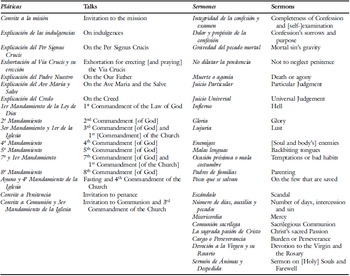
Once at their destination, the father president made arrangements for the processions and public ceremonies in the church and open spaces—the main plaza, the streets, or the graveyard—as local settings allowed. From day one, the mission recreated the most conspicuous aspects of baroque religiosity: images of Our Lady of Refuge and Christ should be present in the reception of the missionaries and preceding every ceremony and ritual; missionaries would admonish people to publicly confess their sins, and they would spend hours in the confessional—every morning and evening—urging the faithful not to condemn their own souls; people would join the Franciscans in prayer and song, chanting alabados and other hymns, and responding to the saetas—religious verses—the missionaries would recite from memory or by reading them from their book of prayers—the Aljaba. Processions would march from the outskirts of the town to the church—in special ceremonies or during the first day of the mission—reproducing social hierarchies: “The Cross and some candles [go] at the front, then the common people, the missionaries and other ecclesiastics after that, then, the carrier of incense, the Great Lady [Our Lady of Refuge] comes after that, and finally, the local priest and his entourage.”Footnote 40 In their sermons and explanations of doctrine—pláticas, or talks—the missionaries would call for the faithful’s repentance while speaking of the devil’s temptations and the wrongdoings people were induced to commit (see Table 1).
Topics for Talks and Sermons for Popular Missions: College of Guadalupe, Eighteenth Century

Table 1 Long description
A table with four columns and nineteen rows. The columns are labeled Pláticas, Talks, Sermones, and Sermons. The rows list various topics and their translations. Row 1: Pláticas, Convite a la misión; Talks, Invitation to the mission; Sermones, Integridad de la confesión y examen; Sermons, Completeness of Confession and [self-examination]. Row 2: Pláticas, Explicación de las indulgencias; Talks, On indulgences; Sermones, Dolor y propósito de la confesión; Sermons, Confession’s sorrows and purpose. Row 3: Pláticas, Explicación del Per Signus Crucis; Talks, On the Per Signus Crucis; Sermones, Gravedad del pecado mortal; Sermons, Mortal sin’s gravity. Row 4: Pláticas, Exhortación al Vía Crucis y su erección; Talks, Exhortation for erecting [and praying] the Via Crucis; Sermones, No dilatar la penitencia; Sermons, Not to neglect penitence. Row 5: Pláticas, Explicación del Padre Nuestro; Talks, On the Our Father; Sermones, Muerte o agonía; Sermons, Death or agony. Row 6: Pláticas, Explicación del Ave María y Salve; Talks, On the Ave Maria and the Salve; Sermones, Juicio Particular; Sermons, Particular Judgment. Row 7: Pláticas, Explicación del Credo; Talks, On the Creed; Sermones, Juicio Universal; Sermons, Universal Judgement. Row 8: Pláticas, 1er Mandamiento de la Ley de Dios; Talks, 1st Commandment of the Law of God; Sermones, Infierno; Sermons, Hell. Row 9: Pláticas, 2º Mandamiento; Talks, 2nd Commandment [of God]; Sermones, Gloria; Sermons, Glory. Row 10: Pláticas, 3er Mandamiento y 1er de la Iglesia; Talks, 3rd Commandment [of God] and 1st [Commandment] of the Church; Sermones, Lujuria; Sermons, Lust. Row 11: Pláticas, 4º Mandamiento; Talks, 4th Commandment [of God]; Sermones, Enemigos; Sermons, [Soul and body’s] enemies. Row 12: Pláticas, 5º Mandamiento; Talks, 5th Commandment [of God]; Sermones, Malas lenguas; Sermons, Backbiting tongues. Row 13: Pláticas, 7º y 1er Mandamiento; Talks, 7th Commandment [of God] and 1st Commandment [of the Church]; Sermones, Ocasión próxima o mala costumbre; Sermons, Temptations or bad habits. Row 14: Pláticas, 8º Mandamiento; Talks, 8th Commandment [of God]; Sermones, Padres de familias; Sermons, Parenting. Row 15: Pláticas, Ayuno y 4º Mandamiento de la Iglesia; Talks, Fasting and 4th Commandment of the Church; Sermones, Pocos que se salvan; Sermons, On the few that are saved. Row 16: Pláticas, Convite a Penitencia; Talks, Invitation to penance; Sermones, Escándalo; Sermons, Scandal. Row 17: Pláticas, Convite a Comunión y 3er Mandamiento de la Iglesia; Talks, Invitation to Communion and 3rd Commandment of the Church; Sermones, Número de días, auxilios y pecados; Sermons, Number of days, intercession and sin. Row 18: Pláticas, ; Talks, ; Sermones, Misericordia; Sermons, Mercy. Row 19: Pláticas, ; Talks, ; Sermones, Comunión sacrílega, La sagrada pasión de Cristo, Cargo o Perseverancia, Devoción a la Virgen y su Rosario, Sermón de Ánimas y Despedida; Sermons, Sacrilegious Communion, Christ’s sacred Passion, Burden or Perseverance, Devotion to the Virgin and the Rosary, Sermon on [Holy] Souls and Farewell.
Source: Anonymous, El predicador mariano, 29–31.
Franciscans from the college of Guadalupe avoided the explanation of the Sixth Commandment—“Thou shalt not commit adultery”—since they did not want “the innocents” to hear about it, limiting their preachings to “unholy thoughts” instead.Footnote 41 Their pláticas, or talks, were not to exceed half an hour in length, in order to allow for a sermon which would take no more than an hour. Although a standard list of talks and sermons did exist, missionaries could focus on the subjects they deemed appropriate for their local audiences: “In small missions, the most useful themes are selected …. In the haciendas … there is a tendency to select the most moving themes, such as the final days, teaching them how to confess [their sins].”Footnote 42
One final note in the Predicador mariano is highly significant for the objectives of this article. There, the anonymous author made a lengthy exposition against recent “reforms in the pulpit” leading to elaborate forms of speech while preaching sermons. He reasoned that since missionaries addressed “people who can’t make sense of fine Spanish,” it was pointless to preach intricate sermons that followed the style of the much-imitated Italian Jesuit Paolo Segneri (1624–94).Footnote 43 “May the preacher become one with his audience, making his message comprehensible,” advised the author, stating that, if people were unable to grasp the meaning of a sermon, then everything was “absolutely” useless.Footnote 44 Preaching a style-oriented sermon was not preaching, “but infatuating, fooling, spooking, aweing and deceiving the audience. And they [some preachers] do practice that because they don’t have the guts to do as they must, just because that’s common usage, because it brings applause and praise.”Footnote 45 In his 1788 chronicle, José Alcocer shared the same criticism of such excesses in eloquence and emotion, which might suggest a broader rejection—at least among Franciscans in Propaganda Fide colleges—of the “reform in the pulpit” following European tendencies. There, Alcocer spoke of a local preaching tradition in which his brethren rejected fancy modes of speech, but “without indulging in vulgar and rude expressions, unworthy of those who announce the Divine Word. [They] take care in making themselves comprehensible to their audience.” Moreover, “in their sermons they make the truth amenable; they adorn it without altering it; they preach it in an orderly, clean and exact fashion.”Footnote 46
Not Entirely Unexpected: Facing Opposition
We have mentioned how the popular missions sought to reinvigorate Christian beliefs and practices among the faithful. However, not everyone agreed with the need for such missions; in fact, there were many instances in which laypersons, and even representatives of the Church and the Crown, openly opposed them, or at least aimed at discrediting the missionaries. It must be noted that Franciscan chroniclers documented many incidents of this sort, aiming to highlight the responses of their own brethren and the workings of Providence, while leaving mentions about names, exact dates, and places out of the record for reasons that we will discuss later.
In his history of the Franciscan colleges of Propaganda Fide (or Chrónica apostólica), Father Isidro Félix de Espinosa gathered many stories of awe and marvel associated with the missions conducted by friars from the college of Queretaro in northern New Spain, in the Kingdom of Guatemala, and among Christian populations. But alongside those edifying stories, Espinosa’s Chrónica includes many “remarkable” incidents pertaining to the popular missions in New Spain; one of these involved “a wealthy man” who, upon learning that the missionaries were about to preach a mission in his town, where he used to “oversee everything,” confronted the Franciscans, letting them know he disliked their sermons and publicly declaring that “this is not the time for missions.” On some other occasion, according to Espinosa, Franciscans from the college of Queretaro were on a popular mission in an unspecified parish; after asking the local priest for his approval, they met with all sort of excuses, which were interpreted by the missionaries as poca gana [unwillingness] by the parish priest to let them preach among the local Indians. In a similar vein, at some point in time, a group of Franciscans from Queretaro arrived in Nueva Vizcaya after a long and hazardous journey. Just when they thought that they could start a popular mission in a certain city in that province, they learned that “the ecclesiastic superior,” the bishop one is allowed to assume, did not grant the respective license. Thus, “the poor clergymen” headed back to their college, arousing feelings of despair and sadness among the local vecinos.Footnote 47 Not even well-respected Franciscans such as Fray Antonio Llinaz were free from criticism, as he also would now and then “receive an insult” [recibía algún oprobio] while conducting a popular mission.Footnote 48
In a different place and time, a friar from the College of Guadalupe identified only by his last name—Garza—recalled that, in 1739, while on a mission in the area of the Etzatlán and Tequila valleys—in present-day Jalisco—a Franciscan from the province of Santiago de Xalisco had snubbed the missionaries of Guadalupe by treating them with total indifference and speaking ill of them: “We went there with the mission. This was not received with any external demonstration …. To repeat the inconveniences we experienced, the poor treatment, both in the food and in their estrangement towards us, would take too long, and I’m just saying that God allowed this, and the fact that the father guardian went up to the pulpit after [our] sermon and spoke nonsense, so that we could go to Guachinango [a place where originally there was to be no mission]. Here we were received with great affection [despite being a diocesan parish].”Footnote 49
Some years later, when the college of Guadalupe’s Fathers Ignacio Erize and José Guadalupe Alcivia arrived “at a certain parish” that they preferred to leave anonymous, they found out that the local priest was living “publicly in a bad relationship”—that is, with a mistress. They were not surprised when they learned that they were not welcome there, and they gave no further thought to the priest’s assertion that “the parishioners did not need any mission.” The padres went on with their journey to the next town, and, once there, one night Alcivia dreamed that the priest died without confession and was condemned. “He was so distressed … [that] he told [about his dream to father] Erize, who in turn answered that he had also had the same dream and that he had seen the devil taking the priest away.” Upon leaving that place they found out that, in fact, the priest had died without confession the very night of the friars’ harsh dismissal.Footnote 50
This anecdote was told time and again by the friars of the college of Guadalupe, even though not all of them found it worth recalling. In his biography of father Ignacio Erize—or Herize—Alcocer simply stated that he had been a “tireless missionary,” an “exemplar” of virtue, a friar of great fame and good name.Footnote 51 The anecdote was apparently disregarded by Alcocer, as one among the “odd incidents” that he found lacking in authority and credibility;Footnote 52 however, it was later reproduced—verbatim—by José Sotomayor in the nineteenth century, embellishing the tale with some reflections on the relation between priests and parishioners, at a time when Catholics felt targeted by secularism and Mexico’s liberal policies.Footnote 53 Expanding on the morals of the incident, Sotomayor argued that
the biggest disgrace for a people is to have a bad priest. If the shepherd is held in the wolf’s claws, what would it be of the sheep? A bad priest is a terrible scourge with which the Lord punishes that people, who deserve it because of their sins, because of their scandals, and because they forgot to partake in the reception of the sacraments, the divine cult, and the assistance of his grace. It is only fair that he who does not deserve a good father gets a bad stepfather.Footnote 54
Already at the height of the tensions between liberal governments and the Church in nineteenth-century Mexico, the opposition of local authorities to the preaching of public sermons was one of the tactics used to undermine the influence of the regular orders.Footnote 55 Liberal governments did not give much details to the Franciscans when they declared that the popular missions were not permitted anymore. For example, in 1857, by express order of the governor of Guanajuato, the Franciscans of the college of Guadalupe were made aware that no license was to be granted for popular missions to be carried out in that state.Footnote 56
Beyond the initial reactions to the abovementioned cases of rejection, it is important to note that the Franciscans from Guadalupe found in historical memory a powerful device to confront their detractors. As the eighteenth century progressed, the apostolic missionaries used the remembrance of rejection as a historiographic trope that aided them in the instruction of new audiences—both within the college of Guadalupe itself and among the parishioners to whom they addressed their preaching. In fact, provisions were circulated in which the guardians of the college of Guadalupe asked the friars who participated in the popular missions to send the college’s chroniclers news of the casos sucedidos on such occasions, in order to keep a record of notable and edifying things that could serve to preserve the memory of the institute. In response to such requests for anecdotes, for example, one unnamed Franciscan reported that, between 1739 and 1755, during a mission that Father Garza took to the town of La Veta, in the vicinity of Zacatecas,
the mission struck a vicious and lost man so badly, that, moved by a diabolical spirit, and unable to restrain himself, he climbed up on a stone in a corner, to preach, or rather, to blaspheme, about the mission and the missionaries alike. This he did just as the people came out from the church, crying and sorry, after [listening to] a sermon. But God allowed that, when he was shouting like a madman, a stone came sine manibus, since it was not known who threw it. The stone had been thrown so strongly, and with such a good aim, that it hit [the madman] in the mouth and broke his jaws into pieces; after that, [he couldn’t help but] stop his preaching, turning his madness and rage into lamentations and woes.Footnote 57
Opposition to the mission had met with due punishment, and thus the respective trope combined the expected and the unexpected. Another formula that combined the same ingredients was the case of a stubborn person who couldn’t care less about the missionaries’ admonitions, like that “big man, given to drunkenness and gambling” who disliked sermons and refused to confess his sins. One day, during a popular mission, that man’s father and uncle made him sit across from the Franciscan preacher, who boldly stated: “Look, unrepentant man, enemy of God, … [as long as] you do not want to quit drinking and gambling, you will be stabbed to death by your best friend while drunk and gambling, and you will ultimately die without confession.” And just as that man kept on such unruly behavior, he met his end just as the preacher had anticipated; that was what, according to an anonymous Franciscan writer, that man’s father had reported to the Franciscans so that they could preach about his son’s wrongdoings.Footnote 58
Just as opposition to missionary work was reprimanded, acceptance of the mission was associated with communal well-being and exceptional cases of individual blessings. At least, that is what Franciscan writers illustrated when speaking of the “fruitful” results [muchos frutos] and overall spiritual edification, after the popular missions had been completed.Footnote 59 That is what Franciscan tradition conveyed, for instance, when father José Gómez recorded that “former president of [the Texan missions] fray Antonio Urbina had said that during the [unspecified] times when [a certain] father Santa María was stationed as missionary in Tutuaca, he [Santa María] had learned about a Christian Indian from mission Tutuaca to whom Our Lady of Refuge had manifested herself and freed him from his [Indian] enemies.”Footnote 60 That was what father Gómez had known “by hearsay,” stating that he transcribed the incident “for the Almighty’s glory” and to comply with the respective orders from the college of Guadalupe.
Disease as an Unexpected Turn of Events
Going on a trip involves the risk of health complications, and those who went on missions around the time of Lent, or towards the end of summer and during the autumn season, were not exempt from this. How did the Franciscans face those challenges when undertaking missions among the faithful?
In some cases, returning to the college was the most viable option for those who suffered a health complication. This happened during the trip of Padres Manuel Pérez and Joaquín Rodríguez in 1741. Having left for a mission in the diocese of Michoacán, and after traveling “a hundred and more leagues” preaching in several towns of the bishopric, Father Pérez fell ill, the victim of fatigue; Rodríguez reported that his companion had been “agitated with scruples” and that he had “lost his mind,” so he opted to return to seek help for Pérez.Footnote 61
Later, in 1745, a mission that took the friars of the College of Guadalupe to a humid and hot area located between the foothills of the Nayarit mountains and the vicinity of the Tequila volcano left Fray José Domínguez so battered that “they took him back to the college in very bad shape,” on the verge of losing his life.Footnote 62
Some other missionaries had better luck and managed to overcome their discomfort during the course of the mission itself. In some cases, the best option was to try to endure the symptoms that afflicted them, as the biographers of Father José Guerra, one of the founders of the College of Guadalupe, point out. It was said about him that despite having one leg rendered almost useless—due to a medical treatment that affected a tendon, as a result of which he developed “an aneurysm that kept him bedridden from time to time”—he always continued with his missionary work, traveling on foot, “almost throughout the entire Mexican territory.”Footnote 63
Fray José Luis Real seemed to show the same resilience in June 1841, when he reported from a hacienda in San Martin, in the bishopric of Guadalajara, that he was continuing with the mission in those places “although with an unknown malady on his tongue, one which does not prevent so far our service.”Footnote 64
Taking a break and trying to overcome disease in the best way possible was also the path followed by the six Franciscans who, from the beginning of 1855, set out towards Mexico’s northwest, bound for Monterrey, Linares, and Tamaulipas. The mission stopped in the small town of Miquihuana for two days in July 1855, “due to Father Bañuelos’s illness,”Footnote 65 and one of the missionaries even had to stop at a ranch identified as Los Catorce, from August 3 to September 15, 1857, “sick to the stomach all the time.”Footnote 66
In other cases, Franciscans had to depend on the aid of local people to recover from health issues. While missionizing in Chiapas in 1684, Fray Melchor López and Fray Antonio Margil got sick in Tuxtla, and they were “so badly ill, that people thought they would die in no time, and in fact they had the coffins ready.” The local physician was unable to help them, due to the lack of medication in town; since the nearest source of medicine was Chiapa de Indios, two leagues away from Tuxtla, he “ordered [the Indians] to carry [the missionaries] on some craddle-like nets and to take them there, as carefully as their extreme weakness required.”Footnote 67
Having this support was important for the group of Franciscans who, in mid-1841, toured several haciendas and ranches in Guanajuato. According to a report that Fray Rafael de Jesús Soria sent to the guardian of the college of Guadalupe, the mission had led them to work among a “crowd of parishioners” that he estimated at more than 14,000 people on various haciendas and ranches, which had “taken a toll on the health” of Alegre, Vázquez, and his own. Their illness notwithstanding, the mission continued, even though they had had several complications: “Father Alegre is still at home, recovering from tonsillitis and is very relieved: I expect him in a few days. Father Vázquez has a stomach ailment, and I also trust in God that he will soon recover. The Dons of Mellado [ranch] have been true gentlemen to us after having indulged us with chocolate, cigars, and helped us with alms …; they have not failed to visit us or send people to get word about us.”Footnote 68
But there were also cases in which leaving for a mission was the final episode in the lives of other friars. In 1745, for example, Fathers José Domínguez, Mariano Garbuno, and Miguel Santoyo were on a mission in the bishopric of Guadalajara. The friars from Guadalupe “traveled one hundred and ten leagues to the west,” visiting towns such as Tequila, Magdalena, Hacienda de Santa Lucía, Hacienda de Cuisillos, San Andrés, and Amatlán de Cañas. In this last place “the warmth of the terrain and the warmth of their charity and zeal in the [work during the mission] … led [Fathers] Mariano Garbuno and Miguel Santoyo to the end of their life, [burning because of] a malignant fever, which they suffered in extreme helplessness and lack of shelter, without human remedy, with their habit stuck to their flesh, in their poor blankets …, until they gave up their spirits.”Footnote 69
Mishaps
Traveling has always been subject to all kinds of mishaps, and that was also true when speaking of the popular missions. For those who ventured through the landscapes of New Spain’s northern frontier, it was a daily situation to feel that on their journeys they were “in danger of [losing] their lives,” as reported by Fray Juan Gregorio de la Campa and Fray Gaspar Solís in 1741, when recounting their travel “from Mazapil to Parras and its middle places,” distressed “by the hostility of the barbaric Toboso [Indian] nation that infests their roads.”Footnote 70
That type of expression was repeated throughout the eighteenth century in the Franciscan experience on the northern frontier, changing the characters and places, but reiterating the “danger of losing one’s life” “due to the hostility of the barbarian Indians.”Footnote 71 In other circumstances and contexts, contingencies were of a different nature. The strong flooding of a river could prevent the missionaries from passing and force them to return home without completing their mission, as happened in 1729 to Simón del Hierro and Manuel González. After leaving Guadalupe on a mission to the outskirts of Guadalajara, they preached through Nochistlán, Yahualica, Cuquío, and Tlacotán, but “finding the Guadalajara River [the Santiago River, at this point] extremely swollen, unable to be traversed, “they went back” to the college.Footnote 72 Minor accidents were by no means ruled out, as exemplified by the passing mention of brother Narro among the list of ocurrencias in 1816; one entry, dated September 19, stated that, on that day, “the father guardian arrived back [in the college] bringing Brother Narro, who was a little indisposed [algo malo], because, the day he had left the college, the cart in which he was traveling rolled over by Guzmán Creek, and he suffered some minor injuries.”Footnote 73
A short moment of rest could also have serious consequences, as happened in the vicinity of Horcasitas (Tamaulipas) to a missionary who reported that, while bathing at night with one of his companions, “the river took me away, and I was at great risk of drowning.”Footnote 74
The gap between the missionaries’ intentions and the expectations of the local populations was also a live issue and could lead to embarrassing moments. At some point, by the mid-eighteenth century, a group of missionaries was in Huejúcar valley, south of Zacatecas. They were approached by some Indian residents of Mecatabasco, asking them to visit their town; the Franciscans agreed to take the mission to that location, and upon their arrival they were welcomed by the residents with all sort of exterior displays of joy and celebration. To the surprise of the president of the mission, “that evening the alcaldes came to visit me, asking me to preach a sermon in order to bring the rain [que les predicara para que lloviera], since there had been no raindrops for over a month and their crops were a total loss. That had been the reason for their urgent call. I told them that they should attend mass and repent, and that way the rain would fall; I insisted that the sermon was not about bringing the rain, but about bringing tears of sorrow and repentance. They were not satisfied by my response, and, thus, they finally got by their trickery what they could have not attained by reason: I preached the sermon that night, and, right after that, the sky turned black, and then followed a rain so intense it rather seemed like a great flood.”Footnote 75
The breakdown of a cart could also cause inconveniences, but in some ways they were surmountable, as confirmed by the 1855 mission that was to leave Guadalupe on February 10, bound for Monterrey, but because “the cart where the flasks come had broken … we left late the next day.”Footnote 76 The author of that note must not have been a friar very well disposed with carriages since, a year later, he remembered that one day in September 1856, almost upon reaching Pesquería [near Monterrey], “a disgrace” nearly happened to him, “because the carriage horses got upset.”Footnote 77
This same mission recorded various situations that complicated the work of the friars: fatigue after several hundred kilometers traveled during the two years that the mission lasted; the “excessive” or “extreme” cold temperatures that they felt at various stages on the road to Monterrey and Tamaulipas; the abundance of soft and tricky sands on the road that prevented them from advancing towards Tampico; and the excesses of the climate that made the work of the confessional difficult in the latter place “due to the heat and the mosquitoes and the distance from the church.”Footnote 78
And, of course, the political events of each era also influenced the ways in which these missions developed. At some point in the early nineteenth century, both the authorities of the college of Guadalupe and the representatives of the civil and ecclesiastical powers in New Spain urged the Franciscans of the college to preach against the insurgency, denouncing the “errors” of their leaders. On the other hand, the repeated political upheavals that Mexico experienced in the nineteenth century meant that on several occasions the friars reached a population that was suffering from the ravages of a military campaign. This is what happened, for example, at the end of 1855, when, after several days of being in the town of Monclova, a group of friars from Guadalupe said that the mission had started out “very cold” due to the effects of the Ayutla Revolution.Footnote 79 The Franciscans understood that the war, and the fact that “there [were] no men [in Monclova] because of the same [revolution] …,” were the reasons why after fifteen days of the mission “there are still only very few people coming to the confessional.”Footnote 80 There were years in which “political things” scared people away from public religious events, according to Franciscans narratives.Footnote 81
Keeping records of all these sorts of occurrences was central to identity formation processes and as a means of cementing local communities. As recent scholarship has suggested, by reflecting upon the lives and deeds of former members of the community, Franciscans from apostolic colleges learned about the ups and downs pertaining to their trade, while also recalling in public how different missionaries had responded to the challenges they encountered during their lifetimes. Thus, for instance, between the late eighteenth and mid-nineteenth centuries, Franciscans from the college of Guadalupe turned successively to three ideal role models whom they found in the biographies of deceased fellow missionaries: the “apostolic man” [varón apostólico], committed to the evangelization of Christians and non-Christians alike during the early years of the college; the “observant friar” [religioso observante], who kept the Franciscan rule and constitutions at a time when mendicant orders saw themselves under attack and subject to severe criticism in the late eighteenth century; and finally, the “resilient friar” [religioso resiliente], who had to endure the attacks from liberal governments during the early republican period.Footnote 82
Noteworthy Events in Everyday Life
In addition to the anticipated–unexpected connection, other binary opposites found in Franciscan recordkeeping may offer interesting clues about how a community of friars perceived daily life within the convent. Case in point: the intertwining of “ordinary” events, minuscule deviations from day-to-day routines, and significant alterations to quotidian activities, which gives some insights on how customary activities or standard practices [de costumbre] complemented (and were complemented by) extraordinary events. Unlike the marvels or wonders described in the previous section, the “out-of-the-ordinary” in this context relates to mere routine-breaking incidents (welcoming a visitor, having a small celebration in the convent, going out on a long-awaited trip).
A sample of four manuscripts entitled booklets of ocurrencias or “notable events” covering the years 1803–17 documents what different Franciscans perceived as worth recording. Although identification of the author is not possible in all cases,Footnote 83 we can detect certain regularities in what the writer perceived as remarkable; at the same time, it is possible to grasp a sense of complementarity between inner and outer spheres, as the actions of “going out” or “leaving” the college, and the equally meaningful “coming in” or “getting to” the college, are the most prominent features of the records throughout the time span in this sample of documents. Ultimately, testimonies of this kind were also part of the making of Franciscan lore, local tradition, and collective memory; for, as we will see, these records showed that missions were completed, that people of diverse social conditions looked to the college for aid, that missionaries served diverse purposes, and that the college found many ways to respond to their benefactors’ desires and expectations.
Franciscans were members of a close-knit community and were not allowed to leave the college without authorization or justification;Footnote 84 thus, whenever an errand or commission called for a friar’s absence from the college, an “occurrence” was duly noted, normally including the purpose and destination of the respective outgoing party. That being the case, it was expected that, once the task had been completed, the friar(s) returned to the college, and a new entry in the log would certify it. An example from 1804 illustrates the process: on February 16 of that year, fathers Lava, Hernández, and Yriarte left the college of Guadalupe, as they were to preach and hear confessions south of Zacatecas; the circle was completed once the three missionaries were back and another entry was created, two months later, on April 26, indicating their arrival “from the popular missions.”Footnote 85 The same sense of order and completion can be seen in the case of father Saenz and the lay brother who accompanied him to give the last rites to Don Marti Soto, vecino of Zacatecas, on February 3, 1809; this party returned to the college eight days later, as the respective booklet of ocurrencias noted.Footnote 86
As depicted by these records, quotidian life consisted of the friars’ completing their usual or routine tasks within the convent and their keeping close ties with both the Christian and the non-Christian populations—in nearby villages and/or in remote missions in northern Mexico. But again, daily life also meant coping with the extraordinary, either responding to new challenges or being prepared for something or someone altering the college’s usual routines. It is possible to identify two sets of intertwined records in the abovementioned sources. One cluster of entries relates to regular activities involving friars going out and coming back to Guadalupe, and comprises administrative and protocolary activities, the organization of the popular missions, the administration of the sacraments, the bishop’s conferral of sacramental orders upon friars, and the granting of licenses of absence for personal reasons. The second group of entries may be identified as extraordinary occurrences, and they relate to events transpiring outside the college, or incidents that presented themselves, out of the blue, within the religious community.
Routine Activities Throughout Any Given Year
Diverse studies on male and female religious communities show that life within the convent was carefully organized according to fixed schedules and strict regulations.Footnote 87 In that regard, routine can be understood as the progression of activities expected within a given time frame, in a standard order or sequence. However, routine is also made up of the way things are expected to happen; that is precisely what this section tries to underline. In Guadalupe, Franciscans developed a sense of regularity that can be explored through the records of ocurrencias, and perhaps the best entry point for that analysis is the detail with which references to the college’s liturgical festivities were crafted.
Whenever a celebration in honor of the Virgin of Guadalupe or other saints is recorded, the respective entry states that the mass and the entire función [religious celebration] transpired “as always,” “as customarily”; in many cases, the entry provides some details of what that “custom” consisted of. For instance, for the commemoration of the Assumption of the Virgin Mary (August 15), the church would open at 4:00 a.m., and the bells would later start to “call” for mass, which would include the friars’ collective praying and chanting as well as the preaching of a special sermon.Footnote 88 Festivities in honor of the Virgin of Guadalupe (December 12) would also be conducted “as always,” resembling this same structure.Footnote 89 Celebrations for Christmas, Lent, and Easter would likewise conform to the same general program.
An important set of activities was conducted by friars holding higher offices in the college. The father guardian or the college’s vicar, for instance, would normally go to Zacatecas to “run some errands,” which might mean meeting members of the local elites and inviting them to serve as godfathers to those young friars who advanced to the priesthood and “chanted [their] first mass.”Footnote 90 Ahead of a small entourage, the guardian and the vicar would customarily go to nearby Zacatecas early in January to greet local civil and ecclesiastical authorities during New Year’s festivities, or whenever courtesy or protocol demanded an official visit to Zacatecas.Footnote 91 Such visits would multiply over the course of the year, as Franciscans used to partake in every local religious community’s celebrations—either honoring their respective patron saint, or as part of other saint’s day festivities.Footnote 92
Administrative issues would also call for frequent absences from the college, as one of the prerequisites for admission to the religious community demanded a thorough investigation of the would-be novice’s personal background. Thus, a couple of friars would normally be sent to the hometown or parish of the aspiring novice to gather information [hacer informaciones] about his lineage and conduct. Between 1803 and 1817, various Franciscans would travel as far north as Durango, and to the southern village of Colima, near the Pacific Ocean, for this purpose.Footnote 93
Aside from these protocolar and administrative matters, the organization of the popular missions and the administration of the sacraments were the most conspicuous reasons for leaving the college for short periods (one or two days) or for long absences (three to six months in the case of the popular missions). After all, that was one of the distinctive characteristics of the Propaganda Fide colleges. It was also one of the recurrent themes in their chronicles, as can be seen in Espinosa’s work,Footnote 94 or in later examples such as José de Alcocer, who reminded his readers that “in the most capable haciendas, landowners take care in arranging for a [Franciscan] father to hear confessions from the cowboys once a year, and that is the only time they attend mass and go to the church to receive the sacraments”; Franciscans from Guadalupe, said Alcocer, “preach in every place the mission takes them, even in ranches lacking church buildings; they also hear confessions, even in the desert, among the most miserable ones.”Footnote 95 Haciendas and ranches near Guadalupe benefited from their proximity to the Franciscan college, as popular missions, confessions, and quick trips to say mass were frequent—especially during Lent—in the cases of Mezquite, Villanueva, San Pedro, Bañon, Ramos, Malpaso, Troncoso, Valle de Tlacotes, El Rincón, Hacienda de Cedros, Pabellón, and, above all, La Sauceda—a rich hacienda related to the mining operations in Vetagrande and Quebradilla, the most frequent destination recorded for this kind of ocurrencia.Footnote 96
Sometimes, a special request or the name of a distinguished patron were significant enough to deserve a larger explanatory note in the college’s records, as on September 14, 1808, when father Saenz went to Zacatecas “to give the last rites to Don Manuel Retegui,” or the day after, when Guadalupe’s guardian fray Francisco Puelles and father Dozal visited Retegui to check on him.Footnote 97 A one-week visit to hacienda de Ramos late in 1808 was likewise recorded, when father Gamarra and lay brother Angulo were there to give the last rites to the landlady.Footnote 98 Other elite members from Zacatecas who asked for the assistance of missionaries from the college of Guadalupe on their deathbed included Martin Loto, Doña Manuela Saavedra, Miguel Viscardo, the controversial Intendant Miguel de Rivera Bernárdez—count of Santiago de la Laguna, who mediated between insurgents and counterinsurgents and was accused of high treason—and Doña Isabel Esparza—“Don Juan Francisco Domínguez’s wife.”Footnote 99 During the Mexican War of Independence, this kind of ministry was significantly altered, as we will discuss later, as individuals scheduled for execution were also in need of spiritual assistance.
A group of lay brothers was entrusted with an important task requiring them to be abroad most of the time. Limosneros collected charities for the college, both in cash and in kind; the list of goods they brought to the college, and the places they visited to collect those items, reinforce our understanding of Propaganda Fide colleges as communities in close interaction with local societies. Although some goods were transported from far-off places—sheep and wool from “Tierra adentro,” sayal from Acámbaro,Footnote 100 sweets from Guadalajara, corn from Ameca, and some unspecified items from Colima—most limosneros sojourned among nearby haciendas and villages collecting flour, cheese, unrefined sugar [piloncillo, panocha], cow fat and bees wax, orange and other fruits, beans and corn, and even palm tree branches for Palm Sunday (from Juchipila).Footnote 101 The limosneros’ activities were another reminder of the way in which time was perceived within the convent, as the rainy season would normally put a temporary halt to their trips, which typically extended from the last days of July through the end of April.Footnote 102
Personal reasons were a common justification for individual or group absence from the college. A routine visit to the friars’ mother,Footnote 103 one last chance to greet her in her deathbed,Footnote 104 or the opportunity to say a farewell before a long journey, all are listed here and there among the ocurrencias.Footnote 105 A short visit home would normally justify getting a license of up to twenty days,Footnote 106 although longer absences were not unusual, as in the case of father Camarena, who left “for his homeland” [a su tierra] in May 1806 and then again in September 1808 for a longer visit.Footnote 107 In July 1810, once the local chapter concluded and a new trienio—three-year span—was about to start, fathers Delgadillo, García Diego, Saenz, and Piñera, as well as brothers Alejandre and Galván, obtained a one-month leave of absence, while father Jauregui was approved for a forty-day absence, and father Frejes received an initial thirty-day leave which could be extended “if he needed more time.”Footnote 108 Another common reason for a leave of absence was the need for taking the waters at one of the nearby hot springs.Footnote 109 Between 1803 and 1817, thirty different friars from Guadalupe were allowed to visit places like La Cantera, Bañón, Ojocaliente, Valparaiso, and Aguascalientes, regularly spending anywhere from ten to forty days.Footnote 110
Every now and then, exceptions were made, and some friars obtained leave for unclear reasons; in those cases, the records of ocurrencias included some comments indicating the recorder’s suspicions about their behavior. Thus, for example, on February 4, 1811, brother Christobal went out “searching for a [missing] mule,” and the respective commentary indicated that “he came back on February 6 without the mule.” Even more explicit was the case of brother Saavedra, when he left for the mines of Espiritu Santo on October 28, 1815; the puzzled recorder of this ocurrencia was unable to ascertain this trip’s reason, indicating that Saavedra left for that place “who knows what for,” and that he stayed there until November 3.Footnote 111
Regularity Interrupted; Extraordinary Occurrences
There was a sense of regularity in the daily activities at the Apostolic Colleges, as we have seen. As well regulated as it was, communal life had room for small surprises that friars understood as part of their routines. For instance, when one of the college’s employees “disappeared” after running some errands in Zacatecas in 1803, the friars resented his absence, commenting that he “went to Zacatecas, as always, riding on a mule,” but this time he had failed to return to the college, taking the mule with him, leaving the community “without a trace of his whereabouts.”Footnote 112
Some routine-breaking events were welcomed by the Franciscans from Guadalupe, as long as they were associated with joy and the opportunity to strengthen community ties—both within the convent and outside its walls. Spending a day outside of the college was a form of community recreation, which, even though it was devised as a periodical activity,Footnote 113 normally changed in content. Between 1803 and 1817, the records of ocurrencias include five references to days of “general recreation,” or “general reception,” clustered in the period 1808–9.Footnote 114 Variety was the dominant note in those experiences: for instance, the opportunity to spend a day in the countryside having some meals there in the fall of 1808, contrasted with the following gathering, early in 1809, when “the general reception was scheduled, but there was no going out because of bad weather”; three months later, however, the time for “general recreation” came, and “we all went to have lunch at Velauzarán’s home.” Late in July 1809, the general recreation included a walk to “la Palma” “to drink some milk.”Footnote 115
Aside from the days of general recreation, there were special occasions on which the friars partook in “general receptions,” sharing meals and treats with the local population and distinguished guests, prolonging the reunion after hours [hospicio y quedada].Footnote 116 When friars received their Priestly Ordination, their padrinos—whether “civil” or “ecclesiastical”—would normally sponsor the reception and the ensuing celebration, as in the cases of fathers Frejes, Tellechea, and González, who chanted their respective first masses in the winter of 1808–9.Footnote 117 The latest records in the sample here analyzed show that, by the end of 1816, a novelty seemed to have been introduced in these receptions, as sorbet-like treats [nieves] are mentioned in the context of the “hospicio y quedada” ensuing the first mass chanted by fathers Yturriaga, Rodríguez, and Muñoz, and the profession of vows by some novices, in the winter of that year.Footnote 118 Sorbets were present at all of those receptions, but in Rodriguez’s case, the record explains that “nieve was offered by his padrinos.”
Although expected, death took many forms within the walls of the college of Guadalupe; anticipation of death is central to Christian doctrine, and the friars were used to imparting the last rites to elders and those severely ill.Footnote 119 The community gathered to pray for the soul of their deceased, and the records of ocurrencias show that, on some occasions, visitors from other convents joined the friars from Guadalupe as a token of spiritual fraternity. That was the case in the passing away of fathers Aldrete and Laba, when the Franciscans from the province of Zacatecas made the trip to Guadalupe for their respective ceremonies and burial.Footnote 120 However, burial ceremonies in the college of Guadalupe did include people other than the members of the local community. Some elite members from Zacatecas, like one Andrés Puelles or Zacatecas Deacon Don Francisco Montes de Oca, chose Guadalupe as their final resting place,Footnote 121 while Don Joaquín Chavarría decided to bury his little son there, “with the concurrence of the [Franciscan] community”;Footnote 122 in other cases, death came to temporary visitors to Guadalupe, like Augustinian friar Juan de Dios Delgado, and the Franciscans welcomed their guest’s community for the burial ceremony.Footnote 123
Visitors passing through the college were registered as routine changing events; however, the laconic tone of the record suggests that those displays of hospitality were part of the way in which life in the college was supposed to be conducted. Entries for July and September 1816, for instance, respectively mention the departure of the fellow Franciscan who had acted as visitador and presided over the local chapter in the college of Guadalupe, and the short stay of the bishop of Durango en route to his cathedral.Footnote 124 In this last case, the visit seems to have left a long-lasting impression, according to the detailed description of what transpired in the college during those days late in 1816: Juan Francisco de Castañiza y González—Bishop of Durango and Marquis of Castañiza—reached Guadalupe on November 11, 1816. He was welcomed “as if he were the bishop [of Zacatecas],” and during the following days gave Priestly Orders to some friars, administered the sacrament of confirmation to local parishioners, and visited Zacatecas city three times, taking some Franciscans from Guadalupe as part of his entourage. He stayed in Guadalupe until December 6, and, as the record emphasizes, “every single day he spent here, upon his own request, there was hospicio y quedada for the whole community; he was accompanied by twenty-eight people who sat at the table with him, and by almost forty servants [mozos].”Footnote 125
The early nineteenth century was a period of profound political and social upheaval in New Spain, marked prominently by the Mexican War of Independence (1810–21). Among the many witnesses to this turbulent era were the Franciscans of Guadalupe, in Zacatecas, whose archival records reveal acute perceptions of and responses to the insurgent movement challenging Spanish colonial rule. The records of ocurrencias provide a unique window onto how the war altered their daily existence, reshaped their religious and political roles, and embedded in their lexicon a sense of extraordinary disruption to ordinary life. The earliest examples in this regard date from September 1808, with news from Spain about the resistance against the French occupation of Spanish soil and the defense of the Catholic monarchy, evoking communal religious fervor symbolized by bell ringing and a solemn Te Deum sung by the entire community—a ritual underscoring loyalty and order within the convent and its surroundings.Footnote 126
By September 1810, tensions had escalated, with reports of uprisings in towns such as San Miguel, San Felipe, and Dolores. The friars’ language here reveals both uncertainty and vigilance: the absence of couriers is noted with anxiety, marking a rupture in the communication networks essential to colonial governance and ecclesiastical coordination. “There was news about the uprising …, [and yet] there have been no couriers since then, and at the present hour we have had none; it is 8:00 p.m. on [September] 22.”Footnote 127
As the insurgency unfolded, Franciscan participation in the struggle became commonplace. Some friars sided with the rebels, while others took an active role in shaping public opinion by preaching against the spread of the insurgency.Footnote 128 In the case of the friars from the college of Guadalupe, their sermons during those days were not merely religious exhortations but also instruments to uphold colonial order and delegitimize the insurgent cause. For example, on September 20, 1810, at the behest of secular authorities, several friars—Diez, Escalera, Dozal, and Velasco—were dispatched to preach in Lagos to stem the spread of the uprising; four days later, “eight fathers went to Zacatecas, preaching to prevent any turmoil.”Footnote 129
Records of remarkable events around the college of Guadalupe include Franciscan encounters with insurgent armies. On November 2, 1810, the arrival of the insurgent army in Guadalupe, led by “the so-called” Marshal Yriarte, is portrayed with disdain. The friars refused to ring the bells, as requested by Yriarte’s men, which illustrates a symbolic defiance and the struggle over sacred space. This act of exclusion reaffirmed ecclesiastical alignment with royal power and the rejection of insurgency, mirroring the decision most religious institutions and clerics made throughout New Spain.Footnote 130 The Franciscans tried to keep track of the unfolding of the war, as revealed by other entries in which Yriarte’s forces are mentioned leaving for San Luis Potosí, “wreaking havoc on the surrounding haciendas,” coming back to Zacatecas later in December 1810 “after their defeat in Guanajuato, where they lost supplies, money, and weapons, [led by] their tarnished general Hidalgo, and their valiant chiefs Allende, Aldama, and Abasolo.” Sometimes it proved difficult for the Franciscan chronicler to get the record straight, as his recording of military actions, such as the December 24, 1810, encounter near Fresnillo—where the victory was disputed—reflects the uncertainty and contested narratives characteristic of the war’s local impact.Footnote 131 In early 1811, as the insurgent army was fleeing north, after their strepitous defeat at the hands of Calleja near Guadalajara, the friars noted the limited military strength accompanying the insurgent leader Hidalgo, highlighting the insurgents’ unconventional and precarious military logistics.Footnote 132
The friars also witnessed Spanish royalist forces quartered within their precincts, such as the Tierra Adentro army’s presence in Zacatecas in February 1811, marking a direct intersection of military and religious spaces. Such accommodations undoubtedly affected their daily lives, as foreign military personnel shared sacred spaces, altering the convent’s atmosphere.Footnote 133
The Franciscans from Guadalupe commemorated major royalist victories with ecclesiastical solemnity, such as the Te Deum celebrations and artillery salutes following Calleja’s defeat of insurgents at Zitácuaro in January 1812, emphasizing the performative nature of religious loyalty to the monarchy during wartime.Footnote 134 It must be remembered that traditional Franciscan views of social order included their recognition of what was then perceived as legitimate sources of power and authority;Footnote 135 the records of ocurrencias reassured Franciscan allegiance to legitimate authorities when the college’s chronicler highlighted his brethren’s preachings thanking God for granting victory to the royalist forces.Footnote 136 In a similar vein, when addressing the visits that some of the friars from the college made to Zacatecas to give the last rites to some prisoners, the anonymous chronicler noted that his fellow Franciscans were dispatched to that city to provide spiritual assistance to individuals who were “brought to justice” [ajusticiados]. That same tone was also employed in an entry dated November 16, 1814, when “the father guardian went to Zacatecas to give father Gonzalez spiritual assistance, as he was executed by shooting [lo pasaron por las armas].”Footnote 137
Noteworthy is the friars’ commitment to royalist propaganda rituals, such as the grand celebration of King Ferdinand VII’s inauguration in June 1813. The festivities involved not just religious ceremonies but also social gatherings with music, feasting, and literary performances, all orchestrated under the leadership of the Guardian Friar Vicente Escalera, a figure noted for his “patriotism.” This event illustrates how the convent served as a center of loyalist cultural affirmation amidst wartime anxieties.Footnote 138
Final Comments
Beyond the well-studied genres of mendicant orders’ chronicles and hagiographies, Franciscan writings include a rich corpus of testimonies recording extraordinary events associated with the preaching of the popular missions and daily occurrences within or around Propaganda Fide colleges. These sources reveal a deliberate process of transforming quotidian life and unexpected incidents into forms of institutional memory and ecclesiastical identity. As we have seen in the case of the college of Guadalupe, Zacatecas, such narratives served apologetic and edifying purposes, aiming not primarily for factual precision but for conveying moral and spiritual certainties that reinforced the order’s mission and authority in a colonial context infused with baroque religiosity and social hierarchy.
Missionary lore was far more than a mere self-celebratory mode of speech intended to highlight the merits that the friars acknowledged in their missionary work. It was not simply a matter of evoking curious passages that reaffirmed, before their own members and outsiders alike, the importance of the religious beliefs the friars sought to instill in the faithful, while bearing witness to the significance of missionary labor. At a deeper level, missionary lore—like many mechanisms for the crafting of historical memory—constituted an exercise in self-definition that accompanied the process of constructing collective identities. Yet, it was not a unidirectional process, for its capacity to attach specific content to a theme or message also depended on the existence of an audience—whether laypeople or members of the very community generating these forms of language—that shared the religious or corporate substratum motivating such expressions. It was a tool that afforded the possibility of articulating, in words, what was important about the work carried out by a religious community. If the effort to forge a sense of collectivity (by finding purpose, establishing fields of action, and building visible signs of presence) was fundamental, so too were the “ways of speaking,” “ways of remembering,” and ways of making beliefs manifest in discourse. In this sense, the missionary experience examined here relates to broader processes of collective identity construction in eighteenth- and nineteenth-century Mexico and Latin America. It is not unwarranted to suggest, for instance, that these processes followed logics similar to the self-affirmation mechanisms of other corporations that also needed to instill, in common speech and collective memory, some identifying trait—political factions, educational institutions, and, of course, other religious corporations. Hence the importance of beginning to problematize the methods, resources, and practices associated with these forms of self-representation.
The intersections between oral tradition, memory, and continuous reworkings of collective identities highlight the fluidity of place and time in these narratives, where the moral and exemplary import outweighed strict historical framing. This fluidity and ambiguity allowed the Franciscan community of Guadalupe to appropriate stories of wonder and mishaps across diverse settings, cultivating a shared history that connected friars who labored in popular missions across colonial and early republican Mexico. They certified that those who opposed missionary work met terrible fates, thus leaving their listeners and readers to reflect on the significance of religious revivals as promoted by those apostolic missionaries.
Ultimately, the construction of Franciscan missionary lore was not just about recounting remarkable miracles or heroic sacrifices but about cultivating a model of self-representation, a sense of belonging and continuity through the ritualized retelling of everyday and exceptional events. By doing so, the Franciscan order crafted a historiography that reinforced social and religious order, pedagogically inspired preachers and the faithful, and preserved the collective memory and institutional ethos of the Propaganda Fide mission—a testament to the enduring power of storytelling in Mexico’s religious culture.