In their focal article, Guzzo et al. (Reference Guzzo, Schneider and Nalbantia2022) raise several critical points about how moves toward “opening” psychological science have the potential to both advance and hinder the progress of the field of I-O psychology. Of these points, the focal article raises several concerns about how the duality between science and practice may be hindered by demands for openness. Although excellent points are raised, the focal article draws out a long-standing false division between science and practice to frame its arguments. We also take issue with the broader contention that the zeitgeist of openness will hinder the progress of our field, both for science and practice. Indeed, we see this notion, and the furthering of the scientist–practitioner divide in service of supporting arguments, as vast oversimplifications of a complex challenge that our field faces—that is, how we can maximize the impact of I-O psychology for our constituents.
To counter these points, we argue that openness is a key condition for maximizing the impact of I-O psychology research and practice. Importantly, we do not view “science” versus “practice” as a meaningful distinction. Rather, we see a continuum existing between the science and practice of I-O psychology, with one benefiting the other. Similarly, openness is not a monolithic “one size fits all” approach to either science or practice. Rather openness, which likewise exists along a continuum, may variously dictate the conduct of science and practice. The continuum of openness is a context in which science and practice operate to the benefit or detriment of advocacy. We see “advocacy” as actions taken by I-O psychologists to benefit society and improve the lives of people at work (see Mallinckrodt et al., Reference Mallinckrodt, Miles and Levy2014).
The focal articles seems to lose sight of the common goal of both the science and practice of I-O psychology, which is to serve as the basis for advocating for the betterment of work for all employees. The idea of a scientist–practitioner–advocate perspective is not new (see Fassinger & O’Brien, Reference Fassinger, O’Brien and Luzzo2000; Lewin, Reference Lewin1948/1997) but has been gaining traction as a model for thinking about the impacts that psychological science and practice can have on society (see Mallinckrodt et al., Reference Mallinckrodt, Miles and Levy2014; Miles & Fassinger, Reference Miles and Fassinger2021). However, the idea of advocacy as a goal of the science and practice of I-O psychology is often ignored in the science–practice debates that characterize our field (e.g., Aguinis et al., Reference Aguinis, Banks, Rogelberg and Cascio2020). To our minds, both science and practice serve the same goal, which is to facilitate the improvement of work by means of advocacy.
Rather than positioning openness as a barrier, we offer that it serves as a condition for maximizing the impact of both science and practice, because it strengthens the potential for advocacy. There are numerous examples of how this could be realized. For example, movements toward the open sharing of data, materials, and code allow others to reproduce and replicate findings, and the preregistration of hypotheses prevents post hoc theorizing and thus leads to more trustworthy research. Additionally, open access to published work puts the results of research into the hands of those who stand to benefit most from its dissemination, such as practitioners and policy makers. These ideas benefit not only science but also practice through bolstering our credibility to external stakeholders (Rudolph, Reference Rudolph2021).
Examples of open practice facilitating science likewise abound, generally taking the form of publicly available resources. In contrast to “open science,” the idea of “open practice” has yet to be widely codified into a set of standards or expectations for conduct (Dahlke et al., Reference Dahlke, Katz and Rudolph2022). Perhaps the best example of an open practice resource in I-O psychology is O*Net, which is a freely available resource that contains job definitions that help both researchers and practitioners understand the nature of work. Other examples include training resources, such as the framework for family-supportive supervisor training (see Hammer et al., Reference Hammer, Kossek, Anger, Bodner and Zimmerman2011).
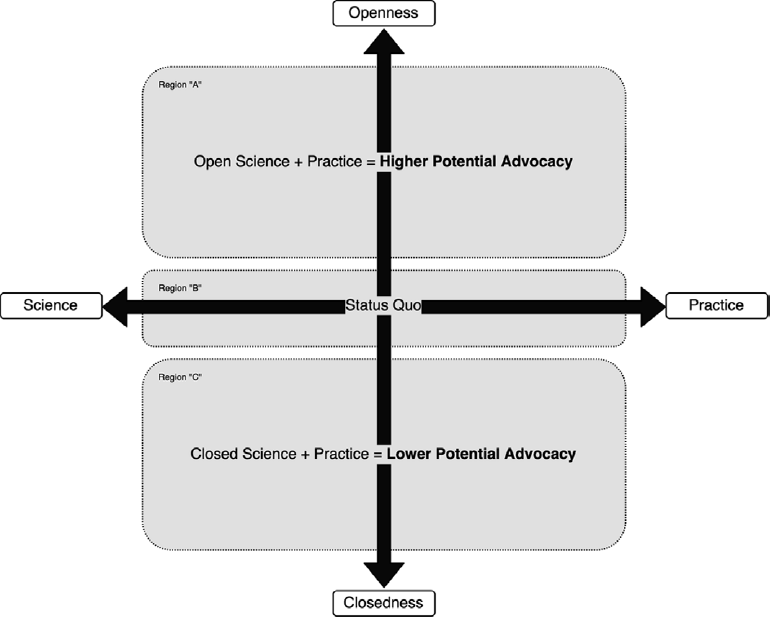
Evidence-based practice is a hallmark of “good” I-O psychology in much the same way that practice-informed research drives the empirical process. Both science and practice are necessarily mutually informing in this way. We argue that the current state (i.e., incomplete adoption of openness; purposeful adoption of closedness) of I-O psychology hinders the potential for our field to realize the goals of advocacy. Figure 1 presents a heuristic representation of this broader idea. It positions two opposing continua: science–practice and openness–closedness. To the extent that I-O psychology aligns with the ideals of openness, a higher degree of advocacy potential may be realized (see Figure 1, Region “A”). Currently, our field sits in a status quo (see Figure 1, Region “B”), representing a suboptimal mix of open and closed science and practice, which may “cancel out” the field’s potential for advocacy. In the worst case, closedness would hamper the advocacy role of I-O psychology research and practice (see Figure 1, Region “C”).
Heuristic Representation of the Open vs. Closed Scientist–Practitioner–Advocate Model.
Note. This model depicts the intersection of two continua: science–practice and openness–closedness. Three cases that result from the intersection of science–practice and openness–closedness are demarcated by gray-shaded regions (i.e., regions “A,” “B,” and “C”). Region “A” represent an ideal case, where open science and practice facilitate higher potential advocacy. Region “B” represents the status quo, where openness is not fully realized and the potential for advocacy is thus not optimized. Region “C” represents a less-than-ideal case, where open science and practice are discouraged, hampering potential advocacy.

In conclusion, all of this is not to say that I-O psychology research and practice have not been impactful. Rather, the optimal realization of our impact has yet to be seen given existing norms against openness. Indeed, Guzzo et al. (Reference Guzzo, Schneider and Nalbantia2022) recognize the strength of field-based norms for “how” to conduct research and practice, and we recognize that implementing the ideas we have presented here may be easier said than done. From our experience, we know that there are administrative hurdles associated with openness. Still, we are not calling for radical transformations, rather a recognition that even small changes to the research and practice process made in service of openness may bolster the advocacy potential of our field.
Encouraging openness is but one challenge we face in I-O psychology, among many (e.g., see Antonakis, Reference Antonakis2017, O’Boyle et al., Reference O’Boyle, Banks and Gonzalez-Mulé2017, Kepes et al., Reference Kepes, Keener, McDaniel and Hartman2022). Such challenges are pressing, but not insurmountable. We believe that, if we want the science and practice of I-O psychology to be maximally beneficial to our constituents and stakeholders—that is, if we truly wish to realize the goals of advocacy—a more open approach to both is required.