1. Introduction
“Although the title to this work to a very large extent correctly describes the contents, yet the argument leans less towards the explanation of a theory than it does towards the logical exposition of the results that must follow from the acceptance of certain fundamental assumptions.” These are the opening remarks of James M. Child's introduction to Ruggiero G. Boscovich's Theory of Natural Philosophy, Reduced to a Single Law of the Forces Existing in Nature (Child Reference Child and Child1922, xi). In the following pages, Child would expose such assumptions, emphasizing a surprising point that seems to be in tension, if not in blatant contradiction, with the title of the work by the Dalmatian savant. Boscovich's “mutual vires” Child explains, “are really accelerations, i.e. tendencies for mutual approach or recession of [pairs of] points, depending on the distance between the points at the time under consideration” (ibid., xiii). So there would be no forces really existing in nature, after all.
In the years that followed the publication of Child's edition, an increasing number of scholars would become interested in Boscovich's main work in natural philosophy. Partly reacting to the phenomenalistic perspective expressed in the editor's introduction, many of them pointed out that in Boscovich's theory, the features of matter – first of all, impenetrability – are explained in terms of an interplay of forces, whatever the term “force” may denote.
For example, in his classical Concepts of Force, Max Jammer recognizes that
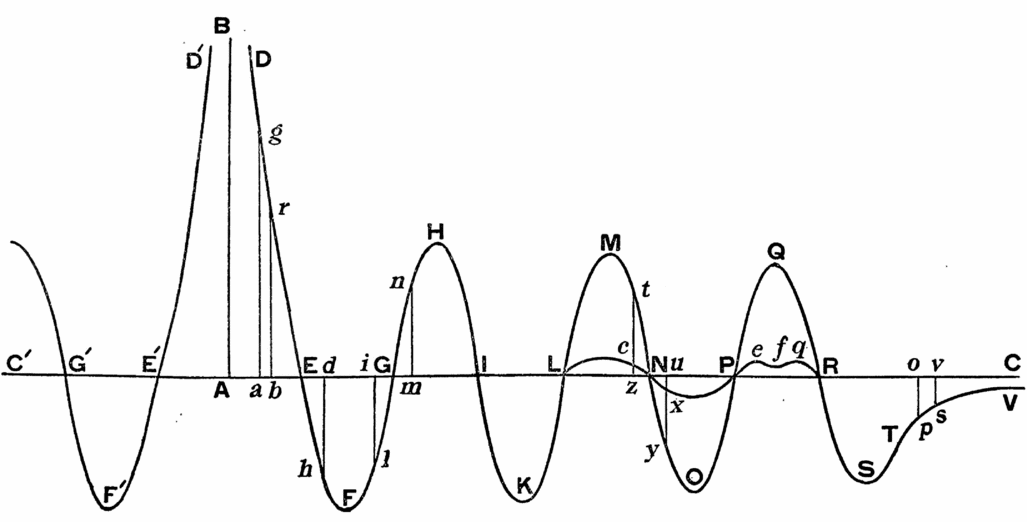
strictly speaking, the ordinates represent accelerations only . . . . From the standpoint of physics, however, we may claim that a physical theory, based on the notion of force as its most fundamental conception, may be called “dynamic,” even if it does not interpret its fundamental concept as a metaphysical entity [On Boscovich's curve of forces, see fig. 1]. (Jammer Reference Jammer1957, 177–178)
Boscovich's curve. (From Ruggiero Giuseppe Boscovich, A Theory of Natural Philosophy, edited by J.M. Child. New York: The Open Court, 1922.)

According to Jammer, this is sufficient to proclaim Boscovich's theory the best example of a dynamic conception of matter in Leibniz's spirit (because of the insistence on material points as “force centers”). And after all, does not Boscovich (1763, §1) describe his own “system” as a “midway between that of Leibniz and that of Newton”?Footnote 1
From this perspective, it might well be that Boscovich implicitly started from some strong assumptions regarding forces “existing in nature,” as the title of the work seems to insinuate. In addition, in all his works of natural philosophy Boscovich made plenty of references to Newton's Opticks, particularly Query 31, wherein hypotheses about the nature of forces are expressed. Many scholars began to suspect that Boscovich's cautious “Newtonian-style” warnings about the reality of forces simply obscured his most profound insights. Influential writings expounding this “force-friendly” view cover a noticeable span of years and include works by Želiko Marković (Reference Marković and Whyte1961), Lancelot Law Whyte (Reference Whyte and Whyte1961), Robert Schofield (Reference Schofield1970), Arnold Thackray (Reference Thackray1970), George Gale (Reference Gale1974), John Heilbron (Reference Heilbron1979 and Reference Heilbron, Arabatzis, Renn and Simões2015), Mirko Grmek (Reference Grmek1996), Edoardo Proverbio (Reference Proverbio2003), Michael Friedman (Reference Friedman and Friedman2004 and Reference Friedman2013), and Russell McCormmach (Reference McCormmach2012). To be sure, a complete list would be far longer and include many of the contributors to the proceedings of past Boscovich conferences, as well as such far-reaching studies as Mary Hesse's (Reference Hesse1961) Forces and Fields.
In the present paper I contend, however, that there are fundamental differences between Boscovich's theory and the “dynamical theories of matter” in vogue at Boscovich's time (if something like a dynamical theory of matter really did exist). Moreover, text-based evidence from Boscovich's Theoria, as well as from other works in natural philosophy and mechanics, suggests that Boscovich never made hidden conjectures on forces; it hints instead at some novel insights about the role of mathematics in his work.
2. A Unified Theory of What?
When it appeared in Vienna between July and August 1758, Boscovich's Theory of Natural Philosophy was the culmination of a twenty-year intellectual journey undertaken by the author. The kernel of this theory had been presented to the audience of his Jesuit confrères already in 1745 as a consequence of the principle of continuity and in the context of a dissertatio on the living forces, namely De viribus vivis. While the Cartesian rules of motion left room for immediate changes of magnitude, Boscovich's metaphysical conviction (that is, the “metaphysical” tenet from which he claims to have derived his theory) is that such sudden changes never take place. As far as quantities occurring in nature are concerned, natural phenomena proceed according to a general principle of continuity.Footnote 2 In order to avoid magnitudes (say, for example, velocity) jumping from one value to another, Boscovich maintains that two (colliding) particles or bodies never come into actual contact. In a nutshell, continuity in the natural processes is associated with discontinuity in the structure of matter.
To clarify this concept, let us imagine having two spheres directed towards one another on their line of junction and with equal and contrary uniform velocities:
Let us assume that no velocities can be extinguished in an instant of time. [In this case] the spheres do not keep on moving with uniform velocity until contact, but whenever [their] particles . . . would arrive at a very little distance, some repulsive force will push them back endlessly, so that their velocities will gradually be extinguished before contact. (Boscovich Reference Boscovich, Guzzardi and Bevilacqua1745, § 46)
If Descartes was right ― Boscovich insinuates ― then the velocities would be abruptly destroyed and immediately re-created at the instant of contact. Instead, a more complicated underlying mechanism should be present such that bodies slow down when approaching one another and pass through all velocity degrees before stopping, changing, or inverting their directions.
This mechanism is explained in terms of a repulsive force acting at a (short) distance. Boscovich reasons that Newtonian action is a long-range force, which dominates at a planetary scale. The motion of the planets is dictated by the inverse-square law, so that the planets accelerate as they are approaching one another and slow down as they are distancing from one another according to 1/r 2 and depending on the product of their masses. But in short-range interactions, things might happen very differently, and in the case of collision, bodies slow down continuously up to a certain point at which the force of attraction inverts its sign and converts into a repulsion that pushes them back up to more or less stable points of equilibrium where repulsion and attraction reciprocally balance. All this excludes both actual contact and immediate changes of magnitude.
As early as 1745, in his treatise on the living forces, Boscovich mentions that, at intermediate range between these two extremes of planetary and particle-like scales, attraction and repulsion convert into one another alternatively; he even mentions that with interstellar distances attraction might convert again in repulsion, a possibility he would explore in depth in the Theoria (see Guicciardini Reference Guicciardini and Pepe1996, 277). In order to account in a more concise way for these features (except the possibility of interstellar inversion), Boscovich draws a graph, which is better known in its final 1758/1763 form, reproduced above as fig. 1.
In qualitative terms, the curve expresses a force acting between two points: one at the origins of the axes in A and the other moving along the x-axis. With the distances plotted on the x-axis, the force intensity is represented on the y-axis. The force is repulsive when the curve is above the x-axis and attractive when it is under it. Therefore, the curve represents the following behavior: the force is infinitely repulsive when the distance is infinitely small (ED grows asymptotically) and infinitely small when the distance grows infinitely large (more precisely, as explained in Boscovich 1763, § 405, when it grows to planetary distances). Between these two extremes, the force is alternatively repulsive and attractive depending on distance. In other words, there can be other inversions between attraction and repulsion whose discovery is a matter of experimental physics: as Boscovich had already emphasized, to find the points where inversions occur (i.e. the points where the curve cuts the axis) is an empirical problem “to be investigated from the phenomena” (Boscovich Reference Boscovich, Guzzardi and Bevilacqua1745, § 56). Here he had also mentioned that the form of the curve is highly undetermined, a circumstance Boscovich (Reference Boscovich, Guzzardi and Bevilacqua1755a) would explore further, as he would deal with the problem of finding its equation.Footnote 3
A very rudimentary theory in 1745, it would be subject to noticeable refinements, extensions, and corrections in the following years. Three such improvements are particularly important:
-
(1) From a mathematical point of view, in his 1745 dissertation De viribus vivis (§ 56) Boscovich seems to consider curves “of parabolic kind” (polynomial in modern terms) as the best candidates for his force law. However, “parabolic curves” do not have any vertical asymptotes. But as we have seen, asymptotic behavior is clearly essential to preserve continuity of the natural processes (and Boscovich Reference Boscovich, Guzzardi and Bevilacqua1745, § 50, correctly recognizes that the y-axis is an asymptote of the curve). Boscovich may have changed his mind after an intensive study of the curves, which led him to develop remarkable ideas about infinity (in Boscovich Reference Boscovich and Pepe1754a) and to make clear the foundations of his theory and the role of the law of continuity (in Boscovich Reference Boscovich, Guzzardi and Bevilacqua1754b). This all came to an end in 1755, with the publication of De lege virium in natura existentium (Boscovich Reference Boscovich, Guzzardi and Bevilacqua1755a), which includes the analytical expression of the curve.
-
(2) An investigation of the structure of matter, which began as a draft in 1748 and was published nine years later as De materiae divisibilitate et principiis corporum. As a consequence of the curve and its asymptotic behavior, particles never come into actual contact, hence matter is discontinuous. Its “primary elements” are to be understood as “indivisible points such that they have no parts and do not take up an extended space; moreover, each of them is placed in an individual mathematical point of space without any extension as well as dimension” (Boscovich Reference Boscovich, Guzzardi and Bevilacqua1757, § 12). So, this work displays a theory of matter according to which matter is homogenously formed by material points (materiae puncta) and the variety of substances is not but an effect of different arrangements of points, whose reciprocal distances give rise to diverse aggregates.
-
(3) This entails the idea of an application of the theory to physics (that is, to all that is not reducible to mechanics), which was announced, above all in reference to cohesion and magnetism, as early as in Boscovich (Reference Boscovich, Guzzardi and Bevilacqua1745, §§ 60–67). He would develop this only in his 1758/1763 Theoria, Part III, but its summary, in turn, was anticipated in De lumine, pars secunda (Boscovich Reference Boscovich1748, § 7).Footnote 4
Boscovich's path can be reconstructed with a certain degree of confidence by looking at the opening paragraphs of the five works where the theory is, in some way, presented: De viribus vivis (1745); De lumine, pars secunda (1748); De materiae divisibilitate et principiis corporum (1757); De continuitatis lege [. . .] (1754b); De lege virium in natura existentium (1755a). He refers to results of past investigations in each subsequent development of the theory. Boscovich (Reference Boscovich1748, § 2) reminds the reader that he had advanced his “theory of forces existing in nature . . . three years ago, in the dissertation De viribus vivis”; the first paragraph of Boscovich (Reference Boscovich, Guzzardi and Bevilacqua1754b) quotes both De viribus vivis and De lumine; Boscovich (Reference Boscovich, Guzzardi and Bevilacqua1755a) adds to the list De continuitatis lege, plus a Synopsis physicae generalis authored by Carlo Benvenuti in 1754, but stemming from himself.Footnote 5 Finally, the premise to Boscovich (Reference Boscovich, Guzzardi and Bevilacqua1757) adds further details, bringing into the picture his Supplementa to a poetic work by his Jesuit confrere and fellow countryman, Benedict Stay (see Stay Reference Stay1755).Footnote 6
The final result was a 380-page in-quarto that appeared in Vienna under the title Philosophiae naturalis theoria redacta ad unicam legem virium in natura existentium. A heavily revised edition, which can be considered the final form of the theory, was printed five years later by Remondini in Venice. The most evident change (but not the most significant) was in the title, which in the Venetian edition underwent a noticeable “inversion of terms”: Theoria philosophiae naturalis redacta ad unicam legem virium in natura existentium.Footnote 7
The work is divided into three sections (partes) of similar length: the first explores the foundations of the theory, expounds the metaphysical underpinnings in the law of continuity, and mentions the conditions for the analytical expression (which is given in a Supplement); the second part discusses elements of statics and rational mechanics in light of the theory; the third part deals primarily with the structure of matter and short- and medium-range effects, including impenetrability and cohesion, effects in fluids and solids (both elastic and soft bodies), chemical processes, electricity, magnetism, and other phenomena. Moreover, Boscovich added an Appendix “ad metaphysicam pertinens” in order to justify his theory in the context of the theological orthodoxy of the Jesuits; it can be split into two subsections, De anima and De Deo. Finally, both editions end up with very similar Supplements (re-ordered and revised in 1763)Footnote 8 that deal with special issues: the equation of the curve of forces (Boscovich Reference Boscovich1758, Suppl. I; Boscovich Reference Boscovich and Child1763, Suppl. III); an objection against attractive forces at the shortest distance (Boscovich Reference Boscovich1758, Suppl. II; Boscovich Reference Boscovich and Child1763, Suppl. IV); space and time in themselves (Boscovich Reference Boscovich1758, Suppl. III; Boscovich Reference Boscovich and Child1763, Suppl. I) and as a subject of human knowledge (Boscovich Reference Boscovich1758, Suppl. IV; Boscovich Reference Boscovich and Child1763, Suppl. II); a problem of statics pertaining the equilibrium of constrained masses (Boscovich Reference Boscovich1758, Suppl. V; Boscovich Reference Boscovich and Child1763, Suppl. V); a mathematical epistle to Carl Sherffer about the center of percussion (which is presented as a sixth supplement in Boscovich 1763) closes the volume.
The well-structured treatise exercised a powerful impression of profound unity and represented an ambitious attempt toward unification for commentators both past and present, including, in very recent years, cosmologist John Barrow (Reference Barrow2007, 19–21). Shortly after Boscovich's work had appeared, Moses Mendelssohn (Reference Mendelssohn1759), a follower of Leibnizian doctrines, authored a review in which, without entering into mathematical or physical details, he presented Boscovich's theory as a well-constructed “system” based entirely on Leibniz's law of continuity. Some months later, the French Journal étranger published a more comprehensive critique of the work. The anonymous reviewer noted that “for many years the R.P. [Révérend Père] Boscovich posed the foundations and revealed a part of the theory he expounds here.” He went on to mention De viribus vivis and other works and concluded: “Of all these scattered pieces, Father Boscovich made a compact treatise [corps d'ouvrage, literally a book block]” (Anonymous 1760, 53).Footnote 9 After all, Boscovich's intention, as the title of his work announced with its emphasis on a “unique law of forces,” was to provide a unified theory. But a unified theory of what?
3. Dynamicism
One way of answering this question follows an honorable historical tradition and insists that Boscovich's theory fits very well into the context of so-called dynamicism, or more precisely, dynamical theories of matter.
However, it is not easy to characterize dynamicism, and extant definitions are unsatisfying to say the least. Jammer places Boscovich alongside Leibniz, Kant, and Spencer under the common label of “Dynamism” (Jammer Reference Jammer1957, chap. 9). He quotes a phrase from Leibniz's Specimen dynamicum as its motto: “Agere est character substantiarum” [it is the character of substance to act]. According to Jammer, Leibniz's conception can be portrayed using another maxim: “Quod non agit, non existit” [what does not act, does not exist], “in contrast to the traditional Operari sequitur esse [action follows existence]” (ibid., 169–170).Footnote 10 Both sentences could also be applied to Boscovich, to whom Jammer ascribes “the real Leibnizian theory of dynamics” (ibid, 170). This is true, even if his concept of force was “merely relational or functional . . . . Since impenetrability and extension, in Boscovich's view, are merely spatial expressions of forces, ‘force’ is consequently more fundamental than ‘matter’ . . . . Boscovich's theory of physical sciences may therefore be rightly called ‘dynamic’” (ibid., 178).
However, the statement that “force is more fundamental than matter” is probably too wide and generic to label any conception as a variation on the Leibnizian dynamicism-theme. After all, it depends on the notion of “fundamental.” If this is taken in the strongest sense, i.e. that forces are the “fundament” of matter, of course this would be an apt description of Leibniz's doctrine. However, Boscovich would reply that the primary elements of matter are indivisible, homogeneous, unextended material points endowed with forces;Footnote 11 but this does not entail that forces are the substance(s) of matter. The question whether forces are superadded by a Creator or are rather intrinsic to matter is not answered here ― is not even posited. As we shall see, Boscovich will always express an agnostic attitude towards this question. So one is forced to consider a weaker sense of the statement “force is more fundamental than matter,” which only entails the primacy of force over matter. But this would be applicable to some tenets of Newton's Opticks too,Footnote 12 and potentially be in conflict with Leibniz's Specimen dynamicum, whose tenets are much more demanding.
More generally, the concept of activity as an inherent quality of substances is of course one of the distinguishing features of the Leibnizian view.Footnote 13 Now, it is not the goal of this paper to discuss or compare such concepts in the Newtonian vs. the Leibnizian context; the main difference between the two approaches can be briefly sketched out as follows: whereas in the Newtonian tradition matter is what passively resists motion, thus it is not conceived as an inherently active substance (hence “active principles,” whatever they are, should be added by God in order to have motion as well as fermentation, generation, and the phenomena described in the last Query to the Opticks), this was a common tenet within the Leibnizian tradition and also applied to some critics of Newtonianism in Britain, whose possible connection to Leibniz is somewhat obscure.Footnote 14
The articulation of this difference is far from sufficient to account for every aspect of Newton's and Leibniz's physics and can be detailed more and more ― which again falls out of the scope of this paper. But even in this rough form, it signals that there are at least two very different senses of activity in the two traditions that are most relevant to Boscovich: one ― the Newtonian ― in which active principles are superadded to matter, and the other one ― the Leibnizian ― in which matter is intrinsically active. Hence, a vague and ambiguous reference to something “active” ― as in Jammer's reconstruction ― is not sufficient to make of Boscovich a more or less radical dynamicist in the Leibnizian tradition. On the other hand, if activity is taken in the most proper Leibnizian sense as the action of a force that “constitutes the inmost nature of the body” (Leibniz 1695, 235, 435), hence grounding the idea of an inherently active substance, this is completely foreign to Boscovich, as we shall see better in the following sections.
A broader description of dynamicism has been attempted by Michael Friedman. He characterizes a “dynamical theory of matter” as one in which “the basic properties of solidity and impenetrability are not taken as primitive and self-explanatory, but are rather viewed as derived from an interplay of forces.” This would be typical, say, for Kant's Physical Monadology, where “the two fundamental forces of attraction and repulsion . . . together determine a limit or boundary beyond which repulsion (and thus impenetrability) is no longer effective and attraction (representing Newtonian gravitation) then takes over unhindered.” But Friedman goes on contending that such a theoretical pattern “exerted a powerful influence in the later part of the eighteenth century, in the work of such thinkers as Boscovich and Priestley, for example” (Friedman Reference Friedman and Friedman2004, x).
More recently, he has argued that it is misleading “to view the force-center atomism of Boscovich and the early Kant as progenitors of the field-theoretic conception of matter developed in the nineteenth century by such thinkers as Faraday and Maxwell” (Friedman Reference Friedman2013, 142 n. 70). One of the most important reasons is quite obvious: in Boscovich's as well as in Kant's theory, forces are fully Newtonian, they act at a distance within a system of at least two bodies (or material points). By contrast, one of the main features of Faraday and Maxwell's conception is that fields act continuously, from point to point: instead of being instantaneous, their actions spread out over time, and space is not reducible to the line of junction between two masses, as in Newton's picture of the gravitational interaction. The mediation of actions through time and space is so fundamental for the nineteenth-century field-theoretic view that attempts have been made in order to apply it, at least conceptually, to gravitation.Footnote 15 (I will come back to this issue at the end of Section 5, where I shall contend that the characterization of Boscovich's conception as a “force-center atomism,” which in fact traces back to Faraday, is misleading too.)
Nevertheless, Friedman (Reference Friedman2013, 97) insists, conceptions like those of Kant and Boscovich are truly “representative of a more general ‘dynamistic’ tendency prevalent in late eighteenth-century natural philosophy.” If not as direct antecedents, they can be even taken “as an anticipation, of sorts, of the field-theoretic approach to physics developed in the nineteenth century beginning with the work of Michael Faraday.” Furthermore, Friedman (ibid. n. 1) makes clear that “the locus classicus for dynamistic approaches to matter generally is Leibniz's Specimen dynamicum,” as Jammer had argued in the above-quoted Concepts of Force. However, whereas Leibniz developed his original “metaphysical-physical conception of force as the essence of matter” against Descartes's view of extension as its essence, “later eighteenth-century versions of this approach . . . appeal to Newtonian impressed forces . . . rather than to Leibnizian ‘living force’.” But in this way the connection to the Specimen dynamicum and the traditional difference between the Leibnizian against the Newtonian view gets completely lost. Plus, the status of the connection, if any exists, between Leibniz's view as expressed in the Specimen dynamicum and in later versions of the dynamical approach (which ones?) remains blurred. The only thing that still characterizes dynamicism is ― again ― the generic statement that force is more fundamental than matter, or the primacy of forces over matter.Footnote 16 But in what sense?
If dynamicism is taken in the wider sense indicated by Friedman, it should not be confined to the Leibnizian tradition only, and amounts more to a theoretical tendency across different orientations than to a definite line of thought alone. From this perspective, he is right in arguing that eighteenth-century versions of a sort of “dynamical approach” appeal more to the Newtonian concept of force than to Leibnizian vis viva (even in Wolff's modified form). In fact, his notion of dynamicism embraces many theories of matter that flourished in the eighteenth century, stimulated by the Opticks with its final “set of imaginative conjectures” (namely the Queries),Footnote 17 more so than by the Specimen dynamicum. After all, it was the Newtonians, not the Leibnizians, who built up a sizeable edifice upon active principles in the course of the eighteenth century.Footnote 18
Boscovich too was strongly influenced by the Opticks, and particularly by the Queries, as he recognizes for example in his (1757).Footnote 19 A complete survey of the quotations from Newton's treatise in Boscovich's works would take a considerable amount of pages; for the present purposes, however, it will suffice to make a single but important case.
As Boscovich acknowledges as early as in 1748, and as early commentators carefully noticed (see Mendelssohn Reference Mendelssohn1759, 354–355; Anon. 1760, 59), his typical inversion of the forces from attraction to repulsion was inspired by a brief passage from the last Query of the Opticks, quoted both in Boscovich (Reference Boscovich1748, § 56) and in Boscovich (Reference Boscovich, Guzzardi and Bevilacqua1757, § 19): “As in Algebra, where affirmative Quantities vanish and cease, there negative ones begin; so in Mechanicks, where Attraction ceases, there a repulsive Virtue ought to succeed” (Newton 1706, 338, 395). Of course, one may doubt that Boscovich had properly understood Newton's text; and of course one is free to think that he has maliciously bent Newton's claim to his own purpose. However, what is crucial in this context is not the proper interpretation of such claim per se but Boscovich's use of it. And according to him, this must be understood as a positive statement about “forces of the same kind [ejusdem generis vires], that vary according to variated distances, so that they pass from being attractive to being repulsive.”Footnote 20
In any case, all this only proves Boscovich's Newtonian legacy, but it is not enough to describe his natural philosophy as dynamical also in Friedman's broader sense. In fact, Boscovich's concept of force differs too much from the readiness or propension to make assumptions about forces and matter ― to say what forces positively are ― which is instead a common trait of the Newtonian dynamical theories of matter (Heilbron Reference Heilbron1979, 67–71).
In the following sections I will explore Boscovich's concept of force, contending that for him force was not that kind of a primary notion.
4. The Power of Mathematics and Boscovich's Agnosticism about Forces
Boscovich made his early claims about forces in a brief dissertation on the problem of attraction in non-resistant space (Boscovich Reference Boscovich1740).Footnote 21 He begins in a plain Newtonian fashion by expressing the principle of inertia and reminding the reader that vis inertiae is considered by “practically all scholars of mechanics” to be an inherent force of bodies, as opposed to some other extrinsic force [vis extrinseca], such as “gravitation, elasticity, the push of other bodies, and other forces of this kind.” Inertia is a force Newton called “vim insitam, & vim inertiae”; it can even be assumed as a “physical hypothesis that not only does not oppose phenomena but satisfactorily agrees with them.” However, he argues:
[Inertia] can be demonstrated neither from the phenomena nor through metaphysical arguments. From the phenomena, indeed, it can never result clearly that gravity, elasticity or other forces of this kind are not intrinsic to the nature of bodies, whose particles either attract or repel reciprocally or, in like manner, are driven to a certain place. Moreover, from the phenomena it will result much less evident that motion of bodies cannot decrease by itself . . . . On the other hand, nothing shall ever be achieved from metaphysical arguments if the nature of bodies is not known. And this only unravels to us through the phenomena. (Boscovich Reference Boscovich1740, III)
In order to make clear his discontent with any physical notion of force, Boscovich quotes the comment to Definition VIII from Newton's Principia:
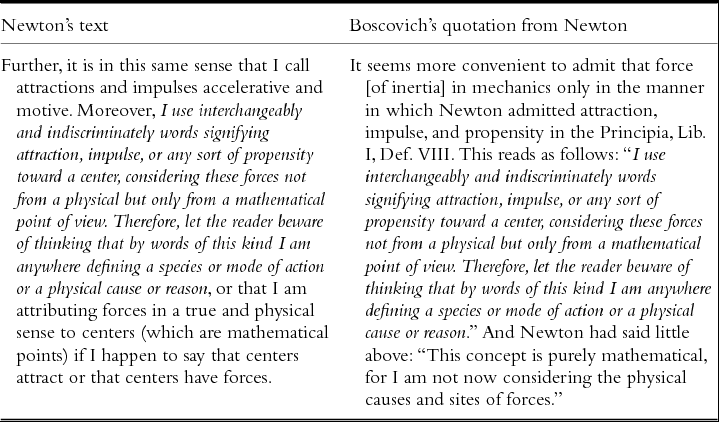
It seems more convenient [satius] to admit that force [i.e. inertia] in mechanics only in the manner in which Newton admitted attraction, impulse, and propensity in the Principia, Lib. I, Def. VIII. This reads as follows: “I use interchangeably and indiscriminately words signifying attraction, impulse, or any sort of propensity toward a center, considering these forces not from a physical but only from a mathematical point of view. Therefore, let the reader beware of thinking that by words of this kind I am anywhere defining a species or mode of action or a physical cause or reason.” And Newton had said little above: “This concept is purely mathematical, for I am not now considering the physical causes and sites of forces.” (Boscovich Reference Boscovich1740, III-IV)Footnote 22
Again, one might suspect that here Boscovich is misrepresenting Newton. In fact, he is deliberately dropping an important passage in the text of the Principia. After the statement “I am anywhere defining a species or mode of action or a physical cause or reason [speciem vel modum actionis causamve aut rationem physicam alicubi definire]” Newton (Reference Newton, Cohen and Whitman1999, 408) added: “or that I am attributing forces in a true and physical sense to centers (which are mathematical points) if I happen to say that centers attract or that centers have forces [vel centris (quae sunt puncta mathematica) vires vere & physice tribuere, si forte aut centra trahere, aut vires centrorum esse dixero].”
The table above compares Newton's original text with Boscovich's “rendering.” The passage Boscovich extracts from Newton is emphasized (the original text is given in the footnote).
Newton's comment to Definition VIII of the Principia in I.B. Cohen & A. Whitman's translation (see Newton Reference Newton, Cohen and Whitman1999, 408) and Boscovich's use of it (my own translation).i

iNewton's text: “Porro attractiones & impulsus eodem sensu acceleratrices & motrices nomino. Voces autem attractionis, impulsus, vel propensionis cujuscunque in centrum, indifferenter & pro se mutuo promiscue usurpo; has vires non physice sed mathematice tantum considerando. Unde caveat lector, ne per hujusmodi voces cogitet me speciem vel modum actionis causamve aut rationem physicam alicubi definire, vel centris (quae sunt puncta mathematica) vires vere & physice tribuere; si forte aut centra trahere, aut vires centrorum esse dixero.” Boscovich's text with the quotation from Newton: “Satius videtur eam ipsam vim in Mechanicam admittere eo tantum pacto, quo Newtonus Attractionem, Impulsum, ac Propensionem admisit Princip. l. I. def. 8. sic enim habet: ‘Voces autem attractionis, impulsus, vel propensionis cujuscunque in centrum, indifferenter & pro se mutuo promiscue usurpo; has vires non physice sed mathematice tantum considerando. Unde caveat lector, ne per hujusmodi voces cogitet me speciem vel modum actionis causamve aut rationem physicam alicubi definire’: & paulo superius dixerat: ‘Mathematicus duntaxat est hic conceptus; nam virium causas, & sedes physicas hic non expendo’.”
One can contend that Newton is only warning the reader that he should not be interpreted as attributing any force to mathematical points at the centers of bodies. Although bodies are real, as observed by Ducheyne (Reference Ducheyne2012, 26), “locating the centripetal force at the centre of a body is a convenient mathematical technique to deal with its overall centripetal force, but it is not to be taken physically, i.e. one should not attribute ‘in a true and physical sense’ to centers.” So Newton's claim, if it is entirely read, does not necessarily entail that forces in general are employed as mere mathematical tools; they have after all a physical reality that is not the task of the Book I of the Principia to investigate.Footnote 23
However, what is crucial to understand Boscovich's concept of force is not the proper interpretation of Newton's passage but the use Boscovich made of it as well as the context in which it is quoted. And, as a matter of fact, Boscovich has dropped the phrase about attributing forces physically to mathematical centers. One can speculate whether this was deliberate or rather just signals that those two lines did not seem particularly significant to him, but the crucial aspect of the question is that he dropped them. He simply did not care about the potential physical implications ― if any ― of such passage for Newton, but focuses on other features:
Consequently [igitur], one shall be allowed to assume [assumere], in the very idea of body transmitted by mechanics [mechanice tradita], a determination to preserve the state of rest or uniform rectilinear motion it had once. Every cause which changes such a state is called external force [vim extrinsecam], i.e. it does not pertain to that idea [of body]. That cause can perhaps be placed either in the nature of the body itself or in a free law promulgated by the Fabricator of Nature himself, when He created the World. If motion decreases by itself in a void, we will consider that void as a resistant medium, and the resistance in fluids, as recognized through experiments, is increased by a double resistance, one from the nature of the decreasing motion, the other from the resistance of the fluid; but the determinations of motions in a non-resistant space will not be physical, but mathematical determinations. (Boscovich Reference Boscovich1740, IV)
The notion of determinatio itself adumbrates a Newtonian background. In the Principia it denotes a direction associated with a velocity or a velocity change (acceleration). In this sense Newton employs it, for example, in the Scholium to the definitions and in the comment to the second law of motion, as well as in the Unpublished Preface to the Principia, without hinting at the nature of the causes of motion.Footnote 24 So, when Boscovich describes inertia or the forces as determinations, he means that they are computable in terms of directions-having-intensity, irrespective of their causes.
The qualification of both inertia and external forces as determinationes becomes more explicit in Boscovich's later works. In a dissertation authored three years later (Boscovich Reference Boscovich1743, § 1), determinatio is primarily applied to inertia: vis inertiae is “a certain determination to preserve the state of rest or uniform rectilinear motion in which they are placed”; external forces are measured through the induced change of motion (more precisely, “the change of state they induce in the briefest possible time”). But after all, if external forces are measured through the motion they induce, this means that only effects matter ― thus, intensities associated with the directions. In Boscovich's De viribus vivis (Reference Boscovich, Guzzardi and Bevilacqua1745), the notion of determinatio is associated with both inertia and the external forces in a straightforward manner: now inertia is said to be “a determination to persist in that state of rest or uniform rectilinear motion once this state has been acquired” (Boscovich Reference Boscovich, Guzzardi and Bevilacqua1745, § 10) and an attractive or repulsive force is described as “that determination . . . by which the particles tend to approach or separate, whatever the physical cause of this tendency [conatus] might be” (Boscovich Reference Boscovich, Guzzardi and Bevilacqua1745, § 50).
Boscovich (Reference Boscovich, Guzzardi and Bevilacqua1745) goes a step further, indeed. Whilst in 1740 external forces were called causes, now he appeals to a more technical usage and seeks to clarify the distinction between force and physical cause.
By the name of powers [potentiae] we mean those causes which, through their actions, change the state of a body. They determine that body to acquire a different velocity in actu secundo, so they are said to produce in it a new velocity in actu primo. The instantaneous action due to which such velocity is thought to be generated is called active force [vis activa]: for us this is the only one force; Leibniz, however, calls it dead force. (Boscovich Reference Boscovich, Guzzardi and Bevilacqua1745, § 13)Footnote 25
Let us remember that an external force is a mathematical determination: it is an abstract mathematical quantity expressing the (intensity of the) propensity of an object to perform (i.e. initiate or change) a motion in a certain direction. Let us clarify this issue by means of an example. Imagine a thrown ball: the force is not the hand that will potentially throw it, but the hand actually throwing ― not the hand as itself, but the very action of throwing. The hand is a physical potential agent (Boscovich would have called it potentia), which causes motion through its action. Let us take off the action, no motion will occur. The action, though, is unphysical because it is an abstract quantity: we could ignore the hand and substitute it, say, with a mechanical device, and obtain the same action-of-throwing.
Similarly, according to Boscovich forces are not physical causes. Rather, they are caused by potentiae or powers (or, they are the actions of powers), which contrarily are physical. Such powers are, for example (Boscovich Reference Boscovich, Guzzardi and Bevilacqua1745, § 13), impenetrability, gravity, elasticity, cohesion, and others. The action of a physical power is a determination, that is a propensity to perform a certain motion. In Boscovich's vocabulary, such is a force, whereas the term power refers to the causal mechanism.Footnote 26
However, note that the nature of physical powers can only be hypothesized, whereas forces ― being mathematical determinations ― are really measured. In order to give a mathematical description of the phenomena, only determinations matter, regardless of any hypothesis about the causal mechanism: “Whatever the physical seat of such powers might be, provided that they generate in a body the same velocity in actu primo . . ., we shall have the same phenomena of motion” (Boscovich Reference Boscovich, Guzzardi and Bevilacqua1745, § 14).
This holds, for example, in the case of gravitation. No matter what its cause might be (the nature of body, God's will, or something other), the mathematical description dispenses with it:
According to the Newtonians, gravitas is a determination of the nature of bodies or rather a free law of God, so that if two bodies are placed at any distance even in a vacuum, they immediately acquire a determination to approach one another and to get a new velocity in actu secundo, which grows as much as the square of the distance is diminished. Imagine to know [intelligantur] that those bodies exist; imagine to know the force of inertia, due to which they preserve the previous velocity, if no power is acting; imagine that a certain determined distance is known; imagine to know that a new generated velocity in actu primo, all conditions being determined, has been generated; then, we will know [that] a continuous takeover [advenire] of a new velocity [occurs], if we will know that the conditions themselves are continuously determined. (Boscovich Reference Boscovich, Guzzardi and Bevilacqua1745, § 14)
***
With all this, Boscovich (Reference Boscovich, Guzzardi and Bevilacqua1745) intends to provide a background for the discussion (and attempted distruction) of the concept of living force. I will not give a detailed account of how Boscovich passes from the generation of velocity to the concept of living force,Footnote 27 rather I shall emphasize an aspect of Boscovich's attitude towards the vis viva debate, where a similar agnosticism about (the nature of) forces emerges.
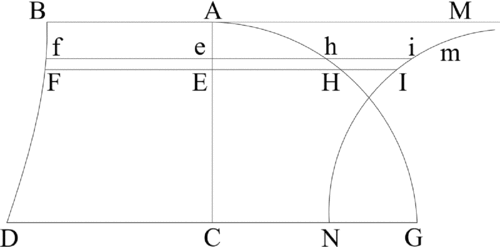
Boscovich constructs a twofold diagram representing separately the two measures of force: momentum (mv) and living force (mv 2).
As pointed out by Iltis (Reference Iltis1970a, 135–139), he suggests in De viribus vivis – a few years before d'Alembert – that the controversy on the living forces is just a dispute over words, once the fundamental quantities of mechanics (space, time, and velocity as a relation between space traversed and time) are correctly interpreted.Footnote 28 An instantaneous acting power produces “only one pressure at any single instant,” but since powers act continuously, the net result is that pressure “passes into velocity [transit in velocitatem] not by multiplication of sort, but just because it is drawn for a continuous time.” Boscovich's awareness of the Calculus is clearly in the background (see e.g. Boscovich Reference Boscovich, Guzzardi and Bevilacqua1745, §§ 16–17, 23); however, he favors a purely geometric approach reminiscent of the Principia, where (i) forces only act instantaneously (see Definition IV) and (ii) the motive force is proportional to a change of velocity (Newton's second law).
In Boscovich's diagram (fig. 2), a pressure EF is thought to increase over a time AC (in modern terms, the diagram plots the “pressure” variation as a function of time). But time can be divided into its infinitesimal elements, or tempuscula: “If the spatiolum Ee is thought as indefinitely small, because of the indefinitely small difference between the segments ef and EF, the small area FEef is thought as a rectangle” (Boscovich Reference Boscovich, Guzzardi and Bevilacqua1745, § 16). Moreover, due to the infinitesimal difference between two instantaneous pressures in an indefinitely small tempuscule, “in that same tempuscule even a non-uniform accelerated motion is thought of like a uniformly accelerated motion.” Now, since pressures cause instantaneous changes in velocity, that is they produce accelerations in each tempuscule Ee the relation v = at holds – or, in the geometrical terms suggested by Boscovich's diagram, the area BAEF (instantaneous velocities from BA to EF, or the increment dv, during time AE) represents a velocity.
Boscovich's graphical representation of momentum and living force as generated by instantaneously acting “pressures” (Modern adaptation from Ruggiero Giuseppe Boscovich, De viribus vivis, Romae: Komarek, 1745, Fig. 3; by courtesy of Andrea Guzzardi).

Therefore, when they are thought about over time, forces are measured through “simple velocities” as opposed to their square, and “the action of powers that generates pressures or velocity ― [the action] which we have called the force [of those powers] ― is measured by composing the velocities generated in the individual particles, that is by multiplying the mass for a single velocity.” So, the final result is momentum as the measure of force when force is viewed as acting over time.Footnote 29
As Boscovich (Reference Boscovich, Guzzardi and Bevilacqua1745, § 20) acknowledges, Leibniz would agree that this is a measure of force; that is, adopting the Leibnizian terminology, the measure of dead force, which is a force that stops acting. However, Boscovich argues further that the Leibnizians as well as their opponents allow for a living force – a vis viva – that is a remnant of powers’ actions within the body on which they have acted. According to Leibniz, it is this force, and not the momentum, that preserves its quantum as mv
2. On the contrary, Boscovich contends, this living force does not exist. It depends only on the quantities one chooses to deal with. If in the diagram we choose to represent through AC the space traversed instead of the time in which an action occurs, and through EF forces instead of their resulting pressures, then BAEF does not correspond to a velocity, but it will be proportional to the square of a velocity. Indeed, force EF generates a velocity which is proportional both to EF and the time in which EF has acted; in modern notation, dv = EF · dt. Now, if we assume that in an infinitesimal segment Ee a point moves with uniform linear motion due to the action of the force EF in the instant of time corresponding to the position E, then the time corresponding to Ee will be proportional to the space traversed and inversely proportional to the velocity:
 $dt = \frac{{Ee}}{v}$
. It is easily obtained by a convenient substitution such that
 $ dv\,{=}\,EF \cdot {{\frac{Ee}{v}}}$
, or v · dv = EFEe, where EF is force and Ee is (an infinitesimal) space. Finally, applying the infinitesimal method, Boscovich (Reference Boscovich, Guzzardi and Bevilacqua1745, § 22) concludes that “the square of the velocity of a body falling from A (where it was at rest) is proportional to the small area BAEF.”Footnote
30
That is to say force, as a function of space, is measured by the square of a velocity. After introducing masses and the modern notation one obtains:
 $\smallint fds = \smallint mvdv$
, with ds = vdt.
Iltis (Reference Iltis1970a, 139) remarks that Boscovich explains neither why, in the second interpretation of the diagram, time is substituted with space, corresponding to the same segment AC, nor why he now introduces forces, causing his schema to appear arbitrary. But once Boscovich's agnostic attitude is taken seriously, the reason is easily conceived: both the introduction of forces and the substitution with space are indeed arbitrary, because mathematics fits both pictures, as Boscovich shows with an example given in § 39 of De viribus vivis (which I will briefly discuss below). The diagram is neutral between its possible interpretations, but it can be tailored to both. This has more to do with such mathematical neutralism than with any physical meaning of the geometrical construction itself. After all, he is just applying the same “mathematical razor” he had used in the 1740-dissertation on Motion of bodies thrown through a non-resistant space.
In the 1745-treatise De viribus vivis, all this brings along an important consequence as far as living forces are concerned:
We have shown that nowhere living forces are needed; however, from very easy principles we can explain all phenomena of motion of kinds whatsoever through an immediate production of velocity by actions of powers that do not leave in those bodies anything other than a different determination of inertia, which persists with inertia itself. If someone, in spite of the uselessness of the living force, wants to assume this yet, he can do what he wishes, phenomena being saved. For, if he would establish that those powers, every time they produce velocity degrees proportional to themselves in individual particles in individual instants of time, also produce proportional forces; then such forces will be as masses multiplied for simple velocities. However, if he wants that, individual equal spaces being given, individual living force degrees occur, which are proportional to the producing forces; then the aggregates of forces will be as masses multiplied by the squares of velocities . . . . Phenomena — which, as we have seen, only depend by velocity production — occur in the same manner in both conceptions. . . . The first one is that of the Antileibnizians, the other one is typical for the Leibnizians. Because of the uselessness of the living forces, we embrace neither. (Boscovich Reference Boscovich, Guzzardi and Bevilacqua1745, §§ 36–37)
Both momenta (mv) and living forces (mv 2) are different descriptions for the same phenomena. This parallels the 1740 paper, where external forces could “be placed either in the nature of the body itself or in a free law promulgated by the Fabricator of Nature,” so they were to be assumed as mathematical determinations to fit both hypotheses. Now, in the 1745 dissertation on the living forces, neither description “can be demonstrated false from the phenomena” (Boscovich Reference Boscovich, Guzzardi and Bevilacqua1745, § 37), since both are due to mathematical assumptions — let us call them the time-like and the space-like assumptions — on what has to be (arbitrarily) taken into consideration in each description.
Let us imagine two comrades L and M, where L does not feel comfortable with living forces, while M does. Now, L observes the disposition [dispositionem] of a body to dig holes after falling onto a soft layer of matter, to stretch a number of elastic springs, to rise to a certain height against constant gravity. If he thinks of such effects as if they were due to the disposition itself, “without considering the powers from which they depend, the series of actions and the instant of times in which they occur, he may call living force such a disposition considered in that manner. Its measure will be given through mass multiplied for the square of velocity.” However, if the way of looking at things changes, measures will be changed too. Let us now imagine that M observes the disposition to cover a certain space in a determinate time with uniform motion, or he observes, in the same chain of events as before, how actions and instants of time follow one another. From M's perspective, what L has (presumably with reluctance) called living forces, he can now measure by multiplying masses for simple velocities. And Boscovich (Reference Boscovich, Guzzardi and Bevilacqua1745, § 39) comments: “Who does not allow to employ the words in this manner, he makes a question de nomine.”Footnote 31
5. Unforced Man
The above-quoted case from Boscovich (Reference Boscovich, Guzzardi and Bevilacqua1745, § 39) makes clear that the time-like as well as the space-like assumptions for the geometrical diagram are legitimate. The most mature version of the epistemology lying at its basis ― agnosticism about forces connected with mathematical neutralism ― appears in Boscovich (Reference Boscovich1758, Reference Boscovich and Child1763). As far as Boscovich's view on inertia and forces as determinations is concerned, the Theoria philosophiae naturalis may be even considered a radicalization of ideas that Boscovich had expressed in his early works.
In establishing the basic elements of his conception, he makes the following assumptions:
-
(1) The primary elements of matter are non-extended, indivisible and perfectly identical points, which are named materiae puncta (Boscovich 1763, § 7). This is a substantial reprise of Boscovich (Reference Boscovich, Guzzardi and Bevilacqua1757), which is often quoted, commented, and developed further in his (1763).Footnote 32
-
(4) The first attribute of these points is “a determination to remain in the same state of rest or of uniform motion in a straight line in which they are initially set” (Boscovich 1763, § 8). This is clearly inertia, and it is introduced and described as it was in his earlier treatises: “In this determination lays what we call vis inertiae. Whether this depends on an arbitrary law of the Creator or on the nature of points itself or on some attribute of them, whatever it may be, I do not seek to know; even if I wished, I see no hope to find it.” Inertia is a description of a kinematic state, a mathematical assumption in Newton's sense, to put it as in the passage of Boscovich's Reference Boscovich1740 dissertation quoted above, De motu corporum projectorum.
-
(5) For any two points, there is a distance-dependent determination to approach or recede from one another: “This determination I call force . . .; this term does not denote the mode of action, but the determination itself, whatever its origin, whose magnitude changes as the distances change” (Boscovich 1763, § 9) — a qualification reminiscent of Newton's caveat in Definition VIII of the Principia. There is nothing special in forces: the term force is nothing but a description of a change of kinematic state ― an idea that, again, is included in the concept of determinatio as exposed in the previous section.
Boscovich's concept of his typical “curve of forces” derives from these three elements. The mathematical expression would be presented in Boscovich (Reference Boscovich, Guzzardi and Bevilacqua1755a), then reprised in Boscovich (Reference Boscovich1758, Reference Boscovich and Child1763) as the analytical solution to the following “problem”:
Required to find the nature of the curve whose abscissae represent distances and whose ordinates represent forces that are changed as the distances are changed in any manner. Forces pass from attractive to repulsive and from repulsive to attractive at any given number of limit points. Further, they are repulsive at extremely small distances and increase in such a manner that they are capable of destroying any velocity, however great it may be. (Boscovich Reference Boscovich, Guzzardi and Bevilacqua1755a, § 75, corresponding to Boscovich 1763, § 117)
Following Child's classical Introduction to Boscovich's Theoria philosophiae naturalis, Lancelot L. Whyte has insisted that Boscovich's solution, epitomized in his celebrated graph (see fig. 1), only includes aspects that may be called kinematic, whilst dynamics remains out of consideration (see Whyte Reference Whyte and Whyte1961, 107–108; Child Reference Child and Child1922, xii-xiv). In particular, Child (Reference Child and Child1922, xiii) argued that “this is corroborated by the statement of Boscovich [1763, §§ 118 n. f, 176 n. m] that the areas under the arcs of his curve are proportional to squares of velocities.” We can express such areas analytically as the integral of the acting force multiplied by the space traversed, hence we obtain:
 $$\begin{equation*}
Subtended\ area = \smallint f \cdot ds = \smallint \frac{{dv}}{{dt}} \cdot ds = \smallint v \cdot dv
\end{equation*}$$
Of course, we are free to think that a particle or a material point accelerates or decelerates because it is moved by a force. But we only know (i.e. measure) the effect; so we can abstract from (i.e. be neutral or agnostic on) the cause of motion, and simply take the measured value of the force ― that is the acceleration. Now, a description which does not take the causes of movements into consideration, and only considers the “geometry of motion” given certain initial conditions regarding positions of objects and their relative velocities, is usually called a kinematic description. (Needless to say, here the terms dynamic and kinematic refer to Newtonian dynamics, not to the Leibnizian dynamicist context explored in Section 3.)
Boscovich's analytical solution only displays spatial terms and parameters, so Child's conclusion appears justified. The formula is presented in a somewhat convoluted and cryptic language in Boscovich (Reference Boscovich, Guzzardi and Bevilacqua1755a, §§ 77–78), then reprised without variations in the 1758–1763 Theoria philosophiae naturalis (see Boscovich 1763, Suppl. III, §§ 25–26); it can be expressed as follows:
 $$\begin{equation*}
y = \frac{{{z^m} + a{z^{m - 1}} + b{z^{m - 2}} + c{z^{m - 3}} + \ldots + f}}{{z\left( {{z^r} + g{z^{r - 1}} + h{z^{r - 2}} + \ldots + l} \right)}}
\end{equation*}$$
where z = x 2, the coefficient a of the numerator is the sum of the squares of all values AE, AG, AI, AL, AN, AP, AR. . . (i.e. the distances of each limit from the origin); b is the sum of the products of such squared values assumed in couples; c is the sum of such products assumed in triplets, and so on; finally, f is the product of all the squared values. The exponent m is the number of the values AE, AG, AI, AL, AN, AP, AR. . . In the denominator, the exponent and the coefficients are constants, and are chosen so that the ratio is reduced to its lowest terms.Footnote 33
Notwithstanding all this, Child's and Whyte's views have been questioned by Schofield (Reference Schofield1970, 236–237), who sees no ground to emphasize a supposed kinematic approach of Boscovich “as opposed to dynamic character of [his] theory.” After all, Schofield claims, by invoking a “determination” of bodies to approach one another, Boscovich is paraphrasing Newton's “endeavour of bodies to approach each other” (a description of attractive force as it appears in the Scholium to Section XI, First Book of the Principia), no matter how this is expressed. So Schofield concludes: “It seems reasonable, therefore, to say that Boscovich's curve is a curve of attractive and repulsive forces. This is the way he used it and it is the way he was understood in the eighteenth and nineteenth centuries.”
The very last issue Schofield raises (namely the way Boscovich has been understood in the past in order to justify how he should be properly understood) is quite unhistorical, so I will not comment on it. Regarding his first preoccupation, as he correctly recognizes, part of the problem is that the distinction between dynamics and kinematics is more a matter of taste than of necessity. The “endeavour of bodies” is measured by the induced change of motion, and dynamics means that we are capable of tracing back such “induced change of motion” to the first “induction of change,” so to speak.
What Boscovich denies, however, is that a more profound causal level can be reached (let us resume our example of the hand throwing a ball: we do not see the hand but just the action of throwing). Following Čuljak (Reference Čuljak1995), we may call this attitude a “micro-reductive explanatory strategy” based on the idea of determinatio. It should not be considered as necessarily antirealist or anticausalist: as we have seen, Boscovich's reader is often reminded that inertia and every external force might be intrinsic to the nature of matter or depend on God's free will. But this more profound causality cannot be captured by Boscovich's theory, which is only designed to account for forces as determinations. In this sense, such a concept of force is only mathematical: every question about its nature is put aside and what is relevant is nothing but the measure of the determinations. In this, Boscovich's view is not much different from what de Gandt, in his classical study of Newton's concept of force, has dubbed secularism:
Scientists can have all sorts of private opinions as to the ultimate realities (or even have none at all), yet a certain common cultural life is possible — with procedures for putting to the proof, and rules governing the confrontation of ideas at a certain level. Mathematics plays a privileged role in the “neutralization” of the study of force. It is, so to speak, an instrument of “de-reification.” (de Gandt Reference Gandt1995, 272)
Once the equivalence between forces and determinations has been posed, the counterposition between kinematic and dynamic interpretation of Boscovich's theory of natural philosophy loses its grounds. Both are part of the same problem ― that is, paraphrasing de Gandt (Reference Gandt1995, 12), “how did force come to be expressed geometrically, and how did mathematics become capable of translating dynamics?”
Nevertheless, Child's emphasis on the kinematic aspects of the law can help frame some important consequences of Boscovich's conception. First of all, it makes evident that, according to Boscovich's curve, forces only depend upon geometrical properties of more or less complicated physical systems, that is, the mutual positions of their components. In a very profound sense, which I try to clarify in the following pages, forces are not properties of matter, but properties of distances. Instrumental for this discussion will be a brief examination of the role of material points in Boscovich's theory.
Note that according to him material point is something like the unit of mass. Newton's gravitational force depends both on the inverse square of the distances and the product of the masses involved. But already Boscovich (Reference Boscovich, Guzzardi and Bevilacqua1757) contends that the mass of a body is equal to the number of material points forming that body.Footnote 34 This idea is more detailed in the Theoria. Here Boscovich complains that “the concept of mass is not strictly definite and distinct, but quite vague, arbitrary, and confused” (Boscovich 1763, § 381). Rather, Newton's notion of mass as “the total quantity of matter pertaining to [a] body” should be understood as “precisely the same thing as the number of points that go to form the body” (Boscovich 1763, § 378). As puzzling as it is (how should we count the points forming a body?), this characterization has two important consequences.
On the one hand, this means that Boscovich's curve also governs the internal structure of bodies (where cohesion dominates), because it applies to the individual material points they are composed of. He seems to think that bodies only interact as if their masses would be concentrated in their centers of gravity. However, no mathematical proof is provided; rather, this is extrapolated from the idea that
the inertia of bodies arises from the inertia of their points and their mutual forces . . . . Since by my Theory is proved that the center of gravity of any mass, composed of any number of points disposed in any manner whatever, is bound to have this property [of inertia], it is clear that the same property can be deduced for all bodies. By this it can also be understood why bodies can be conceived to be collected and condensed at their centers of gravity. (Boscovich 1763, § 382)
On the other hand, even if masses do not explicitly appear in the analytical expression of the curve as it is given in Boscovich's De lege virium in natura existentium (1755a), this does in fact take into account masses. They do not appear, because the curve in its most basic form applies to a system of two material points and the mass value of one material point is . . . exactly one material point. But as soon as heavy bodies become involved, masses have to be taken into account, and the resulting curve plotting their interaction grows in complexity. I will not follow Boscovich in expounding the attempted solutions for the different cases, mostly treated in the second part of his (1763), “Application of the Theory to Mechanics.” For the purposes of this paper it will suffice to notice that the definition of masses in terms of the number of material points allows to reduce masses to purely geometrical aggregates of homogeneous points.Footnote 35
In the following, I will try to give an account in only qualitative terms of the fate of a material point α moving along the x-axis while looking at Boscovich's curve in the most elementary case (a system of two material points). My aim here is not to explore the mathematical underpinnings and conditions of the curve, but to illustrate how the curve of forces only describes the shape or geometry of motion, leaving aside any consideration regarding supposed “force-centers.”
I will examine the graph displayed in fig. 1, taking for granted that it represents a curve that satisfies the six conditions of Boscovich's analytical expression (see Boscovich Reference Boscovich, Guzzardi and Bevilacqua1755a, §§ 75–76; Boscovich 1763, §§ 117–118). In other words, it represents graphically one possible solution (of course, not the only one) of the above-stated equation for the law of forces.
While examining the graph (see fig. 1), let us assume that A, the origin of the axes, is the position of a fixed point we use for appreciating the motion of α. First of all, consider the two extreme positions:
-
(1) when α is very near to A, it tends to rapidly move towards E; at the beginning the motion is very fast, but as α goes away, it slows down;
-
(2) when α is very far, say at planetary distances, it moves towards T, S, and R approximating Newton's inverse-square law. Now the situation is more or less the opposite of (1): when α is very far, the motion is slow but accelerates as it approaches T and S (then it slows down again while approaching R).
Note that the curve only plots velocity changes at any given position on the x-axis. The interesting part, however, is what happens when a third case comes into consideration:
-
(3) α arrives at intermediate points like E and G. Both are zeros on the x-axis, meaning that they are points of “indifference” (which Boscovich calls “limits”), where positive and negative accelerations compensate; but, in a certain sense, they are endowed with different properties. Let us imagine that α is in G. What if α gets determined by any external action (say, a point β) to move towards A through the position E? It will tend to easily acquire the new position E because its acceleration grows towards F, then it slows down but does not invert its sign until it reaches E. But now, once it reaches E, α can hardly keep on moving; if it were determined by any external action to approach A, it will easily tend to recover the previous position E due to the action exerted by A itself. In contrast, let β determine α to move away from E; then, a contrary acceleration determined by A on α itself will take place, for which α will tend to move toward E again; but if α would hardly reach G, and β keeps on determining it to move away, towards I, L, N. . ., α will easily perform the motion in this direction.
Now, it is quite obvious that each case may correspond to some “power” in Boscovich's sense. Each one may represent a physically different phenomenon, such as cohesion (for position E) and some weaker powers like fermentation, elasticity, electricity, magnetism, chemical, or thermal effects for other points. According to Boscovich, we should be agnostic about powers; we only see their “motive” actions. Powers might be really out there, but they become active (i.e. perform their actions) only at definite distances, in a manner which is described by the geometrical properties of the law of forces, whose empirical details have to be found experimentally. Therefore, phenomena are not the outcome of the interplay of powers different by nature (usually called impenetrability, cohesion, electrical and magnetical forces, etc.), but the result of distances, which give rise to certain determinations.
This brings along an important consequence which also concerns a historiographical issue that from time to time emerges in Boscovich's scholarship. As I mentioned in Section 3, Boscovich is often associated with the prehistory of the field theory. George Gale (Reference Gale1974) has particularly insisted on the connection Leibniz-Boscovich-Faraday in a paper whose first aim explicitly was “to argue for the claim that Leibnizian conceptions are significant primary ancestors in the evolving chain of concepts which lead up to the theoretical systems we now call ‘field dynamics’” (Gale Reference Gale1974, 28). I am not sure that a chain of this kind really exists or not (and I do not intend to take a position on this), but certainly I would challenge that Boscovich really belongs to it. Contrarily to Gale (Reference Gale1974, 41), I cannot take for granted that “Boscovich is justly recognized as one of the main figures involved in the founding of field theory” and that there is “no good reason, both structural and historical, to dispute this interpretation.” In the following paragraphs, in fact, I try to provide some “good reason” to dispute it.
Needless to say, the most significant advocate of Boscovich's natural philosophy as a premise to Faraday's field-conception was Faraday himself (see e.g. Faraday Reference Faraday and Faraday1844), whose Boscovichean tendencies have been noted by many commentators old and new (for some early example, see Heimann Reference Heimann1971, 235 n. 2). It should be remembered as well that, whilst in continental Europe Boscovich's theory had not received much attention from his scientific colleagues (see Baldini 2006, 406), in Britain it soon raised discussions; it greatly influenced the scientific context in somewhat unexpected ways through figures like Priestley, Davy, and others; thanks to their mediation, it finally reached Faraday (see Olson Reference Olson1969, Feingold 1993, Harmon Reference Harmon and Bursill-Hall1993, Heilbron Reference Heilbron, Arabatzis, Renn and Simões2015). In his biography of Faraday, L. Pearce Williams (Reference Williams1965, esp. 53–94) has particularly insisted on this background, claiming that much of his field-theoretic conception would be a development of Boscovich's “point atomism” (Williams Reference Williams1965, 127–128).
Now, that Faraday saw in Boscovich a precursor is a matter of fact (see e.g. Faraday Reference Faraday and Faraday1844, 289–291). But to assert that this is a historical connection per se, independent of Faraday's self-presentation, is a completely different issue, which should be historically and structurally proven. In fact, J. Brookes Spencer (Reference Spencer1967) and P.M. Heimann (Reference Heimann1971) have shown that Faraday's interest in Boscovich emerged later as a justificatory attempt to defend his own theory. They have also contended that some aspects of Faraday's theory are inconsistent with Boscovich's views on the structure of matter; for example, Faraday seems to distinguish between matter and the material points, something that Boscovich would not accept (Spencer Reference Spencer1967, 199; Heimann Reference Heimann1971, 244–245). Moreover, Faraday strongly claimed that matter was continuous (Heimann Reference Heimann1971, 245–246) ― again, something that Boscovich explicitly refused. There is enough to argue that Faraday misinterpreted Boscovich's theory on fundamental aspects, including the idea of force as a mathematical determination, which of course for Faraday is a physical entity (something that Boscovich would have better called a power).
More precisely, Faraday (Reference Faraday and Faraday1844, 290) maintained that “his [i.e. Boscovich's] atoms, if I understand aright, are mere centres of forces or powers, not particles of matter, in which the powers themselves reside.” Of course, in Boscovich's view powers do not reside within the material points (in fact, they elicit forces, i.e. external actions), but: 1) Faraday is identifying forces and powers, whereas Boscovich treats them as two very different notions; 2) for Boscovich, points are the elementary material components of matter, to the extent that “the mass of a body is the total quantity of matter pertaining to that body . . .; this is precisely the same thing as the number of points that go to form the body” (Boscovich 1763, § 378).
To such negative evidence from the texts, I would add that the inspection of Boscovich's curve (both the equation and the graphical representation) highlights another important difference, which makes it structurally incompatible with Faraday's conception as well as with other field-theoretic versions. Boscovich's view, like Newton's, only makes sense if there are at least two points with force being exerted on the line of their junction ― in other words, if there is a distance between points. If one point is annihilated (if there is no distance to be measured), then force is annihilated as well. So then how could we measure the force of the remaining supposed force-center? On the contrary, if we conceive points as force-centers, then force should be “monopolar” and persist even in the case that one point (which is really a center of force) gets annihilated. This is of course typical for, say, Faraday's field-theoretic view,Footnote 36 but it is in jarring contrast to Boscovich's concept of force, based on the idea of a mutual determination (let us remember that Boscovich 1763, § 9 explicitly describes forces as determinations pertaining to pairs of material points.)
Now, it is clear that Faraday did not pay attention to these aspects of Boscovich's theory. One reason certainly was his lack of direct knowledge of the original texts, but there are still other causes (see e.g. Heimann Reference Heimann1971, 237). In any event, Faraday's distortion of Boscovich's natural philosophy is the explicandum, not the explicans: it cannot be used as evidence to argue for an influence of Boscovich on the development of the field-theoretic view, but should be explained in the light of the British context and the peculiar reception of Boscovich's theory in Britain.
6. Conclusions
In the previous section (and partly in Section 4) I sought to emphasize, in Boscovich's style of explanation, a certain prominence of the mathematical aspects that have been overlooked by most historians of science. I would term such prominence “Boscovich's mathematical style of explanation,” hinting at Hacking's (Reference Hacking1992) idea of style of reasoning. With this expression I want to imply that Boscovich's style of reasoning was mathematical and also that such mathematical reasoning style was a peculiar one. Both sides of the gun would need a particular study, and neither of them mean that Boscovich inclined to think that the world was in its essence mathematical in any sense of the word. Here I limit myself to some concluding general remarks about Boscovich's commitment to mathematics ― which is both the blessing and the curse of his Theoria.
The curse, to begin with, is due to the fact that experiments would have been most welcome in order to confirm the theory. Boscovich did not, however, perform any experiments to this end. He contented himself to noticing that the “nature” of the curve (that is, the actual forms of interactions between points) and the limit-points are to be investigated experimentally (Boscovich Reference Boscovich, Guzzardi and Bevilacqua1745, § 56). Moreover, the third part of the Theoria reviewed lots of physical phenomena in qualitative terms – nevertheless, he only appears preoccupied with phenomena that fit in with his theory and does not consider a quantitative approach. In this sense, his “chemistry” is emblematic, to say the least:
Now those things which are commonly called the elements – Earth, Water, Air, Fire – are nothing else in my theory but different solids and fluids, formed of the same homogeneous points differently arranged; and from the admixture of these with others, other still more compound bodies are produced. Indeed Earth consists of particles that are not connected together by any force; & these particles acquire solidity when mixed with other particles, as ashes when mixed with oils; or even by some change in their internal arrangement, such as comes about in vitrification . . . . Water is a liquid fluid devoid of elasticity . . . . Air is an elastic fluid, which in all probability consists of particles of very many different sorts . . . . Its particles, however, repel one another with a fairly large force; and this repulsive force of the particles lasts for a long while as the distances are diminished, and pertains to a space that bears a very large ratio to the so much smaller distance, to which it can be reduced by compression. At this distance too the force still increases, the arc of the curve corresponding to it still receding from the axis . . . . Fire is also a highly elastic fluid, which is agitated by the most vigorous internal motions. (Boscovich 1763, § 450)
While in the case of electricity Boscovich (1763, § 511) hints at Franklin and Beccaria, in the passage quoted above he might have borne in mind some experiences or speculations described by Hales (Reference Hales1727), which he knew at least indirectly (Proverbio Reference Proverbio2003, 7–12). But Hales was interested in measuring force as something palpable and definite enough, something that experiments were projected to grasp. So in the summary of Hales (Reference Hales1727) one can find, e.g.: “Chapter II: Experiments, whereby to find out the force with which Trees imbibe moisture; Chapter III: Experiments, shewing the force of the sap in the Vine in the bleeding season.” And again:
The eleventh experiment shews, with what great force branches imbibe water . . ., where a branch with leaves imbibed much more than a column of 7 feet height of water could in the same time drive thro’ 13 inches length of the biggest part of its stem. And in the following experiments we shall find a further proof of their strong imbibing power. (Hales Reference Hales1727, 78)
This approach became familiar to the “Newtonianizing physics” of the late eighteenth century — above all to those who dealt with small and medium range interactions: electricity, magnetism, heat, chemical processes of any sort, and so on. They were individual forces, different in kind, which could be studied through their particular carriers: electric and magnetic fluids, corpuscles and light particles, phlogiston and caloric, aether, etc. (Heilbron Reference Heilbron1979, 67–73). For Boscovich, however, experiments simply measure the approaching and separating of points of the same species within one homogeneous substance, only more or less rarefied.
A similar scheme, for other reasons, applies to Boscovich's relationship with Cartesians and Leibnizians. Since his 1686 Brief demonstration of a Noticeable Error of Descartes, Leibniz's attention was centered on the conservation of a quantity – force. “It is reasonable,” Leibniz (1686a, 117/297) says in his criticism against Descartes, “that the same sum of motive force should be conserved in nature and not be diminished – since we never see force lost by one body without being transferred to another – or augmented . . . . This led Descartes, who held motive force and quantity of motion to be equivalent, to assert that God conserves the same quantity of motion in the world.” For Boscovich, this implies that, in the Leibnizians’ worldview, force remains attached to bodies once action has ceased: a vis viva as opposed to Cartesian vis mortua. Again, force would be something definite whose quantum is palpable because it persists after any action in a system has finished. But this violates the Definition IV of Newton's Principia: “Impressed force . . . consists solely in the action and does not remain in a body after the action has ceased” (Newton Reference Newton, Cohen and Whitman1999, 405).
Probably in no other places than in Leibniz's Discourse on Metaphysics can we appreciate the difference with Boscovich's non-dynamicist (in the sense of Leibniz) conception:
But the force or proximate cause of these changes is something more real [than the changes of motion that it induces], and there is sufficient basis to attribute it to one body more than to another. Also, it is only in this way that we can know to which body the motion belongs. Now, this force is something different from size, shape, and motion, and one can therefore judge that not everything conceived in body consists solely in extension and in its modifications, as our modems have persuaded themselves. Thus we are once again obliged to reestablish some beings or forms they have banished. And it becomes more and more apparent that, although all the particular phenomena of nature can be explained mathematically or mechanically by those who understand them, nevertheless the general principles of corporeal nature and of mechanics itself are more metaphysical than geometrical, and belong to some indivisible forms or natures as the causes of appearances, rather than to corporeal mass or extension. (Leibniz 1686b, 444/51-52)
Perhaps, Boscovich would agree that “not everything conceived in body consists solely in extension and in its modifications” ― but for reasons connected with his Newtonianism and the more or less implied commitment to the active principles of the Opticks. Most probably, he would also agree that “the general principles of corporeal nature and of mechanics itself are more metaphysical than geometrical”: a clear-cut distinction between metaphysics and mathematics was an obvious tenet for a Jesuit, after all. However, with his notion of force as mutual determination, Boscovich would hardly accept that forces, as the “proximate causes” of the changes in motion, are in any sense “more real” than the motions themselves. Most af all, force being a mutual action, he would not see any “sufficient basis” in order “to attribute it to one body more than to another” in Leibniz's sense (see Garber Reference Garber2009, 154–155, for a comment on this).
I have used this long quotation from Leibniz's Discourse on Metaphysics because this is the passage that, according to Gale (Reference Gale1988, 64), “shows a plausible description of the processes leading Leibniz to his discovery of the interpretation of ‘force’ as vis viva.” Thus, in Gale's account, it is crucial in the development of Leibniz's dynamical programme. However, if he is right, the displayed quotation proves that the context of Leibniz's and Boscovich's understanding of force is completely different (contra Gale, Reference Gale1974): how should we understand, in Boscovich's terms, Leibniz's reference to “force or proximate cause”? If we use Boscovich's notion of force, Leibniz's statement is as farthest as possible from Boscovich's view: if forces are determinations, how could they possibly be “more real” than the change of motion they induce? On the other hand, if we translate Leibniz's force with Boscovich's power, then powers are entities (whose real nature is totally unknown) in their own right; so we simply cannot “attribute [a power] to one body more than to another.”
Boscovich, however, came from a different tradition. Educated as a Jesuit, he was neither Cartesian nor Leibnizian, especially considering that Cartesian and Leibnizian philosophies implied views he considered hardly compatible with his own – for example, Leibniz's position on the principle of sufficient reason, which he openly rejects.Footnote 37 Above all, he came from the mathematical practice, both pure and mixed. In the mathematical structure of Newton's Principia he found a cognate perspective to that in which he was educated, and one that still found many supporters even in the Roman College (Casini Reference Casini1983, 143–155). This point – the connection between Boscovich's mathematical style and the Jesuit mathematical tradition – certainly requires further research and evidence. Useful indications could emerge if one follows the suggestion of Romano (Reference Romano, O'Malley, Bailey, Harris and Kennedy2006) in tracing mathematics course content not only through the books but, above all things, through manuscript lecture notes.Footnote 38
Let us reconsider Boscovich (Reference Boscovich1758, Reference Boscovich and Child1763). Of course, one can observe that his aim is neither that of a modern physicist nor can his treatise be seen as an attempt at mathematical physics (see, e.g., Heilbron 2018). Nonetheless, what emerges from the Theoria philosophiae naturalis is a mathematical world image in which physical assumptions are reduced as much as possible. This explains Boscovich's opposition to conjectures about the nature of forces. When he refers to forces, he measures them through velocity changes. One is free to think of them as an effect of “active principles” (such as the cause of gravitation), but Boscovich reasoned that the mathematics governing them only describes the geometry of motion. Is it very difficult to explain the glorious variety of the world by these means? It can be. It is as difficult as to explain, say, the fall of a pin on a desk by applying the Standard Model of quantum mechanics. But this is all that mathematics allows us. Measurements will come after mathematics, and they will be most welcome, as they fit in with it.
Where is, then, the blessing of mathematics? In it, Boscovich envisioned the possibility of overcoming discrepancies between divergent interpretations. Mathematics allowed neutrality over the ultimate realities as well as it could provide a shared set of procedures for confronting ideas. There might have been many theories of the phenomena, but there was only one mathematical structure that united them at their basis.
To me, matter is nothing but indivisible points, that are non-extended, endowed with a force of inertia, and also mutual forces represented by a simple continuous curve having those definite properties which I stated in Art. 117; these can also be defined by an algebraic equation. Whether this law of forces is an intrinsic property of indivisible points; whether it is something substantial or accidental superadded to them, like the substantial or accidental shapes of the Peripatetics; whether it is an arbitrary law of the Author of Nature, who directs those motions by a law made according to His Will; this I do not seek to find, nor indeed can it be found from the phenomena, which are the same in all these theories. (Boscovich 1763, § 516)
For the rest, those agents, which Boscovich called powers and the Newtonians and others (Hales, for example) called forces, might be really out there – or maybe not. About them, we can have different hypotheses that equally match the phenomena; or ― which amounts to the same thing ― we can have different hypotheses about the nature of forces (determinations) described by their “curve.” God only knows. But after all, since we humans have mathematics in order to overcome difficulties and divergences, who cares?
Acknowledgments
I thank Claudio Bartocci, Fabio Bevilacqua, Stefano Di Bella, Lucio Fregonese, Giulio Giorello, Tzuchien Tho for having discussed with me, over the years, many of the topics I touched in this article. I owe a special thanks to Paolo Casini and Niccolò Guicciardini for having read an early version of the manuscript and for their inspiring criticisms and suggestions. I am also in debt to Matteo Valleriani, who invited me to give a talk on this paper at the Max Planck Institute for the History of Science in Berlin, and to Rivka Feldhay and Matthias Schemmel for their helpful comments. Finally, I am grateful to two anonymous reviewers for having attentively read the manuscript; their criticisms and suggestions have significantly helped me improve the text.