Introduction
Cognitive deficits have long been considered core features of schizophrenia and other psychotic disorders (Elvevag & Goldberg, Reference Elvevag and Goldberg2000; Green et al. Reference Green, Nuechterlein, Gold, Barch, Cohen, Essock, Fenton, Frese, Goldberg, Heaton, Keefe, Kern, Kraemer, Stover, Weinberger, Zalcman and Marder2004; Keefe & Harvey, Reference Keefe, Harvey, Geyer and Gross2012). Deficits in processing speed and verbal memory, for example, pervasively endure throughout the lifespan and are major contributors of the profound disability that is associated with the illness (Green & Harvey, Reference Green and Harvey2014). However, the role of impaired cognition in the onset of psychosis is not yet fully understood and is an issue of central importance in the possible prevention of illness. A key unresolved etiological question is whether cognitive deficits represent long-standing traits that are part of the lifelong vulnerability to schizophrenia or, alternately, whether the emergence of psychotic symptoms causes a noticeable drop in cognitive functioning (McGlashan, Reference McGlashan2006). Although considerable data suggest that impaired cognition is in fact neurodevelopmental in nature (Cornblatt et al. Reference Cornblatt, Green, Walker, Mittal, Blaney and Millon1999; Zipursky et al. Reference Zipursky, Reilly and Murray2013; Bora, Reference Bora2015) with problems detectable early in life (Cannon et al. Reference Cannon, Bearden, Hollister, Rosso, Sanchez and Hadley2000), there is a persistent view in the literature that cognition follows a neurodegenerative course through the progression of psychotic illness (Bilder et al. Reference Bilder, Lipschutz-Broch, Reiter, Geisler, Mayerhoff and Lieberman1992; Gold, Reference Gold1998), Since neurocognition provides a window into brain functioning, understanding the course of cognitive functioning in schizophrenia may provide an opportunity of reducing risk for later psychosis (Cornblatt et al. Reference Cornblatt, Lencz, Smith, Correll, Auther and Nakayama2003; Lencz et al. Reference Lencz, Smith, McLaughlin, Auther, Nakayama, Hovey and Cornblatt2006; Pukrop et al. Reference Pukrop, Ruhrmann, Schultze-Lutter, Bechdolf, Brockhaus-Dumke and Klosterkotter2007; Michel et al. Reference Michel, Ruhrmann, Schimmelmann, Klosterkotter and Schultze-Lutter2014). Therefore, the goal of the current report was to prospectively examine the course of neurocognition before and after the transition to psychosis in a group of individuals initially ascertained as clinical high-risk (CHR, i.e. putative prodrome to psychosis).
Although it is well-documented that cognitive deficits are rooted early in neurodevelopment (Cannon et al. Reference Cannon, Bearden, Hollister, Rosso, Sanchez and Hadley2000; Fusar-Poli et al. Reference Fusar-Poli, Deste, Smieskova, Barlati, Yung, Howes, Stieglitz, Vita, McGuire and Borgwardt2012a ), earlier cross-sectional studies with patients with first-episode psychosis (FEP) found less severe neuropsychological deficits compared to chronically ill patients (Schwartzman & Douglas, Reference Schwartzman and Douglas1962; Bilder et al. Reference Bilder, Lipschutz-Broch, Reiter, Geisler, Mayerhoff and Lieberman1992), suggesting that deterioration may have occurred after the onset of psychotic symptoms. The cross-sectional design, however, makes it difficult to tease apart true progressive changes after illness onset, as the recruitment of chronic patients may be biased toward participants with poorer neurocognition (Keshavan et al. Reference Keshavan, Berger, Zipursky, Wood and Pantelis2005). Similarly, older patients with a chronic course of schizophrenia are more likely to be recruited from services that provide ongoing treatments for poor outcomes and disability. More recent cohort studies have found evidence of altered neurocognitive trajectories in individuals that developed schizophrenia relative to those who did not develop the schizophrenia (Reichenberg et al. Reference Reichenberg, Weiser, Rabinowitz, Caspi, Schmeidler, Mark, Kaplan and Davidson2002, Reference Reichenberg, Caspi, Harrington, Houts, Keefe, Murray, Poulton and Moffitt2010; Caspi et al. Reference Caspi, Reichenberg, Weiser, Rabinowitz, Kaplan, Knobler, Davidson-Sagi and Davidson2003; Meier et al. Reference Meier, Caspi, Reichenberg, Keefe, Fisher, Harrington, Houts, Poulton and Moffitt2014). Meier et al. (Reference Meier, Caspi, Reichenberg, Keefe, Fisher, Harrington, Houts, Poulton and Moffitt2014) for example, demonstrated a decline in cognitive performance in individuals who developed schizophrenia repeatedly tested from childhood through adulthood (at age 38) after illness onset.
While these findings suggest neurocognitive deterioration over the course of illness progression, determining the exact timing of the decline is relatively difficult. Cognitive decline could have occurred during the prodromal period, during the first episode, or after the onset of psychosis (Seidman et al. Reference Seidman, Buka, Goldstein and Tsuang2006; Bora, Reference Bora2014). In addition, inconsistent neuropsychological test batteries over the course of a longitudinal study further complicates determining whether or not the onset of psychosis, per se, causes further deterioration in cognitive performance (Bora, Reference Bora2014). Moreover, the impact of the onset and development of psychosis, in and of itself, on the course of cognition in the earliest stages of the illness remains unclear.
Looking to overcome these problems and address the specific issue of whether the onset of psychosis causes further deterioration in cognition, recent studies have prospectively followed individuals that are earlier in the course of illness and are at CHR for developing psychosis. These adolescents and young adults with increasing attenuated positive symptoms are in a critical phase of illness progression and developmental brain maturation processes that may contribute to the pathogenesis of the illness. To date, several CHR studies (Keefe et al. Reference Keefe, Perkins, Gu, Zipursky, Christensen and Lieberman2006; Wood et al. Reference Wood, Brewer, Koutsouradis, Phillips, Francey, Proffitt, Yung, Jackson, McGorry and Pantelis2007; Hawkins et al. Reference Hawkins, Keefe, Christensen, Addington, Woods, Callahan, Zipursky, Perkins, Tohen, Breier and McGlashan2008; Becker et al. Reference Becker, Nieman, Wiltink, Dingemans, van de Fliert, Velthorst, de Haan, van Amelsvoort and Linszen2010; Jahshan et al. Reference Jahshan, Heaton, Golshan and Cadenhead2010; Woodberry et al. Reference Woodberry, McFarlane, Giuliano, Verdi, Cook, Faraone and Seidman2013) have examined the course of cognitive functioning in individuals transitioning to psychotic disorders (i.e. converters) during prospective follow-up. For example, Wood et al. (Reference Wood, Brewer, Koutsouradis, Phillips, Francey, Proffitt, Yung, Jackson, McGorry and Pantelis2007) found that individuals who progressed to full-blown psychosis showed a decline over the follow-up period on measures of visual memory and attentional set-shifting. Similarly, Woodberry et al. (Reference Woodberry, McFarlane, Giuliano, Verdi, Cook, Faraone and Seidman2013) also found a progressive impairment in verbal memory in those who transitioned to psychosis. In contrast, Becker et al. (Reference Becker, Nieman, Wiltink, Dingemans, van de Fliert, Velthorst, de Haan, van Amelsvoort and Linszen2010) reported no deterioration after the onset of psychosis, with large and stable impairments for converters in verbal memory and processing speed.
These inconsistencies may be related to several factors. First, many studies do not account for certain factors that are known to impact the neurodevelopment trajectory of the illness, like gender (Walder et al. Reference Walder, Holtzman, Addington, Cadenhead, Tsuang, Cornblatt, Cannon, McGlashan, Woods, Perkins, Seidman, Heinssen and Walker2013) and age (Glahn et al. Reference Glahn, Kent, Sprooten, Diego, Winkler, Curran, McKay, Knowles, Carless, Göring, Dyer, Olvera, Fox, Almasy, Charlesworth, Kochunov, Duggirala and Blangero2013). Second, the duration of time between assessments could partially explain differences between those who develop psychosis and those who did not (Becker et al. Reference Becker, Nieman, Wiltink, Dingemans, van de Fliert, Velthorst, de Haan, van Amelsvoort and Linszen2010). Participants not developing psychosis during the study are tested at regular and pre-determined intervals (e.g. 12 and 24 months). In contrast, the development of psychosis and the post-psychosis neurocognitive assessment can occur at any time between regularly scheduled assessments resulting in different practice effects. Lastly, the impact of medication treatment with antipsychotics and antidepressants on cognition in CHR subjects who develop psychosis is unclear. This last issue is an important point of consideration given that previous work from our group (Bowie et al. Reference Bowie, McLaughlin, Carrión, Auther and Cornblatt2012) found that antipsychotic treatment was associated with worse neurocognitive performance in high-risk subjects over a short amount of time. Furthermore, cumulative exposure to antipsychotic treatment in schizophrenia may be significantly associated with changes in brain structure and function over time (Fusar-Poli et al. Reference Fusar-Poli, Smieskova, Kempton, Ho, Andreasen and Borgwardt2013). This is particularly problematic in high-risk samples as true positives are treated with a higher proportion of antipsychotics (Cannon et al. Reference Cannon, Cadenhead, Cornblatt, Woods, Addington, Walker, Seidman, Perkins, Tsuang, McGlashan and Heinssen2008; Ruhrmann et al. Reference Ruhrmann, Schultze-Lutter, Salokangas, Heinimaa, Linszen, Dingemans, Birchwood, Patterson, Juckel, Heinz, Morrison, Lewis, von Reventlow and Klosterkotter2010), further confounding the relationship between the onset of psychosis and neurocognition. For example, while Hawkins et al. (Reference Hawkins, Keefe, Christensen, Addington, Woods, Callahan, Zipursky, Perkins, Tohen, Breier and McGlashan2008) found a post-psychosis decline in motor speed, treatment with olanzapine was initiated in the CHR subjects who developed psychosis prior to the post-conversion assessment making it difficult to attribute the decline to the onset of psychosis.
In order to determine whether the neurocognitive deficits that characterize schizophrenia are stable traits, present prior to the onset of psychosis, or manifest due to emergence of psychosis, the course of neurocognition was examined in individuals initially ascertained as CHR who transitioned to psychosis over the course of the prospective study (i.e. converters). The neurocognitive performance of the CHR converters was examined pre-psychosis (i.e. baseline assessment) and shortly after the onset of psychosis and compared to CHR subjects who did not develop psychosis and healthy control subjects. A nested case-control design was conducted to avoid the possible confounding effects of age, gender, time between assessments, and medication treatment. Based on recent meta-analytic data that FEP patients show no deterioration in neurocognitive performance relative to pre-morbid levels (Bora & Murray, Reference Bora and Murray2014) we hypothesized that cognitive deficits in true positives (CHR subjects who developed psychosis) would be apparent prior to the onset of psychosis and would remain stable after post-psychosis onset with no deterioration despite the emergence of psychosis.
Method
Design
In this nested case-control study, the CHR subjects who transitioned to psychosis (CHR + T) were assessed before and after the onset of psychosis. CHR + T subjects were matched to two groups of CHR subjects who did not transition to psychosis (CHR + NT). The first group of CHR + NT subjects were matched for age, gender, baseline severity of positive symptoms, time to retest, and medication status (antipsychotic and antidepressant) at baseline and retest. The second group of CHR + NT subjects were matched for the same demographic and clinical variables, but were unmedicated at both baseline and retest. Healthy controls were also included to assess practice effects. The nested design allowed us to address: (1) cognitive changes over time in subjects who developed psychosis (CHR + T); and (2) practice effects of matched CHR + NT subjects, unrelated to psychosis, medication, age, gender, and time to retest.
Participants
This paper reports retest data for participants recruited during Phase 1 (2000–2006) and Phase 2 (2006–2012) of the Recognition and Prevention (RAP) Program, an ongoing longitudinal investigation initiated in 1998 and funded by the National Institute of Mental Health in 2000. Patient referrals were made to the RAP Program by affiliated outpatient and inpatient psychiatry departments, local mental health providers, school psychologists or counselors, or were self-referred. All procedures were approved by the Institutional Review Board at the North Shore-LIJ Health System. Written informed consent (with assent from participants aged <18 years) was obtained from all participants.
Forty-five participants meeting criteria for Clinical High-Risk, Positive (CHR+) derived from the Scale of Prodromal Symptoms (SOPS; Miller et al. Reference Miller, McGlashan, Woods, Stein, Driesen, Corcoran, Hoffman and Davidson1999, Reference Miller, McGlashan, Rosen, Somjee, Markovich, Stein and Woods2002, Reference Miller, McGlashan, Rosen, Cadenhead, Cannon, Ventura, McFarlane, Perkins, Pearlson and Woods2003) were included in this nested sub-sample. Inclusion criteria were based on the presence of one or more moderate, moderately severe, or severe (scores of 3, 4, or 5) SOPS rated attenuated positive symptoms (scale 0–6). A score of 6 (severe and psychotic) on any item was an exclusion factor for the CHR group. In this paper, subjects in the CHR+ group are broadly comparable to those considered ‘prodromal’ in most other studies in North America and internationally (Correll et al. Reference Correll, Hauser, Auther and Cornblatt2010).
Recruitment in Phase 1 and Phase 2 yielded a total of 240 CHR+ participants. The current nested sub-sample included 15 CHR + T subjects out of a total of 23 CHR + T subjects who developed a psychotic disorder. Eight CHR + T subjects were excluded for not having both a pre- and post-psychosis onset neuropsychological assessment. Matches for the CHR + T subjects were selected from a total pool of 217 CHR + NT subjects. Of the 217 CHR + NT subjects, 188 had a baseline and at least one follow-up visit. Forty CHR + NT subjects were unmedicated at both testing points and a total of 148 were medicated at either the baseline or retest assessment. The sample selection process is outlined in Supplementary Fig. S1.
The 15 CHR + T subjects in the current study were tested at both time 1 (baseline, before psychosis) and time 2 (retest, post-psychosis). Mean time to conversion was 12.34 months (s.d. = 16.06, median = 8.31). The mean time between conversion and the post-conversion retest was 8.14 months (s.d. = 10.19, median = 3.55). Diagnoses at the last follow-up evaluation included: schizophrenia (n = 6), psychosis not otherwise specified (n = 5), bipolar I disorder, most recent episode manic, severe with psychosis (n = 3), delusional disorder, persecutory type (n = 1).
CHR + T subjects were matched on a case-by-case (1:1 ratio) with two groups of CHR + NT subjects: (1) Meds-matched CHR + NT subjects (n = 15) matched on medication treatment (i.e. antipsychotics, antidepressants) at both baseline and retesting; (2) Meds-free CHR + NT subjects (n = 15) unmedicated at both assessments. The CHR + T subjects were also matched in a 1:1 ratio with healthy comparison subjects (CNTL; n = 15). All four subject groups were therefore matched on gender, age (±1-year window), and time to retest (±4-month window). All subjects on medication at testing were receiving stable doses for at least 2 weeks prior to the assessment.
CNTLs were recruited through announcements in local newspapers and within the medical center. Inclusion criteria required participants to be between the ages of 12 and 22 years. Exclusion criteria for all participants included: (1) schizophrenia-spectrum diagnosis; (2) non-English speaking; (3) a medical or neurological disorder; (3) estimated IQ < 70. Healthy controls with a first-degree relative with a diagnosed Axis I psychotic disorder were also excluded.
Baseline clinical assessment
Axis I diagnoses were assessed by the Schedule for Affective Disorders and Schizophrenia for School-Age Children, Epidemiologic Version (K-SADS-E; Orvaschel & Puig-Antich, Reference Orvaschel and Puig-Antich1994). Prodromal symptoms were assessed by the Structured Interview for Prodromal Syndromes (SIPS) and the companion SOPS (Miller et al. Reference Miller, McGlashan, Woods, Stein, Driesen, Corcoran, Hoffman and Davidson1999). Conversion to psychosis was defined as the presence of a psychotic level positive symptom (score of 6 on the SOPS). The K-SADS-E was used to confirm diagnoses in those participants whose symptoms developed into full psychotic disorders. Social and role functioning was assessed using the GF:Social and GF:Role scales (Cornblatt et al. Reference Cornblatt, Auther, Niendam, Smith, Zinberg, Bearden and Cannon2007). The GF:Social scale assesses peer relationships, peer conflict, age-appropriate intimate relationships, and involvement with family members. The GF:Role scale rates performance and amount of support needed in one's specific role (i.e. school, work).
Baseline neurocognitive assessment
Patients were administered a comprehensive battery of tests that took approximately 3.5 h to complete at study entry. Testers were at the master's level or above and trained in the administration and scoring of all tests. Estimated full-scale IQ scores were derived from the Vocabulary and Block Design subscales of the Wechsler Intelligence Scale for Children, 3rd edition (WISC-III; Wechsler, Reference Wechsler1991) for subjects aged <16 years and from the same subscales of the Wechsler Adult Intelligence Scale, Revised (WAIS-R; Wechsler, Reference Wechsler1981) for subjects aged ≥16 years.
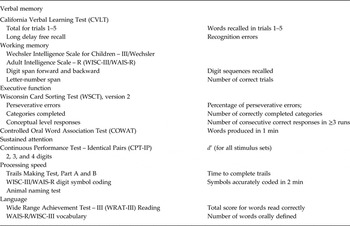
In addition to the intelligence tests, the baseline and retest batteries included neuropsychological tests that assessed six cognitive domains (see Table 1): processing speed, verbal memory, executive function, working memory, sustained attention, and language. Domain construction was based on: (1) rational criteria derived from previous findings in patients with schizophrenia that demonstrated separable neurocognitive factors (Green et al. Reference Green, Nuechterlein, Gold, Barch, Cohen, Essock, Fenton, Frese, Goldberg, Heaton, Keefe, Kern, Kraemer, Stover, Weinberger, Zalcman and Marder2004) and; (2) previous work with subjects at CHR that demonstrated the content validity of the domains (see Seidman et al. Reference Seidman, Giuliano, Meyer, Addington, Cadenhead, Cannon, McGlashan, Perkins, Tsuang, Walker, Woods, Bearden, Christensen, Hawkins, Heaton, Keefe, Heinssen and Cornblatt2010; Carrión et al. Reference Carrión, Goldberg, McLaughlin, Auther, Correll and Cornblatt2011, Reference Carrión, McLaughlin, Goldberg, Auther, Olsen, Olvet, Correll and Cornblatt2013 for more details). Prior to neurocognitive domain construction, raw test scores were log-transformed to reduce skewness and improve the distribution. Extreme values (±3.5 s.d.) were Winsorized to reduce the impact of outliers.(Dixon & Tukey, Reference Dixon and Tukey1968) Test scores were then transformed into standard Z scores using the age-stratified means and s.d.s of a larger group of CNTLs (n = 114) to control for age-related change in cognitive performance. When applicable, tests were reverse-scored so that lower scores reflected worse performance. Domain scores were computed by averaging each subject's Z scores on tests assessing the same neurocognitive domain. Z scores for each domain were then re-standardized using the mean and s.d. of the domain scores of the healthy comparison group. A composite of global neurocognitive performance was calculated by averaging the neurocognitive domains.
Neurocognitive domains, individual tests, and dependent measures

Statistical analyses
All analyses were conducted using SPSS 16.0 (SPSS Inc., USA). Comparisons of demographic and clinical characteristics were performed with Student's t tests for continuous variables, Pearson's χ2 or Fisher's exact tests for categorical variables, and Kolmogorov–Smirnov Z for one ordinal variable (two-tailed, p < 0.05). Linear mixed-effects models for repeated measures were used to compare the neurocognitive performance of the four subjects groups, as well as the change in performance from baseline to retest. Linear mixed effect modeling enabled the use of all available measurements and is robust in the presence of unbalanced designs (i.e. missing observations, inconsistent time intervals) and non-independent correlated data, providing unbiased estimates of covariance parameters (Verbeke & Molenberghs, Reference Verbeke and Molenberghs2000; Mallinckrodt et al. Reference Mallinckrodt, Clark and David2001; Gueorguieva & Krystal, Reference Gueorguieva and Krystal2004; McCulloch et al. Reference McCulloch, Searle and Neuhaus2008). Performance on each neurocognitive test was used as the primary dependent variable. Fixed effects were group (CHR + T, Meds-matched CHR + NT, Meds-free CHR + NT, and CNTLs) and time as (baseline and retest) and the interaction between group and time. The subjects were entered as a random effect. Restricted maximum-likelihood estimation and Type III tests of fixed effects were used, with a heterogeneous autoregressive covariance structure. Post-hoc pairwise comparisons were performed with Bonferroni corrections. Cohen's d was calculated as the mean difference from the mixed model divided by the pooled standard deviation [d = (V2 – V1)/σ pooled] and can be interpreted using the following categories (Cohen, Reference Cohen1988): small = 0.20, medium = 0.50, large = 0.80. A main effect of time along with a group × time interaction would support evidence of a decline specific to the converters. Failing to find worsening in neurocognitive performance for the converters after the onset of psychosis, along with a significant difference between the four groups would suggest a pre-existing cognitive impairment for those who go on to develop a full-blown psychotic disorder. The linear mixed-effects models were also used to examine changes in clinical symptoms (SOPS total positive, negative, disorganized, and general symptom severity levels) from baseline to retest. Partial correlations (adjusted for group status) were conducted to examine the relationships between changes in neurocognitive performance and clinical symptoms over the follow-up period, with the alpha level adjusted using a Bonferroni correction for the number of tests in this analysis.
Results
Demographic and clinical characteristics
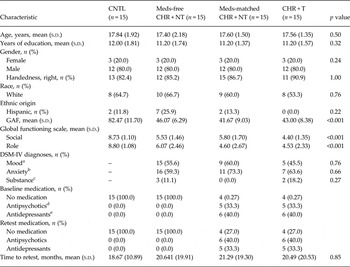
Table 2 summarizes baseline demographic and clinical characteristics for the CHR + T subjects along with the two groups of CHR + NT subjects and CNTLs. The four groups were well-matched, with no differences in baseline age, education level, gender ratio, handedness, race, ethnicity, and time to the retest assessment. The CNTL group had significantly better functioning as seen on the GAF, GF:Social and GF:Role compared to all three CHR groups, while the three CHR groups had comparable levels of functioning at baseline. The CHR + T group was retested on average 8.04 months (s.d. = 10.26) after the onset of psychosis.
Demographic and clinical characteristics

CNTL, Healthy comparison subjects; CHR + NT, CHR + subjects who did not transition to psychosis; CHR + T, CHR+ subjects who did transition to psychosis; GAF, Global Assessment of Functioning; DSM-IV, Diagnostic and Statistical Manual of Mental Disorders, Fourth Edition.
Compared to previous descriptions of CHR+ subjects recruited into the RAP Program (e.g. Carrión et al. Reference Carrión, Goldberg, McLaughlin, Auther, Correll and Cornblatt2011, Reference Carrión, McLaughlin, Goldberg, Auther, Olsen, Olvet, Correll and Cornblatt2013; Olvet et al. Reference Olvet, Carrión, Auther and Cornblatt2015), the mean age of the present cohort is slightly older; however, this is due to matching of the comparison groups to the CHR + T subjects.
a DSM-IV-defined diagnosis of depression, dysthymia, or depressive disorder not otherwise specified (NOS).
b DSM-IV-defined diagnosis of panic disorder, post-traumatic stress disorder, obsessive-compulsive disorder, generalized anxiety disorder, anxiety disorder NOS, or phobias including simple phobias and social phobia.
c DSM-IV-defined diagnosis of alcohol, amphetamine, cannabis, cocaine, hallucinogen, nicotine, opioid, or polysubstance related disorder.
d Antipsychotics included risperidone, quetiapine, aripiprazole, and olanzapine.
e Antidepressants included escitalopram, citalopram hydrobromide, fluoxetine, paroxetin, and bupropion.
Medication treatment at baseline and retest in the CHR + T and Meds-matched CHR + NT groups were comparable. For both groups at the baseline and retest assessment, 11 out of the 15 subjects (73%) were taking medication. At baseline, five (33.3%) subjects were prescribed atypical antipsychotics and six (40.0%) antidepressants. At the retest/post-psychosis assessment, six (40.0%) subjects were prescribed atypical antipsychotics and five antidepressants (33.3%).
Changes in clinical symptoms
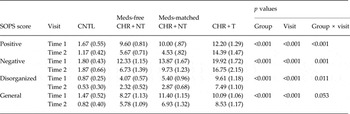
At baseline, CNTLs were significantly different from all three CHR groups, with lower SOPS positive, negative, disorganized, and general symptom levels. The three CHR groups had comparable positive and general symptom levels; however, CHR + T subjects showed significantly worse negative and disorganized symptoms (see Table 2).
As shown in Table 3, the linear mixed-models for repeated measures found significant group differences for all four SOPS symptom scales (all p < 0.001). There were also differential changes across time in symptom levels, as reflected by significant interactions between visit and group (see Table 3). The two groups of CHR + NT subjects showed substantial improvements over time and showed less severe symptoms at retest relative to baseline assessment. On the other hand, CHR + T subjects showed consistent SOPS symptom levels over time, with a worsening in positive symptom levels at retest. Post-hoc comparisons showed that compared to the healthy controls, CHR subjects showed consistently higher levels of SOPS positive, negative, disorganized, and general symptoms. The Meds-free CHR + NT and Meds-matched CHR + NT groups had comparable SOPS symptom levels on all four subscales; however, the CHR + T subjects had higher levels of SOPS positive, negative, disorganized, and general symptoms compared to the two non-converter groups.
SOPS (positive, negative, disorganized, general) symptom levels by group at baseline and post-psychosis onset/retest

SOPS, Scale of Prodromal Symptoms; CNTL, healthy comparison subjects; CHR + NT, CHR+ subjects who did not transition to psychosis; CHR + T, CHR+ subjects who did transition to psychosis.
SOPS total scores are presented along with the standard error of the mean in parentheses and are estimated marginal means derived from the linear mixed models.
Relationship between changes in clinical symptoms and neurocognitive performance
Partial correlations between changes in clinical symptoms and neurocognitive performance over time indicated that increases in positive symptom severity levels were related to improvements in processing speed, sustained attention, working memory, and global cognition (see Supplementary Table S1). Similar relationships were seen also seen for working memory and negative symptoms as well as with global cognition and disorganized symptoms, suggesting that increases in symptom severity over the short follow-up period did not translate into declines in neurocognition. However, these effects did not withstand correction for multiple comparisons.
Neurocognitive performance
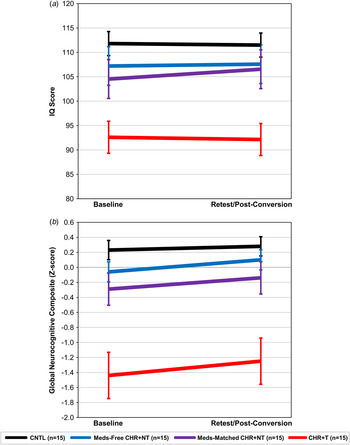
As shown in Fig. 1, each group demonstrated stable neurocognitive and intellectual performance from baseline to retest. However, compared to the healthy controls and CHR subjects that did not transition to psychosis, CHR + T subjects showed a consistent impairment in global neurocognitive and intellectual performance (see Fig. 1a, b ) from baseline (before psychosis) to retest (after psychosis).
(a) Global neurocognitive and (b) intellectual performance (±s.e.) at baseline and retest assessment (post-conversion or matched testing based on duration from baseline) for all four groups. Global neurocognitive performance was calculated by averaging the six neurocognitive domains.

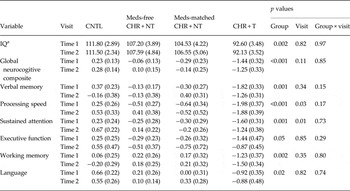
Estimated marginal means of IQ estimates and each neurocognitive domain derived from the linear mixed-models are shown in Table 4. Significant group effects were found for all the neurocognitive domains, including processing speed, verbal memory, executive function, sustained attention, working memory, and language. Post-hoc pairwise comparisons demonstrated that the CHR + T group had significantly lower global neurocognitive and intellectual scores, as well as lower performance on all six neurocognitive domains compared to CNTLs. The CHR + T group also had worse performance compared to the Meds-free CHR + NT group on every measure, except executive function and language. The two non-converter groups demonstrated similar performance, without significant differences.
Intellectual (IQ) performance and neurocognitive Z scores by group at baseline and post-psychosis onset/retest

CNTL, Healthy comparison subjects; CHR + NT, CHR+ subjects who did not transition to psychosis; CHR + T, CHR+ subjects who did transition to psychosis.
Scores are presented as z scores (standard error of the mean) and are estimated marginal means derived from the linear mixed models. A main effect of time along with a group × time interaction would support evidence of a decline specific to the converters. Failing to find worsening in neurocognitive performance for the converters after the onset of psychosis, along with a significant difference between the four groups would suggest a pre-existing cognitive impairment for those who go on to develop a full-blown psychotic disorder.
a Estimated full-scale IQ scores were derived from the vocabulary and block design subscales of the Wechsler Intelligence Scale for Children – Third Edition for subjects aged <16 years and from the Wechsler Adult Intelligence Scale – Revised for subjects aged ≥16 years.
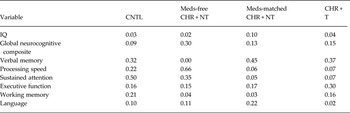
All subject groups demonstrated similar and small improvements (i.e. practice effects) in performance in many of the domains, with only significant improvements in sustained attention (p < 0.01) and processing speed (p = 0.03). Trend level improvements were also seen for the global neurocognitive composite (p = 0.11). Notably, group × visit interactions were not significant for any domain (see Table 3). Table 5 shows effect size (Cohen's d) estimates for changes in intellectual and neurocognitive performance from baseline to retest for all four subject groups. CHR + T subjects showed similar, small effect sizes compared to the healthy controls and other CHR + NT comparison groups. One exception was in the processing speed and attention domains, with healthy controls and Meds-free CHR + NT subjects showing moderate to large improvements, while CHR + T and Meds-matched CHR + NT groups showing smaller improvements over time (see Table 5).
Effect sizes (Cohen's d a ) of neurocognitive change over time for the four subject groups

CNTL, Healthy comparison subjects; CHR + NT, CHR+ subjects who did not transition to psychosis; CHR + T, CHR+ subjects who did transition to psychosis.
a Cohen (Reference Cohen1988) recommended the following categories for interpreting effect sizes: small = 0.2, medium = 0.5, and large = 0.8.
Discussion
In order to understand the temporal and mechanistic nature of cognitive change following the onset of psychosis, we prospectively assessed the neurocognitive performance of a group of clinically at-risk adolescents and young adults before and on average 8 months after the emergence of full-blown psychosis. True positives, CHR subjects who developed psychosis after the baseline testing, showed large neurocognitive and intellectual impairments at baseline, prior to the onset of psychosis, compared to CHR subjects who did not transition to psychosis. These impairments persisted over the course of the short follow-up period, with no further deterioration seen after the onset of psychosis. Moreover, the same seems to be true for antipsychotic and antidepressant treatment, at least in the short-term. On the other hand, false-positives, subjects ascertained as CHR but who did not transition over the follow-up period, demonstrated mild to no impairments in neurocognitive and intellectual performance independent of medication treatment, suggesting that cognitive impairment during the prodrome is related to the underlying vulnerability to illness, consistent with the neurodevelopmental model (Weinberger, Reference Weinberger1987). Taken together, our results indicate that cognition is impaired prior to the onset of psychosis and that the onset of psychosis, in and of itself, does not have a detrimental or ‘neurotoxic’ effect on the course of neurocognition. Thus, cognitive deficits represent trait risk markers, as opposed to state markers of disease status and may serve as possible predictors of schizophrenia prior to the onset of the full illness.
At baseline, individuals at CHR who later converted to psychosis showed a global neurocognitive impairment that mirrored performance levels seen in patients with FEP (Addington & Addington, Reference Addington and Addington2002; Gonzalez-Blanch et al. Reference Gonzalez-Blanch, Crespo-Facorro, Alvarez-Jimenez, Rodriguez-Sanchez, Pelayo-Teran, Perez-Iglesias and Vazquez-Barquero2007). True prodromal subjects showed a deficit in overall neurocognitive performance that was approximately 1.5 s.d.s below that of the healthy controls. These impairments persisted after the onset of full-blown psychosis and did not decline further. Rather, converters to psychosis actually demonstrated small improvements that were most likely due to practice effects over the follow-up period that were highly comparable to those seen in both non-converter groups. In addition to a global neurocognitive impairment, converters also demonstrated stable intellectual deficits that were significantly lower than levels seen in the healthy comparison and matched non-converter groups. In fact, the level of estimated IQ levels seen in the converter group is in line with a large body of evidence from cohort studies that have associated lower intellectual performance with a higher risk for developing schizophrenia (David et al. Reference David, Malmberg, Brandt, Allebeck and Lewis1997).
Converters also showed large impairments of ≥1.5 s.d.s below healthy control levels in specific areas of neurocognition, including sustained attention, verbal memory, processing speed, and executive function. Deficits in these domains have been well-documented at different stages of psychotic illness and have been described as among the core cognitive deficits in schizophrenia (Green et al. Reference Green, Nuechterlein, Gold, Barch, Cohen, Essock, Fenton, Frese, Goldberg, Heaton, Keefe, Kern, Kraemer, Stover, Weinberger, Zalcman and Marder2004). Performance in sustained visual attention as measured by the CPT-IP has been found to be heritable, reliable, and stable (independent of clinical state), representing a promising endophenotype for molecular genetics research in schizophrenia (Cornblatt & Malhotra, Reference Cornblatt and Malhotra2001). Impairments in verbal learning and memory have been shown to make an independent contribution to the prediction of psychosis in CHR subjects (Lencz et al. Reference Lencz, Smith, McLaughlin, Auther, Nakayama, Hovey and Cornblatt2006). Becker et al. (Reference Becker, Nieman, Wiltink, Dingemans, van de Fliert, Velthorst, de Haan, van Amelsvoort and Linszen2010) also found stable deficits in verbal memory as assessed by the CVLT (Trials 1–5, free recall total correct) in CHR subjects before and after the onset of psychosis compared to healthy controls. Moreover, in a meta-analytic review of neurocognitive deficits in first-episode psychosis, Mesholam-Gately et al. (Reference Mesholam-Gately, Giuliano, Goff, Faraone and Seidman2009) found that performance on measures of verbal memory, the CVLT included, were among the poorest compared to healthy levels. Finally, processing speed plays a central role in a variety of high-order cognitive abilities such as language and reading as well as functional outcomes in the earliest phases of the illness (Carrión et al. Reference Carrión, Goldberg, McLaughlin, Auther, Correll and Cornblatt2011; Meyer et al. Reference Meyer, Carrión, Cornblatt, Addington, Cadenhead, Cannon, McGlashan, Perkins, Tsuang, Walker, Woods, Heinssen, Seidman and group2014). Moreover, due to the varying task demands (e.g. flexibility, cognitive control, visual scanning, and motor abilities) used in processing speed measures, deficits in this domain are mostly likely reflective of dysfunction in spatially distributed and interconnected brain regions that are linked to the underlying pathophysiology of the illness (Dickinson et al. Reference Dickinson, Ramsey and Gold2007).
Indeed, these domain-specific deficits most likely reflect a dysfunction of complex integrative neural systems that subserve the neuropsychological measures. Our findings are consistent with mounting evidence of the presence of neurofunctional (Fusar-Poli et al. Reference Fusar-Poli, Perez, Broome, Borgwardt, Placentino, Caverzasi, Cortesi, Veggiotti, Politi, Barale and McGuire2007) and neuroanatomical (Fusar-Poli et al. Reference Fusar-Poli, Radua, McGuire and Borgwardt2012b ) abnormalities prior to the onset of psychosis in subjects at CHR. Abnormal functional connectivity has been found within brain networks that underlie domain-specific performance in working memory, executive function, and processing speed tasks, for example, that include the dorsolateral prefrontal cortex and anterior cingulate cortex, along with hippocampus and subcortical regions. Future prospective cohorts with larger CHR converter groups (e.g. North American Prodrome Longitudinal Study), can examine the relationship between neurocognition along the pathway towards psychosis and changes in brain morphology that have been documented in CHR individuals (Pantelis et al. Reference Pantelis, Velakoulis, McGorry, Wood, Suckling, Phillips, Yung, Bullmore, Brewer, Soulsby, Desmond and McGuire2003; Cannon et al. Reference Cannon, Chung, He, Sun, Jacobson, van Erp, McEwen, Addington, Bearden, Cadenhead, Cornblatt, Mathalon, McGlashan, Perkins, Jeffries, Seidman, Tsuang, Walker, Woods and Heinssen2015).
Limitations
Our findings should be interpreted in light of the following potential limitations. First, our data cannot rule out cognitive deterioration at other periods along the trajectory of the disease. The current report only addresses one critical window on the pathway to illness, the prodrome to shortly after post-psychosis. Decline may occur in childhood or closer to onset of the prodrome (Harvey, Reference Harvey2014). Moreover, the relatively short time frame (8 months) between transition and retest does not rule out further deterioration in the long-term course of the established illness. Cognitive deterioration may occur years later, possibly exacerbated by prolonged medication treatment and repeated hospitalizations. However, recent meta-analyses have not found support for deterioration in older patients with a chronic course of schizophrenia (Szöke et al. Reference Szöke, Trandafir, Dupont, Méary, Schürhoff and Leboyer2008).
Second, it is possible that cognitive functions other than those studied here (e.g. visual memory) do not deteriorate until psychosis manifests, or become more impaired as the illness becomes more chronic. Third, the current study only used a combination of the block design and vocabulary sub-tests to estimate a full-scale IQ. This combination of a verbal and performance measure did, however, demonstrate excellent stability across time in all four comparison groups.
Finally, our ability to detect subtle differences between the groups and to relate individual differences in cognitive course to clinical outcome may have been hindered by the small sample of converters. However, the size of the transitioned group is in line with previous studies that have retested CHR subjects before and after the onset of psychosis (e.g. n = 17, Becker et al. Reference Becker, Nieman, Wiltink, Dingemans, van de Fliert, Velthorst, de Haan, van Amelsvoort and Linszen2010; n = 16, Wood et al. Reference Wood, Brewer, Koutsouradis, Phillips, Francey, Proffitt, Yung, Jackson, McGorry and Pantelis2007; n = 10, Woodberry et al. Reference Woodberry, McFarlane, Giuliano, Verdi, Cook, Faraone and Seidman2013). Furthermore, the neurocognitive effect sizes from baseline to retest were consistent for each group. Despite the small sample size, the effect size of cognitive change over time was consistent across groups, with almost all subjects groups showing small improvements (85% of the results) in performance over time. These sample sizes are most likely due to the difficulty in obtaining repeated neurocognitive assessments on individuals who transition to psychosis during the course of a prospective study, especially after the onset of psychosis. Nevertheless, this limitation should not necessarily diminish the interpretation of the primary result, that is, converters as a group did not show decline in neurocognitive function after the onset of psychosis.
In addition, our study design has a number of strengths compared with previous research. Converters were well-matched to three separate comparison groups on a number of variables known to influence cognitive performance. Confounding by age, gender, baseline positive symptoms, medication at testing, and time to retest are unlikely to explain the key findings. The nested-case control design also minimizes selection bias as cases and controls were sampled from the same cohort ensuring the comparability of the groups.
In summary, the current study does not provide evidence of cognitive deterioration shortly after the emergence of full-blown psychosis. On the contrary, large cognitive deficits are apparent in true positives pre- and post-psychosis onset, with no signs of decline, and therefore appear to be stage-invariant vulnerability traits. Our findings provide further support for the important role of cognition in the neurodevelopmental processes leading to psychotic illness that may ultimately serve as a target for preventive intervention.
Supplementary material
For supplementary material accompanying this paper visit http://dx.doi.org/10.1017/S0033291715001233.
Acknowledgements
We thank the study participants and entire staff of the RAP Program for their time and effort from the very onset of these studies. In addition, the authors would like to thank Pradeep Nagachandran, M.D., Samantha Diaz, Ph.D., and Miranda Farabaugh, MA, for their assistance in carrying out this study. This work was supported by grants from the National Institute of Mental Health (NIMH): MH 61523 (Dr Cornblatt), the Zucker Hillside Hospital Advanced Center for Intervention and Services Research for the Study of Schizophrenia MH 074543 (John M. Kane, M.D.).
Declaration of Interest
Drs. Carrión, Auther, and Ms. Olsen and McLaughlin report no financial relationships with commercial interests. Dr Cornblatt was the original developer of the CPT-IP and has been an advisor for Hoffmann-La Roche. Dr Correll has been a consultant and/or advisor to or has received honoraria from: Alkermes, Bristol-Myers Squibb, Eli Lilly, Genentech, Gerson Lehrman Group, IntraCellular Therapies, Janssen/J&J, Lundbeck, MedAvante, Medscape, Otsuka, Pfizer, ProPhase, Roche, Sunovion, Supernus, and Takeda. He has received grant support from the American Academy of Child and Adolescent Psychiatry BMS, Janssen/J&J, National Institute of Mental Health (NIMH), Novo Nordisk A/S, Otsuka, Takeda and the Thrasher Foundation.