Children from an early age appreciate and understand various kinds of spoken narrative (Dickenson & Snow, Reference Dickenson and Snow1987; Dickensen & Tabors, Reference Dickenson and Tabors1991), including first-hand stories about daily events; retellings of previous experiences; and fantasy-based stories that include characters, conflicts, resolutions, and various action-based sequences. Understanding more complex narrative structure entails the listener building and remembering an integrated and coherent mental model that includes various elements (characters, events, actions, and mental states of the characters) temporally and causally arranged in an overall plot (Bower & Morrow, Reference Bower and Morrow1990; Gersbacher, Reference Gernsbacher1997; van Dijk & Kintsch, Reference van Dijk and Kintsch1983; Zwaan, Reference Zwaan and Ross2004; Zwaan & Radvansky, Reference Zwaan and Radvansky1998). Although the narrative comprehension skills of children have been studied (Berman & Slobin, Reference Berman and Slobin1994; Bornens, Reference Bornens1990; Genereux & McKeough, Reference Genereux and McKeough2007), relatively little research attention has focused on the memory mechanisms supporting children's understanding of spoken narrative. The present study was designed to address this issue by examining the role of three mechanisms of working memory (phonological short-term memory [PSTM], attentional resource capacity/allocation, processing speed) on children's comprehension of spoken narrative.
NARRATIVE DEFINED
At a basic level, narratives include two major components (Bower & Morrow, Reference Bower and Morrow1990). The first is a description of the characters: who they are and what their relationship is with each other. Character description is important because it explains the characters' goals, plans, and actions to resolve some sort of problem as the story's plot unfolds. The second is a mental map of the physical setting in which the story occurs. Embedded within these two main components, stories may comprise up to seven basic elements (or story grammar components; e.g., Stein & Glenn, Reference Stein, Glenn and Freedle1979). These components include a setting, an initiating event, an internal response, internal plan, an attempt, direct consequence, and a reaction. The setting introduces the main character and the time and place of the story. Initiating events are actions, events (i.e., often a problem), changes in the physical environment, or character's internal perception of an event. Internal responses are character's feelings, emotions, goals, desires, intentions, or thoughts leading to a plan of action to solve a problem. Attempts are actions taken by a character to resolve a problem or achieve a goal. Direct consequences are actions, natural occurrences, or end states representing the character's attainment or nonattainment of a goal. Reactions are how or what the character feels or thinks or acts relative to the direct consequence. When combined, these story grammar components make up an episode within a story. An episode is defined as minimally complete if it contains at least one initiating event or internal response causally related to an attempt that was causally related to a direct consequence (Merritt & Liles, Reference Merritt and Liles1989; Peterson & McCabe, 1983). Stories can vary in complexity depending on the number of elements contained in an episode, number of embedded episodes within other episodes, and the total number of episodes.
The central focus of many models of discourse comprehension is on understanding how listeners mentally represent what a text (oral or written) describes. These representations are referred to as mental models (Bower & Morrow, Reference Bower and Morrow1990; Johnson-Laird, Reference Johnson-Laird1983) or situation-based models (van Dijk & Kintsch, Reference van Dijk and Kintsch1983). The processes of integration and inference are crucial to constructing a coherent mental model. Integrating information between adjacent phrases and clauses within sentences is necessary to establish local coherence between, for example, characters and their actions. Inferential processing (understanding the psychological state of characters, connecting characters' actions with event sequences and outcomes) is important in establishing integration across large portions of input to ensure global story coherence.
COGNITIVE MODELS OF NARRATIVE COMPREHENSION
From a memory perspective, listeners must be able to keep track of the many details in a story and ultimately integrate them into a coherent global representation. Numerous memory-based models have been developed to account for how listeners accomplish this feat. These models include minimalist hypothesis models (Gerrig & O'Brien, Reference Gerrig and O'Brien2005; McKoon & Ratcliff, Reference McKoon and Ratcliff1992, Reference McKoon and Ratcliff1998), constructionist accounts (Graesser, Singer, & Trabasso, Reference Graesser, Singer and Trabasso1994; Singer, Graesser, & Trabasso, Reference Singer, Graesser and Trabasso1994), structure-building models (Gernsbacher, Reference Gernsbacher1997), event-indexing models (Zwaan & Radvansky, Reference Zwaan and Radvansky1998), and immersed experiencer models (Zwaan, Reference Zwaan and Ross2004). Ignoring theory-dependent differences, all cognitive models of narrative comprehension explicitly or implicitly invoke the construct of working memory as the memory device supporting comprehension. Although working memory has been conceptualized in different ways by different investigators, all agree that it generally refers to the ability to engage in simultaneous information processing and storage (e.g., Baddeley, Reference Baddeley1998, Reference Baddeley2000; Cowan, Reference Cowan1997; Cowan et al., Reference Cowan, Elliott, Saults, Morey, Mattox and Hismjatullina2005; Just & Carpenter, Reference Just and Carpenter1992). To ensure the construction of an appropriate mental model a listener must be able to simultaneously store the products of prior processing, process newly arriving information, and reactive prior representations that are relevant to the current context so they can be integrated with new information, thereby updating the mental model.
CHILDREN'S NARRATIVE ABILITY AND WORKING MEMORY
Narrative development
Research shows that young preschool age children have the ability to understand and produce primitive accounts of story schemas referred to as narrative scripts. Narrative scripts (i.e., personal narratives) are knowledge structures describing children's knowledge of routine and familiar event sequences or activities. Common narrative scripts for young children include going to birthday parties, getting ready for bed, and going to a restaurant (e.g., Hudson & Shapiro, Reference Hudson, Shapiro, McCabe and Peterson1991; Paris & Paris, Reference Paris and Paris2003). However, by age 5 or so children have the ability to understand and produce stories around a conflict involving a progression of events that includes a central protagonist, and by age 6 comprehend and produce stories involving causal relationships (Botvin & Sutton-Smith, Reference Botvin and Sutton-Smith1977; van den Broek, Reference van den Broek, van den Broek, Bauer and Bourg1997). Between the ages of 8 and 10 children understand and produce more complex stories that include repeated attempts by the protagonist to achieve his/her goal (McKeough, Reference McKeough and Case1992). Narrative development continues to grow beyond age 8, as evidenced by children comprehending and producing stories that contain a greater number of complete episodes, stories that include a greater number of embedded episodes (Peterson & McCabe, Reference Peterson, McCabe, McCabe and Peterson1991; Purcell & Liles, Reference Purcell and Liles1992), as well as stories with characters experiencing different psychological states (Genereux & McKeough, Reference Genereux and McKeough2007; McKeough, Reference McKeough and Astington2000; van den Broek, Reference van den Broek, van den Broek, Bauer and Bourg1997; van den Broek, Lynch, Naslund, Ievers-Landis, & Verduin, Reference van den Broek, Lynch, Naslund, Ievers-Landis and Verduin2003).
Children's working memory
Developmental cognitive research has devoted considerable energy to understanding the development of children's working memory and how working memory relates to various cognitive and academic achievements. There are different theoretical views of working memory (Baddeley, Reference Baddeley1998; Cowan, Reference Cowan1997; Cowan et al., Reference Cowan, Elliott, Saults, Morey, Mattox and Hismjatullina2005), but it is Baddeley's (Reference Baddeley1998) model that has driven much of the developmental memory research. His model guided the present study. From a developmental perspective, working memory can be conceptualized as a multidimensional system comprising several separable yet interactive aspects (Alloway, Gathercole, & Pickering, Reference Alloway, Gathercole and Pickering2006; Bayliss, Jarrold, Baddely, Gunn, & Leigh, Reference Bayliss, Jarrold, Baddeley, Gunn and Leigh2005; Gathercole, Reference Gathercole1999; Gathercole, Pickering, Ambridge, & Wearing, Reference Gathercole, Pickering, Ambridge and Wearing2004), including a PSTM storage buffer, an attentional resource capacity/allocation dimension, and processing speed.
PSTM. PSTM is another key component of working memory. It is a capacity-limited storage buffer responsible for storing incoming speech temporarily while some kind of cognitive task (e.g., comprehension) takes place (Baddeley, Reference Baddeley1998, Reference Baddeley2000). Speech enters PSTM automatically but will fade quickly if it is not immediately processed in some fashion. Temporarily holding speech in PSTM presumably allows a listener to invoke the language system to immediately process that material (Baddeley, Reference Baddeley1998). Moreover, it is suggested that PSTM serves as a mnemonic window in which sequences of incoming words are held, not entire sentences (Baddeley, Reference Baddeley1998). Developmental research indicates that PSTM capacity develops with age and asymptotes by about age 8 (Gathercole, Reference Gathercole1999). PSTM capacity is typically measured using an item recall task such as digit span, word span, or nonword repetition (Alloway et al., Reference Alloway, Gathercole and Pickering2006; Gathercole, Reference Gathercole1999; Gathercole et al., Reference Gathercole, Pickering, Ambridge and Wearing2004). The developmental pattern is that as children get older their item span increases.
PSTM has been implicated in a variety of linguistic abilities of children. A rich developmental literature indicates a strong association between PSTM functioning and lexical learning, especially in children between 4 and 8 years of age (Gathercole & Baddeley, Reference Gathercole and Baddeley1989, Reference Gathercole and Baddeley1990; Gathercole, Willis, Emslie, & Baddeley, Reference Gathercole, Willis, Emslie and Baddeley1992). There is some evidence indicating that PSTM may also be implicated in young school-age children's sentence comprehension, particularly of complex grammatical structures (Ellis Weismer & Thordardottir, Reference Ellis Weismer, Thordardottir, Accardo, Rogers and Capute2002; Montgomery, Reference Montgomery1995). With respect to the comprehension of narrative, however, we would hypothesize no relation to PSTM given that narrative comprehension involves the processing, storage, reactivation, and integration of large amounts of information across wide stretches of input.
Attentional resource capacity/allocation. Another major mechanism of working memory includes attentional resources and control (Baddeley, Reference Baddeley1998, Reference Baddeley2000). Different investigators conceptualize this aspect of working memory in a different ways (see Baddeley, Reference Baddeley1998, Reference Baddeley2000; Cowan, Reference Cowan1997; Cowan et al., Reference Cowan, Elliott, Saults, Morey, Mattox and Hismjatullina2005; Just & Carpenter, Reference Just and Carpenter1992). In the present study, we adopt Baddeley's view of attentional capacity and control. For Baddeley (Reference Baddeley1998, Reference Baddeley2000), attentional resources and control correspond to the central executive component of working memory. Generally, attentional resource capacity refers to the amount of cognitive capacity (i.e., mental energy or activation) available to an individual to perform a cognitive task. Attentional control and allocation refers to an individual's ability to flexibly use his/her resources during complex cognitive processing, for example, dividing or allocating attentional resources between two or more different concurrent mental activities (e.g., verbal processing, verbal storage). It should be made explicit that the notion of attentional resource capacity/allocation as used in the present study is viewed by some as synonymous with the more global construct of working memory (Just & Carpenter, Reference Just and Carpenter1992). The reason is that both constructs entail simultaneous processing and storage. In the present study, the term attentional resource capacity/allocation is used for two related reasons. First, it represents one of the separable mechanisms of working memory (Baddeley, Reference Baddeley1998, Reference Baddeley2000; Bayliss et al., Reference Bayliss, Jarrold, Baddeley, Gunn and Leigh2005). Second, we wish to identify the individual and combined contributions of three different aspects of working memory on children's spoken narrative comprehension.
Children's attentional resource capacity/allocation improves with age (Bayliss et al., Reference Bayliss, Jarrold, Baddeley, Gunn and Leigh2005; Barrouillet & Camos, Reference Barrouillet and Camos2001; Gathercole, Reference Gathercole1999; Gaulin & Campbell, Reference Gaulin and Campbell1994; Gavens & Barrouillet, Reference Gavens and Barrouillet2004). The attentional capacity and allocation of children is typically assessed using various simultaneous processing-storage tasks (i.e., listening span, counting span). For instance, Gaulin and Campbell (Reference Gaulin and Campbell1994) used a listening span task, the competing language processing task (CLPT), to assess 6- to 12-year-old children's resource capacity/allocation. Children were presented auditory sets of simple sentences (Pumpkins are purple, Fish can swim) ranging from two sentences in a set up to seven sentences. They were asked to comprehend each sentence and then at the end of the set recall as many sentence-final words as possible. The results showed that whereas the children demonstrated high comprehension across the age span (93%), word recall steadily improved with age. This response pattern has been replicated by others (Ellis Weismer, Evans, & Hesketh, Reference Ellis Weismer, Evans and Hesketh1999; Mainela-Arnold & Evans, Reference Mainela-Arnold and Evans2005).
There is emerging evidence that resource capacity/control is involved in school age children's global language abilities, as measured by standardized test performance (Leonard et al., Reference Leonard, Weismer, Miller, Francis, Tomblin and Kail2007), as well as their comprehension of complex grammar (Montgomery, Magimairaj, & O'Malley, Reference Montgomery, Magimairaj and O'Malley2008). The study by Montgomery et al. examined the relation between PSTM, attentional capacity/allocation (indexed by listening span), processing speed, and the comprehension of simple sentences and complex sentences in 6- to 11-year-old children. Results showed that resource capacity/control and processing speed both accounted for unique portions of variance in the children's complex sentence comprehension but not simple sentence comprehension. Short-term storage, however, accounted for no unique variance. It was argued that, relative to simple grammar, complex grammar invites significant attentional resources and speed of processing because of their syntactic and working memory-related processing requirements, including the need to allocate sufficient resources to (a) the PSTM buffer to keep new incoming word sequences in an active state long enough for them to be processed, (b) the language system to retrieve appropriate linguistic properties of the input words and activate language processing schemes to generate in a timely manner appropriate linguistic representations of the word sequences (noun phrase, verb phrase), (c) reactivation processes responsible for retrieving representations from prior processing that are currently stored in working memory (Lewis, Vasishth, & van Dyke, Reference Lewis, Vasishth and van Dyke2006; McElree, Foraker, & Dyer, Reference McElree, Foraker and Dyer2003), and (d) integration processes responsible for piecing together prior representations with new representations into a coherent sentence-level representation. We hypothesize a similar need for attentional capacity/control and processing speed to support narrative comprehension given the nature of narrative processing.
Speed of processing. Processing speed refers to processing efficiency or rate (Kail & Salthouse, Reference Kail and Salthouse1994; Salthouse, Reference Salthouse1996) and emphasizes the amount of cognitive work that can be completed in a given unit of time. An underlying assumption regarding processing speed is that it is dependent on “neural processing speed” (Jensen, Reference Jensen1993), that is, rate of synaptic transmission. The basic idea is that those individuals with faster processing are better able to remember and/or process greater amounts of information in the same unit of time than slower processing individuals. The cognitive literature indicates that processing speed improves with age, becoming markedly faster from early childhood through adolescence and into young adulthood (Hale, Reference Hale1990; Kail, Reference Kail1991, Reference Kail1992, Reference Kail2000; Kail & Miller, Reference Kail and Miller2006). Processing speed is assessed using some kind of reaction time (RT) task in which children make a timed response to a verbal or nonverbal stimulus under a simple or cognitively loaded processing condition.
Individual variation in processing speed has been shown to help explain differences across children in a variety of cognitive abilities. This is especially the case with respect to explaining STM span (Ferguson & Bowey, Reference Ferguson and Bowey2005), complex memory span (Towse, Hitch, & Hutton, Reference Towse, Hitch and Hutton1998, Reference Towse, Hitch and Hutton2002), and fluid intelligence (Fry & Hale, Reference Fry and Hale1996, Reference Fry and Hale2000). Speed of processing has also been shown to be associated with school-age children's global language abilities (Leonard et al., Reference Leonard, Weismer, Miller, Francis, Tomblin and Kail2007) as well as their understanding of complex sentence structures (Montgomery & Evans, in press; Montgomery et al., Reference Montgomery, Magimairaj and O'Malley2008). Of interest, processing speed has been shown to account for significantly far less variance than attentional resource capacity/allocation in children's global language performances, that is, sentence-level comprehension and production (Leonard et al., Reference Leonard, Weismer, Miller, Francis, Tomblin and Kail2007; Montgomery & Windsor, Reference Montgomery and Windsor2007). In the present study, though, we would predict that processing speed should be significantly associated with narrative comprehension given the nature of the rapid processing and integration demands inherent in narrative comprehension.
Interrelations among working memory mechanisms in children
Complex memory performance and narrative comprehension both entail the coordination of information processing and storage. That is, both require children to manage the dual demands of processing incoming information while engaging in information storage and retrieval. Understanding the potential relation between children's working memory and narrative comprehension can be facilitated by understanding the nature of the relation among these different working memory mechanisms in the service of complex memory performance. Much of the extant developmental memory literature has examined the influence of single isolated mechanisms such as PSTM, processing speed/retention interval, or attentional resource allocation on complex memory performance (Barouillet & Camos, Reference Barrouillet and Camos2001; Kail, Reference Kail1991; Towse et al., Reference Towse, Hitch and Hutton1998). It has only been recently, though, that investigators have begun to examine the contribution of more than a single mechanism (Bayliss et al., Reference Bayliss, Jarrold, Baddeley, Gunn and Leigh2005; Bayliss, Jarrold, Gunn, & Baddeley, Reference Bayliss, Jarrold, Gunn and Baddeley2003).
Bayliss and colleagues (Reference Bayliss, Jarrold, Gunn and Baddeley2003, Reference Bayliss, Jarrold, Baddeley, Gunn and Leigh2005) examined the contribution of storage and processing speed (efficiency) on the verbal and nonverbal complex memory span of a large group of 6- to-10-year-olds. In both complex memory tasks, the children were presented with the same display screen consisting of different colored squares. Each square contained a single digit (i.e., 1–9) in its center. In the verbal complex span task, the children were required to make an association between an auditorily presented object name (grass) and the color typically associated with the object (green). Immediately following hearing the object name the children were asked to locate the square corresponding to the color of the object. Selecting the appropriate colored object represented the processing component of the task. The children were also asked to remember the digit appearing in the center of each square. At the end of each trial, they recalled as many digits as possible (storage component of task). In the visuospatial complex span task, children were required to scan the display to locate a target square that was differentiated from the other squares by a combination of size and type of square. The children were then required to remember the location of the square. Across both tasks each processing and storage episode was presented for a fixed time window of 5500 ms, thereby controlling the time of the retention interval (Towse et al., Reference Towse, Hitch and Hutton1998). The children also completed separate simple storage tasks, independent of the complex memory tasks. Processing speed/efficiency was also measured using the same complex span tasks except that the tasks did not include the storage component. Processing speed was also assessed using two other speeded measures. Results of hierarchical linear regression and structural equation modeling revealed that age-related changes in both processing speed (efficiency) and storage contributed to the developmental improvement in children's complex memory span.
The contribution of attentional resource capacity/allocation to children's complex memory performance, however, has not been explicitly examined, but attentional resource capacity/allocation has been shown to be important to children's dual-task performance (Irwin-Chase & Burns, Reference Irwin-Chase and Burns2000). It is thus reasonable to think that it should also be important to children's complex memory performance given the need for attentional resources to be allocated to both processing and storage. These investigators presented second and fifth grade children two kinds of dual processing tasks. In one condition each task was designated as having equal priority, and in the other condition one task was designated as primary and the other as secondary (i.e., unequal priority condition). The assumption behind the design was that the unequal priority condition invited children to allocate their attentional resources flexibly, in accordance with the priorities of the task, whereas in the equal priority condition there were no priorities to guide the children's allocation of attention. With this view, compared with the younger children, the older children should show better dual-task performance in the unequal priority condition. The children also completed a single processing task as an index of attentional capacity. Overall, the results were consistent with the authors' hypotheses. In the equal priority task condition there was no significant age difference, after controlling for single task performance. These results were interpreted to suggest that younger and older children do not differ in dual-task performance in the absence of explicit demands to pay greater attention to one task over another. However, on tasks entailing primary and secondary tasks the older children demonstrated better dual-task performance. These results were taken to mean that, relative to younger children, older children have better ability to allocate their attentional resources in accordance with the priorities of the task.
Working memory and narrative comprehension in children
We know of no studies examining the contribution of working memory and its various components to children's understanding of spoken narrative. There is, however, a literature examining its role in school age children's reading comprehension. The literature is mixed and less than definitive, however, with the discrepancy in findings related to methodological differences, for example, age of participants, nature of the memory tasks, and nature of the reading comprehension measures. Relevant to us, many previous studies examined the contribution of working memory from a global construct point of view (i.e., working memory capacity) rather than from the perspective of individual mechanisms.
A number of studies suggest that school-age children's text comprehension is indeed significantly associated with working memory capacity (Cain, Oakhill, & Bryant, Reference Cain, Oakhill and Bryant2004; Leather & Henry, Reference Leather and Henry1994; Seigneuric & Ehrlich, Reference Seigneuric and Ehrlich2005; Swanson & Berninger, Reference Swanson and Berninger1995; Yuill, Oakhill, & Parkin, Reference Yuill, Oakhill and Parkin1989). Moreover, it appears that whereas working memory predicts text comprehension simple STM does not (Leather & Henry, Reference Leather and Henry1994; Swanson & Berninger, Reference Swanson and Berninger1995; Yuill et al., Reference Yuill, Oakhill and Parkin1989). The findings of Cain et al. (Reference Cain, Oakhill and Bryant2004) are especially informative because they suggest that the ability to engage in simultaneous verbal processing and storage is significantly related to the processes of verbal integration and inference making during text processing. Even when adjusting for various language-related variables such as lexical knowledge, decoding abilities, word recognition, phonological awareness, working memory still accounts for significant variance in reading comprehension (Cain et al., Reference Cain, Oakhill and Bryant2004; Swanson & Berninger, Reference Swanson and Berninger1995; Yuill et al., Reference Yuill, Oakhill and Parkin1989). However, other studies (Hosgrove & Garton, Reference Holsgrove and Garton2006) have reported that STM does predict some of the variance in reading comprehension.
AIM AND PREDICTIONS OF THE STUDY
The adult discourse literature and the developmental reading literature both suggest that working memory plays an important role in narrative comprehension. However, we know of no comparable literature focusing on young school-age children's auditory comprehension of narrative. The current investigation, therefore, was carried out to begin to fill this research gap. Our focus was on examining the potential influence of three main components/mechanisms of working memory, PSTM storage, the attentional resource capacity/allocation function of the central executive, and processing speed, on children's ability to understand spoken narrative.
Resource capacity/allocation should predict the greatest amount of variance in children's narrative comprehension because this is the function of the central executive that is assumed to be responsible for controlling the flow of mental resources between PSTM, the language processing system, and working memory (Baddeley, Reference Baddeley1998, Reference Baddeley2000), including reactivation and integration of relevant prior representations with new, developing representations (Gernsbacher, Reference Gernsbacher1997; Graesser et al., Reference Graesser, Singer and Trabasso1994; Singer et al., Reference Singer, Graesser and Trabasso1994). Processing speed should account for the second most amount of variance because children must be able to complete in a timely fashion the various sentence-level and discourse-level processing operations supporting the construction of a mental model. Finally, mental model building involves the storage, reactivation, and timely integration of multiple representations already having been constructed. For this reason, PSTM should predict the least amount of variance because PSTM involves the immediate storage of incoming information.
METHOD
Participants
Sixty-seven typically developing children between the ages of 6 and 11 took part in the study (mean age = 8 years, 4 months [8;4]; SD = 20.3 months). The sample included 28 children between 6;0 and 7;11, 20 children between 8;0 and 9;11, and 19 children between 10;0 and 11;11. Thirty-five girls and 32 boys participated. All of the children were taking part in a larger project designed to investigate the association between information processing and language processing in children with developmental language impairment and typically developing children. All of the children demonstrated at least normal-range nonverbal IQ (≥85) on the Test of Nonverbal Intelligence, Third Edition (Brown, Sherbenou & Johnsen, Reference Brown, Sherbenou and Johnsen1997) and normal-range hearing sensitivity as determined by audiometric pure tone screening at 25 dB HL (American Speech–Language–Hearing Association, 1990) for 500 Hz and 1, 2, and 4 kHz. They also showed normal range articulation abilities based on their performance on the Goldman–Fristoe Test of Articulation, Second Edition (Goldman-Fristoe, Reference Goldman and Fristoe2000), as well as normal or corrected vision. No child had a history of learning disability, neurological impairment, or psychological/emotional disturbance or attention deficit disorder (from parent report).
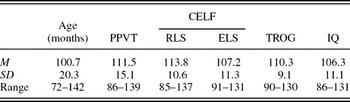
The children met the following language criteria. All were English-speaking children. They obtained a composite receptive language score and a composite expressive language score that was at or above −1 SD from the mean (Tomblin et al., Reference Tomblin, Records, Buckwalter, Zhang, Smith and O'Brien1997) on the Clinical Evaluation of Language Fundamentals, Fourth Edition (Semel, Wiig, & Secord, Reference Semel, Wiig and Secord2003). They also obtained a score that fell at or above −1 SD on the Test for Reception of Grammar, Second Edition (Bishop, Reference Bishop2003), a syntax-specific receptive measure, and the Peabody Picture Vocabulary Test, Third Edition (PPVT-III; Dunn & Dunn, Reference Dunn and Dunn1997), an index of single word receptive vocabulary knowledge. Table 1 displays descriptive summary data by age for the participants.
Participants' age and performance (in standard score) on the language tests and IQ measure

Note: PPVT, Peabody Picture Vocabulary Test; CELF, Clinical Evaluation of Language Fundamentals, Fourth Edition; RLS, receptive language score; ELS, expressive language score; TROG, Test for Reception of Grammar.
Working memory tasks
STM: Digit span task. The children's STM capacity was assessed using a conventional digit span task. Stimulus items consisted of the numbers 1 through 10 with the exception of the number 7, because it is bisyllabic. The task included lists of digits ranging from two numbers up to seven numbers. Each list comprised three trials. All lists and trials included a unique set of digits.
The children were instructed to listen to a man saying some lists of numbers and to repeat as many of them from each list as they could in the same order they heard them. Children received three demonstration items and completed four practice trials prior to the experimental items. The task was discontinued if the child missed two out of three trials on two consecutive lists. Children's responses were recorded on their score sheets by the examiner. Responses were also recorded onto a high-quality digital recorder for later transcription to check the accuracy of online scoring. Thirty-three percent of the samples were rescored; 100% agreement was obtained. The primary dependent variable was the longest list of digits recalled with perfect serial order.
Attentional resource capacity/allocation: Concurrent processing-storage (CPS) task. Attentional resource capacity/control was measured using a conventional listening span task modeled after Gaulin and Campbell's (Reference Gaulin and Campbell1994) task. Children were presented sets of sentences and asked to comprehend the meaning of each sentence and recall the final word of each sentence immediately following the last sentence in a set. The sentences were simple constructions and were arranged in sets beginning with two-sentence sets, with each subsequent set increasing by one sentence up to six-sentence sets.
TASK DESIGN AND STIMULI. The task was a modified version of the CLPT developed by Gaulin and Campbell (Reference Gaulin and Campbell1994). Relative to the original CLPT sentences that included just three words (Pumpkins are purple; Birds can fly), the sentences in the modified version were eight words in length. Longer sentences were used on the assumption that they should require children to strike a greater balance in controlling their attentional resources to both language processing and verbal storage.
The sentences included a range of “simple” structures appropriate to the comprehension of 6-year-old children (Booth, MacWhinney, & Harasaki, Reference Booth, MacWhinney and Harasaki2000; Dick, Wulfeck, Krupa-Kwiatkowski, & Bates, Reference Dick, Wulfeck, Krupa-Kwiatkowski and Bates2004; MacWhinney, Reference MacWhinney and Kuczaj1982), including subject–verb–object sentences (e.g., Most little chickens can eat a little house) and sentences containing a right-branch conjoined verb phrase (e.g., Birds fly in the sky using their nose) or conjoined adjectival phrase (The lady found a puppy that was furry). All of the sentence-final words were monosyllabic or bisyllabic nouns, verbs, or adjectives and were highly familiar to children as young as 6 years of age (Moe, Hopkins, & Rush, Reference Moe, Hopkins and Rush1982). Across the sentences, an approximately equal number of nouns, verbs, adjectives, and adverbs appeared in sentence-final position. Across all sentences, a unique word appeared in sentence-final position.
Across all the sentences and sets, approximately half of the sentences were constructed to require a “Yes” (true) response, because the sentence had real-world truth value, and the other half a “No” (false) response, because the sentence had no real-world truth value (Lions like sleeping in clouds that are soft, Most little chickens can eat a little house). Finally, the task began with a two-sentence block, followed by a three-sentence block, and so on up to a six-sentence block. Each child was administered the entire task.
TASK PROCEDURES. The child sat in front of the touch screen monitor, resting his/her elbow on a soft pad and was instructed to place his/her middle finger tips of his/her dominant hand on the “+” appearing in the middle of the screen. The child was told that he/she will hear a man saying some groups of sentences and he/she needed to do two things: respond to the truth value of each sentence and then recall as many of the sentence-final words in that sentence set as he/she could remember.
The child was told to touch the word “Yes” if the sentence reflected an event that could happen in real life and “No” if the sentence reflected an event that could not happen. The child was instructed to wait until the end of the sentence to make his/her response to make sure he/she could judge its truth value. Immediately following sentence offset, he/she was to respond “Yes” or “No.” Immediately after the child responded the next sentence was presented. Once the complete set of sentences was delivered the computer screen turned green cueing the child to recall as many of the sentence-final words he/she could. The child could recall the words in any order he/she wished. Thus, serial order recall was not required. The primary dependent variable was the total percent of sentences for which the child both correctly comprehended the sentence and recalled the sentence-final word. This combined score is a reflection of dual-task performance and a more robust index of simultaneous processing and storage than storage alone (Conway et al., Reference Conway, Kane, Bunting, Hambrick, Wilhelm and Engle2005; Cowan et al., Reference Cowan, Elliott, Saults, Morey, Mattox and Hismjatullina2005).
Processing speed: Auditory–visual RT (AVRT) task. To derive a measure of children's “basic” processing speed, unconfounded by individual differences among children in linguistic and cognitive knowledge (Montgomery & Windsor, Reference Montgomery and Windsor2007; Windsor & Hwang, Reference Windsor and Hwang1999), children completed an AV (color–word recognition) RT (AVRT) task. The task required children to touch a colored shape (e.g., green square) as quickly as possible in response to hearing a familiar color word (e.g., green).
TASK STIMULI AND DESIGN. Stimuli consisted of three familiar shapes: circle, square, and triangle. Each (3-in.) shape appeared in four different colors: red, blue, green, and yellow. The task consisted of 32 experimental trials. For each trial, a single shape of three different colors (e.g., green circle, blue circle, yellow circle) was displayed on a 17-in. high-resolution color touch screen. Shapes were arranged vertically on the screen, with one shape at the top, one in the middle, and one at the bottom. Across trials, each color word appeared nearly equally often and in each location on the screen. A warning tone was presented 1 s prior to the audio file and visual display.
TASK PROCEDURES. Prior to testing, children's color recognition was assessed by presenting them a practice screen of four different colored shapes and asking them to “point to (red, blue, green, yellow).” Each performed with 100% accuracy. Children rested their elbow on a soft pad positioned a standard distance from the screen and placed their dominate hand in a “touch-ready” position off to the right or left of the screen (depending on handedness) but at the midpoint of the screen. Children were instructed to touch as quickly as possible the object on the screen that matched the color word they heard. Immediately following word presentation (100 ms) the visual array containing the shapes was presented. Prior to experimental testing, the children received two demonstrations and completed 12 practice trials. An inaudible timing pulse triggered the PC-internal clock immediately at the onset of the visual display. Each RT was automatically calculated by the computer as the difference between the onset of the timing pulse and when the child touched the screen. Both response accuracy and speed were stressed, both during practice and experimental testing. The children were given constant encouragement, as well as necessary reminders “to stay focused,” with the intent of enhancing intrasubject RT stability.
Narrative comprehension task
The Test of Narrative Language (TNL; Gillam & Pearson, Reference Gillam and Pearson2004) was used as the measure of children's story comprehension. The test has strong validity (composite comprehension score correlates at .78 with performance on the Test of Language Development, Third Edition) and reliability (.87 internal consistency, .85 test–retest reliability).
Story stimuli. The present study used all three stories from the TNL. The first story (McDonald's Story) was used as a warm-up story and the other two as the experimental stories. The warm-up story conformed to a personal narrative. The two experimental stories adhered to a story grammar structure. Story 1 (Shipwreck Story) involved a little girl who builds a ship at home for a school project and on her way to school breaks the ship when she drops it into a mud puddle. When she arrives at school with the broken ship she must decide on whether to repair the ship. The story included 11 questions, 8 requiring a factual response (e.g., characters in the story, what happened to the ship) and 2 requiring an inferential response (e.g., inferring the main character's psychological states). Story 2 (Dragon Story) was a fantasy-based narrative about a brother and sister who were walking on a trail behind their home and they came upon a treasure chest in front of a cave. The cave, however, was guarded by a dragon. The children developed a plan to take some of the treasure back home with them as proof to their parents of their adventure, but the plan failed when the dragon awoke and scared the children off. Arriving back home the children recounted their adventure to their parents and tried to take them back to the cave but were unable to when they could not find the trail leading to the cave. The story included 14 questions, 11 of which were fact questions (e.g., names of characters, location of the trail) and 2 were inferential (e.g., inferring the characters' psychological states).
Task procedures. Each child was told he/she was going to hear a man telling some stories and to listen carefully because at the end of each story he/she would be asked some questions about what happened in the story. The child listened to each story under headphones at a comfortable listening level (determined by the child). The child always heard the warm-up story prior to the experimental stories providing him/her practice at and familiarity with answering a series questions after listening to a story. Immediately following each story, the child was asked the series of questions as provided in the TNL. The child's responses (single-word response or short phrases) were recorded by the examiner live on the child's score sheet. Responses were also recorded onto the minidisk recorder for later transcription. All of the children's verbal responses for the experimental stories were transcribed by an independent listener; 100% agreement was obtained between the live and transcribed responses. The primary dependent variable was mean percent of questions answered correctly.
General task procedures
All of the children were tested individually in a quiet lab. All testing occurred over three or four sessions, with each session lasting about 90 min. Children were given frequent rest breaks during testing. All of the auditory stimuli were output from the computer (22.5 kHz) and controlled by E-Prime (Schneider, Eschman, & Zuccolott, Reference Schneider, Eschman and Zuccolott2002). Stimuli were delivered binaurally under high-quality headphones at a comfortable listening level that was determined by each child. Three different orders of the memory and comprehension tasks were created. Approximately equal numbers of children received one of the three orders.
Data preparation procedures and preliminary analyses
Prior to the analysis of the AVRT task, a mean RT was calculated for each child by averaging across trials and removing all outliers, as is custom in RT studies (Bowers, Vigliocco, Stadthangen-Gonzalez, & Vinson, Reference Bowers, Vigliocco, Stadthagen-Gonzalez and Vinson1999). An outlier was defined as any RT falling ±2 SD from a child's own mean RT. The data trimming procedure entailed first calculating a mean RT for each child, identifying all outliers and then replacing the outliers with the mean RT, and recalculating the mean. Less than 2% of responses were outliers. This procedure yielded a complete data set for each child.
The internal reliability of each of the memory tasks as well as the narrative comprehension task was computed. The digit span task yielded good reliability (Cronbach α = .78), as did the CPS task (Cronbach α = .76). The AVRT task yielded very strong internal consistency (Cronbach α = .97), whereas the reliability of the two stories combined was good (Cronbach α = .82).
RESULTS
Performance on the experimental tasks
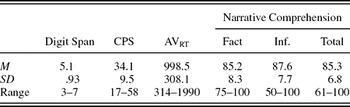
On the digit span task, the children achieved a mean digit span of 5.1. The children also obtained a CPS score of 34% accuracy (percent sentences for which both comprehension and sentence-final word recall was correct). On the comprehension part of the CPS, children achieved 90% correct (SD = 8.5), independent of word recall accuracy. Finally, children yielded a mean AVRT of 998 ms on the AVRT (processing speed) task.
On the narrative comprehension task, the children's performance on two experimental stories was first compared to determine whether they performed similarly on both stories and whether it was appropriate to compute a composite score for the correlation and multiple regression analyses. The children obtained an accuracy score of 83.1% and 86.8% for Story 1 and Story 2, respectively, a difference that was not significant t (66) = 1.12, p > .05. The two scores were thus combined to yield a composite score (85% correct). Across the two stories, the children achieved 85% accuracy on the fact questions and 88% accuracy on the inference questions. It was important that the task yielded neither floor nor ceiling effects. Summary data of the children's performance on each task are displayed in Table 2.
Participants' performance on the experimental tasks

Note: CPS, concurrent processing-storage task; AVRT, mean auditory–visual reaction time (ms); Fact, percent correct factual questions on narrative comprehension task; Inf, percent correct inference questions; Total, total percent correct comprehension.
Correlation analyses
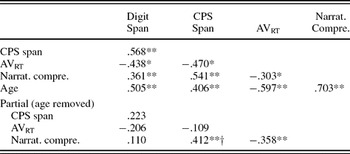
The correlation and partial correlation matrices are shown in Table 3. The correlation matrix included digit span, percent sentences for which both comprehension and sentence-final word recall was correct on the CPS task, mean AVRT, and mean percent correct on the story comprehension task. The partial correlation matrix included the same variables but also included age to adjust for any variance accounted for by age.
Correlation matrix and partial correlation matrix

Note: CPS, concurrent processing-storage span; AVRT, mean reaction time (RT) on the auditory–visual RT task. Because age covaries with digit span, CPS, and AVRT, partialing out age also subtracts shared variance across the memory variables that may contribute to narrative comprehension.
*p < .05. **p < .01 (Bonferroni adjusted). †Correlation covaried for age and Peabody Picture Vocabulary Test score (receptive vocabulary knowledge).
As can be seen in Table 3, age correlated with each of the memory variables, as well as with performance on the narrative comprehension task. It can also be seen that the memory variables correlated significantly with each other. For instance, digit span and CPS significantly correlated; however, the partial correlation did not remain significant. Digit span also correlated with AVRT but the partial correlation was not significant. Performance on the CPS task significantly correlated with AVRT, with the partial correlation failing to reach significance. The magnitude of the raw correlations (i.e., z ratio) between each of the memory variables was also assessed but no significance was found for any of the comparisons (p > .05).
It can also be seen that narrative comprehension significantly correlated with each of the memory variables: digit span (r = .361, p < .01); CPS (r = .541, p < .01); and AVRT (r = −.303, p < .01). The correlation between comprehension and CPS remained significant even after covarying for age (r = .394, p < .01) and both age and PPVT score (r = .412, p < .01). Because both narrative comprehension and CPS performance were language based, children's PPVT score (receptive vocabulary knowledge) was used as a second covariate in order to partial out any effects that receptive vocabulary knowledge may have had on the correlation between the two scores. The two partial correlations were then compared (z ratio) to determine whether there was a difference in magnitude. There was no difference (p > .05). Also, the correlation between comprehension and AVRT remained significant after removing the effects of age (r = −.358, p < .01). There was no difference in the magnitude of the two correlations (p > .05).
Predicting narrative comprehension
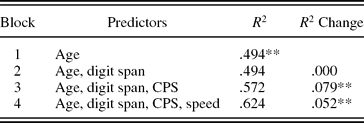
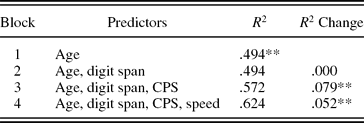
The main research question concerned whether the memory variables contributed to the children's narrative understanding. To this end, a hierarchical linear regression analysis was performed to identify the memory variables predictive of comprehension. The first block of variables entered into the model included age. This variable accounted for almost 50% of the variance. The second block included age and digit span, with digit span accounting for no additional variance. The third block included age, digit span, and CPS score. The CPS score accounted for an additional significant 7.9% of variance. The forth block included the previous three variables along with AVRT, which accounted for another significant 5.2% of variance. The fifth block included three two-way interactions: Age × Digit Span, Age × CPS, and Age × AVRT. None of the interactions reached significance (p > .05). In combination, all of the predictor variables accounted for 62.5% of variance, with age accounting for a disproportionate amount of the variance. Results of the regression analysis appear in Table 4.
Hierarchical regression predicting narrative comprehension from the working memory measures
**p < .01.
DISCUSSION
Explaining the correlation findings
Working memory. The memory correlation findings are entirely consistent with the developmental memory literature. First, each of the working memory measures correlated with each other. The correlation between digit span and CPS span was expected given that the CPS task included a storage component. The association of processing speed (AVRT) with both digit span and CPS span are in line with the notion that the speed with which mental operations take place contributes to memory capacity (Salthouse, Reference Salthouse1991, Reference Salthouse1996). Our data are also consistent with developmental views of STM capacity and working memory capacity, which explicitly include the construct of processing speed (Bayliss et al., Reference Bayliss, Jarrold, Baddeley, Gunn and Leigh2005; Hitch, Towse, & Hutton, Reference Hitch, Towse and Hutton2001; Towse et al., Reference Towse, Hitch and Hutton1998, Reference Towse, Hitch and Hutton2002). Recall that after covarying for the effects of age the correlations were nonsignificant, indicating that the correlations were mediated by age. These findings might appear to be inconsistent with recent developmental work of Bayliss et al. (Reference Bayliss, Jarrold, Gunn and Baddeley2003, Reference Bayliss, Jarrold, Baddeley, Gunn and Leigh2005) who reported robust correlations between children's memory mechanisms and working memory span. However, the children in their studies fell in much narrower age range (8–9 years). The present findings should come as no surprise, then, given that the children spanned a relatively wide age range (6–11 years). Second, each of the memory measures correlated with age, as would be expected. These findings indicate that the children's performance on each task improved with age.
Working memory and narrative comprehension. The aim of the current study was to assess the influence of three mechanisms of working memory on children's comprehension of spoken narrative. We hypothesized children's building of an appropriate mental model should involve the attentional resource capacity/control dimension of the central executive as well as the processing speed mechanisms to a much larger extent than PSTM capacity. These predictions were borne out.
The findings showed that both attentional resource capacity/allocation and processing speed correlated with narrative comprehension, even after adjusting for the effects of age. It was also found that PSTM capacity was associated with comprehension, but this correlation failed to remain significant after partialling out the effects of age. The PSTM finding suggests that immediate STM plays no substantive part in children's narrative understanding. This interpretation is supported by the results of the regression analysis, which showed that PSTM accounted for no variance in comprehension. These findings suggest that the process of building a mental model involves integrating large chunks of verbal material (representations) spanning long distances in the input that cannot be handled by an STM device (Swanson & Berninger, Reference Swanson and Berninger1995; Yuill et al., Reference Yuill, Oakhill and Parkin1989). Although young children's processing of isolated complex sentences appears to be associated with PSTM (e.g., Ellis Weismer & Thordardottir, Reference Ellis Weismer, Thordardottir, Accardo, Rogers and Capute2002; Montgomery, Reference Montgomery1995; Montgomery & Evans, in press), the amount of material needing to be temporarily stored and integrated during the construction of a mental model apparently exceeds the structural (and temporal) limits of the PSTM buffer (Swanson & Berninger, Reference Swanson and Berninger1995; Yuill et al., Reference Yuill, Oakhill and Parkin1989).
That narrative comprehension was associated with attentional resource capacity/allocation and speed of processing was supported by the results of the regression analysis. The results from this analysis indicated that after the effects of age were accounted for (i.e., about 50%), attentional resource capacity/allocation accounted for another significant 7.9% of variance, whereas processing speed accounted for an additional 5.2% of significant variance. We hypothesized resource capacity/allocation should be important to narrative understanding in the following way. Children needed sufficient resources to allocate to (a) PSTM to help keep the sequence of words in an active state long enough for the language system to process them, (b) the language system to create an appropriate linguistic representation of the material stored in PSTM, (c) working memory to store the products of prior processing, (d) retrieval processes devoted to reactivating the stored representations, and (e) various integrative processes responsible for building both local and global coherence during the construction of the mental model. It might be argued that the correlation arose not because narrative comprehension invited attentional resource capacity/allocation but rather because both tasks were verbal in nature. This possibility can be discounted on two grounds. First, recall that the partial correlation was significant after covarying for receptive vocabulary knowledge, and that the partial correlation coefficient was not significantly different from the one with age as the covariate. These findings indicate that receptive vocabulary knowledge did not significantly contribute to the correlation between narrative comprehension and attentional resource capacity/allocation. Second, it has been shown that both verbally based tasks (listening span) and math-based tasks (operational span) significantly correlate with a variety of cognitive performances, including language (Conway & Engle, Reference Conway and Engle1996; Daneman & Merikle, Reference Daneman and Merikle1996; Kane, Bleckley, Conway, & Engle, Reference Kane, Bleckley, Conway and Engle2001).
From a processing speed perspective, all of the processing routines had to be carried out in a timely manner. For instance, sentence interpretation is accomplished via real-time phonological, lexical, morphological, and syntactic analyses and integration operations (e.g., Love, Reference Love2007; Montgomery, Reference Montgomery2005; Montgomery & Leonard, Reference Montgomery and Leonard2006; Roberts, Marinis, Felser, & Clahsen, Reference Roberts, Marinis, Felser and Clahsen2007; Tyler, Reference Tyler1992), with various intermediate analyses (e.g., lexical, phrase- and/or clause-level representations) being integrated into a coherent sentence-level meaning. Building the mental model required children not only to create local coherence at the sentence level but global story coherence by establishing meaningful connections across sentences. As discussed earlier, cognitive models of narrative comprehension provide a useful mechanistic perspective in thinking about how listeners create such models. A common theme running across the different models is that working memory is an important cognitive mediator of narrative processing. It is working memory that allows listeners to be able to store the products of prior processing for later retrieval, use contextual cues to reactivate those representations that are relevant to the current context, and then integrate them with new information to update the developing mental model. The children in the present study appeared to have sufficient functional working memory capabilities to support comprehension.
Resource capacity/allocation and processing speed appear to be important contributors to children's narrative comprehension another component of working memory, but age accounted for a major portion of the variance in comprehension. Another critical age-related memory mechanism that may have played a pivotal role in narrative comprehension is the episodic buffer (Baddeley, Reference Baddeley2000; Baddeley & Wilson, Reference Baddeley and Wilson2002). In the original tripartite model of working memory (Baddeley, Reference Baddeley, Broadbent, McGaugh, Kosslyn, Mackintosh, Tulving and Weiskrantz1986; Baddeley & Hitch, Reference Baddeley, Hitch and Bower1974), working memory was conceptualized to include a central executive and two subsidiary systems, the phonological loop (PSTM) and the visuospatial sketchpad. More recently, though, Baddeley (Reference Baddeley2000) has proposed the inclusion of the episodic buffer as a fourth component. This component was posited specifically to help account for participants' ability to recall prose material. Although the theoretical, empirical, and developmental specificity of the buffer have yet to be delineated, it is assumed that it is limited in capacity and has a primary function of integrating and binding information from a range of sources (e.g., auditory and visual) into a single coherent complex structure or episode. Especially relevant to us is the idea that the buffer is used as a mental modeling space. The buffer would thus seem to be the mechanism of working memory permitting listeners to store a number of representations that have already been created, as well as the work space to retrieve and integrate (bind) these stored representations to new relevant incoming material as a way to update their developing mental model. Of particular note is that the episodic buffer appears to work especially closely with the central executive (Baddeley & Wilson, Reference Baddeley and Wilson2002). Viewed in this way, it is not surprising that the children's comprehension was not predicted by PSTM capacity. STM is not an intermediate storage mechanism designed to hold and integrate multiple “chunks” of information, as is conceptualized in the concept of long-term working memory (Ericsson & Kintsch, Reference Ericsson and Kintsch1995). Rather it is an immediate passive storage device limited to storing a rather small number of pieces of information for a brief period.
SUMMARY AND FUTURE RESEARCH DIRECTIONS
The aim of this study was to examine the influence of three mechanisms of working memory (PSTM, attentional resource capacity/control function of the central executive, processing speed) on children's spoken narrative comprehension. Results showed that attentional resource capacity/allocation and processing speed proved to be important contributors to children's story comprehension. However, PSTM storage played no significant part in explaining children's story comprehension. The present findings are not definitive but they do suggest that certain components of working memory are important to children's comprehension of spoken narrative.
The present study is not without its limitations. One relates to the nature of the comprehension task used. The narratives employed in the present study were not especially demanding with respect to inferential and interpretive language processing. Each story contained only a few inferential questions. Even though story comprehension improved with age, comprehension performance was still quite high overall, including ceiling performance by some of the children. A restricted range of scores may have affected the pattern and strength of correlations that were observed. Future studies may wish to include narrative measures with a greater range of inferential and interpretive language processing demands. This would lead to a greater range in performance and allow investigators to look for different patterns of association between working memory and narrative comprehension. A second limitation concerns the number of measures that were used to assess each mechanism of working memory. In the present study, only a single measure was used. This limited the type of statistical techniques that could be used to address the study question. Thus, future studies may wish to take a more psychometric approach, an approach that would require including two or more measures of each memory variable of interest and a larger sample. Expanding the number of memory measures and participants would lead to the use of more robust modeling techniques (e.g., confirmatory factor analyses, structural equation modeling) to explore the association between working memory and narrative comprehension. Future studies may also want to take a well-defined developmental approach. By including sufficient numbers of children at different ages investigators would be able to explore the potentially changing developmental association between working memory and narrative comprehension. Finally, future work might explore whether there is a contrast in the association between working memory and story comprehension in the auditory and written modalities. The difference in the nature of the signal may give rise to different patterns of association between the working memory components and comprehension.
APPENDIX
CHARACTERISTICS OF STORIES
Linguistic characteristics
Each of the stories was analyzed for length and syntactic complexity. The stories differed in length but were comparable in linguistic complexity. Each story was separated into minimal terminable units known as T-units (Hunt, Reference Hunt1970; Scott, Reference Scott and Nippold1988). A T-unit is an independent clause with all of its subordinate clauses and modifiers. The T-units for each story were then analyzed for clause density (i.e., ratio of clauses to T-units) and number of clauses.
The warm-up story was relatively short, containing 149 words. It included 14 T-units with a mean T-unit length of 10.6. It also included 23 clauses with a clause density of 1.64. Story 1 contained 199 words and included 19 T-units with a mean T-unit length of 9.9. It also included 30 clauses with a clause density of 1.58. Story 2 included 390 words and 34 T-units with a mean T-unit length of 9.9. The story also included 57 clauses with a clause density of 1.68.
Story grammar characteristics
A story grammar analysis was conducted on each story using the set of grammar rules that include story components (Stein & Glenn, Reference Stein, Glenn and Freedle1979). The six basic story components include the following: setting (a main character in a specified time, location or context); initiating event (an obstacle or dilemma faced by the character); internal response (the character responds to the situation and a plan is devised; attempt (the character makes an attempt at solving the problem; direct consequence (success or failure at solving the problem); reaction (character's emotional response to what has happened). Because settings and reactions are not crucial to defining a complete episodic structure (Peterson & McCabe, 1983), a single episode minimally can contain an initiating event or internal response, an attempt and a direct consequence.
The warm-up story was more of a personal narrative and did not contain the minimal elements for a story episode. Rather, it contained a setting and an initiating event as well as an internal response, but no direct consequence. Story 1 contained two episodes. The first episode, which contained all six story grammar components, focused on the planning and building of the ship. The second episode, which also contained all story components with the exception of a reaction, focused on the main character damaging the ship and then deciding to repair it. The story contained a temporal event sequence that included the girl building the ship, carrying the ship to school, breaking the ship, and repairing it at school. The story also contained an embedded causal event sequence related to how the ship was ruined (i.e., child trips on a rock, ship falls into mud puddle, ship is ruined), the child's reaction to breaking the ship, and her deciding to repair the ship. Story 2 also contained two episodes. The first episode contained all story grammar components with the exception of a reaction. The episode focused on the attempt and failure by the children to take back home a piece of gold from the treasure chest as proof to their parents they encountered a treasure chest outside a dragon's cave. The second episode contained an initiating event, attempt, consequence, and reaction focusing on the children's attempt to take their parents back to the cave. The story contained a sequence of temporal events that included two children investigating a new trail behind their house and how they came upon a dragon guarding a cave. A causal event sequence occurs when the children attempt to obtain a piece of gold as proof of their adventure, but fail (i.e., dragon scars the children, both children run away, boy drops the gold). The story also included a second temporal sequence in which the children attempt to bring their parents back to the trail leading to the dragon's cave.
ACKNOWLEDGMENTS
This study was supported by a research challenge grant from Ohio University and the College of Health and Human Services. We express our gratitude to the children and their parents who participated in this study.